REVIEW 4 major objections 5 minor 49 references
Exploring metrics for analyzing dynamic behavior in MPI programs via a coupled-oscillator model
T0 review · 4 major / 5 minor · reviewed 2026-08-07 · deepseek-v4-flash
Pith's one-line read This paper argues that the collective timing behavior of MPI processes can be represented by a coupled-oscillator system whose resynchronization, delay-decay, and wavefront phenomena match MPI traces in qualitative form.
desk verdict A useful but modest extension of the authors' own oscillator model; the sync/desync behavior is largely baked into the chosen potentials, so the paper needs quantitative backing or an honest reframing as an analogy/toolkit. read the letter →
The pith
A machine-rendered reading of the paper's core claim, the machinery that carries it, and where it could break.
The reading
What carries the argument
The central object is the phase ODE, Eq. (2): $\dot{\theta}_i(t) = \frac{2\pi}{t_{\mathrm{comp}}+t_{\mathrm{comm}}} + \zeta_i(t) + \frac{v_p}{P}\sum_j T_{ij} V_{ij}(\theta_j(t-\tau_{ij}(t))-\theta_i(t))$, where $\theta_i$ is the phase of process $i$, $T_{ij}$ encodes which processes communicate, $V_{ij}$ is the interaction potential, $\tau_{ij}$ is communication delay, and $\zeta_i$ is local noise. The coupling strength $v_p = \beta\kappa/(t_{\mathrm{comp}}+t_{\mathrm{comm}})$ imports the idle-wave result that rendezvous-protocol messages ($\beta=2$) couple twice as strongly as eager-protocol ones ($\beta=1$). The argument is carried by the slope of $V$ near zero phase difference: a positive slope makes near-synchronized processes pull together, while a negative slope makes them push apart to evade a bottleneck. For scalable codes the paper uses $\tanh(s\theta)$; for bottlenecked codes it uses a piecewise sine-then-sign potential or a smooth antisymmetric Fourier sum with higher harmonics.
What would settle it
On a cluster with 18 ranks in a one-way next-neighbor chain running a compute-bound solver, inject a one-iteration delay at rank 5 and record the order parameter $R(t)$ under increasing noise strengths: the model predicts that recovery to $R \approx 1$ becomes monotonically faster as noise grows from 0 to about 25% of the phase rate, and that switching to bidirectional rendezvous communication halves the recovery time. A measurement showing either no noise acceleration or no halving under bidirectional rendezvous would contradict the coupling mechanism of Eq. (2).
Extended reading notes
Core claim
The paper argues that the collective timing dynamics of MPI processes—delays rippling along communication links, decay, resynchronization, or persistent desynchronization—can be captured by treating each process as an oscillator whose phase advances through compute-communicate cycles and is pulled or pushed by neighbors through a topology matrix. With a steep $\tanh(s\theta)$ coupling for scalable codes and a short-range-repulsive piecewise or Fourier coupling for bottlenecked codes, the model reproduces, in qualitative form, the phenomena seen in traces: resynchronization after perturbation, halved resynchronization time under bidirectional rendezvous communication, faster delay decay under noise, and persistent computational wavefronts in memory-bound codes. The paper further proposes a toolkit of metrics—order parameter, synchronization entropy, phase gradient, pairwise phase differences, and potential energy—for reading these behaviors consistently across scales.
Load-bearing premise
The entire qualitative match rests on the assumption that the timing of MPI processes can be reduced to a first-order phase equation whose coupling strength is taken from an earlier idle-wave analysis and whose potentials are chosen by hand; if the phase equation does not actually track message-passing causality, the visual matches merely reflect the chosen shapes.
Editorial extensions
If this is right
- In scalable, compute-bound MPI programs, injected delays should spontaneously decay and the program should return to lockstep; the decay rate grows with coupling strength, which the model ties to communication distance and message protocol.
- Bidirectional next-neighbor communication should cut resynchronization time in half relative to unidirectional communication, because the initial delay reaches two neighbors instead of one.
- Moderate local noise should act as a resynchronization aid: jitter erodes coherent phase offsets and accelerates the return to synchrony.
- Memory-bound workloads with local communication and few collectives should exhibit persistent computational wavefronts, with phases drifting apart and staying apart rather than re-locking.
- The proposed metrics offer a consistent multi-scale vocabulary for classifying trace behavior as synchronized, resynchronizing, or persistently desynchronized.
Reading between the lines
- A direct way to turn the qualitative agreement into prediction is to fit the coupling strength $v_p$ and potential slope $s$ on one trace and then forecast the response to a different perturbation or topology without refitting.
- The sign of the potential slope near zero suggests a design rule: deliberately seeding small phase offsets in memory-bound codes could spread contention and avoid the wavefront regime.
- The continuous-time equation implies a measurable idle-wave speed limit of $d/(t_{\mathrm{comp}}+t_{\mathrm{comm}})$ per rank, doubled for bidirectional rendezvous, which a cluster experiment could test directly against the model's coupling-strength mapping.
Editorial analysis
A structured set of objections, weighed in public.
Referee Report
Summary. The paper proposes a coupled-oscillator model of MPI process dynamics, extending the Kuramoto model by introducing sparse topologies, non-sinusoidal interaction potentials, time delays, and noise. Equation (2) gives the governing ODE for each process phase, with coupling strength v_p imported from the authors' earlier work. The paper defines two potential families: a tanh(sθ) potential intended for scalable, compute-bound workloads that resynchronize after perturbations, and piecewise-sinusoidal or Fourier-based potentials intended for bottlenecked, memory-bound workloads that exhibit persistent desynchronization and computational wavefronts. It also presents seven visualization metrics (order parameter, synchronization entropy, phase gradient, pairwise phase differences, histograms, heatmaps, and potential energy) and a MATLAB simulation tool. The evaluation compares model outputs qualitatively with MPI traces from GSSOR, Pi-Solver, 2D-5point Jacobi, and STREAM Triad on the Fritz cluster, claiming qualitative reproduction of resynchronization, topology-sensitive idle-wave propagation, noise-accelerated delay decay, and persistent wavefronts.
Significance. If the central claim is established, the model would offer a lightweight, physically interpretable complement to discrete-event MPI simulators, with potential value for performance diagnosis and hardware-software co-design. The paper is honest about the qualitative nature of the match, but that honesty also marks the current limit: the evidence presented does not yet distinguish a predictive model from a parameterized analogy. A strength of the paper is that the ODE system is explicit and the simulator is released as open source, which makes the model reproducible and enables others to run quantitative tests. The metric toolkit (order parameter, entropy, phase gradients, heatmaps) is a useful contribution in its own right, and the paper provides a clear catalogue of each metric's strengths and limitations. However, the load-bearing validation claim — that Eq. (2) with the chosen potentials reproduces MPI trace phenomena — rests entirely on visual comparison in Figures 5-9, with no quantitative goodness-of-fit, no error bars, no independent parameter calibration, and no comparison against existing simulators or simpler baseline models.
major comments (4)
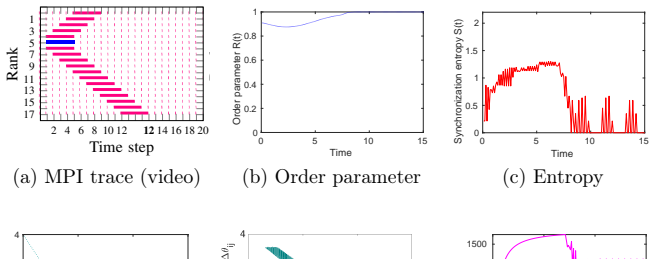
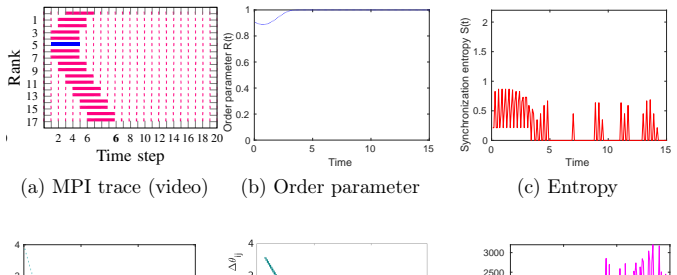
- [Section 4.3, Figures 5-9] The central validation is visual: model plots are placed next to ITAC trace stills and videos, and the text asserts qualitative agreement. No quantitative metric is computed from the traces and compared with the model. For example, Section 4.3.2 claims that bidirectional rendezvous communication halves resynchronization time, but this claim is supported only by visual inspection of the model's order parameter plot; the halving is not measured in either the model output or the MPI traces. The authors should compute concrete quantitative observables from both sides — such as the time for R(t) to reach a threshold, the exponential decay rate of the phase gradient, or the slope of the delay-decay curve — and report these with error bars over repeated runs. Without such a comparison, the paper's main claim of reproducing the four phenomena is not established beyond curve fitting.
- [Sections 3.3.1 and 3.3.2, Eq. (3)-(5)] The interaction potentials encode the qualitative outcome by construction. The tanh(sθ) potential has positive slope at zero phase difference, which pulls phases together, while the piecewise and Fourier potentials have negative slope near zero, which pushes phases apart. Since the potential for each workload class is chosen after observing the target phenomenon, the resulting synchronization or desynchronization is forced by the sign of the potential's slope at the origin rather than emerging from an independently derived physical mechanism. To make the model falsifiable, the authors should either (i) derive the potential shape from measured MPI interaction data, then test predictions on held-out workloads or topologies, or (ii) provide analytical predictions (e.g., resynchronization time as a function of s, v_p, and topology) and verify those predictions quantitatively against trace data. As written, the qualitative match in Section 4.3 does not provide evidence that Eq. (2) captures the causal structure of MPI message passing.
- [Section 3.2, Eq. (2)] The coupling strength v_p = βκ/(tcomp+tcomm) is imported from the authors' prior work [46] without re-derivation or independent calibration in this paper. All timing claims — the rate of resynchronization, the halving time under bidirectional communication, and the noise-accelerated decay — depend directly on the magnitude of v_p. The paper does not report the values of β, κ, tcomp, and tcomm used for GSSOR, Pi-Solver, Jacobi, or STREAM Triad, nor does it show how these are estimated from the traces. The authors should state the parameter values used in each figure and provide a sensitivity analysis, or better, calibrate v_p independently (e.g., from measured delay propagation speeds) and then test the model's predictions.
- [Section 4.3.3, Eq. (6)] The noise model ζ_i(t) = (P_noise/100) dotθ_i(t) r_i(t) is introduced ad hoc, with no empirical support or physical justification for the multiplicative dependence on the current phase velocity. The claim that moderate noise accelerates resynchronization is demonstrated only in model simulations, not compared against measured delay-decay statistics from the traces. The authors should either provide a derivation or empirical basis for this noise form, or at minimum show that the qualitative conclusion is robust to alternative noise models (e.g., additive white noise or jitter in the natural frequency). Without this, the noise-acceleration result is a property of the chosen noise ansatz rather than a verified property of MPI runtime variability.
minor comments (5)
- [Table 1] The table header says 'Kumamoto model' instead of 'Kuramoto model'; this typo appears in the table header.
- [Figure 5 caption] The caption of Figure 5 contains a block of text that appears to be copied from reference [46] ('noise, which is just a collection of statistical, short-term delays... We will investigate this in Section V below.'). This text is not relevant to the current paper and should be removed.
- [Section 3.4.1, item 3] The linearly spaced initialization is written as θ_i = i/(2πn), which gives values much smaller than 2π and is inconsistent with the description 'evenly spaced across [0,2π]'. The intended formula is likely θ_i = 2π i/n or an equivalent.
- [Eq. (6)] The notation r_i(t) = rand(P,1) suggests a vector of length P, but ζ_i(t) is a scalar per oscillator; please clarify how the random vector is evaluated for each i and whether the noise is held constant over a time step.
- [Table 3] The row for 'repulsion width' says 'a, b, ntune fixed points and stability', which is an incomplete sentence fragment and should be reworded.
Circularity Check
Central 'reproductions' are encoded in the potential slopes and the β=2 coupling parameter; only qualitative visual comparison remains.
-
self definitional
[Section 3.3.1, Eq. (3) with Eq. (2); Section 4.3.1]
"This potential is designed to model compute-bound or well-balanced parallel applications, which tend to maintain synchronization; see Figure 2a. The tanh(sθ) function leads to bounded attraction due to its positive slope. ... The model captures the inherent tendency of a scalable, compute-bound GSSOR code to restore phase-aligned execution after perturbations."
In Eq. (2), the coupling term contains +v_p/P Σ_j T_ij V_ij(θ_j−θ_i). With V=tanh(sθ), linearizing about zero phase difference gives a positive restoring term proportional to s v_p/P (θ_j−θ_i), which by construction pulls phases together. The resynchronization behavior claimed as a match in Section 4.3.1 is therefore a mathematical property of the chosen potential, explicitly 'designed to model' synchronized scalable programs, not an emergent prediction from MPI dynamics. The visual agreement with GSSOR traces cannot distinguish the model from the potential's built-in restoring slope.
-
self definitional
[Section 3.3.2, Eq. (4) with Eq. (2); Section 4.3.4]
"To model bottleneck evasion, it introduces short-range repulsion to discourage local synchronization and long-range attraction to maintain overall phase coherence. ... For |θj−θi|<σ: the repulsive sine term pushes oscillators apart if they are too close in phase, evading contention. ... the model visualizations capture persistent phase drift characteristic of computational wavefronts observed in a memory-bound, bottlenecked 2D-5pt Jacobi smoother."
The piecewise potential (and its Fourier variant) is constructed to have a negative slope for small phase differences, i.e., −sin(3π/(2σ)x) for |x|<σ, which actively pushes neighboring phases apart. Thus desynchronization and persistent computational wavefronts are inserted at the level of the potential's shape. Section 4.3.4 then presents this desynchronization as a validated model outcome, but the outcome is a direct consequence of choosing a repulsive potential for exactly that purpose. No independent derivation from memory-bound resource contention is provided.
2 more flagged steps
-
fitted input called prediction
[Section 3.2, Eq. (2); Section 4.3.2 and [46]]
"v_p = β·κ/(tcomp+tcomm) [46] is the coupling strength ... Messages sent via the eager (rendezvous) protocol have β=1 (2). ... capturing how changing the communication pattern from uni-directional to bi-directional next-neighbor topology (using the rendezvous protocol in MPI) affects the absorption of idle waves in scalable MPI workloads, reduces resynchronization time by half [46]. ... The oscillator model correctly maps the faster resynchronization of an idle wave when using the rendezvous protocol (which is modeled by a stronger coupling in the model)."
The factor β=2 for bidirectional rendezvous is placed directly into v_p, doubling the coupling strength. In the linearized first-order phase dynamics, doubling a restoring coupling approximately halves the relaxation time, so the 'topology-sensitive' result that bidirectional communication halves resynchronization time is exactly the chosen value of β, not a model prediction. The paper itself states that the rendezvous protocol is 'modeled by a stronger coupling in the model.' The cited [46] is the authors' own prior work, so the parameterization is not independently validated here.
-
ansatz smuggled in via citation
[Section 1.1 and Section 3.3.1; Eq. (3)]
"In Afzal et al. [10], the authors introduced a parameterized physical model of coupled oscillators ... demonstrate that a network of coupled harmonic oscillators, with appropriately chosen interaction potentials and connectivity matrices, can reproduce some key dynamic behaviors ... in a qualitative way. ... proceeding to the hyperbolic tangent tanh(θ) as proposed in [10], and concluding with the scaled hyperbolic tangent tanh(sθ) formulation introduced above."
The paper's core interaction potential, whose slope encodes the central synchronization behavior, is adopted from the same authors' earlier work [10], which itself introduced the potential as a modeling choice to reproduce the same qualitative MPI behaviors. The citation supplies the ansatz but not an independent, externally falsifiable derivation. Thus the 'new' model's predictive content about synchronization inherits its form from a same-author construction rather than from a first-principles account of MPI communication.
full rationale
The paper is honest that its matches are qualitative, but the specific claims in Sections 4.3.1, 4.3.2, and 4.3.4 reduce to the model's own construction. With V=tanh(sθ), the linearized coupling in Eq. (2) has a positive restoring slope at zero phase difference, forcing resynchronization for scalable workloads. With the piecewise or Fourier potentials, the slope near zero is negative, forcing desynchronization and persistent wavefronts for bottlenecked workloads. The topology-sensitive halving of resynchronization time is not predicted: it is encoded by setting β=2 for bidirectional rendezvous in the coupling strength v_p. The paper's comparisons to MPI traces are visual only, with no out-of-sample quantitative metric such as resynchronization-time error, order-parameter trajectory error, or noise-strength slope fitted against trace data. The future-work sentence 'tighter integration with real-time MPI traces' concedes that the current evidence does not separate a predictive model from a parameterized analogy. The noise-acceleration result is the least forced, since it emerges from the dynamics rather than a slope sign, but it is also only qualitatively compared. Overall, the central claims are substantially circular or fitted, so a score of 7 is warranted; this does not deny the model's value as an exploratory, physically inspired analogy for MPI performance dynamics.
Assumptions & free parameters
free parameters (5)
- s (steepness of tanh(sθ) potential) =
not reported
- σ (repulsion width in piecewise potential) =
not reported
- a, b, N (Fourier potential coefficients) =
not reported
- coupling scale v_p = βκ/(tcomp+tcomm) =
not reported here; taken from [46]
- noise amplitude P_noise/100 in Eq. (6) =
varied from 1% to 25%
assumptions (5)
- domain assumption MPI process phases evolve by a first-order Kuramoto-like ODE, Eq. (2).
- ad hoc to paper Coupling strength is v_p = βκ/(tcomp+tcomm) as in [46].
- ad hoc to paper The interaction potential shape class encodes the application class: tanh(sθ) for synchronization, piecewise/Fourier for desynchronization.
- ad hoc to paper Noise model ζ_i(t) = (P_noise/100) dotθ_i(t) r_i(t) represents runtime variability.
- standard math Numerical solution by Dormand-Prince with adaptive time stepping is accurate enough for the reported dynamics.
Cite this review
Pith. "Pith review of Exploring metrics for analyzing dynamic behavior in MPI programs via a coupled-oscillator model." pith.science (2026). https://pith.science/paper/VQ6NVGXW
@misc{pith2026250602792,
  author       = {Pith},
  title        = {Pith review of: Exploring metrics for analyzing dynamic behavior in MPI programs via a coupled-oscillator model},
  year         = {2026},
  howpublished = {\url{https://pith.science/paper/VQ6NVGXW}},
  note         = {Machine review of arXiv:2506.02792}
}
read the original abstract
We propose a novel, lightweight, and physically inspired approach to modeling the dynamics of parallel distributed-memory programs. Inspired by the Kuramoto model, we represent MPI processes as coupled oscillators with topology-aware interactions, custom coupling potentials, and stochastic noise. The resulting system of nonlinear ordinary differential equations opens a path to modeling key performance phenomena of parallel programs, including synchronization, delay propagation and decay, bottlenecks, and self-desynchronization. This paper introduces interaction potentials to describe memory- and compute-bound workloads and employs multiple quantitative metrics -- such as an order parameter, synchronization entropy, phase gradients, and phase differences -- to evaluate phase coherence and disruption. We also investigate the role of local noise and show that moderate noise can accelerate resynchronization in scalable applications. Our simulations align qualitatively with MPI trace data, showing the potential of physics-informed abstractions to predict performance patterns, which offers a new perspective for performance modeling and software-hardware co-design in parallel computing.
Figures


Figures from the paper (7 more)



Reference graph
Works this paper leans on
-
[46]
I. Aranson, L. Kramer, The world of the complex ginzburg–landau equation, Reviews of Modern Physics 74 (2002) 99–143. doi:10.1103/ RevModPhys.74.99. 41
work page 2002
-
[1]
A. Afzal, G. Hager, G. Wellein, Propagation and Decay of Injected One-Off Delays on Clusters: A Case Study, in: 2019 IEEE Interna- tional Conference on Cluster Computing (CLUSTER), volume 2019- September, Institute of Electrical and Electronics Engineers Inc., 2019, pp. 1–10. doi:10.1109/CLUSTER.2019.8890995
- [2]
-
[3]
A. Afzal, G. Hager, G. Wellein, Noise-driven Cluster-level performance modelling and engineering, 2021. URL:https://app.swapcard. com/event/isc-high-performance-2021-digital/planning/ UGxhbm5pbmdfNDU0MDIx, poster at the ISC High Performance Confer- ence, June 24– July 02, 2021, Frankfurt, Germany
work page 2021
-
[4]
A. Afzal, G. Hager, G. Wellein, Desynchronization and Wave Pattern Formation in MPI-Parallel and Hybrid Memory-Bound Programs, in: Lecture Notes in Computer Science, volume 12151 LNCS, 2020, pp. 391–411. doi:10.1007/978-3-030-50743-5\_20
-
[5]
A. Afzal, G. Wellein, G. Hager, Addressing White-Box modeling and simulation challenges in parallel computing, in: Proceedings of the 2022 ACM SIGSIM Conference on Principles of Advanced Discrete Simula- tion, SIGSIM-PADS ’22, Association for Computing Machinery, New York, NY, USA, 2022, p. 25–26. doi:10.1145/3518997.3534986
- [6]
-
[7]
A. Afzal, G. Hager, G. Wellein, Analytic performance model for paral- lel overlapping memory-bound kernels, Concurrency and Computation: Practice and Experience 34 (2022) e6816. doi:10.1002/cpe.6816
Show all 49 references
-
[8]
Afzal, G
A. Afzal, G. Hager, S. Marakidis, G. Wellein, Making applications faster by asynchronous execution: slowing down processes or relaxing MPI collectives, Future Generation Computer Systems (FGCS) (????). doi:10.1016/j.future.2023.06.017
-
[9]
Afzal, G
A. Afzal, G. Hager, G. Wellein, White-box modelling of paral- lel computing dynamics, 2022. URL:https://sighpc.ipsj.or.jp/ HPCAsia2022/poster/115_abstract.pdf, poster at the International Conference on High Performance Computing in Asia-Pacific Region (HPC Asia 2022), June 27–...
2022
-
[10]
Afzal, G
A. Afzal, G. Hager, G. Wellein, Physical oscillator model for supercom- puting, in: 14th IEEE/ACM Performance Modeling, Benchmarking and Simulation of High Performance Computer Systems (PMBS), 2023. doi:10.1145/3624062.3625535
2023
-
[11]
Afzal, G
A. Afzal, G. Hager, G. Wellein, Physical Oscillator Model for Paral- lel Distributed Computing, 2021. URL:https://app.swapcard. com/event/isc-high-performance-2021-digital/planning/ UGxhbm5pbmdfNDUzNTk2, poster at ISC High Performance 2021
2021
-
[12]
Kuramoto, Self-entrainment of a population of coupled non-linear oscillators, in: H
Y. Kuramoto, Self-entrainment of a population of coupled non-linear oscillators, in: H. Araki (Ed.), International symposium on mathemat- ical problems in theoretical physics, Springer Berlin Heidelberg, 1975, pp. 420–422. doi:https://doi.org/10.1007/BFb0013365
1975 doi
-
[13]
Kuramoto, Chemical turbulence, in: Chemical oscillations, waves, and turbulence, Springer Berlin Heidelberg, Berlin, Heidelberg, 1984, pp
Y. Kuramoto, Chemical turbulence, in: Chemical oscillations, waves, and turbulence, Springer Berlin Heidelberg, Berlin, Heidelberg, 1984, pp. 111–140. doi:10.1007/978-3-642-69689-3
1984 doi
-
[14]
Afzal, G
A. Afzal, G. Hager, G. Wellein, DisCostiC: Simulating mpi applications without executing code, 2024. URL:https://sc24.supercomputing. org/proceedings/poster/poster_pages/post167.html, poster at 38 the International Conference for High Performance Computing, Net- working, Stora...
2024
-
[15]
Hoefler, T
T. Hoefler, T. Schneider, A. Lumsdaine, LogGOPSim - simulating large- scale applications in the LogGOPS model, in: Proceedings of the 19th ACM International Symposium on High Performance Distributed Com- puting, ACM, 2010, pp. 597–604. doi:10.1145/1851476.1851564
2010
-
[16]
A. F. Rodrigues, K. S. Hemmert, B. W. Barrett, C. Kersey, R. Oldfield, M. Weston, R. Risen, J. Cook, P. Rosenfeld, E. Cooper-Balis, B. Jacob, The structural simulation toolkit, SIGMETRICS Perform. Eval. Rev. 38 (2011) 37–42. doi:10.1145/1964218.1964225
2011
-
[17]
Zheng, G
G. Zheng, G. Kakulapati, L. Kale, BigSim: a parallel simulator for per- formance prediction of extremely large parallel machines, in: 18th In- ternational Parallel and Distributed Processing Symposium, 2004. Pro- ceedings., 2004, pp. 78–. doi:10.1109/IPDPS.2004.1303013
2004 arXiv
-
[18]
Girona, J
S. Girona, J. Labarta, R. M. Badia, Validation of Dimemas communica- tion model for mpi collective operations, in: European Parallel Virtual Machine/Message Passing Interface Users’ Group Meeting, Springer, 2000, pp. 39–46
2000
-
[19]
S. Böhm, C. Engelmann, xSim: The extreme-scale simulator, in: 2011 International Conference on High Performance Computing & Simula- tion, 2011, pp. 280–286. doi:10.1109/HPCSim.2011.5999835
2011
-
[20]
Casanova, A
H. Casanova, A. Legrand, M. Quinson, SimGrid: A generic framework for large-scale distributed experiments, in: Tenth International Con- ference on Computer Modeling and Simulation (uksim 2008), 2008, pp. 126–131. doi:10.1109/UKSIM.2008.28
2008 doi
-
[21]
Bresch, Shallow-water equations and related topics, Handbook of differential equations: evolutionary equations 5 (2009) 1–104
D. Bresch, Shallow-water equations and related topics, Handbook of differential equations: evolutionary equations 5 (2009) 1–104. doi:10. 1016/S1874-5717(08)00208-9
2009
-
[22]
Huang, C
G. Huang, C. Sun, A continuum model with microstructures for wave propagation in ultra-thin films, International Journal of Solids and Structures 43 (2006) 7014–7027. URL:https://www. 39 sciencedirect.com/science/article/pii/S0020768306000643. doi:https://doi.org/10.1016/j.ijs...
2006 doi
-
[23]
J. K. Hunter, J. Scheurle, Existence of perturbed solitary wave solu- tions to a model equation for water waves, Physica D: Nonlinear Phe- nomena 32 (1988) 253–268. URL:https://www.sciencedirect.com/ science/article/pii/0167278988900541. doi:https://doi.org/10. 1016/0167-2789(...
1988
-
[24]
P. G. Drazin, R. S. Johnson, Solitons: an introduction, volume 2, Cam- bridge university press, 1989
1989
-
[25]
M. C. Potter, D. C. Wiggert, Schaum’s Outline of Fluid Mechanics, McGraw-Hill Education, 2021
2021
-
[26]
Ising, Beitrag zur Theorie des Ferro-und Paramagnetismus, Ph.D
E. Ising, Beitrag zur Theorie des Ferro-und Paramagnetismus, Ph.D. thesis, Grefe & Tiedemann, 1924
1924
-
[27]
Komura, Y
Y. Komura, Y. Okabe, Gpu-based single-cluster algorithm for the simulation of the ising model, Journal of Computational Physics 231 (2012) 1209–1215. URL:https://doi.org/10.1016/j.jcp.2011.09
2012 doi
-
[28]
S. H. Strogatz, Sync: The Emerging Science of Spontaneous Order, Hyperion, 2003
2003
-
[29]
doi:10.1016/j.jcp.2011.09.029
2011 doi
-
[30]
R. Roy, T. W. Murphy, T. Maier, Z. Gills, K. A. Shore, Chaotic behavior in semiconductor lasers with optical feedback, Physical Review Letters 68 (1992) 1259–1262
1992
-
[31]
S. H. Strogatz, D. M. Abrams, F. McRobie, B. Eckhardt, E. Ott, Crowd synchrony on the millennium bridge, Nature 438 (2005) 43–44
2005
-
[32]
Pantaleone, Synchronization of metronomes, American Journal of Physics 70 (2002) 992–1000
J. Pantaleone, Synchronization of metronomes, American Journal of Physics 70 (2002) 992–1000
2002
-
[33]
Ermentrout, N
B. Ermentrout, N. Kopell, Multiple pulse interactions and averaging in systems of coupled neural oscillators, Journal of Mathematical Biology 29 (1991) 195–217
1991
-
[34]
A. T. Winfree, The Geometry of Biological Time, Springer, 2001. 40
2001
-
[35]
Leloup, A
J.-C. Leloup, A. Goldbeter, Modeling the circadian clock: from molecu- lar mechanisms to physiological functions, Chronobiology International 15 (1998) 341–366
1998
-
[36]
Glass, Synchronization and rhythmic processes in physiology, Nature 410 (2001) 277–284
L. Glass, Synchronization and rhythmic processes in physiology, Nature 410 (2001) 277–284
2001
-
[37]
M. D. Greenfield, Synchronous behavior in the acoustic signaling of crickets, Princeton University Press, 1994
1994
-
[38]
Z. Néda, E. Ravasz, Y. Brechet, T. Vicsek, A.-L. Barabási, The sound of many hands clapping: relating acoustic energy to synchronization and temporal shift, Nature 403 (2000) 849–850
2000
-
[39]
Pikovsky, M
A. Pikovsky, M. Rosenblum, J. Kurths, Synchronization: A Univer- sal Concept in Nonlinear Sciences, Cambridge Nonlinear Science Series, Cambridge University Press, 2001. doi:10.1017/CBO9780511755743
2001 doi
-
[40]
D. M. Abrams, S. H. Strogatz, Chimera states for coupled oscillators, Physical Review Letters 93 (2004) 174102
2004
-
[41]
G. C. Sethia, A. Sen, Chimera states: The existence criteria revisited, Physical Review Letters 112 (2014) 144101
2014
-
[42]
P. W. Anderson, Considerations on the flow of superfluid helium, Re- views of Modern Physics 38 (1966) 298–310
1966
-
[43]
Fradkin, Field Theories of Condensed Matter Physics, 2 ed., Cam- bridge University Press, 2013
E. Fradkin, Field Theories of Condensed Matter Physics, 2 ed., Cam- bridge University Press, 2013
2013
-
[44]
superconductor
J. Goldstone, Field theories with “superconductor” solutions, Il Nuovo Cimento (1955-1965) 19 (1961) 154–164
1961
-
[45]
M. C. Cross, P. C. Hohenberg, Pattern formation outside of equilibrium, Reviews of Modern Physics 65 (1993) 851–1112
1993
-
[47]
Afzal, G
A. Afzal, G. Hager, G. Wellein, Analytic Modeling of Idle Waves in Parallel Programs: Communication, Cluster Topology, and Noise Im- pact, in: Lecture Notes in Computer Science, volume 12728, 2021, pp. 351–371. doi:10.1007/978-3-030-78713-4\_19
2021 doi
-
[48]
Afzal, G
A. Afzal, G. Hager, G. Wellein, S. Marakidis, Exploring techniques for the analysis of spontaneous asynchronicity in MPI-Parallel appli- cations, in: Parallel Processing and Applied Mathematics, PPAM’22,
-
[2022]
doi:10.1007/978-3-031-30442-2\_12. 42
Reviewed August 7, 2026 · model on record in the stance chip above.
Discussion (0). Sign in to comment.