REVIEW 4 major objections 6 minor 66 references
Optimistic Interior Point Methods for Sequential Hypothesis Testing by Betting
T0 review · 4 major / 6 minor · reviewed 2026-08-08 · deepseek-v4-flash
Pith's one-line read Interior-point betting rejects nulls faster than ONS
desk verdict Sensible adaptation of FTRL+barriers to testing by betting, but Lemma 7's constant-regret proof does not hold up, so the claimed advantage over ONS is unproven. read the letter →
The pith
A machine-rendered reading of the paper's core claim, the machinery that carries it, and where it could break.
The reading
What carries the argument
The carrier of the argument is the self-concordant logarithmic barrier used as the regularizer in Follow-the-Regularized-Leader. In the two-sided betting game the regularizer is $R(\theta)=-\ln(1-\theta)-\ln(1+\theta)$, whose Hessian $(2+2\theta^2)/(1-\theta^2)^2$ blows up at the endpoints and compensates the exploding gradient $g_t/(1-g_t\theta_t)$, keeping the local norm $\|\nabla\ell_t(\theta_t)\|^*_{\theta_t}\le 1$. The FTRL argmin has the closed form $\theta_{t+1}=(1-\sqrt{1+(\eta G_t)^2})/(\eta G_t)$, which is why the method stays computationally light; the same barrier calculus produces the optimistic variant by inserting a predicted gradient $m_t$ into the update.
What would settle it
Two concrete checks settle the proof. First, plug $x=\eta G_{t-1}=10$ into the appendix inequality (43): the left-hand side is about $0.0328$, while $1/x^2=0.01$, so the inequality fails. Second, simulate FTRL+Barrier with $g_t=-c$ so that $G_t=-ct$; at $G_t=-100$ the update gives $\theta_t\approx 0.99995$, making $(1-\theta_t)^2c^2$ arbitrarily close to $0$, so no uniform $c'$ exists.
Extended reading notes
Core claim
The central claim is that interior-point regularization removes the need to halve the decision space in sequential testing by betting. For difference-in-means testing the action set is $[-1,1]$ with barrier $R(\theta)=-\ln(1-\theta)-\ln(1+\theta)$; for one-sided testing it is $[0,1]$ with $R(\theta)=-\ln\theta-\ln(1-\theta)$. The barrier's Hessian grows near the boundary and cancels the growth of the log-loss gradient, so the local gradient norm stays bounded and the FTRL regret bound applies without projection. Under a linear-growth condition on the cumulative gradient, the paper derives a constant regret $\Theta(t_0)$, and from it an expected rejection time of $$E[\tau]=\Theta\left(t_0+\frac{\ln(1/\$\alpha$)}{\omega_*}+\frac{\$sigma^{2}$}{\omega_*^2}\right)$$ for a level-$\alpha$ test with asymptotic power one. The claimed advantage over ONS is quantitative: for small $\alpha$ the $\ln(1/\alpha)/\omega_*$ term dominates and matches the known lower bound $1/\omega_*$ for the coefficient of $\ln(1/\alpha)$.
Load-bearing premise
The constant-regret lemma assumes a linear growth $|G_t|\ge c t$ and also a uniform constant $c'$ with $(1-\theta_t)^2 c^2\ge c'^2$; the second assumption fails when the cumulative gradient is large and negative because $\theta_t\to 1$, and the appendix's inequality $(1-\theta_t^2)^2\le 1/(\eta G_{t-1})^2$ is algebraically false, so the claimed speed advantage over ONS is unproven as written.
Editorial extensions
If this is right
- If Theorem 2 is correct, the small-$\alpha$ expected rejection time for FTRL+Barrier scales as $\Theta(\ln(1/\alpha)/\omega_*)$, matching the lower bound in [WSSJ25] and removing the extra $\ln(1/\Delta^2)$ factor paid by ONS.
- Both proposed methods are level-$\alpha$ anytime-valid tests with asymptotic power one, so the faster rejection does not come at the cost of losing Type-I error control.
- The closed-form updates make the methods as cheap per round as ONS and roughly two orders of magnitude cheaper than universal-portfolio baselines that require an optimization each round.
- The linear-growth condition that triggers the speedup holds immediately for distributions with disjoint supports and, with high probability after $t_0=O(1/(\delta b^2 \mathrm{SNR}))$, for overlapping distributions with high signal-to-noise ratio.
- The optimistic variant can reject even faster when consecutive gradients are close, e.g., when the two groups are well separated and have small variances.
Reading between the lines
- A corrected or modified proof would likely need a one-sided growth assumption, meaning a fixed sign for the cumulative gradient, or an explicit boundary-avoidance condition; if so, the provable speed advantage over ONS would hold for alternatives in one direction rather than for all alternatives.
- The same barrier-regularization idea could be applied to other betting payoffs beyond the log-loss of $1-g\theta$, suggesting a general recipe: choose a self-concordant barrier whose Hessian mirrors the singularity of the payoff.
- Because the authors leave open how to pick the optimistic hint $m_t$, a concrete next step is to feed a short-horizon forecast of $g_t$ into the optimistic algorithm and measure rejection time against the non-optimistic version; the paper's Example 3 predicts the speedup appears when $|g_t-g_{t-1}|\ll |g_t|$.
Editorial analysis
A structured set of objections, weighed in public.
Referee Report
Summary. The paper proposes two betting-based sequential hypothesis testing algorithms, FTRL+Barrier and Optimistic-FTRL+Barrier, which use self-concordant barrier functions to update over the full decision space rather than the halved space used by Online Newton Steps. The main theoretical claim is that, under a linear growth condition on cumulative gradients, FTRL+Barrier enjoys constant regret, leading to an expected rejection time of Θ(t0 + ln(1/α)/ω* + σ²/ω*²) under the alternative, which is asymptotically better than the ONS guarantee for small α. The paper also proves anytime validity and asymptotic power one for the meta-algorithm, provides closed-form updates, and reports simulations showing faster rejection than ONS and competitive performance with portfolio-based baselines at lower per-round cost.
Significance. If the main theoretical claim were valid, the paper would make a useful contribution: it offers a lightweight, closed-form alternative to ONS that can bet on the full interval, and Theorem 1 usefully isolates the general reduction from no-regret learning to anytime-valid testing by betting. The paper also ships code and gives a careful comparison to recent lower bounds by Waudby-Smith et al. and Agrawal and Ramdas. However, the central advantage over ONS rests entirely on Lemma 7, and the proof of that lemma contains two algebraic steps that are incorrect as written. The experiments also use η = 1, outside the theoretical regime η ≤ 1/4, so the empirical gains are not currently explained by the paper's theory. The anytime-validity and power-one parts appear sound, but the claimed constant-regret improvement is not established in the current manuscript.
major comments (4)
- [Appendix C, Eq. (43)] The inequality (1−θ_t²)² ≤ 1/(ηG_{t−1})² is algebraically false. From the closed form θ_t = (1−√(1+x²))/x with x = ηG_{t−1}, one computes 1−θ_t² = 2(√(1+x²)−1)/x², so (1−θ_t²)² = 4(√(1+x²)−1)²/x⁴ ≤ 4/x², not ≤ 1/x². The displayed bound in (43) is therefore off by a factor of 4, and the Hessian lower bound in (44) is overstated by the same factor. As written, the proof does not establish the constant-regret conclusion of Lemma 7.
- [Appendix C, Eqs. (46)–(47)] The step from (46) to (47) requires a universal constant c′ > 0 with (1−θ_t)²c² ≥ c′² for all t. No such constant exists: when ηG_{t−1} < 0 and |ηG_{t−1}| → ∞, the closed-form update gives θ_t → 1, so (1−θ_t)² → 0. This is exactly the sign pattern that occurs under H1 in the one-sided testing problem and also arises in difference-in-means testing when the cumulative gradient is negative. Consequently, the tail sum ∑_{t>t0} ∥∇ℓ_t∥*²_{θ_t} is not shown to be O(1), and the claimed Θ(t0 + ln(1/α)/ω* + σ²/ω*²) rejection-time bound in Theorem 2 is unsupported.
- [Example 2, Eq. (31)] The statement that the linear growth condition holds 'with probability at least 1−δ for all t ≥ t0' is not established by the proof. Inequality (31) is a pointwise Chebyshev bound for a fixed t; it does not control the joint event over all t ≥ t0. A simple union bound over t ≥ t0 of the displayed failure probabilities does not converge to δ, since the terms decay only like 1/t. Since Example 2 is offered as a concrete scenario satisfying the linear growth condition, this missing simultaneous guarantee weakens the motivation for the central condition.
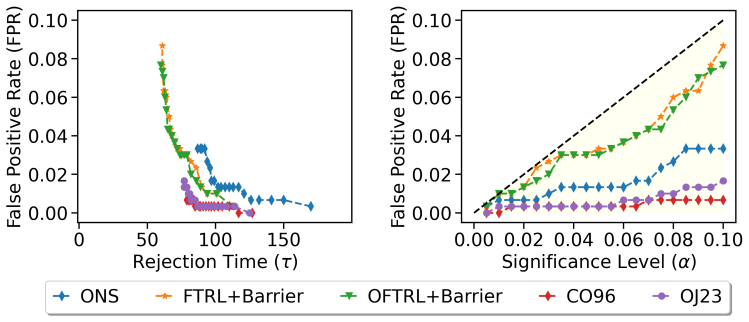
- [Section 4, experimental setup] All experiments for FTRL+Barrier and OFTRL+Barrier use η = 1, but Lemma 6 requires η ≤ 1/4 and Lemma 5 requires η∥∇ℓ_t(θ_t)∥*_{θ_t} ≤ 1/4. Thus the simulations operate outside the regime where the paper's regret bounds are proven, and the observed speedups cannot be attributed to the theoretical constant-regret claim as stated. The paper should either add experiments in the proven regime or provide a separate analysis covering η = 1.
minor comments (6)
- [Theorem 2] The notation E[τ] = Θ(t0 + ln(1/α)/ω* + σ²/ω*²) overstates what is proven: the proof gives only an upper bound of the displayed form, and the cited lower bound from Waudby-Smith et al. applies in the α → 0 regime, not to the full expression including the σ²/ω*² term.
- [Eq. (33)] The maximization over θ of −θ∆ − θ²(Var[g] + ∆²) gives ∆²/(4(Var[g] + ∆²)) when the unconstrained optimum is feasible, not ∆²/(Var[g] + ∆²). The asymptotic comparison in α is unaffected, but the displayed constant is wrong.
- [Appendix C, final simplification] The simplification from the displayed bound to 1/η(t0/8 + 1/(c′²t0) + R(θ*)) is not algebraically consistent: the earlier bound has 2/(c′²η)(1/(t0−1) − 1/(T−1)), and for t0 > 1, 2/(t0−1) is not bounded by 1/t0.
- [Appendix C, one-sided Hessian derivation] The claim that 'with a computer-aided analysis, the Hessian has a simplified expression' (Eq. (50)) should be replaced by a short derivation, since this identity is load-bearing for the one-sided case.
- [Algorithm 3 / Lemma 8] It is not specified what hint m_t was used in the experiments for OFTRL+Barrier. The text discusses setting m_{t+1} = ∇ℓ_t(θ_t) as one natural choice, but the experimental section does not confirm that this choice was made, which impedes reproducibility.
- [Throughout] There are several typos and formatting issues, including 'Online Portforlio' in Section 4, the broken reference '[W A18]', and a duplicated sentence beginning 'For the difference-in-means testing, R(θ) = ...' in the one-sided part of Appendix C.
Circularity Check
No significant circularity: the regret-to-rejection-time derivation is built on external regret bounds and explicit data assumptions, not on its own conclusions.
full rationale
The central derivation chain is: (i) Algorithm 1 with any no-regret learner is a level-alpha test with asymptotic power one, proven in-paper via Ville's inequality and Hoeffding's inequality (Theorem 1); (ii) FTRL+Barrier's regret is bounded using the external self-concordant FTRL bound of Abernethy, Hazan, and Rakhlin (Lemma 5), the closed-form updates (Lemmas 2-3), and an explicit linear-growth assumption on cumulative gradients (Lemma 7); (iii) the expected rejection time follows by substituting the regret bound into Theorem 1 (Theorem 2). The linear-growth condition |G_t| >= ct is an assumption on the data stream with concrete supporting examples, not a fitted parameter renamed as a prediction, and the bound E[tau] = Theta(t0 + ln(1/alpha)/omega* + sigma^2/omega*^2) is computed from regret and concentration inequalities rather than imposed. Comparisons to ONS use the standard ONS regret bound, and the lower-bound comparisons use external results [WSSJ25, AR25]. The self-citations that appear ([CW25] for the ONS regret lemma, [WAL24] for the optimistic FTRL lemma) concern published, standard results whose stated assumptions do not include the present paper's conclusions; they are not used as a uniqueness argument or to forbid alternative approaches. The known proof gap in Lemma 7 (the inequality involving (1-theta_t^2)^2 and the existence of the uniform constant c') is a mathematical correctness issue about the proof of the stated bound, not a circularity: the theorem's conclusion is not identical to its hypothesis by construction. Accordingly, no circular step is present.
Assumptions & free parameters
free parameters (1)
- learning rate η =
η=1 in all experiments
assumptions (4)
- standard math FTRL regret bound for self-concordant barriers (Theorem 4.1 of AHR12)
- standard math Ville's inequality and randomized Ville's inequality
- domain assumption Data are i.i.d. with bounded, sub-Gaussian increments ψ_t
- domain assumption Linear growth of cumulative gradients |G_t| ≥ ct
Cite this review
Pith. "Pith review of Optimistic Interior Point Methods for Sequential Hypothesis Testing by Betting." pith.science (2026). https://pith.science/paper/VQE2H2VZ
@misc{pith2026250207774,
  author       = {Pith},
  title        = {Pith review of: Optimistic Interior Point Methods for Sequential Hypothesis Testing by Betting},
  year         = {2026},
  howpublished = {\url{https://pith.science/paper/VQE2H2VZ}},
  note         = {Machine review of arXiv:2502.07774}
}
abstract
The technique of ``testing by betting" frames nonparametric sequential hypothesis testing as a multiple-round game, where a player bets on future observations that arrive in a streaming fashion, accumulates wealth that quantifies evidence against the null hypothesis, and rejects the null once the wealth exceeds a specified threshold while controlling the false positive error. Designing an online learning algorithm that achieves a small regret in the game can help rapidly accumulate the bettor's wealth, which in turn can shorten the time to reject the null hypothesis under the alternative $H_1$. However, many of the existing works employ the Online Newton Step (ONS) to update within a halved decision space to avoid a gradient explosion issue, which is potentially conservative for rapid wealth accumulation. In this paper, we introduce a novel strategy utilizing interior-point methods in optimization that allows updates across the entire interior of the decision space without the risk of gradient explosion. Our approach not only maintains strong statistical guarantees but also facilitates faster null hypothesis rejection, while being as computationally lightweight as ONS thanks to its closed-form updates.
Figures


Figures from the paper (6 more)



Reference graph
Works this paper leans on
-
[1]
Algorithms for portfolio management based on the newton method
Amit Agarwal, Elad Hazan, Satyen Kale, and Robert E Schapire. Algorithms for portfolio management based on the newton method. In Proceedings of the 23rd international conference on Machine learning , pages 9--16, 2006
work page 2006
-
[2]
Interior-point methods for full-information and bandit online learning
Jacob D Abernethy, Elad Hazan, and Alexander Rakhlin. Interior-point methods for full-information and bandit online learning. IEEE Transactions on Information Theory , 58(7):4164--4175, 2012
work page 2012
-
[3]
On stopping times of power-one sequential tests: Tight lower and upper bounds
Shubhada Agrawal and Aaditya Ramdas. On stopping times of power-one sequential tests: Tight lower and upper bounds. arXiv preprint arXiv:2504.19952 , 2025
arXiv 2025
-
[4]
Self-concordant analysis for logistic regression
Francis Bach. Self-concordant analysis for logistic regression. 2010
work page 2010
-
[5]
Protected test-time adaptation via online entropy matching: A betting approach
Yarin Bar, Shalev Shaer, and Yaniv Romano. Protected test-time adaptation via online entropy matching: A betting approach. NeurIPS , 2024
work page 2024
-
[6]
Convex optimization
Stephen P Boyd and Lieven Vandenberghe. Convex optimization . Cambridge university press, 2004
2004
-
[7]
Ben Chugg, Santiago Cortes-Gomez, Bryan Wilder, and Aaditya Ramdas. Auditing fairness by betting. Advances in Neural Information Processing Systems , 36:6070--6091, 2023
work page 2023
-
[8]
Brian Cho, Kyra Gan, and Nathan Kallus. Peeking with peak: Sequential, nonparametric composite hypothesis tests for means of multiple data streams. ICML , 2024
work page 2024
Show all 66 references
-
[9]
Universal portfolios with side information
Thomas M Cover and Erik Ordentlich. Universal portfolios with side information. IEEE Transactions on Information Theory , 42(2), 1996
1996
-
[10]
Black-box reductions for parameter-free online learning in banach spaces
Ashok Cutkosky and Francesco Orabona. Black-box reductions for parameter-free online learning in banach spaces. In Conference On Learning Theory , pages 1493--1529. PMLR, 2018
2018
-
[11]
Universal gambling schemes and the complexity measures of kolmogorov and chaitin
Thomas M Cover. Universal gambling schemes and the complexity measures of kolmogorov and chaitin. Technical Report, no. 12 , 1974
1974
-
[12]
Universal portfolios
Thomas M Cover. Universal portfolios. Mathematical finance , 1(1):1--29, 1991
1991
-
[13]
Online detection of LLM -generated texts via sequential hypothesis testing by betting
Can Chen and Jun-Kun Wang. Online detection of LLM -generated texts via sequential hypothesis testing by betting. ICML , 2025
2025
-
[14]
Online optimization with gradual variations
Chao-Kai Chiang, Tianbao Yang, Chia-Jung Lee, Mehrdad Mahdavi, Chi-Jen Lu, Rong Jin, and Shenghuo Zhu. Online optimization with gradual variations. In Conference on Learning Theory , pages 6--1. JMLR Workshop and Conference Proceedings, 2012
2012
-
[15]
Optimistic online mirror descent for bridging stochastic and adversarial online convex optimization
Sijia Chen, Yu-Jie Zhang, Wei-Wei Tu, Peng Zhao, and Lijun Zhang. Optimistic online mirror descent for bridging stochastic and adversarial online convex optimization. Journal of Machine Learning Research , 25(178):1--62, 2024
2024
-
[16]
From individual experience to collective evidence: A reporting-based framework for identifying systemic harms
Jessica Dai, Paula Gradu, Inioluwa Deborah Raji, and Benjamin Recht. From individual experience to collective evidence: A reporting-based framework for identifying systemic harms. ICML , 2025
2025
-
[17]
Multiple testing with anytime-valid monte-carlo p-values
Lasse Fischer and Aaditya Ramdas. Multiple testing with anytime-valid monte-carlo p-values. arXiv preprint arXiv:2404.15586 , 2024
2024 arXiv
-
[18]
Safe testing
Peter Grünwald, Rianne de Heide, and Wouter Koolen. Safe testing. Journal of the Royal Statistical Society Series B: Statistical Methodology , 86(5):1091--1128, 2024
2024
-
[19]
Anytime-valid tests of conditional independence under model-x
Peter Gr \"u nwald, Alexander Henzi, and Tyron Lardy. Anytime-valid tests of conditional independence under model-x. Journal of the American Statistical Association , 119(546):1554--1565, 2024
2024
-
[20]
Introduction to online convex optimization
Elad Hazan et al. Introduction to online convex optimization. Foundations and Trends in Optimization , 2(3-4):157--325, 2016
2016
-
[21]
Logarithmic regret algorithms for online convex optimization
Elad Hazan, Amit Agarwal, and Satyen Kale. Logarithmic regret algorithms for online convex optimization. Machine Learning , 69(2):169--192, 2007
2007
-
[22]
Extracting certainty from uncertainty: Regret bounded by variation in costs
Elad Hazan and Satyen Kale. Extracting certainty from uncertainty: Regret bounded by variation in costs. Machine learning , 80:165--188, 2010
2010
-
[23]
An online portfolio selection algorithm with regret logarithmic in price variation
Elad Hazan and Satyen Kale. An online portfolio selection algorithm with regret logarithmic in price variation. Mathematical Finance , 25(2):288--310, 2015
2015
-
[24]
Regret bounds for online portfolio selection with a cardinality constraint
Shinji Ito, Daisuke Hatano, Hanna Sumita, Akihiro Yabe, Takuro Fukunaga, Naonori Kakimura, and Ken-ichi Kawarabayashi. Regret bounds for online portfolio selection with a cardinality constraint. Advances in Neural Information Processing Systems , 31, 2018
2018
-
[25]
A modular analysis of adaptive (non-) convex optimization: Optimism, composite objectives, and variational bounds
Pooria Joulani, Andr \'a s Gy \"o rgy, and Csaba Szepesv \'a ri. A modular analysis of adaptive (non-) convex optimization: Optimism, composite objectives, and variational bounds. In International Conference on Algorithmic Learning Theory , pages 681--720, 2017
2017
-
[26]
Tighter pac-bayes bounds through coin-betting
Kyoungseok Jang, Kwang-Sung Jun, Ilja Kuzborskij, and Francesco Orabona. Tighter pac-bayes bounds through coin-betting. In The Thirty Sixth Annual Conference on Learning Theory , pages 2240--2264. PMLR, 2023
2023
-
[27]
Efficient and near-optimal online portfolio selection
R \'e mi J \'e z \'e quel, Dmitrii M Ostrovskii, and Pierre Gaillard. Efficient and near-optimal online portfolio selection. arXiv preprint arXiv:2209.13932 , 2022
2022 arXiv
-
[28]
A new interpretation of information rate
John L Kelly. A new interpretation of information rate. the bell system technical journal , 35(4):917--926, 1956
1956
-
[29]
Efficient online portfolio with logarithmic regret
Haipeng Luo, Chen-Yu Wei, and Kai Zheng. Efficient online portfolio with logarithmic regret. Advances in neural information processing systems , 31, 2018
2018
-
[30]
A survey of algorithms and analysis for adaptive online learning
H Brendan McMahan. A survey of algorithms and analysis for adaptive online learning. Journal of Machine Learning Research , 18(90):1--50, 2017
2017
-
[31]
Damped online newton step for portfolio selection
Zakaria Mhammedi and Alexander Rakhlin. Damped online newton step for portfolio selection. In Conference on learning theory , pages 5561--5595. PMLR, 2022
2022
-
[32]
Interior point polynomial time methods in convex programming
Arkadi Nemirovski. Interior point polynomial time methods in convex programming. Lecture notes , 42(16):3215--3224, 2004
2004
-
[33]
Introductory lectures on convex optimization: A basic course , volume 87
Yurii Nesterov. Introductory lectures on convex optimization: A basic course , volume 87. Springer Science & Business Media, 2013
2013
-
[34]
Interior-point polynomial algorithms in convex programming
Yurii Nesterov and Arkadii Nemirovski. Interior-point polynomial algorithms in convex programming . SIAM, 1994
1994
-
[35]
Interior-point methods for optimization
Arkadi S Nemirovski and Michael J Todd. Interior-point methods for optimization. Acta Numerica , 17:191--234, 2008
2008
-
[36]
Tight concentrations and confidence sequences from the regret of universal portfolio
Francesco Orabona and Kwang-Sung Jun. Tight concentrations and confidence sequences from the regret of universal portfolio. IEEE Transactions on Information Theory , 2023
2023
-
[37]
Coin betting and parameter-free online learning
Francesco Orabona and D \'a vid P \'a l. Coin betting and parameter-free online learning. Advances in Neural Information Processing Systems , 29, 2016
2016
-
[38]
A modern introduction to online learning
Francesco Orabona. A modern introduction to online learning. arXiv preprint arXiv:1912.13213 , 2019
1912 arXiv
-
[39]
Sequential kernelized independence testing
Aleksandr Podkopaev, Patrick Bl \"o baum, Shiva Kasiviswanathan, and Aaditya Ramdas. Sequential kernelized independence testing. In International Conference on Machine Learning , pages 27957--27993. PMLR, 2023
2023
-
[40]
Deep anytime-valid hypothesis testing
Teodora Pandeva, Patrick Forr \'e , Aaditya Ramdas, and Shubhanshu Shekhar. Deep anytime-valid hypothesis testing. In International Conference on Artificial Intelligence and Statistics , pages 622--630. PMLR, 2024
2024
-
[41]
Sequential predictive two-sample and independence testing
Aleksandr Podkopaev and Aaditya Ramdas. Sequential predictive two-sample and independence testing. Advances in neural information processing systems , 36:53275--53307, 2023
2023
-
[42]
Adaptive conformal inference by betting
Aleksandr Podkopaev, Dong Xu, and Kuang-Chih Lee. Adaptive conformal inference by betting. ICML , 2024
2024
-
[43]
Game-theoretic statistics and safe anytime-valid inference
Aaditya Ramdas, Peter Gr \"u nwald, Vladimir Vovk, and Glenn Shafer. Game-theoretic statistics and safe anytime-valid inference. Statistical Science , 38(4):576--601, 2023
2023
-
[44]
Randomized and exchangeable improvements of markov's, chebyshev's and chernoff's inequalities
Aaditya Ramdas and Tudor Manole. Randomized and exchangeable improvements of markov's, chebyshev's and chernoff's inequalities. arXiv preprint arXiv:2304.02611 , 2023
2023 arXiv
-
[45]
Admissible anytime-valid sequential inference must rely on nonnegative martingales
Aaditya Ramdas, Johannes Ruf, Martin Larsson, and Wouter Koolen. Admissible anytime-valid sequential inference must rely on nonnegative martingales. arXiv preprint arXiv:2009.03167 , 2020
2009 arXiv
-
[46]
The expected sample size of some tests of power one
Herbert Robbins and David Siegmund. The expected sample size of some tests of power one. The Annals of Statistics , 2(3):415--436, 1974
1974
-
[47]
Online learning with predictable sequences
Alexander Rakhlin and Karthik Sridharan. Online learning with predictable sequences. In Conference on Learning Theory , pages 993--1019. PMLR, 2013
2013
-
[48]
Hypothesis testing with e-values
Aaditya Ramdas and Ruodu Wang. Hypothesis testing with e-values. arXiv preprint arXiv:2410.23614 , 2024
2024 arXiv
-
[49]
Fast convergence of regularized learning in games
Vasilis Syrgkanis, Alekh Agarwal, Haipeng Luo, and Robert E Schapire. Fast convergence of regularized learning in games. Advances in Neural Information Processing Systems , 28, 2015
2015
-
[50]
Testing by betting: A strategy for statistical and scientific communication
Glenn Shafer. Testing by betting: A strategy for statistical and scientific communication. Journal of the Royal Statistical Society Series A: Statistics in Society , 184(2):407--431, 2021
2021
-
[51]
Model- X sequential testing for conditional independence via testing by betting
Shalev Shaer, Gal Maman, and Yaniv Romano. Model- X sequential testing for conditional independence via testing by betting. In International Conference on Artificial Intelligence and Statistics , pages 2054--2086. PMLR, 2023
2023
-
[52]
Nonparametric two-sample testing by betting
Shubhanshu Shekhar and Aaditya Ramdas. Nonparametric two-sample testing by betting. IEEE Transactions on Information Theory , 70(2):1178--1203, 2023
2023
-
[53]
Online learning meets optimization in the dual
Shai Shalev-Shwartz and Yoram Singer. Online learning meets optimization in the dual. In International Conference on Computational Learning Theory , pages 423--437. Springer, 2006
2006
-
[54]
Game-theoretic foundations for probability and finance , volume 455
Glenn Shafer and Vladimir Vovk. Game-theoretic foundations for probability and finance , volume 455. John Wiley & Sons, 2019
2019
-
[55]
Data-dependent bounds for online portfolio selection without lipschitzness and smoothness
Chung-En Tsai, Ying-Ting Lin, and Yen-Huan Li. Data-dependent bounds for online portfolio selection without lipschitzness and smoothness. Advances in Neural Information Processing Systems , 36:62764--62791, 2023
2023
-
[56]
I bet you did not mean that: Testing semantic importance via betting
Jacopo Teneggi and Jeremias Sulam. I bet you did not mean that: Testing semantic importance via betting. NeurIPS , 2024
2024
-
[57]
Open problem: Fast and optimal online portfolio selection
Tim Van Erven, Dirk Van der Hoeven, Wojciech Kot owski, and Wouter M Koolen. Open problem: Fast and optimal online portfolio selection. In Conference on learning theory , pages 3864--3869. PMLR, 2020
2020
-
[58]
Etude critique de la notion de collectif
Jean Ville. Etude critique de la notion de collectif . Gauthier-Villars Paris, 1939
1939
-
[59]
E-values: Calibration, combination and applications
Vladimir Vovk and Ruodu Wang. E-values: Calibration, combination and applications. The Annals of Statistics , 49(3):1736--1754, 2021
2021
-
[60]
Acceleration through optimistic no-regret dynamics
Jun-Kun Wang and Jacob D Abernethy. Acceleration through optimistic no-regret dynamics. Advances in Neural Information Processing Systems , 31, 2018
2018
-
[61]
No-regret dynamics in the Fenchel game: A unified framework for algorithmic convex optimization
Jun-Kun Wang, Jacob Abernethy, and Kfir Y Levy. No-regret dynamics in the Fenchel game: A unified framework for algorithmic convex optimization. Mathematical Programming , 205(1):203--268, 2024
2024
-
[62]
Universal inference
Larry Wasserman, Aaditya Ramdas, and Sivaraman Balakrishnan. Universal inference. Proceedings of the National Academy of Sciences , 117(29):16880--16890, 2020
2020
-
[63]
Primal-dual interior-point methods
Stephen J Wright. Primal-dual interior-point methods . SIAM, 1997
1997
-
[64]
Estimating means of bounded random variables by betting
Ian Waudby-Smith and Aaditya Ramdas. Estimating means of bounded random variables by betting. Journal of the Royal Statistical Society Series B: Statistical Methodology , 86(1):1--27, 2024
2024
-
[65]
Universal log-optimality for general classes of e-processes and sequential hypothesis tests
Ian Waudby-Smith, Ricardo Sandoval, and Michael I Jordan. Universal log-optimality for general classes of e-processes and sequential hypothesis tests. arXiv preprint arXiv:2504.02818 , 2025
2025 arXiv
-
[66]
Pushing the efficiency-regret pareto frontier for online learning of portfolios and quantum states
Julian Zimmert, Naman Agarwal, and Satyen Kale. Pushing the efficiency-regret pareto frontier for online learning of portfolios and quantum states. In Conference on Learning Theory , pages 182--226. PMLR, 2022
2022
Reviewed August 8, 2026 · model on record in the stance chip above.
Discussion (0). Continue with ORCID to comment.