REVIEW 1 major objections 5 minor 42 references
GRAIL: Graph Edit Distance and Node Alignment Using LLM-Generated Code
T0 review · 1 major / 5 minor · reviewed 2026-08-16 · deepseek-v4-flash
Pith's one-line read This paper claims that an LLM can be steered by evolutionary prompt tuning to write short programs that, through maximum-weight bipartite matching, give tight upper bounds on graph edit distance and beat supervised neural and non-neural…
desk verdict GRAIL has a genuinely useful idea—LLM-evolved code for GED upper bounds—but the main selection loop as written is sign-inverted and cannot work; fix that before believing the empirical claims. read the letter →
The pith
A machine-rendered reading of the paper's core claim, the machinery that carries it, and where it could break.
The reading
What carries the argument
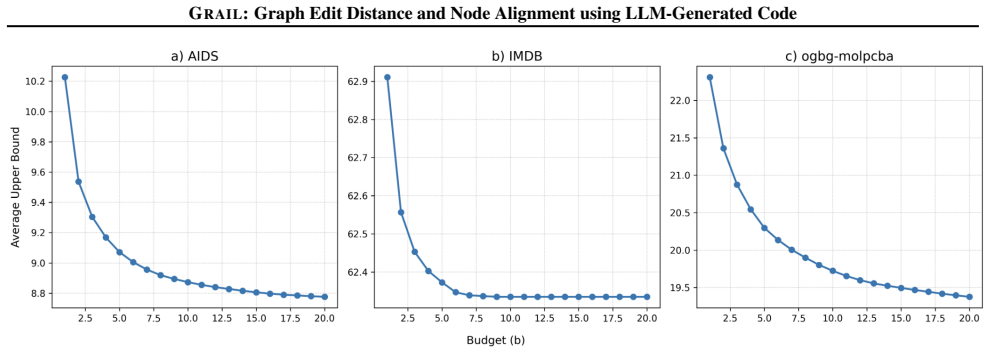
The load-bearing mechanism is the reduction of GED approximation to maximum-weight bipartite matching with LLM-generated weights, combined with an upper-bound objective. Concretely, a program maps a graph pair to a weight matrix; running a bipartite matching algorithm, here the Neighbor-biased mapper, gives a bijection between nodes, and evaluating the edit cost of that bijection gives an upper bound on the true GED. Since any single mapping is feasible, the prediction cannot undercut the true distance, which makes the training signal (the sum over training pairs of the minimum upper bound among selected programs) a surrogate for approximation error that requires no labels. The evolutionary prompt loop keeps the top-scoring short programs, asks the LLM to improve them, filters for executability and runtime, and reselects a budget of complementary programs by greedy submodular maximization.
What would settle it
Hold the model, prompt template, and datasets fixed, but replace the evolutionary top-k feedback with a loop that always feeds the initial trivial program back to the LLM; if the resulting answer set still matches GRAIL's RMSE, then the claimed discovery process is not what carries the result.
Extended reading notes
Core claim
GRAIL treats GED approximation as the problem of learning a program that outputs a weight matrix for a fully connected bipartite graph between the nodes of two graphs; a maximum-weight bipartite matching on that graph yields a node mapping, and the GED of that mapping is an upper bound on the true GED. The paper claims that an LLM, prompted with the problem definition and the best programs found so far, can mutate and combine programs until the greedy submodular selection of a budget of programs stops improving the training objective, which sums over training pairs the minimum upper bound among selected programs. Because this objective is an upper bound and is monotone submodular, greedy selection yields a good answer set, and because the program pool is evolved by LLM prompt feedback, no ground-truth GED is needed. Empirically, the resulting programs outperform the neural baselines GREED, GEDGNN, ERIC, H2MN, and GRAPHEDX, as well as the leading non-neural heuristics, on the six benchmark datasets, including a trained-once mixture variant.
Load-bearing premise
The load-bearing premise is that the LLM, when shown the current best programs and asked to mutate them, will keep producing new programs that improve the training objective; if the model fails to generate useful mutations, the whole loop degenerates to the trivial zero-weight program and the method collapses.
Editorial extensions
If this is right
- Approximating GED no longer requires NP-hard ground-truth labels; training a GRAIL-style system needs only unlabeled graph pairs and LLM calls.
- The discovered programs are executable, short code, so the resulting heuristic and the node alignment it induces are open to inspection and manual improvement.
- A single program set trained once on a mixture of datasets transfers across domains, graph sizes, and label sets, eliminating per-dataset retraining.
- Because every predicted GED is an upper bound on the true distance, the method can never quietly underestimate similarity, a useful property for downstream search and filtering.
Reading between the lines
- An implication the paper leaves implicit is that the upper-bound guarantee makes the program set usable as an admissible pruning rule in similarity search: any pair whose upper bound already exceeds a query threshold can be safely discarded.
- The method's ceiling is set by the LLM's mutation diversity, which suggests a testable extension: seeding the prompt pool with human-written heuristic programs, or with programs from several different LLMs, and measuring whether the discovered answer set improves.
- The interpretability claim could be quantified by measuring the shortest program length that still reaches a given RMSE, and comparing those programs against the best known hand-designed GED heuristics.
- The reported ground-truth evaluation is confined to graphs of at most a few dozen nodes; an extension would test the upper-bound gap on larger graphs using exact solvers or tight lower bounds where available.
Signed reviews
Editorial analysis
A structured set of objections, weighed in public.
Referee Report
Summary. The paper proposes GRAIL, a framework that uses an LLM in an evolutionary loop to generate executable programs that compute node similarity matrices for maximum-weight bipartite matching. The resulting node mappings yield upper bounds on the true graph edit distance, and a greedy selection chooses a bounded set of complementary programs. The authors report RMSE and exact-match-ratio results on six benchmark datasets, plus a variant (GRAIL-MIX) trained on a mixture of datasets to demonstrate cross-domain transfer. The central claim is that GRAIL achieves competitive or better approximation quality than neural and non-neural baselines without any ground-truth GED supervision during training.
Significance. The idea of replacing a neural regressor with an LLM-evolved program is novel and, if sound, would be a meaningful contribution to the GED approximation literature. The upper-bound formulation is elegant and genuinely avoids the need for NP-hard training labels, in contrast to most neural baselines. The paper also emphasizes interpretability of the discovered programs and releases its codebase, which is a further strength. However, the significance is heavily contingent on the correctness of the evolutionary selection loop and on the reliability of the empirical comparison; the concerns below show that both require substantial revision before the claims can be accepted.
major comments (1)
- [§A.1.2, Lemma 2] The submodularity inequality is stated in the wrong direction. For A′ ⊆ A, the marginal decrease from adding P is larger for the smaller set; a concrete assignment shows J(A∪{P})−J(A) ≥ J(A′∪{P})−J(A′) rather than the reverse. For example, with a single graph pair and costs c_a=3, c_b=1, c_P=2, take A'={a}, A={a,b}. Then J(A')=3, J(A)=1, J(A'∪{P})=2, J(A∪{P})=1, so J(A∪{P})−J(A)=0 and J(A'∪{P})−J(A')=−1, violating the claimed inequality. The monotonicity lemma is correct, but the proof of submodularity does not go through, so the greedy selection in Algorithm 1 is not justified as a submodular greedy method. If the authors instead define the gain function G(A)=J(∅)−J(A), then G is monotone submodular, and the standard (1−1/e) guarantee applies to selecting the b programs with maximum final gain; the paper should be rewritten around that formulation.
minor comments (5)
- [§5.1, Tables 3 and 4] The empirical comparison reports a single run for each variant, with no error bars or multiple seeds. GRAIL is stochastic in two ways: the LLM is sampled at temperature 0.99, and the island/cluster selection in the evolutionary loop is randomized. Different runs can therefore produce different programs and different RMSE/EMR values. Given that several comparisons are decided by small margins (e.g., AIDS RMSE 0.57 vs 0.61; ogbg-molhiv 2.96 vs 3.02), the reported rankings and the claim that GRAIL "consistently ranks among the top algorithms" are not yet supported. At minimum, the authors should report the mean and standard deviation over at least several independent evolutionary runs.
- [§5.3, Tables 5 and 6] The inter-domain generalization claim is not directly supported by the experiments. Table 6 shows GRAIL models transferring across datasets, but there is no neural baseline evaluated on the same off-diagonal transfer tasks; Table 5 only compares GREED within the molecule domain, and the "NA" entries mean the comparison set is incomplete. Therefore the statement that this ability is "not seen in neural approximators" (end of §5.3) is an overreach. The authors should either include cross-domain runs of neural baselines on the same train/test combinations or restrict the claim to what the experiments show.
- [§5.2, Table 3] The statement that GRAIL "comprehensively outperform[s] the baselines" is too strong, since GREED achieves lower RMSE than GRAIL on ogbg-molpcba (2.48 vs 3.18) and GEDGNN achieves lower RMSE on ogbg-molhiv (1.75 vs 2.96). The wording should be softened to "on average" or "in most datasets."
- [Abstract] The abstract says "seven datasets," but Tables 3 and 4 benchmark only six; ogbg-ppa is used only in the scale experiment of Fig. 3a. Please correct the count.
- [§4.2] There is a typo in the sentence "Since the programs evolve through mutations introduced by the LLM, the selection mechanism optimizes two distinct objectives." The comma after "LLM" should be removed or the sentence restructured.
Circularity Check
No circularity: GRAIL's predictions are evaluated against externally computed ground-truth GED, and the upper-bound objective is not a re-labeled fit.
full rationale
GRAIL's claimed derivation is self-contained. Training minimizes J(A) = sum over training pairs of min_{P in A} GED_{pi(P)}(G1,G2) (Eq. 5), and since Definition 4 defines true GED as the minimum over all mappings, every GED_{pi(P)} is a guaranteed upper bound on the true GED. The objective is therefore not defined in terms of the test quantity; for any training pair, |pred - true| = pred - true because pred >= true, so minimizing the upper bound is legitimately equivalent to minimizing approximation error on those pairs. Test performance is measured against held-out ground truth computed by MIP-F2 (Appendix A.3.1) and is not used to fit any parameter. The paper's citations, including FunSearch, are used as algorithmic building blocks and are not load-bearing uniqueness claims. One internal concern is worth separating from circularity: Algorithm 1 and Eq. 6 define score(P) = J(A union {P}) - J(A), which by monotonicity is non-positive, so selecting the arg max would prefer the program with the smallest reduction; this is an optimization-sign inconsistency, not a circular reduction of the reported predictions to the training inputs.
Assumptions & free parameters
free parameters (5)
- b (function budget) =
15
- k (top programs in prompt) =
2
- number of islands =
5
- temperature =
0.99
- LLM model =
Gemini 1.5 Pro (gemini-1.5-pro-001)
assumptions (4)
- standard math For any node mapping π, the edit cost GEDπ(G1,G2) is an upper bound on the true GED(G1,G2).
- standard math J(A) is monotone and submodular, enabling greedy selection.
- ad hoc to paper The LLM can be evolved via prompts to produce programs that improve J(A) on training pairs and transfer to test pairs.
- domain assumption MIP-F2 with a 600-second time limit gives exact GED values for the test pairs that are kept.
Cite this review
Pith. "Pith review of GRAIL: Graph Edit Distance and Node Alignment Using LLM-Generated Code." pith.science (2026). https://pith.science/paper/VQGXDYXD
@misc{pith2026250502124,
  author       = {Pith},
  title        = {Pith review of: GRAIL: Graph Edit Distance and Node Alignment Using LLM-Generated Code},
  year         = {2026},
  howpublished = {\url{https://pith.science/paper/VQGXDYXD}},
  note         = {Machine review of arXiv:2505.02124}
}
read the original abstract
Graph Edit Distance (GED) is a widely used metric for measuring similarity between two graphs. Computing the optimal GED is NP-hard, leading to the development of various neural and non-neural heuristics. While neural methods have achieved improved approximation quality compared to non-neural approaches, they face significant challenges: (1) They require large amounts of ground truth data, which is itself NP-hard to compute. (2) They operate as black boxes, offering limited interpretability. (3) They lack cross-domain generalization, necessitating expensive retraining for each new dataset. We address these limitations with GRAIL, introducing a paradigm shift in this domain. Instead of training a neural model to predict GED, GRAIL employs a novel combination of large language models (LLMs) and automated prompt tuning to generate a program that is used to compute GED. This shift from predicting GED to generating programs imparts various advantages, including end-to-end interpretability and an autonomous self-evolutionary learning mechanism without ground-truth supervision. Extensive experiments on seven datasets confirm that GRAIL not only surpasses state-of-the-art GED approximation methods in prediction quality but also achieves robust cross-domain generalization across diverse graph distributions.
Figures


Figures from the paper (8 more)



Reference graph
Works this paper leans on
-
[1]
write newline
" write newline "" before.all 'output.state := FUNCTION n.dashify 't := "" t empty not t #1 #1 substring "-" = t #1 #2 substring "--" = not "--" * t #2 global.max substring 't := t #1 #1 substring "-" = "-" * t #2 global.max substring 't := while if t #1 #1 substring * t #2 global.max substring 't := if while FUNCTION format.date year duplicate empty "emp...
-
[2]
Bai, J. and Zhao, P. Tagsim: type-aware graph similarity learning and computation. Proc. VLDB Endow., 15 0 (2): 0 335–347, October 2021. ISSN 2150-8097. doi:10.14778/3489496.3489513. URL https://doi.org/10.14778/3489496.3489513
arXiv 2021
-
[3]
Simgnn: A neural network approach to fast graph similarity computation
Bai, Y., Ding, H., Bian, S., Chen, T., Sun, Y., and Wang, W. Simgnn: A neural network approach to fast graph similarity computation. In WSDM, WSDM '19, pp.\ 384–392, 2019
work page 2019
-
[4]
Learning-based efficient graph similarity computation via multi-scale convolutional set matching
Bai, Y., Ding, H., Gu, K., Sun, Y., and Wang, W. Learning-based efficient graph similarity computation via multi-scale convolutional set matching. AAAI, pp.\ 3219--3226, Apr. 2020
work page 2020
-
[5]
Blumenthal, D. B. New techniques for graph edit distance computation. CoRR, abs/1908.00265, 2019. URL http://arxiv.org/abs/1908.00265
arXiv 1908
-
[6]
Blumenthal, D. B. and Gamper, J. Improved lower bounds for graph edit distance. IEEE Transactions on Knowledge and Data Engineering, 30 0 (3): 0 503--516, 2018. doi:10.1109/TKDE.2017.2772243
arXiv 2018
-
[7]
Blumenthal, D. B. and Gamper, J. On the exact computation of the graph edit distance. Pattern Recogn. Lett., 134 0 (C): 0 46–57, June 2020. ISSN 0167-8655. doi:10.1016/j.patrec.2018.05.002. URL https://doi.org/10.1016/j.patrec.2018.05.002
-
[8]
B., Boria, N., Gamper, J., Bougleux, S., and Brun, L
Blumenthal, D. B., Boria, N., Gamper, J., Bougleux, S., and Brun, L. Comparing heuristics for graph edit distance computation. The VLDB journal, 29 0 (1): 0 419--458, 2020
work page 2020
Show all 42 references
-
[9]
R., Ranu, S., and Karras, P
Bommakanti, A., Vonteri, H. R., Ranu, S., and Karras, P. Eugene: Explainable unsupervised approximation of graph edit distance, 2024 a . URL https://arxiv.org/abs/2402.05885
2024
-
[10]
R., Skitsas, K., Ranu, S., Mottin, D., and Karras, P
Bommakanti, A., Vonteri, H. R., Skitsas, K., Ranu, S., Mottin, D., and Karras, P. Fugal: Feature-fortified unrestricted graph alignment. In The Thirty-eighth Annual Conference on Neural Information Processing Systems, 2024 b
2024
-
[11]
Hogmmnc: a higher order graph matching with multiple network constraints model for gene--drug regulatory modules identification
Chen, J., Peng, H., Han, G., Cai, H., and Cai, J. Hogmmnc: a higher order graph matching with multiple network constraints model for gene--drug regulatory modules identification. Bioinformatics, 35 0 (4): 0 602--610, 2019
2019
-
[12]
Graph matching applications in pattern recognition and image processing
Conte, D., Foggia, P., Sansone, C., and Vento, M. Graph matching applications in pattern recognition and image processing. Proceedings 2003 International Conference on Image Processing (Cat. No.03CH37429), 2: 0 II--21, 2003. URL https://api.semanticscholar.org/CorpusID:267842199
2003
-
[13]
H., Leiserson, C
Cormen, T. H., Leiserson, C. E., Rivest, R. L., and Stein, C. Introduction to Algorithms, Third Edition. The MIT Press, 3rd edition, 2009. ISBN 0262033844
2009
-
[14]
D., Manchanda, S., Mahapatra, S., and Reddy, C
Doan, K. D., Manchanda, S., Mahapatra, S., and Reddy, C. K. Interpretable graph similarity computation via differentiable optimal alignment of node embeddings. In SIGIR, pp.\ 665–674, 2021
2021
-
[15]
Spectral graph matching and regularized quadratic relaxations: Algorithm and theory
Fan, Z., Mao, C., Wu, Y., and Xu, J. Spectral graph matching and regularized quadratic relaxations: Algorithm and theory. In III, H. D. and Singh, A. (eds.), Proceedings of the 37th International Conference on Machine Learning, volume 119 of Proceedings of Machine Learning Res...
2020
-
[16]
D., Rusch, T
Giovanni, F. D., Rusch, T. K., Bronstein, M., Deac, A., Lackenby, M., Mishra, S., and Veli c kovi \'c , P. How does over-squashing affect the power of GNN s? Transactions on Machine Learning Research, 2024. ISSN 2835-8856. URL https://openreview.net/forum?id=KJRoQvRWNs
2024
-
[17]
Gordon, V. S. and Whitley, L. D. Serial and parallel genetic algorithms as function optimizers. In Proceedings of the 5th International Conference on Genetic Algorithms, pp.\ 177–183, San Francisco, CA, USA, 1993. Morgan Kaufmann Publishers Inc. ISBN 1558602992
1993
-
[18]
and Singh, A
He, H. and Singh, A. Closure-tree: An index structure for graph queries. In 22nd International Conference on Data Engineering (ICDE'06), pp.\ 38--38, 2006. doi:10.1109/ICDE.2006.37
2006 doi
-
[19]
Hopcroft, J. E. and Karp, R. M. An n\^ 5/2 algorithm for maximum matchings in bipartite graphs. SIAM Journal on Computing, 2 0 (4): 0 225--231, 1973
1973
-
[20]
Open graph benchmark: Datasets for machine learning on graphs
Hu, W., Fey, M., Zitnik, M., Dong, Y., Ren, H., Liu, B., Catasta, M., and Leskovec, J. Open graph benchmark: Datasets for machine learning on graphs. In Larochelle, H., Ranzato, M., Hadsell, R., Balcan, M. F., and Lin, H. (eds.), Advances in Neural Information Processing Syste...
2020
-
[21]
Open graph benchmark: Datasets for machine learning on graphs, 2021
Hu, W., Fey, M., Zitnik, M., Dong, Y., Ren, H., Liu, B., Catasta, M., and Leskovec, J. Open graph benchmark: Datasets for machine learning on graphs, 2021. URL https://arxiv.org/abs/2005.00687
2021 arXiv
-
[22]
Graph edit distance with general costs using neural set divergence
Jain, E., Roy, I., Meher, S., Chakrabarti, S., and De, A. Graph edit distance with general costs using neural set divergence. In The Thirty-eighth Annual Conference on Neural Information Processing Systems, 2024
2024
-
[23]
and Hero, A
Justice, D. and Hero, A. A binary linear programming formulation of the graph edit distance. IEEE Transactions on Pattern Analysis and Machine Intelligence, 28 0 (8): 0 1200--1214, 2006. doi:10.1109/TPAMI.2006.152
2006 doi
-
[24]
Kuhn, H. W. The hungarian method for the assignment problem. Naval Research Logistics Quarterly, 2 0 (1-2): 0 83--97, 1955
1955
-
[25]
An integer projected fixed point method for graph matching and map inference
Leordeanu, M., Hebert, M., and Sukthankar, R. An integer projected fixed point method for graph matching and map inference. Advances in neural information processing systems, 22, 2009
2009
-
[26]
New binary linear programming formulation to compute the graph edit distance
Lerouge, J., Abu-Aisheh, Z., Raveaux, R., H \'e roux, P., and Adam, S. New binary linear programming formulation to compute the graph edit distance. Pattern Recognition, 72: 0 254--265, 2017 a
2017
-
[27]
New binary linear programming formulation to compute the graph edit distance
Lerouge, J., Abu-Aisheh, Z., Raveaux, R., Héroux, P., and Adam, S. New binary linear programming formulation to compute the graph edit distance. Pattern Recognition, 72: 0 254--265, 2017 b . ISSN 0031-3203. doi:https://doi.org/10.1016/j.patcog.2017.07.029. URL https://www.scie...
2017 doi
-
[28]
Graph matching networks for learning the similarity of graph structured objects
Li, Y., Gu, C., Dullien, T., Vinyals, O., and Kohli, P. Graph matching networks for learning the similarity of graph structured objects. In ICML, pp.\ 3835--3845, 2019
2019
-
[29]
M., Bause, F., Kersting, K., Mutzel, P., and Neumann, M
Morris, C., Kriege, N. M., Bause, F., Kersting, K., Mutzel, P., and Neumann, M. Tudataset: A collection of benchmark datasets for learning with graphs. CoRR, abs/2007.08663, 2020. URL https://arxiv.org/abs/2007.08663
2007 arXiv
-
[30]
Computing graph edit distance via neural graph matching
Piao, C., Xu, T., Sun, X., Rong, Y., Zhao, K., and Cheng, H. Computing graph edit distance via neural graph matching. Proceedings of the VLDB Endowment, 16 0 (8): 0 1817--1829, 2023
2023
-
[31]
Greed: A neural framework for learning graph distance functions
Ranjan, R., Grover, S., Medya, S., Chakaravarthy, V., Sabharwal, Y., and Ranu, S. Greed: A neural framework for learning graph distance functions. Advances in Neural Information Processing Systems, 35: 0 22518--22530, 2022
2022
-
[32]
Answering top-k representative queries on graph databases
Ranu, S., Hoang, M., and Singh, A. Answering top-k representative queries on graph databases. In Proceedings of the 2014 ACM SIGMOD international conference on Management of data, pp.\ 1163--1174, 2014
2014
-
[33]
P., Dupont, E., Ruiz, F
Romera-Paredes, B., Barekatain, M., Novikov, A., Balog, M., Kumar, M. P., Dupont, E., Ruiz, F. J., Ellenberg, J. S., Wang, P., Fawzi, O., et al. Mathematical discoveries from program search with large language models. Nature, 625 0 (7995): 0 468--475, 2024
2024
-
[34]
Global alignment of multiple protein interaction networks with application to functional orthology detection
Singh, R., Xu, J., and Berger, B. Global alignment of multiple protein interaction networks with application to functional orthology detection. Proceedings of the National Academy of Sciences, 105 0 (35): 0 12763--12768, 2008. doi:10.1073/pnas.0806627105. URL https://www.pnas....
2008 doi
-
[35]
L., Lyon, D., Junge, A., Wyder, S., Huerta-Cepas, J., Simonovic, M., Doncheva, N
Szklarczyk, D., Gable, A. L., Lyon, D., Junge, A., Wyder, S., Huerta-Cepas, J., Simonovic, M., Doncheva, N. T., Morris, J. H., and et al., P. B. String v11: protein–protein association networks with increased coverage, supporting functional discovery in genome-wide experimenta...
2019
-
[36]
Combinatorial learning of graph edit distance via dynamic embedding
Wang, R., Zhang, T., Yu, T., Yan, J., and Yang, X. Combinatorial learning of graph edit distance via dynamic embedding. In IEEE Conference on Computer Vision and Pattern Recognition, 2021
2021
-
[37]
Wang, X., Ding, X., Tung, A. K. H., Ying, S., and Jin, H. An efficient graph indexing method. In Proceedings of the 2012 IEEE 28th International Conference on Data Engineering (ICDE '12), pp.\ 210--221, USA, 2012. IEEE Computer Society
2012
-
[38]
N., Gomes, J., Geniesse, C., Pappu, A
Wu, Z., Ramsundar, B., Feinberg, E. N., Gomes, J., Geniesse, C., Pappu, A. S., Leswing, K., and Pande, V. Moleculenet: a benchmark for molecular machine learning. Chemical science, 9 0 (2): 0 513--530, 2018
2018
-
[39]
and Vishwanathan, S
Yanardag, P. and Vishwanathan, S. Deep graph kernels. In Proceedings of the 21st ACM SIGKDD International Conference on Knowledge Discovery and Data Mining (KDD '15), pp.\ 1365--1374, New York, NY, USA, 2015. Association for Computing Machinery
2015
-
[40]
H2mn: Graph similarity learning with hierarchical hypergraph matching networks
Zhang, Z., Bu, J., Ester, M., Li, Z., Yao, C., Yu, Z., and Wang, C. H2mn: Graph similarity learning with hierarchical hypergraph matching networks. In Proceedings of the 27th ACM SIGKDD Conference on Knowledge Discovery & Data Mining, KDD '21, pp.\ 2274–2284, New York, NY, USA...
2021
-
[41]
and Tan, G
Zhuo, W. and Tan, G. Efficient graph similarity computation with alignment regularization. Advances in Neural Information Processing Systems, 35: 0 30181--30193, 2022
2022
-
[42]
W., and et al., J
Zitnik, M., Feldman, M. W., and et al., J. L. Evolution of resilience in protein interactomes across the tree of life. Proceedings of the National Academy of Sciences, 116 0 (10): 0 4426--4433, 2019
2019
Reviewed August 16, 2026 · model on record in the stance chip above.
Discussion (0). Continue with ORCID to comment.