REVIEW 4 major objections 4 minor 29 references
A Computational Approach to Modeling Conversational Systems: Analyzing Large-Scale Quasi-Patterned Dialogue Flows
T0 review · 4 major / 4 minor · reviewed 2026-08-06 · deepseek-v4-flash
Pith's one-line read A new graph pipeline doubles semantic coherence and yields cycle-free dialogue trees.
desk verdict The Filter & Reconnect pipeline is a real but modest combination; the headline metric S measures the clustering, not the graph simplification, so the paper's central claim is unsupported as written. read the letter →
The pith
A machine-rendered reading of the paper's core claim, the machinery that carries it, and where it could break.
The reading
What carries the argument
The load-bearing object is the Filter & Reconnect graph-simplification procedure acting on a Markov-chain transition matrix $T$, where $T_{ij}$ is the observed probability of moving from cluster $i$ to cluster $j$. The metric that carries the semantic claim is $S$, the average cosine similarity of each utterance embedding to its cluster centroid (Eq. 9). Filter & Reconnect's three stages—threshold filtering, top-K edge restriction, iterative weakest-edge cycle removal, and reconnection of detached subgraphs—are what convert a noisy directed graph into a single connected tree-like component; the $0$ δ-hyperbolicity result is the structural signature of that enforced acyclicity.
What would settle it
Run the same utterance embeddings, K-means++ clusters, and LLM intent labels on ABCD and MultiWOZ 2.2 with and without the Filter & Reconnect step. If $S$ is identical in both runs while coverage drops, the claimed 2.06x semantic gain comes from the earlier pipeline stages, not from graph simplification; if $S$ changes, measure how much of the gain survives when filtering is applied to graphs built from different clustering methods.
Extended reading notes
Core claim
The paper claims that combining SBERT embeddings, K-means++ clustering, LLM-generated intent labels, and a Markov-chain transition matrix produces conversational graphs whose quality is improved by a new Filter & Reconnect post-processing step. Filter & Reconnect drops low-weight edges and self-loops, keeps only the top-K incoming edges per node, removes every remaining cycle by deleting its weakest edge, and reconnects any fragment by restoring the strongest previously deleted transition. In the paper's tables this yields graphs with branching factor below 1, no cycles, and δ-hyperbolicity 0, while the semantic metric S—average cosine similarity between utterances and their cluster centroids—rises from 0.122 to 0.384 on MultiWOZ 2.2 and from 0.148 to 0.305 on ABCD, which the paper reports as a factor-2.06 improvement. The paper also reports that coverage, the fraction of observed transitions preserved, drops substantially, from full coverage to roughly 0.17–0.18, making the claimed contribution an explicit trade-off between interpretability and completeness.
Load-bearing premise
The load-bearing premise is that the average cosine similarity between utterances and their cluster centroids, $S$, is a valid and comparable measure of conversational-graph quality, even though the graph-simplification step does not change the cluster labels from which $S$ is computed.
Editorial extensions
If this is right
- Conversational graphs produced by this pipeline are acyclic and connected, which makes them directly renderable as trees for visualization.
- The 2.06x gain in $S$ suggests that LLM-based intent labeling produces semantically tighter clusters than verb-phrase labels, independent of the graph-simplification step.
- Coverage drops by design, so downstream applications must decide how much observed transition detail they are willing to sacrifice for readable structure.
- The same pipeline can be applied to any large dialogue collection with loose intent flow, including chatbot logs and customer-support transcripts.
Reading between the lines
- Because Filter & Reconnect only changes edges and not cluster assignments, the reported $S$ improvement is logically attributable to the embedding, clustering, and LLM-labeling stages rather than to the simplification; the paper's own note that filtering leaves node labels unchanged implies the 2.06x figure would be unchanged even if Filter & Reconnect were omitted.
- A direct test would compare $S$ from the full pipeline against the same pipeline with graph filtering disabled; if $S$ is identical, the simplification contributes only the tree structure, not the semantic gain.
- The $0$ δ-hyperbolicity value is a built-in consequence of the cycle-removal step, so it should not be read as evidence that real conversations are tree-like; it is a design target, not an empirical discovery.
- Coverage and $S$ should be combined into a single precision-style trade-off, or measured against human-annotated intent transitions, before claims about 'optimal clarity' can be compared across methods.
Editorial analysis
A structured set of objections, weighed in public.
Referee Report
Summary. The paper proposes a pipeline for constructing conversational graphs from loosely structured ('quasi-patterned') dialogue datasets. Utterances are embedded with Sentence-BERT, clustered with K-means++, labeled by an LLM, and converted into a Markov-chain transition graph. The main contribution is a graph simplification method called Filter & Reconnect, which applies threshold and top-K filtering, removes cycles, and reconnects disconnected subgraphs. The authors report that combining LLM-based labeling with Filter & Reconnect increases the semantic metric S by a factor of 2.06 over Ferreira et al. (2023), while reducing δ-hyperbolicity to 0, and they argue this yields more interpretable conversational graphs. The evaluation uses two datasets, MultiWOZ 2.2 and ABCD, and compares four approaches on structural metrics (branching factor, number of cycles, δ-hyperbolicity) and semantic metrics (S and Coverage).
Significance. If the claims were valid, the paper would offer a practical method for turning noisy, large-scale dialogue data into clean, tree-like intent-transition graphs, with potential value for chatbot monitoring and dialogue management. The authors provide a public code repository, which is a strength for reproducibility, and the paper is clearly organized around a concrete pipeline. However, the headline semantic improvement is not attributable to the proposed Filter & Reconnect method, because the metric S is computed from cluster assignments that the method does not change. Likewise, the δ=0 result is guaranteed by the cycle-removal procedure, not by a demonstrated property of conversational structure. The evaluation therefore does not support the central contribution as stated.
major comments (4)
- [Section V-B, Eq. (9); Section VI-B2; Table I] The reported 2.06x increase in S (ABCD: 0.305 vs. 0.148) is not evidence for the Filter & Reconnect method. S is defined in Eq. (9) as the average cosine similarity between each utterance and its K-means++ cluster centroid. This quantity depends only on the cluster assignments, not on graph edges, transition probabilities, or the LLM-generated labels. The paper itself concedes in Section VI-B2 that 'filtering affects only edge selection, leaving node labels—and thus semantic similarity—largely unchanged.' The difference in S therefore comes from the SBERT/K-means++ labeling step, not from Filter & Reconnect, and the comparison to Ferreira et al. is confounded because the two pipelines use different embeddings and clustering procedures.
- [Section III-E3 and Table I] The δ=0 claim is definitional rather than empirical. The Cycle Removal stage of Filter & Reconnect iteratively removes the weakest edge in each cycle until the graph is acyclic; any graph produced by this procedure is a tree or forest and therefore has δ-hyperbolicity 0. Reporting δ=0 in Table I as a favorable outcome is valid only as a description of the algorithm's output, not as a validation that the resulting structure is semantically or conversationally meaningful. No baseline or alternative simplification method is compared under the same cycle-removal constraint, so the interpretability benefit is asserted rather than demonstrated.
- [Table I and Section V-B2] The Coverage metric collapses from 1.00 for Ferreira et al. to 0.172 on ABCD for Filter & Reconnect, meaning that roughly 83% of the transitions observed in the dataset are absent from the final graph. The paper frames this as a necessary trade-off between coverage and interpretability, but no evidence is given that the retained 17% of transitions correspond to the 'dominant intent transitions' or that the pruned graph is more useful for the claimed downstream applications. Without a user study, downstream-task evaluation, or an external standard for what should be preserved, the coverage drop is as consistent with loss of important structure as with noise removal.
- [Section III-E and Section VI] The method depends on four free parameters—threshold τ, top-k K, number of clusters Nc, and the number n of nearest vectors used for LLM labeling—yet no sensitivity analysis, ablation, or principled selection procedure is reported. Table I shows results only for τ=0.1 and top-k=1 in the case study, and the benchmark table does not state the parameter values used per dataset. Since the structural results (B, Ncycles, δ) are direct consequences of these parameters, the absence of a parameter study makes it impossible to assess the robustness of the reported gains.
minor comments (4)
- [Throughout] The paper uses inconsistent terminology and typography, e.g., 'Kmeans++' vs. 'K-means++', 'Top_k' vs. 'Top-K', and the unusual symbol '⊮' in Eq. (10) without definition; the indicator function should be written explicitly.
- [Section III-C] The intent extraction step selects the n vectors closest to each centroid and passes them to an LLM, but the paper does not specify n, the prompt template, or the LLM decoding settings; these details are needed for reproducibility despite the public code link.
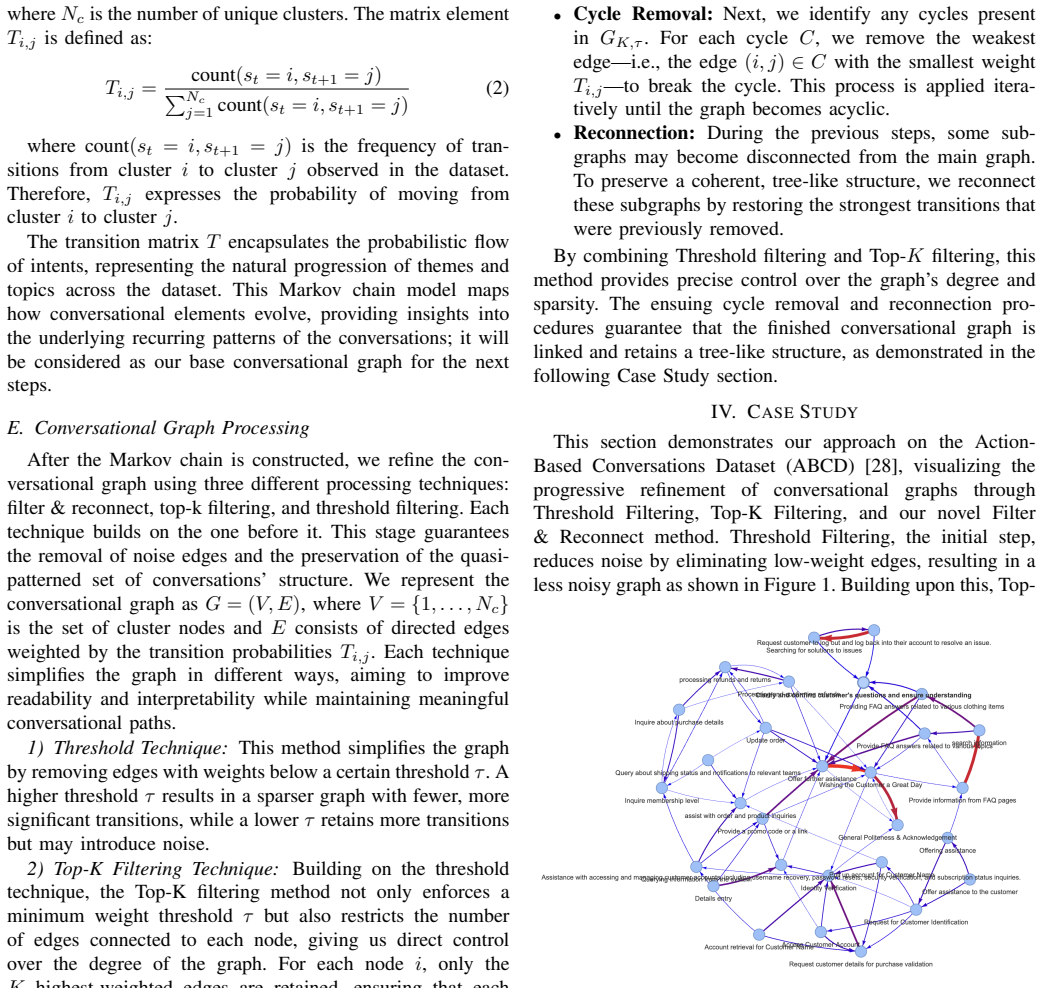
- [Section IV, Figures 1-3] The figures are small and do not include readable node labels or edge weights, making it difficult to verify the claimed qualitative improvement in interpretability from the figures alone.
- [References] Reference [13] is listed with a mismatched year and is not consistently formatted; several references lack page numbers or full venue information, which should be corrected.
Circularity Check
The headline semantic gain is just the K-means clustering objective, and the δ=0 result is the algorithm's own acyclicity stop rule.
-
fitted input called prediction
[Section V-B1, Eqs. 8-9 and Section VI-B2 (Table I discussion)]
"The overall semantic coherence is calculated as the average similarity over all utterances: S = 1/N Σ_{c∈C} Σ_{u_i∈I_c} x_i·µ(c)/(||x_i|| ||µ(c)||) (9) ... Note that filtering affects only edge selection, leaving node labels—and thus semantic similarity—largely unchanged."
Eq. 9 measures average cosine similarity of each utterance to its K-means++ centroid. Eq. 1 is the K-means objective min Σ ||x_i − µ_c||², which, for normalized SBERT embeddings, is equivalent to maximizing the same cosine similarity. Thus S is an internal measure of how well the clustering step itself fits the data. Filter & Reconnect, the paper's central contribution, only edits graph edges; the paper concedes it leaves node labels, and therefore S, unchanged. The reported 2.06x S improvement in the abstract and Table I is therefore a comparison of the SBERT/LLM clustering pipeline against Ferreira et al.'s clustering, not a validation of the proposed graph simplification.
-
self definitional
[Section III-E3 (Cycle Removal) and Table I (ABCD/MultiWOZ rows)]
"For each cycle C, we remove the weakest edge—i.e., the edge (i, j) ∈ C with the smallest weight Ti,j—to break the cycle. This process is applied iteratively until the graph becomes acyclic."
The algorithm explicitly iterates until the graph is acyclic, and the Reconnection stage restores edges while preserving a 'tree-like structure'. Any tree has Gromov δ-hyperbolicity equal to 0 by the definition in Eq. 6. Therefore the reported δ=0 for Filter & Reconnect is guaranteed by the method's own termination condition; it is a restatement of the construction, not an empirical finding. The abstract's 'enforcing a tree-like structure with 0 δ-hyperbolicity' is true by definition, so Table I's δ=0 row provides no independent evidence that the simplification improves interpretability.
full rationale
The two headline claims of the paper reduce to the pipeline's own machinery. The semantic metric S (Eq. 9) is, for normalized SBERT embeddings, the same objective that K-means++ optimizes (Eq. 1), and the paper itself notes that Filter & Reconnect only changes edge selection, leaving node labels and S unchanged; hence the 2.06x S gain over Ferreira et al. is an internal clustering-quality comparison, not a test of the proposed graph simplification. The structural claim of 0 δ-hyperbolicity is also guaranteed by construction: the Cycle Removal stage iterates until acyclicity and the Reconnection stage restores a tree, and trees have δ=0 by definition. Coverage is reported honestly, including the low values for the pruned graphs, but it is not used as a positive claim. There are no self-citations used as load-bearing evidence, and the paper contains independent content such as dataset processing and LLM intent labeling, but the central quantitative claims in the abstract are either the clustering objective or a definitional consequence of the algorithm's stop rule.
Assumptions & free parameters
free parameters (4)
- threshold τ =
0.1
- top-k K =
1
- number of clusters Nc =
not reported
- n nearest vectors for LLM labeling =
not reported
assumptions (4)
- domain assumption Intent transitions are first-order Markov: the next intent cluster depends only on the current cluster.
- domain assumption K-means clusters on SBERT embeddings correspond to meaningful intents.
- domain assumption Gemini 1.5 Flash produces correct, consistent intent labels from sampled utterances.
- domain assumption δ-hyperbolicity computed on the directed shortest-path metric is a meaningful readability measure.
Cite this review
Pith. "Pith review of A Computational Approach to Modeling Conversational Systems: Analyzing Large-Scale Quasi-Patterned Dialogue Flows." pith.science (2026). https://pith.science/paper/VQP7XGBH
@misc{pith2026250713544,
  author       = {Pith},
  title        = {Pith review of: A Computational Approach to Modeling Conversational Systems: Analyzing Large-Scale Quasi-Patterned Dialogue Flows},
  year         = {2026},
  howpublished = {\url{https://pith.science/paper/VQP7XGBH}},
  note         = {Machine review of arXiv:2507.13544}
}
read the original abstract
The analysis of conversational dynamics has gained increasing importance with the rise of large language model-based systems, which interact with users across diverse contexts. In this work, we propose a novel computational framework for constructing conversational graphs that capture the flow and structure of loosely organized dialogues, referred to as quasi-patterned conversations. We introduce the Filter & Reconnect method, a novel graph simplification technique that minimizes noise while preserving semantic coherence and structural integrity of conversational graphs. Through comparative analysis, we demonstrate that the use of large language models combined with our graph simplification technique has resulted in semantic metric S increasing by a factor of 2.06 compared to previous approaches while simultaneously enforcing a tree-like structure with 0 {\delta}-hyperbolicity, ensuring optimal clarity in conversation modeling. This work provides a computational method for analyzing large-scale dialogue datasets, with practical applications related to monitoring automated systems such as chatbots, dialogue management tools, and user behavior analytics.
Figures


Reference graph
Works this paper leans on
-
[1]
N., Kaiser, Ł., & Polosukhin, I
Vaswani, A., Shazeer, N., Parmar, N., Uszkoreit, J., Jones, L., Gomez, A. N., Kaiser, Ł., & Polosukhin, I. (2017). Attention Is All You Need. In Advances in Neural Information Processing Systems (pp. 5998–6008). Retrieved from https://arxiv.org/abs/1706.03762
arXiv 2017
-
[2]
Radford, A., Narasimhan, K., Salimans, T., & Sutskever, I. (2018). Improving Language Understanding by Generative Pre-Training. OpenAI. Retrieved from https://cdn.openai.com/research-covers/ language-unsupervised/language_understanding_paper.pdf
work page 2018
-
[3]
title=A Survey of Large Language Models, author=Wayne Xin Zhao et al, year=2024, eprint=2303.18223, archivePrefix=arXiv, prima- ryClass=cs.CL, url=https://arxiv.org/abs/2303.18223
arXiv 2024
-
[4]
Natural Language Processing Advancements: Breaking Barriers in Human-Computer Interaction,
J. G. Carrasco Ramírez, "Natural Language Processing Advancements: Breaking Barriers in Human-Computer Interaction," Journal of Artificial Intelligence and General Systems (JAIGS) , vol. 3, no. 1, pp. 31-39, Feb. 2024
work page 2024
-
[5]
Cross-lingual Transfer Learning for Multilingual Task Oriented Dialogue
S. Schuster, S. Gupta, R. Shah, and M. Lewis, "Cross-lingual Transfer Learning for Multilingual Task Oriented Dialogue" in Proc. of the 2019 Conf. of the North American Chapter of the Association for Computa- tional Linguistics: Human Language Technologies , Minneapolis, MN, pp. 3795–3805, 2019. doi: 10.18653/v1/N19-1380
-
[6]
H. Khanpour, N. Guntakandla, and R. Nielsen, "Dialogue Act Classi- fication in Domain-Independent Conversations Using a Deep Recurrent Neural Network," in Proc. of COLING 2016, the 26th International Conf. on Computational Linguistics: Technical Papers , Osaka, Japan, pp. 2012–2021, 2016. Available: https://aclanthology.org/C16-1189
work page 2016
-
[7]
S. Hochreiter, "Long Short-Term Memory," journal : Neural Computa- tion MIT-Press, 1997
work page 1997
-
[8]
Bidirectional LSTM-CRF Models for Sequence Tagging,
Z. Huang, W. Xu, and K. Yu, "Bidirectional LSTM-CRF Models for Sequence Tagging," arXiv preprint arXiv:1508.01991, 2015. †Code Repository : https://github.com/achrefbenammar404/quasi- patterned-conversations-analysis.git
arXiv 2015
Show all 29 references
-
[9]
In Proceedings of the 23rd International Conference on Hybrid Intelligent Systems (HIS 2023) , 2023
Patrícia Ferreira, Daniel Martins, Ana Alves, Catarina Silva, and Hugo Gonçalo Oliveira.Unsupervised Flow Discovery from Task-oriented Di- alogues. In Proceedings of the 23rd International Conference on Hybrid Intelligent Systems (HIS 2023) , 2023. In press
2023
-
[10]
spaCy 2: Natural Language Under- standing with Bloom Embeddings, Convolutional Neural Networks, and Incremental Parsing,
M. Honnibal and I. Montani, "spaCy 2: Natural Language Under- standing with Bloom Embeddings, Convolutional Neural Networks, and Incremental Parsing," unpublished manuscript, 2017. Available: https://spacy.io
2017
-
[11]
Sentence-BERT: Sentence Embeddings Using Siamese BERT-Networks,
N. Reimers and I. Gurevych, "Sentence-BERT: Sentence Embeddings Using Siamese BERT-Networks," arXiv, 2019. Available: http://arxiv. org/abs/1908.10084
2019 arXiv
-
[12]
Arthur, D., & Vassilvitskii, S. (2007). k-means++: The advantages of careful seeding. In Proceedings of the Eighteenth Annual ACM- SIAM Symposium on Discrete Algorithms (pp. 1027–1035). Society for Industrial and Applied Mathematics
2007
-
[13]
IntentGPT: Few-shot Intent Discovery with Large Language Models
Rodriguez, A., et al. IntentGPT: Few-shot Intent Discovery with Large Language Models. arXiv preprint arXiv:2411.10670 , 2023. Retrieved from https://arxiv.org/abs/2411.10670
2023 arXiv
-
[14]
Song, X., et al. Large Language Models Meet Open-World Intent Dis- covery and Recognition: An Evaluation of ChatGPT.Proceedings of the 2023 Conference on Empirical Methods in Natural Language Processing, pages 10291-10304, 2023. Retrieved from https://aclanthology.org/2023. em...
2023
-
[15]
He, M., & Garner, P. N. Can ChatGPT Detect Intent? Evaluating Large Language Models for Spoken Language Understanding. arXiv preprint arXiv:2305.13512, 2023. Retrieved from https://arxiv.org/abs/ 2305.13512
2023 arXiv
-
[16]
ILLUMINER: Instruction-tuned Large Language Models as Few-shot Intent Classifier and Slot Filler
Mirza, P., et al. ILLUMINER: Instruction-tuned Large Language Models as Few-shot Intent Classifier and Slot Filler. In Proceedings of the 2024 Joint International Conference on Computational Linguistics, Language Resources and Evaluation (LREC-COLING 2024) , pages 8639–8651,
2024
-
[17]
Auto-Intent: Automated Intent Discovery and Self- Exploration for Large Language Model Web Agents
Kim, J., et al. Auto-Intent: Automated Intent Discovery and Self- Exploration for Large Language Model Web Agents. arXiv preprint arXiv:2410.22552, 2024. Retrieved from https://arxiv.org/abs/2410. 22552
2024 arXiv
-
[18]
A rule-based short query intent identifi- cation system,
A. De and S. K. Kopparapu, "A rule-based short query intent identifi- cation system," in 2010 International Conference on Signal and Image Processing, 2010, pp. 212–216
2010
-
[19]
BERT: Pre-training of Deep Bidirectional Transformers for Language Understanding,
J. Devlin, M. W. Chang, K. Lee, and K. Toutanova, "BERT: Pre-training of Deep Bidirectional Transformers for Language Understanding," in Proceedings of the 2019 Conference of the North American Chapter of the Association for Computational Linguistics: Human Language Technologi...
2019 doi
-
[20]
KeyBERT: Minimal keyword extraction with BERT,
M. Grootendorst, "KeyBERT: Minimal keyword extraction with BERT," Zenodo, version 0.3.0, 2020. Available: https://doi.org/10.5281/zenodo. 4461265. doi: 10.5281/zenodo.4461265
2020 doi
-
[21]
Intent Discovery Through Unsu- pervised Semantic Text Clustering,
S. Padmasundari and S. Bangalore, "Intent Discovery Through Unsu- pervised Semantic Text Clustering," in Proc. of Interspeech , vol. 2018, pp. 606–610, 2018
2018
-
[22]
Gem- ini 1.5: Unlocking Multimodal Understanding Across Millions of Tokens of Context,
M. Reid, N. Savinov, D. Teplyashin, D. Lepikhin, T. Lillicrap, J.-B. Alayrac, R. Soricut, A. Lazaridou, O. Firat, J. Schrittwieser, et al., "Gem- ini 1.5: Unlocking Multimodal Understanding Across Millions of Tokens of Context," arXiv, 2024. Available: https://arxiv.org/abs/2403.05530
2024 arXiv
-
[23]
J. R. Norris, Markov Chains , 2nd ed. Cambridge, UK: Cambridge University Press, 1998
1998
-
[24]
On the number of cycles in a graph
Harary, Frank, and Bennet Manvel. "On the number of cycles in a graph." Matematický ˇcasopis 21.1 (1971): 55-63
1971
-
[25]
Gromov hyperbolic graphs,
S. Bermudo, J. M. Rodríguez, J. M. Sigarreta, and J.-M. Vilaire, "Gromov hyperbolic graphs," Discrete Mathematics, vol. 313, no. 15, pp. 1575–1585, 2013
2013
-
[26]
On the Hyperbolicity of Small-World and Treelike Random Graphs,
W. Chen, W. Fang, G. Hu, and M. W. Mahoney, "On the Hyperbolicity of Small-World and Treelike Random Graphs," Internet Mathematics , vol. 9, no. 4, pp. 434–491, 2013. doi: 10.1080/15427951.2013.828336. Available: https://doi.org/10.1080/15427951.2013.828336
2013
-
[27]
MultiWOZ 2.2: A dialogue dataset with additional annotation corrections and state tracking baselines
Xiaoxue Zang, Abhinav Rastogi, Srinivas Sunkara, Raghav Gupta, Jianguo Zhang, and Jindong Chen. MultiWOZ 2.2: A dialogue dataset with additional annotation corrections and state tracking baselines. In Proceedings of the 2nd Workshop on Natural Language Processing for Conversat...
2020
-
[28]
Action- based conversations dataset: A corpus for building more in-depth task- oriented dialogue systems
Derek Chen, Howard Chen, Yi Yang, Alex Lin, and Zhou Yu. Action- based conversations dataset: A corpus for building more in-depth task- oriented dialogue systems. arXiv preprint arXiv:2104.00783 , 2021
2021 arXiv
-
[2024]
Retrieved from https://aclanthology.org/2024.lrec-main.758
2024
Reviewed August 6, 2026 · model on record in the stance chip above.
Discussion (0). Sign in to comment.