REVIEW 5 major objections 4 minor 46 references
Causal Supervision of Attention for Affective Behaviour Analysis
T0 review · 5 major / 4 minor · reviewed 2026-08-02 · deepseek-v4-flash
Pith's one-line read Supervising attention with random counterfactual interventions, together with Key–Value decorrelation and a SwiGLU projection, raises the Aff-Wild2 multi-task composite score from 0.45 to 1.2214 on the official validation fold.
desk verdict A solid ABAW challenge entry that combines three known ideas and reports a strong leaderboard number, but the component-wise gains fall inside the noise of the five-fold evaluation and the causal story is underevidenced. read the letter →
The pith
A machine-rendered reading of the paper's core claim, the machinery that carries it, and where it could break.
The reading
What carries the argument
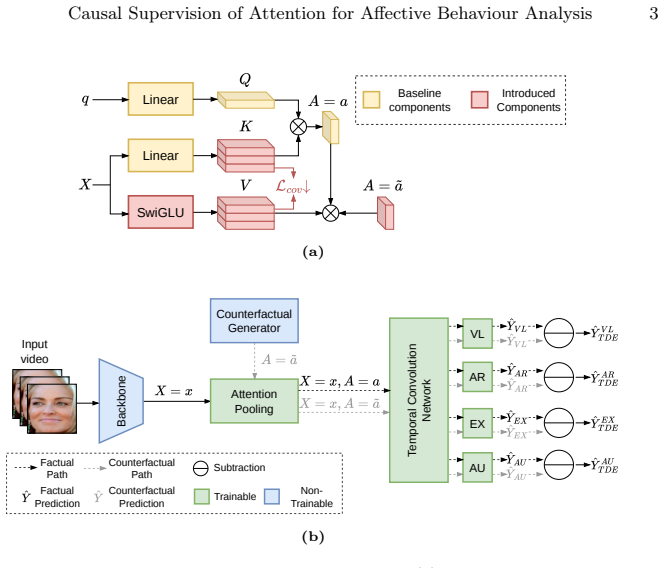
The load-bearing object is the Total Direct Effect of attention: TDE = ŷ(x, a) − ŷ(x, do(a = ã)), where ã = softmax(z) with z ∼ N(0, I). Training maximizes a loss on this difference for each task, implementing causal supervision of attention. Supporting machinery includes cross-covariance regularization L_cov = ‖K^T V / S‖²_F on token-centered Key and Value matrices, and a SiLU-gated linear projection (SwiGLU) that replaces the linear Value projection. In scaled dot-product attention, Key representations determine attention allocation while Value representations carry the aggregated content.
What would settle it
Train the same framework with the counterfactual attention fixed to a uniform distribution, or to the factual attention shuffled across tokens; if the composite score remains the same, the specific random counterfactual distribution is not what drives the gain. Alternatively, if learned attention maps on the validation set show no measurable drop in correlation with subject identity compared with plain attention pooling, the claimed subject-invariance effect is not materializing.
Extended reading notes
Core claim
The paper's central claim is that the causal contribution of attention to affective predictions can be supervised directly. For each task, the model computes a factual prediction using the learned attention and a counterfactual prediction using an attention vector drawn from softmax of a standard Gaussian; the difference, the Total Direct Effect, is maximized against the task label. This pushes attention toward regions whose change actually changes the prediction, rather than regions that merely correlate with the label in the training set. The authors further claim that minimizing the Frobenius norm of the centered cross-covariance between Key and Value representations reduces redundancy, a
Load-bearing premise
The method assumes that replacing real attention with softmax-normalized standard Gaussian vectors is a meaningful intervention set, such that maximizing the prediction change against these random vectors teaches attention to be causally relevant rather than merely forcing unstable predictions.
Editorial extensions
If this is right
- Adding causal supervision of attention is compatible with any differentiable attention pooling head and any task loss, so the same Total Direct Effect objective can be attached to attention layers in other facial-analysis pipelines.
- Because the composite score rises for both a face-specialized and a general-purpose backbone, the benefit does not depend on a single feature extractor.
- The ablation attributes gains to interaction: SwiGLU alone can hurt, but SwiGLU plus causal supervision or covariance regularization consistently beats the attention-pooling baseline, so the components are complementary.
- If the gains hold on the hidden test set, the method would substantially outperform the official baseline under the challenge's own scoring metric.
Reading between the lines
- The 'invariant regions' claim is asserted via the causal-supervision objective but never directly measured; a fair test would compare attention maps across identities and poses to see whether the supervised attention actually reduces identity correlation.
- Sampling counterfactuals from a Gaussian may act mainly as a regularizer that softens attention and prevents overconfidence; this alternative explanation could be tested by replacing the Gaussian samples with uniform attention or with permuted factual attention and checking whether the gains persist.
- The same recipe, counterfactual attention supervision plus Key–Value decorrelation, could transfer to other spurious-correlation problems such as medical image classification or video action recognition where patch attention is used.
- Because the Total Direct Effect loss maximizes sensitivity to random perturbations, it may interact with label noise; ablations varying the counterfactual distribution would clarify how much of the gain is from causal pressure versus variance reduction.
Editorial analysis
A structured set of objections, weighed in public.
Referee Report
Summary. The paper proposes an attention-pooling framework for the ABAW multi-task learning challenge, adding three components to a baseline attention-pooling architecture with a frozen ViT backbone and TCN: causal supervision of attention (CSA), K-V cross-covariance regularization, and a SwiGLU value projection. On Aff-Wild2, the full method reports P=1.2214 on the official validation fold with a FRoundation backbone, compared with P=0.45 for the official ConvNeXt baseline. Five-fold ablation means for the full model are 0.9569 (DINOv2) and 1.1948 (FRoundation) versus 0.8730 and 1.0524 for the no-component baseline.
Significance. If the claimed improvements are statistically robust, the paper offers a useful set of attention-pooling modifications for multitask affective computing and a competitive ABAW result. The two-backbone evaluation and the ablation table are strengths, as is the clear description of the three proposed modules. However, the evidence is not yet sufficient: the reported confidence intervals overlap, the comparison against the official baseline is confounded by the choice of backbone and temporal encoder, the causal interpretation of the auxiliary loss rests on an unvalidated intervention distribution, and the CSA loss is not fully specified for classification tasks. The manuscript is a reasonable competition/workshop paper but needs additional statistical and controlled experiments before the central claims can be accepted.
major comments (5)
- [§4, Table 2] The ablation evidence for the proposed components is statistically inconclusive. For DINOv2, the baseline is 0.8730±0.0912 and the full model is 0.9569±0.1481; the gain of 0.0839 is smaller than the full model's 95% CI half-width (0.1481). For FRoundation, the gain is 0.1424 versus a half-width of 0.1498. With only five folds, the overlapping intervals do not establish a significant improvement, and the abstract's 'consistent improvements' is further contradicted by fold 3 for DINOv2 (P=0.8074 in Table 1, below the no-component baseline mean of 0.8730). The authors should report per-fold P values for every ablation row, compute within-fold paired differences, and give a paired significance test (noting the limited power of n=5).
- [§4, Table 1 and Table 2] The headline comparison to the official baseline is confounded. The official baseline (row 11) uses a frozen ConvNeXt backbone and achieves P=0.45, whereas the FRoundation baseline without any of the proposed components already reaches a five-fold mean of 1.0524 (Table 2). Thus most of the improvement from 0.45 to 1.2214 is due to the choice of frozen backbone, TCN, and attention pooling, not to CSA, covariance regularization, or SwiGLU. To support the paper's claim, report a controlled comparison in which the same frozen backbone, TCN, and attention-pooling architecture are trained with all proposed components disabled, and give both the official-validation fold and the five-fold mean.
- [§2.1, Eqs. (1)–(2)] The causal interpretation of the CSA loss is not validated. Counterfactual attention vectors are defined as Softmax(z) with z∼N(0,I); using do(A=ã) in Eq. (1) assumes that random softmax vectors are a meaningful intervention set for estimating the direct effect of attention. Maximizing L(Ŷ_TDE, y) can in principle be achieved by making predictions highly sensitive to arbitrary perturbations of attention, rather than by learning attention that is causally relevant or subject-invariant. The manuscript provides no sensitivity analysis over the counterfactual distribution (e.g., standard deviation, uniform versus Gaussian, learned counterfactuals) and no evidence that the resulting attention maps are more identity-invariant than the baseline. This is a load-bearing assumption for the central causal claim and should be addressed with targeted experiments.
- [§2.2, Eq. (4)] The cross-covariance regularization is described as reducing redundancy between K and V, but minimizing ||K^T V||_F only drives K and V to be orthogonal; it can also be satisfied by collapsing either K or V to zero, which would destroy information rather than encourage complementarity. The authors do not report the scale or rank of K and V, do not use a normalized/off-diagonal penalty (as in Barlow Twins), and do not provide sensitivity to λ_cov. Please clarify why the absolute cross-covariance, rather than a correlation-based penalty, is the correct objective, and show that it does not degenerate.
- [§2.1–2.4, Eqs. (1)–(2)] The CSA objective is not fully specified for the classification tasks. Eq. (2) states L_CSA = L(Ŷ_TDE, y), and §2.4 defines L_AU_CSA and L_EX_CSA as CSA objectives for AU and EX. However, Ŷ_TDE is the difference between factual and counterfactual predictions; for AU/EX, the task losses are BCE/cross-entropy, which require inputs in [0,1] (or valid logits). A difference of two softmax outputs or logits is generally not a valid input for these losses. Please specify exactly what is fed into each task loss for the CSA term (e.g., softmax of the TDE, or TDE computed after the loss) and justify it.
minor comments (4)
- [Introduction] Typo: 's-Aff-Wild2' should be 'the Aff-Wild2 dataset'.
- [§4, Table 1] The official baseline row reports only the composite P; per-task CCC/EX/AU values would allow a direct comparison with the proposed method's individual metrics.
- [§3.3] No random seed or multiple-run variability is reported for the five folds; please state whether each fold uses one run and add seeds, since the statistical analysis depends on this.
- [§2.4] λ_CSA and λ_cov are tuned separately per backbone (0.1/0.05 vs 0.35/0.15). A short sensitivity analysis would help, and the choice should be justified.
Circularity Check
No circularity: the reported gains are empirical results from held-out folds; no fitted quantity is renamed a prediction.
full rationale
The paper's central claim is an empirical improvement in the composite challenge score P on Aff-Wild2. The proposed training objective L_Overall = L_Task + lambda_CSA * L_CSA + lambda_cov * L_cov is defined by Eqs. (1)-(4) independently of the evaluation metric in Eq. (5); P is computed from task metrics on held-out folds, not derived from the loss terms by construction. The CSA loss uses random Gaussian counterfactual attention vectors sampled independently of labels, and its supervision L(y_hat_TDE, y) is an auxiliary training signal rather than a renamed prediction target. The covariance regularization and SwiGLU projection are cited to external prior work (Wang et al. 2023; Zbontar et al. 2021; Bardes et al. 2021; Shazeer 2020). The paper contains no self-citations by the present authors, no imported uniqueness theorem, and no equation in which a fitted parameter is relabeled as a prediction. Concerns raised about overlapping 95% CIs in Table 2 and about the choice of the counterfactual distribution concern statistical power and assumption validity, not circularity. Under the hard rules, those concerns do not raise the circularity score.
Assumptions & free parameters
free parameters (4)
- λ_CSA (CSA loss weight) =
0.1 for DINOv2, 0.35 for FRoundation
- λ_cov (cross-covariance loss weight) =
0.05 for DINOv2, 0.15 for FRoundation
- Attention heads and head size =
head size 64, number of heads matches backbone output dimension
- TCN depth and kernel size =
3 layers, kernel 5
assumptions (3)
- domain assumption Aff-Wild2 labels are valid for evaluating generalization to unseen subjects (the validation set is from different subjects/conditions than training).
- ad hoc to paper Random softmax attention vectors constitute an effective set of interventions for estimating the causal contribution of attention.
- domain assumption Frozen pre-trained backbones (DINOv2, FRoundation) provide patch features that support task-relevant attention pooling.
invented entities (2)
-
Counterfactual attention vectors ã ~ Softmax(N(0,I))
-
K-V cross-covariance penalty as a proxy for 'representation complementarity'
Cite this review
Pith. "Pith review of Causal Supervision of Attention for Affective Behaviour Analysis." pith.science (2026). https://pith.science/paper/VQV63PEZ
@misc{pith2026260712091,
  author       = {Pith},
  title        = {Pith review of: Causal Supervision of Attention for Affective Behaviour Analysis},
  year         = {2026},
  howpublished = {\url{https://pith.science/paper/VQV63PEZ}},
  note         = {Machine review of arXiv:2607.12091}
}
abstract
The \textit{11th Affective Behaviour Analysis in-the-wild Competition} includes the Multi-Task Learning Challenge, where participants develop a unified framework for Valence-Arousal Estimation, Expression Recognition, and Action Unit Detection. The challenge lies in learning emotion-related representations that generalize across subjects while remaining robust to spurious factors such as identity, illumination, pose, and demographic variation. To aggregate features extracted by a pre-trained backbone into a compact representation for prediction, attention mechanisms selectively weight the most informative facial regions. However, these attention weights can still capture dataset-specific correlations rather than genuine affective cues. To address this limitation, we propose an attention pooling framework that combines causal supervision with cross-covariance regularization of attention components, encouraging subject-invariant attention and non-redundant representations that improve generalization. Our method achieves $CCC_{VA}=0.5123$ for VA estimation on the official validation set, together with $F_{EX}=0.3116$ and $F_{AU}=0.3974$ for expression recognition and action unit detection, respectively, resulting in an overall $P$ score (the sum of the individual task metrics) of $1.2214$.
Figures
Reference graph
Works this paper leans on
-
[1]
Journal of Medical and Biological Engineering40(2), 149–157 (2020) 8 Rašajski et al
Ayata, D., Yaslan, Y., Kamasak, M.E.: Emotion recognition from multimodal phys- iological signals for emotion aware healthcare systems. Journal of Medical and Biological Engineering40(2), 149–157 (2020) 8 Rašajski et al
2020
-
[2]
arXiv preprint arXiv:2404.08471 (2024)
Bardes, A., Garrido, Q., Ponce, J., Chen, X., Rabbat, M., LeCun, Y., Assran, M., Ballas, N.: Revisiting feature prediction for learning visual representations from video. arXiv preprint arXiv:2404.08471 (2024)
arXiv 2024
-
[3]
arXiv preprint arXiv:2105.04906 (2021)
Bardes, A., Ponce, J., LeCun, Y.: Vicreg: Variance-invariance-covariance regular- ization for self-supervised learning. arXiv preprint arXiv:2105.04906 (2021)
arXiv 2021
-
[4]
Information Sciences582, 593–617 (2022)
Canal, F.Z., Müller, T.R., Matias, J.C., Scotton, G.G., de Sa Junior, A.R., Pozze- bon, E., Sobieranski, A.C.: A survey on facial emotion recognition techniques: A state-of-the-art literature review. Information Sciences582, 593–617 (2022)
2022
-
[5]
Chettaoui, T., Damer, N., Boutros, F.: Froundation: Are foundation models ready for face recognition? Image and Vision Computing156, 105453 (2025)
2025
-
[6]
In: Proceedings of the IEEE/CVF conference on computer vision and pattern recognition
Deng, J., Guo, J., Xue, N., Zafeiriou, S.: Arcface: Additive angular margin loss for deep face recognition. In: Proceedings of the IEEE/CVF conference on computer vision and pattern recognition. pp. 4690–4699 (2019)
2019
-
[7]
Environmental Psychology & Nonverbal Behavior (1978)
Ekman, P., Friesen, W.V.: Facial action coding system. Environmental Psychology & Nonverbal Behavior (1978)
1978
-
[8]
Ekman, P., Friesen, W.V., et al.: The repertoire of nonverbal behavior: Categories, origins, usage and coding, vol. 1. Mouton de Gruyter Berlin (1969)
1969
Show all 46 references
-
[9]
International Journal of Synthetic Emotions (IJSE)1(1), 68–99 (2010)
Gunes, H., Pantic, M.: Automatic, dimensional and continuous emotion recogni- tion. International Journal of Synthetic Emotions (IJSE)1(1), 68–99 (2010)
2010
-
[10]
BMC psychology12(1), 95 (2024)
Guo, R., Guo, H., Wang, L., Chen, M., Yang, D., Li, B.: Development and ap- plication of emotion recognition technology—a systematic literature review. BMC psychology12(1), 95 (2024)
2024
-
[11]
In: 2020 15th IEEE International Conference on Automatic Face and Gesture Recognition (FG 2020)(FG)
Kollias, D., Schulc, A., Hajiyev, E., Zafeiriou, S.: Analysing affective behavior in the first abaw 2020 competition. In: 2020 15th IEEE International Conference on Automatic Face and Gesture Recognition (FG 2020)(FG). pp. 794–800 (2020)
2020
-
[12]
In: Proceedings of the IEEE/CVF Con- ference on Computer Vision and Pattern Recognition
Kollias, D.: Abaw: Valence-arousal estimation, expression recognition, action unit detection & multi-task learning challenges. In: Proceedings of the IEEE/CVF Con- ference on Computer Vision and Pattern Recognition. pp. 2328–2336 (2022)
2022
-
[13]
In: European Conference on Computer Vision
Kollias, D.: Abaw: Learning from synthetic data & multi-task learning challenges. In: European Conference on Computer Vision. pp. 157–172. Springer (2023)
2023
-
[14]
arXiv preprint arXiv:2409.17717 (2024)
Kollias, D., Shao, C., Kaloidas, O., Patras, I.: Behaviour4all: in-the-wild facial behaviour analysis toolkit. arXiv preprint arXiv:2409.17717 (2024)
2024 arXiv
-
[15]
arXiv preprint arXiv:1910.11111 (2019)
Kollias, D., Sharmanska, V., Zafeiriou, S.: Face behavior a la carte: Expressions, affect and action units in a single network. arXiv preprint arXiv:1910.11111 (2019)
1910 arXiv
-
[16]
arXiv preprint arXiv:2105.03790 (2021)
Kollias, D., Sharmanska, V., Zafeiriou, S.: Distribution matching for heteroge- neous multi-task learning: a large-scale face study. arXiv preprint arXiv:2105.03790 (2021)
2021 arXiv
-
[17]
In: Pro- ceedings of the AAAI Conference on Artificial Intelligence
Kollias, D., Sharmanska, V., Zafeiriou, S.: Distribution matching for multi-task learning of classification tasks: a large-scale study on faces & beyond. In: Pro- ceedings of the AAAI Conference on Artificial Intelligence. vol. 38, pp. 2813–2821 (2024)
2024
-
[18]
In: Proceedings of the IEEE/CVF Conference on Computer Vision and Pattern Recognition
Kollias, D., Tzirakis, P., Baird, A., Cowen, A., Zafeiriou, S.: Abaw: Valence-arousal estimation, expression recognition, action unit detection & emotional reaction in- tensity estimation challenges. In: Proceedings of the IEEE/CVF Conference on Computer Vision and Pattern Rec...
2023
-
[19]
In: Proceedings of the IEEE/CVF Conference on Computer Vision and Pattern Recognition
Kollias, D., Tzirakis, P., Cowen, A., Zafeiriou, S., Kotsia, I., Baird, A., Gagne, C., Shao, C., Hu, G.: The 6th affective behavior analysis in-the-wild (abaw) com- petition. In: Proceedings of the IEEE/CVF Conference on Computer Vision and Pattern Recognition. pp. 4587–4598 (...
2024
-
[20]
In: Proceedings of the Computer Vision and Pattern Recognition Conference
Kollias, D., Tzirakis, P., Cowen, A., Zafeiriou, S., Kotsia, I., Granger, E., Peder- soli, M., Bacon, S., Baird, A., Gagne, C., et al.: Advancements in affective and behavior analysis: The 8th abaw workshop and competition. In: Proceedings of the Computer Vision and Pattern Re...
2025
-
[21]
In: Proceedings of the IEEE/CVF Conference on Computer Vision and Pattern Recognition
Kollias, D., Tzirakis, P., Cowen, A., Zafeiriou, S., Kotsia, I., Granger, E., Pedersoli, M., Bacon, S., Madsen, J., Belharbi, S., et al.: From affect to complex behavior: Ad- vancing multimodal human-centered ai at the 10th abaw workshop & competition. In: Proceedings of the I...
2026
-
[22]
International Journal of Computer Vision pp
Kollias, D., Tzirakis, P., Nicolaou, M.A., Papaioannou, A., Zhao, G., Schuller, B., Kotsia, I., Zafeiriou, S.: Deep affect prediction in-the-wild: Aff-wild database and challenge, deep architectures, and beyond. International Journal of Computer Vision pp. 1–23 (2019)
2019
-
[23]
arXiv preprint arXiv:1811.07770 (2018)
Kollias,D.,Zafeiriou,S.:Aff-wild2:Extendingtheaff-wilddatabaseforaffectrecog- nition. arXiv preprint arXiv:1811.07770 (2018)
2018 arXiv
-
[24]
arXiv preprint arXiv:1910.04855 (2019)
Kollias, D., Zafeiriou, S.: Expression, affect, action unit recognition: Aff-wild2, multi-task learning and arcface. arXiv preprint arXiv:1910.04855 (2019)
1910 arXiv
-
[25]
arXiv preprint arXiv:2103.15792 (2021)
Kollias, D., Zafeiriou, S.: Affect analysis in-the-wild: Valence-arousal, expressions, action units and a unified framework. arXiv preprint arXiv:2103.15792 (2021)
2021 arXiv
-
[26]
In: Proceedings of the IEEE/CVF International Conference on Computer Vision
Kollias, D., Zafeiriou, S.: Analysing affective behavior in the second abaw2 compe- tition. In: Proceedings of the IEEE/CVF International Conference on Computer Vision. pp. 3652–3660 (2021)
2021
-
[27]
In: European Conference on Computer Vision
Kollias, D., Zafeiriou, S., Kotsia, I., Dhall, A., Ghosh, S., Shao, C., Hu, G.: 7th abaw competition: Multi-task learning and compound expression recognition. In: European Conference on Computer Vision. pp. 31–45. Springer (2024)
2024
-
[28]
In: Proceedings of the IEEE/CVF International Conference on Computer Vision
Kollias, D., Zafeiriou, S., Kotsia, I., Slabaugh, G., Senadeera, D.C., Zheng, J., Yadav, K.K.K., Shao, C., Hu, G.: From emotions to violence: Multimodal fine- grained behavior analysis at the 9th abaw. In: Proceedings of the IEEE/CVF International Conference on Computer Vision...
2025
-
[29]
In: proceedings of the IEEE Con- ference on Computer Vision and Pattern Recognition
Lea, C., Flynn, M.D., Vidal, R., Reiter, A., Hager, G.D.: Temporal convolutional networks for action segmentation and detection. In: proceedings of the IEEE Con- ference on Computer Vision and Pattern Recognition. pp. 156–165 (2017)
2017
-
[30]
In: Proceedings of the IEEE/CVF conference on computer vision and pattern recognition
Liu, Z., Mao, H., Wu, C.Y., Feichtenhofer, C., Darrell, T., Xie, S.: A convnet for the 2020s. In: Proceedings of the IEEE/CVF conference on computer vision and pattern recognition. pp. 11976–11986 (2022)
2022
-
[31]
arXiv preprint arXiv:1711.05101 (2017)
Loshchilov, I., Hutter, F.: Decoupled weight decay regularization. arXiv preprint arXiv:1711.05101 (2017)
2017 arXiv
-
[32]
In: Proceedings of the IEEE conference on computer vision and pattern recognition
Marinoiu, E., Zanfir, M., Olaru, V., Sminchisescu, C.: 3d human sensing, action and emotion recognition in robot assisted therapy of children with autism. In: Proceedings of the IEEE conference on computer vision and pattern recognition. pp. 2158–2167 (2018)
2018
-
[33]
arXiv preprint arXiv:2304.07193 (2023)
Oquab, M., Darcet, T., Moutakanni, T., Vo, H., Szafraniec, M., Khalidov, V., Fernandez, P., Haziza, D., Massa, F., El-Nouby, A., et al.: Dinov2: Learning robust visual features without supervision. arXiv preprint arXiv:2304.07193 (2023)
2023 arXiv
-
[34]
In: Proc
Paszke, A., et al.: Automatic differentiation in Pytorch. In: Proc. of NeurIPS Work- shop Autodiff (2017)
2017
-
[35]
Cambridge university press (2009)
Pearl, J.: Causality. Cambridge university press (2009)
2009
-
[36]
MIT press (2000)
Picard, R.W.: Affective computing. MIT press (2000)
2000
-
[37]
In: Proceedings of the IEEE/CVF Conference on Computer Vision and Pattern Recognition
Psaroudakis, A., Kollias, D.: Mixaugment & mixup: Augmentation methods for facial expression recognition. In: Proceedings of the IEEE/CVF Conference on Computer Vision and Pattern Recognition. pp. 2367–2375 (2022) 10 Rašajski et al
2022
-
[38]
Journal of personality and social psy- chology39(6), 1161 (1980)
Russell, J.A.: A circumplex model of affect. Journal of personality and social psy- chology39(6), 1161 (1980)
1980
-
[39]
Alexandria Engineering Journal68, 817–840 (2023)
Sajjad, M., Ullah, F.U.M., Ullah, M., Christodoulou, G., Cheikh, F.A., Hijji, M., Muhammad, K., Rodrigues, J.J.: A comprehensive survey on deep facial expression recognition: challenges, applications, and future guidelines. Alexandria Engineering Journal68, 817–840 (2023)
2023
-
[40]
arXiv preprint arXiv:2002.05202 (2020)
Shazeer, N.: Glu variants improve transformer. arXiv preprint arXiv:2002.05202 (2020)
2002 arXiv
-
[41]
Frontiers in Robotics and AI7, 532279 (2020)
Spezialetti, M., Placidi, G., Rossi, S.: Emotion recognition for human-robot inter- action: Recent advances and future perspectives. Frontiers in Robotics and AI7, 532279 (2020)
2020
-
[42]
International journal of epidemiology45(6), 1904–1908 (2016)
VanderWeele, T.J.: Explanation in causal inference: developments in mediation and interaction. International journal of epidemiology45(6), 1904–1908 (2016)
1904
-
[43]
In: Proceedings of the Thirty-Second International Joint Conference on Artificial Intelligence (2023)
Wang, H., Chen, J., Du, L., Fu, Q., Han, S., Song, X.: Causal-based supervision of attention in graph neural network: a better and simpler choice towards powerful attention. In: Proceedings of the Thirty-Second International Joint Conference on Artificial Intelligence (2023)
2023
-
[44]
In: Computer Vision and Pat- tern Recognition Workshops (CVPRW), 2017 IEEE Conference on
Zafeiriou, S., Kollias, D., Nicolaou, M.A., Papaioannou, A., Zhao, G., Kotsia, I.: Aff-wild: Valence and arousal ‘in-the-wild’challenge. In: Computer Vision and Pat- tern Recognition Workshops (CVPRW), 2017 IEEE Conference on. pp. 1980–1987. IEEE (2017)
2017
-
[45]
In: International conference on machine learn- ing
Zbontar, J., Jing, L., Misra, I., LeCun, Y., Deny, S.: Barlow twins: Self-supervised learning via redundancy reduction. In: International conference on machine learn- ing. pp. 12310–12320. PMLR (2021)
2021
-
[46]
In: Proceedings of the IEEE/CVF Conference on Computer Vision and Pattern Recognition
Zhu, Z., Huang, G., Deng, J., Ye, Y., Huang, J., Chen, X., Zhu, J., Yang, T., Lu, J., Du, D., et al.: Webface260m: A benchmark unveiling the power of million-scale deep face recognition. In: Proceedings of the IEEE/CVF Conference on Computer Vision and Pattern Recognition. pp....
2021
Reviewed August 2, 2026 · model on record in the stance chip above.
Discussion (0). Sign in to comment.