REVIEW 3 major objections 5 minor 46 references
Occlusion Robust Face Recognition Based on Mask Learning with PairwiseDifferential Siamese Network
T0 review · 3 major / 5 minor · reviewed 2026-08-14 · deepseek-v4-flash
Pith's one-line read Occluded-face recognition can be fixed by learning which deep features are corrupted and discarding them.
desk verdict A genuinely novel mask-learning idea undermined by test-set tuning of the key threshold and missing error bars; worth reviewing, but the headline gains need a validation split before I'd believe them. read the letter →
The pith
A machine-rendered reading of the paper's core claim, the machinery that carries it, and where it could break.
The reading
What carries the argument
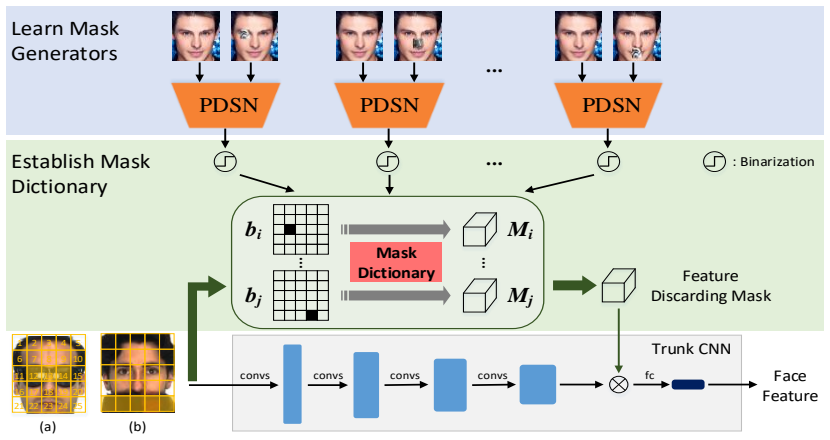
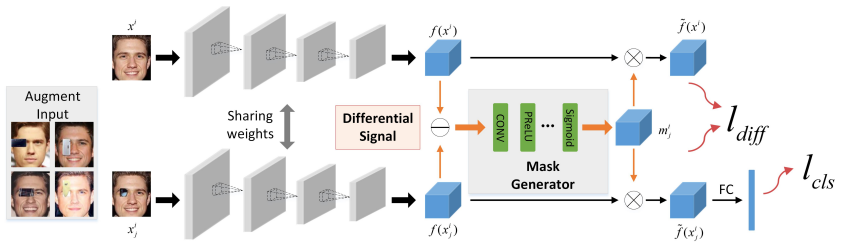
The load-bearing object is the Feature Discarding Mask (FDM), a binary mask with the same dimensions C×W×H as the top convolutional feature map, whose entries indicate which feature elements are corrupted when a given facial block is occluded. It is assembled in three stages: (I) a Pairwise Differential Siamese Network (PDSN), with a shared trunk CNN and a mask generator branch, learns a [0,1]-valued mask for each of the central 3×3 facial blocks from |f(clean)−f(occluded)| under an L1 contrastive loss plus a classification loss; (II) about 200,000 output masks per generator are averaged and binarized by zeroing the smallest τ=25% of mean values; (III) at test time, an FCN-8s detector locates the occlusion, dictionary items with at least 0.5 IoU are AND-ed into one FDM, and the FDM is multiplied into the top-conv feature before the fc layers. The key design choice is the per-element, per-channel mask at the top conv layer, motivated by measured median relative rates of change showing that different channels react differently to the same spatial occlusion.
What would settle it
Run the full pipeline on the AR dataset with the learned FCN-8s detector and, alternatively, with hand-labeled occlusion regions; if the hand-labeled masks do not reproduce or exceed the reported 98.19/98.33 gains over the trunk CNN, then the detector rather than the mask-learning principle is carrying the result.
Extended reading notes
Core claim
The paper's central claim is that occlusion corrupts deep CNN features in a spatially structured, channel-specific way, and that this corruption pattern can be learned from clean/occluded pairs of the same face. The authors find that on the top convolutional layer, rather than the final fully connected layer, the positions of feature elements changed by a given occlusion are largely consistent across identities. They learn a mask generator for each of nine central facial blocks from the absolute difference between the clean and occluded features, using a pairwise contrastive loss that pulls the masked occluded feature toward the clean one plus a classification loss that preserves identity. Binarizing these generators yields a mask dictionary; at test time, detected occlusions select dictionary items with at least 0.5 IoU and combine them by logical AND. Multiplying this Feature Discarding Mask with the top-conv feature before the fc layers removes corrupted elements. The paper reports AR Protocol 2 rank-1 gains from 95.14/96.53 (trunk) to 98.19/98.33 for sunglasses/scarf, and occluded MegaFace/Facescrub gains from 51.86 to 56.34, with clean LFW and MegaFace accuracies unchanged.
Load-bearing premise
The entire gain rests on the FCN-8s occlusion detector returning the correct occlusion location at test time, because the mask is assembled only from dictionary blocks whose IoU with the detected region is at least 0.5; the detector's accuracy is reported only on synthetic Facescrub occlusions, not on the real AR occlusions used for the headline numbers, so a detector failure would apply the wrong mask and could eliminate the reported gains.
Editorial extensions
If this is right
- An already trained face model can gain occlusion robustness by adding a mask dictionary, without sacrificing clean recognition: LFW stays at 99.20 percent and MegaFace at 74.40 percent.
- The method handles arbitrary partial occlusions by AND-ing a small number of dictionary masks, so the cost scales with the number of detected facial blocks rather than the number of occlusion types.
- The baseline that is merely finetuned with occluded faces reaches only 53.03 percent on occluded MegaFace/Facescrub while the masked method reaches 56.34 percent, indicating that removing corrupted elements helps more than shrinking the affected feature range.
- Occlusions on the outermost 16 of the 25 facial blocks can be ignored with less than 0.1 percent accuracy drop, so the fixed central 3×3 set of learned masks covers the regions that matter for recognition.
Reading between the lines
- Beyond the paper's own claims, the same differential-mask idea could be applied to other recognition tasks with local corruption, such as object re-identification, iris recognition, or defending against adversarial patches, by learning a mask dictionary per semantic region rather than per facial block.
- The dictionary is tied to one trunk model: since the masks are read from the top-conv activations of a fixed network, switching to a different backbone would require re-learning the masks, so the method is model-specific rather than a universal feature-cleaning module.
- The learned masks could serve as a diagnostic tool: they reveal which feature channels a network relies on for specific facial regions, potentially exposing shortcut cues such as hair or background in clean training.
- A testable extension would be to replace the FCN-8s occlusion detector with a simple patch-based detector or a randomly placed oracle block and measure how much of the gain depends on precise occlusion localization.
Signed reviews
Editorial analysis
A structured set of objections, weighed in public.
Referee Report
Summary. This paper addresses occlusion-robust face recognition by learning feature discarding masks that remove corrupted elements from top-convolutional features. The method has three stages: train Pairwise Differential Siamese Networks (PDSN) with a classification loss plus a pairwise L1 contrastive loss to generate masks for each of nine central facial blocks; binarize the mean masks into a dictionary of Feature Discarding Masks (FDMs) using a discarding threshold tau; and at test time detect occlusions with an FCN-8s network, combine relevant dictionary masks by logical AND, multiply the trunk CNN's top-conv features by the combined mask, and use the purified features for recognition. Experiments on AR, MegaFace/Facescrub, and LFW report gains over the trunk CNN on occluded probes and no loss on clean LFW. The central claim is that explicitly discarding corrupted feature elements outperforms occlusion augmentation baselines and prior methods.
Significance. If the reported results hold, the work is significant: the idea of per-element top-conv masks learned from pairwise differential signals is well motivated by the MED analysis in Section 3.1, and the ablations in Section 4.2 genuinely support the differential supervision and binarization choices. The preservation of LFW accuracy (99.20 vs 99.20 for the trunk CNN) is a strength relative to the baseline's drop to 98.68. However, the empirical support is weakened by test-set selection of tau, lack of detector evaluation on the realistic AR occlusions, and absence of error bars or released code. The manuscript does not contain machine-checked proofs, but the method is specified clearly enough to be reimplemented.
major comments (3)
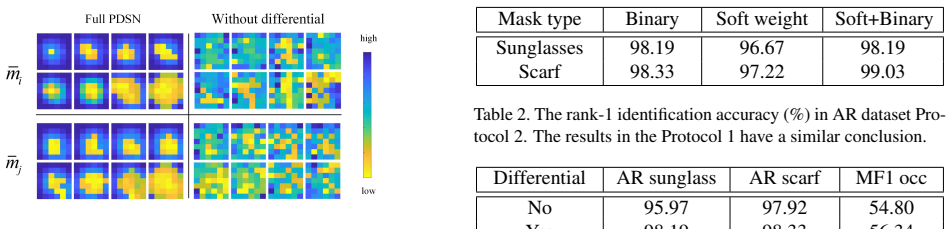
- [Section 4.2, Table 1; Tables 2, 3, 6] The threshold tau is selected by scanning 0, 0.05, ..., 0.45 directly on the AR dataset (Table 1), and the same AR Protocol 2 evaluation is used for the headline results in Tables 2, 3, and 6. Because the reported improvements over Trunk CNN in Table 6 Protocol 2 are only 3.05 and 1.80 percentage points, tuning tau on the evaluation set could account for a substantial part of the gain; the statement that performance is 'not highly sensitive' is not supported without variance estimates. Please retune tau on a held-out validation split (or report the full curve and the corresponding results for all tau), and provide confidence intervals.
- [Section 3.3 and Section 4.1] The test-time pipeline depends on the FCN-8s occlusion detector: Stage III assembles the FDM from dictionary entries whose block IoU with the detected occlusion is at least 0.5. Quantitative detector accuracy (mean IU 98.51) is reported only for the synthetic occluded Facescrub dataset, not for the real AR occlusions used in the headline experiments. A systematic detector failure on AR images could apply wrong masks and eliminate the reported gains. Please report detector performance on AR (pixel IoU or block-level hit rate) and a sensitivity analysis of the final recognition accuracy to detection errors.
- [Tables 2, 3, 5, 6] All results are single-run accuracies with no error bars, significance tests, or released code/models, although the margins over the trunk CNN are small in several comparisons (e.g., 51.86 vs 56.34 on MF1occ). The phrase 'significantly outperforms' therefore overshoots the statistical evidence presented. Please provide bootstrap confidence intervals or multiple-run standard deviations, and consider releasing code or trained models to allow independent verification.
minor comments (5)
- [Eq. (6)] The phrase 'the smallest top tau*K mean values' is self-contradictory; it should read 'the smallest tau*K mean values'.
- [Section 3.3] The 0.5 IoU threshold used to decide which dictionary blocks are relevant is not ablated or justified; please add a sensitivity study or cite prior usage.
- [Table 4] The text should clarify that the Ours and Trunk CNN results are identical (99.20) because the method is designed not to alter clean-face features, rather than implying that the two rows are independent measurements.
- [Section 4.5] The claim that 'the mask dictionary and the model are not finetuned with any AR face data' should be reconciled with the use of AR training images (26 subjects) in the FCN-8s occlusion detector and with the selection of tau on the AR test set; a precise statement of which AR data influenced which component is needed.
- [Figure 7] The highlighted regions in the mean masks are mentioned in the text but not explained in the caption; please define what the highlight denotes.
Circularity Check
AR gains partly reflect τ selected on the AR test set; core mask-learning derivation is otherwise self-contained.
-
fitted input called prediction
[Section 4.2, Table 1; Section 4.5, Table 6]
"By varying τ from 0 to 0.45, we evaluate our method on the AR dataset. ... The best accuracy is achieved at τ = 0.25 and the performance is not highly sensitive to this threshold. ... It is worth noting that the mask dictionary and the model are not finetuned with any AR face data at all, while other algorithms usually train with this dataset."
The threshold τ is fitted by scanning values on the AR dataset, and the same AR Protocol 2 results (Table 6, 98.19% sunglasses / 98.33% scarf) are then reported as the method's performance. Because Table 1's τ=0 accuracy (95.84%) already matches the trunk-CNN average, the headline AR gains (98.19/98.33 vs 95.14/96.53) are partly an artifact of selecting τ on the test set. The Section 4.5 statement that the model is 'not finetuned with any AR face data' omits this threshold selection, so the AR result is not an independent prediction but a fitted parameter reported as evaluation.
full rationale
The core derivation is self-contained: mask generators are learned from paired clean/occluded top-conv features via Eqs. (2)-(5), the dictionary is binarized in Eq. (6), and test-time FDM assembly in Sec. 3.3 is an independent inference procedure. No load-bearing self-citation chain or imported uniqueness theorem is present; the cited ArcFace and CosFace models are external contributions. The LFW and MegaFace evaluations were not used to fit τ and remain genuine held-out measurements. The only circularity-adjacent element is the AR threshold selection in Table 1 followed by AR results in Table 6, which compromises the AR headline but not the derivation itself; hence a moderate score rather than a high one.
Assumptions & free parameters
free parameters (3)
- Discarding threshold tau =
0.25
- Loss weight lambda =
10
- IoU threshold for block relevance =
0.5
assumptions (5)
- domain assumption The top conv layer of the trunk CNN preserves local spatial information such that occluding a specific facial block consistently corrupts a specific set of feature elements across different identities.
- domain assumption The mask dictionary learned from CASIA-WebFace pairs transfers to other datasets, identities, and occlusion types not used in mask training.
- domain assumption The FCN-8s occlusion segmentation produces accurate occlusion masks at test time.
- domain assumption Applying the same FDM to a clean gallery face does not remove identity-relevant information needed for fair comparison.
- domain assumption The trunk CNN's features are fixed and the mask generator has enough capacity to isolate occlusions without trunk retraining.
Cite this review
Pith. "Pith review of Occlusion Robust Face Recognition Based on Mask Learning with PairwiseDifferential Siamese Network." pith.science (2026). https://pith.science/paper/VRMCBIZP
@misc{pith2026190806290,
  author       = {Pith},
  title        = {Pith review of: Occlusion Robust Face Recognition Based on Mask Learning with PairwiseDifferential Siamese Network},
  year         = {2026},
  howpublished = {\url{https://pith.science/paper/VRMCBIZP}},
  note         = {Machine review of arXiv:1908.06290}
}
read the original abstract
Deep Convolutional Neural Networks (CNNs) have been pushing the frontier of the face recognition research in the past years. However, existing general CNN face models generalize poorly to the scenario of occlusions on variable facial areas. Inspired by the fact that a human visual system explicitly ignores occlusions and only focuses on non-occluded facial areas, we propose a mask learning strategy to find and discard the corrupted feature elements for face recognition. A mask dictionary is firstly established by exploiting the differences between the top convoluted features of occluded and occlusion-free face pairs using an innovatively designed Pairwise Differential Siamese Network (PDSN). Each item of this dictionary captures the correspondence between occluded facial areas and corrupted feature elements, which is named Feature Discarding Mask (FDM). When dealing with a face image with random partial occlusions, we generate its FDM by combining relevant dictionary items and then multiply it with the original features to eliminate those corrupted feature elements. Comprehensive experiments on both synthesized and realistic occluded face datasets show that the proposed approach significantly outperforms the state-of-the-arts.
Figures


Figures from the paper (3 more)

Reference graph
Works this paper leans on
-
[1]
Recognizing partially occluded faces from a single sample per class using string- based matching
Weiping Chen and Yongsheng Gao. Recognizing partially occluded faces from a single sample per class using string- based matching. In European Conference on Computer Vi- sion, pages 496–509, 2010
work page 2010
-
[2]
Arcface: Additive angular margin loss for deep face recognition
Jiankang Deng, Jia Guo, Niannan Xue, and Stefanos Zafeiriou. Arcface: Additive angular margin loss for deep face recognition. In IEEE Conference on Computer Vision and Pattern Recognition, pages 4690–4699, 2019
work page 2019
-
[3]
Efficient decision-based black- box adversarial attacks on face recognition
Yinpeng Dong, Hang Su, Baoyuan Wu, Zhifeng Li, Wei Liu, Tong Zhang, and Jun Zhu. Efficient decision-based black- box adversarial attacks on face recognition. In Proceedings of the IEEE Conference on Computer Vision and Pattern Recognition, pages 7714–7722, 2019
work page 2019
-
[4]
Deep residual learning for image recognition
Kaiming He, Xiangyu Zhang, Shaoqing Ren, and Jian Sun. Deep residual learning for image recognition. In IEEE Con- ference on Computer Vision and Pattern Recognition, pages 770–778, 2016
work page 2016
-
[5]
Maximum correntropy criterion for robust face recognition
Ran He, Wei-Shi Zheng, and Bao-Gang Hu. Maximum correntropy criterion for robust face recognition. IEEE Transactions on Pattern Analysis and Machine Intelligence, 33(8):1561–1576, 2010
work page 2010
-
[6]
A regularized correntropy framework for robust pat- tern recognition
Ran He, Wei-Shi Zheng, Bao-Gang Hu, and Xiang-Wei Kong. A regularized correntropy framework for robust pat- tern recognition. Neural computation , 23(8):2074–2100, 2011
work page 2011
-
[7]
Squeeze-and-excitation net- works
Jie Hu, Li Shen, and Gang Sun. Squeeze-and-excitation net- works. In IEEE Conference on Computer Vision and Pattern Recognition, pages 7132–7141, 2018
work page 2018
-
[8]
Huang, Marwan Mattar, Tamara Berg, and Eric Learned-Miller
Gary B. Huang, Marwan Mattar, Tamara Berg, and Eric Learned-Miller. Labeled Faces in the Wild: A Database for Studying Face Recognition in Unconstrained Environ- ments. In Workshop on Faces in ’Real-Life’ Images: De- tection, Alignment, and Recognition, 2008
work page 2008
Show all 46 references
-
[9]
Seitz, Daniel Miller, and Evan Brossard
Ira Kemelmacher-Shlizerman, Steven M. Seitz, Daniel Miller, and Evan Brossard. The megaface benchmark: 1 million faces for recognition at scale. In IEEE Conference on Computer Vision and Pattern Recognition , pages 4873– 4882, 2016
2016
-
[10]
Structured sparse error coding for face recogni- tion with occlusion
Xiao-Xin Li, Dao-Qing Dai, Xiao-Fei Zhang, and Chuan- Xian Ren. Structured sparse error coding for face recogni- tion with occlusion. IEEE transactions on image processing, 22(5):1889–1900, 2013
1900
-
[11]
Nonpara- metric subspace analysis for face recognition
Zhifeng Li, Wei Liu, Dahua Lin, and Xiaoou Tang. Nonpara- metric subspace analysis for face recognition. In IEEE Con- ference on Computer Vision and Pattern Recognition, pages 961–966, 2005
2005
-
[12]
Targeting ultimate accuracy: Face recogni- tion via deep embedding
Jingtuo Liu, Yafeng Deng, Tao Bai, Zhengping Wei, and Chang Huang. Targeting ultimate accuracy: Face recogni- tion via deep embedding. arXiv preprint arXiv:1506.07310, 2015
2015 arXiv
-
[13]
Spatio-temporal em- bedding for statistical face recognition from video
Wei Liu, Zhifeng Li, and Xiaoou Tang. Spatio-temporal em- bedding for statistical face recognition from video. In Euro- pean Conference on Computer Vision, pages 374–388, 2006
2006
-
[14]
Sphereface: Deep hypersphere embed- ding for face recognition
Weiyang Liu, Yandong Wen, Zhiding Yu, Ming Li, Bhiksha Raj, and Le Song. Sphereface: Deep hypersphere embed- ding for face recognition. In IEEE Conference on Computer Vision and Pattern Recognition, pages 212–220, 2017
2017
-
[15]
Fully convolutional networks for semantic segmentation
Jonathan Long, Evan Shelhamer, and Trevor Darrell. Fully convolutional networks for semantic segmentation. In IEEE Conference on Computer Vision and Pattern Recognition , pages 3431–3440, 2015
2015
-
[16]
The ar face database
Aleix M Martinez. The ar face database. CVC Technical Report24, 1998
1998
-
[17]
Largest matching areas for illumination and occlusion robust face recognition
Niall McLaughlin, Ji Ming, and Danny Crookes. Largest matching areas for illumination and occlusion robust face recognition. IEEE transactions on cybernetics , 47(3):796– 808, 2016
2016
-
[18]
A comprehensive analysis of deep learning based representa- tion for face recognition
Mostafa Mehdipour Ghazi and Hazim Kemal Ekenel. A comprehensive analysis of deep learning based representa- tion for face recognition. In IEEE Conference on Computer Vision and Pattern Recognition Workshops , pages 34–41, 2016
2016
-
[19]
Improv- ing the recognition of faces occluded by facial accessories
Rui Min, Abdenour Hadid, and Jean-Luc Dugelay. Improv- ing the recognition of faces occluded by facial accessories. In Face and Gesture 2011, pages 442–447, 2011
2011
-
[20]
A data-driven approach to cleaning large face datasets
Hong-Wei Ng and Stefan Winkler. A data-driven approach to cleaning large face datasets. In IEEE International Con- ference on Image Processing (ICIP), pages 343–347, 2014
2014
-
[21]
Occlusion invariant face recognition using selective local non-negative matrix factorization basis images
Hyun Jun Oh, Kyoung Mu Lee, and Sang Uk Lee. Occlusion invariant face recognition using selective local non-negative matrix factorization basis images. Image and Vision Com- puting, 26(11):1515 – 1523, 2008
2008
-
[22]
Increasing cnn ro- bustness to occlusions by reducing filter support
Elad Osherov and Michael Lindenbaum. Increasing cnn ro- bustness to occlusions by reducing filter support. In IEEE International Conference on Computer Vision (ICCV), pages 550–561, 2017
2017
-
[23]
Partially occluded facial image retrieval based on a similarity measurement
Sohee Park, Hansung Lee, Jang Hee Yoo, Geonwoo Kim, and Soonja Kim. Partially occluded facial image retrieval based on a similarity measurement. Mathematical Problems in Engineering, 2015(1):1–11, 2015
2015
-
[24]
Real-time facial segmentation and performance capture from rgb input
Shunsuke Saito, Tianye Li, and Hao Li. Real-time facial segmentation and performance capture from rgb input. In European Conference on Computer Vision, pages 244–261, 2016
2016
-
[25]
Facenet: A unified embedding for face recognition and clus- tering
Florian Schroff, Dmitry Kalenichenko, and James Philbin. Facenet: A unified embedding for face recognition and clus- tering. In IEEE Conference on Computer Vision and Pattern Recognition, pages 815–823, 2015
2015
-
[26]
Very deep convo- lutional networks for large-scale image recognition
Karen Simonyan and Andrew Zisserman. Very deep convo- lutional networks for large-scale image recognition. arXiv preprint arXiv:1409.1556, 2014
2014 arXiv
-
[27]
Deeply learned face representations are sparse, selective, and robust
Yi Sun, Xiaogang Wang, and Xiaoou Tang. Deeply learned face representations are sparse, selective, and robust. In IEEE Conference on Computer Vision and Pattern Recog- nition, pages 2892–2900, 2015
2015
-
[28]
Going deeper with convolutions
Christian Szegedy, Wei Liu, Yangqing Jia, Pierre Sermanet, Scott Reed, Dragomir Anguelov, Dumitru Erhan, Vincent Vanhoucke, and Andrew Rabinovich. Going deeper with convolutions. In IEEE Conference on Computer Vision and Pattern Recognition, pages 1–9, 2015
2015
-
[29]
En- hancing convolutional neural networks for face recognition with occlusion maps and batch triplet loss
Daniel S ´aez Trigueros, Li Meng, and Margaret Hartnett. En- hancing convolutional neural networks for face recognition with occlusion maps and batch triplet loss. Image and Vision Computing, 79:99–108, 2018
2018
-
[30]
Occlusion robust face recognition based on mask learning
Weitao Wan and Jiansheng Chen. Occlusion robust face recognition based on mask learning. In IEEE International Conference on Image Processing (ICIP), pages 3795–3799, 2017
2017
-
[31]
Decorre- lated adversarial learning for age-invariant face recognition
Hao Wang, Dihong Gong, Zhifeng Li, and Wei Liu. Decorre- lated adversarial learning for age-invariant face recognition. In IEEE Conference on Computer Vision and Pattern Recog- nition, pages 3527–3536, 2019
2019
-
[32]
Cosface: Large margin cosine loss for deep face recognition
Hao Wang, Yitong Wang, Zheng Zhou, Xing Ji, Dihong Gong, Jingchao Zhou, Zhifeng Li, and Wei Liu. Cosface: Large margin cosine loss for deep face recognition. In IEEE Conference on Computer Vision and Pattern Recognition , pages 5265–5274, 2018
2018
-
[33]
Orthogonal deep features decomposition for age-invariant face recogni- tion
Yitong Wang, Dihong Gong, Zheng Zhou, Xing Ji, Hao Wang, Zhifeng Li, Wei Liu, and Tong Zhang. Orthogonal deep features decomposition for age-invariant face recogni- tion. In European Conference on Computer Vision , pages 738–753, 2018
2018
-
[34]
A discriminative feature learning approach for deep face recog- nition
Yandong Wen, Kaipeng Zhang, Zhifeng Li, and Yu Qiao. A discriminative feature learning approach for deep face recog- nition. In European Conference on Computer Vision, pages 499–515, 2016
2016
-
[35]
Robust feature set matching for partial face recog- nition
Renliang Weng, Jiwen Lu, Junlin Hu, Gao Yang, and Yap- Peng Tan. Robust feature set matching for partial face recog- nition. In IEEE International Conference on Computer Vi- sion (ICCV), pages 601–608, 2013
2013
-
[36]
Robust point set matching for partial face recognition
Renliang Weng, Jiwen Lu, and Yap-Peng Tan. Robust point set matching for partial face recognition. IEEE Transactions on Image Processing, 25(3):1163–1176, 2016
2016
-
[37]
Robust face recognition via sparse represen- tation
John Wright, Allen Y Yang, Arvind Ganesh, S Shankar Sas- try, and Yi Ma. Robust face recognition via sparse represen- tation. IEEE Transactions on Pattern Analysis and Machine Intelligence, 31(2):210–227, 2009
2009
-
[38]
Nuclear norm based matrix regression with applications to face recognition with occlusion and illumi- nation changes
Jian Yang, Lei Luo, Jianjun Qian, Ying Tai, Fanlong Zhang, and Yong Xu. Nuclear norm based matrix regression with applications to face recognition with occlusion and illumi- nation changes. IEEE Transactions on Pattern Analysis and Machine Intelligence, 39(1):156–171, 2017
2017
-
[39]
Robust kernel representation with statistical local features for face recognition
Meng Yang, Lei Zhang, Simon Chi-Keung Shiu, and David Zhang. Robust kernel representation with statistical local features for face recognition. IEEE Transactions on Neural Networks and Learning Systems, 24(6):900–912, 2013
2013
-
[40]
Robust sparse coding for face recognition
Meng Yang, Lei Zhang, Jian Yang, and David Zhang. Robust sparse coding for face recognition. In IEEE Conference on Computer Vision and Pattern Recognition , pages 625–632, 2011
2011
-
[41]
Face anti- spoofing: Model matters, so does data
Xiao Yang, Wenhan Luo, Linchao Bao, Yuan Gao, Dihong Gong, Shibao Zheng, Zhifeng Li, and Wei Liu. Face anti- spoofing: Model matters, so does data. In IEEE Interna- tional Conference on Computer Vision and Pattern Recogni- tion (CVPR), 2019
2019
-
[42]
Learn- ing face representation from scratch
Dong Yi, Zhen Lei, Shengcai Liao, and Stan Z Li. Learn- ing face representation from scratch. arXiv preprint arXiv:1411.7923, 2014
2014 arXiv
-
[43]
Joint face detection and alignment using multitask cascaded convolutional networks
Kaipeng Zhang, Zhanpeng Zhang, Zhifeng Li, and Yu Qiao. Joint face detection and alignment using multitask cascaded convolutional networks. IEEE Signal Processing Letters , 23(10):1499–1503, 2016
2016
-
[44]
Range loss for deep face recognition with long- tailed training data
Xiao Zhang, Zhiyuan Fang, Yandong Wen, Zhifeng Li, and Yu Qiao. Range loss for deep face recognition with long- tailed training data. In IEEE International Conference on Computer Vision (ICCV), pages 5409–5418, 2017
2017
-
[45]
Robust lstm-autoencoders for face de- occlusion in the wild
Fang Zhao, Jiashi Feng, Jian Zhao, Wenhan Yang, and Shuicheng Yan. Robust lstm-autoencoders for face de- occlusion in the wild. IEEE Transactions on Image Process- ing, 27(2):778–790, 2018
2018
-
[46]
Face recognition with contiguous occlusion using markov random fields
Zihan Zhou, Andrew Wagner, Hossein Mobahi, John Wright, and Yi Ma. Face recognition with contiguous occlusion using markov random fields. In IEEE International Conference on Computer Vision (ICCV), pages 1050–1057, 2009
2009
Reviewed August 14, 2026 · model on record in the stance chip above.
Discussion (0). Continue with ORCID to comment.