REVIEW 3 major objections 5 minor 2 cited by
Spectral diversity in collisional neutrino-flavor conversion: flavor equipartition or swap
T0 review · 3 major / 5 minor · reviewed 2026-08-07 · deepseek-v4-flash
Pith's one-line read The fate of collisional neutrino flavor conversion depends on which instability mode dominates.
desk verdict A credible, clearly written study showing that the asymptotic state of collisional neutrino-flavor conversion is mode-dependent; the main caveat is that the central swap result uses only off-diagonal collisions. read the letter →
The pith
A machine-rendered reading of the paper's core claim, the machinery that carries it, and where it could break.
The reading
What carries the argument
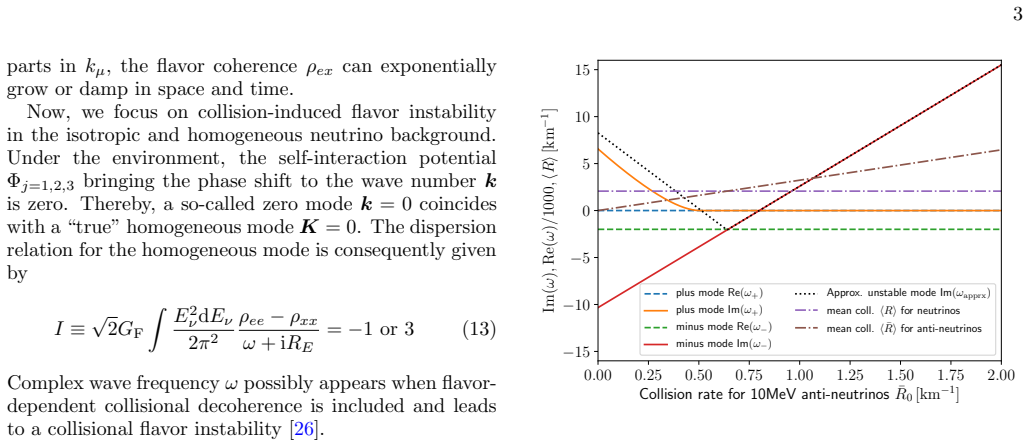
The central objects are the energy-dependent flavor polarization vectors $\mathbf{P}_E$ and $\bar{\mathbf{P}}_E$, whose equation of motion is $d_t\mathbf{P}=\mathbf{H}\times\mathbf{P}-R_E\mathbf{P}_\perp$, with the collision term truncated to the off-diagonal decoherence rate $R_E$. The argument runs through two tools. The first is the dispersion relation of the collisional flavor instability, $\int \frac{E^2 dE}{2\pi^2}\frac{\rho_{ee}-\rho_{xx}}{\omega+iR_E}=-1$ or $3$, whose unstable solutions split into a plus mode and a minus mode; the energy profile of the associated eigenvector $\tilde{Q}_E\propto(\rho_{ee}-\rho_{xx})/(\omega+iR_E)$ is flat for the minus mode and low-energy-peaked for the plus mode, which is what produces the opposite spectral monotonicity. The second is the low-energy flavor-pendulum limit, where sum and difference vectors $\mathbf{S}_E=\mathbf{P}_E+\bar{\mathbf{P}}_E$ and $\mathbf{D}_E=\mathbf{P}_E-\bar{\mathbf{P}}_E$ obey equations whose low-energy acceleration depends on $\mathbf{D}_{\rm int}\cdot\mathbf{S}_{E\sim0}$, with the sign of its time derivative set by the neutrino-antineutrino mean-collision-rate difference. That sign criterion is identical to the one selecting the dominant linear mode, so the pendulum calculation closes the loop between linear and nonlinear dynamics.
What would settle it
Repeat the multi-energy quantum-kinetic simulation for the plus-mode case ($\bar{R}_0=0.1$ km$^{-1}$) with the full collision term that includes the diagonal population-changing contributions; a disappearance or significant weakening of the low-energy full flavor swap would falsify the claimed mode-determined dichotomy in realistic conditions.
Extended reading notes
Core claim
Within a homogeneous, isotropic, two-flavor quantum kinetic equation that keeps only the flavor-decohering part of collisions, the paper shows that collision-induced flavor instability has two distinct unstable branches, called the plus and minus modes, and that the asymptotic state of CFC is mode-dependent rather than universal. For parameters where the minus mode dominates, the unstable eigenvector is nearly flat in neutrino energy; all energies grow together, and collisional decoherence then collapses the polarization vector most strongly where the collision rate is highest, so the highest-energy neutrinos settle at flavor equipartition while lower-energy neutrinos remain close to their initial states. For parameters where the plus mode dominates, the eigenvector is peaked at low energy; low-energy neutrinos saturate first and, being weakly coupled to the background, are driven by the collective self-interaction to a full flavor swap, while higher-energy neutrinos, arriving late to the nonlinear phase, undergo only partial conversion. The paper further derives a pendulum criterion: in the low-energy limit the sign of $d_t(\mathbf{D}_{\rm int}\cdot\mathbf{S}_{E\sim0})$ is controlled by the difference in mean collision rates between neutrinos and antineutrinos, and that sign determines whether weakly coupled neutrinos can cross the flavor-equipartition line. The same sign selects the dominant linear mode, tying the linear and nonlinear pictures together.
Load-bearing premise
The dichotomy depends on dropping the diagonal, population-changing part of the collision term, a truncation the paper itself says can modify the asymptotic behaviors when restored.
Editorial extensions
If this is right
- The asymptotic state of CFC cannot be captured by a single universal subgrid rule; a supernova or merger simulation must know which CFI mode dominates at each radius to predict final neutrino spectra.
- Collisional flavor swap can arise without the diagonal, population-changing collision terms and outside the resonance-like regime, whenever the plus mode grows fastest.
- The sign of the difference between mean neutrino and antineutrino collision rates, not just their overall size, controls whether weakly coupled neutrinos swap or return to their initial flavor.
- In plus-mode conditions the final spectra reverse the low-energy $\nu_e$/$\nu_x$ order compared with minus-mode conditions, giving an observable spectral signature of the underlying instability mode.
- Deep radii with low electron fraction, where neutrino and antineutrino opacities differ strongly, are the natural places for plus-mode CFC and flavor swap to become relevant.
Reading between the lines
- Beyond the paper, restoring the diagonal, population-changing collision terms may soften the sharp dichotomy, since the paper itself notes these terms alter the polarization-vector length and asymptotic behavior.
- Beyond the paper, the eigenvector structure offers a cheap way to classify the dominant mode in local simulations by looking at the energy-resolved growth of flavor coherence before nonlinear saturation.
- Beyond the paper, because mean collision rates vary with radius in realistic supernova profiles, a neutrino trajectory could cross the mode-switch condition more than once, producing alternating swap and equipartition zones rather than one global outcome.
- Beyond the paper, the low-energy pendulum criterion could be ported to three-flavor or mildly anisotropic neutrino gases, though such generalizations remain untested.
Editorial analysis
A structured set of objections, weighed in public.
Referee Report
Summary. The paper studies collisional neutrino-flavor conversion (CFC) in a homogeneous, isotropic, multi-energy neutrino gas with a collision term restricted to the off-diagonal flavor-decohering part. Linear stability analysis identifies two unstable modes, called plus and minus, whose dominance switches with the sign of the difference between neutrino and antineutrino mean collision rates. Numerical simulations for two representative antineutrino reaction rates show that the minus mode produces flavor equipartition at high energies while low-energy neutrinos return near their initial states, whereas the plus mode produces a full flavor swap at low energies and weaker conversion at high energies. The paper presents two explanations for this spectral dichotomy: an eigenvector analysis of the unstable modes and a flavor-pendulum model. The authors conclude that the sign of the collision-rate asymmetry selects between equipartition and swap and suggest that CFC with flavor swap can be important at deeper radii in supernovae and merger remnants.
Significance. If the claimed dichotomy survives a more complete treatment of collisions, the paper would be an important step toward subgrid modeling of CFC: it shows that the asymptotic spectral pattern is selected not merely by the overall collision strength but by which linear mode dominates, which is controlled by the sign of the mean collision-rate asymmetry. The paper's strengths are the clear linear-stability criterion, the explicit eigenvector formula that matches the energy-dependent growth seen in the simulations, and the fact that the numerical findings are presented in enough detail to be reproduced. The pendulum explanation, while heuristic, is consistent with the numerics and provides an intuitive picture. The central limitation is that the collision term (Eq. 4) drops all diagonal population-changing terms, and the paper's own Section V concedes that these can modify the asymptotic behavior; the astrophysical extrapolation in the abstract is therefore not yet supported by the present model.
major comments (3)
- [Sec. II.A, Eq. (4) and Sec. V] The central dichotomy is established only for the truncated collision term C[ρ] = −R_E ρ_ex (Eq. 4), which drops all diagonal population-changing terms. The paper's own Sec. V states that including the diagonal components "can also modify the asymptotic behaviors of CFC because it changes the length of the polarization vector" and that a previously reported collisional flavor swap in the resonance-like regime required those diagonal terms. The new claim is precisely that a swap can arise from off-diagonal decoherence alone in the plus mode, and the abstract extrapolates this to "deeper radii" in CCSNe and BNSM remnants, where the physical collision operator includes emission, absorption, and inelastic-scattering terms. These terms change P0 and P3 rather than only the transverse components, so they alter the first term (D_int·S_E~0)D_int_z in Eq. (31) and can prevent low-energy polarization vectors from crossing the equipartition plane. Without a numerical test with the full collision operator, or at least an explicit caveat that the astrophysical conclusion is conditional on the truncation, the abstract's statement that "CFC with flavor swap can become crucial at deeper radii" is not supported by the present simulations.
- [Sec. IV.B, Eqs. (29)-(31)] The flavor-pendulum derivation uses two uncontrolled approximations: the factorization ⟨R_E S_E⟩ ≈ ⟨R_E⟩ S_int in Eq. (29) and the condition μ >> R_E in going from Eq. (29) to Eq. (30). Because R_E is strongly energy dependent (∝ E^2) and the polarization vectors S_E are energy dependent, the factorization neglects correlations that may matter in the multi-energy regime. The numerical result in Fig. 9 is consistent with the sign argument, so the pendulum picture is plausible, but as written the derivation is not a rigorous independent explanation. I ask the authors to either quantify the error of these approximations (for example, by evaluating the neglected terms from the simulation data) or to label the pendulum discussion as a heuristic consistency check rather than a derivation.
- [Sec. III, Figs. 2-4] The claim that the sign of the mean collision-rate asymmetry selects between equipartition and swap is based on only two simulations, Rbar0 = 1 and 0.1 km^-1. Figure 1 shows a continuous variation of the growth rates with Rbar0, and the physical mechanism in Secs. IV.A and IV.B suggests a transition near ⟨R_E⟩ = ⟨Rbar_E⟩, but no simulation at intermediate values is presented. A scan over Rbar0/R0 would establish whether the asymptotic state actually switches at the mode crossing and whether the behavior is a clean dichotomy or a gradual crossover. Without such a scan, the criterion stated in the abstract is an extrapolation from two points.
minor comments (5)
- [Sec. I] The text contains several typographical errors, including "behaviros" and "FInally", which should be corrected to "behaviors" and "Finally".
- [Sec. II.B] "dimentions" should be "dimensions" in the sentence beginning "We restore the dimentions in phase space."
- [Fig. 4 and Sec. III] The figure caption uses "¯R_E = 0.1" while the model definition in Eq. (19) uses "¯R_0"; the notation should be harmonized to avoid confusion.
- [Sec. II.A, Eq. (21)] The expression for P_ex uses P_0, but the text earlier states that the initial value of P_3 is set to unity; please clarify the normalization of P_0 in Eq. (5) and how it relates to the occupation-number difference in the two-flavor framework.
- [Sec. III] No convergence test is reported for the numerical solutions of Eq. (6); a short statement on time-step and energy-grid convergence would strengthen confidence in the asymptotic spectra shown in Figs. 4 and 6.
Circularity Check
No significant circularity: the linear-stability and pendulum analyses are derived independently of the nonlinear simulation outcomes, and the modeling limitations stated in Sec. V do not reduce the central claim to its inputs.
full rationale
The paper's central claim, that the asymptotic state of collisional neutrino-flavor conversion is mode-dependent, rests on three independent pieces: (i) the linear stability analysis yielding the approximate growth rates of the plus and minus modes (Eqs. 14-17), (ii) the nonlinear simulations shown in Figs. 2-6, and (iii) the pendulum model of Sec. IV.B. The eigenvector formula (Eq. 24) is derived from the dispersion relation, not from the simulated asymptotic states, and the pendulum criterion (Eqs. 31-32) uses the same mean collision rates that define the linear modes without fitting any parameter to the nonlinear results. The statement that the outcome is 'determined by the magnitude of mean collision rates... that is, the dominant growing modes' is an explanatory identification between a linear-theory predictor and the observed nonlinear outcome, not a circular definition. The self-citations in the paper (e.g., Refs. [54, 56]) concern approximations that are re-derived in the text, and they are not load-bearing in the sense of substituting for the present derivation. The only serious limitation is the truncated collision term C[rho] = -R_E rho_ex (Eq. 4), which drops all diagonal population-changing terms; the paper explicitly acknowledges in Sec. V that adding these terms 'can also modify the asymptotic behaviors of CFC because it changes the length of the polarization vector.' This is a scope restriction and a robustness concern, not a circularity: the equipartition-versus-swap dichotomy is demonstrated within the stated model, and the admitted sensitivity to diagonal collisions is presented as an open issue rather than hidden. No fitted parameter is renamed as a prediction, and no uniqueness claim is imported from prior work by the same authors. Therefore the derivation chain is self-contained and no circular step is present.
Assumptions & free parameters
free parameters (5)
- antineutrino reaction rate Rbar0 =
1 and 0.1 km^-1 (two runs)
- energy power of collision rates =
2 (E^2 scaling)
- self-interaction strength mu0 =
10^4 km^-1
- initial perturbation amplitude =
10^-3
- initial neutrino temperatures and asymmetry =
T_nue = 4 MeV, T_antinue = 5 MeV, alpha_asym = 0.8
assumptions (6)
- domain assumption Collision term contains only off-diagonal parts (flavor decoherence); diagonal population-changing terms are neglected.
- domain assumption Neutrino gas is isotropic and homogeneous.
- standard math Neutrino self-interactions follow the mean-field Hamiltonian with no many-body corrections.
- domain assumption Initial state contains only electron-type neutrinos and antineutrinos.
- ad hoc to paper Approximation <R_E S_E> ≈ <R_E> S_int and condition mu >> R_E in the pendulum derivation.
- domain assumption Eigenvector analysis from linear theory is used to interpret nonlinear asymptotic states.
Cite this review
Pith. "Pith review of Spectral diversity in collisional neutrino-flavor conversion: flavor equipartition or swap." pith.science (2026). https://pith.science/paper/VRQOVLGY
@misc{pith2026250209260,
  author       = {Pith},
  title        = {Pith review of: Spectral diversity in collisional neutrino-flavor conversion: flavor equipartition or swap},
  year         = {2026},
  howpublished = {\url{https://pith.science/paper/VRQOVLGY}},
  note         = {Machine review of arXiv:2502.09260}
}
read the original abstract
Quantum kinetics of neutrinos are known to potentially change the classical neutrino radiation field in high-energy astrophysical sources such as core-collapse supernovae and binary neutron-star mergers. However, the mixing phenomena still have open issues in the nonlinear dynamics and the asymptotic states, particularly for recently discovered collision-induced flavor conversion. In this paper, we investigate linear and nonlinear dynamics of collisional neutrino-flavor conversion (CFC) with multi-energy neutrino gases through numerical simulations, demonstrating that the asymptotic states dramatically change depending on unstable modes dominating the system. In one unstable mode, high-energy neutrinos reach a flavor equipartition, but low-energy neutrinos return back to almost their initial states. In contrast, in the other one, rather low-energy neutrinos achieve a full flavor swap, but high-energy neutrinos undergo less flavor conversion. We clarify the distinct spectral behaviors in two different ways based on stability analysis and flavor pendulum. Our result suggests that CFC with flavor swap can become crucial at deeper radii with low electron fraction and requires more detailed theoretical modeling of neutrino quantum kinetics.
Figures


Figures from the paper (4 more)


Forward citations
Cited by 2 Pith papers
-
Predicting the outcome of collisional neutrino flavor conversion
Collisional neutrino flavor instabilities settle into a state at the edge of instability with nonzero flavor coherence, and explicit formulas predict this final state.
-
Comparative Testing of Subgrid Models for Fast Neutrino Flavor Conversions in Core-collapse Supernova Simulations
A 1D supernova simulation with four-species BGK subgrid modeling shows that three-species assumptions overestimate flavor conversion and that semi-implicit time integration is the most reliable.
Reference graph
Works this paper leans on
-
[1]
G. Sigl and G. Raffelt, General kinetic description of rel- ativistic mixed neutrinos, Nuclear Physics B 406, 423 (1993)
work page 1993
-
[2]
H. Duan, G. M. Fuller, and Y.-Z. Qian, Collective Neu- trino Oscillations, Annual Review of Nuclear and Particle Science 60, 569 (2010)
work page 2010
-
[3]
I. Tamborra and S. Shalgar, New Developments in Fla- vor Evolution of a Dense Neutrino Gas, Annual Review of Nuclear and Particle Science 10.1146/annurev-nucl- 102920-050505 (2021)
-
[4]
S. Richers and M. Sen, Fast Flavor Transformations, in Handbook of Nuclear Physics, edited by I. Tanihata, H. Toki, and T. Kajino (Springer Nature, Singapore,
-
[5]
M. C. Volpe, Neutrinos from dense environments: Flavor mechanisms, theoretical approaches, observations, and new directions, Reviews of Modern Physics 96, 025004 (2024)
work page 2024
-
[6]
T. Fischer, G. Guo, K. Langanke, G. Mart ´ ınez-Pinedo, Y.-Z. Qian, and M.-R. Wu, Neutrinos and nucleosynthe- sis of elements, Progress in Particle and Nuclear Physics 137, 104107 (2024)
work page 2024
- [7]
-
[8]
B. Dasgupta, A. Mirizzi, and M. Sen, Fast neutrino flavor conversions near the supernova core with realistic flavor- dependent angular distributions, Journal of Cosmology and Astroparticle Physics 2017 (02), 019
work page 2017
Show all 62 references
-
[9]
Abbar, H
S. Abbar, H. Duan, K. Sumiyoshi, T. Takiwaki, and M. C. Volpe, Fast neutrino flavor conversion modes in multidimensional core-collapse supernova models: The role of the asymmetric neutrino distributions, Physical Review D 101, 043016 (2020)
2020
-
[10]
Nagakura, A
H. Nagakura, A. Burrows, L. Johns, and G. M. Fuller, Where, when, and why: Occurrence of fast-pairwise collective neutrino oscillation in three-dimensional core- collapse supernova models, Physical Review D 104, 083025 (2021)
2021
-
[11]
Akaho, J
R. Akaho, J. Liu, H. Nagakura, M. Zaizen, and S. Ya- mada, Collisional and fast neutrino flavor instabilities in two-dimensional core-collapse supernova simulation with Boltzmann neutrino transport, Physical Review D 109, 023012 (2024)
2024
-
[12]
Wu and I
M.-R. Wu and I. Tamborra, Fast neutrino conversions: Ubiquitous in compact binary merger remnants, Physical Review D 95, 103007 (2017)
2017
-
[13]
George, M.-R
M. George, M.-R. Wu, I. Tamborra, R. Ardevol-Pulpillo, and H.-T. Janka, Fast neutrino flavor conversion, ejecta properties, and nucleosynthesis in newly-formed hyper- massive remnants of neutron-star mergers, Physical Re- view D 102, 103015 (2020)
2020
-
[14]
Richers, Evaluating approximate flavor instability metrics in neutron star mergers, Physical Review D 106, 083005 (2022)
S. Richers, Evaluating approximate flavor instability metrics in neutron star mergers, Physical Review D 106, 083005 (2022)
2022
-
[15]
O. Just, S. Abbar, M.-R. Wu, I. Tamborra, H.-T. Janka, and F. Capozzi, Fast neutrino conversion in hydrody- namic simulations of neutrino-cooled accretion disks, Physical Review D 105, 083024 (2022)
2022
-
[16]
Grohs, S
E. Grohs, S. Richers, S. M. Couch, F. Foucart, J. Froustey, J. P. Kneller, and G. C. McLaughlin, Two- moment Neutrino Flavor Transformation with Applica- tions to the Fast Flavor Instability in Neutron Star Merg- ers, The Astrophysical Journal 963, 11 (2024)
2024
-
[17]
Froustey, S
J. Froustey, S. Richers, E. Grohs, S. D. Flynn, F. Foucart, J. P. Kneller, and G. C. McLaughlin, Neutrino fast flavor oscillations with moments: Linear stability analysis and application to neutron star mergers, Physical Review D 109, 043046 (2024)
2024
-
[18]
Li and D
X. Li and D. M. Siegel, Neutrino Fast Flavor Conver- sions in Neutron-Star Postmerger Accretion Disks, Phys- ical Review Letters 126, 251101 (2021)
2021
-
[19]
Fern´ andez, S
R. Fern´ andez, S. Richers, N. Mulyk, and S. Fahlman, Fast flavor instability in hypermassive neutron star disk outflows, Physical Review D 106, 103003 (2022)
2022
-
[20]
Ehring, S
J. Ehring, S. Abbar, H.-T. Janka, G. Raffelt, and I. Tam- borra, Fast neutrino flavor conversion in core-collapse su- pernovae: A parametric study in 1D models, Physical Review D 107, 103034 (2023)
2023
-
[21]
Ehring, S
J. Ehring, S. Abbar, H.-T. Janka, G. Raffelt, and I. Tamborra, Fast Neutrino Flavor Conversions Can Help and Hinder Neutrino-Driven Explosions, Physical Review Letters 131, 061401 (2023)
2023
-
[22]
Ehring, S
J. Ehring, S. Abbar, H.-T. Janka, G. Raffelt, K. Naka- mura, and K. Kotake, Gravitational-Wave Signatures of Nonstandard Neutrino Properties in Collapsing Stellar Cores (2024), arXiv:2412.02750 [astro-ph]
2024
-
[23]
Nagakura and K
H. Nagakura and K. Sumiyoshi, Neutron star kick driven by asymmetric fast-neutrino flavor conversion (2024), arXiv:2401.15180 [astro-ph, physics:gr-qc, physics:hep- ph]
2024 arXiv
-
[24]
K. Mori, T. Takiwaki, K. Kotake, and S. Horiuchi, Three- dimensional core-collapse supernova models with phe- nomenological treatment of neutrino flavor conversions (2025), arXiv:2501.15256 [astro-ph]
2025 arXiv
-
[25]
R. F. Sawyer, Multiangle instability in dense neutrino systems, Physical Review D 79, 105003 (2009)
2009
-
[26]
Johns, Collisional Flavor Instabilities of Supernova Neutrinos, Physical Review Letters 130, 191001 (2023)
L. Johns, Collisional Flavor Instabilities of Supernova Neutrinos, Physical Review Letters 130, 191001 (2023). 12
2023
-
[27]
Bhattacharyya and B
S. Bhattacharyya and B. Dasgupta, Fast Flavor Depolar- ization of Supernova Neutrinos, Physical Review Letters 126, 061302 (2021)
2021
-
[28]
Bhattacharyya and B
S. Bhattacharyya and B. Dasgupta, Elaborating the ul- timate fate of fast collective neutrino flavor oscillations, Physical Review D 106, 103039 (2022)
2022
-
[29]
M.-R. Wu, M. George, C.-Y. Lin, and Z. Xiong, Collec- tive fast neutrino flavor conversions in a 1D box: Initial conditions and long-term evolution, Physical Review D 104, 103003 (2021)
2021
-
[30]
Zaizen and H
M. Zaizen and H. Nagakura, Characterizing quasis- teady states of fast neutrino-flavor conversion by stability and conservation laws, Physical Review D 107, 123021 (2023)
2023
-
[31]
Zaizen and H
M. Zaizen and H. Nagakura, Simple method for deter- mining asymptotic states of fast neutrino-flavor conver- sion, Physical Review D 107, 103022 (2023)
2023
-
[32]
Xiong, M.-R
Z. Xiong, M.-R. Wu, S. Abbar, S. Bhattacharyya, M. George, and C.-Y. Lin, Evaluating approximate asymptotic distributions for fast neutrino flavor conver- sions in a periodic 1D box, Physical Review D 108, 063003 (2023)
2023
-
[33]
George, Z
M. George, Z. Xiong, M.-R. Wu, and C.-Y. Lin, Evolution and the quasistationary state of collective fast neutrino flavor conversion in three dimensions without axisymme- try, Physical Review D 110, 123018 (2024)
2024
-
[34]
Nagakura, M
H. Nagakura, M. Zaizen, J. Liu, and L. Johns, Resolution requirements for numerical modeling of neutrino quan- tum kinetics, Physical Review D 111, 043028 (2025)
2025
-
[35]
Nagakura and M
H. Nagakura and M. Zaizen, Time-Dependent and Qua- sisteady Features of Fast Neutrino-Flavor Conversion, Physical Review Letters 129, 261101 (2022)
2022
-
[36]
Nagakura, Global features of fast neutrino-flavor con- version in binary neutron star mergers, Physical Review D 108, 103014 (2023)
H. Nagakura, Global features of fast neutrino-flavor con- version in binary neutron star mergers, Physical Review D 108, 103014 (2023)
2023
-
[37]
Shalgar and I
S. Shalgar and I. Tamborra, Neutrino flavor conversion, advection, and collisions: Toward the full solution, Phys- ical Review D 107, 063025 (2023)
2023
-
[38]
Xiong, M.-R
Z. Xiong, M.-R. Wu, M. George, C.-Y. Lin, N. K. Largani, T. Fischer, and G. Mart ´ ınez-Pinedo, Fast neu- trino flavor conversions in a supernova: Emergence, evolution, and effects, Physical Review D 109, 123008 (2024)
2024
-
[39]
Nagakura, Roles of Fast Neutrino-Flavor Conversion on the Neutrino-Heating Mechanism of Core-Collapse Su- pernova, Physical Review Letters 130, 211401 (2023)
H. Nagakura, Roles of Fast Neutrino-Flavor Conversion on the Neutrino-Heating Mechanism of Core-Collapse Su- pernova, Physical Review Letters 130, 211401 (2023)
2023
-
[40]
Zaizen and H
M. Zaizen and H. Nagakura, Fast neutrino-flavor swap in high-energy astrophysical environments, Physical Review D 109, 083031 (2024)
2024
-
[41]
D. F. G. Fiorillo and G. G. Raffelt, Fast Flavor Conver- sions at the Edge of Instability in a Two-Beam Model, Physical Review Letters 133, 221004 (2024)
2024
-
[42]
J. Liu, H. Nagakura, M. Zaizen, L. Johns, R. Akaho, and S. Yamada, Quasisteady evolution of fast neutrino-flavor conversions, Physical Review D 111, 023051 (2025)
2025
-
[43]
J. D. Martin, J. Carlson, V. Cirigliano, and H. Duan, Fast flavor oscillations in dense neutrino media with collisions, Physical Review D 103, 063001 (2021)
2021
-
[44]
Shalgar and I
S. Shalgar and I. Tamborra, Change of direction in pair- wise neutrino conversion physics: The effect of collisions, Physical Review D 103, 063002 (2021)
2021
-
[45]
C. Kato, H. Nagakura, and T. Morinaga, Neutrino Trans- port with the Monte Carlo Method. II. Quantum Kinetic Equations, The Astrophysical Journal Supplement Series 257, 55 (2021)
2021
-
[46]
Kato and H
C. Kato and H. Nagakura, Effects of energy-dependent scatterings on fast neutrino flavor conversions, Physical Review D 106, 123013 (2022)
2022
-
[47]
Sasaki and T
H. Sasaki and T. Takiwaki, A detailed analysis of the dynamics of fast neutrino flavor conversions with scat- tering effects, Progress of Theoretical and Experimental Physics 2022, 073E01 (2022)
2022
-
[48]
R. S. L. Hansen, S. Shalgar, and I. Tamborra, Enhance- ment or damping of fast neutrino flavor conversions due to collisions, Physical Review D 105, 123003 (2022)
2022
-
[49]
Johns and H
L. Johns and H. Nagakura, Self-consistency in models of neutrino scattering and fast flavor conversion, Physical Review D 106, 043031 (2022)
2022
-
[50]
Padilla-Gay, I
I. Padilla-Gay, I. Tamborra, and G. G. Raffelt, Neutrino fast flavor pendulum. II. Collisional damping, Physical Review D 106, 103031 (2022)
2022
-
[51]
D. F. G. Fiorillo, I. Padilla-Gay, and G. G. Raffelt, Colli- sions and collective flavor conversion: Integrating out the fast dynamics, Physical Review D 109, 063021 (2024)
2024
-
[52]
Delfan Azari, H
M. Delfan Azari, H. Sasaki, T. Takiwaki, and H. Okawa, Systematic Local Simulations of Fast Neutrino Flavor Conversions with Scattering Effects, Progress of Theo- retical and Experimental Physics 2024, 103E01 (2024)
2024
-
[53]
Xiong, L
Z. Xiong, L. Johns, M.-R. Wu, and H. Duan, Collisional flavor instability in dense neutrino gases, Physical Review D 108, 083002 (2023)
2023
-
[54]
J. Liu, M. Zaizen, and S. Yamada, Systematic study of the resonancelike structure in the collisional flavor in- stability of neutrinos, Physical Review D 107, 123011 (2023)
2023
-
[55]
J. Liu, R. Akaho, A. Ito, H. Nagakura, M. Zaizen, and S. Yamada, Universality of the neutrino collisional flavor instability in core-collapse supernovae, Physical Review D 108, 123024 (2023)
2023
-
[56]
Lin and H
Y.-C. Lin and H. Duan, Collision-induced flavor instabil- ity in dense neutrino gases with energy-dependent scat- tering, Physical Review D 107, 083034 (2023)
2023
-
[57]
Johns and S
L. Johns and S. Rodriguez, Collisional flavor pen- dula and neutrino quantum thermodynamics (2023), arXiv:2312.10340 [astro-ph, physics:hep-ph]
2023 arXiv
-
[58]
Xiong, M.-R
Z. Xiong, M.-R. Wu, G. Mart ´ ınez-Pinedo, T. Fischer, M. George, C.-Y. Lin, and L. Johns, Evolution of colli- sional neutrino flavor instabilities in spherically symmet- ric supernova models, Physical Review D 107, 083016 (2023)
2023
-
[59]
Also, in the bottom panel, the flavor coherence first undergoes linear damping isoenergetically, and then exponential growth with some energy spreading occurs
in the case with a resonance-like CFI. Also, in the bottom panel, the flavor coherence first undergoes linear damping isoenergetically, and then exponential growth with some energy spreading occurs. The behaviors can be understood through the unstable modes in the lin- ear reg...
-
[60]
C. Kato, H. Nagakura, and L. Johns, Collisional flavor swap with neutrino self-interactions, Physical Review D 109, 103009 (2024)
2024
-
[61]
Izaguirre, G
I. Izaguirre, G. Raffelt, and I. Tamborra, Fast Pairwise Conversion of Supernova Neutrinos: A Dispersion Re- lation Approach, Physical Review Letters 118, 021101 (2017)
2017
-
[62]
A. B. Balantekin, M. J. Cervia, A. V. Patwardhan, E. Rrapaj, and P. Siwach, Quantum information and quantum simulation of neutrino physics, The European Physical Journal A 59, 186 (2023)
2023
Reviewed August 7, 2026 · model on record in the stance chip above.
Discussion (0). Continue with ORCID to comment.