REVIEW 3 major objections 5 minor 2 cited by
Variability of X-ray polarization of Cyg X-1
T0 review · 3 major / 5 minor · reviewed 2026-08-15 · deepseek-v4-flash
Pith's one-line read Cyg X-1's X-ray polarization doubles when the source turns hard.
desk verdict The hard/soft PD difference and PD-energy trend are robust and worth citing; the orbital PA loop is a real but marginal detection that the abstract overstates. read the letter →
The pith
A machine-rendered reading of the paper's core claim, the machinery that carries it, and where it could break.
The reading
What carries the argument
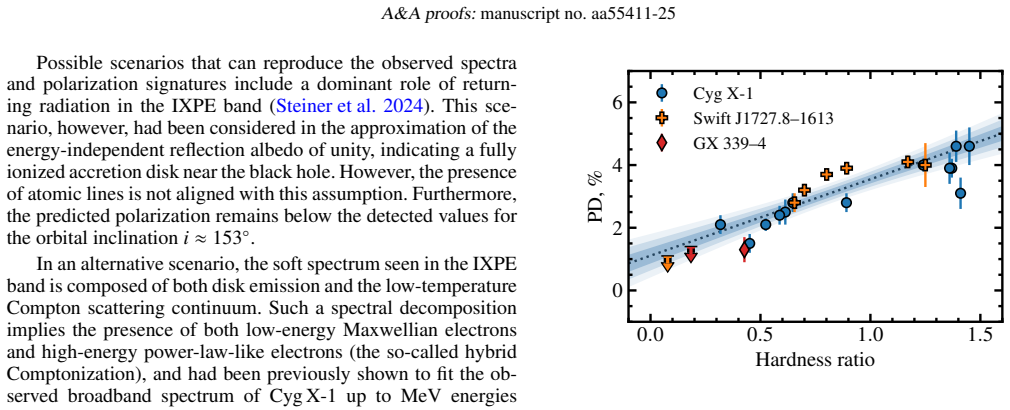
The load-bearing object is the trajectory traced by the normalized Stokes parameters $(q,u)$ over the 5.6-day orbit. After subtracting an epoch-average center, the residual vector's polarization angle is tested against a linear model in orbital phase, a rotating-vector model in which a full 360-degree loop in the $(q,u)$-plane corresponds to 180 degrees of polarization-angle rotation; significance is assessed with the non-Gaussian likelihood for polarization angles. The state dependence is quantified by fitting polarization degree as a linear function of the IXPE 4-8 keV / 2-4 keV hardness ratio, and the energy dependence by comparing constant-polarization-degree fits to linearly increasing fits in 2-8 keV bins.
What would settle it
Re-observe Cyg X-1 in the hard state several times a year apart, each time covering a full 5.6-day orbit, and fit the $(q,u)$ loop center independently for every epoch. If the centers differ by more than their combined statistical errors, the fixed-center rotating-vector model cannot describe the full campaign, and the claimed one-loop counterclockwise orbital rotation would not be a stable property of the source.
Extended reading notes
Core claim
The central claim is that the X-ray polarization of Cyg X-1 is a state-dependent quantity with a stable geometry. Across 13 Imaging X-ray Polarimetry Explorer observations spread over 2022-2024, the polarization degree changes from about 4.0% in hard states to about 2.2% in soft states and correlates linearly with spectral hardness (Pearson r=0.92), while the polarization angle remains near -25 degrees, aligned with the radio jet, in every state and at every energy. The rise of polarization degree with energy is statistically significant in both states. In the hard state, phase-resolved analysis shows a closed one-loop trajectory in the $(q,u)$-plane with a counterclockwise rotation of the polarization angle by 180 degrees per orbit, significant at roughly 4 sigma for the full-orbit Epoch 1; the authors interpret this as scattering of the X-ray emission at intrabinary structure rather than a change in the inner flow orientation. No superorbital signal is found at 294 days, with an upper limit of about 5 degrees on polarization-angle variations, and first radio polarization detections give a jet-aligned angle with a fivefold polarization-degree rise during the soft-state transition.
Load-bearing premise
The orbital-variability result assumes the center of the $(q,u)$ loop measured from the single 2022 full-orbit observation stays fixed for all later hard-state observations, so that any residual rotation is assigned to orbital phase rather than to slow drift of the average polarization over years.
Editorial extensions
If this is right
- A linear polarization-degree/hardness relation means polarization measurements can track the spectral state continuously, and models that require an abrupt change in the X-ray emitting geometry at the state transition are disfavored.
- Energy-dependent polarization degree with a constant angle across 2-8 keV tightens upper limits on Faraday rotation and on the large-scale magnetic field in the X-ray emitting region.
- The alignment of X-ray, optical, and radio polarization angles with the jet implies a common projected geometry from the inner accretion flow out to the jet, including a predominantly toroidal magnetic field in the radio-emitting part.
- The absence of superorbital angle swings above about 5 degrees rules out the earlier suggestion that a 15-20 degree precession tilt of the inner flow explains the high hard-state polarization degree.
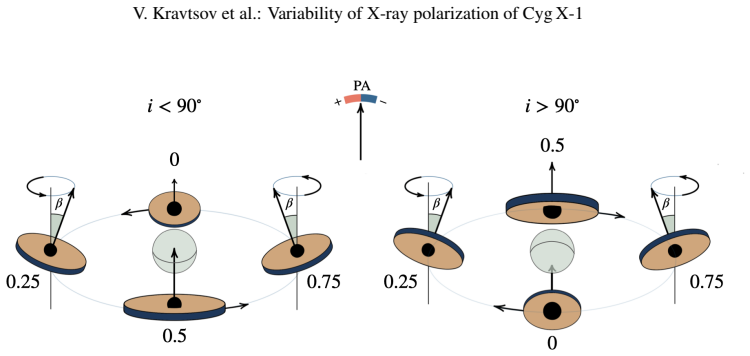
- A single counterclockwise loop per orbit in X-rays, against two clockwise loops in optical polarization, points to different origins for the two bands: scattering at intrabinary material for X-rays rather than the disk-scattering geometry that drives the optical signal.
Reading between the lines
- If the polarization-degree/hardness correlation holds as a universal relation across black hole X-ray binaries, a single IXPE pointing with a hardness measurement could serve as a proxy for the full polarimetric state, sidestepping long monitoring campaigns.
- The apparent anti-correlation between X-ray and radio polarization degree across the hard-to-soft transition, if confirmed with simultaneous data, suggests the jet's synchrotron emission becomes increasingly polarized exactly as the coronal X-ray polarization weakens; a dedicated transition campaign could test whether the two respond to the same geometric change.
- The model that invokes scattering at intrabinary structure predicts a phase-dependent polarized signal that should also appear in the soft state, diluted by the stronger disk or returning-radiation component; searching for a small orbital loop in soft-state phase-resolved data would test this origin.
- If high-order Compton scattering dominates the hard-state IXPE band, the polarization-degree rise should flatten above about 8 keV as polarization saturates; a future polarimeter with sensitivity at higher energies could distinguish this from the low-scattering-order scenario proposed here.
Signed reviews
Editorial analysis
A structured set of objections, weighed in public.
Referee Report
Summary. The manuscript reports a three-year multiwavelength polarimetric campaign of Cyg X-1, comprising 13 IXPE pointings in 2022-2024 plus optical (DIPol, RoboPol) and radio (VLA, RATAN-600, AMI) monitoring. The main X-ray results are: (i) a state-dependent polarization degree, about 4.0% in the hard state and about 2.2% in the soft state; (ii) a statistically significant increase of PD with photon energy in both states; (iii) a strong correlation (r=0.92) between PD and the 4-8/2-4 keV hardness ratio; (iv) a PA that is independent of spectral state and photon energy and aligned with the radio jet; (v) possible orbital-phase-dependent PA variation in the hard state that is statistically significant mainly for the single full-orbit Epoch 1; and (vi) no detected superorbital variability at P_so=294 d. The authors interpret the orbital signal, if real, as scattering at intrabinary structure, and discuss implications for the geometry of the X-ray-emitting region.
Significance. If the central results hold, this is an important dataset: it is the first multi-epoch X-ray polarimetric campaign covering state transitions in a persistent black hole X-ray binary, and the energy-dependent PD and the PD-hardness correlation will provide strong constraints on Comptonization and disk geometries. The alignment of the PA across radio, optical, and X-ray bands and the cross-source comparison with Swift J1727.8-1613 and GX 339-4 are valuable additions. The analysis is generally careful, including the use of the proper PA probability density of Naghizadeh-Khouei & Clarke for the phase-resolved PA fits. The state-dependent PD and energy-dependent PD results are on solid statistical footing. The orbital variability claim is the least secure part of the paper: the all-epoch evidence is marginal and rests on a loop-center constancy assumption that the authors themselves flag as potentially wrong.
major comments (3)
- [Abstract and §3.2] The abstract states 'We find significant orbital changes of PA in the hard state' and attributes them to intrabinary scattering, but the evidence presented in §3.2 is marginal for the full sample: the F-test in §3.2.1 gives p=0.048, and the Monte-Carlo significance for the all-epoch rotating-vector linear-PA model in §3.2.2 is 5.2%. The strong significance is obtained only for Epoch 1 after subtracting the Epoch-1 average (q,u) as the loop center. The authors themselves note in §3.2.2 that the low all-epoch significance 'may result from our assumption that the center of the loop in the (q,u)-plane remains constant over several years of observation.' The orbital variability should therefore be described as tentative or Epoch-1-specific in the abstract and in Section 5, not as a firm detection.
- [Abstract and §4.1] The abstract states that the orbital changes are 'attributed to scattering of X-ray emission at the intrabinary structure,' but §4.1 concludes, after considering the precession scenario and the intrabinary-scattering scenario, that 'further quantitative study is needed to draw conclusions on the applicability of this scenario.' This is an unsupported causal attribution as written. The abstract and summary should be reworded to say that the orbital variability, if real, is consistent with intrabinary scattering, or that this scenario requires further quantitative study.
- [§3.2.2] The claimed 3-4σ significance for Epoch 1 is obtained after subtracting the mean Stokes parameters ⟨q⟩ and ⟨u⟩ that are computed from the same ten Epoch-1 phase bins. This center-subtraction step introduces a statistical correlation between the residuals, and the Monte-Carlo test described in the text (randomly distributing 10 PAs and fitting the linear model) does not appear to simulate the full Stokes measurement and center-subtraction procedure. The reported Epoch-1 significance should be confirmed with a Monte-Carlo that generates q,u data from the null hypothesis (constant q,u with the observed errors), estimates the center from the simulated data, and then repeats the PA fit and model comparison. This is load-bearing because the Epoch-1 result is the strongest evidence for orbital variability.
minor comments (5)
- [§3.2.1] The F-test in §3.2.1 is performed for a model that assumes equal amplitudes r_v for q and u and a fixed π/2 phase offset. The authors should state whether relaxing these restrictions (e.g., allowing an elliptical loop) changes the conclusion, or explicitly justify the circular-loop ansatz.
- [§3.2.2] The description of the Monte-Carlo test for the rotating-vector model should specify the number of trials, whether the slope of the linear model is fixed at 1/2 or fitted, and whether the loop-center subtraction is included in the simulation.
- [§4.1] The units and definition of μ in the precessing-disk toy model are unclear. As written, with i=153° and PDmax=0.37%, the formula PD=PDmax(1-μ) gives a PD of order 0.7% for μ=cos(153°), not the 3-5% PD shown in Fig. 5. If μ is meant to be |cos i| and PDmax is meant to be 0.37 (dimensionless), this should be stated explicitly.
- [Various] Minor editorial issues: 'hard-sate' in §3.1 should be 'hard-state'; the caption of Fig. 5 contains 'of of'; 'χ²/dof=33/12' should be 'χ²/d.o.f.=33/12'; and the quantity exp(-ΔlogL/2)=0.09 in §3.2.2 is a p-value-like quantity and should be labeled as such.
- [Fig. 10 and §4.2] The hardness ratio definition changes in Fig. 10 (energy-flux ratio 4-8 keV/2-4 keV) from the photon-flux ratio used earlier in the paper. This is stated in the text, but the figure caption should also flag the definition change so that readers do not compare the two hardness scales directly.
Circularity Check
No significant circularity: the paper's central results are direct IXPE measurements with stated statistical tests, and the few fitted models are transparently labeled as fits rather than predictions.
full rationale
The main claims—state-dependent X-ray polarization degree, PD increasing with energy, PA alignment with the jet, and the PD–hardness correlation—are direct measurements from IXPE data analyzed with standard tools (xpbintool, PCUBE, energy-binned extraction). No parameter is fitted to a subset of data and then presented as a prediction of a closely related quantity. The PD–hardness relation is a descriptive linear fit to the measured points, not a derived theoretical result, so it does not reduce to its inputs by construction. The orbital-variability analysis is the only place where a fitted quantity is reused: the (q,u) loop center is computed from Epoch 1 data and then subtracted from the same Epoch 1 data to define the variable polarization angle. This is a genuine statistical caveat, and the authors explicitly acknowledge it: 'The low significance of the linear trend is influenced by the outlier (Epoch 11), and may result from our assumption that the center of the loop in the (q,u)-plane remains constant over several years of observation.' However, subtracting a mean does not by itself force the observed ordered 180-degree rotation of PA_v; the Monte-Carlo test for random polarization angles would not produce the favorable log-likelihood unless the phase ordering were real. The high Epoch-1 significance may be somewhat overconfident because the two center parameters are effectively fitted on the same data, but this is a statistical overfitting/robustness concern, not a by-construction equivalence. Similarly, the precessing-disk model in Sect. 4.1 is fitted to the same orbital-loop data it is used to interpret, and the authors state that the intrabinary-scattering attribution needs 'further quantitative study'; this is model interpretation with acknowledged uncertainty, not circularity. Self-citations (e.g., Kravtsov et al. 2023 for ISM correction and optical polarization behavior) are contextual calibration or comparisons and are not load-bearing for the central X-ray state-dependent results, which are self-contained against the IXPE measurements. The abstract's wording that orbital PA changes are 'significant' is stronger than the all-epoch statistics justify, but overstatement of a marginal result is not circular reasoning.
Assumptions & free parameters
free parameters (4)
- Hardness threshold between hard and soft states =
0.4 (adopted)
- Variable-component amplitude r_v =
not quoted
- PDmax in precessing-disk model =
0.37%
- Tilt angle beta in precessing-disk model =
2 deg
assumptions (8)
- standard math Standard error propagation and Gaussian statistics apply to the measured Stokes parameters and to the F-test and likelihood ratio comparisons.
- domain assumption IXPE instrumental calibration and background subtraction are correct for all 13 pointings.
- domain assumption The interstellar polarization correction for the optical data (Table 2 of Kravtsov et al. 2023) is accurate.
- domain assumption The IXPE hardness ratio (4-8 keV / 2-4 keV) is a valid tracer of the accretion spectral state.
- ad hoc to paper The center of the (q,u) loop is constant over the years of hard-state observations and equal to the Epoch 1 average.
- ad hoc to paper The variable component in Eq. (1) has a constant amplitude r_v and a fixed pi/2 phase offset between q and u.
- ad hoc to paper In the precessing-disk toy model, PD depends linearly on cos(inclination) as PD = PDmax(1 - mu) with the orbital inclination fixed to i=153 deg.
- domain assumption Radio PA aligned with the jet implies a predominantly toroidal magnetic field in the jet.
Cite this review
Pith. "Pith review of Variability of X-ray polarization of Cyg X-1." pith.science (2026). https://pith.science/paper/VRZTD7BI
@misc{pith2026250503942,
  author       = {Pith},
  title        = {Pith review of: Variability of X-ray polarization of Cyg X-1},
  year         = {2026},
  howpublished = {\url{https://pith.science/paper/VRZTD7BI}},
  note         = {Machine review of arXiv:2505.03942}
}
abstract
We present the results of a three-year X-ray, optical, and radio polarimetric monitoring campaign of the prototypical black hole X-ray binary Cyg X-1, conducted from 2022 to 2024. The X-ray polarization of Cyg X-1 was measured 13 times with the Imaging X-ray Polarimetry Explorer (IXPE), covering both hard and soft spectral states. The X-ray polarization degree (PD) in the hard state was found to be $\approx4.0\%$, roughly twice as high as in the soft state, where it was around $2.2\%$. In both states, a statistically significant increase of PD with the energy was found. Moreover, a linear relation between PD and spectral hardness suggests a gradual and continuous evolution of the polarization properties, rather than an abrupt change of polarization production mechanism between states. The polarization angle (PA) was independent of the spectral state and showed no trend with the photon energy. The X-ray PA is well aligned with the orientation of the radio jet, as well as the optical and radio PAs. We find significant orbital changes of PA in the hard state, which we attribute to scattering of X-ray emission at intrabinary structure. No significant superorbital variability in PD or PA was found at the period $P_{\rm{so}}$ = 294 d. We also find no correlation between the X-ray and optical polarization; if any, there is a long-term anti-correlation between the X-ray PD and the radio PD.
Figures


Figures from the paper (7 more)


Forward citations
Cited by 2 Pith papers
-
Unchanged X-Ray Polarization During Accretion Dips in the Low Hard State of Cygnus X-1
During Cygnus X-1 accretion dips the 2–8 keV polarization is unchanged within errors, indicating the absorbed disk does not contribute and supporting an extended oblate corona.
-
Exploring MAXI J1744-294: IXPE insights into a Newly Discovered X-ray Transient
A new IXPE observation finds no X-ray polarization from MAXI J1744-294 and uses the 1.3% upper limit to constrain the accretion disk inclination to roughly 38-71 degrees, depending on spin and atmosphere albedo.
Reference graph
Works this paper leans on
-
[1]
2024, A&A, 688, A220
Ahlberg, V ., Kravtsov, V ., & Poutanen, J. 2024, A&A, 688, A220
2024
-
[2]
2021, Astroparticle Physics, 133, 102628
Baldini, L., Barbanera, M., Bellazzini, R., et al. 2021, Astroparticle Physics, 133, 102628
2021
-
[3]
D., et al
Baldini, L., Bucciantini, N., Lalla, N. D., et al. 2022, SoftwareX, 19, 101194
2022
-
[4]
M., Press, W
Bardeen, J. M., Press, W. H., & Teukolsky, S. A. 1972, ApJ, 178, 347
1972
-
[5]
& Done, C
Barnier, S. & Done, C. 2024, ApJ, 977, 201
2024
-
[6]
Belloni, T. M. 2010, in Lecture Notes in Physics, V ol. 794, The Jet Paradigm (Berlin Heidelberg: Springer Verlag), 53
2010
-
[7]
Beloborodov, A. M. & Poutanen, J. 1999, ApJ, 517, L77
1999
-
[8]
Bjornsson, C. I. & Blumenthal, G. R. 1982, ApJ, 259, 805
1982
Show all 95 references
-
[9]
2021, MNRAS, 501, 3715
Blinov, D., Kiehlmann, S., Pavlidou, V ., et al. 2021, MNRAS, 501, 3715
2021
-
[10]
Bochkarev, N. G. & Karitskaya, E. A. 1983, Soviet Astronomy Letters, 9, 6
1983
-
[11]
T., Chubb, T
Bowyer, S., Byram, E. T., Chubb, T. A., & Friedman, H. 1965, Science, 147, 394
1965
-
[12]
Brentjens, M. A. & de Bruyn, A. G. 2005, A&A, 441, 1217
2005
-
[13]
& Svoboda, J
Brigitte, M. & Svoboda, J. 2025, in WDS’24 Proc. Contrib. Papers, Physics, ed. J. Šafránková & J. Pavl˚ u (Prague: Matfyzpress), 178–184
2025
-
[14]
Brocksopp, C., Miller-Jones, J. C. A., Fender, R. P., & Stappers, B. W. 2007, MNRAS, 378, 1111
2007
-
[15]
C., McLean, I
Brown, J. C., McLean, I. S., & Emslie, A. G. 1978, A&A, 68, 415 CASA Team, Bean, B., Bhatnagar, S., et al. 2022, PASP, 134, 114501
1978
-
[16]
1960, Radiative transfer (New York: Dover Publications, Inc.)
Chandrasekhar, S. 1960, Radiative transfer (New York: Dover Publications, Inc.)
1960
-
[17]
Connors, P. A. & Stark, R. F. 1977, Nature, 269, 128
1977
-
[18]
P., Tzioumis, A
Corbel, S., Fender, R. P., Tzioumis, A. K., et al. 2000, A&A, 359, 251
2000
-
[19]
A., Coriat, M., Miller-Jones, J
Curran, P. A., Coriat, M., Miller-Jones, J. C. A., et al. 2014, MNRAS, 437, 3265 Di Gesu, L., Marshall, H. L., Ehlert, S. R., et al. 2023, Nature Astronomy, 7, 1245 Di Marco, A., Fabiani, S., La Monaca, F., et al. 2022, AJ, 164, 103
2014
-
[20]
2007, A&AR, 15, 1 Dovˇciak, M., Karas, V ., & Matt, G
Done, C., Gierli´nski, M., & Kubota, A. 2007, A&AR, 15, 1 Dovˇciak, M., Karas, V ., & Matt, G. 2004, MNRAS, 355, 1005 Dovˇciak, M., Muleri, F., Goosmann, R. W., Karas, V ., & Matt, G. 2008, MNRAS, 391, 32
2007
-
[21]
P., Stirling, A
Fender, R. P., Stirling, A. M., Spencer, R. E., et al. 2006, MNRAS, 369, 603
2006
-
[22]
2025, A&A, 696, A224
Poutanen, J. 2025, A&A, 696, A224
2025
-
[23]
2010, ApJ, 719, L79 Gierli´nski, M., Zdziarski, A
Fragos, T., Tremmel, M., Rantsiou, E., & Belczynski, K. 2010, ApJ, 719, L79 Gierli´nski, M., Zdziarski, A. A., Done, C., et al. 1997, MNRAS, 288, 958 Gierli´nski, M., Zdziarski, A. A., Poutanen, J., et al. 1999, MNRAS, 309, 496
2010
-
[24]
Gies, D. R. & Bolton, C. T. 1986, ApJ, 304, 371
1986
-
[25]
& Hjellming, R
Han, X. & Hjellming, R. M. 1992, ApJ, 400, 304
1992
-
[26]
C., Hunstead, R
Hannikainen, D. C., Hunstead, R. W., Campbell-Wilson, D., et al. 2000, ApJ, 540, 521
2000
-
[27]
C., et al
Hickish, J., Razavi-Ghods, N., Perrott, Y . C., et al. 2018, MNRAS, 475, 5677
2018
-
[28]
A., & Poutanen, J
Ibragimov, A., Zdziarski, A. A., & Poutanen, J. 2007, MNRAS, 381, 723
2007
-
[29]
2024, ApJ, 968, 76
Ingram, A., Bollemeijer, N., Veledina, A., et al. 2024, ApJ, 968, 76
2024
-
[30]
2015, ApJ, 815, 53
Kallman, T., Dorodnitsyn, A., & Blondin, J. 2015, ApJ, 815, 53
2015
-
[31]
A., V oloshina, I
Karitskaya, E. A., V oloshina, I. B., Goranskii, V . P., et al. 2001, Astronomy Re- ports, 45, 350
2001
-
[32]
C., Barbour, M
Kemp, J. C., Barbour, M. S., Henson, G. D., et al. 1983, ApJ, 271, L65
1983
-
[33]
E., Di Gesu, L., Liodakis, I., et al
Kim, D. E., Di Gesu, L., Liodakis, I., et al. 2024, A&A, 681, A12
2024
-
[34]
V ., Kosenkov, I
Kravtsov, V ., Berdyugin, A. V ., Kosenkov, I. A., et al. 2022, MNRAS, 514, 2479
2022
-
[35]
V ., Piirola, V ., et al
Kravtsov, V ., Berdyugin, A. V ., Piirola, V ., et al. 2020, A&A, 643, A170
2020
-
[36]
V ., et al
Kravtsov, V ., Veledina, A., Berdyugin, A. V ., et al. 2023, A&A, 678, A58
2023
-
[37]
& Beheshtipour, B
Krawczynski, H. & Beheshtipour, B. 2022, ApJ, 934, 4
2022
-
[38]
2022, Science, 378, 650
Krawczynski, H., Muleri, F., Dovˇciak, M., et al. 2022, Science, 378, 650
2022
-
[39]
2006, MNRAS, 368, 1025
Kitamoto, S. 2006, MNRAS, 368, 1025
2006
-
[40]
Li, L.-X., Narayan, R., & McClintock, J. E. 2009, ApJ, 691, 847 Article number, page 11 A&A proofs:manuscript no. aa55411-25
2009
-
[41]
2022, A&A, 660, A25
Loktev, V ., Veledina, A., & Poutanen, J. 2022, A&A, 660, A25
2022
-
[42]
Loktev, V ., Veledina, A., Poutanen, J., Nättilä, J., & Suleimanov, V . F. 2024, A&A, 685, A84
2024
-
[43]
Longair, M. S. 1994, High energy astrophysics, V ol. 2 (Cambridge: Cambridge University Press)
1994
-
[44]
I., & Gabuzda, D
Lyutikov, M., Pariev, V . I., & Gabuzda, D. C. 2005, MNRAS, 360, 869
2005
-
[45]
& Belmont, R
Malzac, J. & Belmont, R. 2009, MNRAS, 392, 570
2009
-
[46]
C., et al
Mastroserio, G., De Marco, B., Baglio, M. C., et al. 2025, ApJ, 978, L19
2025
-
[47]
2009, PASJ, 61, 999
Matsuoka, M., Kawasaki, K., Ueno, S., et al. 2009, PASJ, 61, 999
2009
-
[48]
A., & Weisskopf, M
Meszaros, P., Novick, R., Szentgyorgyi, A., Chanan, G. A., & Weisskopf, M. C. 1988, ApJ, 324, 1056
1988
-
[49]
Miller-Jones, J. C. A., Bahramian, A., Orosz, J. A., et al. 2021, Science, 371, 1046
2021
-
[50]
& Clarke, D
Naghizadeh-Khouei, J. & Clarke, D. 1993, A&A, 274, 968
1993
-
[51]
P., Veledina, A., & Poutanen, J
Nitindala, A. P., Veledina, A., & Poutanen, J. 2025, A&A, 694, A230
2025
-
[52]
Novikov, I. D. & Thorne, K. S. 1973, in Black Holes (Les Astres Occlus), ed. C. DeWitt & B. DeWitt (New York: Gordon and Breach), 343–450
1973
-
[53]
R., McKiconley, B., Hurley-Walker, N., et al
Offringa, A. R., McKiconley, B., Hurley-Walker, N., et al. 2014, MNRAS, 444, 606
2014
-
[54]
A., McClintock, J
Orosz, J. A., McClintock, J. E., Aufdenberg, J. P., et al. 2011, ApJ, 742, 84
2011
-
[55]
1994, A&A, 284, 331
Ott, M., Witzel, A., Quirrenbach, A., et al. 1994, A&A, 284, 331
1994
-
[56]
E., Middei, R., et al
Pacciani, L., Kim, D. E., Middei, R., et al. 2025, ApJ, 983, 78
2025
-
[57]
2015, MNRAS, 452, 715
Panopoulou, G., Tassis, K., Blinov, D., et al. 2015, MNRAS, 452, 715
2015
-
[58]
2014, in Proc
Piirola, V ., Berdyugin, A., & Berdyugina, S. 2014, in Proc. SPIE, V ol. 9147, Ground-based and Airborne Instrumentation for Astronomy V , ed. S. K. Ram- say, I. S. McLean, & H. Takami, 91478I
2014
-
[59]
C., et al
Piirola, V ., Berdyugin, A., Frisch, P. C., et al. 2020, A&A, 635, A46
2020
-
[60]
A., Berdyugin, A
Piirola, V ., Kosenkov, I. A., Berdyugin, A. V ., Berdyugina, S. V ., & Poutanen, J. 2021, AJ, 161, 20 Podgorný, J., Svoboda, J., Dovˇciak, M., et al. 2024, A&A, 686, L12
2021
-
[61]
& Svensson, R
Poutanen, J. & Svensson, R. 1996, ApJ, 470, 249
1996
-
[62]
Poutanen, J., Veledina, A., & Beloborodov, A. M. 2023, ApJ, 949, L10
2023
-
[63]
Poutanen, J., Veledina, A., & Zdziarski, A. A. 2018, A&A, 614, A79
2018
-
[64]
& Vurm, I
Poutanen, J. & Vurm, I. 2009, ApJ, 690, L97
2009
-
[65]
A., & Ibragimov, A
Poutanen, J., Zdziarski, A. A., & Ibragimov, A. 2008, MNRAS, 389, 1427
2008
-
[66]
C., Terrell, J., & Holt, S
Priedhorsky, W. C., Terrell, J., & Holt, S. S. 1983, ApJ, 270, 233
1983
-
[67]
R., Van Eck, C
Purcell, C. R., Van Eck, C. L., West, J., Sun, X. H., & Gaensler, B. M. 2020, RM- Tools: Rotation measure (RM) synthesis and Stokes QU-fitting, Astrophysics Source Code Library, record ascl:2005.003
2020
-
[68]
& Cooke, D
Radhakrishnan, V . & Cooke, D. J. 1969, Astrophys. Lett., 3, 225
1969
-
[69]
Ramachandran, V ., Sander, A. A. C., Oskinova, L. M., et al. 2025, A&A, 698, A37
2025
-
[70]
N., Rajarshi, C
Ramaprakash, A. N., Rajarshi, C. V ., Das, H. K., et al. 2019, MNRAS, 485, 2355
2019
-
[71]
2024, ApJ, 962, 34
Rankin, J., Kravtsov, V ., Muleri, F., et al. 2024, ApJ, 962, 34
2024
-
[72]
2020, MNRAS, 495, 1491
Rao, A., Gandhi, P., Knigge, C., et al. 2020, MNRAS, 495, 1491
2020
-
[73]
Rees, M. J. 1975, MNRAS, 171, 457
1975
-
[74]
D., Miller-Jones, J
Russell, T. D., Miller-Jones, J. C. A., Curran, P. A., et al. 2015, MNRAS, 450, 1745
2015
-
[75]
Schnittman, J. D. & Krolik, J. H. 2009, ApJ, 701, 1175
2009
-
[76]
Shakura, N. I. & Sunyaev, R. A. 1973, A&A, 500, 33
1973
-
[77]
Sobolev, V . V . 1963, A treatise on radiative transfer (Princeton: Van Nostrand)
1963
-
[78]
2021, AJ, 162, 208
Soffitta, P., Baldini, L., Bellazzini, R., et al. 2021, AJ, 162, 208
2021
-
[79]
Stark, R. F. & Connors, P. A. 1977, Nature, 266, 429
1977
-
[80]
F., Nathan, E., Hu, K., et al
Steiner, J. F., Nathan, E., Hu, K., et al. 2024, ApJ, 969, L30
2024
-
[81]
M., Spencer, R
Stirling, A. M., Spencer, R. E., de la Force, C. J., et al. 2001, MNRAS, 327, 1273
2001
-
[82]
F., Forsblom, S
Suleimanov, V . F., Forsblom, S. V ., Tsygankov, S. S., et al. 2023, A&A, 678, A119
2023
-
[83]
Sunyaev, R. A. & Titarchuk, L. G. 1980, A&A, 86, 121
1980
-
[84]
Sunyaev, R. A. & Titarchuk, L. G. 1985, A&A, 143, 374
1985
-
[85]
F., et al
Svoboda, J., Dovˇciak, M., Steiner, J. F., et al. 2024, ApJ, 966, L35
2024
-
[86]
1972, ApJ, 177, L5
Tananbaum, H., Gursky, H., Kellogg, E., Giacconi, R., & Jones, C. 1972, ApJ, 177, L5
1972
-
[87]
2023, ApJ, 958, L16
Veledina, A., Muleri, F., Dovˇciak, M., et al. 2023, ApJ, 958, L16
2023
-
[88]
2024, Nature Astronomy, 8, 1031
Veledina, A., Muleri, F., Poutanen, J., et al. 2024, Nature Astronomy, 8, 1031
2024
-
[89]
2013, MNRAS, 430, 3196
Veledina, A., Poutanen, J., & Vurm, I. 2013, MNRAS, 430, 3196
2013
-
[90]
C., Soffitta, P., Baldini, L., et al
Weisskopf, M. C., Soffitta, P., Baldini, L., et al. 2022, JATIS, 8, 026002
2022
-
[91]
Westfold, K. C. 1959, ApJ, 130, 241
1959
-
[92]
Zdziarski, A. A. & Gierli´nski, M. 2004, Progress of Theoretical Physics Supple- ment, 155, 99
2004
-
[93]
A., Gierli ´nski, M., Mikołajewska, J., et al
Zdziarski, A. A., Gierli ´nski, M., Mikołajewska, J., et al. 2004, MNRAS, 351, 791
2004
-
[94]
A., Pooley, G
Zdziarski, A. A., Pooley, G. G., & Skinner, G. K. 2011, MNRAS, 412, 1985
2011
-
[95]
Zwart, J. T. L., Barker, R. W., Biddulph, P., et al. 2008, MNRAS, 391, 1545 1 Department of Physics and Astronomy, FI-20014 University of
2008
Reviewed August 15, 2026 · model on record in the stance chip above.
Discussion (0). Continue with ORCID to comment.