REVIEW 3 major objections 4 minor 289 references
Gravitational caloric theory: From early dark energy to a wide variety of gravitational phenomena
T0 review · 3 major / 4 minor · reviewed 2026-08-10 · deepseek-v4-flash
Pith's one-line read A new gravity theory ties early dark energy to the matter-radiation transition and offers an inflation alternative.
desk verdict A serious vector-tensor theory with a careful dynamical-systems core; the ESHU inflation alternative is not established, but the paper deserves a real referee. read the letter →
The pith
A machine-rendered reading of the paper's core claim, the machinery that carries it, and where it could break.
The reading
What carries the argument
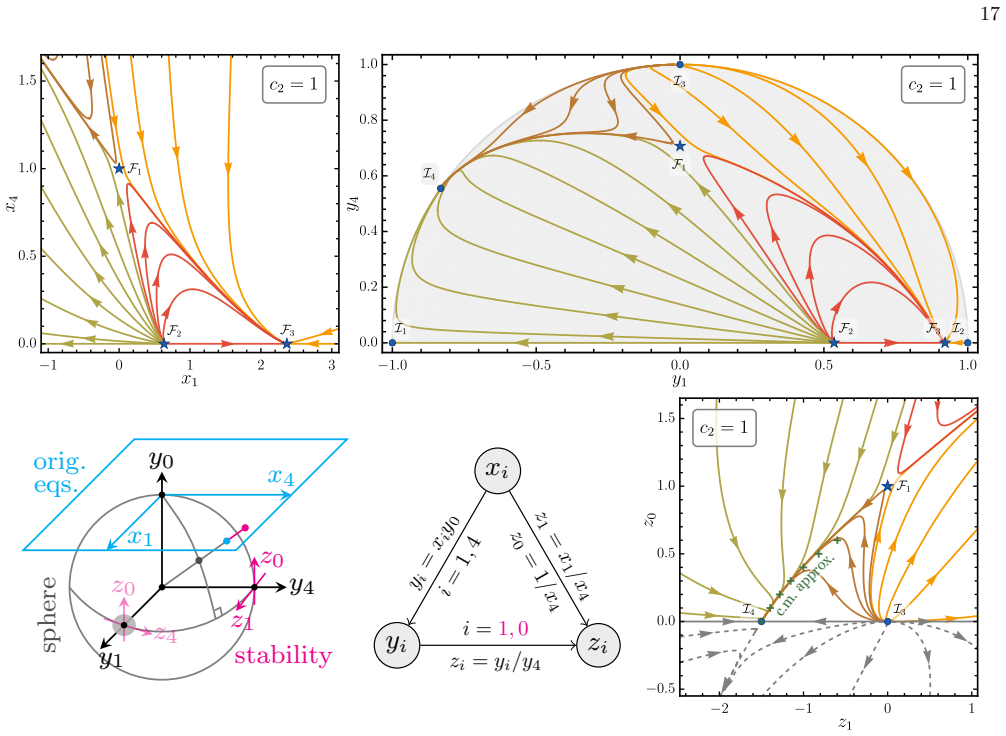
The central object is the caloric vector field $S_\mu$, with an effective gravitational tensor $S_{\mu\nu} = \nabla_\mu S_\nu + \nabla_\nu S_\mu + \dots$ whose linear terms make the field act like a source of spacetime curvature. The cosmological trigger is the source term $c_1 (\partial w_f)^2$ in the vector equation, which is nonzero only while the total fluid equation of state changes during the radiation-matter transition. The argument is carried by a two-dimensional dynamical system in the variables $x_1 = S_0/H$ and $x_3 = \varrho_f/H$; stability of the critical point $F_1$ ensures EDE dissipation, a critical point at infinity $I_3$ organizes the ESHU dynamics, and centre manifold theory extracts the asymptotic behaviour of the Λ-cancelling and ESHU attractors.
What would settle it
A Solar System or gravitational-wave test that measures a PPN parameter different from $\gamma=1$ or a gravitational-wave speed different from $c$ on a background where the caloric field cannot be set to zero would falsify the weak-field recovery. Directly, a cosmological perturbation calculation showing that the caloric EDE source excites unstable or observationally excluded matter fluctuations at matter-radiation equality would falsify the EDE mechanism.
Extended reading notes
Core claim
GCT modifies gravity from the fluid side by coupling a vector field $S_\mu$ to the standard energy-momentum tensor through a source term proportional to $(\partial w_f)^2$, where $w_f$ is the total fluid equation of state. In the radiation- and matter-dominated eras this source vanishes and the field decays to a stable critical point, while during the radiation-matter transition it drives a transient EDE component whose peak occurs near equality. The same field admits Λ-cancelling solutions that asymptote to a linearly expanding universe, and, through a critical point at infinity, an Early Static Hot Universe in which the field offsets hot gas so that a large comoving Hubble radius is generated. A Minkowski-space perturbation analysis singles out $c_2 = 1$ for stability, recovers the Newtonian limit with $\gamma_{\rm PPN}=1$ under asymptotically flat boundary conditions, and yields six gravitational-wave polarizations propagating at the speed of light.
Load-bearing premise
The weak-field recovery of general relativity assumes a Minkowski background with $S_\mu=0$ and standard asymptotically flat boundary conditions, but the paper itself notes that asymptotically flat exact solutions are non-generic, so real cosmological or compact-object backgrounds may not admit these boundary conditions.
Editorial extensions
If this is right
- A quantitative cosmological perturbation analysis can test whether the caloric EDE model resolves the Hubble tension without violating CMB constraints.
- The ESHU scenario, if viable, would provide a thermal alternative to inflation in which primordial fluctuations could arise from ordinary high-temperature gas rather than vacuum quantum fluctuations.
- The self-tuning Λ-cancelling solution offers a concrete dynamical framework for studying the old cosmological constant problem, although the paper notes it does not yet describe a full hot Big Bang history.
- For $c_2=1$, GCT predicts all six gravitational-wave polarizations at light speed, giving a clear observational signature for future GW detectors.
- The exact spherically symmetric solutions include wormholes and naked singularities but no black holes beyond Schwarzschild, motivating a search for a no-hair theorem or a dynamical collapse obstruction.
Reading between the lines
- The same $w_f$-trigger mechanism could be applied to the $S_8$ tension by modifying the Poisson equation on cosmological scales, as the paper hints but does not develop.
- The Λ-like behaviour of $S_\mu$ seen in both cosmology and local static solutions suggests that the caloric field might be a unified stand-in for dark energy and an effective cosmological constant, a connection the paper leaves speculative.
- A testable extension would be to compute the primordial power spectrum generated by thermal fluctuations in ESHU and compare its scalar tilt and non-Gaussianity with CMB observations.
Editorial analysis
A structured set of objections, weighed in public.
Referee Report
Summary. The paper introduces gravitational caloric theory (GCT), a vector-tensor extension of general relativity in which a new vector field S_mu is sourced by fluid thermodynamic quantities and coupled to gravity while preserving covariant conservation of the standard fluid energy-momentum tensor. The main cosmological claims are: (i) early dark energy triggered by the radiation-matter transition through the source term c1(∂w_f)^2, with the total fluid equation of state addressing the EDE coincidence problem (Sec. III A); (ii) a Λ-cancelling self-tuning solution (Sec. III B); and (iii) an Early Static Hot Universe (ESHU) that purportedly offers an alternative to inflation by generating a large comoving Hubble radius (Sec. III C). The paper also performs gauge-invariant linear perturbations about Minkowski spacetime, finding c2=1 stability, recovery of the Newtonian limit with γ_PPN=1, and six luminal gravitational-wave polarizations, and analyzes static spherically symmetric solutions, obtaining wormholes, naked singularities, effective Λ behavior, and two new exact solutions. The mathematical derivations are detailed and internally consistent, but the central physical claims are not established at the level asserted in the abstract and conclusions.
Significance. If the EDE trigger were parameter-free and the ESHU mechanism robust, this paper would open a genuinely new direction in modified gravity, and the dynamical-systems toolkit—Poincaré compactification, centre manifold theory, and attractor analysis—is applied carefully and usefully. The exact static solutions and the explicit decoupling of the linearized perturbation equations are also valuable as technical contributions. However, the significance as advertised is currently limited by three load-bearing gaps: the EDE amplitude is set by an order-20 free parameter rather than predicted, the ESHU horizon-solving cases require extreme initial data and are explicitly not robust to time-varying w_f, and the weak-field recovery of general relativity depends on Minkowski background boundary conditions that the paper itself shows are non-generic in the exact spherically symmetric sector. The paper is a serious exploratory study, but the central claims need substantial revision or additional analysis before they can be accepted.
major comments (3)
- [III A 3, Eq. (3.15), Fig. 5] The EDE amplitude is not a prediction of the theory. Eq. (3.15) shows Ω_EDE proportional to c1, and the numerical demonstration in Fig. 5 reaches the 10% level by choosing c1=20. This violates the paper's own 'strong rule' in Sec. I A that no additional parameters set the EDE energy scale and that all parameters should be dimensionless and of order unity. Furthermore, the source term c1(∂w_f)^2 is introduced in Sec. II A specifically to vanish in constant-EoS eras and peak at the transition, so the timing of the EDE trigger is encoded in the field equations by construction rather than derived from independent physics. The paper should either demonstrate that a 10% EDE amplitude can be obtained with O(1) parameters and generic initial conditions, or explicitly state that GCT offers a trigger mechanism but not a parameter-free resolution of the EDE coincidence problem.
- [III C, Table IV, Sec. VI] The claim that ESHU 'offers an alternative to inflation' is not supported by the paper's own analysis. Table IV and the discussion around Eq. (3.34) show that the n=3 case fails to solve the horizon problem. For the n=2 and n=1 cases, solving the horizon problem requires x3,max > e^70 (Eqs. (3.38) and (3.48)), which entails extreme initial conditions, and Table IV explicitly states 'Not robust if ẇ_f ≠ 0'. Since the real early universe has a time-varying w_f through the radiation-matter transition (Eq. (3.13)), the advertised power-law or exponentially decreasing comoving Hubble radius may not be realized. In addition, Fig. 8 case 1b shows that even at constant w_f a second branch of initial conditions does not follow the I3→F1 attractor, so the mechanism is not generic. The abstract and Sec. VI should be revised to present ESHU as a speculative possibility with known obstructions, not as an established inflationary alternative.
- [IV C, V B 3, VI] The weak-field recovery of general relativity, used to claim consistency with Solar System and gravitational-wave constraints, relies on a Minkowski background with S_mu=0 and standard asymptotically flat boundary conditions. The paper itself cautions in Sec. IV and Sec. VI that asymptotically flat exact solutions are non-generic in the explored spherically symmetric sector, and that changing boundary conditions can alter the physical implications. If the true cosmological or compact-object background does not admit those boundary conditions, the Newtonian limit, γ_PPN=1, and the six-polarization result may not apply to the real Universe. Since these constraints are used to validate the theory, the domain of validity of the Minkowski-based analysis must be established, or the claims must be correspondingly qualified, before they can be regarded as tests of GCT.
minor comments (4)
- [II A] The text refers to 'Porca theory'; this should be 'Proca theory'.
- [I C] There is a typo 'explity i → z_i' in the technical background; it should read 'explicit y_i → z_i projection'.
- [I A] The sentence contains a duplicated phrase: 'new independent and precise measurements from the from the TRGB-SBF project'.
- [Fig. 5] The horizontal axis label 'N-foldingnumbere' and several other axis labels contain missing spaces or run-together words; they should be cleaned up for readability.
Circularity Check
The EDE coincidence 'resolution' is built into the source term by construction, and the ESHU inflation alternative is an imposed parameter regime rather than an emergent prediction.
-
self definitional
[Sec. II A (source term in Eq. 2.1b) and Sec. III A 3]
"We now turn to the source term of the EDE. This must correctly represent the cosmic radiation-matter transition. Considering the dimensions, a suitable choice is a term like (∂ μwf)2 ... The source term vanishes in both the radiation- and (pressureless) matter-dominated eras due to the constancy of wf, while being nonzero during the transition. ... The source term peaks exactly at matter-radiation equality, whereas the total Ω EDE attains its maximum very near that epoch. ... This result is sufficient to resolve the EDE coincidence problem."
The source term c1(w'_f)^2 is introduced in Sec. II A with the explicit design goal of being nonzero only during the radiation-matter transition, and w_f is parametrized in Eq. (3.13) with N_eq set to matter-radiation equality. The later demonstration that Ω_EDE peaks near equality and the assertion that this resolves the coincidence problem simply read back that input. The timing of EDE is imposed through the definition of the source term, not derived from independent dynamics; the 'resolution' is therefore self-definitional.
-
other
[Sec. III C 3, Eqs. (3.39)-(3.42) and discussion after Eq. (3.47)]
"In summary, the ESHU dynamics with n=1 can be realized by imposing {˜c35 >0, α>0, ˜λ I3,− <0, β c.m. >0} in conjunction with Eqs. (3.39), (3.41) and (3.42). ... To address the horizon problem, r h is required to decrease during the late-ESHU era, which in turn imposes β c.m. >1."
The exponentially decreasing comoving Hubble radius in Eq. (3.47) is not derived from an independent physical mechanism; it is produced by choosing c4, c6, and α through Eqs. (3.39)-(3.42) so that β_c.m. > 1, where β_c.m. > 1 is exactly the condition for the CHR to decrease. The paper then presents this imposed behavior as the basis for claiming that ESHU 'offers an alternative to inflation.' The advertised inflation-like outcome is an input to the parameter construction rather than a prediction from the theory.
full rationale
The central EDE claim is circular in the precise sense that the trigger, c1(∂ w_f)^2, is defined to vanish in constant-EoS eras and peak at the radiation-matter transition; the numerical peak of Ω_EDE near equality and the 'resolution' of the coincidence problem are therefore consequences of the chosen ansatz, not independent outputs. The ESHU n=1 mechanism is similarly an engineered parameter regime: the parameter constraints are imposed to make β_c.m. > 1, and the exponential CHR decrease follows by construction. However, the self-citation to Tian & Zhu is not the main circular step, and much of the paper is self-contained: the Minkowski perturbation analysis (Sec. IV), the stability selection c2 = 1, the Abel-equation reduction and exact spherically symmetric solutions (Sec. V), and the critical-point/centre-manifold mathematics are derived from the stated field equations with stated assumptions and checked numerically/series-wise. The paper also honestly reports that n=3 ESHU fails to solve the horizon problem and that n=2 and n=1 require extreme x3,max and are not robust to time-varying w_f; these are strength-of-claim issues rather than circularity. Overall, because the EDE coincidence resolution and the headline ESHU inflation alternative reduce by construction to inputs of the model, while substantial auxiliary analyses remain independent, the appropriate circularity score is 6.
Assumptions & free parameters
free parameters (7)
- c1 =
20 in Fig. 5
- c2 =
varies: 1, 2.5, 0.5, -5
- c3 =
varies: -2, 2, -1, -896/73
- c4 =
-186956805/2579236 for n=1 ESHU
- c5 =
varies: -3, 2.5, -2, -13
- c6 =
-76932660/644809 for n=1 ESHU
- ESHU initial x3,max =
1000 in numerical evolutions; > e^70 required for horizon problem
assumptions (6)
- ad hoc to paper The GCT field equations (2.1) are directly constructed and assumed to define a consistent classical field theory without a Lagrangian.
- ad hoc to paper The standard fluid energy-momentum tensor is covariantly conserved, and J_mu includes only fluid components, excluding the cosmological constant.
- ad hoc to paper The vector-field source term c1(∂w_f)^2 is introduced to encode the radiation-matter transition.
- domain assumption The radiation-matter transition is modeled by w_f(N) = (1/3)/(1 + e^{N-N_eq}) with N_eq = -8.13.
- domain assumption Linear perturbation theory around Minkowski assumes S_mu = 0 in the background and standard asymptotically flat boundary conditions.
- ad hoc to paper Static spherically symmetric configurations assume S_mu = [alpha(r), beta(r), 0, 0].
invented entities (1)
-
Caloric vector field S_mu
Cite this review
Pith. "Pith review of Gravitational caloric theory: From early dark energy to a wide variety of gravitational phenomena." pith.science (2026). https://pith.science/paper/VS6VRWUV
@misc{pith2026260807318,
  author       = {Pith},
  title        = {Pith review of: Gravitational caloric theory: From early dark energy to a wide variety of gravitational phenomena},
  year         = {2026},
  howpublished = {\url{https://pith.science/paper/VS6VRWUV}},
  note         = {Machine review of arXiv:2608.07318}
}
abstract
Gravitational caloric theory (GCT) extends general relativity by introducing a vector field $S_\mu$ that is sourced by and non-minimally coupled to the fluid sector, while preserving covariant conservation of the standard fluid energy-momentum tensor. The initial motivation is to trigger early dark energy (EDE) using the total fluid equation of state that encodes the cosmic radiation-matter transition, thereby addressing the associated coincidence problem. The EDE dynamics are analyzed in detail by recasting the background evolution equations as a two-dimensional dynamical system. Poincar\'e compactification probes the global structure of this system and illustrates the role of critical points at infinity in shaping the phase portrait. There are two cosmological applications beyond EDE, both belonging to a broader family of energy-cancelling solutions in which conventional energy components (e.g., the cosmological constant $\Lambda$ or an ideal fluid) preferentially excite $S_\mu$ rather than sourcing spacetime curvature. First, the $\Lambda$-cancelling solution corresponds to the so-called self-tuning mechanism proposed to address the old cosmological constant problem. A major limitation is that our present realization cannot enter the standard hot Big Bang phase and therefore should not be regarded as a complete self-tuning solution. Second, inspired by a nontrivial critical point at infinity in the EDE phase portrait, we propose an \textit{Early Static Hot Universe} in which $S_\mu$ offsets the gravitational effect of ordinary hot gas, yielding quasi-static expansion with a decreasing comoving Hubble radius that can address the horizon problem. This scenario offers an alternative to inflation. This paper opens several avenues for further investigation of GCT, including cosmology, gravitational waves, and compact objects. (Abstract abridged to meet arXiv limits.)
Figures


Figures from the paper (8 more)




Reference graph
Works this paper leans on
-
[1]
•Signature: (−,+,+,+)
Riemannian geometry •Metric:g µν. •Signature: (−,+,+,+). •Christoffel symbols: Γλ µν = 1 2 gλα(∂νgµα +∂ µgνα −∂ αgµν). •Riemann curvature tensor: Rρ λµν =∂ µΓρ λν −∂ νΓρ λµ + Γρ αµΓα λν −Γ ρ ανΓα λµ. •Ricci tensor and Ricci scalar: Rµν =R α µαν,andR=g µνRµν. •Einstein tensor: Gµν =R µν − 1 2 gµνR. •Partial derivative:∂ µ. •Covariant derivative:∇ µ and ∇µS...
-
[2]
11 exhibit mirror symmetry about theη= 0 plane [265]
Mirror of the Schwarzschild metric The red, green, and blue trajectories in Fig. 11 exhibit mirror symmetry about theη= 0 plane [265]. This im- 38 λ µ η singularity at r= 0 or + ∞ singularity at r =rc Limit of blue line: µ→ const.⁄= 0 η→±∞ Limit of red line: η→ const.⁄= 0 µ→−∞ Schwarzschild metric Mirror of Schwarzschild Charged metric (+) Charged metric ...
-
[3]
Inspired by the series anal- ysis in Sec
An exact charged solution Here aGuess & Checkstrategy is employed to con- struct new exact solutions. Inspired by the series anal- ysis in Sec. V C 1 and the exact solutions in Sec. V C 2, consider the ansatzµ= [2(α−e λ)]−1 with an undeter- mined constantα. Substituting this form into Eq. (5.8a) determinesη(λ), after which Eq. (5.8b) provides a self- cons...
2022
-
[4]
At a fixed physical spacetime pointpwe write xµ(p)7→˜xµ(p) =x µ(p) +ξ µ(p),(A.1) whereξ µ =O(ϵ) is of the same order as the first-order perturbations
Gauge transformations In linear perturbation theory, a gauge transforma- tion is an infinitesimal coordinate transformation (pas- sive viewpoint). At a fixed physical spacetime pointpwe write xµ(p)7→˜xµ(p) =x µ(p) +ξ µ(p),(A.1) whereξ µ =O(ϵ) is of the same order as the first-order perturbations. We decompose each field into a prescribed background (not a...
-
[5]
Let (x 1, x2)∗ be a critical point in a finite region, i.e.,P ∗ =Q ∗ = 0
Linear stability theory In the main text we only need planar systems, which we write as x′ 1 =P(x 1, x2), x′ 2 =Q(x 1, x2), (B.1) where ′ ≡d/dN. Let (x 1, x2)∗ be a critical point in a finite region, i.e.,P ∗ =Q ∗ = 0. The Jacobian matrix is J= " ∂P/∂x 1 ∂P/∂x 2 ∂Q/∂x 1 ∂Q/∂x 2 # ,(B.2) and linear stability follows from the eigenvalues ofJ∗. For a 2×2 rea...
-
[6]
A convenient way to study them is the Poincar´ e compactification [124]
Coordinate transformations for infinity Critical points may also occur at infinity. A convenient way to study them is the Poincar´ e compactification [124]. For definiteness we assume thatPandQin Eq. (B.1) are bivariate polynomials, and denote their highest-degree homogeneous parts byP m(x1, x2) andQ m(x1, x2) (al- lowing one of them to vanish if the degr...
-
[7]
[115, 122] for rigorous statements)
Centre manifold theory We summarize the center-manifold method for a two- dimensional system with one vanishing eigenvalue (see Refs. [115, 122] for rigorous statements). Throughout this subsection we follow the (z 1, z0) ordering, i.e.,a= [a1, a0]T with indices 1 and 0 denoting the first and sec- ond components, respectively. Letz= [z 1, z0]T and suppose...
-
[8]
3/(2−4c 2) 0 # ,(B.18) and J∗ = −3 ˜c2
Shifting the critical point to the origin with ˜z=z−z ∗ gives d˜z dσ =J ∗˜z+f( ˜z),(B.13) wheref= [f 1(˜z1,˜z0), f0(˜z1,˜z0)]T satisfiesf i(0,0) = 0 and∂f i/∂˜zj|(0,0) = 0 fori, j∈ {1,0}, i.e.,fstarts at quadratic order. Diagonalize the linear part by intro- ducing eigenvectorsv 1 (forλ) andv 0 (for 0), defining S∗ = [v1,v 0], and transforming tou≡[u 1, u...
Show all 289 references
-
[9]
Einstein, The foundation of the general theory of relativity, Ann
A. Einstein, The foundation of the general theory of relativity, Ann. Phys. (Berlin)354, 769 (1916), Trans- lation,The Principle of Relativity, Dover Publications, New York (1923)
1916
-
[10]
Fischbach and C
E. Fischbach and C. L. Talmadge,The Search for Non- Newtonian Gravity(Springer, New York, 1999) Cur- rently, no positive signals have been confirmed. It is worth emphasizing that the interpretation of most cos- mological data strongly depends on the cosmological model and cann...
1999
-
[11]
C. M. Will, The confrontation between general relativity and experiment, Living Rev. Relativity17, 4 (2014)
2014
-
[12]
Brans and R
C. Brans and R. H. Dicke, Mach’s principle and a rel- ativistic theory of gravitation, Phys. Rev.124, 925 (1961)
1961
-
[13]
H. A. Buchdahl, Non-linear Lagrangians and cosmolog- ical theory, Mon. Not. R. Astron. Soc.150, 1 (1970)
1970
-
[14]
A. A. Starobinsky, A new type of isotropic cosmological models without singularity, Phys. Lett. B91, 99 (1980)
1980
-
[15]
Milgrom, A modification of the Newtonian dynamics as a possible alternative to the hidden mass hypothesis, Astrophys
M. Milgrom, A modification of the Newtonian dynamics as a possible alternative to the hidden mass hypothesis, Astrophys. J.270, 365 (1983)
1983
-
[16]
S. M. Carroll, V. Duvvuri, M. Trodden, and M. S. Turner, Is cosmic speed-up due to new gravitational physics?, Phys. Rev. D70, 043528 (2004)
2004
-
[17]
T. D. Lee and C. N. Yang, Conservation of heavy parti- cles and generalized gauge transformations, Phys. Rev. 98, 1501 (1955)
1955
-
[18]
Arkani-Hamed, S
N. Arkani-Hamed, S. Dimopoulos, and G. Dvali, The hierarchy problem and new dimensions at a millimeter, Phys. Lett. B429, 263 (1998)
1998
-
[19]
M. B. Green and J. H. Schwarz, Anomaly cancellations in supersymmetricD= 10 gauge theory and superstring theory, Phys. Lett. B149, 117 (1984)
1984
-
[20]
H. L. Callendar, The caloric theory of heat and Carnot’s principle, Proc. Phys. Soc. London23, 153 (1910)
1910
-
[21]
Hubble, A relation between distance and radial ve- locity among extra-galactic nebulae, Proc
E. Hubble, A relation between distance and radial ve- locity among extra-galactic nebulae, Proc. Natl. Acad. Sci. U.S.A.15, 168 (1929)
1929
-
[22]
Sandage, Current problems in the extragalactic dis- tance scale, Astrophys
A. Sandage, Current problems in the extragalactic dis- tance scale, Astrophys. J.127, 513 (1958)
1958
-
[23]
R. B. Tully and J. R. Fisher, A new method of deter- mining distances to galaxies, Astron. Astrophys.54, 661 (1977)
1977
-
[24]
W. L. Freedman, B. F. Madore, B. K. Gibson, L. Fer- rarese, D. D. Kelson, S. Sakai, J. R. Mould, J. Kenni- cutt, Robert C., H. C. Ford, J. A. Graham,et al., Final results from the Hubble Space Telescope Key Project to measure the Hubble constant, Astrophys. J.553, 47 (2001)
2001
-
[25]
The Λ-cold-dark-matter (ΛCDM) model together with the flat Friedmann-Lema ˆ ıtre-Robertson-Walker (FLR W) background
-
[26]
Komatsu, K
E. Komatsu, K. M. Smith, J. Dunkley, C. L. Bennett, B. Gold, G. Hinshaw, N. Jarosik, D. Larson, M. R. Nolta, L. Page,et al., Seven-yearWilkinson Microwave Anisotropy Probe (WMAP)observations: Cosmological interpretation, Astrophys. J. Suppl.192, 18 (2011), We quote constraints...
2011
-
[27]
A. G. Riess, L. Macri, S. Casertano, H. Lampeitl, H. C. Ferguson, A. V. Filippenko, S. W. Jha, W. Li, and R. Chornock, A 3% solution: Determination of the Hub- ble constant with theHubble Space Telescopeand Wide Field Camera 3, Astrophys. J.730, 119 (2011)
2011
-
[28]
P. A. R. Ade, N. Aghanim, C. Armitage-Caplan, M. Ar- naud, M. Ashdown, F. Atrio-Barandela, J. Aumont, C. Baccigalupi, A. J. Banday, R. B. Barreiro,et al. (Planck Collaboration),Planck2013 results. XVI. Cos- mological parameters, Astron. Astrophys.571, A16 (2014)
2014
-
[29]
P. A. R. Ade, N. Aghanim, M. Arnaud, M. Ashdown, J. Aumont, C. Baccigalupi, A. J. Banday, R. B. Bar- reiro, J. G. Bartlett, N. Bartolo,et al.(Planck Collabo- ration),Planck2015 results. XIII. Cosmological param- eters, Astron. Astrophys.594, A13 (2016)
2016
-
[30]
A. G. Riess, L. M. Macri, S. L. Hoffmann, D. Scolnic, S. Casertano, A. V. Filippenko, B. E. Tucker, M. J. Reid, D. O. Jones, J. M. Silverman,et al., A 2.4% de- termination of the local value of the Hubble constant, Astrophys. J.826, 56 (2016)
2016
-
[31]
Aghanim, Y
N. Aghanim, Y. Akrami, M. Ashdown, J. Aumont, C. Baccigalupi, M. Ballardini, A. J. Banday, R. B. Bar- reiro, N. Bartolo, S. Basak,et al.(Planck Collabora- tion),Planck2018 results VI. Cosmological parameters, Astron. Astrophys.641, A6 (2020)
2020
-
[32]
A. G. Riess, W. Yuan, L. M. Macri, D. Scolnic, D. Brout, S. Casertano, D. O. Jones, Y. Murakami, G. S. Anand, L. Breuval,et al., A comprehensive mea- surement of the local value of the Hubble constant with 1 km s−1 Mpc−1 uncertainty from the Hubble space tele- 45 scope and the...
2022
-
[33]
Efstathiou and S
G. Efstathiou and S. Gratton, A detailed description of the CamSpec likelihood pipeline and a reanalysis of the Planckhigh frequency maps, Open J. Astrophys.4, 8 (2021)
2021
-
[34]
Brout, D
D. Brout, D. Scolnic, B. Popovic, A. G. Riess, A. Carr, J. Zuntz, R. Kessler, T. M. Davis, S. Hinton, D. Jones, et al., The Pantheon+ analysis: Cosmological con- straints, Astrophys. J.938, 110 (2022), See Fig. 18 in
2022
-
[35]
for a graphical representation
-
[36]
R. I. Anderson, On Cepheid distances in theH 0 mea- surement, arXiv:2403.02801 , See Fig. 2 for a summary
-
[37]
Di Valentino, J
E. Di Valentino, J. L. Said, A. Riess, A. Pollo, V. Poulin, A. G´ omez-Valent, A. Weltman, A. Palmese, C. D. Huang, C. v. d. Bruck,et al., The CosmoVerse White Paper: Addressing observational tensions in cosmology with systematics and fundamental physics, Phys. Dark Universe49...
2025
-
[38]
J. B. Jensen, J. P. Blakeslee, M. Cantiello, M. Cowles, G. S. Anand, R. B. Tully, E. Kourkchi, and G. Rai- mondo, The TRGB-SBF Project. III. Refining the HST surface brightness fluctuation distance scale calibration with JWST, Astrophys. J.987, 87 (2025)
2025
-
[39]
Louis, A
T. Louis, A. La Posta, Z. Atkins, H. T. Jense, I. Abril- Cabezas, G. E. Addison, P. A. R. Ade, S. Aiola, T. Alford, D. Alonso,et al., The Atacama Cosmol- ogy Telescope: DR6 power spectra, likelihoods and LambdaCDM parameters, arXiv:2503.14452
-
[40]
Salvatelli, A
V. Salvatelli, A. Marchini, L. Lopez-Honorez, and O. Mena, New constraints on coupled dark energy from the Planck satellite experiment, Phys. Rev. D88, 023531 (2013)
2013
-
[41]
J.-Q. Xia, H. Li, and X. Zhang, Dark energy constraints after the new Planck data, Phys. Rev. D88, 063501 (2013)
2013
-
[42]
Marra, L
V. Marra, L. Amendola, I. Sawicki, and W. Valkenburg, Cosmic variance and the measurement of the local Hub- ble parameter, Phys. Rev. Lett.110, 241305 (2013)
2013
-
[43]
R. C. Keenan, A. J. Barger, and L. L. Cowie, Evidence for a∼300 megaparsec scale under-density in the local galaxy distribution, Astrophys. J.775, 62 (2013)
2013
-
[44]
Hojjati, E
A. Hojjati, E. V. Linder, and J. Samsing, New con- straints on the early expansion history of the universe, Phys. Rev. Lett.111, 041301 (2013), This paper did not discuss the SH0ES 2011 result. However, Figs. 1 and 3 in the paper make it suitable for our citation
2013
-
[45]
Sch¨ oneberg, G
N. Sch¨ oneberg, G. Franco Abell´ an, A. P´ erez S´ anchez, S. J. Witte, V. Poulin, and J. Lesgourgues, TheH 0 Olympics: A fair ranking of proposed models, Phys. Rep.984, 1 (2022)
2022
-
[46]
Our aim here is not to provide a complete literature review on the origins of the con- troversy, but rather to offer illustrative examples
For clarity, the references cited under each keyword are limited to those addressing a specific type of solution to the Hubble tension. Our aim here is not to provide a complete literature review on the origins of the con- troversy, but rather to offer illustrative examples. S...
-
[47]
Ben-Dayan, R
I. Ben-Dayan, R. Durrer, G. Marozzi, and D. J. Schwarz, Value ofH 0 in the inhomogeneous universe, Phys. Rev. Lett.112, 221301 (2014)
2014
-
[48]
Odderskov, S
I. Odderskov, S. M. Koksbang, and S. Hannestad, The local value ofH 0 in an inhomogeneous universe, J. Cos- mol. Astropart. Phys. 02 (2016) 001
2016
-
[49]
Poulin, T
V. Poulin, T. L. Smith, T. Karwal, and M. Kamionkowski, Early dark energy can resolve the Hubble tension, Phys. Rev. Lett.122, 221301 (2019)
2019
-
[50]
J. C. Hill, E. McDonough, M. W. Toomey, and S. Alexander, Early dark energy does not restore cosmo- logical concordance, Phys. Rev. D102, 043507 (2020)
2020
-
[51]
J. C. Hill, E. Calabrese, S. Aiola, N. Battaglia, B. Bol- liet, S. K. Choi, M. J. Devlin, A. J. Duivenvoorden, J. Dunkley, S. Ferraro,et al., Atacama Cosmology Tele- scope: Constraints on prerecombination early dark en- ergy, Phys. Rev. D105, 123536 (2022)
2022
-
[52]
T. L. Smith, M. Lucca, V. Poulin, G. F. Abellan, L. Balkenhol, K. Benabed, S. Galli, and R. Murgia, Hints of early dark energy in Planck, SPT, and ACT data: New physics or systematics?, Phys. Rev. D106, 043526 (2022)
2022
-
[53]
Efstathiou, E
G. Efstathiou, E. Rosenberg, and V. Poulin, Improved Planck constraints on axionlike early dark energy as a resolution of the Hubble tension, Phys. Rev. Lett.132, 221002 (2024)
2024
-
[54]
G.-B. Zhao, M. Raveri, L. Pogosian, Y. Wang, R. G. Crittenden, W. J. Handley, W. J. Percival, F. Beutler, J. Brinkmann, C.-H. Chuang,et al., Dynamical dark energy in light of the latest observations, Nat. Astron. 1, 627 (2017)
2017
-
[55]
Y. Wang, L. Pogosian, G.-B. Zhao, and A. Zucca, Evo- lution of dark energy reconstructed from the latest ob- servations, Astrophys. J. Lett.869, L8 (2018)
2018
-
[56]
Camarena and V
D. Camarena and V. Marra, On the use of the local prior on the absolute magnitude of Type Ia supernovae in cosmological inference, Mon. Not. R. Astron. Soc. 504, 5164 (2021)
2021
-
[57]
Efstathiou, ToH 0 or not toH 0?, Mon
G. Efstathiou, ToH 0 or not toH 0?, Mon. Not. R. As- tron. Soc.505, 3866 (2021)
2021
-
[58]
Calabrese, J
E. Calabrese, J. C. Hill, H. T. Jense, A. La Posta, I. Abril-Cabezas, G. E. Addison, P. A. R. Ade, S. Aiola, T. Alford, D. Alonso,et al., The Atacama Cosmology Telescope: DR6 constraints on extended cosmological models, arXiv:2503.14454 , This paper analyzed multi- ple extende...
-
[59]
Knox and M
L. Knox and M. Millea, Hubble constant hunter’s guide, Phys. Rev. D101, 043533 (2020)
2020
-
[60]
A. R. Khalife, M. B. Zanjani, S. Galli, S. G¨ unther, J. Lesgourgues, and K. Benabed, Review of Hubble ten- sion solutions with new SH0ES and SPT-3G data, J. Cosmol. Astropart. Phys. 04 (2024) 059
2024
-
[61]
Jedamzik, L
K. Jedamzik, L. Pogosian, and G.-B. Zhao, Why reduc- ing the cosmic sound horizon alone can not fully resolve the Hubble tension, Commun. Phys.4, 123 (2021)
2021
-
[62]
M.-X. Lin, G. Benevento, W. Hu, and M. Raveri, Acous- tic dark energy: Potential conversion of the Hubble ten- sion, Phys. Rev. D100, 063542 (2019)
2019
-
[63]
Sakstein and M
J. Sakstein and M. Trodden, Early dark energy from massive neutrinos as a natural resolution of the Hubble tension, Phys. Rev. Lett.124, 161301 (2020)
2020
-
[64]
Kamionkowski, J
M. Kamionkowski, J. Pradler, and D. G. E. Walker, Dark energy from the string axiverse, Phys. Rev. Lett. 113, 251302 (2014)
2014
-
[65]
Poulin, T
V. Poulin, T. L. Smith, D. Grin, T. Karwal, and 46 M. Kamionkowski, Cosmological implications of ultra- light axionlike fields, Phys. Rev. D98, 083525 (2018)
2018
-
[66]
While ordinary matter can exert an indirect influence on scalar field dynamics through Hubble friction, this does not provide a mechanism to control the emergence time of EDE
-
[67]
Niedermann and M
F. Niedermann and M. S. Sloth, New early dark energy, Phys. Rev. D103, L041303 (2021)
2021
-
[68]
V. K. Oikonomou, Unifying inflation with early and late dark energy epochs in axionF(R) gravity, Phys. Rev. D103, 044036 (2021)
2021
-
[69]
This naturally forces the peak of its relative energy density to coincide with the epoch of matter-radiation equality
Zumalac´ arregui [270] constructed a trigger-free solution, in which the key ingredient is an energy density that di- lutes faster than matter but slower than radiation. This naturally forces the peak of its relative energy density to coincide with the epoch of matter-radiatio...
-
[70]
Carrillo Gonz´ alez, Q
M. Carrillo Gonz´ alez, Q. Liang, J. Sakstein, and M. Trodden, Neutrino-assisted early dark energy: The- ory and cosmology, J. Cosmol. Astropart. Phys. 04 (2021) 063
2021
-
[71]
Karwal, M
T. Karwal, M. Raveri, B. Jain, J. Khoury, and M. Trod- den, Chameleon early dark energy and the Hubble ten- sion, Phys. Rev. D105, 063535 (2022)
2022
-
[72]
M.-X. Lin, E. McDonough, J. C. Hill, and W. Hu, Dark matter trigger for early dark energy coincidence, Phys. Rev. D107, 103523 (2023)
2023
-
[73]
S. X. Tian and Z.-H. Zhu, Early dark energy ink- essence, Phys. Rev. D103, 043518 (2021), We refer to the EDE model given by Eq. (25) in this paper
2021
-
[74]
S. X. Tian and Z.-H. Zhu, Gravitation with modified fluid Lagrangian: Variational principle and an early dark energy model, Phys. Rev. D107, 103507 (2023), Energy is conserved in this framework. However, mo- mentum was not analyzed and does not appear to be conserved, as no co...
2023
-
[75]
C. Jing, S. Tian, and Z.-H. Zhu, Early dark energy triggered by spacetime dynamics that encodes cosmic radiation-matter transition, Phys. Rev. D109, 044016 (2024)
2024
-
[76]
Maziashvili, Inflaton-driven early dark energy, As- tropart
M. Maziashvili, Inflaton-driven early dark energy, As- tropart. Phys.145, 102792 (2023)
2023
-
[77]
D. H. F. de Souza and R. Rosenfeld, Can neutrino- assisted early dark energy models ameliorate theH 0 tension in a natural way?, Phys. Rev. D108, 083512 (2023)
2023
-
[78]
However, they do not provide a concrete and viable parameter setting (in their Sec
Carrillo Gonz´ alezet al.[271] dispute these arguments. However, they do not provide a concrete and viable parameter setting (in their Sec. II C) to directly ad- dress the issue, particularly the ∆ criterion proposed in Ref. [68]. Separately, Kamionkowski & Mathur [272] propos...
-
[79]
Ichiki and Y.-Y
K. Ichiki and Y.-Y. Keum, Primordial neutrinos, cosmo- logical perturbations in interacting dark-energy model: CMB and LSS, J. Cosmol. Astropart. Phys. 6 (2008) 005
2008
-
[80]
I. M. Oldengott, C. Rampf, and Y. Y. Y. Wong, Boltz- mann hierarchy for interacting neutrinos I: Formalism, J. Cosmol. Astropart. Phys. 04 (2015) 016
2015
-
[81]
Here we refer to the model proposed by Linet al.[63]
As stated by Linet al.[63], the model proposed by Kar- walet al.[62] does not correctly resolve the EDE coin- cidence problem. Here we refer to the model proposed by Linet al.[63]
-
[82]
S. M. Carroll, The cosmological constant, Living Rev. Relativity4, 1 (2001)
2001
-
[83]
Harko and F
T. Harko and F. S. N. Lobo,f(R, L m) gravity, Eur. Phys. J. C70, 373 (2010)
2010
-
[84]
Harko, F
T. Harko, F. S. N. Lobo, S. Nojiri, and S. D. Odintsov, f(R, T) gravity, Phys. Rev. D84, 024020 (2011)
2011
-
[85]
(8) in Ref
See discussions above Eq. (8) in Ref. [66]. While intro- ducing a cosmological constant can provide a temporary fix, it makes the model theoretically unappealing
-
[86]
A theory that solves every observational anomaly by in- serting new physics at a specific energy scale becomes increasingly cumbersome
Cosmic evolution spans a wide range of energy scales. A theory that solves every observational anomaly by in- serting new physics at a specific energy scale becomes increasingly cumbersome. Furthermore, a collection of phenomenological patches may conceal a more funda- mental,...
-
[87]
Lewis, A
A. Lewis, A. Challinor, and A. Lasenby, Efficient com- putation of cosmic microwave background anisotropies in closed Friedmann-Robertson-Walker models, Astro- phys. J.538, 473 (2000)
2000
-
[88]
D. Blas, J. Lesgourgues, and T. Tram, The cosmic linear anisotropy solving system (CLASS). Part II: Approxi- mation schemes, J. Cosmol. Astropart. Phys. 07 (2011) 034
2011
-
[89]
P. J. E. Peebles,The Large-Scale Structure of the Uni- verse(Princeton University Press, New Jersey, 1980)
1980
-
[90]
V. J. Mart ´ ınez and E. Saar,Statistics of the Galaxy Dis- tribution(Chapman & Hall/CRC, Boca Raton, 2002)
2002
-
[91]
The existence of this tension and the possible systematic errors in the relevant observations remain an ongoing debate [28]
According to the latest KiDS result [275], theS 8 ten- sion disappears. The existence of this tension and the possible systematic errors in the relevant observations remain an ongoing debate [28]
-
[92]
P. A. R. Ade, N. Aghanim, M. Arnaud, M. Ashdown, J. Aumont, C. Baccigalupi, A. J. Banday, R. B. Bar- reiro, J. G. Bartlett, N. Bartolo,et al.(Planck Collab- oration), Planck 2015 results. XXIV. Cosmology from Sunyaev-Zeldovich cluster counts, Astron. Astrophys. 594, A24 (2016)
2016
-
[93]
Asgari, C.-A
M. Asgari, C.-A. Lin, B. Joachimi, B. Giblin, C. Hey- mans, H. Hildebrandt, A. Kannawadi, B. St¨ olzner, T. Tr¨ oster, J. L. van den Busch,et al., KiDS-1000 cosmology: Cosmic shear constraints and comparison between two point statistics, Astron. Astrophys.645, A104 (2021)
2021
-
[94]
T. M. C. Abbott, M. Aguena, A. Alarcon, S. Allam, O. Alves, A. Amon, F. Andrade-Oliveira, J. Annis, S. Avila, D. Bacon,et al.(DES Collaboration), Dark Energy Survey Year 3 results: Cosmological constraints from galaxy clustering and weak lensing, Phys. Rev. D 105, 023520 (2022)
2022
-
[95]
Poulin, J
V. Poulin, J. L. Bernal, E. D. Kovetz, and M. Kamionkowski, Sigma-8 tension is a drag, Phys. Rev. D107, 123538 (2023)
2023
-
[96]
M.-X. Lin, B. Jain, M. Raveri, E. J. Baxter, C. Chang, 47 M. Gatti, S. Lee, and J. Muir, Late time modification of structure growth and theS 8 tension, Phys. Rev. D 109, 063523 (2024)
2024
-
[97]
Y. B. Zel’dovich and I. D. Novikov,Relativistic As- trophysics. Vol. 1: Stars and Relativity(University of Chicago Press, Chicago, Illinois, 1971)
1971
-
[98]
C. W. Misner, K. S. Thorne, and J. A. Wheeler,Grav- itation(W. H. Freeman, San Francisco, 1973) p. 567
1973
-
[99]
de Rham, J
C. de Rham, J. T. Deskins, A. J. Tolley, and S.-Y. Zhou, Graviton mass bounds, Rev. Mod. Phys.89, 025004 (2017)
2017
-
[100]
Baker, A
T. Baker, A. Barreira, H. Desmond, P. Ferreira, B. Jain, K. Koyama, B. Li, L. Lombriser, A. Nicola, J. Sakstein, et al., Novel Probes Project: Tests of gravity on astro- physical scales, Rev. Mod. Phys.93, 015003 (2021)
2021
-
[101]
B. P. Abbott, R. Abbott, T. D. Abbott, F. Acer- nese, K. Ackley, C. Adams, T. Adams, P. Addesso, R. X. Adhikari, V. B. Adya,et al.(LIGO Scientific and Virgo Collaborations), Tests of general relativity with GW170817, Phys. Rev. Lett.123, 011102 (2019)
2019
-
[102]
Bertotti, L
B. Bertotti, L. Iess, and P. Tortora, A test of general relativity using radio links with the Cassini spacecraft, Nature (London)425, 374 (2003)
2003
-
[103]
B. P. Abbott, R. Abbott, T. D. Abbott, F. Acernese, K. Ackley, C. Adams, T. Adams, P. Addesso, R. X. Ad- hikari, V. B. Adya,et al.(LIGO Scientific and Virgo Collaborations), GW170817: Observation of gravita- tional waves from a binary neutron star inspiral, Phys. Rev. Lett.119...
2017
-
[104]
B. P. Abbott, R. Abbott, T. D. Abbott, F. Acer- nese, K. Ackley, C. Adams, T. Adams, P. Addesso, R. X. Adhikari, V. B. Adya,et al.(LIGO Scientific and Virgo Collaborations,FermiGamma-ray Burst Moni- tor, and INTEGRAL), Gravitational waves and gamma- rays from a binary neutron ...
2017
-
[105]
B. P. Abbott, R. Abbott, T. D. Abbott, M. R. Aber- nathy, F. Acernese, K. Ackley, C. Adams, T. Adams, P. Addesso, R. X. Adhikari,et al.(LIGO Scientific and Virgo Collaborations), Observation of gravitational waves from a binary black hole merger, Phys. Rev. Lett. 116, 061102 (2016)
2016
-
[106]
Akiyama, A
K. Akiyama, A. Alberdi, W. Alef, K. Asada, R. Azu- lay, A.-K. Baczko, D. Ball, M. Balokovi´ c, J. Barrett, D. Bintley,et al.(Event Horizon Telescope Collabora- tion), First M87 Event Horizon Telescope results. I. The shadow of the supermassive black hole, Astrophys. J. Lett.87...
2019
-
[107]
P. A. M. Dirac, Quantised singularities in the electro- magnetic field, Proc. R. Soc. Lond. A.133, 60 (1931)
1931
-
[108]
A. H. Guth, Inflationary universe: A possible solution to the horizon and flatness problems, Phys. Rev. D23, 347 (1981)
1981
-
[109]
Sato, First-order phase transition of a vacuum and the expansion of the universe, Mon
K. Sato, First-order phase transition of a vacuum and the expansion of the universe, Mon. Not. R. Astron. Soc. 195, 467 (1981)
1981
-
[110]
Unfortunately, both Starobinsky [6] and Sato [100] failed to recognize that the exponential expansion could resolve the horizon and flatness problems
-
[111]
A. D. Dolgov, Field model with a dynamic cancella- tion of the cosmological constant, JETP Lett.41, 345 (1985)
1985
-
[112]
L. H. Ford, Cosmological-constant damping by unstable scalar fields, Phys. Rev. D35, 2339 (1987)
1987
-
[113]
Charmousis, E
C. Charmousis, E. J. Copeland, A. Padilla, and P. M. Saffin, General second-order scalar-tensor theory and self-tuning, Phys. Rev. Lett.108, 051101 (2012)
2012
-
[114]
Newton,Mathematical Principles of Natural Philoso- phy(London, 1687)
I. Newton,Mathematical Principles of Natural Philoso- phy(London, 1687)
-
[115]
J. C. Maxwell, On physical lines of force, Philos. Mag. 90, 11 (1861)
-
[116]
J. C. Maxwell, A dynamical theory of the electromag- netic field, Philos. Trans. R. Soc. London155, 459 (1865)
-
[117]
P. A. M. Dirac, The cosmological constants, Nature (London)139, 323 (1937)
1937
-
[118]
R. H. Dicke, New research on old gravitation, Science 129, 621 (1959)
1959
-
[119]
A. D. Sakharov, Vacuum quantum fluctuations in curved space and the theory of gravitation, Dokl. Akad. Nauk SSSR177, 70 (1967), Translation, Sov. Phys. Usp.34, 394 (1991)
1967
-
[120]
Lucchin and S
F. Lucchin and S. Matarrese, Power-law inflation, Phys. Rev. D32, 1316 (1985)
1985
-
[121]
Ratra and P
B. Ratra and P. J. E. Peebles, Cosmological conse- quences of a rolling homogeneous scalar field, Phys. Rev. D37, 3406 (1988)
1988
-
[122]
E. J. Copeland, A. R. Liddle, and D. Wands, Exponen- tial potentials and cosmological scaling solutions, Phys. Rev. D57, 4686 (1998)
1998
-
[123]
Hao and X.-Z
J.-G. Hao and X.-Z. Li, Attractor solution of phantom field, Phys. Rev. D67, 107303 (2003)
2003
-
[124]
Bahamonde, C
S. Bahamonde, C. G. B¨ ohmer, S. Carloni, E. J. Copeland, W. Fang, and N. Tamanini, Dynamical sys- tems applied to cosmology: Dark energy and modified gravity, Phys. Rep.775-777, 1 (2018)
2018
-
[125]
L. A. Ure˜ na-L´ opez, Scalar phantom energy as a cosmo- logical dynamical system, J. Cosmol. Astropart. Phys. 09 (2005) 013
2005
-
[126]
A. D. Linde, Chaotic inflation, Phys. Lett. B129, 177 (1983)
1983
-
[127]
V. A. Belinsky, L. P. Grishchuk, I. M. Khalatnikov, and Y. B. Zeldovich, Inflationary stages in cosmologi- cal models with a scalar field, Phys. Lett. B155, 232 (1985), An extended version can be found in Sov. Phys. JETP62, 195 (1985)
1985
-
[128]
A. D. Rendall, Cosmological models and centre manifold theory, Gen. Relativ. Gravit.34, 1277 (2002)
2002
-
[129]
Theattractorin this context specifically refers to the stable manifold — a special trajectory along the repul- sive direction that attracts nearby orbits
Thesaddle-typeindicates a critical point that attracts trajectories in one direction and repels in the other. Theattractorin this context specifically refers to the stable manifold — a special trajectory along the repul- sive direction that attracts nearby orbits. Figure 1b in...
-
[130]
Lefschetz,Differential Equations: Geometric Theory, 2nd ed
S. Lefschetz,Differential Equations: Geometric Theory, 2nd ed. (John Wiley & Sons, New York, 1957) See Sec- tion IX.5. An example of the approximate mapping is given on page 205
1957
-
[131]
Carr,Applications of Centre Manifold Theory (Springer, New York, 1981)
J. Carr,Applications of Centre Manifold Theory (Springer, New York, 1981)
1981
-
[132]
Perko,Differential Equations and Dynamical Sys- tems, 3rd ed
L. Perko,Differential Equations and Dynamical Sys- tems, 3rd ed. (Springer, New York, 2001) See Sections 1.5, 1.6 and 3.10
2001
-
[133]
J. D. Meiss,Differential Dynamical Systems(SIAM, Philadelphia, 2007) See Section 6.8
2007
-
[134]
Einstein, Approximate integration of the field equa- tions of gravitation, Sitzungsberichte der K¨ oniglich Preußischen Akademie der Wissenschaften (Berlin) 48 1916, 688 (1916)
A. Einstein, Approximate integration of the field equa- tions of gravitation, Sitzungsberichte der K¨ oniglich Preußischen Akademie der Wissenschaften (Berlin) 48 1916, 688 (1916)
1916
-
[135]
E. E. Flanagan and S. A. Hughes, The basics of gravi- tational wave theory, New J. Phys.7, 204 (2005)
2005
-
[136]
Delhom, A
A. Delhom, A. Jim´ enez-Cano, and F. Jos´ e Maldonado Torralba, Instabilities in field theories: Lecture notes with a view into modified gravity, arXiv:2207.13431 , See page 23
-
[137]
Bertschinger, One gravitational potential or two? Forecasts and tests, Phil
E. Bertschinger, One gravitational potential or two? Forecasts and tests, Phil. Trans. R. Soc. A369, 4947 (2011)
2011
-
[138]
D. M. Eardley, D. L. Lee, and A. P. Lightman, Gravitational-wave observations as a tool for testing rel- ativistic gravity, Phys. Rev. D8, 3308 (1973)
1973
-
[139]
D. M. Eardley, D. L. Lee, A. P. Lightman, R. V. Wag- oner, and C. M. Will, Gravitational-wave observations as a tool for testing relativistic gravity, Phys. Rev. Lett. 30, 884 (1973)
1973
-
[140]
R. C. Tolman, Static solutions of Einstein’s field equa- tions for spheres of fluid, Phys. Rev.55, 364 (1939)
1939
-
[141]
J. R. Oppenheimer and G. M. Volkoff, On massive neu- tron cores, Phys. Rev.55, 374 (1939)
1939
-
[142]
A. D. Polyanin and V. F. Zaitsev,Handbook of Ordinary Differential Equations: Exact Solutions, Methods, and Problems, 3rd ed. (CRC Press, Boca Raton, 2018) See Sections 1.5 and 13.4.1
2018
-
[143]
H. G. Ellis, Ether flow through a drainhole: A parti- cle model in general relativity, J. Math. Phys. (N.Y.) 14, 104 (1973); Errata, J. Math. Phys. (N.Y.)15, 520 (1974)
1973
-
[144]
M. S. Morris and K. S. Thorne, Wormholes in spacetime and their use for interstellar travel: A tool for teaching general relativity, Am. J. Phys.56, 395 (1988), See dis- cussions related to Eqs. (1) and (37) in this paper
1988
-
[145]
S. X. Tian,Testing gravity theory in strong and weak field regions, Ph.D. thesis, Wuhan University, China (2020), The key ingredient of theMapleprogram can be found in Appendix B of this thesis. This program is used to substitute metric into field equations. [137]https://www.xact.es
2020
-
[146]
Brizuela, J
D. Brizuela, J. M. Mart ´ ın-Garc ´ ıa, and G. A. Mena Marugan,xPert: Computer algebra for metric perturbation theory, Gen. Relativ. Gravit.41, 2415 (2009)
2009
-
[147]
Nutma,xTras: A field-theory inspiredxActpackage for mathematica, Comput
T. Nutma,xTras: A field-theory inspiredxActpackage for mathematica, Comput. Phys. Commun.185, 1719 (2014)
2014
-
[148]
G. W. Horndeski, Second-order scalar-tensor field equa- tions in a four-dimensional space, Int. J. Theor. Phys. 10, 363 (1974)
1974
-
[149]
Bargmann, Relativity, Rev
V. Bargmann, Relativity, Rev. Mod. Phys.29, 161 (1957)
1957
-
[150]
J. D. Bekenstein, Relativistic gravitation theory for the modified Newtonian dynamics paradigm, Phys. Rev. D 70, 083509 (2004)
2004
-
[151]
Harko, Thermodynamic interpretation of the gener- alized gravity models with geometry-matter coupling, Phys
T. Harko, Thermodynamic interpretation of the gener- alized gravity models with geometry-matter coupling, Phys. Rev. D90, 044067 (2014)
2014
-
[152]
M. A. S. Pinto, T. Harko, and F. S. N. Lobo, Gravi- tationally induced particle production in scalar-tensor f(R, T) gravity, Phys. Rev. D106, 044043 (2022)
2022
-
[153]
However, its inherent structure limits its applica- bility in our work
Conformal coupling is free from this non-conservation issue. However, its inherent structure limits its applica- bility in our work
-
[154]
K. C. Jacobs, Spatially homogeneous and Euclidean cos- mological models with shear, Astrophys. J.153, 661 (1968)
1968
-
[155]
Heisenberg, A systematic approach to generalisations of General Relativity and their cosmological implica- tions, Phys
L. Heisenberg, A systematic approach to generalisations of General Relativity and their cosmological implica- tions, Phys. Rep.796, 1 (2019)
2019
-
[156]
Maggiore, Phantom dark energy from nonlocal in- frared modifications of general relativity, Phys
M. Maggiore, Phantom dark energy from nonlocal in- frared modifications of general relativity, Phys. Rev. D 89, 043008 (2014)
2014
-
[157]
Dirian, S
Y. Dirian, S. Foffa, N. Khosravi, M. Kunz, and M. Mag- giore, Cosmological perturbations and structure forma- tion in nonlocal infrared modifications of general rela- tivity, J. Cosmol. Astropart. Phys. 06 (2014) 033
2014
-
[158]
S. X. Tian and Z.-H. Zhu, Revisiting scalar and tensor perturbations in a nonlocal gravity, Phys. Rev. D100, 124059 (2019)
2019
-
[159]
II, we can assume that the metric is dimensionless and [dx µ] = length
For simplicity, in Sec. II, we can assume that the metric is dimensionless and [dx µ] = length. This assumption breaks down for the FLR W metric, which would assign a different dimension toS 0 in Sec. III. Nevertheless, this inconsistency does not affect the discussion in Sec. II
-
[160]
(2.1) are unable to ensure the stability of the critical pointF 1 in Fig
More specifically, the∇ µSν ,c 2,c 4 andc 6 terms in Eq. (2.1) are unable to ensure the stability of the critical pointF 1 in Fig. 2
-
[161]
However, Sec
Generally, a rescaledGis required in modified gravity [228]. However, Sec. IV shows that it is not needed for GCT
-
[162]
It is unnecessary to introduce a free coefficient for the ∇µSν +∇ ν Sµ term inS µν due to a scaling property — ifS µν =c 0(∇µSν +∇ ν Sµ) +· · ·, then the transforma- tion{ ˜Sµ =c 0Sµ,˜c1 =c 1,˜c2 =c 2/c0,˜c3 =c 3/c0,˜c4 = c4/c2 0,˜c5 =c 5/c0,˜c6 =c 6/c2 0,˜c7 =c 7,˜c8 =c 8}abs...
-
[163]
One may recall the linearized Einstein field equations
-
[164]
Proca, Wave theory of positive and negative elec- trons, J
A. Proca, Wave theory of positive and negative elec- trons, J. Phys. Radium7, 347 (1936)
1936
-
[165]
Tasinato, Cosmic acceleration from Abelian symme- try breaking, J
G. Tasinato, Cosmic acceleration from Abelian symme- try breaking, J. High Energy Phys. 04 (2014) 067
2014
-
[166]
Heisenberg, Generalization of the Proca action, J
L. Heisenberg, Generalization of the Proca action, J. Cosmol. Astropart. Phys. 05 (2014) 015, In this theory, one may can construct terms like (∇µAµ)3/Aν Aν in the Lagrangian and also in the gravitational field equations. But this is not a linear term
2014
-
[167]
Deser and Y
S. Deser and Y. Pang, Are all identically conserved ge- ometric tensors metric variations of actions? A status report, Phys. Lett. B790, 533 (2019)
2019
-
[168]
Deser, All identically conserved gravitational tensors are metric variations of invariant actions, Ann
S. Deser, All identically conserved gravitational tensors are metric variations of invariant actions, Ann. Phys. (N.Y.)448, 169163 (2023)
2023
-
[169]
Here we do not consider the case of zero eigenvalues
-
[170]
T. L. Smith, V. Poulin, and M. A. Amin, Oscillating scalar fields and the Hubble tension: A resolution with novel signatures, Phys. Rev. D101, 063523 (2020)
2020
-
[171]
This follows directly from the definition ofx 3
-
[172]
2 Left, which ultimately leads the analysis to the critical points at infinity
Our initial motivation for introducing the Poincar´ e sphere was to clarify the behavior of trajectories in the upper-right corner of Fig. 2 Left, which ultimately leads the analysis to the critical points at infinity
-
[173]
Roughly speaking,x 3 = 2 is an asymptote of the red and green trajectories in Fig. 2. Extending the range of the phase portrait makes the trend clear [167]
-
[174]
20 49 in Ref
The continuous infinity arc can serve as an attractor or a source in the phase portrait (see Example 1 on p. 20 49 in Ref. [123] and its Poincar´ e map for an illustration)
-
[175]
The results or plots that support this statement are not shown in this paper
-
[176]
A. G. Riess, A. V. Filippenko, P. Challis, A. Clocchi- atti, A. Diercks, P. M. Garnavich, R. L. Gilliland, C. J. Hogan, S. Jha, R. P. Kirshner,et al., Observational evi- dence from supernovae for an accelerating universe and a cosmological constant, Astron. J.116, 1009 (1998)
1998
-
[177]
Perlmutter, G
S. Perlmutter, G. Aldering, G. Goldhaber, R. A. Knop, P. Nugent, P. G. Castro, S. Deustua, S. Fabbro, A. Goo- bar, D. E. Groom,et al., Measurements of Ω and Λ from 42 high-redshift supernovae, Astrophys. J.517, 565 (1999)
1999
-
[178]
Einstein, Cosmological considerations in the gen- eral theory of relativity, Sitzungsberichte der K¨ oniglich Preußischen Akademie der Wissenschaften (Berlin) 1917, 142 (1917)
A. Einstein, Cosmological considerations in the gen- eral theory of relativity, Sitzungsberichte der K¨ oniglich Preußischen Akademie der Wissenschaften (Berlin) 1917, 142 (1917)
1917
-
[179]
Amendola and S
L. Amendola and S. Tsujikawa,Dark Energy: Theory and Observations(Cambridge University Press, Cam- bridge, 2010) p. 54
2010
-
[180]
Based on the definition ofx 4, the case where the equality holds can be understood from a limiting perspective
-
[181]
6, the grey dashed curves represent trajectories withz 0 <0, while the arrows still indicate the direction of increasingσ
As an illustration, in thez i panel of Fig. 6, the grey dashed curves represent trajectories withz 0 <0, while the arrows still indicate the direction of increasingσ
-
[182]
For the zero-eigenvalue case, we simply assume that the stability could be determined by the quadratic terms, without proof from centre manifold theory
-
[183]
For higher-dimensional systems, the termeigenvectorshould be replaced by eigenspacefor mathematical accuracy
Our analysis concerns only two-dimensional real sys- tems, so the eigenvector associated with the zero eigen- value can always be chosen real. For higher-dimensional systems, the termeigenvectorshould be replaced by eigenspacefor mathematical accuracy
-
[184]
Melia and A
F. Melia and A. S. H. Shevchuk, TheR h =ctuniverse, Mon. Not. R. Astron. Soc.419, 2579 (2012), Accord- ingly, GCT furnishes a mechanism for realizing this cos- mological model. However, in our view, such model can not provide a realistic description of the present Uni- verse [...
2012
-
[185]
Melia, TheR h =ctuniverse without inflation, As- tron
F. Melia, TheR h =ctuniverse without inflation, As- tron. Astrophys.553, A76 (2013)
2013
-
[186]
Y. B. Zel’dovich, Cosmological constant and elementary particles, Sov. Phys. JETP6, 316 (1967)
1967
-
[187]
Weinberg, The cosmological constant problem, Rev
S. Weinberg, The cosmological constant problem, Rev. Mod. Phys.61, 1 (1989)
1989
-
[188]
R. D. Peccei, J. Sol` a, and C. Wetterich, Adjusting the cosmological constant dynamically: Cosmons and a new force weaker than gravity, Phys. Lett. B195, 183 (1987)
1987
-
[189]
S. M. Barr and D. Hochberg, Dynamical adjustment of the cosmological constant, Phys. Lett. B211, 49 (1988)
1988
-
[190]
Charmousis, E
C. Charmousis, E. J. Copeland, A. Padilla, and P. M. Saffin, Self-tuning and the derivation of a class of scalar- tensor theories, Phys. Rev. D85, 104040 (2012)
2012
-
[191]
Bruneton, M
J.-P. Bruneton, M. Rinaldi, A. Kanfon, A. Hees, S. Schl¨ ogel, and A. F¨ uzfa, Fab Four: When John and George play gravitation and cosmology, Adv. Astron. 2012, 430694 (2012)
2012
-
[192]
E. J. Copeland, A. Padilla, and P. M. Saffin, The cos- mology of the Fab-Four, J. Cosmol. Astropart. Phys. 12 (2012) 026
2012
-
[193]
E. V. Linder, How fabulous is Fab 5 cosmology?, J. Cos- mol. Astropart. Phys. 12 (2013) 032
2013
-
[194]
Mart ´ ın-Moruno, N
P. Mart ´ ın-Moruno, N. J. Nunes, and F. S. N. Lobo, Horndeski theories self-tuning to a de Sitter vacuum, Phys. Rev. D91, 084029 (2015)
2015
-
[195]
Babichev and G
E. Babichev and G. Esposito-Far` ese, Cosmological self- tuning and local solutions in generalized Horndeski the- ories, Phys. Rev. D95, 024020 (2017)
2017
-
[196]
Khan and A
A. Khan and A. Taylor, A minimal self-tuning model to solve the cosmological constant problem, J. Cosmol. Astropart. Phys. 10 (2022) 075
2022
-
[197]
2 is plotted forw f = 0 (matter)
Note that Fig. 2 is plotted forw f = 0 (matter). Taking wf = 1/3 (radiation) instead does not alter the qualita- tive structure of the phase portrait [167]
-
[198]
This scenario is not considered in the present work
IfI 3 is an unstable node, the following ESHU could still be realized in principle, but only at the expense of highly fine-tuned initial conditions. This scenario is not considered in the present work
-
[199]
This is nontrivial, as then= 3 case will be shown below to fail to solve the horizon problem
-
[200]
A. D. Linde, A new inflationary universe scenario: A possible solution of the horizon, flatness, homogeneity, isotropy and primordial monopole problems, Phys. Lett. B108, 389 (1982)
1982
-
[201]
Albrecht and P
A. Albrecht and P. J. Steinhardt, Cosmology for grand unified theories with radiatively induced symmetry breaking, Phys. Rev. Lett.48, 1220 (1982)
1982
-
[202]
Section III C 3 presents a model, in whichacan change by a large factor
This is a rough description. Section III C 3 presents a model, in whichacan change by a large factor
-
[203]
One exception is warm inflation, in which radiation is produced continuously during inflation, allowing ther- mal fluctuations to be important [278, 279]
-
[204]
G. F. R. Ellis and R. Maartens, The emergent uni- verse: Inflationary cosmology with no singularity, Clas- sical Quantum Gravity21, 223 (2004)
2004
-
[205]
Creminelli, A
P. Creminelli, A. Nicolis, and E. Trincherini, Galilean genesis: An alternative to inflation, J. Cosmol. As- tropart. Phys. 11 (2010) 021
2010
-
[206]
Khoury, B
J. Khoury, B. A. Ovrut, P. J. Steinhardt, and N. Turok, Ekpyrotic universe: Colliding branes and the origin of the hot big bang, Phys. Rev. D64, 123522 (2001)
2001
-
[207]
Wang and R
Y. Wang and R. Brandenberger, Scale-invariant fluctua- tions from Galilean genesis, J. Cosmol. Astropart. Phys. 10 (2012) 021
2012
-
[208]
Y.-F. Cai, Y. Wan, and X. Zhang, Cosmology of the spinor emergent universe and scale-invariant perturba- tions, Phys. Lett. B731, 217 (2014)
2014
-
[209]
Labra˜ na, Emergent universe scenario and the low CMB multipoles, Phys
P. Labra˜ na, Emergent universe scenario and the low CMB multipoles, Phys. Rev. D91, 083534 (2015)
2015
-
[210]
Brandenberger and C
R. Brandenberger and C. Vafa, Superstrings in the early universe, Nucl. Phys. B316, 391 (1989)
1989
-
[211]
A. A. Tseytlin and C. Vafa, Elements of string cosmol- ogy, Nucl. Phys. B372, 443 (1992)
1992
-
[212]
Nayeri, R
A. Nayeri, R. H. Brandenberger, and C. Vafa, Producing a scale-invariant spectrum of perturbations in a Hage- dorn phase of string cosmology, Phys. Rev. Lett.97, 021302 (2006)
2006
-
[213]
Kaloper, L
N. Kaloper, L. Kofman, A. Linde, and V. Mukhanov, On the new string theory inspired mechanism of gen- eration of cosmological perturbations, J. Cosmol. As- tropart. Phys. 10 (2006) 006
2006
-
[214]
R. H. Brandenberger, String gas cosmology: Progress and problems, Classical Quantum Gravity28, 204005 (2011)
2011
-
[215]
N. Deo, S. Jain, and C.-I. Tan, String distributions above the Hagedorn energy density, Phys. Rev. D40, 2626 (1989). 50
1989
-
[216]
D. A. Lowe and L. Thorlacius, Hot string soup: Ther- modynamics of strings near the Hagedorn transition, Phys. Rev. D51, 665 (1995)
1995
-
[217]
R. H. Brandenberger, S. Kanno, J. Soda, D. A. Easson, J. Khoury, P. Martineau, A. Nayeri, and S. P. Patil, More on the spectrum of perturbations in string gas cosmology, J. Cosmol. Astropart. Phys. 11 (2006) 009
2006
-
[218]
Danos, A
R. Danos, A. R. Frey, and A. Mazumdar, Interaction rates in string gas cosmology, Phys. Rev. D70, 106010 (2004)
2004
-
[219]
Reif,Fundamentals of Statistical and Thermal Physics(McGraw-Hill, New York, 1965)
F. Reif,Fundamentals of Statistical and Thermal Physics(McGraw-Hill, New York, 1965)
1965
-
[220]
Parker and S
L. Parker and S. A. Fulling, Quantized matter fields and the avoidance of singularities in general relativity, Phys. Rev. D7, 2357 (1973)
1973
-
[221]
Battefeld and P
D. Battefeld and P. Peter, A critical review of classical bouncing cosmologies, Phys. Rep.571, 1 (2015)
2015
-
[222]
Lilley and P
M. Lilley and P. Peter, Bouncing alternatives to infla- tion, C. R. Phys.16, 1038 (2015)
2015
-
[223]
Thez 1-axis corresponds to the circular arc in Fig. 2. This expectation hinges on the eigenvectors being pre- cisely aligned with the coordinate axes. If such an align- ment is absent, it may be sufficient to require only that I3 be a saddle to realize ESHU
-
[224]
(3.29) gives du 0/d˜σidentically equal to zero, whereu 0 ∝3(w f −1)z 0 + (2−6w f)(z1 −1/˜c35)
Mathematically, adopting the conventions in Ap- pendix B 3, Eq. (3.29) gives du 0/d˜σidentically equal to zero, whereu 0 ∝3(w f −1)z 0 + (2−6w f)(z1 −1/˜c35). This is similar to the behaviour of Eq. (3.25) along its centre manifold, i.e., thez 1-axis (see discussions be- low E...
-
[225]
Dodelson and F
S. Dodelson and F. Schmidt,Modern Cosmology, 2nd ed. (Academic Press, London, 2020)
2020
-
[226]
This value is essentially arbitrary and does not affect the subsequent calculations or the physical conclusions
-
[227]
B. A. Bassett, S. Tsujikawa, and D. Wands, Inflation dy- namics and reheating, Rev. Mod. Phys.78, 537 (2006)
2006
-
[228]
Pitrou, A
C. Pitrou, A. Coc, J.-P. Uzan, and E. Vangioni, Preci- sion big bang nucleosynthesis with improved helium-4 predictions, Phys. Rep.754, 1 (2018)
2018
-
[229]
S. X. Tian, Cosmological consequences of a scalar field with oscillating equation of state. IV. Primordial nucle- osynthesis and the deuterium problem, Phys. Rev. D 106, 043524 (2022)
2022
-
[230]
8, the contribution from [Ns.sta, Ns.max] is smaller than that from [N s.max, Ns.end], and thus is also negligible
As shown in Fig. 8, the contribution from [Ns.sta, Ns.max] is smaller than that from [N s.max, Ns.end], and thus is also negligible
-
[231]
Preliminary calculations [167] suggest that, for the illus- trative trajectories shown as the orange dashed curve in Fig
We have not yet demonstrated this conclusion rigorously in numerical calculations due to numerical instabilities. Preliminary calculations [167] suggest that, for the illus- trative trajectories shown as the orange dashed curve in Fig. 2, an extremely largex 3,max may be obtai...
-
[232]
In light of the mismatch between the analytic approxi- mation and the numerical evolution in case 1b discussed later, it is necessary to point out that then= 3 and n= 2 examples displayed here are chosen on the same side in the phase portrait as case 1a, corresponding to the o...
-
[233]
This normalization is arbitrary, and the present choice is made for convenience in the discussion below
-
[234]
does not depend on the explicit form ofϕ(u 0)
In principle,β c.m. does not depend on the explicit form ofϕ(u 0). To see this, start from du 0/d˜σ=g 0(u1, u0), which follows from Eq. (B.16), and expandg 0(u1, u0) near the origin. The first nonzero terms are quadratic, of the formu 2 1,u 1u0, andu 2
-
[235]
Therefore,ϕ(u 0) does not enter the leading term ofg 0(ϕ(u0), u0)
Since the centre-manifold expansion impliesu 1 ∝u 2 0 near the origin, the terms involvingu 1 are higher order. Therefore,ϕ(u 0) does not enter the leading term ofg 0(ϕ(u0), u0)
-
[236]
In fact, it is not aligned with thez 0-axis, as suggested by Eq
This does not imply that, in the system{dz i/d˜σ}, the eigenvector corresponding to ˜λI3,+ = 0 is aligned with thez 0-axis. In fact, it is not aligned with thez 0-axis, as suggested by Eq. (3.43). Under this misalignment, the approximationz 0 ≈u 0 reflects the difference in th...
-
[237]
S. X. Tian and Z.-H. Zhu, Newtonian approximation and possible time-varyingGin nonlocal gravities, Phys. Rev. D99, 064044 (2019)
2019
-
[238]
In Maxwell theory, the internalU(1) gauge transformation (not a coordinate transformation)A µ 7→ Aµ+∂µχleaves the physical field strengthF µν =∂ µAν − ∂ν Aµ invariant [280]
It is worth emphasizing the distinction betweenS µ and the electromagnetic vector potentialA µ regarding gauge freedom. In Maxwell theory, the internalU(1) gauge transformation (not a coordinate transformation)A µ 7→ Aµ+∂µχleaves the physical field strengthF µν =∂ µAν − ∂ν Aµ ...
-
[239]
V. F. Mukhanov, H. A. Feldman, and R. H. Bran- denberger, Theory of cosmological perturbations, Phys. Rep.215, 203 (1992)
1992
-
[240]
IV, the results of Sec
However, as discussed at the beginning of Sec. IV, the results of Sec. V suggest that asymptotically flat bound- ary conditions may be unphysical in GCT. A systematic treatment of this issue is beyond the scope of the present work
-
[241]
de Rham and A
C. de Rham and A. Matas, Ostrogradsky in theories with multiple fields, J. Cosmol. Astropart. Phys. 06 (2016) 041
2016
-
[242]
Here it is used only as a diagnostic example, and our final conclusion will rely on the original second-order system rather than any particular reconstructed Lagrangian
This reconstruction is not unique. Here it is used only as a diagnostic example, and our final conclusion will rely on the original second-order system rather than any particular reconstructed Lagrangian
-
[243]
Ganz and K
A. Ganz and K. Noui, Reconsidering the Ostrograd- sky theorem: Higher-derivatives Lagrangians, Ghosts and Degeneracy, Classical Quantum Gravity38, 075005 (2021)
2021
-
[244]
D. S. Kaparulin, S. L. Lyakhovich, and A. A. Sharapov, Classical and quantum stability of higher-derivative dy- namics, Eur. Phys. J. C74, 3072 (2014)
2014
-
[245]
Raidal and H
M. Raidal and H. Veerm¨ ae, On the quantisation of com- plex higher derivative theories and avoiding the Ostro- gradsky ghost, Nucl. Phys. B916, 607 (2017)
2017
-
[246]
J. F. Donoghue and G. Menezes, Ostrogradsky instabil- ity can be overcome by quantum physics, Phys. Rev. D 104, 045010 (2021)
2021
-
[247]
Bellini and I
E. Bellini and I. Sawicki, Maximal freedom at minimum cost: Linear large-scale structure in general modifica- tions of gravity, J. Cosmol. Astropart. Phys. 07 (2014) 050
2014
-
[248]
Langlois, M
D. Langlois, M. Mancarella, K. Noui, and F. Vernizzi, Effective description of higher-order scalar-tensor theo- ries, J. Cosmol. Astropart. Phys. 05 (2017) 033. 51
2017
-
[249]
F. A. E. Pirani, On the physical significance of the Rie- mann tensor, Acta Phys. Pol.15, 389 (1956), Republi- cation: Gen. Relativ. Gravit.41, 1215 (2009)
1956
-
[250]
Y. Gong, S. Hou, D. Liang, and E. Papantonopoulos, Gravitational waves in Einstein-æther and generalized TeVeS theory after GW170817, Phys. Rev. D97, 084040 (2018)
2018
-
[251]
Zhang, X
C. Zhang, X. Zhao, A. Wang, B. Wang, K. Yagi, N. Yunes, W. Zhao, and T. Zhu, Gravitational waves from the quasicircular inspiral of compact binaries in Einstein-aether theory, Phys. Rev. D101, 044002 (2020)
2020
-
[252]
Yagi and L
K. Yagi and L. C. Stein, Black hole based tests of gen- eral relativity, Classical Quantum Gravity33, 054001 (2016)
2016
-
[253]
G. J. Olmo, D. Rubiera-Garcia, and A. Wojnar, Stel- lar structure models in modified theories of gravity: Lessons and challenges, Phys. Rep.876, 1 (2020)
2020
-
[254]
Pellicer and R
R. Pellicer and R. J. Torrence, Nonlinear electrodynam- ics and general relativity, J. Math. Phys. (N.Y.)10, 1718 (1969)
1969
-
[255]
Fan and X
Z.-Y. Fan and X. Wang, Construction of regular black holes in general relativity, Phys. Rev. D94, 124027 (2016)
2016
-
[256]
Reissner, ¨Uber die eigengravitation des elektrischen feldes nach der Einsteinschen theorie, Ann
H. Reissner, ¨Uber die eigengravitation des elektrischen feldes nach der Einsteinschen theorie, Ann. Phys. (Berlin)355, 106 (1916)
1916
-
[257]
Nordstr¨ om, On the energy of the gravitation field in Einstein’s theory, Proc
G. Nordstr¨ om, On the energy of the gravitation field in Einstein’s theory, Proc. Kon. Ned. Akad. Wetensch.20, 1238 (1918)
1918
-
[258]
Note that the vacuum condition does not preclude a point mass, as in the Schwarzschild solution of general relativity
-
[259]
(5.1), the branch ν′ = 0 can be fixed toν= 0 without loss of generality
Because the constant part ofνcan be absorbed by rescaling the time coordinate in Eq. (5.1), the branch ν′ = 0 can be fixed toν= 0 without loss of generality
-
[260]
(5.6) withMaple(Version 2022) yields this transformation (instead of an explicit solution)
Solving Eq. (5.6) withMaple(Version 2022) yields this transformation (instead of an explicit solution)
2022
-
[261]
(5.6) is prefer- able to Eq
Note that, for numerical integration, Eq. (5.6) is prefer- able to Eq. (5.7) for two reasons. It avoids the need to reconstructrand remains well behaved at points where λ′ vanishes, which indeed occur in the solutions dis- cussed below
-
[262]
Y. Kim, C. Y. Oh, and N. Park, Classical geometry of de Sitter spacetime: An introductory review, arXiv:hep- th/0212326
-
[263]
Kehagias and M
A. Kehagias and M. Maggiore, Spherically symmetric static solutions in a nonlocal infrared modification of general relativity, J. High Energy Phys. 08 (2014) 29, See discussions in pages 8–9 of this paper
2014
-
[264]
Section V B 2 argues against a smooth continuation of the Λ-like behavior tor= 0. This conclusion limits the domain in which a series expansion aboutr= 0 can faithfully represent the solution, but it does not com- pletely preclude the validity of such a local expansion
-
[265]
Barriola and A
M. Barriola and A. Vilenkin, Gravitational field of a global monopole, Phys. Rev. Lett.63, 341 (1989)
1989
-
[266]
James, E
O. James, E. von Tunzelmann, P. Franklin, and K. S. Thorne, VisualizingInterstellar’s wormhole, Am. J. Phys.83, 486 (2015), See Ref. [14] in this paper
2015
-
[267]
Penrose, Gravitational collapse: The role of general relativity, Riv
R. Penrose, Gravitational collapse: The role of general relativity, Riv. Nuovo Cimento1, 252 (1969)
1969
-
[268]
Even so, the de Sitter-related terminology is retained in the main text
Ifλis taken too large whenλ ′ = 0, the approximately constant-curvature region may shrink to a very small interval, rendering the Λ-like behavior barely visible. Even so, the de Sitter-related terminology is retained in the main text
-
[269]
(5.7) yields the candidate limits{0,1/2}asλ→+∞and {0,(1± √ 2)/2}asλ→ −∞
If one assumes that the asymptotic limit ofµexists and remains finite, then imposing dµ/dλ= 0 in Eq. (5.7) yields the candidate limits{0,1/2}asλ→+∞and {0,(1± √ 2)/2}asλ→ −∞. Although this argument is not a rigorous proof, it provides a useful consistency check on the numerical...
-
[270]
The boundary data are taken to be (λ, µ, η) = (2,−0.5,±0.5) and (2,−0.5,±1.5) for the red trajec- tories, (0,−0.2,±1) for the green trajectories, and (0,0.1,±0.9) and (2,0.5,±2.2) for the blue trajectories
-
[271]
Again, this is not a rigorous proof, since it assumes that µandηapproach finite constants asλ→ −∞
-
[272]
The present analysis does not establish whether these are physical singularities
-
[273]
The Schwarzschild metric corresponds to the first branch and is discussed in Sec. V C 2
-
[274]
Note that this symmetry disappears if Λ̸= 0
Equation (5.8) provides a rigorous proof of this symme- try. Note that this symmetry disappears if Λ̸= 0
-
[275]
This is trivial — we can set the Schwarzschild radius to be negative in the Schwarzschild metric to construct a naked singularity
-
[276]
Penrose, Gravitational collapse and space-time sin- gularities, Phys
R. Penrose, Gravitational collapse and space-time sin- gularities, Phys. Rev. Lett.14, 57 (1965)
1965
-
[277]
S. W. Hawking and R. Penrose, The singularities of gravitational collapse and cosmology, Proc. R. Soc. Lond. A.314, 529 (1970)
1970
-
[278]
S. M. Carroll,Spacetime and Geometry: An Introduc- tion to General Relativity(Addison Wesley, San Fran- cisco, 2004) p. 255
2004
-
[279]
Zumalac´ arregui, Gravity in the era of equality: To- wards solutions to the Hubble problem without fine- tuned initial conditions, Phys
M. Zumalac´ arregui, Gravity in the era of equality: To- wards solutions to the Hubble problem without fine- tuned initial conditions, Phys. Rev. D102, 023523 (2020)
2020
-
[280]
Carrillo Gonz´ alez, Q
M. Carrillo Gonz´ alez, Q. Liang, J. Sakstein, and M. Trodden, Neutrino-assisted early dark energy is a natural resolution of the Hubble tension, arXiv:2302.09091
-
[281]
Kamionkowski and A
M. Kamionkowski and A. Mathur, Thermocoupled early dark energy, Phys. Rev. D111, 063551 (2025)
2025
-
[282]
Dodelson, M
S. Dodelson, M. Kaplinghat, and E. Stewart, Solving the coincidence problem: Tracking oscillating energy, Phys. Rev. Lett.85, 5276 (2000)
2000
-
[283]
S. X. Ti´ an, Cosmological consequences of a scalar field with oscillating equation of state: A possible solution to the fine-tuning and coincidence problems, Phys. Rev. D 101, 063531 (2020)
2020
-
[284]
A. H. Wright, B. St¨ olzner, M. Asgari, M. Bilicki, B. Giblin, C. Heymans, H. Hildebrandt, H. Hoekstra, B. Joachimi, K. Kuijken,et al., KiDS-Legacy: Cosmo- logical constraints from cosmic shear with the complete Kilo-Degree Survey, arXiv:2503.19441
-
[285]
G. F. Lewis, Matter matters: Unphysical properties of theR h =ctuniverse, Mon. Not. R. Astron. Soc.432, 2324 (2013)
2013
-
[286]
Fujii, Inconsistency of theR h =ctcosmology from the viewpoint of the redshift of the cosmic microwave background radiation, RNAAS4, 72 (2020)
H. Fujii, Inconsistency of theR h =ctcosmology from the viewpoint of the redshift of the cosmic microwave background radiation, RNAAS4, 72 (2020)
2020
-
[287]
Berera and L.-Z
A. Berera and L.-Z. Fang, Thermally induced density perturbations in the inflation era, Phys. Rev. Lett.74, 1912 (1995). 52
1995
-
[288]
Berera, Warm inflation, Phys
A. Berera, Warm inflation, Phys. Rev. Lett.75, 3218 (1995)
1995
-
[289]
R. M. Wald,General Relativity(The University of Chicago Press, Chicago, 1984) pp. 65, 75
1984
Reviewed August 10, 2026 · model on record in the stance chip above.
Discussion (0). Continue with ORCID to comment.