REVIEW 3 major objections 5 minor 46 references
Semi-Local Parameterization of the Electron Localization Function in Second-Order Density Gradients
T0 review · 3 major / 5 minor · reviewed 2026-08-14 · deepseek-v4-flash
Pith's one-line read A two-parameter formula built from an exactly solvable harmonic-oscillator model approximates the electron localization function using only the electron density and its second-order gradients, capturing the qualitative differences between…
desk verdict The exact alpha<=1 mapping is a clean result, but the fitted ELF fails the uniform-gas limit and the transferability claim is not supported. read the letter →
The pith
A machine-rendered reading of the paper's core claim, the machinery that carries it, and where it could break.
The reading
What carries the argument
The central object is the exact relation $\eta_1(s,q) = \frac{5}{9}\sqrt{2\pi}\,e^{\frac{1}{2}\frac{s^2}{s^2-q}}/\sqrt{s^2-q}$, which gives $D/D_h$ for the harmonic-oscillator confinement model in the one-occupied-state regime. The paper's Eq. (28) generalizes this to $\tilde{\eta}(s,q) = \frac{5}{9}\sqrt{2\pi}\, e^{\frac{1}{2}\frac{\beta s^2}{f_{\epsilon,\delta}(s,q)}}/[f_{\epsilon,\delta}(s,q)]^{\gamma/2}$, where $f_{\epsilon,\delta}$ is a smooth regulator that replaces $s^2-q$ when that quantity would become zero or negative, preventing singularities in real densities. The combination $s^2-q$ plays a decisive role: it is always positive in the harmonic-oscillator model, and in real systems its sign identifies regions the model cannot describe. The two fitted parameters $\beta$ and $\gamma$ (plus fixed regulator constants $\epsilon=0.1$, $\delta=10$) carry the entire empirical content.
What would settle it
Take a stretched H2 molecule across a range of bond lengths, compute Eq. (28) from the exact ground-state density, and compare with the exact ELF from the KS orbitals. If the parameterization does not reproduce the qualitative sequence—two atomic shells, a build-up of bonding localization at intermediate distance, and separation into atoms—then the extrapolation beyond the fitted harmonic-oscillator regime fails in a chemically generic case.
Extended reading notes
Core claim
The paper's central claim is that the ratio $D/D_h$ underlying ELF—the Pauli kinetic energy density normalized by the Thomas-Fermi value—can be approximated by $\tilde{\eta}(s,q)$ of Eq. (28), a two-parameter form in the reduced density gradient $s$ and reduced Laplacian $q$. This form is exact for the harmonic-oscillator edge-electron-gas model in the regime $0<\alpha\le 1$, where $\alpha$ is the degree of fermionic confinement, and is extended to $0<\alpha\le2$ by fitting the two parameters ($\beta=1.122$, $\gamma=1.420$) to the exact ELF of the model. The paper then assumes, by extrapolation, that the same expression describes real systems with many occupied states. Tests on solid fcc Al, diamond Si, and graphene on a Ni(111) surface show that the parameterized ELF mimics the qualitative topology of the real ELF—shells, bonding regions, and the contrast between covalent and metallic bonding—but misses quantitative accuracy, especially where the combination $s^2-q$ is negative, regions that the harmonic-oscillator model never enters.
Load-bearing premise
The entire transferability of the formula rests on the assumption that a fit to a harmonic oscillator containing at most two occupied states describes electron localization in real systems, where many states are occupied and densities are far from harmonic confinement.
Editorial extensions
If this is right
- Bond types (covalent, metallic, dispersive) can be read from a stored electron density alone, without requiring Kohn-Sham orbitals or kinetic energy densities.
- Density-only electronic structure methods, including orbital-free DFT, gain access to an ELF-like bond descriptor.
- Large computational databases that archive only densities become amenable to bond-analysis visualization.
- The sign of $s^2-q$ emerges as a diagnostic for where the underlying confinement model is trustworthy.
- Because the ELF expression is semi-local, it is inexpensive to evaluate and can be applied to very large systems or to post-processing of density data.
Reading between the lines
- The failure on weak chemisorption suggests a testable extension: the parameterization could be recalibrated with a model that includes more than two occupied states, or a second confinement dimension, to cover low-localization regions.
- The quantity $s^2-q$ may itself be a useful local bond descriptor beyond ELF, since it exactly tracks the harmonic-oscillator regime boundary in this model.
- A natural empirical extension would be to fit $\beta$ and $\gamma$ against a database of exact ELF values from many real molecules and solids, rather than only the harmonic-oscillator model, to improve quantitative accuracy.
- One could make the method adaptive by setting $\delta$ and $\epsilon$ per spatial region based on the local density, but the paper's Fig. 11 suggests the sharp cutoff is not removable by changing $\delta$ alone.
Signed reviews
Editorial analysis
A structured set of objections, weighed in public.
Referee Report
Summary. The paper derives a semi-local approximation to the electron localization function (ELF) in terms of the electron density, its gradient, and its Laplacian, using a one-dimensional harmonically confined electron gas as a model system. For confinement parameter α in (0,1] the authors obtain an exact closed-form relation between D/D_h and the reduced gradient s and Laplacian q (Eq. (25)). For α in (0,2] they introduce a regularized parametric form (Eqs. (28)–(29)) with parameters β, γ, ε, and δ, and then assume, without further derivation, that this form is valid for α > 2. The approximation is tested against KS-orbital ELF for bulk fcc Al, diamond Si, and graphene on a Ni surface in both physisorbed and chemisorbed geometries. The paper concludes that the parameterization reproduces the qualitative features of ELF, especially in regions of high localization, and positions the functional as useful when only the density is available.
Significance. If it were reliable, the proposed functional would be a simple orbital-free proxy for ELF, relevant for analyzing stored densities and for orbital-free DFT. The exact derivation for α in (0,1] is a clean formal result, and the paper is commendably explicit about its limitations. However, the approximation fails in the uniform-electron-gas limit, which is the reference state built into the very definition of ELF. It also fails, by the authors' own admission, to distinguish chemisorption from physisorption for graphene on Ni. These are not peripheral issues: they directly affect the claimed ability to characterize metallic and dispersive bonding. The visual agreements shown for Al and Si are suggestive but are not supported by any quantitative error measure, so the central transferability claim remains only weakly evidenced. The exact HO part and the honest discussion of limitations are strengths, but they do not by themselves establish the 'generally applicable' approximation announced in the abstract.
major comments (3)
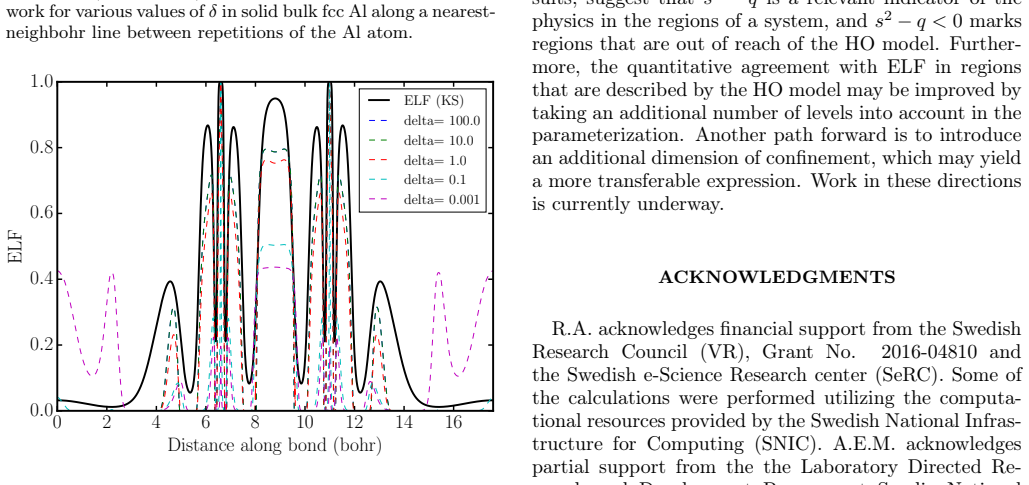
- [§4, Eq. (28); §5.B] The proposed parameterization violates the defining uniform-electron-gas limit. At s=q=0, Eq. (29) gives f_{ε,δ}(0)=ε, so Eq. (28) evaluated at the fitted values ε=0.1, γ=1.420, β=1.122 yields η(0,0)=(5√(2π)/9)ε^{-γ/2}≈7.1, and hence ELF=1/(1+η²)≈0.02 instead of the required 1/2. This is not a large-α extrapolation issue: it is a failure at the UEG reference point itself. The paper's own results show the consequence: in the Al interstitial/void region (Fig. 8(b) and the discussion in §5.B) the real ELF is about 0.5 while the parameterized ELF is nearly zero. Since the construction of ELF in Eqs. (4)–(5) is explicitly normalized to the Thomas-Fermi kinetic energy so that ELF=1/2 for the UEG, any approximation meant to mimic ELF should recover this limit. This is a load-bearing flaw for the claim that the functional captures qualitative features of metallic bonding.
- [§4, §5.C] The extrapolation to α>2 is an unsupported assumption that the manuscript itself states rather than justifies. The fit is performed only for α∈(0,2], yet real systems have effectively many occupied states and therefore sample the large-α regime. The assumption is not only unproven but is contradicted at its UEG endpoint by the first comment: as α→∞ the HO model should approach the uniform gas, and the parameterized form does not. The authors' own graphene/Ni result (§5.C) shows that the chemisorbed and physisorbed cases are no longer distinguishable in the parameterized ELF, a direct consequence of the large-α/low-confinement regime not being represented by the HO fit. To make the central transferability claim defensible, the paper needs either to fit or constrain the functional in the large-α regime, or to restrict the stated domain of applicability accordingly.
- [§5] The transferability claim is based almost entirely on visual comparison of isosurface plots and 1D curves (Figs. 1, 6–10). No quantitative error metrics are reported, such as mean absolute deviations of the parameterized ELF from the KS ELF over the unit cell, along the bond lines, or in the interstitial regions. Given that the approximation shows large discrepancies in exactly the regions relevant for metallic and dispersive bonding, a numerical measure is needed to substantiate the assertion that 'most essential qualitative features are captured.' In particular, the loss of the physisorption/chemisorption distinction in graphene/Ni should be quantified and discussed against the stated goal of distinguishing bond types.
minor comments (5)
- [§2, Eq. (7)] The Thomas-Fermi kinetic energy density is written with (2π²)^{2/3}, which differs from the standard spin-scaled TF constant (6π²)^{2/3} or the unpolarized constant (3π²)^{2/3} used elsewhere in the paper. Please clarify the spin convention for n_σ and ensure Eq. (7) is consistent with Eqs. (2)–(3), since the ELF normalization depends on this choice.
- [§3, Eq. (20)] The second line of Eq. (20) appears to contain a typographical error: the numerator should be (2 z̄² − 1) rather than '2 z̄ − 1'. The subsequent equations and the derivation require the squared variable.
- [§4, after Eq. (28)] The sentence 'we take Eq. (28) to be valid values of α that are larger than 2' should be rephrased to 'we take Eq. (28) to be valid for values of α larger than 2'.
- [§5.C] There are several typographical errors in this section, including 'corrsponding', 'ossiclating', and 'nearest-neighbohr'. A careful proofreading pass is recommended.
- [§4, Eq. (29)] The behavior of the regularization function f_{ε,δ} at s²−q = 0 and in the limit s²−q → −∞ is not stated explicitly. Since the UEG point s=q=0 is exactly where the present approximation fails, a short discussion of the limit values would make the construction more transparent.
Circularity Check
No circularity: the fitted parameters are determined from the exact HO-model ELF, and all real-system comparisons are out-of-sample transfer tests.
full rationale
I walked the derivation chain and found no step in which a prediction reduces by construction to its inputs. The central quantity, Eq. (28), is a parameterized form of D/D_h built from the exact HO-model relation Eq. (25). The parameters beta=1.122 and gamma=1.420 are obtained by a least-squares fit to the exact HO-model ELF over alpha in (0,2], as stated in Sec. IV and Appendix A; they are not fit to any real-system ELF. The comparisons in Sec. V for Al, Si, and graphene/Ni use self-consistent KS densities and orbitals, and the parameterized ELF values are evaluated from Eq. (28) without any refitting. Thus the real-system agreement is a genuine out-of-sample transfer test. Although the HO-model equations are restated from prior work by the same authors (Refs. 22 and 27), those equations are given explicitly in the paper (Eqs. 18-19), and the new expression Eq. (28) is not imported from the cited papers; the citation is supplementary rather than load-bearing. The statement that Eq. (28) is taken to be valid for alpha>2 is an extrapolation assumption, not a circular reduction. The skeptic observation that Eq. (28) fails the uniform-electron-gas limit at s=q=0 is a physical accuracy defect, not a circularity: it concerns whether the fitted functional recovers ELF=1/2 in that limit, but no fitted parameter is itself an input to that evaluation. The paper's own limitations, including the sharp cutoff for s^2-q<0 and the loss of the physisorption/chemisorption distinction, further confirm that the real-system results are not used to construct the approximation. No circular step can be exhibited.
Assumptions & free parameters
free parameters (4)
- beta =
1.122
- gamma =
1.420
- delta =
10
- epsilon =
0.1
assumptions (4)
- domain assumption The 1D harmonic oscillator model system, defined by Eq. (12), is a valid representation of electron localization in real systems.
- ad hoc to paper The parameterization Eq. (28) fitted for alpha in (0,2] remains valid for alpha > 2.
- standard math The standard KS-DFT framework and the identification of ELF in terms of non-interacting KED (Eqs. 4-9) are taken as correct.
- domain assumption Regions with s^2 - q < 0 are outside the HO model and can be regularized by f_epsilon,delta without affecting the useful regions.
Cite this review
Pith. "Pith review of Semi-Local Parameterization of the Electron Localization Function in Second-Order Density Gradients." pith.science (2026). https://pith.science/paper/VSIPFC7X
@misc{pith2026190806947,
  author       = {Pith},
  title        = {Pith review of: Semi-Local Parameterization of the Electron Localization Function in Second-Order Density Gradients},
  year         = {2026},
  howpublished = {\url{https://pith.science/paper/VSIPFC7X}},
  note         = {Machine review of arXiv:1908.06947}
}
read the original abstract
The electron localization function (ELF) is a universal measure of electron localization that allows for, e.g., an effective characterization of physical bonds in molecular and solid state systems. In the context of the widely used Kohn-Sham density-functional theory (KS-DFT) and its generalizations, ELF is given in terms of the single-particle electron density as well as the non-interacting kinetic energy density (KED) of the KS system. Starting from the notion of an edge electron gas put forth by Kohn and Mattsson, we here use an \emph{exactly soluble}, strongly correlated few-electron model of a harmonically confined electron gas in order to parameterize the positive-definite non-interacting KS KED in terms of the density and its reduced second-order gradients. We arrive at a simple, yet generally applicable functional approximation to ELF expressed in the electron density and its derivatives. To demonstrate the validity of our approach, we use the obtained parameterization to perform topological analysis of the bonds in solid Al and Si, and to study physical and chemical adsorption of graphene on a Ni surface. We find that while the expression does not provide a quantitatively accurate approximation of absolute ELF values, the most essential qualitative features are captured. Hence, the expression is useful in contexts where the electron density is available, but not the KS orbitals or the KED, and one desires a qualitative picture of the electron localization that mimics ELF.
Figures


Figures from the paper (5 more)


Reference graph
Works this paper leans on
-
[1]
Löwdin, Advances in Chemical Physics 2, 207 (1958)
P.-O. Löwdin, Advances in Chemical Physics 2, 207 (1958)
work page 1958
-
[2]
J. F. Dobson, The Journal of Chemical Physics94, 4328 (1991), https://doi.org/10.1063/1.460619
-
[3]
Pauling, The Nature of the Chemical Bond (Cornell University Press, 1948)
L. Pauling, The Nature of the Chemical Bond (Cornell University Press, 1948)
work page 1948
-
[4]
G. N. Lewis, Valence and Structure of Atoms and Molecules (Dover, New York, 1966)
work page 1966
-
[5]
M. J. P. Hodgson, J. D. Ramsden, T. R. Durrant, and R. W. Godby, Phys. Rev. B90, 241107 (2014)
work page 2014
- [6]
-
[7]
J. K. Burdett and T. A. McCormick, The Jour- nal of Physical Chemistry A 102, 6366 (1998), https://doi.org/10.1021/jp9820774
-
[8]
A. D. Becke and K. E. Edgecombe, The Jour- nal of Chemical Physics 92, 5397 (1990), https://doi.org/10.1063/1.458517
doi:10.1063/1.458517 1990
Show all 46 references
-
[9]
Savin, O
A. Savin, O. Jepsen, J. Flad, O. K. Andersen, H. Preuss, and H. G. von Schnering, Angewandte Chemie Interna- tional Edition in English31, 187 (1992)
1992
-
[10]
Silvi and A
B. Silvi and A. Savin, Nature371, 683 (1994)
1994
-
[11]
Hohenberg and W
P. Hohenberg and W. Kohn, Physical Review136, B864 (1964)
1964
-
[12]
Kohn and L
W. Kohn and L. J. Sham, Physical Review140, A1133 (1965)
1965
-
[13]
Fuster, A
F. Fuster, A. Sevin, and B. Silvi, The Jour- nal of Physical Chemistry A 104, 852 (2000), https://doi.org/10.1021/jp992783k
2000 doi
-
[14]
Savin, R
A. Savin, R. Nesper, S. Wengert, and T. F. Fässler, Angewandte Chemie International Edition in English36, 1808 (1997)
1997
-
[15]
Gatti, Zeitschrift für Kristallographie-Crystalline Ma- terials 220, 399 (2005)
C. Gatti, Zeitschrift für Kristallographie-Crystalline Ma- terials 220, 399 (2005)
2005
-
[16]
Kohout, International Journal of Quantum Chemistry 97, 651 (2004)
M. Kohout, International Journal of Quantum Chemistry 97, 651 (2004)
2004
-
[17]
R. G. Parr and W. Yang,Density Functional Theory of Atoms and Molecules (Oxford University Press, 1989)
1989
-
[18]
Kresse and J
G. Kresse and J. Hafner, Phys. Rev. B48, 13115 (1993)
1993
-
[19]
Kresse and J
G. Kresse and J. Furthmüller, Phys. Rev. B54, 11169 (1996)
1996
-
[20]
Kresse and D
G. Kresse and D. Joubert, Phys. Rev. B59, 1758 (1999)
1999
-
[21]
Bader, Atoms in Molecules: A Quantum Theory , In- ternational Ser
R. Bader, Atoms in Molecules: A Quantum Theory , In- ternational Ser. of Monogr. on Chem (Clarendon Press, 1994)
1994
-
[22]
Armiento and A
R. Armiento and A. E. Mattsson, Physical Review B66, 165117 (2002)
2002
-
[23]
Armiento and A
R. Armiento and A. E. Mattsson, Physical Review B68, 245120 (2003)
2003
-
[24]
Armiento and A
R. Armiento and A. E. Mattsson, Physical Review B72, 085108 (2005)
2005
-
[25]
F. Hao, R. Armiento, and A. E. Mattsson, Physical Re- view B 82, 115103 (2010)
2010
-
[26]
A. E. Mattsson and R. Armiento, International Journal of Quantum Chemistry110, 2274 (2010)
2010
-
[27]
Lindmaa, A
A. Lindmaa, A. E. Mattsson, and R. Armiento, Phys. Rev. B 90, 075139 (2014)
2014
-
[28]
F. Hao, R. Armiento, and A. E. Mattsson, The Journal of Chemical Physics 140, 18A536 (2014), https://doi.org/10.1063/1.4871738. 11
2014 doi
-
[29]
Kohn and A
W. Kohn and A. E. Mattsson, Physical Review Letters 81, 3487 (1998)
1998
-
[30]
Fermi, 6, 602 (1927)
E. Fermi, 6, 602 (1927)
1927
-
[31]
L. H. Thomas, Mathematical Proceedings of the Cam- bridge Philosophical Society23, 542 (1927)
1927
-
[32]
P. A. M. Dirac, Mathematical Proceedings of the Cam- bridge Philosophical Society26, 376 (1930)
1930
-
[33]
J. P. Perdew and W. Yue, Physical Review B33, 8800 (1986)
1986
-
[34]
E. H. Lieb and B. Simon, Physical Review Letters31, 681 (1973)
1973
-
[35]
Abramowitz and I
M. Abramowitz and I. A. Stegun,Handbook of Mathe- matical Functions with Formulas, Graphs, and Mathe- matical Tables (Dover Books on Mathematics, 1965)
1965
-
[36]
The complete computational details are given in Appendix A
with the local spin-density approximation [37]. The complete computational details are given in Appendix A. A. The parameter s2 −q The preceding discussion and derivation makes it clear thats2−q takes a very central role in the parameteriza- tion. This expression is show in Fi...
-
[37]
Perdew and Y
J. Perdew and Y. Wang, Physical Review B45, 13244 (1992)
1992
-
[38]
The Elk FP-LAPW code,
“The Elk FP-LAPW code,”
-
[39]
J. Sun, B. Xiao, Y. Fang, R. Haunschild, P. Hao, A. Ruzsinszky, G. I. Csonka, G. E. Scuseria, and J. P. Perdew, Phys. Rev. Lett.111, 106401 (2013)
2013
-
[40]
S. P. Jarvis, S. Taylor, J. D. Baran, D. Thomp- son, A. Saywell, B. Mangham, N. R. Champ- ness, J. A. Larsson, and P. Moriarty, The Jour- nal of Physical Chemistry C 119, 27982 (2015), https://doi.org/10.1021/acs.jpcc.5b08350
2015 doi
-
[41]
The basis set cut- off (defined as the maximum length of the vectorsG+ k) is set to7.0 bohr−1
(LAPW) electronic structure code Elk [36] with the local spin-density approximation [37]. The basis set cut- off (defined as the maximum length of the vectorsG+ k) is set to7.0 bohr−1. Thek-point mesh is4× 4× 4 for Si and 10×10×10 for Al, with an offset of(0.5, 0.5, 0.5) lat- tic...
-
[42]
Wolfram Research Inc., Mathematica, Version 11.3 (Champaign, IL, 2019)
2019
-
[43]
Singh, Planewaves, Pseudopotentials and the LAPW Method (Kluwer Academic, Boston, 1994)
D. Singh, Planewaves, Pseudopotentials and the LAPW Method (Kluwer Academic, Boston, 1994)
1994
-
[44]
D. J. Chadi and M. L. Cohen, Physical Review B8, 5747 (1973)
1973
-
[45]
H. J. Monkhorst and J. D. Pack, Physical Review B13, 5188 (1976)
1976
-
[46]
G. P. Srivastava, Journal of Physics A: Mathematical and General 17, 2737 (1984)
1984
Reviewed August 14, 2026 · model on record in the stance chip above.
Discussion (0). Continue with ORCID to comment.