A fast sum-of-Gaussians algorithm for the high-dimensional fractional Fokker-Planck equation
Pith reviewed 2026-06-29 02:56 UTC · model grok-4.3
The pith
A sum-of-Gaussians approximation turns the fundamental solution of the fractional Fokker-Planck equation into a sum of separable heat kernels.
A machine-rendered reading of the paper's core claim, the machinery that carries it, and where it could break.
Core claim
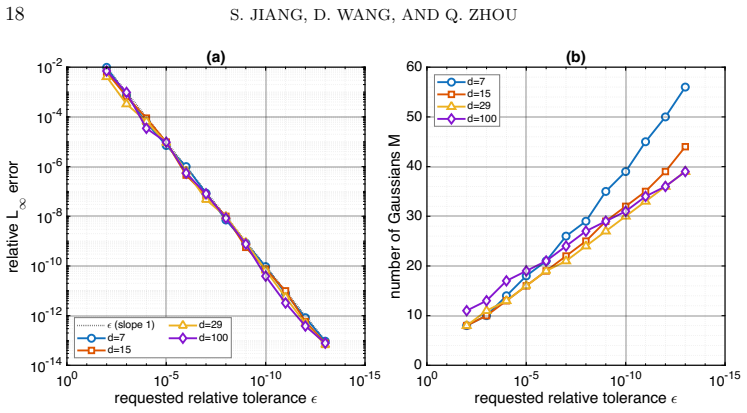
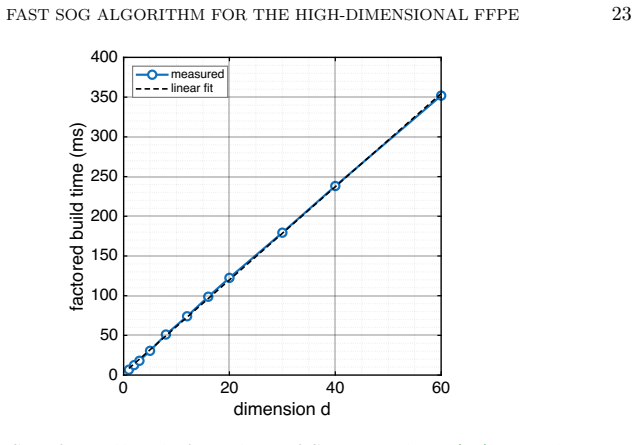
The fundamental solution is represented as a separated sum of heat kernels obtained by applying a sum-of-Gaussians quadrature to the nonseparable stretched exponential that appears in the Fourier symbol; each term factorizes across coordinates, so that on a tensor-product grid the representation is assembled in O(M d N) operations where M grows only logarithmically with inverse tolerance and accuracy is preserved up to dimension 10^5.
What carries the argument
Sum-of-Gaussians quadrature applied to the Laplace-transform representation of the stretched exponential (itself the Fourier symbol of the fractional operator), justified by its complete monotonicity as the transform of a one-sided α-stable density.
If this is right
- Any initial datum expressible as a finite sum of tensor products can be evolved in closed form using only one-dimensional convolutions.
- Storage and arithmetic cost on a tensor grid scale linearly with dimension rather than exponentially.
- An a-priori error bound holds for the pure-fractional case and supplies an explicit parameter-selection rule for given accuracy over chosen space-time ranges.
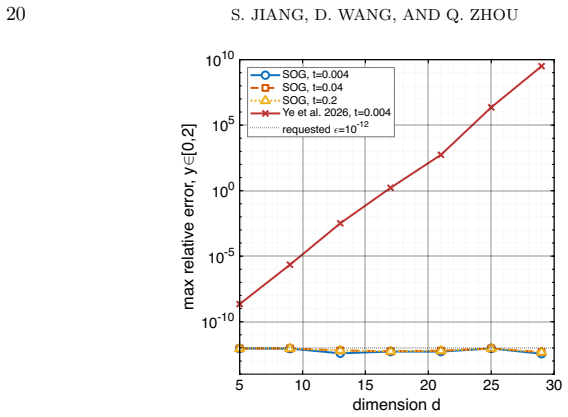
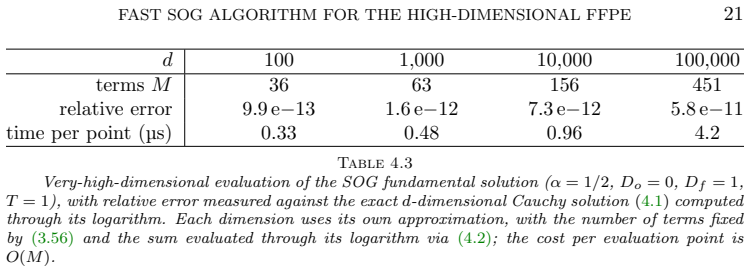
- Accuracy exceeding ten digits is maintained in dimensions up to 10^5, exceeding the range reachable by radial quadrature on the same problem.
Where Pith is reading between the lines
- The separated representation supplies a concrete class of high-dimensional solutions whose error can be tracked analytically, offering a test bed for tensor-network or neural-network approximations to more general data.
- Because the same complete-monotonicity argument applies to other Fourier multipliers whose symbols are completely monotone, the technique extends immediately to other fractional operators whose symbols admit Laplace representations.
- The logarithmic growth of M with tolerance suggests the method remains practical for tolerances far below machine epsilon, provided the one-dimensional convolutions can be performed to matching precision.
Load-bearing premise
The stretched exponential arising from the fractional operator is completely monotone and therefore equals the Laplace transform of a one-sided α-stable density.
What would settle it
Compute the relative error of the sum-of-Gaussians fundamental solution against a direct Fourier inversion on a moderate-dimensional grid for a sequence of tolerances; the error should remain below the prescribed tolerance while the number of terms grows only logarithmically.
Figures
read the original abstract
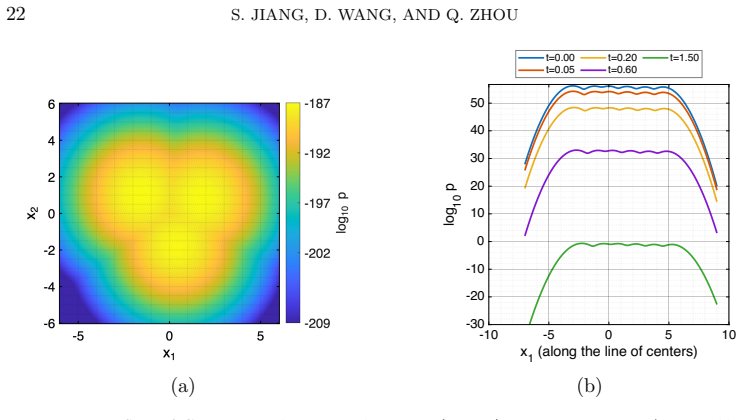
We present a fast, high-order algorithm for the free-space fractional Fokker-Planck equation (FFPE) in arbitrary spatial dimension. Its fundamental solution, corresponding to a Dirac-delta initial condition, is obtained from the explicit Fourier representation by applying a sum-of-Gaussians (SOG) approximation to the nonseparable stretched exponential, using its complete monotonicity as the Laplace transform of a one-sided $\alpha$-stable density. Each Gaussian term is an ordinary heat kernel and therefore factorizes across spatial coordinates. On a tensor-product grid, the separated form can be assembled in $O(MdN)$ work and storage, rather than forming all $O(N^d)$ grid values, where $M$ is the number of Gaussian terms and $N$ is the number of points per dimension. We prove an a~priori error estimate for the pure-fractional fundamental solution and give a parameter-selection procedure for prescribed accuracy over specified ranges of space and time. In numerical experiments the method achieves more than ten digits of relative accuracy, with $M$ growing only logarithmically in the inverse tolerance, and maintains this accuracy in dimensions up to $d=10^{5}$. This exceeds the dimensions reached in comparable radial-quadrature tests, where the integrand becomes increasingly oscillatory as the dimension grows. Because the method represents the fundamental solution as a separated sum of heat kernels, any initial datum given as a finite sum of tensor products can be evolved in closed form using only one-dimensional convolutions. This yields a computable class of high-dimensional solutions that is amenable to error analysis, and tensor neural networks provide one possible way to construct such separated representations for more general data.
Editorial analysis
A structured set of objections, weighed in public.
Referee Report
Summary. The manuscript presents a fast algorithm for the free-space high-dimensional fractional Fokker-Planck equation. The fundamental solution is obtained from its Fourier representation by applying a sum-of-Gaussians (SOG) approximation to the stretched exponential exp(−t|ξ|^α), justified by its complete monotonicity as the Laplace transform of a one-sided α-stable density. Each term is a separable heat kernel, enabling O(M d N) assembly and storage on tensor-product grids. The paper states an a priori error estimate for the pure-fractional case together with a parameter-selection procedure, and reports numerical results achieving more than ten digits of relative accuracy with M growing only logarithmically in the inverse tolerance, up to d = 10^5.
Significance. If the central claims hold, the work supplies a dimension-robust method for a class of fractional evolution equations whose direct discretization is prohibitive in high d. The separation into heat kernels, the a priori error control, and the logarithmic scaling of M constitute concrete strengths; the approach also yields an explicit class of high-dimensional solutions amenable to further analysis via one-dimensional convolutions.
minor comments (2)
- [Abstract and § on error estimate] The abstract and introduction should state the precise range of t and |x| over which the reported ten-digit accuracy and the a priori error bound are guaranteed; without this the parameter-selection procedure cannot be fully assessed.
- [SOG construction section] Clarify whether the quadrature rule used to discretize the Laplace-transform integral for the SOG coefficients is the same for all α ∈ (0,2] or whether its nodes/weights depend on α; this affects the claimed dimension independence.
Simulated Author's Rebuttal
We thank the referee for the careful reading and positive assessment of the manuscript, including the recognition of the dimension-robust separated representation, a priori error control, and logarithmic scaling of M. The recommendation for minor revision is noted. No specific major comments were provided in the report, so we address the overall evaluation below.
Circularity Check
No significant circularity
full rationale
The paper begins from the known Fourier representation of the FFPE fundamental solution and invokes the standard fact that exp(−t |ξ|^α) is completely monotone (hence the Laplace transform of a one-sided α-stable density) to obtain an exact integral representation as a mixture of Gaussians. The subsequent finite SOG is produced by quadrature whose error is controlled independently of dimension. No equation reduces the target quantity to a fitted parameter defined by the same data, no load-bearing step rests on a self-citation, and the central construction is self-contained against external mathematical benchmarks.
Axiom & Free-Parameter Ledger
free parameters (1)
- M (number of Gaussian terms)
axioms (1)
- domain assumption The Fourier symbol of the fractional operator yields a stretched exponential that is completely monotone and equals the Laplace transform of a one-sided α-stable density.
Reference graph
Works this paper leans on
-
[1]
1986 , publisher=
One-dimensional stable distributions , author=. 1986 , publisher=
1986
-
[2]
1981 , publisher=
Approximation theory and methods , author=. 1981 , publisher=
1981
-
[3]
SIAM Rev
The exponentially convergent trapezoidal rule , author=. SIAM Rev. , volume=. 2014 , publisher=
2014
-
[4]
A Fast and Accurate Solver for the Fractional
Ye, Qihao and Tian, Xiaochuan and Wang, Dong , journal=. A Fast and Accurate Solver for the Fractional. 2026 , publisher=
2026
-
[5]
Exact and explicit probability densities for one-sided
Penson, Karol A and G. Exact and explicit probability densities for one-sided. Phys. Rev. Lett. , volume=. 2010 , publisher=
2010
-
[6]
2011 , publisher=
Fourier Analysis: An Introduction , author=. 2011 , publisher=
2011
-
[7]
2020 , publisher=
Predescu, Cristian and Lerer, Adam K and Lippert, Ross A and Towles, Brian and Grossman, JP and Dirks, Robert M and Shaw, David E , journal=. 2020 , publisher=
2020
-
[8]
1989 , publisher=
Risken, Hannes , booktitle=. 1989 , publisher=
1989
-
[9]
Stochastic processes: Time evolution, symmetries and linear response , author=. Phys. Rep. , volume=. 1982 , publisher=
1982
-
[10]
Einstein, Albert , journal=
-
[11]
Stochastic problems in physics and astronomy , author=. Rev. Mod. Phys. , volume=. 1943 , publisher=
1943
-
[12]
2014 , publisher=
Stochastic processes in cell biology , author=. 2014 , publisher=
2014
-
[13]
The pricing of options and corporate liabilities , author=. J. Polit. Econ. , volume=. 1973 , publisher=
1973
-
[14]
Thermodynamic uncertainty relation for biomolecular processes , author=. Phys. Rev. Lett. , volume=. 2015 , publisher=
2015
-
[15]
Information thermodynamics on causal networks , author=. Phys. Rev. Lett. , volume=. 2013 , publisher=
2013
-
[16]
Stochastic gradient descent as approximate
Mandt, Stephan and Hoffman, Matthew D and Blei, David M , journal=. Stochastic gradient descent as approximate
-
[17]
Weak Ergodicity Breaking of Receptor Motion in Living Cells Stemming from Random Diffusivity , author =. Phys. Rev. X , volume =. 2015 , month =
2015
-
[18]
Ergodic and nonergodic processes coexist in the plasma membrane as observed by single-molecule tracking , author=. Proc. Natl. Acad. Sci. USA , volume=. 2011 , publisher=
2011
-
[19]
The random walk's guide to anomalous diffusion: a fractional dynamics approach , author=. Phys. Rep. , volume=. 2000 , publisher=
2000
-
[20]
Acta Numer
Numerical methods for nonlocal and fractional models , author=. Acta Numer. , volume=. 2020 , publisher=
2020
-
[21]
Ecology , volume=
Displaced honey bees perform optimal scale-free search flights , author=. Ecology , volume=. 2007 , publisher=
2007
-
[22]
A deterministic approximation of diffusion equations using particles , author=. SIAM J. Sci. Stat. Comput. , volume=. 1990 , publisher=
1990
-
[23]
Positivity-preserving and energy-dissipative finite difference schemes for the
Hu, Jingwei and Zhang, Xiangxiong , journal=. Positivity-preserving and energy-dissipative finite difference schemes for the. 2023 , publisher=
2023
-
[24]
A second-order accurate numerical approximation for the fractional diffusion equation , author=. J. Comput. Phys. , volume=. 2006 , publisher=
2006
-
[25]
The variational formulation of the
Jordan, Richard and Kinderlehrer, David and Otto, Felix , journal=. The variational formulation of the. 1998 , publisher=
1998
-
[26]
A fully discrete variational scheme for solving nonlinear
Junge, Oliver and Matthes, Daniel and Osberger, Horst , journal=. A fully discrete variational scheme for solving nonlinear. 2017 , publisher=
2017
-
[27]
A positivity-preserving high order discontinuous Galerkin scheme for convection--diffusion equations , author=. J. Comput. Phys. , volume=. 2018 , publisher=
2018
-
[28]
Solving high-dimensional partial differential equations using deep learning , author=. Proc. Natl. Acad. Sci. USA , volume=. 2018 , publisher=
2018
-
[29]
Score-based physics-informed neural networks for high-dimensional
Hu, Zheyuan and Zhang, Zhongqiang and Karniadakis, George E and Kawaguchi, Kenji , journal=. Score-based physics-informed neural networks for high-dimensional. 2025 , publisher=
2025
-
[30]
Neural Parametric
Liu, Shu and Li, Wuchen and Zha, Hongyuan and Zhou, Haomin , journal=. Neural Parametric. 2022 , publisher=
2022
-
[31]
Solving high-dimensional
Tang, Xun and Ying, Lexing , journal=. Solving high-dimensional. 2024 , publisher=
2024
-
[32]
A novel and accurate finite difference method for the fractional
Duo, Siwei and van Wyk, Hans Werner and Zhang, Yanzhi , journal=. A novel and accurate finite difference method for the fractional. 2018 , publisher=
2018
-
[33]
Kammler, D. W. , title =. J. Math. Anal. Appl. , volume =. 1977 , publisher =
1977
-
[34]
and Monz
Beylkin, G. and Monz. On computing distributions of products of non-negative independent random variables , journal =. 2019 , publisher =
2019
-
[35]
and Liang, J
Gao, Z. and Liang, J. and Xu, Z. , title =. J. Sci. Comput. , volume =. 2022 , publisher =
2022
-
[36]
Acta Numer
Numerical methods for nonlocal and fractional models , author=. Acta Numer. , volume=
-
[37]
Numerical operator calculus in higher dimensions , author=. Proc. Natl. Acad. Sci. USA , volume=
-
[38]
Algorithms for numerical analysis in high dimensions , author=. SIAM J. Sci. Comput. , volume=
-
[39]
Tensor Spaces and Numerical Tensor Calculus , author=
-
[40]
Tensor Neural Network and Its Numerical Integration , author =. J. Comput. Math. , volume =
-
[41]
SIAM Rev
Tensor Decompositions and Applications , author =. SIAM Rev. , volume =
-
[42]
Tensor-Train Decomposition , author =. SIAM J. Sci. Comput. , volume =
-
[43]
The Density-Matrix Renormalization Group in the Age of Matrix Product States , author =. Ann. Phys. , volume =
-
[44]
A Practical Introduction to Tensor Networks: Matrix Product States and Projected Entangled Pair States , author =. Ann. Phys. , volume =
-
[45]
Advances in Neural Information Processing Systems 28 , pages =
Tensorizing Neural Networks , author =. Advances in Neural Information Processing Systems 28 , pages =. 2015 , publisher =
2015
-
[46]
Advances in Neural Information Processing Systems 29 , pages =
Supervised Learning with Tensor Networks , author =. Advances in Neural Information Processing Systems 29 , pages =. 2016 , publisher =
2016
-
[47]
Tensor Field Networks: Rotation- and Translation-Equivariant Neural Networks for 3D Point Clouds , author =
-
[48]
arXiv preprint arXiv:1708.00006 , year =
Tensor Networks in a Nutshell , author =. arXiv preprint arXiv:1708.00006 , year =
-
[49]
arXiv preprint arXiv:2302.09019 , year =
Tensor Networks Meet Neural Networks: A Survey and Future Perspectives , author =. arXiv preprint arXiv:2302.09019 , year =
-
[50]
Computing Multi-Eigenpairs of High-Dimensional Eigenvalue Problems Using Tensor Neural Networks , author =. J. Comput. Phys. , volume =
-
[51]
Solving High-Dimensional Partial Differential Equations Using Tensor Neural Network and A Posteriori Error Estimators , author =. J. Sci. Comput. , volume =
-
[52]
arXiv preprint arXiv:2508.10454 , year =
Qi Zhou and Teng Wu and Jianghao Liu and Qingyuan Sun and Hehu Xie and Zhenli Xu , title =. arXiv preprint arXiv:2508.10454 , year =
-
[53]
On approximation of functions by exponential sums , journal =
Beylkin, Gregory and Monz. On approximation of functions by exponential sums , journal =. 2005 , publisher =
2005
-
[54]
Qiang Du and Max Gunzburger and R. B. Lehoucq and Kun Zhou , title =. SIAM Rev. , volume =
-
[55]
Qiang Du and Max Gunzburger and R. B. Lehoucq and Kun Zhou , title =. Math. Models Methods Appl. Sci. , volume =
-
[56]
Xiaochuan Tian and Qiang Du , title =. SIAM J. Numer. Anal. , volume =
-
[57]
ESAIM Math
Michael Griebel and Jan Hamaekers , title =. ESAIM Math. Model. Numer. Anal. , volume =
-
[58]
Harry Yserentant , title =. Numer. Math. , volume =. 2004 , issn =
2004
-
[59]
Shen, Jie and Yu, Haijun , title =. SIAM J. Sci. Comput. , volume =
-
[60]
Shen, Jie and Xu, Jie and Yang, Jiang , title =. J. Comput. Phys. , volume =
-
[61]
The Journal of Chemical Physics , volume =
Wu, Teng and Zhou, Qi and Zheng, Huangjie and Xie, Hehu and Xu, Zhenli , title =. The Journal of Chemical Physics , volume =. 2026 , month =
2026
discussion (0)
Sign in with ORCID, Apple, or X to comment. Anyone can read and Pith papers without signing in.