REVIEW 3 major objections 5 minor 40 references
CD-30°11223 is not a supernova progenitor: rotation and magnetic angular-momentum transport quench the helium detonation, leaving a CO white dwarf with a 0.194-solar-mass He/C/O envelope.
Reviewed by Pith at T0; open to challenge. T0 means a machine referee read the full paper against a public rubric. the ladder, T0–T4 →
T0 review · deepseek-v4-flash
2026-08-01 13:02 UTC pith:VSNZLXLW
load-bearing objection A careful rotating-binary evolution model that likely kills the SN Ia progenitor claim for CD-30, but the blanket generalization to all similar systems outruns the evidence. the 3 major comments →
Will a Supernova explode in CD-30{deg}11223?
The pith
A machine-rendered reading of the paper's core claim, the machinery that carries it, and where it could break.
Core claim
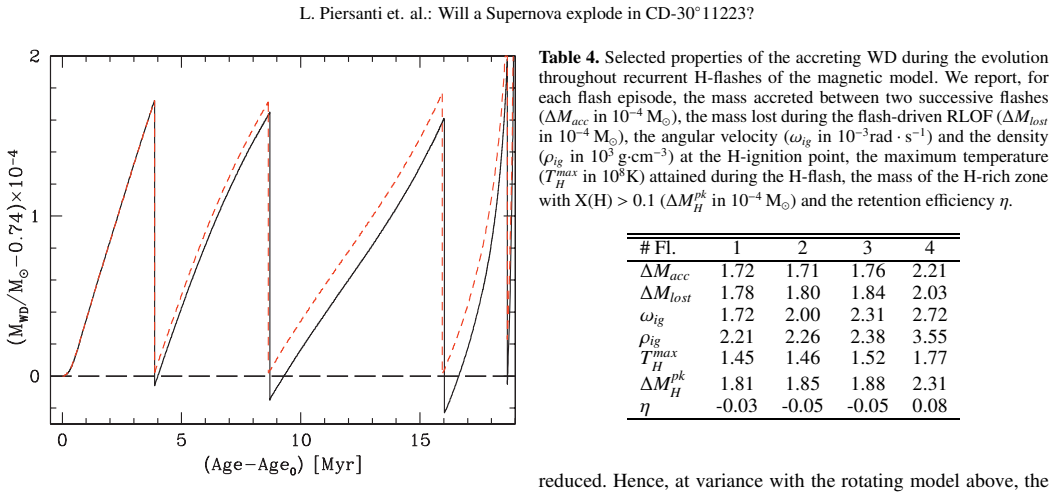
The paper's central claim: CD-30°11223 is not a supernova progenitor. If rotation is ignored, the model produces a double detonation and a peculiar Type Ia event. Once rotation and magnetic angular-momentum transport are included, the accretor never reaches detonation: two very strong helium flashes (peak temperature ~1.35×10⁹ K, below detonation threshold) eject much of the accreted matter via Roche-lobe overflow. The final structure is a CO core capped by a ~0.194-solar-mass He/C/O envelope, with the donor reduced to an extremely low mass. The conclusion is extended to all detached binaries with similar masses and orbital periods.
What carries the argument
Rotation, and the internal redistribution of angular momentum by a magnetic dynamo instability in the differentially rotating white dwarf. The instability enforces nearly rigid rotation, so that during helium accretion the surface spin approaches the critical break-up rate. Centrifugal support then lowers the effective gravity of the accreted layers, reducing compressional heating — the heating that would otherwise drive the helium layer to detonation. Magnetic transport also suppresses mixing, so flashes burn inside the accreted layer rather than eroding the core. Each strong flash instead triggers Roche-lobe overflow that ejects most of the freshly accreted matter.
Load-bearing premise
The load-bearing premise is that the white dwarf spins up as it accretes and that magnetic instabilities redistribute that angular momentum efficiently enough to lower the effective gravity in the helium layer; if tides from the companion slow the white dwarf significantly, the helium could compress and detonate as in the non-rotating model.
What would settle it
Measure or infer the white dwarf's surface rotation in a CD-30-like system that is already transferring mass: if it is locked near the orbital period (70.5 min) rather than near critical rotation, the spin-up premise fails and the non-rotating detonation path remains open. A complementary check: a 3D hydrodynamic simulation of the first strong helium flash at the reported ignition density (~7×10⁵ g/cm³) that produces a self-sustaining detonation would directly overturn the magnetic-model conclusion.
If this is right
- CD-30°11223 will end as a stable CO white dwarf with a ~0.194-solar-mass He/C/O buffer, accreting at a very low rate from a nearly exhausted donor.
- The suppression of detonation is robust to how angular momentum is transported: both shear-driven and magnetically enforced rigid rotation remove the explosion, though with different flash histories.
- The conclusion is extended to detached sdB+WD binaries with similar component masses and orbital periods, removing part of the proposed double-detonation SN Ia progenitor population.
- In the magnetic model, artificially draining the white dwarf's angular momentum on timescales from 1 to 10⁹ years never reignites helium, because the whole star compresses homologously instead of heating a local shell.
- The non-rotating model, by contrast, yields a double detonation, a peculiar Type Ia-like event, and a hypervelocity donor (~747 km/s).
Where Pith is reading between the lines
- Editorial inference: if tidal torques from the companion brake the white dwarf efficiently — an effect the paper explicitly leaves to future work — the spin-up premise fails and the non-rotating detonation path could be restored.
- Editorial inference: for more massive white dwarfs (≳0.9 solar masses), where a much thinner helium layer can detonate, the same rotation mechanism may not suffice to suppress explosions; the paper's conclusion should not be extrapolated there without retesting.
- Editorial inference: population models of Type Ia supernovae from sdB+WD binaries should be revised downward; a statistical prediction is a deficit of the dim, peculiar supernovae this channel was invoked to explain.
- Editorial inference: the predicted end state — a massive He/C/O buffer on a CO white dwarf with a very low-mass companion — offers a concrete observational fingerprint for systems caught near the end of mass transfer.
Editorial analysis
A structured set of objections, weighed in public.
Referee Report
Summary. The paper models the future evolution of the sdB+WD binary CD-30°11223 using the FuNS stellar evolution code. Three models are compared: a non-rotating accretor, a rotating accretor with rotation-driven instabilities, and a rotating model with Tayler-Spruit magnetic angular-momentum transport. In the non-rotating model, helium accretion leads to a helium detonation and a SN Ia-like event (0.98 foe, 0.243 Msun of 56Ni). In both rotating models, rotation reduces compressional heating so that strong helium flashes eject material without detonation; the magnetic model ends with a CO white dwarf capped by a massive He/C/O envelope (ΔM_env ~ 0.194 Msun) and a low-mass remnant of the donor. The authors conclude that CD-30 cannot be regarded as a SN Ia progenitor and generalize this to all detached binary systems with similar masses and orbital periods.
Significance. If the conclusion holds, it removes a proposed SN Ia progenitor channel for low-mass CO white dwarfs in sdB+WD binaries and strengthens the case that rotation must be included in double-detonation studies. The main strength is that the non-detonation outcome is reproduced in two rotating models with different angular-momentum transport prescriptions (purely hydrodynamical instabilities vs. Tayler-Spruit), so the qualitative result is not an artifact of one transport scheme. The work is forward modeling with standard external physics; no fitted value is repackaged as a derived prediction. The final configuration is a falsifiable prediction for future observations of CD-30. However, the conclusion is conditional on an unquantified tidal coupling and on extrapolation beyond the end of the computation, and the universal generalization is not supported by a parameter survey.
major comments (3)
- [§7, Eq. (3) of Paper I] The central conclusion depends on the accreting WD retaining near-critical rotation during helium accretion. The paper explicitly states (Sec. 7) that angular momentum is deposited 'such that it could attain critical rotation velocity (Eq. (3) in Paper I)' and that 'the effect of tides that may slow-down rotation awaits exploration.' The non-rotating model (Sec. 4) detonates at M_WD=0.8934 Msun and ρ_ig=1.15e6 g cm^-3; if tidal torques from the 0.47 Msun companion keep the WD near orbital synchronization (ω≈1.5e-3 rad/s for P_orb=70.53 min) rather than near critical (ω_crit is at least an order of magnitude larger), the rotationally reduced compressibility disappears and the Sec. 4 detonation path is restored. Without a tidal synchronization estimate, the 'cannot be regarded as potential progenitor' conclusion is not fully secured.
- [Abstract; §7] The statement that the conclusion 'applies also to all detached binary systems having similar masses of components and orbital periods' is not supported by the computations. Only one initial configuration is evolved (Sec. 3: M_WD=0.74 Msun, M_sdB=0.47 Msun, P0=88.17 min) under two angular-momentum transport prescriptions. No parameter survey is carried out, and the helium-flash behavior in Secs. 5–6 is sensitive to the mass-transfer history and donor composition. The universal claim should be removed or replaced by a clearly qualified statement until a grid of systems is computed.
- [§6.1] The conclusion that the strong first helium flash in the magnetic model does not become a detonation rests on an explicit hydrodynamic code whose details 'will be presented elsewhere.' The flash ignites at ρ_ig=6.99e5 g cm^-3, only a factor ~1.6 below the non-rotating detonation density of 1.15e6 g cm^-3. Since this is the point that separates an explosion from a non-explosion in the magnetic model, the manuscript should provide sufficient numerical detail (resolution, shock-capturing scheme, nuclear network) or a citable code reference; otherwise the no-detonation claim is not independently checkable.
minor comments (5)
- [Abstract] 'We use stellar the evolution code FuNS' should read 'the stellar evolution code'.
- [§2] 'Lagragian' is a typo for 'Lagrangian'.
- [§6.1, Abstract] The computation stops at M_don=0.0197 Msun because 'the adopted input physics became inadequate'; the abstract's 'the system ends its life' is therefore an extrapolation. The final envelope mass ΔM_env≈0.194 Msun should be labeled as an inference from the last computed model.
- [§3/§7] The critical-rotation boundary condition is expressed via Eq. (3) of Paper I, which is not restated here. A brief restatement or summary would make the paper more self-contained.
- [Abstract, §5] The abstract's 'two very strong He-flashes' refers specifically to the magnetic model; the rotating model of Sec. 5 experiences six helium flashes (Table 3). Clarify to avoid confusion.
Circularity Check
No significant circularity: the CD-30 fate is obtained by forward stellar-evolution modeling with independently cited physics, not by a fit or self-citation masquerading as a prediction.
full rationale
The paper's central claim—that CD-30 will not produce a SN Ia—is a forward evolutionary calculation using the FuNS code with physical prescriptions (Endal & Sofia 1978; Spruit 2002; Itoh et al. 1987) that are external to the present result. The non-rotating model does produce a He-detonation and a 0.98-foe SN Ia, while the rotating and magnetic models produce strong but non-dynamical He-flashes; this contrast is a computed outcome, not a definitional identity. The sdB initial model is fitted to observed Teff, log g, and L, but the subsequent evolution to He-accretion and flashes is a genuine prediction rather than a restatement of those fitted quantities. Self-citations to Paper I provide the framework, initial assumptions, and the prescription that accreted angular momentum can bring the WD toward critical rotation (Eq. 3 of Paper I), but the CD-30 calculation itself is independent and the conclusion is not proven by invoking Paper I alone. The acknowledged caveat that 'The effect of tides that may slow-down rotation awaits exploration' identifies an unquantified external assumption on which the no-SN-Ia conclusion depends, but an unvalidated input or model limitation is not the same as circularity. No fitted parameter is renamed as a prediction, no uniqueness theorem is imported from the authors' prior work, and no known result is merely relabeled. The generalization to 'all detached binary systems having similar masses' is an extrapolation from the computed models, not a tautology. Therefore the derivation chain is not circular.
Axiom & Free-Parameter Ledger
free parameters (2)
- H-rich skin mass of sdB donor (ΔM_H) =
6e-4 M_sun
- Initial orbital period at formation (P0) =
88.17 min
axioms (4)
- domain assumption Standard stellar structure and nuclear reaction rates as implemented in FuNS
- domain assumption Angular momentum transport by rotation-driven instabilities and the Tayler-Spruit mechanism (Spruit 2002)
- domain assumption No tidal torques act to remove angular momentum from the accreting WD
- domain assumption Matter lost from the WD during RLOF carries the specific angular momentum of the accretor
read the original abstract
Context: Accretion of He-rich matter onto a low mass carbon-oxygen white dwarf in a binary system with a He-rich donor may lead to an explosive event of Supernova Ia proportion, though with low peak luminosity and peculiar nucleosynthesis. Recently such a statement has been questioned, suggesting that, if the effects of rotation are accounted for in the evolution of the accretor, the latter does not explode, but it becomes a white dwarf with a massive He-buffer. Aims: We investigate the expected evolution of the currently detached binary CD-30{\deg}11223 harboring a 0.74 Msun carbon-oxygen white dwarf and a 0.47 Msun donor with a He-burning core and a very thin H-envelope (Delta M_H=6e-4 Msun). Methods: We use stellar the evolution code FuNS to compute the evolution of CD-30{\deg}11223. With respect to our earlier study of the system PTF J2238+743015.1, we include also the transport of angular momentum due to magnetic instabilities in the accretor interiors (``magnetic model''). Results: During the H-accretion phase, the effects of rotation in the accretor are negligible. In the ``magnetic model'', the angular momentum deposited by the accreted matter is very efficiently redistributed along the whole WD due to magnetic instabilities, so that the angular velocity of the accreted layers remains very low. During the He-accretion phase, the accretor experiences two very strong He-flashes which result in the ejection from the binary system of a large part of the matter previously accreted. The system ends its life as a carbon-oxygen core capped by a massive He/C/O-envelope (Delta M_{env} ~ 0.194 Msun) and an extremely low-mass companion, remnant of the donor. Conclusions: The system CD-30{\deg}11223 cannot be regarded as the potential progenitor of Supernova Ia. Such a conclusion applies also to all detached binary systems having similar masses of components and orbital periods.
Figures




Reference graph
Works this paper leans on
-
[1]
J., Townsley, D
Boos, S. J., Townsley, D. M., Shen, K. J., Caldwell, S., & Mile s, B. J. 2021, ApJ, 919, 126
2021
-
[2]
2018, Mont hly Notices of the Royal Astronomical Society, 482, 4346
Bravo, E., Badenes, C., & Martínez-Rodríguez, H. 2018, Mont hly Notices of the Royal Astronomical Society, 482, 4346
2018
-
[3]
2015, Ap J, 807, 74
Brooks, J., Bildsten, L., Marchant, P ., & Paxton, B. 2015, Ap J, 807, 74
2015
-
[4]
1971, Ap&SS, 10,355
Castellani, V ., Giannone, P ., & Renzini, A. 1971, Ap&SS, 10,355
1971
-
[5]
1928, Mathematische Annalen, 100, 32
Courant, R., Friedrichs, K., & Lewy, H. 1928, Mathematische Annalen, 100, 32
1928
-
[6]
2009, ApJ, 696, 797 den Hartogh, J
Cristallo, S., Straniero, O., Gallino, R., et al. 2009, ApJ, 696, 797 den Hartogh, J. W., Eggenberger, P ., & Deheuvels, S. 2020, A&A, 634, L16
2009
-
[7]
Denissenkov, P . A. & Pinsonneault, M. 2007, ApJ, 655, 1157
2007
-
[8]
B., Kupfer, T., & Dorsch, M
Deshmukh, K., Bauer, E. B., Kupfer, T., & Dorsch, M. 2024, MNRAS, 527, 2072
2024
-
[9]
Endal, A. S. & Sofia, S. 1978, ApJ, 220, 279
1978
-
[10]
L., & Jermyn, A
Fuller, J., Piro, A. L., & Jermyn, A. S. 2019, MNRAS, 485, 3661
2019
-
[11]
Hillman, Y ., Michaelis, A., & Perets, H. B. 2026, Journal of H igh Energy Astro- physics, 53, 100605
2026
-
[12]
1987, ApJ, 317, 733
Itoh, N., Kohyama, Y ., & Takeuchi, H. 1987, ApJ, 317, 733
1987
-
[13]
B., van Roestel, J., et al
Kupfer, T., Bauer, E. B., van Roestel, J., et al. 2022, ApJ, 92 5, L12
2022
-
[14]
& Tornambè, A
Limongi, M. & Tornambè, A. 1991, ApJ, 371, 317
1991
-
[15]
R., et al
Liu, Z.-W., Pakmor, R., Seitenzahl, I. R., et al. 2013, ApJ, 7 74, 37
2013
-
[16]
& Arnett, D
Livne, E. & Arnett, D. 1995, ApJ, 452, 62
1995
-
[17]
& Glasner, A
Livne, E. & Glasner, A. 1991, ApJ, 370, 272
1991
-
[18]
& Fuller, J
Ma, L. & Fuller, J. 2019, MNRAS, 488, 4338
2019
-
[19]
& Meynet, G
Maeder, A. & Meynet, G. 2004, A&A, 422, 225
2004
-
[20]
& Bruenn, S
Mezzacappa, A. & Bruenn, S. W. 1993, ApJ, 405, 669
1993
-
[21]
C., & Langer, N
Neunteufel, P ., Y oon, S. C., & Langer, N. 2017, A&A, 602, A55
2017
-
[22]
2023, Scien ce, 379, 300
Petitdemange, L., Marcotte, F., & Gissinger, C. 2023, Scien ce, 379, 300
2023
-
[23]
2024, A&A, 681, A75
Petitdemange, L., Marcotte, F., Gissinger, C., & Daniel, F. 2024, A&A, 681, A75
2024
-
[24]
2013, ApJ, 774 , 98
Piersanti, L., Cristallo, S., & Straniero, O. 2013, ApJ, 774 , 98
2013
-
[25]
Piersanti, L., Tornambé, A., & Y ungelson, L. R. 2014, MNRAS, 445, 3239
2014
-
[26]
R., & Bravo, E
Piersanti, L., Y ungelson, L. R., & Bravo, E. 2024, A&A, 689, A 287
2024
-
[27]
R., Cristallo, S., & Tornambé, A
Piersanti, L., Y ungelson, L. R., Cristallo, S., & Tornambé, A. 2019, MNRAS, 484, 950
2019
-
[28]
R., & Tornambé, A
Piersanti, L., Y ungelson, L. R., & Tornambé, A. 2015, MNRAS, 452, 2897
2015
-
[29]
S., Bauer, E
Rajamuthukumar, A. S., Bauer, E. B., Justham, S., et al. 2025 , A&A, 704, A82
2025
-
[30]
J., Boos, S
Shen, K. J., Boos, S. J., Townsley, D. M., & Kasen, D. 2021, The Astrophysical Journal, 922, 68
2021
-
[31]
Spruit, H. C. 1999, A&A, 349, 189
1999
-
[32]
Spruit, H. C. 2002, A&A, 381, 923
2002
-
[33]
2006, Nuclear Ph ysics A, 777, 311
Straniero, O., Gallino, R., & Cristallo, S. 2006, Nuclear Ph ysics A, 777, 311
2006
-
[34]
Tayler, R. J. 1973, Monthly Notices of the Royal Astronomical Society, 161, 365
1973
-
[35]
Teckenburg, P ., Kupfer, T., Brown, A. J., et al. 2025, arXiv e -prints, arXiv:2510.25653 V ennes, S., Kawka, A., O’Toole, S. J., Németh, P ., & Burton, D. 2012, ApJ, 759, L25
Pith/arXiv arXiv 2025
-
[36]
A., Zimmerman, G
Weaver, T. A., Zimmerman, G. B., & Woosley, S. E. 1978, ApJ, 22 5, 1021
1978
-
[37]
Wong, T. L. S. & Bildsten, L. 2023, ApJ, 951, 28
2023
-
[38]
Wood, P . R. 1974, ApJ, 190, 609
1974
-
[39]
Woosley, S. E. & Weaver, T. A. 1994, ApJ, 423, 371 Y ungelson, L. R. 2008, Astronomy Letters, 34, 620
1994
-
[40]
S., & Mathis, S
Zahn, J.-P ., Brun, A. S., & Mathis, S. 2007, A&A, 474, 145 Article number, page 9 of 10 A&A proofs: manuscript no. ms Appendix A: Rotating model Table A.1. Selected properties of the rotating model during the H-accr etion phase. For each flash episode we report the duration of t he accretion phase ( ∆T in Myr) the ignition density ( ρig in 10 3g·cm−3), th...
2007
discussion (0)
Sign in with ORCID, Apple, or X to comment. Anyone can read and Pith papers without signing in.