Graph-Based Offline Signature Verification
Pith reviewed 2026-05-25 16:58 UTC · model grok-4.3
The pith
Graph representations of signatures achieve top results on several verification benchmarks.
A machine-rendered reading of the paper's core claim, the machinery that carries it, and where it could break.
Core claim
Graphs provide a powerful representation formalism that offers great promise to benefit tasks like handwritten signature verification. While most state-of-the-art approaches rely on fixed-size representations, graphs are flexible in size and allow modeling local features as well as the global structure of the handwriting. The paper presents two graph-based approaches—keypoint graphs with approximated graph edit distance and inkball models—proposes improvements in computational time and accuracy, and reports that the proposed methods achieve top results for several benchmarks on four evaluated datasets.
What carries the argument
Keypoint graphs with approximated graph edit distance together with inkball models, which encode signatures as variable-size graphs to compare genuine and forged examples.
If this is right
- Keypoint graphs with approximated graph edit distance become practical for verification after the proposed speed and accuracy improvements.
- Inkball models supply a second, distinct graph-based verification technique that also reaches leading benchmark scores.
- Both approaches demonstrate that flexible-size representations can compete with or surpass fixed-size vectors on multiple datasets.
- The reported top results on four benchmarks indicate graph methods are ready for broader experimental use in signature verification.
Where Pith is reading between the lines
- Graph encodings could be tested on related variable-length handwriting tasks such as writer identification or document retrieval.
- The same keypoint and inkball constructions might be combined with learned embeddings to improve generalization across writing styles.
- If the structural advantage holds, graph methods could reduce the need for large labeled training sets that fixed-size deep models typically require.
Load-bearing premise
The graph structures and distance measures capture the essential differences between genuine and forged signatures in a way that generalizes beyond the four tested benchmark datasets.
What would settle it
Results on an additional, independent signature dataset in which neither keypoint graphs nor inkball models reach the accuracy of the best fixed-size methods would falsify the central claim.
Figures

read the original abstract
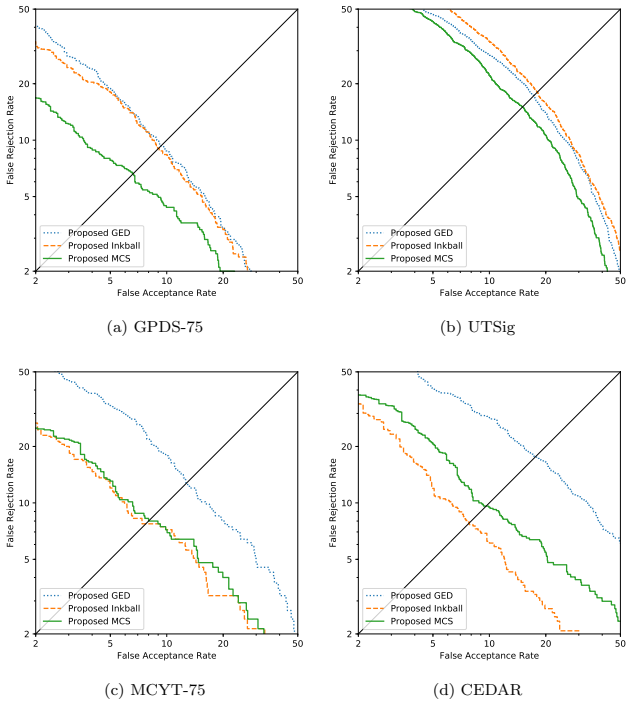
Graphs provide a powerful representation formalism that offers great promise to benefit tasks like handwritten signature verification. While most state-of-the-art approaches to signature verification rely on fixed-size representations, graphs are flexible in size and allow modeling local features as well as the global structure of the handwriting. In this article, we present two recent graph-based approaches to offline signature verification: keypoint graphs with approximated graph edit distance and inkball models. We provide a comprehensive description of the methods, propose improvements both in terms of computational time and accuracy, and report experimental results for four benchmark datasets. The proposed methods achieve top results for several benchmarks, highlighting the potential of graph-based signature verification.
Editorial analysis
A structured set of objections, weighed in public.
Referee Report
Summary. The manuscript presents two graph-based methods for offline signature verification—keypoint graphs with approximated graph edit distance and inkball models—along with proposed improvements for speed and accuracy. It reports experimental results on four benchmark datasets and claims that the methods achieve top results on several of them, arguing that graphs offer advantages over fixed-size representations by flexibly modeling local features and global structure.
Significance. If the empirical claims hold with proper validation, the work would usefully demonstrate the applicability of graph representations to signature verification and could motivate further graph-based work in document analysis; the explicit improvements to existing graph methods and the benchmark comparisons are concrete contributions.
major comments (1)
- Experimental section: the abstract and provided description state that the methods achieve 'top results' on several benchmarks, yet supply no information on data splits, implementation details, error bars, or statistical significance tests; without these, the central empirical claim cannot be evaluated for robustness.
minor comments (1)
- Abstract: the four benchmark datasets are not named; adding their names would allow readers to immediately contextualize the claimed performance.
Simulated Author's Rebuttal
We thank the referee for their review. The single major comment concerns missing experimental details needed to evaluate our claims of top results. We address this below.
read point-by-point responses
-
Referee: Experimental section: the abstract and provided description state that the methods achieve 'top results' on several benchmarks, yet supply no information on data splits, implementation details, error bars, or statistical significance tests; without these, the central empirical claim cannot be evaluated for robustness.
Authors: We agree that the manuscript as submitted does not supply the requested details on data splits, implementation, error bars, or statistical tests, which prevents full evaluation of the robustness of the 'top results' claims. In the revised version we will expand the experimental section to include explicit descriptions of the train/test splits for each of the four benchmarks, full implementation and parameter details, results with error bars (standard deviation across runs where relevant), and statistical significance tests against the competing methods. revision: yes
Circularity Check
No significant circularity
full rationale
The paper presents two graph-based methods (keypoint graphs with approximated GED and inkball models) for offline signature verification, describes improvements, and reports empirical results on four external benchmark datasets. The central claim is an empirical performance claim ('top results for several benchmarks') resting on comparisons to prior methods on standard data, not on any mathematical derivation, prediction, or first-principles result that reduces to fitted parameters or self-citations by construction. No load-bearing step matches the enumerated circularity patterns; the work is self-contained against external benchmarks.
Axiom & Free-Parameter Ledger
Reference graph
Works this paper leans on
-
[1]
L. G. Hafemann, R. Sabourin, L. S. Oliveira, Offline handwritten signature verification - literature review, in: Proc of Int. Conf. on Image Processing Theory, Tools and Applications (IPTA), 2017, pp. 1–8
work page 2017
-
[2]
M. Diaz, M. A. Ferrer, D. Impedovo, M. I. Malik, G. Pirlo, R. Plamondon, A perspective analysis of handwritten signature technology, ACM Comput. Surv. 51 (6) (2019) 117:1–117:39. doi:10.1145/3274658. URL http://doi.acm.org/10.1145/3274658 29
-
[3]
M. B. Yilmaz, B. Yanikoglu, C. Tirkaz, A. Kholmatov, Offline signature verification using classifier combination of HOG and LBP features, in: Proc. Int. Joint Conference on Biometrics, 2011, pp. 1–7
work page 2011
- [4]
-
[5]
J. F. Vargas, M. A. Ferrer, C. M. Travieso, J. B. Alonso, Off-line signature verification based on grey level information using texture features, Pattern Recognition 44 (2) (2011) 375–385
work page 2011
-
[6]
V. Nguyen, M. Blumenstein, V. Muthukkumarasamy, G. Leedham, Off- line Signature Verification Using Enhanced Modified Direction Features in Conjunction with Neural Classifiers and Support Vector Machines, in: Ninth International Conference on Document Analysis and Recognition (ICDAR 2007) Vol 2, Vol. 2, IEEE, 2007, pp. 734–738
work page 2007
- [7]
-
[8]
A. Hassa¨ ıne, S. Al-Maadeed, J. M. Alja’am, A. Jaoua, A. Bouridane, The ICDAR2011 Arabic Writer Identification Contest, in: 2011 International Conference on Document Analysis and Recognition, no. October, IEEE, 2011, pp. 1470–1474
work page 2011
-
[9]
A. Gilperez, F. Alonso-Fernandez, S. Pecharroman, J. Fierrez, J. Ortega- Garcia, Off-line signature verification using contour features, in: Proc. 11th Int. Conf. on Front. in Handwriting Rec., 2008, pp. 1–6
work page 2008
-
[10]
D. Impedovo, G. Pirlo, Automatic signature verification: The state of the art, IEEE Trans. on Systems, Man and Cybernetics Part C: Applications and Reviews 38 (5) (2008) 609–635. 30
work page 2008
-
[11]
R. Plamondon, G. Lorette, Automatic signature verification and writer identification - the state of the art, Pattern Recognition 22 (2) (1989) 107– 131
work page 1989
-
[12]
L. G. Hafemann, R. Sabourin, L. S. Oliveira, Learning features for of- fline handwritten signature verification using deep convolutional neural networks, Pattern Recognition 70 (2017) 163–176
work page 2017
-
[13]
E. J. Justino, F. Bortolozzi, R. Sabourin, A comparison of SVM and HMM classifiers in the off-line signature verification, Pattern Recognition Letters 26 (9) (2005) 1377–1385
work page 2005
- [14]
-
[15]
A. Piyush Shanker, A. Rajagopalan, Off-line signature verification using DTW, Pattern Recognition Letters 28 (12) (2007) 1407–1414
work page 2007
-
[16]
A. Soleimani, B. N. Araabi, K. Fouladi, Deep multitask metric learning for offline signature verification, Pattern Recognition Letters 80 (2016) 84–90
work page 2016
-
[17]
R. Sabourin, R. Plamondon, L. Beaumier, Structural interpretation of handwritten signature images, Int. Journal of Pattern Recognition and Ar- tificial Intelligence 8 (3) (1994) 709–748
work page 1994
- [18]
- [19]
-
[20]
P. Maergner, K. Riesen, R. Ingold, A. Fischer, A structural approach to offline signature verification using graph edit distance, in: Proc. of Interna- 31 tional Conference on Document Analysis and Recognition (ICDAR), IEEE, 2017, pp. 1216–1222
work page 2017
-
[21]
A. Fischer, K. Riesen, H. Bunke, Graph similarity features for HMM-based handwriting recognition in historical documents, in: Proc. 12th Int. Conf. on Frontiers in Handwriting Recognition, 2010, pp. 253–258
work page 2010
-
[22]
M. Stauffer, A. Fischer, K. Riesen, Graph-based keyword spotting in his- torical handwritten documents, in: Proc. Int. Workshop on Structural, Syntactic, and Statistical Pattern Recognition, 2016, pp. 564–573
work page 2016
- [23]
-
[24]
Howe, Part-structured inkball models for one-shot handwritten word spotting, in: Proc
N. Howe, Part-structured inkball models for one-shot handwritten word spotting, in: Proc. of International Conference on Document Analysis and Recognition (ICDAR), 2013
work page 2013
-
[25]
N. Howe, A. Fischer, B. Wicht, Inkball models as features for handwriting recognition, in: Proc. of International Conference on Frontiers in Hand- writing Recognition (ICFHR), 2016
work page 2016
-
[26]
P. Maergner, N. Howe, K. Riesen, R. Ingold, A. Fischer, Offline signa- ture verification via structural methods: Graph edit distance and inkball models, in: Proc. of International Conference on Frontiers in Handwriting Recognition (ICFHR), 2018, pp. 163–168
work page 2018
-
[27]
A. Fischer, C. Y. Suen, V. Frinken, K. Riesen, H. Bunke, Approximation of graph edit distance based on Hausdorff matching, Pattern Recognition 48 (2) (2015) 331–343
work page 2015
-
[28]
P. Maergner, K. Riesen, R. Ingold, A. Fischer, Offline signature verifica- tion based on bipartite approximation of graph edit distance, in: Proc. of International Graphonomics Society Conference (IGS), 2017, pp. 162–165. 32
work page 2017
-
[29]
P. Maergner, V. Pondenkandath, M. Alberti, M. Liwicki, K. Riesen, R. In- gold, A. Fischer, Offline signature verification by combining graph edit distance and triplet networks, in: Structural, Syntactic, and Statistical Pattern Recognition (S+SSPR), Springer International Publishing, 2018, pp. 470–480
work page 2018
-
[30]
T. Y. Zhang, C. Y. Suen, A fast parallel algorithm for thinning digital patterns, Communications of the ACM 27 (3) (1984) 236–239
work page 1984
-
[31]
M. A. Ferrer, M. Diaz-Cabrera, A. Morales, Static Signature Synthesis: A Neuromotor Inspired Approach for Biometrics, IEEE Transactions on Pattern Analysis and Machine Intelligence 37 (3) (2015) 667–680
work page 2015
- [32]
-
[33]
K. Riesen, Structural Pattern Recognition with Graph Edit Distance, Ad- vances in Computer Vision and Pattern Recognition, Springer International Publishing, 2015
work page 2015
-
[34]
P. Felzenszwalb, D. Huttenlocher, Pictorial structures for object recogni- tion, International Journal of Computer Vision 61 (1)
-
[35]
Howe, Inkball models for character localization and out-of-vocabulary word spotting, in: Proc
N. Howe, Inkball models for character localization and out-of-vocabulary word spotting, in: Proc. of International Conference on Document Analysis and Recognition (ICDAR), 2015
work page 2015
-
[36]
P. Felzenszwalb, R. Girshick, D. McAllester, D. Ramanan, Object detection with discriminatively trained part based models, IEEE Transactions on Pattern Analysis and Machine Intelligence 32 (9) (2010) 1627–1645
work page 2010
-
[37]
A. Fischer, M. Diaz, R. Plamondon, M. A. Ferrer, Robust score normaliza- tion for DTW-based on-line signature verification, in: Proc. of International Conference on Document Analysis and Recognition (ICDAR), IEEE, 2015, pp. 241–245. 33
work page 2015
-
[38]
M. A. Ferrer, GPDSsyntheticSignature database website, accessed on Jan 28, 2019 (2016). URL http://www.gpds.ulpgc.es/downloadnew/download.htm
work page 2019
-
[39]
A. Soleimani, K. Fouladi, B. N. Araabi, Utsig: A persian offline signature dataset, IET Biometrics 6 (1) (2016) 1–8
work page 2016
-
[40]
J. Ortega-Garcia, J. Fierrez-Aguilar, D. Simon, J. Gonzalez, M. Faundez- Zanuy, V. Espinosa, A. Satue, I. Hernaez, J.-J. Igarza, C. Vivaracho, D. Es- cudero, Q.-I. Moro, MCYT baseline corpus: a bimodal biometric database, IEEE Proceedings-Vision, Image and Signal Processing 150 (6) (2003) 395– 401
work page 2003
-
[41]
J. Fierrez-Aguilar, N. Alonso-Hermira, G. Moreno-Marquez, J. Ortega- Garcia, An off-line signature verification system based on fusion of local and global information, in: Biometric Authentication, Springer, 2004, pp. 295–306
work page 2004
-
[42]
M. K. Kalera, S. Srihari, A. Xu, Offline signature verification and identifica- tion using distance statistics, International Journal of Pattern Recognition and Artificial Intelligence 18 (07) (2004) 1339–1360
work page 2004
-
[43]
P. N. Narwade, R. R. Sawant, S. V. Bonde, Offline handwritten signature verification using cylindrical shape context, 3D Research 9 (4) (2018) 48
work page 2018
-
[44]
A. Soleimani, K. Fouladi, B. N. Araabi, Persian offline signature verification based on curvature and gradient histograms, in: Int. Conf. on Computer and Knowledge Engineering (ICCKE), 2016, pp. 147–152
work page 2016
-
[45]
F. Alonso-Fernandez, M. Fairhurst, J. Fierrez, J. Ortega-Garcia, Automatic measures for predicting performance in off-line signature, in: Proc. 14th Int. Conf. on Image Processing, 2007, pp. 369–372
work page 2007
-
[46]
S. Y. Ooi, A. B. J. Teoh, Y. H. Pang, B. Y. Hiew, Image-based handwritten signature verification using hybrid methods of discrete Radon transform, 34 principal component analysis and probabilistic neural network, Applied Soft Computing 40 (2016) 274–282
work page 2016
-
[47]
L. G. Hafemann, L. S. Oliveira, R. Sabourin, Fixed-sized representation learning from offline handwritten signatures of different sizes, International Journal on Document Analysis and Recognition (IJDAR) 21 (3) (2018) 219–232
work page 2018
-
[48]
S. Chen, S. Srihari, A New Off-line Signature Verification Method based on Graph, 18th International Conference on Pattern Recognition (ICPR’06) (2006) 869–872
work page 2006
-
[49]
R. K. Bharathi, B. H. Shekar, Off-line signature verification based on chain code histogram and support vector machine, in: Int. Conf. on Advances in Computing, Communications and Informatics (ICACCI), 2013, pp. 2063– 2068. 35
work page 2013
discussion (0)
Sign in with ORCID, Apple, or X to comment. Anyone can read and Pith papers without signing in.