REVIEW 6 major objections 5 minor 61 references
Orbit classification and analysis of qutrit graph states under local complementation and local scaling
T0 review · 6 major / 5 minor · reviewed 2026-08-07 · deepseek-v4-flash
Pith's one-line read For qutrit graph states with up to seven qutrits, the paper maps every Local Clifford entanglement class to an orbit graph and shows orbit geometry strongly tracks the Schmidt measure.
desk verdict Useful new qutrit orbit-graph statistics, but the missing cross-check against Danielsen's qutrit classification and the unstated restriction to connected graphs undercut the complete-characterization claim. read the letter →
The pith
A machine-rendered reading of the paper's core claim, the machinery that carries it, and where it could break.
The reading
What carries the argument
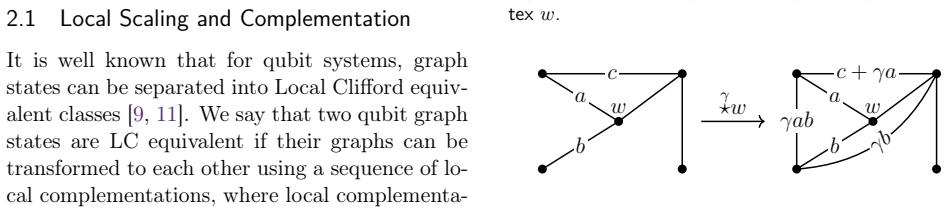
The load-bearing object is the orbit graph (OG). For each entanglement class, take all non-isomorphic weighted graph states in the class as vertices and connect two vertices whenever a single local scaling or local complementation operation at some vertex, with some scaling factor $\gamma \in \mathbb{F}_3$, maps one state to the other; operation types and weights are ignored, giving a simple undirected graph with possible self-loops. Local scaling multiplies every incident edge weight at a vertex by $\gamma$, while local complementation updates the weights in the neighborhood of a vertex by $\Gamma_{uv} \leftarrow \Gamma_{uv} + \gamma \Gamma_{uw} \Gamma_{vw}$, and both operations correspond to generalized Clifford gates. The orbit graph turns an entanglement class into a classical graph, so standard invariants such as chromatic number, density, average shortest-path length, diameter, and maximum degree can be computed and then compared with the Schmidt measure, which is the mechanism behind both the classification table and the correlation analysis.
What would settle it
Compute the exact average shortest-path length and diameter for the largest $n=7$ orbit graphs, for instance the orbit with $|V|=338{,}868$ vertices listed as orbit 81 in Table 1, using an exact breadth-first method, and recompute the correlation coefficients in Table 3 with the exact values. If the heuristic values are systematically off, the reported correlations with the Schmidt measure would shift; if they agree, the statistical conclusions are confirmed.
Extended reading notes
Core claim
The paper claims a complete enumeration, for qutrit graph states with $n \le 7$, of the orbits generated by local scaling and local complementation, and identifies these orbits with the Local Clifford entanglement classes. A table with 103 orbits lists, for each class, a representative state, the size and edge count of its orbit graph, the orbit's chromatic number, density, average shortest-path length, diameter, maximum degree, and the Schmidt measure (with bounds where exact values are not known). The main quantitative claim is that five pairs of observables involving the Schmidt measure have linear correlation coefficients with $|r|$ between 0.81 and 0.87, and that the same pairs of observables are anticorrelated or correlated in the same directions as in the qubit analysis, indicating a dimension-independent link between orbit connectivity and entanglement. If the claim is right, the table is the qutrit counterpart of the qubit LC catalog up to twelve particles, and orbit geometry can be used directly to estimate preparation costs and entanglement resources.
Load-bearing premise
The statistical conclusions about the seven-qutrit orbits assume that the randomized estimates for average shortest-path length and diameter, used on the largest orbit graphs where exact computation is infeasible, are close to the true values; the heuristic was benchmarked against exact values only on smaller orbits.
Editorial extensions
If this is right
- The 103-orbit table gives a complete lookup reference for Local Clifford entanglement classes of qutrit graph states with up to seven qutrits, including representative states and orbit observables.
- Strong correlations between orbit geometry and the Schmidt measure mean that a classical computation on the orbit graph can estimate the entanglement strength of every state in the class without computing the measure directly.
- Average shortest-path length and diameter of an orbit graph bound the number of local operations required to transform any state in a class into any other, which is directly relevant to state preparation and quantum network routing.
- The agreement with the qubit correlation pattern supports using qutrit orbit data as a stepping stone for higher prime dimensions, where full enumeration is computationally harder.
- The reported absence of tree-shaped orbit graphs for qutrits is the one qualitative difference from qubits and constrains which universal resource states for measurement-based quantum computation can appear in qutrit Local Clifford classes.
Reading between the lines
- The near-isomorphic orbit pairs identified in the table, such as orbits 17 and 22 for $n=6$, suggest that many distinct weight assignments on the same underlying simple graph produce equivalent orbit structures; checking all nine such pairs explicitly could further compress the catalog.
- The absence of correlation between $\deg(g)_{\min}$ and every other observable is a hint that the minimal maximum degree is not the right orbit-level proxy for controlled-Z preparation depth in qutrits; correlating it with an actual minimal circuit-depth computation would test this directly.
- Because the enumeration pipeline is general in the local dimension, a natural next test is to run the same orbit extraction for a small sample of $d=5$ or $d=7$ cases with few particles; the paper's argument predicts the correlation pattern will persist, and those runs would confirm whether the $d=3$ statistics are representative.
- A concrete next use of the catalog is to test the local-unitary versus local-Clifford equivalence conjecture for qutrits up to seven particles: by checking, for each pair of orbits, whether any representative states are locally unitarily equivalent, one can search for qutrit counterexamples; the paper identifies this as an open direction.
Editorial analysis
A structured set of objections, weighed in public.
Referee Report
Summary. The paper presents a computational enumeration of Local Clifford (LC) orbits of qutrit graph states for n <= 7, using the graphical operations of local scaling and local complementation over F_3. The authors construct an 'orbit graph' whose vertices are (canonical, non-isomorphic) weighted graphs and whose edges represent single local operations, then extract connected components to obtain 103 orbits. For each orbit they compute graph-theoretic observables (chromatic number, density, self-loops, degree, ASPL, diameter) and the Schmidt measure, and they report Pearson and Kendall correlations between these observables. The central claims are completeness of the orbit classification up to 7 qutrits and that correlations between orbit properties closely follow the qubit case. The paper is accompanied by a GitHub repository with the enumeration and analysis code.
Significance. If the orbit counts are correct, the paper provides a useful catalogue of qutrit LC entanglement classes and a statistical characterization of their orbit graphs, extending the qubit program of Adcock et al. to qutrits. The explicit repository is a strength, as is the use of established tools (nauty, networkx) in a clearly described pipeline. However, the completeness claim is not currently supported by an independent check against the existing qutrit classification, and the statistical claims rely on unconverged heuristics and an unspecified treatment of Schmidt-measure bounds. These issues are fixable and do not obviously invalidate the enumeration, but they must be addressed before the paper can be recommended.
major comments (6)
- [Sec. 1, Sec. 3.1, Table 1] The paper claims a complete characterization of qutrit LC orbits up to n=7 but never compares its 103 orbits with the existing classification of [23], which the introduction itself says provides representative graphs for LC orbits up to n=12. Since a bug in canonicalization, operation implementation, or connected-component finding would silently change every orbit count and all downstream statistics, the paper must include a direct per-n comparison with [23] (orbit counts and, where possible, representative graphs). Without this, the central completeness claim rests entirely on the authors' own code.
- [Sec. 3.1, Sec. 3.2.1, abstract] The text never states explicitly whether disconnected graph states were included in the enumeration. The n=3 row of Table 1 lists a single orbit whose representative has two edges, yet the 27 labeled qutrit graph states on three vertices include disconnected product states such as the empty graph and a single-edge graph tensored with |+>. If disconnected graph states were excluded, the abstract's 'complete characterization of the entanglement classes' is misleading, and the paper should say throughout that the classification covers connected graph states only. If they were included, the missing disconnected orbits need to be explained.
- [Sec. 3.2.1, Sec. 4.2, Table 3] The orbit graph is built on non-isomorphic weighted graphs ('we will only check non-isomorphic graphs'), but the physical interpretations in Sec. 4.2 refer to transformations between individual graph states, e.g., ASPL as the average number of local operations to transform one state to another. Quotienting by graph isomorphism can shorten or alter distances, because relabeling is not a local operation and may not correspond to an LC transformation of a fixed labeled state. The manuscript neither proves that the quotient preserves the distances it interprets nor benchmarks this approximation. This affects all orbit-graph observables and the correlations reported in Table 3, and it needs to be justified or the interpretations need to be restricted to isomorphism classes.
- [Sec. 3.2.2, Table 3] For n=7, ASPL for more than half of the orbits and the diameter for a substantial fraction are estimated by random sampling. The only validation reported is 'perfect agreement' with exact networkx results on smaller orbits, with no numbers, and no sample sizes or error estimates are given for the heuristic. The strong correlations in Table 3 (e.g., r(ES, dmax)=0.81 and r(D, <dOG>)=-0.99) could be affected by biased estimates on the largest orbit graphs, up to about 339,000 vertices. The authors should provide a quantitative validation of the heuristic on the largest feasible exact cases and report the sampling error or confidence intervals for the approximate ASPL and diameter values.
- [Sec. 3.2.3, Tables 1-3] Several orbits in Table 1 have only upper and lower bounds for the Schmidt measure, e.g., (2,3) and (3,4), yet Tables 2 and 3 treat ES as a single numerical variable. The paper never states how these intervals were converted to point values for computing the mean, standard deviation, and the Pearson and Kendall correlation coefficients. The authors should specify the convention (e.g., midpoint, lower bound, or exact-only) and assess how sensitive the reported correlations are to this choice.
- [Sec. 2.1, Sec. 3.1] Proposition 1 states local scaling for any gamma in F_d, and Sec. 3.1 says 'all possible local scalings and local complementations for all scaling factors'. For gamma=0, the operator M(0) maps every basis state to |0> and is not unitary, so it is not a valid local Clifford operation. Including gamma=0 in the enumeration would connect connected graphs to disconnected ones and would collapse the orbit structure; the results in Table 1 show this was not done. The paper should explicitly restrict gamma to F_d^\times and correct the statement in Sec. 3.2.1 that the local operations are 'self-inverse': gamma-local scaling and gamma-local complementation are inverted by the corresponding operation with gamma^{-1} or -gamma, respectively, and the graph is undirected because all inverse pairs are included.
minor comments (5)
- [Table 1] There are formatting problems in Table 1: entries such as '1 .79' and '0 .90476' should read '1.79' and '0.90476'. The column header spacing and the use of '| e|' should also be cleaned up.
- [Sec. 4.2] The statement that 'not a single orbit is a tree' is made without a definition of tree for an orbit graph that can have self-loops; this should be clarified.
- [Appendix A] The density definition in Eq. (16) is given for a simple graph, but Table 1 reports D values for orbit graphs with self-loops. The manuscript should state explicitly how self-loops are counted in D, since the reported value D=1.13333 for orbit 4 cannot follow from the displayed formula without additional conventions.
- [Sec. 3.2.3] The Schmidt-measure computation relies on the authors' own prior work [49]; the paper should state more concretely which features of [49] are used and confirm that the method is applicable to all orbits in Table 1, especially those where only bounds are reported.
- [Sec. 3.2.2] The use of the Wolfram Engine for edge coloring is mentioned but no version or specific function is cited; please add details for reproducibility.
Circularity Check
No circularity: the orbit enumeration is a self-contained graph-atlas computation; the only self-citation ([49]) supplies an independent Schmidt-measure tool and is not load-bearing.
full rationale
The central claim — a complete LC orbit classification of qutrit graph states for n <= 7 — is obtained by an explicit forward algorithm described in Sec. 3.1: all non-isomorphic simple graphs are generated with nauty geng, all F3 weight assignments are added, canonical forms are chosen by permutation, an atlas is built whose edges are single local scalings and local complementations, and connected components yield the orbits. No parameter is fitted and no target orbit count is fed back as an input; Table 1 is the output of this enumeration, not a constraint used in the construction. The Schmidt-measure bounds used in Table 1 rely on the authors' prior work [49], but that is a separate, parameter-free result about chi-colorable graph states and does not presuppose the orbit classification; it is best read as an external computational tool rather than as a premise that forces the paper's conclusions. The heuristic ASPL and diameter estimates for large n=7 orbit graphs are benchmarked against exact networkx results on smaller orbits, which is a validation step rather than a fit. The lack of an explicit per-n comparison with the existing qutrit LC representatives in [23] is a completeness or correctness risk for the enumeration, not a circular dependency, because the paper does not derive its counts from [23]. Similarly, the comparison with the qubit orbit study [14] is an external benchmark, not an input to the classification. Overall, no equation or claimed prediction reduces by construction to an input, to a fitted parameter, or to a self-citation chain.
Assumptions & free parameters
assumptions (4)
- domain assumption Local scaling and local complementation generate the full local Clifford equivalence relation for qutrit graph states (Propositions 1 and 2, attributed to [21]).
- domain assumption The Schmidt measure can be computed from graph colorability features as listed in Sec. 3.2.3 (from [48,49]).
- domain assumption The random-sampling heuristic for ASPL and diameter on n=7 orbit graphs gives values close to the exact values.
- ad hoc to paper The orbit graph can be built on non-isomorphic (unlabeled) weighted graphs without losing the connectivity structure relevant to the observables.
Cite this review
Pith. "Pith review of Orbit classification and analysis of qutrit graph states under local complementation and local scaling." pith.science (2026). https://pith.science/paper/VT4AUQSV
@misc{pith2026250605478,
  author       = {Pith},
  title        = {Pith review of: Orbit classification and analysis of qutrit graph states under local complementation and local scaling},
  year         = {2026},
  howpublished = {\url{https://pith.science/paper/VT4AUQSV}},
  note         = {Machine review of arXiv:2506.05478}
}
read the original abstract
Graph states and their entanglement properties are pivotal for the development of quantum computing and technologies. For qubits, local complementation, a graphical rule that connects all the equivalent states under Local Clifford (LC) operations, was used for the complete characterization of all the LC equivalence classes up until 12 particles, assisting applications in quantum error correction and state preparation protocols optimization. This concept has been extended for qudits. In this work, we provide a complete characterization of the entanglement classes up until 7 qutrits, mapping each class into an orbit. The graph-theoretic properties of the orbits are studied, illuminating the rich structure they have. Clear connections between the connectivity of the orbits and the entanglement properties are observed. The correlations between the graph-theoretic properties and the Schmidt measure provide useful insights regarding qudit state preparation and fault-tolerance. This work is accompanied by a repository consisting of the code to extract the orbits and perform the presented statistical analysis. The strong interplay between quantum theory and graph theory is well-known and extensively studied for qubits. Our work provides practical tools and results to assist this endeavor for the qudit case.
Figures


Figures from the paper (1 more)

Reference graph
Works this paper leans on
-
[23]
On the classifica- tion of hermitian self-dual additive codes over gf(9)
Lars Eirik Danielsen. On the classifica- tion of hermitian self-dual additive codes over gf(9). IEEE Transactions on Informa- tion Theory, 58(8):5500–5511, 2012. DOI: 10.1109/TIT.2012.2196255
-
[1]
Robert Raussendorf, Daniel E. Browne, and Hans J. Briegel. Measurement-based quantum computation on cluster states. Phys. Rev. A , 68:022312, Aug 2003. DOI: 10.1103/PhysRevA.68.022312. URL https://link.aps.org/doi/10.1103/ PhysRevA.68.022312
-
[2]
M. Veldhorst, H. G. J. Eenink, C. H. Yang, and A. S. Dzurak. Silicon cmos ar- chitecture for a spin-based quantum com- puter. Nature Communications , 8(1): 14 1766, 2017. DOI: 10.1038/s41467-017- 01905-6. URL https://doi.org/10.1038/ s41467-017-01905-6
-
[3]
Bjoern Lekitsch, Sebastian Weidt, Austin G. Fowler, Klaus Mølmer, Simon J. Devitt, Christof Wunderlich, and Winfried K. Hensinger. Blueprint for a microwave trapped ion quantum computer. Sci- ence Advances , 3(2):e1601540, 2017. DOI: 10.1126/sciadv.1601540. URL https://www.science.org/doi/abs/10. 1126/sciadv.1601540
-
[5]
Alexander, Shuntaro Takeda, Junichi Yoshikawa, Nicolas C
Warit Asavanant, Yu Shiozawa, Shota Yokoyama, Baramee Charoensombuta- mon, Hiroki Emura, Rafael N. Alexander, Shuntaro Takeda, Junichi Yoshikawa, Nicolas C. Menicucci, Hidehiro Yonezawa, and Akira Furusawa. Generation of time-domain-multiplexed two-dimensional cluster state. Science, 366(6463):373–376,
-
[6]
R. Barends, J. Kelly, A. Megrant, A. Veitia, D. Sank, and et al. Superconducting quan- tum circuits at the surface code threshold for fault tolerance. Nature, 508(7497):500– 503, 2014. DOI: 10.1038/nature13171. URL https://doi.org/10.1038/nature13171
-
[7]
Damian Markham and Barry C. Sanders. Graph states for quantum secret shar- ing. Phys. Rev. A, 78:042309, Oct 2008. DOI: 10.1103/PhysRevA.78.042309. URL https://link.aps.org/doi/10.1103/ PhysRevA.78.042309
-
[8]
Adrian Keet, Ben Fortescue, Damian Markham, and Barry C. Sanders. Quan- tum secret sharing with qudit graph states. Phys. Rev. A, 82:062315, Dec 2010. DOI: 10.1103/PhysRevA.82.062315. URL https://link.aps.org/doi/10.1103/ PhysRevA.82.062315
Show all 61 references
-
[12]
López-Tarrida, Pilar Moreno, and José R
Adán Cabello, Antonio J. López-Tarrida, Pilar Moreno, and José R. Portillo. Entanglement in eight-qubit graph states. Physics Letters A , 373(26): 2219–2225, 2009. ISSN 0375-9601. DOI: https://doi.org/10.1016/j.physleta.2009.04.055. URL https://www.sciencedirect. com/science/a...
2009 doi
-
[13]
Lars Eirik Danielsen and Matthew G. Parker. On the classification of all self-dual additive codes over gf(4) of length up to 12. Journal of Combina- torial Theory, Series A , 113(7):1351– 1367, 2006. ISSN 0097-3165. DOI: https://doi.org/10.1016/j.jcta.2005.12.004. URL https://...
2006 doi
-
[14]
Adcock, Sam Morley-Short, Axel Dahlberg, and Joshua W
Jeremy C. Adcock, Sam Morley-Short, Axel Dahlberg, and Joshua W. Silverstone. Map- ping graph state orbits under local comple- mentation. Quantum, 4:305, August 2020. ISSN 2521-327X. DOI: 10.22331/q-2020-08- 07-305. URL https://doi.org/10.22331/ q-2020-08-07-305
2020 doi
-
[15]
Algorithm to verify local equiva- 15 lence of stabilizer states, 2025
Adam Burchardt, Jarn de Jong, and Lina Vandré. Algorithm to verify local equiva- 15 lence of stabilizer states, 2025. URLhttps: //arxiv.org/abs/2410.03961
2025 arXiv
-
[16]
Lo- cal Equivalence of Stabilizer States: A Graphical Characterisation
Nathan Claudet and Simon Perdrix. Lo- cal Equivalence of Stabilizer States: A Graphical Characterisation. In 42nd In- ternational Symposium on Theoretical Aspects of Computer Science (STACS 2025), volume 327 of Leibniz International Proceedings in Informatics (LIPIcs), pages 2...
2025 doi
-
[17]
Decid- ing local unitary equivalence of graph states inquasi-polynomialtime, 2025
Nathan Claudet and Simon Perdrix. Decid- ing local unitary equivalence of graph states inquasi-polynomialtime, 2025. URL https: //arxiv.org/abs/2502.06566
2025
-
[18]
The lu-lc conjecture is false, 2008
Zhengfeng Ji, Jianxin Chen, Zhaohui Wei, and Mingsheng Ying. The lu-lc conjecture is false, 2008. URLhttps://arxiv.org/abs/ 0709.1266
2008 arXiv
-
[19]
Graph states under the action of local clifford group in non-binary case, 2007
Mohsen Bahramgiri and Salman Beigi. Graph states under the action of local clifford group in non-binary case, 2007. URL https://arxiv.org/abs/quant-ph/ 0610267
2007
-
[20]
Morley-Short
S. Morley-Short. Towards realistic architec- tures for linear optical quantum computing. PhD thesis, University of Bristol, 2019. URL https://hdl.handle.net/1983/ ecf3e9e6-3287-4dcd-871b-d879a8bf0bec
2019
-
[21]
Measurement- based quantum computation beyond qubits
Robert Ivan Booth. Measurement- based quantum computation beyond qubits. Theses, Sorbonne Univer- sité, February 2022. URL https: //theses.hal.science/tel-03867179
2022
-
[22]
An efficient algorithm to recognize locally equiv- alent graphs in non-binary case, 2007
Mohsen Bahramgiri and Salman Beigi. An efficient algorithm to recognize locally equiv- alent graphs in non-binary case, 2007. URL https://arxiv.org/abs/cs/0702057
2007 arXiv
-
[24]
Schlingemann and R
D. Schlingemann and R. F. Werner. Quan- tum error-correcting codes associated with graphs. Physical Review A, 65(1), December
-
[25]
Löbl, Stefano Paesani, and An- ders S
Matthias C. Löbl, Stefano Paesani, and An- ders S. Sørensen. Loss-tolerant architecture for quantum computing with quantum emit- ters. Quantum, 8:1302, March 2024. ISSN 2521-327X. DOI: 10.22331/q-2024-03-28-
2024 doi
-
[26]
Pettersson, Anders S
Love A. Pettersson, Anders S. Sørensen, and Stefano Paesani. Deterministic gen- eration of concatenated graph codes from quantum emitters. PRX Quantum , 6: 010305, Jan 2025. DOI: 10.1103/PRXQuan- tum.6.010305. URL https://link.aps. org/doi/10.1103/PRXQuantum.6.010305
2025 doi
-
[27]
A zx-calculus approach for the construction of graph codes, 2024
Zipeng Wu, Song Cheng, and Bei Zeng. A zx-calculus approach for the construction of graph codes, 2024. URL https://arxiv. org/abs/2304.08363
2024 arXiv
-
[28]
Equivalence classes of quantum error- correcting codes, 2024
Andrey Boris Khesin and Alexander Li. Equivalence classes of quantum error- correcting codes, 2024. URL https:// arxiv.org/abs/2406.12083
2024 arXiv
-
[29]
Bell, Love A
Thomas J. Bell, Love A. Pettersson, and Stefano Paesani. Optimizing graph codes for measurement-based loss tolerance.PRX Quantum, 4:020328, May 2023. DOI: 10.1103/PRXQuantum.4.020328. URL https://link.aps.org/doi/10.1103/ PRXQuantum.4.020328
2023 doi
-
[30]
Campbell
Earl T. Campbell. Enhanced fault-tolerant quantum computing in d-level systems. Phys. Rev. Lett. , 113:230501, Dec 2014. DOI: 10.1103/PhysRevLett.113.230501. URL https://link.aps.org/doi/10. 1103/PhysRevLett.113.230501
2014 doi
-
[32]
Qudit vs
James Keppens, Quinten Eggerickx, Vukan Levajac, George Simion, and Bart Sorée. Qudit vs. qubit: Simulated performance of error correction codes in higher dimensions,
-
[33]
López-Tarrida, and José R
Adán Cabello, Lars Eirik Danielsen, 16 Antonio J. López-Tarrida, and José R. Portillo. Optimal preparation of graph states. Phys. Rev. A, 83:042314, Apr 2011. DOI: 10.1103/PhysRevA.83.042314. URL https://link.aps.org/doi/10.1103/ PhysRevA.83.042314
2011 doi
-
[34]
Resources required for preparing graph states
Peter Høyer, Mehdi Mhalla, and Simon Per- drix. Resources required for preparing graph states. In Tetsuo Asano, editor,Algorithms and Computation, pages 638–649, Berlin, Heidelberg, 2006. Springer Berlin Heidel- berg
2006
-
[35]
Economou
Evangelia Takou, Edwin Barnes, and Sophia E. Economou. Optimization complexity and resource minimization of emitter-based photonic graph state genera- tion protocols, 2024. URLhttps://arxiv. org/abs/2407.15777
2024 arXiv
-
[36]
Complexity of graph-state preparation by clifford circuits, 2025
Soh Kumabe, Ryuhei Mori, and Yusei Yoshimura. Complexity of graph-state preparation by clifford circuits, 2025. URL https://arxiv.org/abs/2402.05874
2025 arXiv
-
[37]
Optimization of deterministic photonic-graph-state generation via local operations
Sobhan Ghanbari, Jie Lin, Benjamin MacLellan, Luc Robichaud, Piotr Roz- tocki, and Hoi-Kwong Lo. Optimization of deterministic photonic-graph-state generation via local operations. Phys. Rev. A, 110:052605, Nov 2024. DOI: 10.1103/PhysRevA.110.052605. URL https://link.aps.org/d...
2024 doi
-
[38]
Löbl, Love A
Matthias C. Löbl, Love A. Pettersson, Andrew Jena, Luca Dellantonio, Stefano Paesani, and Anders S. Sørensen. Gener- ating graph states with a single quantum emitter and the minimum number of fu- sions. Phys. Rev. A, 111:052604, May 2025. DOI: 10.1103/PhysRevA.111.052604. URL ...
2025 doi
-
[39]
Enu- merating the classes of local equivalency in graphs, 2007
Mohsen Bahramgiri and Salman Beigi. Enu- merating the classes of local equivalency in graphs, 2007. URL https://arxiv.org/ abs/math/0702267
2007 arXiv
-
[40]
The complexity of the vertex-minor problem, 2019
Axel Dahlberg, Jonas Helsen, and Stephanie Wehner. The complexity of the vertex-minor problem, 2019. URL https://arxiv.org/ abs/1906.05689
2019 arXiv
-
[41]
Transforming graph states using single-qubit operations
Axel Dahlberg and Stephanie Wehner. Transforming graph states using single-qubit operations. Philosophical Transactions of the Royal Society A: Mathematical, Physical and Engineering Sciences, 376(2133):20170325,
-
[42]
URL https://github.com/ hrachya-zakaryan/qudit-lc
Github repository for orbit extraction and data analysis. URL https://github.com/ hrachya-zakaryan/qudit-lc
-
[43]
McKay and Adolfo Piperno
Brendan D. McKay and Adolfo Piperno. Practical graph isomorphism, ii. Jour- nal of Symbolic Computation , 60:94– 112, 2014. ISSN 0747-7171. DOI: https://doi.org/10.1016/j.jsc.2013.09.003. URL https://www.sciencedirect. com/science/article/pii/ S0747717113001193
2014 doi
-
[44]
Classical Coloring of Graphs
Adrian Kosowski and Krzysztof Manuszewski. Classical Coloring of Graphs. ISBN 0-8218-3458-4, 2004
2004
-
[45]
R. L. Graham and H. O. Pollak. On the addressing problem for loop switch- ing. The Bell System Technical Journal, 50 (8):2495–2519, 1971. DOI: 10.1002/j.1538- 7305.1971.tb02618.x
1971
-
[46]
A short proof for a generalization of viz- ing’s theorem
Claude Berge and Jean Claude Fournier. A short proof for a generalization of viz- ing’s theorem. Journal of Graph The- ory, 15(3):333–336, 1991. ISSN 0364-9024. DOI: 10.1002/jgt.3190150309. URL https: //doi.org/10.1002/jgt.3190150309
1991 doi
-
[47]
I. Holyer. The np-completeness of edge col- orings. SIAM Journal on Computing, 10(4): 718–720, 1981. DOI: 10.1137/0210053
1981 doi
-
[49]
URL https: //arxiv.org/abs/2408.09515
Konstantinos-Rafail Revis, Hrachya Za- karyan, and Zahra Raissi.χ-colorable graph states: Closed-form expressions and quan- tum orthogonal arrays, 2025. URL https: //arxiv.org/abs/2408.09515
2025 arXiv
-
[50]
Maurice G. Kendall. The treatment of ties in ranking problems.Biometrika, 33(3):239– 251, 1945
1945
-
[51]
Scheme for constructing graphs associated with stabilizer quantum codes,
Carlo Cafaro, Damian Markham, and Peter van Loock. Scheme for constructing graphs associated with stabilizer quantum codes,
-
[52]
Griffiths
Shiang Yong Looi, Li Yu, Vlad Gheorghiu, 17 and Robert B. Griffiths. Quantum- error-correcting codes using qudit graph states. Phys. Rev. A, 78:042303, Oct 2008. DOI: 10.1103/PhysRevA.78.042303. URL https://link.aps.org/doi/10.1103/ PhysRevA.78.042303
2008 doi
-
[53]
Konstantin Tiurev, Peter-Jan H. S. Derks, Joschka Roffe, Jens Eisert, and Jan-Michael Reiner. Correcting non-independent and non-identically distributed errors with sur- face codes. Quantum, 7:1123, September
-
[55]
Browne, and Terry Rudolph
Mercedes Gimeno-Segovia, Pete Shadbolt, Dan E. Browne, and Terry Rudolph. From three-photon greenberger-horne- zeilinger states to ballistic universal quantum computation. Phys. Rev. Lett., 115:020502, Jul 2015. DOI: 10.1103/PhysRevLett.115.020502. URL https://link.aps.org/doi...
2015 doi
-
[56]
Physical- depth architectural requirements for gen- erating universal photonic cluster states
Sam Morley-Short, Sara Bartolucci, Mer- cedes Gimeno-Segovia, Pete Shadbolt, Hugo Cable, and Terry Rudolph. Physical- depth architectural requirements for gen- erating universal photonic cluster states. Quantum Science and Technology , 3(1): 015005, nov 2017. DOI: 10.1088/2058...
2017 doi
-
[57]
The Foliage Partition: An Easy-to- Compute LC-Invariant for Graph States
Adam Burchardt and Frederik Hahn. The Foliage Partition: An Easy-to- Compute LC-Invariant for Graph States. Quantum, 9:1720, April 2025. ISSN 2521-327X. DOI: 10.22331/q-2025-04-24-
2025 doi
-
[58]
Complex quantum net- works: a topical review.Journal of Physics A: Mathematical and Theoretical, 57(23): 233001, may 2024
Johannes Nokkala, Jyrki Piilo, and Gines- tra Bianconi. Complex quantum net- works: a topical review.Journal of Physics A: Mathematical and Theoretical, 57(23): 233001, may 2024. DOI: 10.1088/1751- 8121/ad41a6. URL https://dx.doi.org/ 10.1088/1751-8121/ad41a6
2024 doi
-
[59]
F. Hahn, A. Pappa, and J. Eisert. Quan- tum network routing and local comple- mentation. npj Quantum Information, 5 (1):76, 2019. DOI: 10.1038/s41534-019- 0191-6. URL https://doi.org/10.1038/ s41534-019-0191-6
2019 doi
-
[60]
Zwerger, W
M. Zwerger, W. Dür, and H. J. Briegel. Measurement-based quantum repeaters. Phys. Rev. A , 85:062326, Jun 2012. DOI: 10.1103/PhysRevA.85.062326. URL https://link.aps.org/doi/10.1103/ PhysRevA.85.062326
2012 doi
-
[61]
Van den Nest, W
M. Van den Nest, W. Dür, G. Vidal, and H. J. Briegel. Classical simulation versus universality in measurement-based quantum computation. Phys. Rev. A, 75: 012337, Jan 2007. DOI: 10.1103/Phys- RevA.75.012337. URL https://link.aps. org/doi/10.1103/PhysRevA.75.012337. 18 A Quanti...
2007 doi
-
[1302]
URL https://doi.org/10.22331/ q-2024-03-28-1302
2024
-
[1720]
URL https://doi.org/10.22331/ q-2025-04-24-1720
2025
-
[2014]
URLhttps://arxiv.org/abs/1407. 2777
-
[2018]
DOI: 10.1098/rsta.2017.0325
2017
-
[2019]
URL https://www.science.org/doi/abs/10
DOI: 10.1126/science.aay2645. URL https://www.science.org/doi/abs/10. 1126/science.aay2645
-
[2023]
DOI: 10.22331/q- 2023-09-26-1123
ISSN 2521-327X. DOI: 10.22331/q- 2023-09-26-1123. URL http://dx.doi. org/10.22331/q-2023-09-26-1123
2023 doi
-
[2025]
URLhttps://arxiv.org/abs/2502. 05992
Reviewed August 7, 2026 · model on record in the stance chip above.
Discussion (0). Sign in to comment.