Optimisation of neoadjuvant pembrolizumab therapy for locally advanced MSI-H/dMMR colorectal cancer using data-driven delay integro-differential equations
Pith reviewed 2026-05-23 16:41 UTC · model grok-4.3
The pith
A single medium-to-high dose of pembrolizumab can eradicate tumors in locally advanced MSI-H/dMMR colorectal cancer.
A machine-rendered reading of the paper's core claim, the machinery that carries it, and where it could break.
Core claim
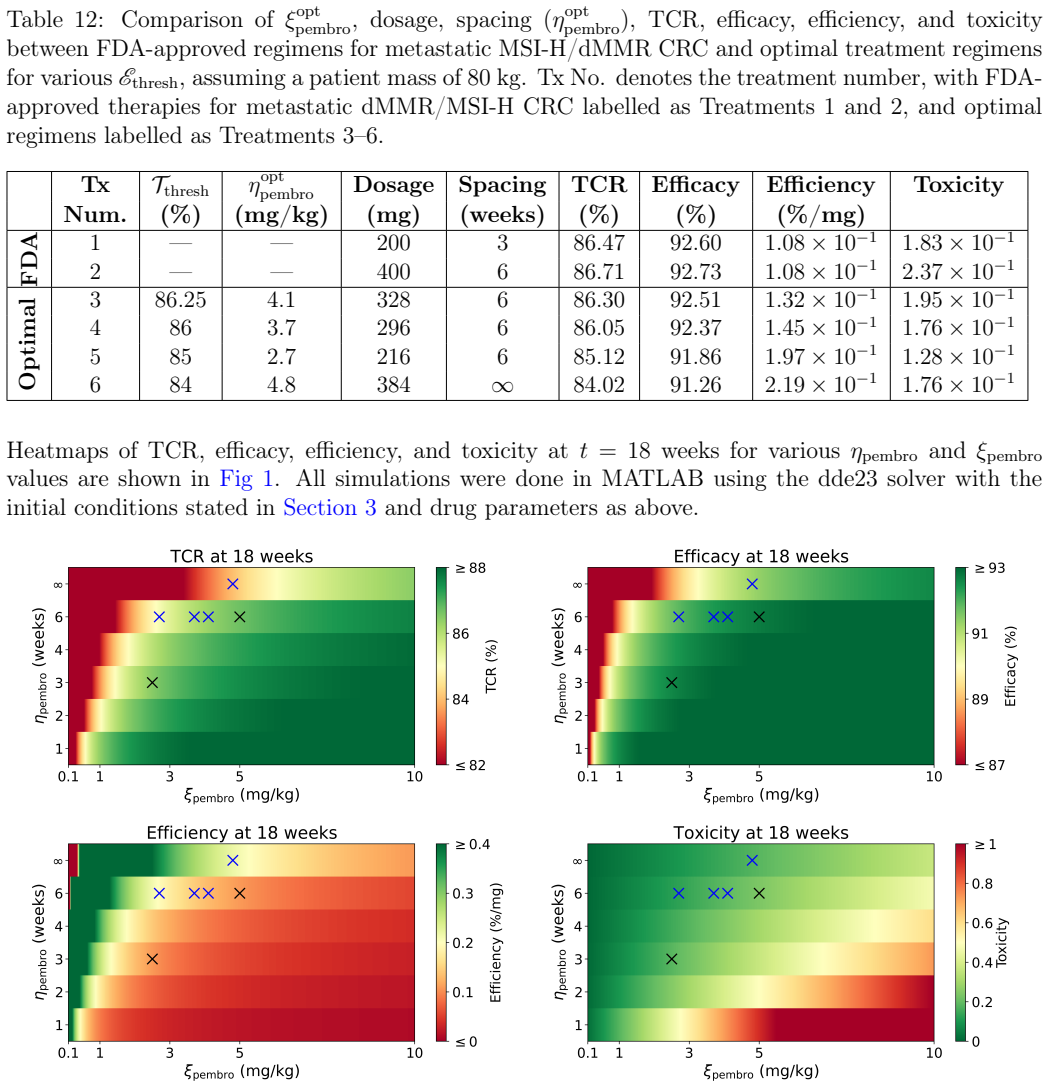
By modeling immune dynamics with delay integro-differential equations in tumor and lymph node compartments, the authors optimize pembrolizumab dosing and conclude that a single medium-to-high dose may be sufficient for effective tumour eradication while being efficient, safe, and practical in laMCRC patients.
What carries the argument
Delay integro-differential equations tracking DC migration, T cell proliferation, CD8+ T cell exhaustion and reinvigoration in the tumour site and tumour-draining lymph node compartments.
If this is right
- Current FDA-approved multi-dose regimens for metastatic MSI-H/dMMR CRC can be improved for the locally advanced setting by reducing to a single dose.
- Mechanistic factors such as T cell reinvigoration rates can be used to predict which patients will respond to neoadjuvant pembrolizumab.
- Treatment efficiency improves by shortening duration and lowering cumulative toxicity while maintaining tumor eradication.
- Patient quality of life benefits from fewer infusions without loss of clinical efficacy.
Where Pith is reading between the lines
- The same equation framework could be adapted to test dosing schedules for other PD-1 inhibitors in MSI-H tumors outside colorectal cancer.
- Direct clinical trials in laMCRC patients would provide the decisive test of the single-dose prediction.
- Adding variables for combination agents such as chemotherapy would allow the model to explore synergistic neoadjuvant strategies.
Load-bearing premise
The parameters and initial conditions derived from pharmacokinetic studies, radiographic data, and deconvolution of TCGA COADREAD and GSE26571 RNA-seq datasets accurately represent the in vivo immune dynamics and drug effects in laMCRC patients.
What would settle it
A clinical observation that tumors persist or recur after administration of a single medium-to-high dose of pembrolizumab to laMCRC patients would falsify the model's optimized dosing result.
Figures


read the original abstract
Colorectal cancer (CRC) poses a major public health challenge due to its increasing prevalence, particularly among younger populations. Microsatellite instability-high (MSI-H) CRC and deficient mismatch repair (dMMR) CRC constitute 15% of all CRC and exhibit remarkable responsiveness to immunotherapy, especially with PD-1 inhibitors. Despite this, there is a significant need to optimise immunotherapeutic regimens to maximise clinical efficacy and patient quality of life. To address this, we employ a novel framework driven by delay integro-differential equations to model the interactions among cancer cells, immune cells, and immune checkpoints in locally advanced MSI-H/dMMR CRC (laMCRC). Several of these components are being modelled deterministically for the first time in cancer, paving the way for a deeper understanding of the complex underlying immune dynamics. We consider two compartments$\unicode{x2014}$the tumour site and the tumour-draining lymph node (TDLN)$\unicode{x2014}$taking into account phenomena such as DC migration, T cell proliferation, and CD8+ T cell exhaustion and reinvigoration. Parameter values and initial conditions are derived from experimental data, integrating various pharmacokinetic, bioanalytical, and radiographic studies, along with deconvolution of bulk RNA-sequencing data from the TCGA COADREAD and GSE26571 datasets. We finally optimised neoadjuvant treatment with pembrolizumab, a widely used PD-1 inhibitor, to balance efficacy, efficiency, and toxicity in laMCRC patients. We mechanistically analysed factors influencing treatment success and improved upon currently FDA-approved therapeutic regimens for metastatic MSI-H/dMMR CRC, demonstrating that a single medium-to-high dose of pembrolizumab may be sufficient for effective tumour eradication while being efficient, safe, and practical.
Editorial analysis
A structured set of objections, weighed in public.
Referee Report
Summary. The manuscript develops a system of delay integro-differential equations (DIDEs) describing interactions among cancer cells, dendritic cells, and CD8+ T cells across tumour and tumour-draining lymph node compartments in locally advanced MSI-H/dMMR colorectal cancer. Parameters and initial conditions are obtained from pharmacokinetic studies, radiographic volumes, and cell-type deconvolution of TCGA COADREAD and GSE26571 RNA-seq data. The model is then used to optimise neoadjuvant pembrolizumab dosing, with the central claim that a single medium-to-high dose suffices for tumour eradication while remaining efficient and safe.
Significance. If the DIDE framework and its parameterisation can be shown to reproduce independent clinical kinetics, the work would supply a mechanistic, data-driven route to regimen optimisation that could reduce treatment burden relative to current FDA-approved schedules. The explicit inclusion of delay-integral terms for DC migration and T-cell reinvigoration is a technical advance over standard ODE models in this setting.
major comments (2)
- [Abstract] Abstract (parameter derivation paragraph): all rate constants for DC migration, T-cell proliferation, exhaustion, and reinvigoration, together with compartment initial conditions, are stated to be taken directly from external PK, radiographic, and deconvolution sources; the reported optimum (single medium-to-high dose) is therefore a direct numerical output of these fitted values rather than an independent prediction, creating a circularity that must be addressed by out-of-sample validation against serial biopsy or ctDNA time series.
- [Model construction] Model construction (two-compartment DIDE system): the mapping from bulk RNA-seq cell proportions to the delay kernels and integral terms that govern DC trafficking and CD8+ reinvigoration is not shown to be robust under alternative deconvolution methods or under perturbation of the assumed delay distributions; because these kernels determine the location of the optimal dose, their sensitivity must be quantified and reported.
minor comments (2)
- Provide the explicit system of DIDEs (including all integral kernels and coupling terms between tumour and TDLN compartments) so that the optimisation procedure can be reproduced.
- Report error bars or credible intervals on the optimised dose arising from parameter uncertainty; the current claim of sufficiency for a single dose lacks quantitative bounds.
Simulated Author's Rebuttal
We thank the referee for their thorough review and valuable suggestions. Below we provide point-by-point responses to the major comments. We believe these revisions will strengthen the manuscript.
read point-by-point responses
-
Referee: [Abstract] Abstract (parameter derivation paragraph): all rate constants for DC migration, T-cell proliferation, exhaustion, and reinvigoration, together with compartment initial conditions, are stated to be taken directly from external PK, radiographic, and deconvolution sources; the reported optimum (single medium-to-high dose) is therefore a direct numerical output of these fitted values rather than an independent prediction, creating a circularity that must be addressed by out-of-sample validation against serial biopsy or ctDNA time series.
Authors: We clarify that the parameters are sourced from independent external studies and public datasets (PK, radiographic, TCGA COADREAD, GSE26571), and are not tuned to achieve the reported optimum. The single medium-to-high dose sufficiency emerges from the model's mechanistic structure. We agree that out-of-sample validation would be ideal to confirm the prediction. However, the available data do not include serial time-series from the same patients, so such validation is not possible in the current study. In the revised manuscript, we will add an explicit discussion of this limitation and its implications. We have also included additional sensitivity analyses on key parameters to bolster confidence in the results. revision: partial
-
Referee: [Model construction] Model construction (two-compartment DIDE system): the mapping from bulk RNA-seq cell proportions to the delay kernels and integral terms that govern DC trafficking and CD8+ reinvigoration is not shown to be robust under alternative deconvolution methods or under perturbation of the assumed delay distributions; because these kernels determine the location of the optimal dose, their sensitivity must be quantified and reported.
Authors: We appreciate this point. The delay kernels were informed by cell proportions from deconvolution of the specified RNA-seq datasets. To address robustness, the revised manuscript will include a new supplementary analysis testing alternative deconvolution methods (such as different algorithms) and perturbations to the delay distributions (varying means and variances by up to 30%). We will report that the optimal dosing regimen remains qualitatively unchanged under these variations, with quantitative details provided. revision: yes
- Out-of-sample validation with serial biopsy or ctDNA time series data, which is not available in the datasets used and would require new clinical studies.
Circularity Check
No circularity: model parameters from external data; optimization is forward simulation
full rationale
The paper constructs a DIDE system whose parameters and initial conditions are taken from independent external sources (pharmacokinetic studies, radiographic data, TCGA COADREAD and GSE26571 deconvolution). The headline result (single medium-to-high pembrolizumab dose suffices) is obtained by numerically optimizing the resulting model; this is a standard forward prediction step, not a reduction of the output to the fitted inputs by construction. No self-citations, self-definitional equations, or renamings of known results are present in the provided text. The derivation chain remains self-contained against the cited external benchmarks.
Axiom & Free-Parameter Ledger
free parameters (2)
- rate constants for DC migration, T-cell proliferation, exhaustion, and reinvigoration
- initial conditions for cell populations in tumour and TDLN compartments
axioms (1)
- domain assumption The two-compartment (tumour site and tumour-draining lymph node) structure plus delay and integral terms sufficiently capture the relevant immune dynamics
Forward citations
Cited by 1 Pith paper
-
Sensitivity analysis-guided model reduction of a mathematical model of pembrolizumab therapy for de novo metastatic MSI-H/dMMR colorectal cancer
Sensitivity analysis using FAST and EFAST reduces a data-driven model of pembrolizumab therapy in de novo metastatic MSI-H/dMMR CRC to two simpler versions that reproduce original trajectories.
Reference graph
Works this paper leans on
-
[1]
Increased HMGB1 expression correlates with higher expression of c-IAP2 and pERK in colorectal cancer
Zhang W, An F, Xia M, Zhan Q, Tian W, Jiao Y. Increased HMGB1 expression correlates with higher expression of c-IAP2 and pERK in colorectal cancer. Medicine. 2019 Jan;98(3):e14069. Available from: http://dx.doi.org/10.1097/MD.0000000000014069
-
[2]
Abdullah TM, Whatmore J, Bremer E, Slibinskas R, Michalak M, Eggleton P. Endoplasmic reticulum stress-induced release and binding of calreticulin from human ovarian cancer cells. Cancer Immunology, Immunotherapy. 2021 Nov;71(7):1655–1669. Available from:http://dx. doi.org/10.1007/s00262-021-03072-6
-
[3]
Key biomarkers within the colorectal cancer related inflammatory microenvironment
Calu V, Ionescu A, Stanca L, Geicu OI, Iordache F, Pisoschi AM, et al. Key biomarkers within the colorectal cancer related inflammatory microenvironment. Scientific Reports. 2021 Apr;11(1). Available from: http://dx.doi.org/10.1038/s41598-021-86941-5
-
[4]
Kim YW, Kim SK, Kim CS, Kim IY, Cho MY, Kim NK. Association of Serum and Intratumoral Cytokine Profiles with Tumor Stage and Neutrophil Lymphocyte Ratio in Colorectal Cancer. An- ticancer research. 2014;34(7):3481-7. Available from:https://ar.iiarjournals.org/content/ 34/7/3481.long
work page 2014
-
[5]
AutenshlyusAI,ArkhipovSA,KuntsTA,MarinkinIO,MikhailovaES,KarpukhinaXV,etal. Cy- tokine profiles of tumor supernatants in invasive ductal cancer and fibroadenoma of the breast and its relationship with VEGF-A expression in the tumors. International Journal of Immunopathol- ogy and Pharmacology. 2017 Jan;30(1):83–88. Available from:http://dx.doi.org/10.1177...
work page 2017
-
[6]
Inflammation and tumor progression: signaling pathways and targeted intervention
Zhao H, Wu L, Yan G, Chen Y, Zhou M, Wu Y, et al. Inflammation and tumor progression: signaling pathways and targeted intervention. Signal Transduction and Targeted Therapy. 2021 Jul;6(1). Available from:http://dx.doi.org/10.1038/s41392-021-00658-5. 33
-
[7]
West WH. Continuous infusion recombinant interleukin-2 (rIL-2) in adoptive cellular therapy of renal carcinoma and other malignancies. Cancer Treatment Reviews. 1989 Jun;16:83–89. Available from: http://dx.doi.org/10.1016/0305-7372(89)90027-3
-
[8]
Czajka-Francuz P, Francuz T, Cisoń-Jurek S, Czajka A, Fajkis M, Szymczak B, et al. Serum cytokine profile as a potential prognostic tool in colorectal cancer patients – one center study. Reports of Practical Oncology & Radiotherapy. 2020 Nov;25(6):867–875. Available from:http: //dx.doi.org/10.1016/j.rpor.2020.08.004
-
[9]
Local and systemic Th17 immune response associated with advanced stage colon cancer
Sharp SP, Avram D, Stain SC, Lee EC. Local and systemic Th17 immune response associated with advanced stage colon cancer. Journal of Surgical Research. 2017 Feb;208:180–186. Available from: http://dx.doi.org/10.1016/j.jss.2016.09.038
-
[10]
Krzystek-Korpacka M, Diakowska D, Kapturkiewicz B, Bębenek M, Gamian A. Profiles of circu- lating inflammatory cytokines in colorectal cancer (CRC), high cancer risk conditions, and health are distinct. Possible implications for CRC screening and surveillance. Cancer Letters. 2013 Aug;337(1):107–114. Available from:http://dx.doi.org/10.1016/j.canlet.2013.05.033
-
[11]
The changes of Th17 cells and the related cytokines in the progression of human colorectal cancers
Wang J, Xu K, Wu J, Luo C, Li Y, Wu X, et al. The changes of Th17 cells and the related cytokines in the progression of human colorectal cancers. BMC Cancer. 2012 Sep;12(1). Available from: http://dx.doi.org/10.1186/1471-2407-12-418
-
[12]
Elevated serum levels of transforming growth factor beta 1 in patients with colorectal carcinoma
Shim KS, Kim KH, Han WS, Park EB. Elevated serum levels of transforming growth factor beta 1 in patients with colorectal carcinoma. Cancer. 1999 Feb;85(3):554–561. Available from:http: //dx.doi.org/10.1002/(SICI)1097-0142(19990201)85:3<554::AID-CNCR6>3.0.CO;2-X
-
[13]
Advanced Colorectal Cancer Is Associated With Enhanced IL-23 and IL-10 Serum Levels
Stanilov N, Miteva L, Deliysky T, Jovchev J, Stanilova S. Advanced Colorectal Cancer Is Associated With Enhanced IL-23 and IL-10 Serum Levels. Laboratory Medicine. 2010 Mar;41(3):159–163. Available from:http://dx.doi.org/10.1309/LM7T43AQZIUPIOWZ
-
[14]
Lala M, Li TR, de Alwis DP, Sinha V, Mayawala K, Yamamoto N, et al. A six-weekly dosing schedule for pembrolizumab in patients with cancer based on evaluation using modelling and simulation. European Journal of Cancer. 2020 May;131:68–75. Available from:http://dx.doi. org/10.1016/j.ejca.2020.02.016
-
[15]
KEYTRUDA (pembrolizumab) injection Label; 2021
Merck. KEYTRUDA (pembrolizumab) injection Label; 2021. Available from: https://www. accessdata.fda.gov/drugsatfda_docs/label/2021/125514s096lbl.pdf
work page 2021
-
[16]
Zandarashvili L, Sahu D, Lee K, Lee YS, Singh P, Rajarathnam K, et al. Real-time Kinetics of High-mobility Group Box 1 (HMGB1) Oxidation in Extracellular Fluids Studied by in Situ Protein NMR Spectroscopy. Journal of Biological Chemistry. 2013 Apr;288(17):11621–11627. Available from: http://dx.doi.org/10.1074/jbc.M113.449942
-
[17]
Zhang Y, Thangam R, You SH, Sultonova RD, Venu A, Min JJ, et al. Engineering Calreticulin- Targeting Monobodies to Detect Immunogenic Cell Death in Cancer Chemotherapy. Cancers. 2021 Jun;13(11):2801. Available from:http://dx.doi.org/10.3390/cancers13112801
-
[18]
In: Cell Surface Calreticulin: Role in Signaling Throm- bospondin Anti-Adhesive Activity
Goicoechea SM, Murphy-Ullrich JE. In: Cell Surface Calreticulin: Role in Signaling Throm- bospondin Anti-Adhesive Activity. Springer US; 2003. p. 193–204. Available from: http: //dx.doi.org/10.1007/978-1-4419-9258-1_18. 34
-
[19]
Anatomical Origin of Dendritic Cells Determines Their Life Span in Peripheral Lymph Nodes
Ruedl C, Koebel P, Bachmann M, Hess M, Karjalainen K. Anatomical Origin of Dendritic Cells Determines Their Life Span in Peripheral Lymph Nodes. The Journal of Immunology. 2000 Nov;165(9):4910–4916. Available from:http://dx.doi.org/10.4049/jimmunol.165.9.4910
-
[20]
Developmental kinetics and lifespan of dendritic cells in mouse lymphoid organs
Kamath AT, Henri S, Battye F, Tough DF, Shortman K. Developmental kinetics and lifespan of dendritic cells in mouse lymphoid organs. Blood. 2002 Sep;100(5):1734–1741. Available from: http://dx.doi.org/10.1182/blood.V100.5.1734.h81702001734_1734_1741
work page doi:10.1182/blood.v100.5.1734.h81702001734_1734_1741 2002
-
[21]
Takada K, Jameson SC. Self–class I MHC molecules support survival of naive CD8 T cells, but depress their functional sensitivity through regulation of CD8 expression levels. Journal of Experimental Medicine. 2009 Sep;206(10):2253–2269. Available from:http://dx.doi.org/10. 1084/jem.20082553
work page 2009
-
[22]
Directly measured kinetics of circulating T lymphocytes in normal and HIV-1-infected humans
Hellerstein M, Hanley MB, Cesar D, Siler S, Papageorgopoulos C, Wieder E, et al. Directly measured kinetics of circulating T lymphocytes in normal and HIV-1-infected humans. Nature Medicine. 1999 Jan;5(1):83–89. Available from:http://dx.doi.org/10.1038/4772
-
[23]
Mature Dendritic Cells May Promote High-Avidity Tuning of Vaccine T Cell Responses
Kumbhari A, Egelston CA, Lee PP, Kim PS. Mature Dendritic Cells May Promote High-Avidity Tuning of Vaccine T Cell Responses. Frontiers in Immunology. 2020 Oct;11. Available from: http://dx.doi.org/10.3389/fimmu.2020.584680
-
[24]
Vukmanovic-Stejic M, Zhang Y, Cook JE, Fletcher JM, McQuaid A, Masters JE, et al. Human CD4+ CD25hi Foxp3+ regulatory T cells are derived by rapid turnover of memory populations in vivo. Journal of Clinical Investigation. 2006 Sep;116(9):2423–2433. Available from: http: //dx.doi.org/10.1172/JCI28941
-
[25]
The fate and lifespan of human monocyte subsets in steady state and systemic inflammation
Patel AA, Zhang Y, Fullerton JN, Boelen L, Rongvaux A, Maini AA, et al. The fate and lifespan of human monocyte subsets in steady state and systemic inflammation. Journal of Experimen- tal Medicine. 2017 Jun;214(7):1913–1923. Available from:http://dx.doi.org/10.1084/jem. 20170355
work page doi:10.1084/jem 2017
-
[26]
Natural killer cells in cancer biology and therapy
Wu SY, Fu T, Jiang YZ, Shao ZM. Natural killer cells in cancer biology and therapy. Molecular Cancer. 2020 Aug;19(1). Available from:http://dx.doi.org/10.1186/s12943-020-01238-x
-
[27]
Functions of natural killer cells
Vivier E, Tomasello E, Baratin M, Walzer T, Ugolini S. Functions of natural killer cells. Nature Immunology. 2008 Apr;9(5):503–510. Available from:http://dx.doi.org/10.1038/ni1582
-
[28]
Potentiation of Natural Killer Cells for Cancer Immunotherapy: A Review of Literature
Lowry LE, Zehring WA. Potentiation of Natural Killer Cells for Cancer Immunotherapy: A Review of Literature. Frontiers in Immunology. 2017 Sep;8. Available from: http://dx.doi. org/10.3389/fimmu.2017.01061
-
[29]
In vivo administration of purified human interleukin 2
Lotze MT, Matory YL, Ettinghausen SE, Rayner AA, Sharrow SO, Seipp CA, et al. In vivo administration of purified human interleukin 2. II. Half life, immunologic effects, and expansion of peripheral lymphoid cells in vivo with recombinant IL 2. The Journal of Immunology. 1985 Oct;135(4):2865–2875. Available from:http://dx.doi.org/10.4049/jimmunol.135.4.2865
-
[30]
Interferon-γ-Induced Necrosis: An Antitumor Biotherapeutic Per- spective
Balachandran S, Adams GP. Interferon-γ-Induced Necrosis: An Antitumor Biotherapeutic Per- spective. Journal of Interferon & Cytokine Research. 2013 Apr;33(4):171–180. Available from: http://dx.doi.org/10.1089/jir.2012.0087. 35
-
[31]
Ma Y, Zhao S, Shen S, Fang S, Ye Z, Shi Z, et al. A novel recombinant slow-release TNF α-derived peptide effectively inhibits tumor growth and angiogensis. Scientific Reports. 2015 Sep;5(1). Available from:http://dx.doi.org/10.1038/srep13595
-
[32]
Cytokine kinetics in an in vitro whole blood model following an endotoxin challenge
Oliver J, Bland L, Oettinger C, Arduino M, McAllister S, Aguero S, et al. Cytokine kinetics in an in vitro whole blood model following an endotoxin challenge. Lymphokine and cytokine research. 1993 April;12(2):115—120. Available from:https://pubmed.ncbi.nlm.nih.gov/8324076/
-
[33]
Tirado-Rodriguez B, Ortega E, Segura-Medina P, Huerta-Yepez S. TGF-β: An Important Me- diator of Allergic Disease and a Molecule with Dual Activity in Cancer Development. Journal of Immunology Research. 2014;2014:1–15. Available from:http://dx.doi.org/10.1155/2014/ 318481
-
[34]
Pharmacodynamics of subcutaneous recombinant human interleukin-10 in healthy volunteers
Huhn RD, Radwanski E, Gallo J, Affrime MB, Sabo R, Gonyo G, et al. Pharmacodynamics of subcutaneous recombinant human interleukin-10 in healthy volunteers. Clinical Pharmacol- ogy & Therapeutics. 1997 Aug;62(2):171–180. Available from:http://dx.doi.org/10.1016/ S0009-9236(97)90065-5
work page 1997
-
[35]
Lassman ME, Chappell DL, McAvoy T, Cheng A, de Alwis DP, Pruitt SK, et al. Experimental Medicine Study to Measure Immune Checkpoint Receptors PD-1 and GITR Turnover Rates In Vivo in Humans. Clinical Pharmacology & Therapeutics. 2021 Feb;109(6):1575–1582. Available from: http://dx.doi.org/10.1002/cpt.2129
-
[36]
Advances in pharmacokinetics and pharmacodynamics of PD-1/PD-L1 inhibitors
Yan T, Yu L, Shangguan D, Li W, Liu N, Chen Y, et al. Advances in pharmacokinetics and pharmacodynamics of PD-1/PD-L1 inhibitors. International Immunopharmacology. 2023 Feb;115:109638. Available from:http://dx.doi.org/10.1016/j.intimp.2022.109638
-
[37]
Evaluation of the pharmacokinetics and metabolism of pembrolizumab in the treatment of melanoma
Longoria TC, Tewari KS. Evaluation of the pharmacokinetics and metabolism of pembrolizumab in the treatment of melanoma. Expert Opinion on Drug Metabolism & Toxicology. 2016 Aug;12(10):1247–1253. Available from:http://dx.doi.org/10.1080/17425255.2016.1216976
-
[38]
Pembrolizumab for the treatment of PD-L1 positive advanced or metastatic non-small cell lung cancer
Dang TO, Ogunniyi A, Barbee MS, Drilon A. Pembrolizumab for the treatment of PD-L1 positive advanced or metastatic non-small cell lung cancer. Expert Review of Anticancer Therapy. 2015 Dec;16(1):13–20. Available from:http://dx.doi.org/10.1586/14737140.2016.1123626
-
[39]
Li H, Yu J, Liu C, Liu J, Subramaniam S, Zhao H, et al. Time dependent pharmacokinetics of pembrolizumab in patients with solid tumor and its correlation with best overall response. Journal of Pharmacokinetics and Pharmacodynamics. 2017 Jun;44(5):403–414. Available from: http://dx.doi.org/10.1007/s10928-017-9528-y
-
[40]
Li H, Sun Y, Yu J, Liu C, Liu J, Wang Y. Semimechanistically Based Modeling of Pembrolizumab Time-Varying Clearance Using 4 Longitudinal Covariates in Patients With Non–Small Cell Lung Cancer. Journal of Pharmaceutical Sciences. 2019 Jan;108(1):692–700. Available from:http: //dx.doi.org/10.1016/j.xphs.2018.10.064
-
[41]
Ahamadi M, Freshwater T, Prohn M, Li C, de Alwis D, de Greef R, et al. Model-Based Char- acterization of the Pharmacokinetics of Pembrolizumab: A Humanized Anti-PD-1 Monoclonal Antibody in Advanced Solid Tumors. CPT: Pharmacometrics & Systems Pharmacology. 2016 Nov;6(1):49–57. Available from:http://dx.doi.org/10.1002/psp4.12139. 36
-
[42]
Mechanisms Controlling PD-L1 Expression in Cancer
Cha JH, Chan LC, Li CW, Hsu JL, Hung MC. Mechanisms Controlling PD-L1 Expression in Cancer. Molecular Cell. 2019 Nov;76(3):359–370. Available from:http://dx.doi.org/10.1016/ j.molcel.2019.09.030
work page 2019
-
[43]
Glycosylation and stabilization of programmed death ligand-1 suppresses T-cell activity
Li CW, Lim SO, Xia W, Lee HH, Chan LC, Kuo CW, et al. Glycosylation and stabilization of programmed death ligand-1 suppresses T-cell activity. Nature Communications. 2016 Aug;7(1). Available from: http://dx.doi.org/10.1038/ncomms12632
-
[44]
Contact-dependent Stimulation and Inhibi- tion of Dendritic Cells by Natural Killer Cells
Piccioli D, Sbrana S, Melandri E, Valiante NM. Contact-dependent Stimulation and Inhibi- tion of Dendritic Cells by Natural Killer Cells. The Journal of Experimental Medicine. 2002 Feb;195(3):335–341. Available from:http://dx.doi.org/10.1084/jem.20010934
-
[45]
Verdijk P, Aarntzen EHJG, Lesterhuis WJ, Boullart ACI, Kok E, van Rossum MM, et al. Limited Amounts of Dendritic Cells Migrate into the T-Cell Area of Lymph Nodes but Have High Immune Activating Potential in Melanoma Patients. Clinical Cancer Research. 2009 Apr;15(7):2531–2540. Available from: http://dx.doi.org/10.1158/1078-0432.CCR-08-2729
-
[46]
Dictionary of immune responses to cytokines at single-cell resolution
Cui A, Huang T, Li S, Ma A, Pérez JL, Sander C, et al. Dictionary of immune responses to cytokines at single-cell resolution. Nature. 2023 Dec;625(7994):377–384. Available from:http: //dx.doi.org/10.1038/s41586-023-06816-9
-
[47]
Cancer-associated fibroblasts: tumor defenders in radiation therapy
Zhang Y, Lv N, Li M, Liu M, Wu C. Cancer-associated fibroblasts: tumor defenders in radiation therapy. Cell Death & Disease. 2023 Aug;14(8). Available from:http://dx.doi.org/10.1038/ s41419-023-06060-z
work page 2023
-
[48]
Gastl GA, Abrams JS, Nanus DM, Oosterkamp R, Silver J, Liu F, et al. Interleukin-10 production by human carcinoma cell lines and its relationship to interleukin-6 expression. International Journal of Cancer. 1993 Aug;55(1):96–101. Available from:http://dx.doi.org/10.1002/ijc. 2910550118
work page doi:10.1002/ijc 1993
-
[49]
Inflammatory Bowel Disease: How Effective Is TNF-α Suppression? PLOS ONE
Lo WC, Arsenescu V, Arsenescu RI, Friedman A. Inflammatory Bowel Disease: How Effective Is TNF-α Suppression? PLOS ONE. 2016 Nov;11(11):e0165782. Available from:http://dx.doi. org/10.1371/journal.pone.0165782
-
[50]
Rössler O, Betge J, Harbaum L, Mrak K, Tschmelitsch J, Langner C. Tumor size, tumor location, and antitumor inflammatory response are associated with lymph node size in colorectal cancer patients. Modern Pathology. 2017 Jun;30(6):897–904. Available from:http://dx.doi.org/10. 1038/modpathol.2016.227
work page 2017
-
[51]
Visualizing the First 50 Hr of the Primary Immune Response to a Soluble Antigen
Catron DM, Itano AA, Pape KA, Mueller DL, Jenkins MK. Visualizing the First 50 Hr of the Primary Immune Response to a Soluble Antigen. Immunity. 2004 Sep;21(3):341–347. Available from: http://dx.doi.org/10.1016/j.immuni.2004.08.007
-
[52]
Autoimmunity: from bench to bedside
Anaya JM, Shoenfeld Y, Rojas-Villarraga A, Levy RA, Cervera R. Autoimmunity: from bench to bedside. El Rosario University Press; 2013
work page 2013
-
[53]
Heritable changes in division speed accompany the diversification of single T cell fate
Plambeck M, Kazeroonian A, Loeffler D, Kretschmer L, Salinno C, Schroeder T, et al. Heritable changes in division speed accompany the diversification of single T cell fate. Proceedings of the National Academy of Sciences. 2022 Feb;119(9). Available from:http://dx.doi.org/10.1073/ pnas.2116260119. 37
work page 2022
-
[54]
Kaech SM, Ahmed R. Memory CD8+ T cell differentiation: initial antigen encounter triggers a developmental program in naïve cells. Nature Immunology. 2001 May;2(5):415–422. Available from: http://dx.doi.org/10.1038/87720
-
[55]
Masopust D, Murali-Krishna K, Ahmed R. Quantitating the Magnitude of the Lymphocytic Choriomeningitis Virus-Specific CD8 T-Cell Response: It Is Even Bigger than We Thought. Journal of Virology. 2007 Feb;81(4):2002–2011. Available from:http://dx.doi.org/10.1128/ jvi.01459-06
work page 2007
-
[56]
Blank CU, Haining WN, Held W, Hogan PG, Kallies A, Lugli E, et al. Defining ‘T cell exhaustion’. Nature Reviews Immunology. 2019 Sep;19(11):665–674. Available from:http://dx.doi.org/10. 1038/s41577-019-0221-9
work page 2019
-
[57]
CD8 T Cell Exhaustion During Chronic Viral Infection and Cancer
McLane LM, Abdel-Hakeem MS, Wherry EJ. CD8 T Cell Exhaustion During Chronic Viral Infection and Cancer. Annual Review of Immunology. 2019 Apr;37(1):457–495. Available from: http://dx.doi.org/10.1146/annurev-immunol-041015-055318
-
[58]
Jelley-Gibbs DM, Lepak NM, Yen M, Swain SL. Two Distinct Stages in the Transition from Naive CD4 T Cells to Effectors, Early Antigen-Dependent and Late Cytokine-Driven Expansion and Differentiation. The Journal of Immunology. 2000 Nov;165(9):5017–5026. Available from: http://dx.doi.org/10.4049/jimmunol.165.9.5017
-
[59]
Homann D, Teyton L, Oldstone MBA. Differential regulation of antiviral T-cell immunity results in stable CD8+ but declining CD4+ T-cell memory. Nature Medicine. 2001 Aug;7(8):913–919. Available from: http://dx.doi.org/10.1038/90950
-
[60]
Effector and memory T-cell differentiation: implications for vaccine development
Kaech SM, Wherry EJ, Ahmed R. Effector and memory T-cell differentiation: implications for vaccine development. Nature Reviews Immunology. 2002 Apr;2(4):251–262. Available from: http://dx.doi.org/10.1038/nri778
-
[61]
Darrasse-Jèze G, Bergot AS, Durgeau A, Billiard F, Salomon BL, Cohen JL, et al. Tumor emergence is sensed by self-specific CD44hi memory Tregs that create a dominant tolerogenic environment for tumors in mice. Journal of Clinical Investigation. 2009 Aug. Available from: http://dx.doi.org/10.1172/JCI36628
-
[62]
Regulatory T cells converted from Th1 cells in tumors suppress cancer immunity via CD39
Tan SN, Hao J, Ge J, Yang Y, Liu L, Huang J, et al. Regulatory T cells converted from Th1 cells in tumors suppress cancer immunity via CD39. Journal of Experimental Medicine. 2025 Feb;222(4). Available from:http://dx.doi.org/10.1084/jem.20240445
-
[63]
Structure and Interactions of the Human Programmed Cell Death 1 Receptor
Cheng X, Veverka V, Radhakrishnan A, Waters LC, Muskett FW, Morgan SH, et al. Structure and Interactions of the Human Programmed Cell Death 1 Receptor. Journal of Biological Chem- istry. 2013 Apr;288(17):11771–11785. Available from:http://dx.doi.org/10.1074/jbc.M112. 448126
-
[64]
Pluim D, Ros W, Miedema IHC, Beijnen JH, Schellens JHM. Multiparameter Flow Cytometry Assay for Quantification of Immune Cell Subsets, PD-1 Expression Levels and PD-1 Receptor Occupancy by Nivolumab and Pembrolizumab. Cytometry Part A. 2019 Aug;95(10):1053–1065. Available from: http://dx.doi.org/10.1002/cyto.a.23873
-
[65]
Liu Y, Cheng Y, Xu Y, Wang Z, Du X, Li C, et al. Increased expression of programmed cell death protein 1 on NK cells inhibits NK-cell-mediated anti-tumor function and indicates poor 38 prognosis in digestive cancers. Oncogene. 2017 Jul;36(44):6143–6153. Available from: http: //dx.doi.org/10.1038/onc.2017.209
-
[66]
Saito A, Tojo M, Kumagai Y, Ohzawa H, Yamaguchi H, Miyato H, et al. Flow cytometry detection ofcell type-specificexpression ofprogrammeddeath receptorligand-1 (PD-L1)incolorectal cancer specimens. Heliyon. 2021 Jan;7(1):e05880. Available from: http://dx.doi.org/10.1016/j. heliyon.2020.e05880
work page doi:10.1016/j 2021
-
[67]
PD-L1+ and XCR1+ dendritic cells are region-specific regulators of gut homeostasis
Moreira TG, Mangani D, Cox LM, Leibowitz J, Lobo ELC, Oliveira MA, et al. PD-L1+ and XCR1+ dendritic cells are region-specific regulators of gut homeostasis. Nature Communications. 2021 Aug;12(1). Available from:http://dx.doi.org/10.1038/s41467-021-25115-3
-
[68]
Anbari S, Wang H, Zhang Y, Wang J, Pilvankar M, Nickaeen M, et al. Using quantitative systems pharmacology modeling to optimize combination therapy of anti-PD-L1 checkpoint inhibitor and T cell engager. Frontiers in Pharmacology. 2023 Jun;14. Available from:http://dx.doi.org/ 10.3389/fphar.2023.1163432
-
[69]
Saito Y, Fujiwara Y, Shinchi Y, Mito R, Miura Y, Yamaguchi T, et al. Classification of PD-L1 expression in various cancers and macrophages based on immunohistocytological analysis. Cancer Science. 2022 Jun;113(9):3255–3266. Available from:http://dx.doi.org/10.1111/cas.15442
-
[70]
Pivotal Dose of Pembrolizumab: A Dose-Finding Strategy for Immuno-Oncology
Li TR, Chatterjee M, Lala M, Abraham AK, Freshwater T, Jain L, et al. Pivotal Dose of Pembrolizumab: A Dose-Finding Strategy for Immuno-Oncology. Clinical Pharmacology & Ther- apeutics. 2021 Mar;110(1):200–209. Available from:http://dx.doi.org/10.1002/cpt.2170
-
[71]
Extract from the Clinical Evaluation Report for Pembrolizumab; 2016
Therapeutic Goods Administration. Extract from the Clinical Evaluation Report for Pembrolizumab; 2016. Available from: https://www.tga.gov.au/sites/default/files/ auspar-pembrolizumab-rch-161014-cer.pdf
work page 2016
-
[72]
CT volumetric measurement of colorectal cancer helps predict tumor staging and prognosis
Park JY, Kim SH, Lee SM, Lee JS, Han JK. CT volumetric measurement of colorectal cancer helps predict tumor staging and prognosis. PLOS ONE. 2017 Jun;12(6):e0178522. Available from: http://dx.doi.org/10.1371/journal.pone.0178522
-
[73]
Real-time tracking of cell cycle progression during CD8+ effector and memory T-cell differentiation
Kinjyo I, Qin J, Tan SY, Wellard CJ, Mrass P, Ritchie W, et al. Real-time tracking of cell cycle progression during CD8+ effector and memory T-cell differentiation. Nature Communications. 2015 Feb;6(1). Available from:http://dx.doi.org/10.1038/ncomms7301. 39
discussion (0)
Sign in with ORCID, Apple, or X to comment. Anyone can read and Pith papers without signing in.