Effects of a quadrupolar magnetic term in a Generalized St\"ormer problem
Pith reviewed 2026-05-25 17:48 UTC · model grok-4.3
The pith
A quadrupolar magnetic term added to the dipolar field creates specific trajectories and new equilibria for charged dust grains around rotating planets.
A machine-rendered reading of the paper's core claim, the machinery that carries it, and where it could break.
Core claim
The existence of specific trajectories is due to the quadrupolar and dipolar magnetic terms. Equilibrium and stability behaviors along with orbital frequencies are derived for various charged dust grains, yielding a new model of the dynamical system.
What carries the argument
Generalized Störmer problem with linear combination of dipolar and quadrupolar magnetic terms in an axisymmetric rotating frame, which shapes the effective potential governing particle motion.
If this is right
- Specific trajectories exist only when both dipolar and quadrupolar terms are retained.
- Equilibrium points and their stability change with grain charge and size.
- Orbital frequencies become functions of the quadrupolar strength in addition to the dipolar one.
- The revised model applies to magnetospheric dynamics under more realistic field approximations.
Where Pith is reading between the lines
- Models of dust transport in rings or tori around magnetized planets could incorporate this term for better accuracy.
- The framework might extend to other solar-system bodies whose fields have measured quadrupole moments.
- Numerical integration of sample trajectories under the combined field could test the analytic equilibria.
Load-bearing premise
The planetary magnetic field can be represented by a linear combination of dipolar and quadrupolar terms with charged grains treated as test particles that do not modify the field.
What would settle it
Measured trajectories or orbital frequencies of charged dust grains that deviate systematically from the equilibria and frequencies predicted when both magnetic terms are included.
Figures
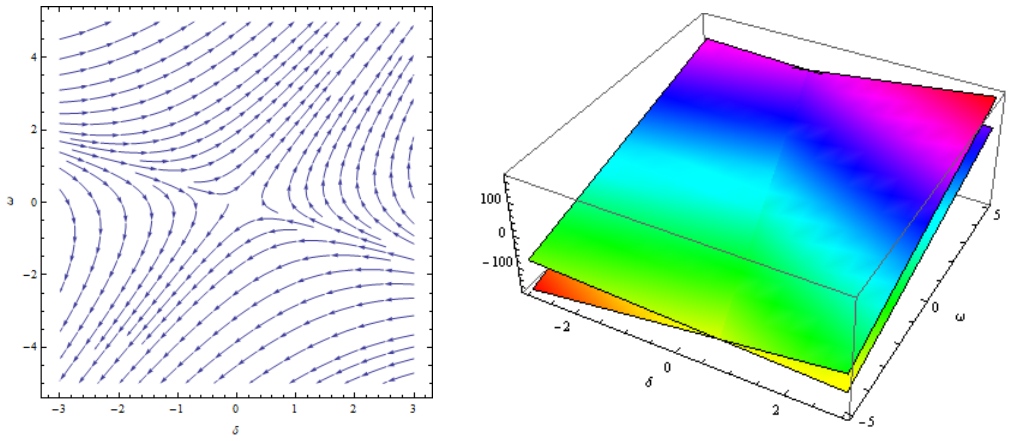
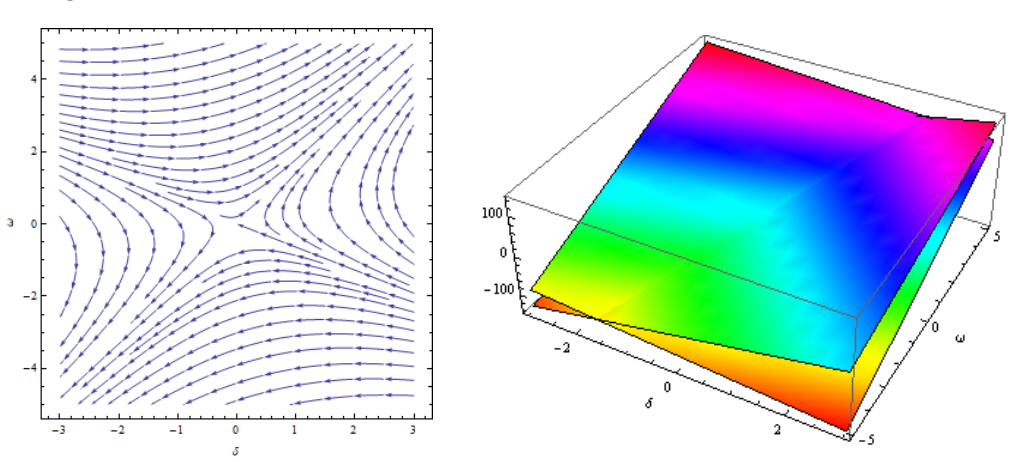
read the original abstract
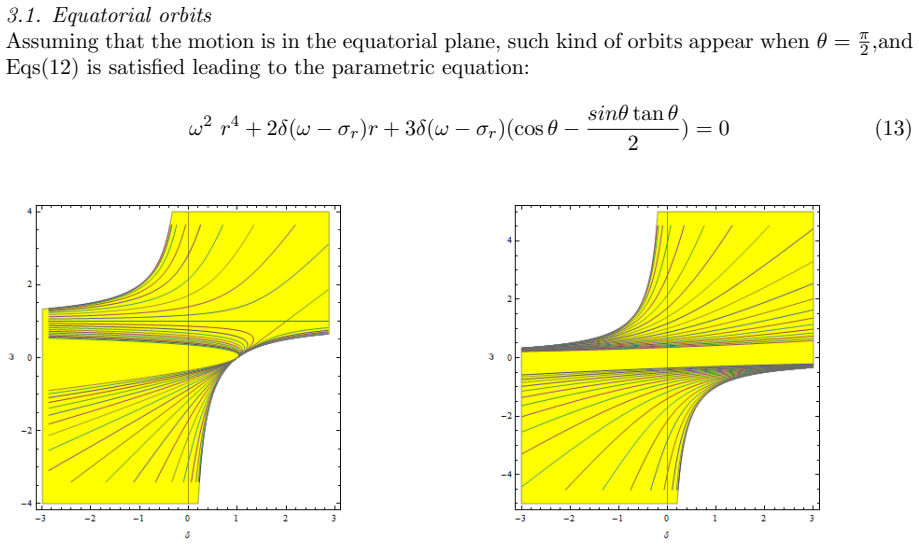
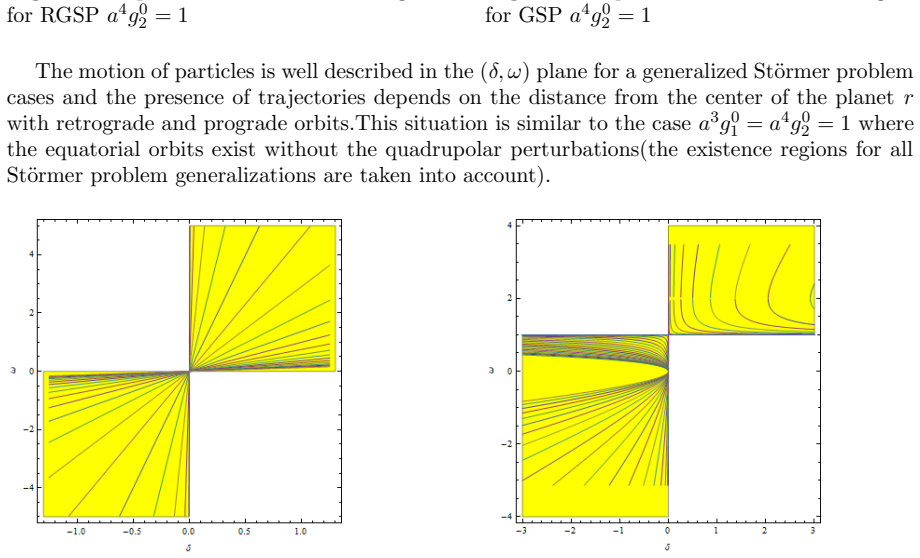
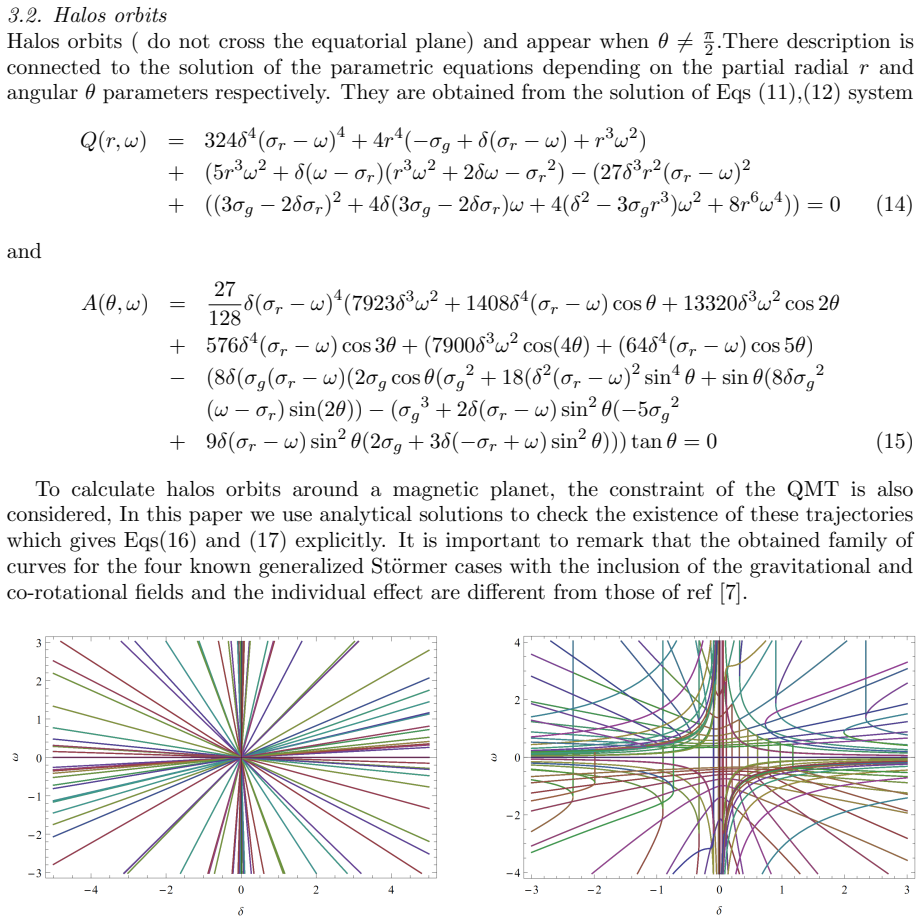
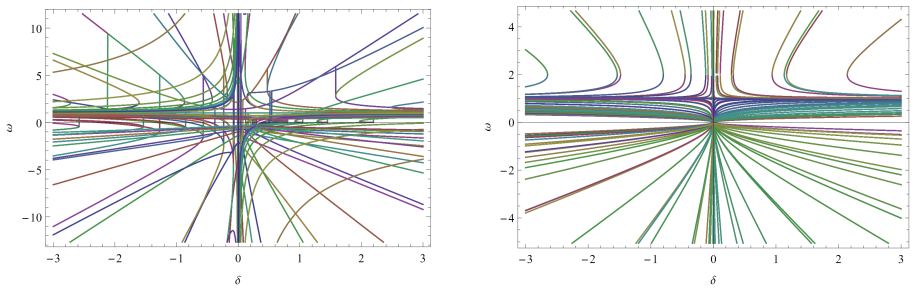
A new generalized St\"ormer problem is proposed. The charged particles motion around a rotating axisymmetric magnetic planet is studied using various conditions mainly in planetary magnetospheres. It is shown that the existence of specific trajectories is due to the quadrupolar and dipolar magnetic terms. Moreover, the equilibrium and stability behaviors and the corresponding orbital frequencies for various kinds of charged dust grains are treated giving rise to a new model describing the dynamical system and leading to more interesting results.
Editorial analysis
A structured set of objections, weighed in public.
Referee Report
Summary. The manuscript proposes a generalized Störmer problem that augments the standard dipolar magnetic field with a quadrupolar term for an axisymmetric, rotating planet. It derives the equations of motion for charged dust grains treated as test particles, shows that certain bounded trajectories require both multipole contributions, and performs linear stability analysis around equilibria to obtain orbital frequencies as functions of grain charge-to-mass ratio and other parameters.
Significance. If the derivations hold, the work supplies a concrete, analytically tractable extension of the classical Störmer problem that incorporates the next-order magnetic multipole relevant to many planetary fields. This could improve modeling of charged-grain dynamics in magnetospheres without introducing free parameters beyond the standard dipole and quadrupole moments, and the stability-frequency results are directly falsifiable against in-situ dust measurements.
minor comments (3)
- [§2] §2, after Eq. (3): the effective potential is written with an explicit time-dependent term arising from the rotating frame; clarify whether this term is retained in the subsequent equilibrium search or averaged out, as the distinction affects the interpretation of the reported equilibria.
- [Table 1] Table 1: the listed stability boundaries for positive versus negative grains are given only for the combined dipole+quadrupole case; adding a column or row for the pure-dipole limit would make the incremental effect of the quadrupolar term immediately visible and strengthen the central claim.
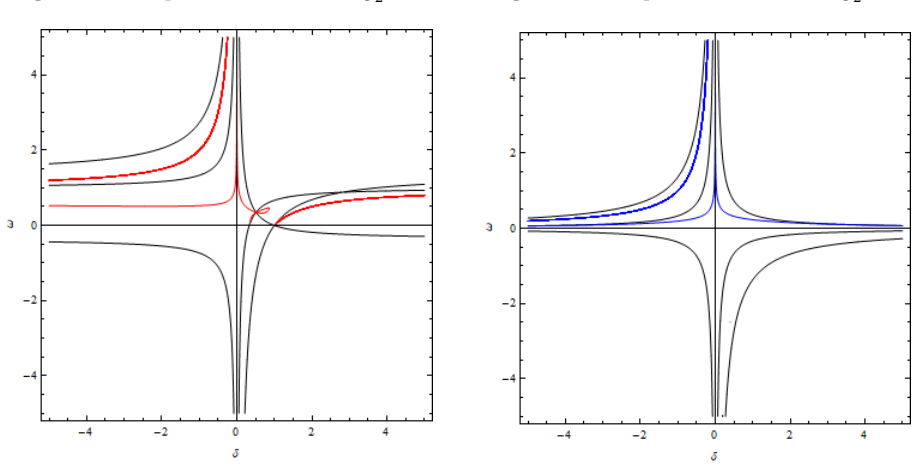
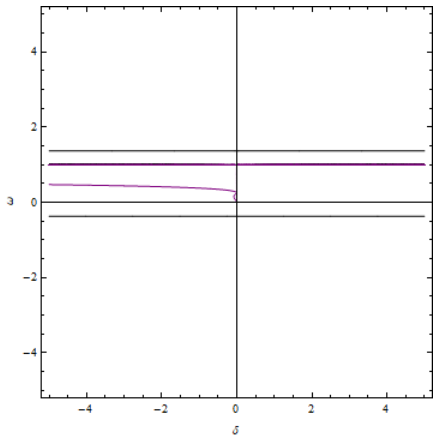
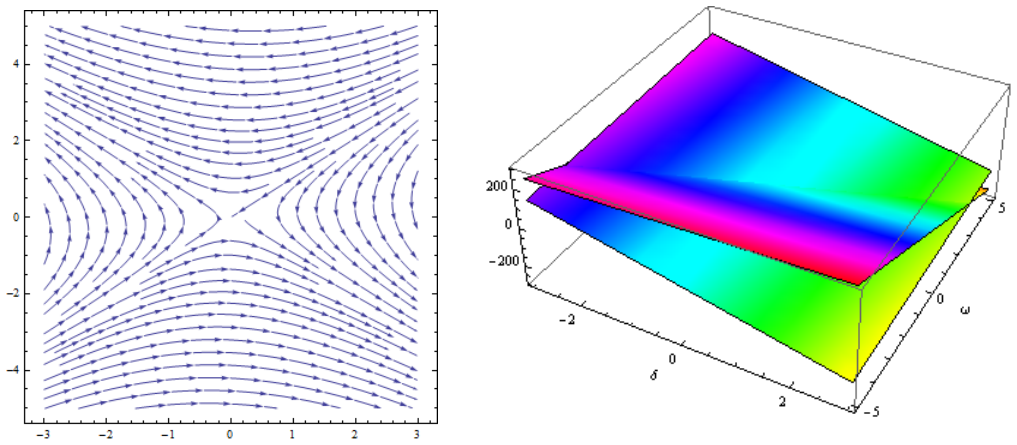
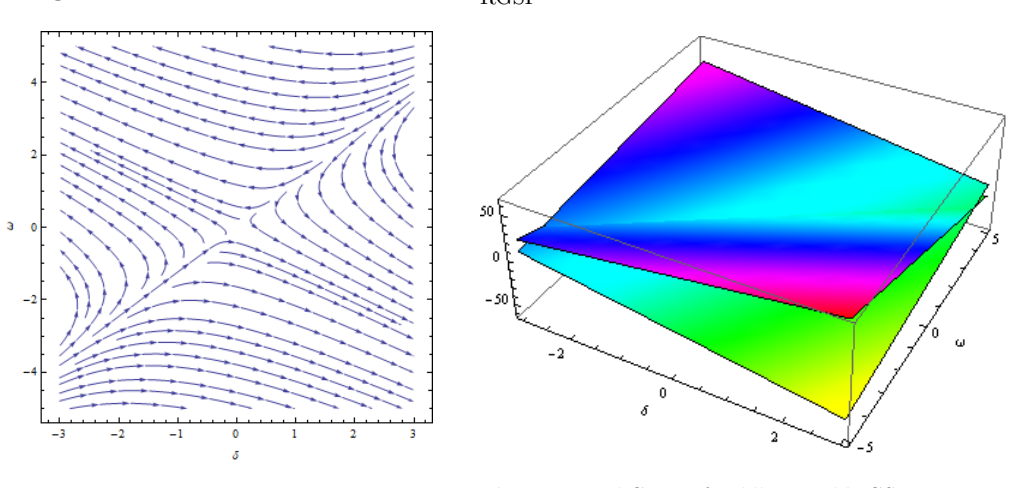
- [Fig. 3] Fig. 3 caption and surrounding text: the plotted frequencies are stated to be 'orbital frequencies,' but it is unclear whether these are the epicyclic frequencies or the guiding-center frequencies; a brief sentence defining the quantity plotted would remove ambiguity.
Simulated Author's Rebuttal
We thank the referee for their positive assessment of the manuscript, the accurate summary of our generalized Störmer problem, and the recommendation for minor revision. No specific major comments or requested changes were provided in the report.
Circularity Check
No significant circularity detected
full rationale
The paper extends the classical Störmer problem by superposing an axisymmetric quadrupolar term onto the usual dipolar magnetic field in a rotating frame and then derives the equations of motion for test-particle charged grains. Equilibria, linear stability, and orbital frequencies are obtained by direct analysis of those equations. No parameter is fitted to a data subset and then re-used as a prediction of a closely related quantity; no load-bearing uniqueness theorem or ansatz is imported solely via self-citation; and the central claim (that specific trajectories require both multipoles) follows from the explicit form of the potential rather than from a definitional identity. The derivation chain is therefore self-contained and independent of its own outputs.
Axiom & Free-Parameter Ledger
axioms (2)
- domain assumption The magnetic field of the planet is axisymmetric and can be represented by a superposition of dipolar and quadrupolar terms.
- domain assumption Charged dust grains can be treated as test particles whose motion does not back-react on the magnetic field.
Reference graph
Works this paper leans on
-
[1]
Hamilton D P 1993 Icarus 101 244-2
work page 1993
-
[2]
Mitchell C J, Hor˜ anyi M and Howard J E 2003 J Geophys Res: Space Physics 108 1-10
work page 2003
-
[3]
Mendis D A, Axford W I 1974 Ann. Rev. of Earth and Planets. Sci 2 419-474
work page 1974
-
[4]
Shukla P K and Mamun A A 2002 Introduction to Dusty Plasma Physics (Bristol: IOP Publ)
work page 2002
-
[5]
Kov˜ ar J, Stuchlik Z and Karas V 2012 Class Quantum Grav 25 1-17
work page 2012
-
[6]
In˜ arrea M, Lanchares V, Palacian J F, Pascual A I, Pablo Salas J and Yanguas P 2012 Physica. D 241 1026-1042
work page 2012
- [7]
-
[8]
In˜ arrea M, Lanchares V, Palacian J F, Pascual A I, Pablo Salas J and Yanguas P 2004Physica. D 197 242-268
-
[9]
In˜ arrea M, Lanchares V, Palacian J F, Pascual A I, Pablo Salas J and Yanguas P 2009 Chaos Solitons and Fractals 42 155-169
work page 2009
-
[10]
Jontof-Hutter D and Hamilton D P 2012 Icarus 218 420-432
work page 2012
-
[11]
Jontof-Hutter D and Hamilton D P 2012 Icarus 220 487-502
work page 2012
-
[12]
Maravilla D 1999 Geofisica internacional 38 1-11
work page 1999
-
[13]
Kolesnikov E K 2017 J Geomagnetism and Aeronomy 57 137-146
work page 2017
-
[14]
Int, Conf on Conf´ erence ”Lumi´ ere et Astronomie” (Algeria) ISBN 978-9947-0-4967-9
Leghmouche A, Mebarki N and Bouldjedri A , 2015 Proc. Int, Conf on Conf´ erence ”Lumi´ ere et Astronomie” (Algeria) ISBN 978-9947-0-4967-9
work page 2015
-
[15]
Leghmouche A, Mebarki N, 2017 Proc. Int, Conf on 4th Algerian Conference on Astronomy and Astrophysics (Algeria) (to appear in IOP journal of conference series publishing)
work page 2017
-
[16]
Howard J E, Dullin H R and Hor˜ anyi M 2000 Phys. Rev. Lett 84 3244-3247
work page 2000
-
[17]
Howard J E, Hor˜ anyi M and Stewart G R 1999 Phys. Rev. Lett 83 3993-3996
work page 1999
-
[18]
Alfv´ en H and Falthammar C G 1963Cosmical Electrodynamics: Fundamental Principles (Oxford:Clarendon Press)
-
[19]
2011 Physics of the Earth and Planetary Interiors 187 92-108
Schubert G and Soderlund K.M. 2011 Physics of the Earth and Planetary Interiors 187 92-108
work page 2011
discussion (0)
Sign in with ORCID, Apple, or X to comment. Anyone can read and Pith papers without signing in.