REVIEW 3 major objections 7 minor 46 references
Full-bandwidth transformer
T0 review · 3 major / 7 minor · reviewed 2026-08-14 · deepseek-v4-flash
Pith's one-line read Autoregressive transformers waste a second feedback channel between decoding steps; fusing the previous top-layer hidden state with the sampled token embedding through a gated linear unit converts negligible per-token compute into gains…
desk verdict A clean, well-executed 1B-scale study of feeding the top-layer state back through a gate — consistent gains and a genuinely interesting stabilization finding, but the headline 2x data-efficiency claim needs error bars and a decoding-side stability check before I'd fully trust it. read the letter →
The pith
A machine-rendered reading of the paper's core claim, the machinery that carries it, and where it could break.
The reading
What carries the argument
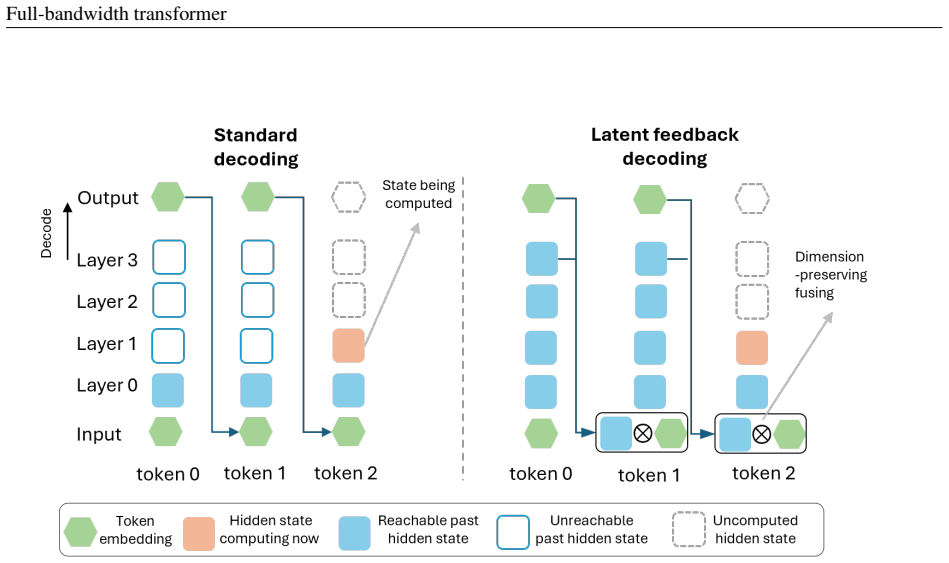
The central object is latent feedback decoding, a gated linear unit fusion $e_t \otimes h_{t-1}^{L} = W_U h_{t-1}^{L} \odot \sigma(W_G e_t)$ that turns the previous top-layer hidden state into the next input, with the sampled token embedding acting only as a multiplicative gate. Around it sits the scheduled multi-pass training objective: each pass shifts the previous pass's hidden states one position right, fuses them with token embeddings, and re-runs the stack in parallel across positions, so a length-$T$ recurrence is trained over $k$ instead of $T$ sequential steps. The load-bearing stability ingredient is the feedback-pass schedule, mostly single-pass, with about 22\% two-pass and 3\% three-pass batches late in training, which empirically converts the learned feedback map into a contraction toward a fixed point; prefix mixin matches the prompt-then-generate input distribution, and depth scaling plus a shared input basis and jitter noise keep long rollouts stable.
What would settle it
Hold the weights of a 200B full-bandwidth model fixed and run SOFT decoding past the trained 3-pass horizon on held-out, out-of-distribution prompts while logging $\lVert h_t^{L} - h_{t-1}^{L}\rVert$: if the per-step state change grows or oscillates instead of decaying to a small plateau, the contraction premise fails; if SOFT does not beat STANDARD decoding on GSM8K or HumanEval across the same rollouts, the data-efficiency claim is overturned.
Extended reading notes
Core claim
On the paper's own terms, the discovery is that the vertical feedback channel between decoding steps can be widened to its full width without changing the transformer architecture or the language-modeling objective. The mechanism is the gated fusion $e_t \otimes h_{t-1}^{L} = W_U h_{t-1}^{L} \odot \sigma(W_G e_t)$: the sampled token embedding acts as a gate on the previous top-layer state, which occupies the value pathway, so discarding the state would discard the input itself and the channel cannot be bypassed. Trained with a scheduled multi-pass objective (temporal parallelism), latent feedback yields better validation loss and 5-shot accuracy, with the 100B-token recurrent model matching the 200B-token standard baseline and the 200B model matching the 400B standard baseline under fused prefilling. On free-form generation, the same weights under latent-feedback decoding beat standard decoding on GSM8K, MATH-500, HumanEval, and MBPP, sometimes approaching baselines trained with up to $5\times$ the tokens, and base models often produce much shorter reasoning traces at equal or better accuracy. A secondary finding is that the training signal itself improves representations: even evaluated with standard decoding, models trained with the latent-feedback objective beat next-token-only models on the same data.
Load-bearing premise
All downstream gains depend on one thing: the feedback map learned from at most three training passes must keep behaving stably over hundreds or thousands of generated tokens; the paper verifies this with repeated fused-prefill passes on the training distribution, not with long sampled decoding, and admits the schedule is a heuristic.
Editorial extensions
If this is right
- Under fused prefilling, the 100B-token full-bandwidth model matches the 200B-token standard baseline and the 200B-token model matches the 400B-token standard baseline in validation loss and 5-shot LM Eval accuracy, so a small amount of prefill-time compute buys roughly $2\times$ pretraining data efficiency.
- With weights held fixed, latent-feedback decoding (SOFT) improves over standard decoding on every free-form task tested; on MATH-500 the 200B model rises from 0.27 to 0.37 Pass@1, surpassing the 1T-token no-recurrence baseline.
- The gains survive long-context extension and instruction tuning: on GSM8K the instructed model improves from 64.5 to 67.9 and on HumanEval from 42.5 to 45.9, beating the matched 200B standard baseline on all tasks.
- On base models, latent feedback often produces markedly shorter reasoning traces at equal or better accuracy, consistent with intermediate computation riding the hidden state instead of being verbalized; this conciseness disappears after instruction tuning because the tuning traces imitate standard verbose reasoning.
- Training with the latent-feedback objective improves downstream 5-shot accuracy even when the model is evaluated as an ordinary transformer with standard decoding, so the multi-pass objective acts as an auxiliary state-supervision signal independent of the decoding change.
Reading between the lines
- The stabilization result implies a transferable recipe the paper does not test: a 3\% dose of deeper unrolls may contractivize other shallow-trained recurrent maps, such as looped transformers, at little extra training cost.
- The disappearance of concise traces after instruction tuning suggests an untested fix: on-policy post-training whose rollouts are decoded with latent feedback should keep both the accuracy and the conciseness.
- Should the token-equivalence hold at larger scales, the practical scaling axis shifts from acquiring more unique tokens to spending more compute per unique token, which would matter most for data-constrained training runs.
- A more direct test of the mechanism than any downstream benchmark would be to measure contraction on long sampled-token rollouts, since the paper's stability diagnostic repeatedly applies fused prefilling on the training distribution rather than the actual decoding distribution.
Signed reviews
Editorial analysis
A structured set of objections, weighed in public.
Referee Report
Summary. The paper introduces the full-bandwidth transformer, which widens the inter-step feedback channel of an autoregressive transformer by fusing the previous top-layer hidden state with the sampled token embedding via a gated linear unit (Eq. 4) and feeding the result back as the next input. To train this recurrence without sacrificing parallel teacher forcing, the authors propose a scheduled multi-pass objective that starts from a standard checkpoint, spends most of training on one-pass batches, and mixes small fractions of two- and three-pass batches; a prefix mixin and lightweight stabilization recipes (RMSNorm on fused inputs, tied embeddings, jitter noise) are added to keep the feedback map stable. At 1B scale and up to 400B tokens, the paper reports improvements in validation loss, 5-shot LM Eval, GSM8K, MATH-500, HumanEval, MBPP, and instruction-tuned settings, with fused prefilling letting a 100B-token model match a 200B-token standard baseline and a 200B-token model match a 400B-token standard baseline. The paper also reports shorter reasoning traces under latent-feedback decoding and controlled state-tracking experiments showing that recurrent prefilling exposes global state to shallow layers.
Significance. If the empirical claims hold, this is a significant result: it proposes a new axis of scaling—spending extra compute per token through a parallelizable latent-feedback recurrence—while preserving the standard transformer architecture, KV cache, and language-modeling objective. The paper is unusually concrete on engineering: it provides full training and inference pseudo-code, a vLLM-compatible implementation strategy, an explicit token-equivalent-compute accounting, and controlled synthetic probes that mechanistically verify the claimed bandwidth increase. The central falsifiable predictions—shorter reasoning traces and shallow-layer accessibility—are clean and well motivated. The main risk is not circularity but transfer of the stability evidence: the contraction diagnostics are run on repeated fused prefill passes over fixed tokens, whereas decoding iterates the feedback map over the model's own sampled tokens. This is a load-bearing gap that the revision should close before the 2x-token equivalence claim can be considered established.
major comments (3)
- [Sec. 3.3, Eqs. (8)-(11), Figs. 3 and 10] The stability evidence in Fig. 3 and Fig. 10 is obtained by repeatedly applying fused prefill passes over fixed token sequences, i.e., iterating k in Eqs. (10)-(11) while the token embeddings remain constant. Decoding, by contrast, iterates Eq. (8) where the token a_t is sampled from the model's own distribution conditioned on the fed-back hidden state, so the input distribution changes at every step as a function of the state. A contraction on the fixed-token iteration does not by itself imply stability of the stochastic sampled-token dynamics, and the sentence in Sec. 3.3 claiming that 'hundred-token rollouts show no sign of breakdown' is not supported by a diagnostic on the actual decoding distribution. Because the central equivalence claim in Secs. 4.1-4.2 depends on long, stable latent-feedback decoding, please add decoding-side diagnostics: hidden-state norm and step-to-step change over 100-1000 generated tokens, task quality as a function of rollout length, and ideally multiple decoding runs or seeds to check for divergence or collapse.
- [Sec. 4.2, Fig. 5, Table 1, Fig. 6] The headline results that latent feedback 'matches or approaches' standard baselines trained with roughly 2x more tokens are reported from single runs without error bars or repeated decoding seeds. The math and coding numbers are Pass@1 and Pass@3 estimates from 10 rollouts per problem with temperature selected separately per method, so sampling noise is nontrivial. Please report confidence intervals, ideally across multiple decoding seeds, for SOFT and FUSED versus STANDARD decoding, and state whether the observed ordering is stable. Without this, the 2x-token equivalence claim is not fully supported by the evidence as presented.
- [Sec. 3.3, Fig. 3, Sec. 6] The stability recipe is centered on a specific unablated configuration: 75% one-pass, 22% two-pass, 3% three-pass batches, with jitter noise sigma=0.02 and feedback objective weight lambda=1. The paper acknowledges in Sec. 6 that the schedule is heuristic, but because Fig. 3 shows that the 3% three-pass fraction is precisely what changes a diverging map into a contraction, the reader cannot tell how robust the recipe is to model scale, data mixture, or training length. Please include a small sensitivity study of the three-pass fraction and sigma, or replace the heuristic with a principled fixed-point convergence check that determines the schedule.
minor comments (7)
- [Sec. 2, Fig. 7, Table 2] There are several typos: 'veritical' should be 'vertical' in Sec. 2, 'perfix' should be 'prefix' in the Fig. 7 caption, 'comparision' should be 'comparison' in the Table 2 caption, and 'bandwith' should be 'bandwidth' in Fig. 4.
- [Eq. (4)] Equation (4) uses the notation sigma and circled-dot without defining them in the text; please state explicitly that sigma is the sigmoid function and circled-dot is elementwise multiplication.
- [Fig. 4] The 10B run is trained with 100% three-pass batches, which is inconsistent with the schedule used for the 100B-400B runs; please explain why this run is included in the same figure or move it to an ablation.
- [Abstract and Sec. 4.1] The abstract says 'roughly 1.5x more tokens' while Sec. 4.1 concludes 'roughly 2x pretraining data efficiency'; please reconcile the claimed factor or specify the different regimes to which each number refers.
- [Listing 2] The comment 'standard decoding: x = embed(tok)' is placed on a line that is commented out in a way that may confuse readers; please clarify that the active fused line is the only change relative to standard decoding.
- [Sec. 4.2] The temperature values selected for each decoding regime are not reported; please list the chosen temperatures for each task and method, since the comparison is conditioned on this selection.
- [Sec. 3.1] The claim that latency-feedback decoding costs 'under 1% per token' should be quantified relative to the full forward pass, and the overhead of the vLLM buffer copy described in Appendix D should be included in that estimate.
Circularity Check
No significant circularity: the efficiency and stability claims are measured against external baselines and independent diagnostics, with self-citations confined to related work.
full rationale
The paper's central claim—that latent feedback converts negligible extra inference compute into gains equivalent to roughly 2x more training tokens—is an empirical comparison against standard transformers trained on 100B-1T tokens, evaluated on held-out LM Eval, GSM8K, MATH-500, HumanEval, and MBPP; nothing in Eq. (12) makes the matched-2x result true by construction. Eqs. (3) and (8) define the decoding procedure, Eqs. (9)-(11) define the multi-pass training approximation, and Eq. (12) defines the objective; the gains reported in Figs. 4-6 and Table 1 are measured outcomes, not identities. The contraction/stability evidence in Figs. 3 and 10 is an explicitly labeled proxy diagnostic for long-horizon self-composition, and the paper additionally reports that hundred-token rollouts show no sign of breakdown, so no 'prediction' is being replaced by its fit. Self-citations (JTP, next-latent prediction, and temporal-parallelism work including T2MLR and LRT) appear only as related work or as compatible extensions left for future work; no uniqueness theorem or load-bearing result is imported from same-author prior work. The acknowledged heuristics (feedback-pass scheduling, prefix mixin, and noise level) are training hyperparameters disclosed in Sec. 6, not disguised as derived predictions. The state-tracking probes are synthetic controls with an explicit caveat that decodability does not by itself imply improved output. Accordingly, no circular step is present.
Assumptions & free parameters
free parameters (3)
- Feedback-pass mixture schedule =
75% one-pass / 22% two-pass / 3% three-pass (200B and 400B runs); 75% one-pass / 25% three-pass (100B run); 100%…
- Jitter noise sigma =
0.02
- Feedback objective weight lambda =
1
assumptions (4)
- domain assumption The top-layer hidden state and the token embedding space can be aligned (via weight tying and RMSNorm on the fused input) so that the gated fusion is a learnable and useful feedback signal.
- domain assumption Repeated fused prefill passes are a faithful proxy for the long-horizon autoregressive decoding loop when testing feedback stability.
- domain assumption The self-trained standard transformer baselines are fair comparators for the claimed data-efficiency ratios.
- standard math In a transformer with a KV cache, all past fused inputs remain attendable, so feeding back the latest top-layer state suffices to expose the full history of top-layer states to every layer.
Cite this review
Pith. "Pith review of Full-bandwidth transformer." pith.science (2026). https://pith.science/paper/VTWOBQP4
@misc{pith2026260808888,
  author       = {Pith},
  title        = {Pith review of: Full-bandwidth transformer},
  year         = {2026},
  howpublished = {\url{https://pith.science/paper/VTWOBQP4}},
  note         = {Machine review of arXiv:2608.08888}
}
abstract
Autoregressive transformers compute along two axes: horizontally across generated tokens, and vertically through model depth. Dense attention gives each token broad horizontal access to the past, but the vertical feedback channel between decoding steps remains narrow: only the sampled token returns to the bottom of the stack, while the top-layer hidden state is discarded. We introduce the \emph{full-bandwidth transformer}, which widens this channel with \emph{latent feedback}: at each decoding step, the previous top-layer hidden state is fused with the sampled token embedding through a gated linear unit and fed back as the next input. Latent feedback lets non-verbalized computation re-enter the stack with a renewed depth budget, while preserving the standard transformer architecture, KV cache, and language-modeling objective. To train full-bandwidth transformers without losing parallel teacher forcing, we use a scheduled multi-pass objective that introduces latent feedback late in pretraining and mixes a small fraction of deeper feedback passes for stability. We train 1B-parameter full-bandwidth transformers up to 400B tokens and find that latent feedback improves validation loss, 5-shot language-model evaluation, math and coding generation, and instruction-tuned performance. With negligible per-token decoding overhead, full-bandwidth transformers match or approach standard transformers trained with roughly $1.5\times$ more tokens, and manage to produce shorter reasoning traces at equal or better accuracy.
Figures


Figures from the paper (7 more)


Reference graph
Works this paper leans on
-
[1]
arXiv preprint arXiv:2401.06066 , year=
Deepseekmoe: Towards ultimate expert specialization in mixture-of-experts language models , author=. arXiv preprint arXiv:2401.06066 , year=
-
[2]
First conference on language modeling , year=
Mamba: Linear-time sequence modeling with selective state spaces , author=. First conference on language modeling , year=
-
[3]
International Conference on Learning Representations , volume=
Gated delta networks: Improving mamba2 with delta rule , author=. International Conference on Learning Representations , volume=
-
[4]
arXiv preprint arXiv:2510.21450 , year=
Pararnn: Unlocking parallel training of nonlinear rnns for large language models , author=. arXiv preprint arXiv:2510.21450 , year=
-
[5]
Moe lens-an expert is all you need , author=. Sparsity in LLMs (SLLM): Deep Dive into Mixture of Experts, Quantization, Hardware, and Inference , year=
-
[6]
arXiv preprint arXiv:2510.23671 , year=
Sparsity and Superposition in Mixture of Experts , author=. arXiv preprint arXiv:2510.23671 , year=
-
[7]
The Illusion of Specialization: Unveiling the Domain-Invariant" Standing Committee" in Mixture-of-Experts Models , author=. arXiv preprint arXiv:2601.03425 , year=
-
[8]
arXiv preprint arXiv:2405.03133 , year=
Lory: Fully differentiable mixture-of-experts for autoregressive language model pre-training , author=. arXiv preprint arXiv:2405.03133 , year=
Show all 46 references
-
[9]
arXiv preprint arXiv:2002.09402 , year=
Addressing Some Limitations of Transformers with Feedback Memory , author=. arXiv preprint arXiv:2002.09402 , year=
2002 arXiv
-
[10]
arXiv preprint arXiv:2602.08984 , year=
Next Concept Prediction in Discrete Latent Space Leads to Stronger Language Models , author=. arXiv preprint arXiv:2602.08984 , year=
-
[11]
Forty-third International Conference on Machine Learning , year=
NITP: Next Implicit Token Prediction for LLM Pre-training , author=. Forty-third International Conference on Machine Learning , year=
-
[12]
arXiv preprint arXiv:2606.03938 , year=
q0: Primitives for Hyper-Epoch Pretraining , author=. arXiv preprint arXiv:2606.03938 , year=
-
[13]
arXiv preprint arXiv:2510.20280 , year=
Context-level language modeling by learning predictive context embeddings , author=. arXiv preprint arXiv:2510.20280 , year=
-
[14]
arXiv preprint arXiv:2401.15077 , year=
Eagle: Speculative sampling requires rethinking feature uncertainty , author=. arXiv preprint arXiv:2401.15077 , year=
-
[15]
arXiv preprint arXiv:2404.19737 , year=
Better & faster large language models via multi-token prediction , author=. arXiv preprint arXiv:2404.19737 , year=
-
[16]
Forty-third International Conference on Machine Learning , year=
NorMuon: Making Muon more efficient and scalable , author=. Forty-third International Conference on Machine Learning , year=
-
[17]
International Conference on Learning Representations , volume=
Chain of thought empowers transformers to solve inherently serial problems , author=. International Conference on Learning Representations , volume=
-
[18]
Cai, Ziyang and Zhu, Xingyu and Dong, Yihe and He, Yinghui and Arora, Sanjeev , journal=. T\^
-
[19]
arXiv preprint arXiv:2605.26797 , year=
Latent Recurrent Transformer: Architecture Exploration, Training Strategies, and Scaling Behavior , author=. arXiv preprint arXiv:2605.26797 , year=
-
[20]
arXiv preprint arXiv:2606.18206 , year=
Fixed-Point Reasoners: Stable and Adaptive Deep Looped Transformers , author=. arXiv preprint arXiv:2606.18206 , year=
-
[21]
arXiv preprint arXiv:2509.23184 , year=
Ponderlm-2: Pretraining llm with latent thoughts in continuous space , author=. arXiv preprint arXiv:2509.23184 , year=
-
[22]
arXiv preprint arXiv:2606.31779 , year=
Bridging the Gap Between Latent and Explicit Reasoning with Looped Transformers , author=. arXiv preprint arXiv:2606.31779 , year=
-
[23]
arXiv preprint arXiv:1807.03819 , year=
Universal transformers , author=. arXiv preprint arXiv:1807.03819 , year=
-
[24]
International Conference on Machine Learning , pages=
Looped transformers as programmable computers , author=. International Conference on Machine Learning , pages=. 2023 , organization=
2023
-
[25]
arXiv preprint arXiv:2412.06769 , year=
Training large language models to reason in a continuous latent space , author=. arXiv preprint arXiv:2412.06769 , year=
-
[26]
Advances in Neural Information Processing Systems , volume=
Hybrid latent reasoning via reinforcement learning , author=. Advances in Neural Information Processing Systems , volume=
-
[27]
Advances in Neural Information Processing Systems , volume=
Soft thinking: Unlocking the reasoning potential of llms in continuous concept space , author=. Advances in Neural Information Processing Systems , volume=
-
[28]
arXiv preprint arXiv:2603.20219 , year=
Thinking into the Future: Latent Lookahead Training for Transformers , author=. arXiv preprint arXiv:2603.20219 , year=
-
[29]
arXiv preprint arXiv:2110.14168 , year=
Training verifiers to solve math word problems , author=. arXiv preprint arXiv:2110.14168 , year=
-
[30]
arXiv preprint arXiv:2305.20050 , year=
Let's Verify Step by Step , author=. arXiv preprint arXiv:2305.20050 , year=
-
[31]
2021 , eprint=
Evaluating Large Language Models Trained on Code , author=. 2021 , eprint=
2021
-
[32]
arXiv preprint arXiv:2108.07732 , year=
Program Synthesis with Large Language Models , author=. arXiv preprint arXiv:2108.07732 , year=
-
[33]
arXiv preprint arXiv:2511.05963 , year=
Next-latent prediction transformers learn compact world models , author=. arXiv preprint arXiv:2511.05963 , year=
-
[34]
arXiv preprint arXiv:2503.21801 , year=
Efficient joint prediction of multiple future tokens , author=. arXiv preprint arXiv:2503.21801 , year=
-
[35]
Tensor Programs
Greg Yang and Dingli Yu and Chen Zhu and Soufiane Hayou , booktitle=. Tensor Programs. 2024 , url=
2024
-
[36]
Advances in Neural Information Processing Systems , volume=
Signal propagation in transformers: Theoretical perspectives and the role of rank collapse , author=. Advances in Neural Information Processing Systems , volume=
-
[37]
arXiv preprint arXiv:2506.02285 , year=
Why gradients rapidly increase near the end of training , author=. arXiv preprint arXiv:2506.02285 , year=
-
[38]
Advances in Neural Information Processing Systems , volume=
Scaling laws and compute-optimal training beyond fixed training durations , author=. Advances in Neural Information Processing Systems , volume=
-
[39]
arXiv preprint arXiv:2404.06395 , year=
Minicpm: Unveiling the potential of small language models with scalable training strategies , author=. arXiv preprint arXiv:2404.06395 , year=
-
[40]
Journal of machine learning research , volume=
Palm: Scaling language modeling with pathways , author=. Journal of machine learning research , volume=
-
[41]
arXiv preprint arXiv:2412.08905 , year=
Phi-4 technical report , author=. arXiv preprint arXiv:2412.08905 , year=
-
[42]
arXiv preprint arXiv:2506.16029 , year=
EvoLM: In search of lost language model training dynamics , author=. arXiv preprint arXiv:2506.16029 , year=
-
[43]
The Thirteenth International Conference on Learning Representations , year=
The Belief State Transformer , author=. The Thirteenth International Conference on Learning Representations , year=
-
[44]
Advances in neural information processing systems , volume=
Chain-of-thought prompting elicits reasoning in large language models , author=. Advances in neural information processing systems , volume=
-
[45]
The Thirty-ninth Annual Conference on Neural Information Processing Systems , year=
Scaling up Test-Time Compute with Latent Reasoning: A Recurrent Depth Approach , author=. The Thirty-ninth Annual Conference on Neural Information Processing Systems , year=
-
[46]
arXiv preprint arXiv:2001.08361 , year=
Scaling laws for neural language models , author=. arXiv preprint arXiv:2001.08361 , year=
2001 arXiv
Reviewed August 14, 2026 · model on record in the stance chip above.
Discussion (0). Continue with ORCID to comment.