REVIEW 3 major objections 5 minor 1 cited by
Harnessing Photon Indistinguishability in Quantum Extreme Learning Machines
T0 review · 3 major / 5 minor · reviewed 2026-08-15 · deepseek-v4-flash
Pith's one-line read Photon indistinguishability—the property that lets identical photons interfere—is claimed to be a scalable resource that enlarges the feature space of photonic quantum extreme learning machines.
desk verdict The paper's real contribution is a clean experimental demonstration of coincidence-based QELMs on a classical task, but its central claim about an indistinguishability-driven advantage rests on a rank-to-accuracy transfer that its own experiment contradicts. read the letter →
The pith
A machine-rendered reading of the paper's core claim, the machinery that carries it, and where it could break.
The reading
What carries the argument
The central object is the $n$-photon coincidence feature matrix, whose entries are the measured coincidences $C_{j_1\cdots j_n}$ between output modes. For $n$ photons and $m$ detectors the ideal coincidence is $$C_{j_1\cdots j_n}=\frac{\$\alpha$}{n!}\left|\sum_{\$\sigma$\in S(n)}E_{\$\sigma$(1)j_1}\cdots E_{\$\sigma$(n)j_n}\right|^2+\frac{1-\$\alpha$}{n!}\sum_{\$\sigma$\in S(n)}\left|E_{\$\sigma$(1)j_1}\cdots E_{\$\sigma$(n)j_n}\right|^2,$$ with $\alpha=1$ for indistinguishable photons, $\alpha=0$ for distinguishable photons, and $E_{ij}$ the output field of photon $i$ in mode $j$. The multimode fiber implements the fixed random projection; a single-photon avalanche diode (SPAD) array records intensities or two-photon coincidences; and the rank of the feature matrix—the number of singular values needed to reach 90% of the total squared energy—serves as the paper's proxy for the expressivity of the ELM. The scaling simulations use the coincidence Hilbert space whose dimension is the binomial coefficient $\binom{m}{n}$.
What would settle it
Run the scaling simulation at $n=5$ photons with $m=10$ detectors across many random transmission matrices and compare actual test accuracy; if indistinguishable photons show no statistically significant accuracy gain over distinguishable photons despite a higher feature-matrix rank, the proposed link between expressivity and performance is refuted.
Extended reading notes
Core claim
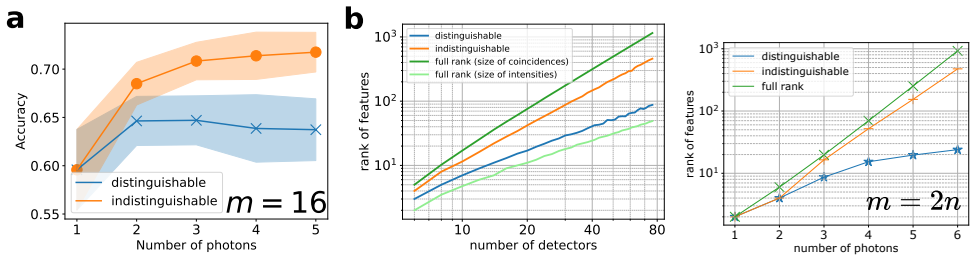
The paper's central claim is that indistinguishability can be harnessed as a computational resource in QELMs: with indistinguishable photons the random projections generated by a multimode fiber span a higher-dimensional feature space than with distinguishable photons, and this advantage increases with the number of photons. Experimentally, with two photons and up to 22 detectors, the coincidence-based ELMs reach 93% and 91% accuracy and clearly beat the 87% intensity-only ELM, but the distinguishable and indistinguishable variants are statistically comparable. The simulations extend the claim: fixing 16 detectors and going from one to five photons, the indistinguishable ELM rises from about 60% to 70% accuracy while the distinguishable one plateaus around 63%; the feature-matrix rank of indistinguishable photons scales between linear and quadratic in the number of detectors and, when $m=2n$, grows exponentially with photon number, versus a polynomial scaling for distinguishable photons. The paper concludes that the enhanced expressivity comes from quantum interference enriching the dimensionality of coincidence space, not from entanglement.
Load-bearing premise
The central claim rests on the assumption that the rank of the feature matrix—how many independent directions the random projections produce—faithfully tracks classification accuracy, even though in the two-photon experiment indistinguishable photons had higher rank while distinguishable photons had higher accuracy.
Editorial extensions
If this is right
- Coincidence-based QELMs are a practical upgrade over intensity-based optical ELMs: on the MNIST 0-1 task they improve accuracy from 87% to above 91% with the same optical hardware.
- At currently accessible sizes (two photons, 22 detectors) indistinguishability is not yet a measurable advantage; the predicted advantage appears only as the number of photons and detectors grows.
- The expressivity of indistinguishable-photon features scales faster than distinguishable-photon features—super-linear in detectors and exponential in photon number under $m=2n$—so photon number is a more efficient resource than adding detectors.
- Partial indistinguishability ($\alpha$ around 0.73) can outperform full indistinguishability on some tasks, making the coherence of the source a tunable hyperparameter rather than a maximized resource.
- To exploit the predicted advantage at scale, future QELMs must avoid measuring the full exponential Hilbert space; the paper points to partial-measurement strategies as the needed direction.
Reading between the lines
- If the rank-to-accuracy transfer holds, the largest practical gains should appear on tasks that demand many independent features, such as fine-grained or texture classification, rather than the two-class MNIST task used here; the paper's own experiment may simply be too easy to expose the advantage.
- The partial-indistinguishability optimum suggests that a variable-delay or tunable-coherence source could be treated as an adjustable knob and optimized per task; this is a control dimension not considered in the scaling simulations.
- A direct comparison against classical random feature maps with the same number of output features would make the quantum advantage quantitative; the paper shows rank scaling but not a classical baseline at matched feature counts.
- The experimental counterexample—higher rank but lower accuracy for the indistinguishable ELM—implies rank alone understates the role of generalization; a combined measure with the training-test accuracy gap would be a stricter expressivity proxy.
Signed reviews
Editorial analysis
A structured set of objections, weighed in public.
Referee Report
Summary. The manuscript reports an experimental photonic quantum extreme learning machine in which two photons are encoded with MNIST images, propagated through a multimode fiber, and detected on a SPAD array. Features are derived from intensities or from two-photon coincidences for distinguishable and indistinguishable photons. The experiments show that coincidence-based features outperform intensity-only features, while no significant difference is observed between distinguishable and indistinguishable photons at the experimental scale. Numerical simulations for up to five photons and for scaled detector numbers show an accuracy advantage for indistinguishable photons and a larger rank of the feature matrix, which the authors interpret as enhanced expressivity. The paper concludes that photon indistinguishability provides a scalable QELM advantage without relying on high-dimensional entanglement.
Significance. If the simulation results hold, the paper would provide evidence that photon indistinguishability can improve QELM accuracy at larger photon numbers without requiring entanglement. The experimental implementation is careful: Eq. (1) is the standard multimode bosonic coincidence formula, the comparison between DELM and IELM is reported with honest overlapping error bars, and the authors explicitly acknowledge the absence of a clear experimental advantage at the current scale. The rank-scaling analysis attempts to connect the simulated gain to a mechanistic cause, and the normalization of the rank against a Gaussian random matrix provides an external reference. However, as detailed below, the rank-to-accuracy proxy is not validated and is contradicted by the paper's own experimental data, so the causal claim needs substantial revision. The work is likely of interest to the quantum machine learning and photonic computing community.
major comments (3)
- [Experimental results with two photons and 22 detectors (Figs. 2a and 2c)] At 22 detectors, the IELM has higher feature-matrix rank (Fig. 2c) while the DELM has higher classification accuracy, 93% vs 91% (Fig. 2a). The text states that 'The rank of the feature matrix serves as a practical proxy of system expressivity' and uses the rank to explain a performance advantage, but the only direct experimental test of this transfer goes in the wrong direction. Since the central claim attributes the simulated quantum advantage to increased rank and expressivity, the manuscript must either validate the rank-to-accuracy transfer in a setting where both quantities are measured, or substantially weaken the causal claim and present the rank scaling only as a heuristic that is not yet evidenced to predict classification performance.
- [Variability of the system and Methods (rank calculation)] The rank at threshold t=0.9 is sensitive to shot noise, as the text concedes: 'a high amount of shot noise in the system will add up in the measured feature matrix and the rank will converge to the rank of a random matrix'. The experimental rank at 22 detectors has no error bar ('there is only one subset of detectors, and thus we do not know the error bar'), and the threshold t=0.9 is not motivated. The higher experimental IELM rank could therefore be an artifact of noise or of the threshold choice rather than a sign of useful expressivity. Please provide a noise-model analysis of the rank for the experimental coincidence counts and a sensitivity study with respect to t.
- [Simulations when scaling the number of photons and modes (Fig. 4b,c)] The scaling claim that the distinguishable rank is linear in m while the indistinguishable rank is between linear and quadratic (and exponential for m=2n) needs clarification. For two photons, the dimension of the n-fold coincidence space is C(m,2) ~ m^2, so the distinguishable rank cannot exceed this dimension and a linear scaling is not obvious. The text does not state the number of random inputs p used to build the feature matrix in Fig. 4b,c; if p is comparable to m, the computed rank is truncated by p. Please specify p, the feature matrix dimensions, and the details of the Gaussian-matrix normalization, and verify that the reported scaling is not an artifact of matrix size or of the m=2n choice that simultaneously changes both photon number and detector number.
minor comments (5)
- [Abstract] The word 'densly' should be 'densely'.
- [Simulations when scaling the number of photons and modes] 'Sterling's formula' should be 'Stirling's formula'.
- [Simulations when scaling the number of photons and modes] In the sentence 'The dimensionality of the n-fold coincidence space form detectors', 'form' should be 'for m detectors'.
- [Equation (1) and Fig. 3a] The coefficient α in Eq. (1) is called the indistinguishability, and Fig. 3a varies 'indistinguishability' from 0 to 1, but the relation between α, the measured HOM visibility, and the simulation parameter is not defined; please state explicitly how α enters the simulations and how it relates to experimental visibility.
- [Figure 4 caption] The caption of Fig. 4c should define the ordinate and state that the rank is normalized by the Gaussian random matrix rank, to match the description in the main text.
Circularity Check
No circularity: the QELM features, rank diagnostics, and accuracy simulations are independent outputs of the same standard bosonic-statistics model, with no fitted parameters and no load-bearing self-citations.
full rationale
The paper's derivation chain is self-contained. The coincidence model in Eq. (1) is a standard expression for n-photon bosonic statistics; the indistinguishability parameter alpha is not fitted to the target metrics but is tied to independently measured HOM visibility. The central simulation results (Fig. 4) are direct evaluations of classification accuracy and feature-matrix rank from this model, not inversions of the conclusions back into the inputs. The rank is additionally benchmarked against the rank of a Gaussian random matrix, providing an external reference. No parameter is fitted to accuracy, and the accuracy advantage of the IELM is computed directly from the features, not inferred from the rank. The paper's self-citations ([24], [25], [26]) concern the experimental apparatus and a supporting explanation of nonlinearity; they are not load-bearing for the quantum-advantage claim, which is supported by the model simulations and external datasets (MNIST, FashionMNIST). The experimental discrepancy where the IELM has higher rank but lower accuracy at 22 detectors, together with the paper's own admission that 'there is only one subset of detectors, and thus we do not know the error bar' and that shot noise inflates measured rank toward the random-matrix rank, weakens the expressivity-proxy argument as a correctness matter, but it does not make any step circular. The exponential scaling of the indistinguishable-photon rank with n at m=2n is related to the known binomial dimension C(2n,n), but the paper computes the rank from the feature matrices rather than assuming the conclusion. No pattern of self-definition, fitted-input-called-prediction, or self-citation reduction is present.
Assumptions & free parameters
free parameters (1)
- rank threshold t =
0.9
assumptions (4)
- domain assumption The multimode fiber acts as a fixed linear random unitary transformation on the input field modes, described by a complex transmission matrix E_ij that stays constant during training.
- standard math Coincidence probabilities follow Eq. (1), with alpha interpolating between distinguishable and indistinguishable multiphoton statistics.
- domain assumption The rank of the feature matrix at threshold t is a valid proxy for expressivity and predicts classification performance.
- domain assumption The simulated random transmission matrices and shot noise reproduce the experimental configuration and follow the Hilbert-space model proposed in ref [14].
Cite this review
Pith. "Pith review of Harnessing Photon Indistinguishability in Quantum Extreme Learning Machines." pith.science (2026). https://pith.science/paper/VUAMVFNR
@misc{pith2026250511238,
  author       = {Pith},
  title        = {Pith review of: Harnessing Photon Indistinguishability in Quantum Extreme Learning Machines},
  year         = {2026},
  howpublished = {\url{https://pith.science/paper/VUAMVFNR}},
  note         = {Machine review of arXiv:2505.11238}
}
read the original abstract
Recent advancements in machine learning have led to an exponential increase in computational demands, driving the need for innovative computing platforms. Quantum computing, with its Hilbert space scaling exponentially with the number of particles, emerges as a promising solution. In this work, we implement a quantum extreme machine learning (QELM) protocol leveraging indistinguishable photon pairs and multimode fiber as a random densly connected layer. We experimentally study QELM performance based on photon coincidences -- for distinguishable and indistinguishable photons -- on an image classification task. Simulations further show that increasing the number of photons reveals a clear quantum advantage. We relate this improved performance to the enhanced dimensionality and expressivity of the feature space, as indicated by the increased rank of the feature matrix in both experiment and simulation.
Figures


Figures from the paper (1 more)
Forward citations
Cited by 1 Pith paper
-
Large-scale quantum reservoir computing using a Gaussian Boson Sampler
A frequency-multiplexed Gaussian boson sampler with over 400 modes can serve as a quantum reservoir computer, with correlation-based features and squeezed light outperforming mean-field and classical-light baselines.
Reference graph
Works this paper leans on
-
[14]
Neill, Giulia Marcucci, and Daniele Faccio
Sam Nerenberg, Oliver D. Neill, Giulia Marcucci, and Daniele Faccio. Photon Number-Resolving Quantum Reservoir Com- puting, June 2024. arXiv:2402.06339 [quant-ph]
arXiv 2024
-
[1]
Deeplearn- ing.Nature, 521(7553):436–444, May 2015
YannLeCun, YoshuaBengio, andGeoffreyHinton. Deeplearn- ing.Nature, 521(7553):436–444, May 2015
work page 2015
-
[2]
Alternative Paradigms of Computation
William Gasarch, Nathan Hayes, Emily Kaplitz, and William Regli. AlternativeParadigmsofComputation, November2021. arXiv:2111.08916 [cs]
-
[3]
Michael A. Nielsen and Isaac L. Chuang. Quantum Compu- tation and Quantum Information: 10th Anniversary Edition, December 2010. ISBN: 9780511976667 Publisher: Cambridge University Press
work page 2010
-
[4]
Quantum ma- chine learning.Nature, 549(7671):195–202, September 2017
Jacob Biamonte, Peter Wittek, Nicola Pancotti, Patrick Rebentrost, Nathan Wiebe, and Seth Lloyd. Quantum ma- chine learning.Nature, 549(7671):195–202, September 2017
work page 2017
-
[5]
Ex- treme learning machine: Theory and applications.Neurocom- puting, 70(1):489–501, December 2006
Guang-Bin Huang, Qin-Yu Zhu, and Chee-Kheong Siew. Ex- treme learning machine: Theory and applications.Neurocom- puting, 70(1):489–501, December 2006
work page 2006
-
[6]
Harnessing disordered quantum dynamics for machine learning
Keisuke Fujii and Kohei Nakajima. Harnessing disordered quantum dynamics for machine learning.Physical Review Applied, 8(2):024030, August 2017. arXiv:1602.08159 [nlin, physics:quant-ph]
work page Pith review arXiv 2017
-
[7]
L. Innocenti, S. Lorenzo, I. Palmisano, A. Ferraro, M. Pater- nostro, and G. M. Palma. Potential and limitations of quan- tum extreme learning machines.Communications Physics, 6(1):118, May 2023
work page 2023
Show all 27 references
-
[8]
Saade, F
A. Saade, F. Caltagirone, I. Carron, L. Daudet, A. Drémeau, S. Gigan, and F. Krzakala. Random projections through mul- tiple optical scattering: Approximating Kernels at the speed of light. In2016 IEEE International Conference on Acous- tics, Speech and Signal Processing (ICAS...
2016
-
[9]
Pho- tonic extreme learning machine by free-space optical propaga- tion.Photonics Research, 9(8):1446, August 2021
Davide Pierangeli, Giulia Marcucci, and Claudio Conti. Pho- tonic extreme learning machine by free-space optical propaga- tion.Photonics Research, 9(8):1446, August 2021
2021
-
[10]
Pho- tonic extreme learning machine based on frequency multiplex- ing.Optics Express, 29(18):28257, August 2021
Alessandro Lupo, Lorenz Butschek, and Serge Massar. Pho- tonic extreme learning machine based on frequency multiplex- ing.Optics Express, 29(18):28257, August 2021
2021
-
[11]
The Computational Com- plexity of Linear Optics, November 2010
Scott Aaronson and Alex Arkhipov. The Computational Com- plexity of Linear Optics, November 2010. arXiv:1011.3245 [quant-ph]
2010 arXiv
-
[12]
C. K. Hong, Z. Y. Ou, and L. Mandel. Measurement of subpi- cosecond time intervals between two photons by interference. Physical Review Letters, 59(18):2044–2046, November 1987
1987
-
[13]
On fundamental aspects of quantum extreme learning machines, December 2023
Weijie Xiong, Giorgio Facelli, Mehrad Sahebi, Owen Agnel, Thiparat Chotibut, Supanut Thanasilp, and Zoë Holmes. On fundamental aspects of quantum extreme learning machines, December 2023. arXiv:2312.15124 [quant-ph, stat]
2023 arXiv
-
[15]
Mas- simo Palma, Alessandro Ferraro, and Mauro Paternostro
Alessia Suprano, Danilo Zia, Luca Innocenti, Salvatore Lorenzo, Valeria Cimini, Taira Giordani, Ivan Palmisano, Emanuele Polino, Nicolò Spagnolo, Fabio Sciarrino, G. Mas- simo Palma, Alessandro Ferraro, and Mauro Paternostro. 7 Experimental Property Reconstruction in a Photoni...
2024
-
[16]
Massimo Palma, Alessandro Fer- raro, Fabio Sciarrino, and Mauro Paternostro
Danilo Zia, Luca Innocenti, Giorgio Minati, Salvatore Lorenzo, Alessia Suprano, Rosario Di Bartolo, Nicolò Spagnolo, Taira Giordani, Valeria Cimini, G. Massimo Palma, Alessandro Fer- raro, Fabio Sciarrino, and Mauro Paternostro. Quantum ex- treme learning machines for photonic...
2025
-
[17]
Lecun, L
Y. Lecun, L. Bottou, Y. Bengio, and P. Haffner. Gradient- based learning applied to document recognition.Proceedings of the IEEE, 86(11):2278–2324, November 1998. Conference Name: Proceedings of the IEEE
1998
-
[18]
Compact Random Feature Maps
Raffay Hamid, Ying Xiao, Alex Gittens, and Dennis DeCoste. Compact Random Feature Maps
-
[19]
Random Feature Maps for Dot Product Kernels
Purushottam Kar and Harish Karnick. Random Feature Maps for Dot Product Kernels. InProceedings of the Fifteenth Inter- national Conference on Artificial Intelligence and Statistics, pages 583–591. PMLR, March 2012. ISSN: 1938-7228
2012
-
[20]
The Low-Rank Sim- plicity Bias in Deep Networks, March 2023
Minyoung Huh, Hossein Mobahi, Richard Zhang, Brian Che- ung, Pulkit Agrawal, and Phillip Isola. The Low-Rank Sim- plicity Bias in Deep Networks, March 2023. arXiv:2103.10427 [cs]
2023 arXiv
-
[21]
Bowei Dong, Frank Brückerhoff-Plückelmann, Lennart Meyer, Jelle Dijkstra, Ivonne Bente, Daniel Wendland, Akhil Varri, Samarth Aggarwal, Nikolaos Farmakidis, Mengyun Wang, Guoce Yang, June Sang Lee, Yuhan He, Emmanuel Gooskens, Dim-Lee Kwong, Peter Bienstman, Wolfram H. P. Pern...
2024
-
[22]
Low-coherence light enhances pho- tonic computing.Nature Photonics, 18(10):1009–1009, Octo- ber 2024
Giampaolo Pitruzzello. Low-coherence light enhances pho- tonic computing.Nature Photonics, 18(10):1009–1009, Octo- ber 2024. Publisher: Nature Publishing Group
2024
-
[23]
Fashion-MNIST: a Novel Image Dataset for Benchmarking Machine Learning Algorithms, September 2017
HanXiao, KashifRasul, andRolandVollgraf. Fashion-MNIST: a Novel Image Dataset for Benchmarking Machine Learning Algorithms, September 2017. arXiv:1708.07747 [cs]
2017 arXiv
-
[24]
Nonlinear optical encoding enabled by recurrent linear scattering.Nature Pho- tonics, 18(10):1067–1075, October 2024
Fei Xia, Kyungduk Kim, Yaniv Eliezer, SeungYun Han, Liam Shaughnessy, Sylvain Gigan, and Hui Cao. Nonlinear optical encoding enabled by recurrent linear scattering.Nature Pho- tonics, 18(10):1067–1075, October 2024
2024
-
[25]
Programmable linear quantum net- works with a multimode fibre.Nature Photonics, 14(3):139– 142, March 2020
Saroch Leedumrongwatthanakun, Luca Innocenti, Hugo De- fienne, Thomas Juffmann, Alessandro Ferraro, Mauro Pater- nostro, and Sylvain Gigan. Programmable linear quantum net- works with a multimode fibre.Nature Photonics, 14(3):139– 142, March 2020
2020
-
[26]
Large Reconfigurable Quan- tum Circuits with SPAD Arrays and Multimode Fibers, May
Adrian Makowski, Michał Dąbrowski, Ivan Michel Antolovic, Claudio Bruschini, Hugo Defienne, Edoardo Charbon, Radek Lapkiewicz, and Sylvain Gigan. Large Reconfigurable Quan- tum Circuits with SPAD Arrays and Multimode Fibers, May
-
[2023]
arXiv:2305.16206 [physics, physics:quant-ph]. 8
Reviewed August 15, 2026 · model on record in the stance chip above.
Discussion (0). Continue with ORCID to comment.