REVIEW 3 major objections 5 minor 66 references
Right Scaling for Right Pricing: A Case Study on Total Cost of Ownership Measurement for Cloud Migration
T0 review · 3 major / 5 minor · reviewed 2026-08-14 · deepseek-v4-flash
Pith's one-line read A three-step process turns forecast SaaS usage into an IaaS/PaaS cost estimate and a SaaS price; a document-management case study shows compute, not storage, drives the total.
desk verdict A transparent, practitioner-oriented TCO process with a real case study, but the load-bearing VM count rests on an unstated linear-scaling assumption. read the letter →
The pith
A machine-rendered reading of the paper's core claim, the machinery that carries it, and where it could break.
The reading
What carries the argument
The carrying object is the usage-to-cost mapping between the SaaS service provided and the I/PaaS services consumed. The process needs two maps: one from SaaS to I/PaaS metrics, linking expected and actual service-level quality to resources, and one from SaaS to I/PaaS usage patterns, linking usage variation to required resource levels. These maps feed a cost model with three resource categories (compute, storage, network) and the formula $TCO = CapEx + OpEx$, where $CapEx$ covers migration and implementation and $OpEx$ covers fixed and variable IaaS/PaaS charges; price is then set as $P = TCO \cdot (1 + \lambda)$, with $\lambda$ the producer's target profit margin, which can be negative. In the case study the mapping is operationalised by monitoring a typical tenant's CPU load and storage volumes, sizing VM counts by linear multiplication of per-tenant CPU load, and assuming an 80/20 split between reserved and on-demand instances.
What would settle it
Run the same document-management workload with multiple tenants sharing the same web and worker VMs in a controlled cloud testbed, and measure the actual CPU utilisation and the number of VMs needed to meet the latency target; a systematic difference from the linear per-tenant multiplication used in the case study would disprove the cost estimates. A second check is to compare the eleven-month single-tenant usage forecast against the realised usage of the 240 migrated clients over the three-year period.
Extended reading notes
Core claim
The central claim is that right-scaling, defined as sizing a predicted workload to a machine configuration profile, should be the basis for right-pricing: a software producer's SaaS price should be built from a total cost of ownership that includes both operating expenditure (compute, storage, network costs derived from forecast usage) and capital expenditure (migration and implementation costs). The case study applies the process to a document management system being re-engineered for a public cloud, producing a three-year cost picture in which compute costs are the dominant operating component (about €129,701) while storage is tiny (about €293), and the one-time implementation and migration cost (€168,647) is large enough that omitting it would materially change the recommended price. The paper therefore concludes that migration costs must be included in TCO calculations that inform both adoption and pricing decisions.
Load-bearing premise
The estimate assumes that the computing power a group of tenants needs is exactly the per-tenant CPU load multiplied by the number of tenants, with no sharing or smoothing of capacity between tenants; if real multi-tenant workloads do not scale that way, the VM counts, the total cost, and the resulting prices will be wrong.
Editorial extensions
If this is right
- A software producer can produce a defensible pre-migration cost estimate by combining usage forecasts, benchmarked VM performance, and provider price lists before committing to a target architecture.
- Compute, not storage, is the cost component that should drive right-scaling decisions; in the case study storage accounts for a negligible share of operating cost.
- One-time migration costs belong in the price; in the case study the €168,647 capital expenditure is comparable to or larger than the three-year operating costs.
- The formula $P = TCO \cdot (1 + \lambda)$ gives an explicit lever for testing pricing strategies, including negative margins used for market entry.
- Because usage forecasts carry uncertainty, the process should be paired with sensitivity or scenario analysis before a pricing model is locked in.
Reading between the lines
- If multi-tenant CPU demand turns out not to scale linearly, the method still works but the linear sizing rule would need replacing with a measured consolidation curve; that would make the case study a usable test rather than just an illustration.
- The same mapping logic could be applied to serverless or function-as-a-service offerings, where the usage-to-cost mapping runs at the level of function executions rather than VM instances; the paper lists serverless as future work, and the framework would need a new resource model.
- The case study's 'compute dominates, storage is negligible' finding is likely to hold for image- and document-heavy workloads, but data-transfer-heavy or long-term archive-heavy SaaS services could easily invert the cost structure, so the process matters more than the specific numbers.
Signed reviews
Editorial analysis
A structured set of objections, weighed in public.
Referee Report
Summary. This paper proposes a three-step process (analyze and model, right-scaling, right-pricing) for estimating the total cost of ownership when migrating an on-premise software product to IaaS/PaaS, and illustrates it with a case study of a document management system migrated to Microsoft Azure. The TCO is decomposed into CapEx (implementation costs) and OpEx (storage and compute charges), and the price is derived via P = TCO*(1+l). The case study covers 240 tenants migrating over three years, using historical storage data and monitored CPU loads to estimate Azure VM counts and storage costs, and concludes that compute costs dominate and migration costs should be included in pricing decisions.
Significance. If the process holds up, it addresses a real and under-studied link between architecture choices, cloud operating costs, and SaaS pricing. The case study is a concrete and transparent illustration: the authors state their assumptions explicitly (no caching, no query optimization, no performance tuning, no smoothing), present detailed cost tables, and make the arithmetic checkable. The main limitation is that the central right-scaling step rests on an unstated and unvalidated linear scaling rule, which propagates directly into the dominant compute-cost figure and hence into the derived prices. The paper is honest about being an 'initial process', but that framing does not remove the need for the sizing rule to be justified or for the results to be shown robust to that rule.
major comments (3)
- [Section 5.2/Table 13] The number of web-role and worker-role VMs (6/18/30 and 2/4/6 for 80/160/240 tenants) is the most consequential input to the TCO, since compute costs (€129,701) dominate the total. The text says only that VM requirements were computed by 'simple linear multiplication of the CPU load per tenant' and Section 5.3 explicitly assumes 'no smoothing effect of multiple tenants sharing the same application compute resources.' No formula is given for converting per-tenant CPU load into a VM count, no per-VM capacity ceiling or SLA utilization threshold is specified, and no evidence is provided that multi-tenant aggregate load scales linearly. If tenant peaks are not coincident, or if a single VM can host several tenants below its capacity ceiling, the VM counts—and hence the TCO and the derived price from Eq. (1)—change materially. The paper should either define and justify a concrete scaling/capacity model with data, or re-frame the case study as conditional on the linear-scaling assumption and add a sensitivity analysis.
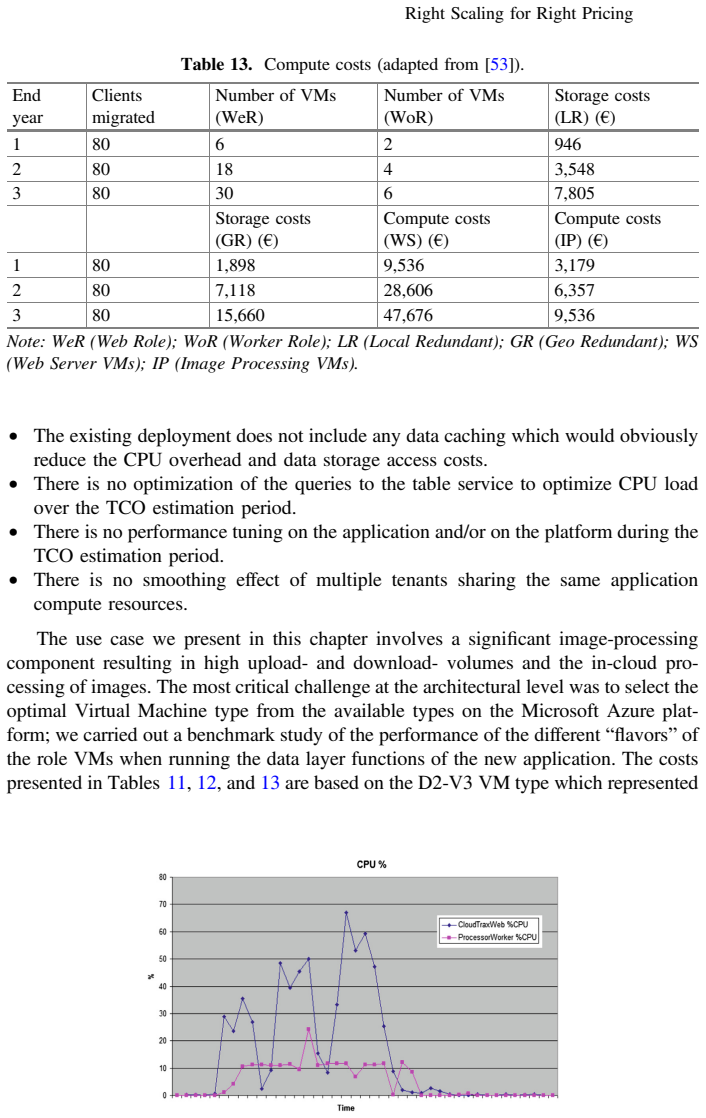
- [Section 5.2/Table 9] The workload percentages (web peak 67.1%, web average 31.5%, worker peak 24.3%, worker average 10.4%) are presented as the basis for sizing, but the measurement procedure is not reported: over what period, on how many tenants, with what workload mix, and with what variability? The text refers to a 'snapshot' of one typical tenant, which is insufficient to establish that these percentages represent the 80-, 160-, and 240-tenant cohorts that Table 13 is sized for. Without this information, the TCO calculation is not reproducible and the right-scaling step cannot be independently assessed.
- [Section 4.2 vs. Section 5] Section 4.2 lists 'A sensitivity analysis of I/PaaS costs to potential changes in SaaS usage' as one of the steps to take, but Section 5 does not present one. Given the uncertainty in both the usage forecast (Table 8) and the VM sizing rule, a sensitivity analysis is not optional; it is required to support the claim that the process is usable for migration decisions and price setting. The case study should include at least a one-way sensitivity analysis over the CPU-load percentages and the reserved/on-demand instance split.
minor comments (5)
- [Section 5.1] The first paragraph says the SP 'overs document management services'; this should be 'offers document management services'.
- [Section 5.3] The text states that storage 'accounts for a very tiny portion of the TCO (€293.31 – 0.001%)'; using the reported compute cost of €129,701 and storage cost of €293.31, the storage share is approximately 0.23%, so the percentage should be corrected or a different denominator stated.
- [Section 1] The acronym 'I/PaaS' is used throughout but is not expanded at first use; define 'IaaS/PaaS' when it first appears.
- [Section 5.2] The term 'DaaS storage' is introduced without expansion; spell out 'Data-as-a-Service' at first mention.
- [Conclusions] The paper states that 'observations should also hold for applications with less data volume' in Section 5.3; this generalization is not supported by the single-case evidence and should be presented as a hypothesis, not a conclusion.
Circularity Check
No significant circularity: the TCO calculation combines externally observed workload data with published Azure prices, and the pricing equation is an explicit markup identity rather than a fitted prediction.
full rationale
The paper's derivation chain is transparently input-to-output: right-scaling (§3.2, §5.2) converts forecast tenant usage into VM and storage quantities, those quantities are multiplied by published Azure list prices (Tables 4–6) to obtain OpEx, migration costs are added as CapEx, and price is then set by the definitional markup P = TCO × (1 + μ) (Eq. 1). Equation (1) is not an empirical prediction derived from the data; it is the definition of a cost-plus price, with μ chosen by the SP's pricing strategy (§6). The TCO inputs are not fitted to the outputs: storage forecasts use eleven months of historical tenant data (Tables 7–9), compute load comes from a monitored operational snapshot (Fig. 2), and prices come from Microsoft Azure's published schedule. The most fragile step — the 'simple linear multiplication of the CPU load per tenant' in §5.2 and the explicit assumption of 'no smoothing effect of multiple tenants sharing the same application compute resources' in §5.3 — is an accuracy-limiting assumption, not circularity: the VM counts are not derived from TCO or price and are not later used to fit those same VM counts. The paper's heavy adaptation of figures and tables from the authors' prior work [53] is transparently labelled ('adapted from [53]'), and the self-citation supplies the process presentation rather than a uniqueness theorem or fitted parameter that forces the conclusion. Because no load-bearing step reduces by construction to its own inputs, and the paper itself flags its limitations in §7, the appropriate circularity score is 0.
Assumptions & free parameters
free parameters (4)
- reserved/on-demand instance split =
80% reserved / 20% on-demand
- profit margin l =
variable, not fixed in the case study
- D2-V3 VM type selection =
D2-V3
- CPU load percentages (web peak 67.1%, web avg 31.5%, worker peak 24.3%, worker avg 10.4%) =
measured in a 20-minute monitoring snapshot
assumptions (4)
- domain assumption Multi-tenant VM requirements scale linearly with the number of tenants (Section 5.2: 'simple linear multiplication of the CPU load per tenant').
- domain assumption No smoothing, caching, query optimization, or performance tuning over the TCO period (Section 5.3 assumptions).
- domain assumption Azure published prices remain constant over the 3-year forecast (Tables 4-6).
- domain assumption The 80/20 reserved/on-demand split is a reasonable baseline configuration (Section 4.3).
Cite this review
Pith. "Pith review of Right Scaling for Right Pricing: A Case Study on Total Cost of Ownership Measurement for Cloud Migration." pith.science (2026). https://pith.science/paper/VUNKCR3S
@misc{pith2026190804136,
  author       = {Pith},
  title        = {Pith review of: Right Scaling for Right Pricing: A Case Study on Total Cost of Ownership Measurement for Cloud Migration},
  year         = {2026},
  howpublished = {\url{https://pith.science/paper/VUNKCR3S}},
  note         = {Machine review of arXiv:1908.04136}
}
read the original abstract
Cloud computing promises traditional enterprises and independent software vendors a myriad of advantages over on-premise installations including cost, operational and organizational efficiencies. The decision to migrate software configured for on-premise delivery to the cloud requires careful technical consideration and planning. In this chapter, we discuss the impact of right-scaling on the cost modelling for migration decision making and price setting of software for commercial resale. An integrated process is presented for measuring total cost of ownership, taking in to account IaaS/PaaS resource consumption based on forecast SaaS usage levels. The process is illustrated with a real world case study.
Figures

Reference graph
Works this paper leans on
-
[1]
Al-Roomi, M., Al-Ebrahim, S., Buqrais, S., Ahmad, I.: Cloud computing pricing models: a survey. Int. J. Grid Distrib. Comput. 6(5), 93 –106 (2013)
work page 2013
-
[2]
In: IEEE Sixth International Conference on Cloud Computing (2013)
Andrikopoulos, V., Song, Z., Leymann, F.: Supporting the migration of applications to the cloud through a decision support system. In: IEEE Sixth International Conference on Cloud Computing (2013)
work page 2013
-
[3]
In: IEEE 8th International Conference on Cloud Computing, pp
Anwar, A., Sailer, A., Kochut, A., Schulz, C.O., Segal, A., Butt, A.R.: Cost-aware cloud metering with scalable service management infrastructure. In: IEEE 8th International Conference on Cloud Computing, pp. 285 –292 (2015)
work page 2015
-
[4]
Armbrust, M., et al.: A view of cloud computing. Commun. ACM 53(4), 50 –58 (2010)
work page 2010
-
[5]
Arnold, G., Davies, M.: Value-Based Management: Context and Application. Wiley, New York (2000)
work page 2000
-
[6]
Baden-Fuller, C., Hae fliger, S.: Business models and techno-logical innovation. Long Range Plan. 46(6), 419 –426 (2013)
work page 2013
-
[7]
Balalaie, A., Heydarnoori, A., Jamshidi, P., Tamburri, D.A., Lynn, T.: Microservices migration patterns. Softw. Pract. Exp. 48,1 –24 (2018)
work page 2018
-
[8]
http://www.bain.com/ publications/articles/the-changing-faces-of-the-cloud.aspx
Bain and Company: The Changing Faces of the Cloud (2017). http://www.bain.com/ publications/articles/the-changing-faces-of-the-cloud.aspx. Accessed 28 Jan 2018
work page 2017
Show all 66 references
-
[9]
Strategy Leadersh
Berman, S.J., Kesterson-Townes, L., Marshall, A., Srivathsa, R.: How cloud computing enables process and business model innovation. Strategy Leadersh. 40(4), 27 –35 (2012)
2012
-
[10]
In: Proceedings of the First Edition of the MCC Workshop on Mobile Cloud Computing, pp
Bonomi, F., Milito, R., Zhu, J., Addepalli, S.: Fog computing and its role in the internet of things. In: Proceedings of the First Edition of the MCC Workshop on Mobile Cloud Computing, pp. 13 –16 (2012)
2012
-
[11]
CFO Publishing (2012)
CFO Research: The Business Value of Cloud Computing: A Survey of Senior Finance Executives. CFO Publishing (2012). http://lp.google-mkto.com/rs/google/images/CFO% 2520Research-Google_research%2520report_061512.pdf. Accessed 20 Jan 2018
2012
-
[12]
Cusumano, M.A.: The changing labyrinth of software pricing. Commun. ACM 50(7), 19–22 (2007)
2007
-
[13]
Computer 41(1), 20 –27 (2008)
Cusumano, M.A.: The changing software business: moving from products to services. Computer 41(1), 20 –27 (2008)
2008
-
[14]
DaSilva, C.M., Trkman, P., Desouza, K., Lindic, J.: Disruptive technologies: a business model perspective on cloud computing. Technol. Anal. Strateg. Manag. 25(10), 1161 –1173 (2013)
2013
-
[15]
In: IEEE International Conference on Advanced Information Networking and Applications, pp
Dillon, T., Wu, C., Chang, E.: Cloud computing: issues and challenges. In: IEEE International Conference on Advanced Information Networking and Applications, pp. 27 –33 (2010)
2010
-
[16]
In: Paci fic Asia Conference on Information Systems (2012)
D ’souza A., Kabbedijk, J., Seo, D., Jansen, S., Brinkkemper, S.: Software-as-a-service: implications for business and technology in product software companies. In: Paci fic Asia Conference on Information Systems (2012)
2012
-
[17]
Durkee, D.: Why cloud computing will never be free. Commun. ACM 53(5), 62–69 (2010) Right Scaling for Right Pricing Author Version
2010
-
[18]
serverless
Eivy, A.: Be wary of the economics of “serverless” cloud computing. IEEE Cloud Comput. 4(2), 6 –12 (2017)
2017
-
[19]
Working Paper Series - Department of Computer Science University College London – LSE, (2000)
Farbey, B., Finkelstein, A.: Evaluation in software engineering: ROI, but more than ROI. Working Paper Series - Department of Computer Science University College London – LSE, (2000). http://is.lse.ac.uk/all_wp.htmS
2000
-
[20]
Butterworth-Heinemann, Oxford (1993)
Farbey, B., Land, F., Targett, D.: How to Assess Your IT Investment: A study of Methods and Practice. Butterworth-Heinemann, Oxford (1993)
1993
-
[21]
8(6), 24 –29 (2006)
Ferrante, D.: Software licensing models: what ’s out there? IT Prof. 8(6), 24 –29 (2006)
2006
-
[22]
In: 11th International Conference on Innovations in Information Technology (IIT) (2015)
Filiopoulou, E., Mitropoulo, P., Tsadimas, A.: Integrating cost analysis in the cloud: a SoS approach. In: 11th International Conference on Innovations in Information Technology (IIT) (2015)
2015
-
[23]
In: Lassenius, C., Dings øyr, T., Paasivaara, M
Giardino, C., Bajwa, S.S., Wang, X., Abrahamsson, P.: Key challenges in early-stage software startups. In: Lassenius, C., Dings øyr, T., Paasivaara, M. (eds.) XP 2015. LNBIP, vol. 212, pp. 52 –63. Springer, Cham (2015). https://doi.org/10.1007/978-3-319-18612-2_5
2015 doi
-
[24]
Gilia, P., Sood, S.: Automatic selection and ranking of cloud providers using service level agreements. Int. J. Comput. Appl. 72(11), 45 –52 (2013)
2013
-
[25]
Han, Y.: Cloud computing: case studies and total costs of ownership. Inf. Technol. Libr. 30 (4), 198 –206 (2011)
2011
-
[26]
In: Hawaii International Conference on System Sciences (HICSS), pp
Harmon, R., Demirkan, H., He fley, B., Auseklis, N.: Pricing strategies for information technology services: a value-based approach. In: Hawaii International Conference on System Sciences (HICSS), pp. 1 –10 (2009)
2009
-
[27]
In: Bridging Data and Decisions, pp
Heilig, L., Vo ß, S.: Decision analytics for cloud computing: a classi fication and literature review. In: Bridging Data and Decisions, pp. 1–26 (2014)
2014
-
[28]
Elastic 60,1 –7 (2016)
Hendrickson, S., Sturdevant, S., Harter, T., Venkataramani, V., Arpaci-Dusseau, A.C., Arpaci-Dusseau, R.H.: Serverless computation with openlambda. Elastic 60,1 –7 (2016)
2016
-
[29]
Hinterhuber, A.: Customer value-based pricing strategies: why companies resist. J. Bus. Strategy 29(4), 41 –50 (2008)
2008
-
[30]
Hinterhuber, A., Liozu, S.M.: Is innovation in pricing your next source of competitive advantage? Bus. Horiz. 57, 413 –423 (2014)
2014
-
[31]
Ingenbleek, P., Debruyne, M., Frambach, R.T., Verhallen, T.M.: Successful new product pricing practices: a contingency approach. Mark. Lett. 14(4), 289 –305 (2003)
2003
-
[32]
https://www.isaca
ISACA: Calculating Cloud ROI: From the Customer Perspective (2012). https://www.isaca. org/knowledge-center/research/researchdeliverables/pages/calculating-cloud-roi-from-the- customer-perspective.aspx. Accessed 20 Jan 2018
2012
-
[33]
IEEE Trans
Jamshidi, P., Ahmad, A., Pahl, C.: Cloud migration research: a systematic review. IEEE Trans. Cloud Comput. 1(2), 142 –157 (2013)
2013
-
[34]
In: International Workshop on Engineering Service Oriented Applications – WESOA 2014 (2014)
Jamshidi, P., Pahl, C., Chinenyeze, S., Liu, X.: Cloud migration patterns: a multi-cloud service architecture perspective. In: International Workshop on Engineering Service Oriented Applications – WESOA 2014 (2014)
2014
-
[35]
A Phase-driven Approach to Cloud Migration (2010)
Jinesh, V.: Migrating your existing applications to the AWS cloud. A Phase-driven Approach to Cloud Migration (2010). http://docs.huihoo.com/amazon/aws/whitepapers/ Migrating-your-Existing-Applications-to-the-AWS-Cloud-October-2010.pdf. Accessed 21 Jan 2018
2010
-
[36]
Karunakaran, S., Krishnaswamy, V., Rangaraja, P.S.: Business view of cloud: decisions, models and opportunities –a classi fication and review of research. Manag. Res. Rev. 38(6), 582–604 (2015)
2015
-
[37]
In: IEEE International Conference on Services Computing (SCC), pp
Laatikainen, G., Ojala, A.: SaaS architecture and pricing models. In: IEEE International Conference on Services Computing (SCC), pp. 597 –604 (2014)
2014
-
[38]
Lehmann, S., Buxmann, P.: Pricing strategies of software vendors. Bus. Inf. Syst. Eng. 1(6), 452–462 (2009) P. Rosati et al. Author Version
2009
-
[39]
Science and Technology Options Assessment (STOA) (2016)
Leimbach, T., et al.: Potential and Impacts of Cloud Computing Services and Social Network Websites. Science and Technology Options Assessment (STOA) (2016). http:// www.europarl.europa.eu/RegData/etudes/etudes/join/2014/513546/IPOL-JOIN_ET(2014) 513546_EN.pdf. Accessed 15 Aug 2016
2016
-
[40]
In: Proceedings of the 9th International Conference on Utility and Cloud Computing, pp
Leitner, P., Cito, J., Stö ckli, E.: Modelling and managing deployment costs of microservice- based cloud applications. In: Proceedings of the 9th International Conference on Utility and Cloud Computing, pp. 165 –174 (2016)
2016
-
[41]
In: IEEE International Conference on Cloud Computing, pp
Li, X., Li, Y., Liu, T., Qiu, J., Wang, F.: The method and tool of cost analysis for cloud computing. In: IEEE International Conference on Cloud Computing, pp. 93 –100 (2009)
2009
-
[42]
In: IEEE International Conference on Cloud Computing, pp
Li, H., Zhong, L., Liu, J., Li, B., Xu, K.: Cost-effective partial migration of VoD services to content clouds. In: IEEE International Conference on Cloud Computing, pp. 203 –210 (2011)
2011
-
[43]
In: IEEE International Conference on Cloud Computing Technology and Science (CloudCom), pp
Lynn, T., Rosati, P., Lejeune, A., Emeakaroha, V.: A preliminary review of enterprise serverless cloud computing (function-as-a-service) platforms. In: IEEE International Conference on Cloud Computing Technology and Science (CloudCom), pp. 162 –169 (2017)
2017
-
[44]
https://www.marketsandmarkets.com/Market-Reports/function-as- a-service-market-127202409.html
Market and Markets: Function-as-a-Service Market by User Type (Developer-Centric and Operator-Centric), Application (Web & Mobile Based, Research & Academic), Service Type, Deployment Model, Organization Size, Industry Vertical, and Region - Global Forecast to 2021 (2017). htt...
2017
-
[45]
Marston, S., Li, Z., Bandyopadhyay, S., Zhang, J., Ghalsasi, A.: Cloud computing - the business perspective. Decis. Support Syst. 51(1), 176 –189 (1999)
1999
-
[46]
In: 45th Hawaii International Conference on System Science (HICSS), pp
Martens, B., Walterbusch, M., Teuteberg, F.: Costing of cloud computing services: a total cost of ownership approach. In: 45th Hawaii International Conference on System Science (HICSS), pp. 1563 –1572 (2012)
2012
-
[47]
Misra, S.C., Mondal, A.: Identi fication of a company ’s suitability for the adoption of cloud computing and modelling its corresponding return on investment. Math. Comput. Model. 53 (3), 504 –521 (2011)
2011
-
[48]
In: IEEE 5th International Conference on Cloud Computing (CLOUD), pp
Ojala, A.: Software renting in the era of cloud computing. In: IEEE 5th International Conference on Cloud Computing (CLOUD), pp. 662 –669 (2012)
2012
-
[49]
In: Lau, K.-K., Lamersdorf, W., Pimentel, E
Pahl, C., Xiong, H., Walshe, R.: A comparison of on-premise to cloud migration approaches. In: Lau, K.-K., Lamersdorf, W., Pimentel, E. (eds.) ESOCC 2013. LNCS, vol. 8135, pp. 212 –226. Springer, Heidelberg (2013). https://doi.org/10.1007/978-3-642-40651-5_18
2013 doi
-
[50]
In: 22nd Americas Conference on Information Systems (AMCIS) (2016)
Paulsson, V., Morrison, J., Emeakaroha, V., Lynn, T.: Cloud service brokerage: a systematic literature review using a software development lifecycle. In: 22nd Americas Conference on Information Systems (AMCIS) (2016)
2016
-
[51]
Purchasing Supply Manag
Ronchi, S., Brun, A., Golini, R., Fan, X.: What is the value of an IT e-procurement system? J. Purchasing Supply Manag. 16(2), 131 –140 (2010)
2010
-
[52]
In: IEEE International Conference on Cloud Computing Technology and Science (CloudCom), pp
Rosati, P., Fox, G., Kenny, D., Lynn, T.: Quantifying the financial value of cloud investments: a systematic literature review. In: IEEE International Conference on Cloud Computing Technology and Science (CloudCom), pp. 194 –201 (2017)
2017
-
[53]
In: 8th International Conference on Cloud Computing and Services Science (CLOSER) (2018)
Rosati, P., Fowley, F., Pahl, C., Taibi, D., Lynn, T.: Making the cloud work for software producers: linking architecture, operating cost and revenue. In: 8th International Conference on Cloud Computing and Services Science (CLOSER) (2018)
2018
-
[54]
IEEE Internet Things J
Shi, W., Cao, J., Zhang, Q., Li, Y., Xu, L.: Edge computing: vision and challenges. IEEE Internet Things J. 3(5), 637 –646 (2016)
2016
-
[55]
In: International Conference on Optimization, Reliability, and Information Technology (ICROIT), pp
Singh, H., Sachdev, A.: The quantum way of cloud computing. In: International Conference on Optimization, Reliability, and Information Technology (ICROIT), pp. 397 –400 (2014)
2014
-
[56]
Multikonferenz Wirtschaftsinformatik, MKWI (2010) Right Scaling for Right Pricing Author Version
Strebel, J., Stage, A.: An economic decision model for business software application deployment on hybrid cloud environments. Multikonferenz Wirtschaftsinformatik, MKWI (2010) Right Scaling for Right Pricing Author Version
2010
-
[57]
IEEE Cloud IEEE Cloud Comput
Taibi, D., Lenarduzzi, V., Pahl, C.: Processes, motivations and issues for migrating to microservices architectures: an empirical investigation. IEEE Cloud IEEE Cloud Comput. J. 4(5), 22 –32 (2017)
2017
-
[58]
In: 8th International Conference on Cloud Computing and Services Science (CLOSER) (2018)
Taibi, D., Lenarduzzi, V., Pahl, C.: Architectural patterns for microservices: a systematic mapping study. In: 8th International Conference on Cloud Computing and Services Science (CLOSER) (2018)
2018
-
[59]
In: Abrahamsson, P., Corral, L., Oivo, M., Russo, B
Terho, H., Suonsyrj ä, S., Karisalo, A., Mikkonen, T.: Ways to cross the rubicon: pivoting in software startups. In: Abrahamsson, P., Corral, L., Oivo, M., Russo, B. (eds.) PROFES
-
[60]
SOCA 11(2), 233 –247 (2017)
Villamizar, M., et al.: Cost comparison of running web applications in the cloud using monolithic, microservice, and AWS lambda architectures. SOCA 11(2), 233 –247 (2017)
2017
-
[61]
In: IEEE International Conference on Software Quality, Reliability and Security Companion (QRS-C), pp
Wagner, B., Sood, A.: Economics of resilient cloud services. In: IEEE International Conference on Software Quality, Reliability and Security Companion (QRS-C), pp. 368 –374 (2016)
2016
-
[62]
Walterbusch, M., Martens, B., Teuteberg, F.: Evaluating cloud computing services from a total cost of ownership perspective. Manag. Res. Rev. 36(6), 613 –638 (2013)
2013
-
[63]
In: Strategic Information Management: Challenges and Strategies in Managing Information Systems, pp
Willcocks, L.P.: Evaluating the outcomes of information systems plans managing information technology evaluation — techniques and processes. In: Strategic Information Management: Challenges and Strategies in Managing Information Systems, pp. 271 –294 (2001)
2001
-
[64]
In: Federated Conference on Computer Science and Information Systems (FedCSIS), pp
Xiong, H., et al.: CloudLightning: a self-organized self-managed heterogeneous cloud. In: Federated Conference on Computer Science and Information Systems (FedCSIS), pp. 749 – 758 (2017)
2017
-
[65]
Yang, H., Tate, M.: A descriptive literature review and classi fication of cloud computing research. Commun. Assoc. Inf. Syst. 31(1), 35 –60 (2012) P. Rosati et al. Author Version
2012
-
[2015]
9459, pp
LNCS, vol. 9459, pp. 555 –568. Springer, Cham (2015). https://doi.org/10.1007/978- 3-319-26844-6_41
2015 doi
Reviewed August 14, 2026 · model on record in the stance chip above.
Discussion (0). Continue with ORCID to comment.