REVIEW 3 major objections 6 minor 74 references
TimeNeRF: Building Generalizable Neural Radiance Fields across Time from Few-Shot Input Views
T0 review · 3 major / 6 minor · reviewed 2026-08-06 · deepseek-v4-flash
Pith's one-line read TimeNeRF renders novel views of unseen scenes at any time of day, from just a few input images and without per-scene retraining.
desk verdict Static few-shot NVS is solid; the temporal claim is plausible but rests on self-referential pseudo supervision with no real time-of-day validation. read the letter →
The pith
A machine-rendered reading of the paper's core claim, the machinery that carries it, and where it could break.
The reading
What carries the argument
The framework is a two-stage pipeline. Stage 1 trains a modified DRIT++ image translation model to produce content features and style features, where content is meant to be free of environmental change factors. Stage 2 uses: (a) an appearance-agnostic geometry extractor that builds multi-level cost volumes from the content features and passes them through a 3D U-Net to get geometry features; (b) an implicit scene network based on GeoNeRF-style multi-head self-attention that predicts density $\sigma$ and a 3D content feature $\xi_x$ for each sample point; (c) a factors extraction module with two MLPs, $g_t$ mapping a reference style feature to a time in $[0,2\pi)$ and $g_a$ extracting time-irrelevant features $a$ from the input views; and (d) a two-branch time-dependent radiance field constructor $T(\xi_x, a, t)$ that fuses content features with time (branch 1) and with time plus $a$ (branch 2) to produce the color $c^x_t$. Four losses drive training: an MSE loss using view-weighted input colors to learn density, a pseudo stylized loss comparing rendered colors to DRIT++ stylized pseudo ground truth, a $\Delta t$ loss that enforces unique outputs at different times via a small discriminator MLP, and a reconstruction loss at the predicted input time $t_0$ so the rendered view matches the original input style.
What would settle it
A direct test would be to take the same static scene photographed at several distinct times of day (ideally with aligned cameras), feed each time's views into TimeNeRF, and compare the predicted densities and the geometry features at corresponding 3D locations; if the content radiance field is truly time-invariant, the densities should be nearly identical across capture times, whereas any systematic disagreement shows that environmental factors leaked into the content features and the time code is compensating for improper geometry.
Extended reading notes
Core claim
The paper claims that a generalizable, few-shot neural radiance field can be made time-aware by first building a content radiance field from which environmental change factors (time of day, weather, illumination) have been removed, and then transforming it into the radiance field of a specific moment using a time code and time-irrelevant style factors. The key architectural claim is that the cost volume used for geometry estimation is constructed from disentangled content features instead of raw image features, which lets the same model handle input views captured under varying conditions. The time axis is encoded cyclically as $t \in [0, 2\pi)$ with $(\cos t, \sin t)$ embedding, so the model can be queried at arbitrary times during testing without any reference image.
Load-bearing premise
The whole method depends on the pretrained DRIT++ content extractor returning content features that are truly free of environmental change factors, so that geometry and density are time-invariant; this assumption is never tested directly, and the pseudo stylized training labels are generated by the same DRIT++ model, making the disentanglement only indirectly and self-referentially validated.
Editorial extensions
If this is right
- If the central claim holds, capturing a handful of photos of an outdoor scene under whatever conditions are available would be enough to later render that scene at any requested time of day, enabling cinematic and metaverse-style relighting without recollecting data.
- Because the time code is a free input at test time, the model could drive continuous day-night animation from a static set of views, which is exactly the smooth dawn-to-dusk transition the paper demonstrates qualitatively.
- Training on varied weather (Ithaca365) and varied time (Waymo) suggests that time and weather can be treated as separable axes, so future models could control them independently and generalize to unseen capture conditions.
- The reported parity with GeoNeRF on standard few-shot view synthesis implies that adding a time axis does not have to come at the cost of plain novel view quality.
Reading between the lines
- The paper's architecture implies a testable decoupling: because the content radiance field and density are supposed to be time-invariant, the same geometry should be reconstructed from input views at different times of day for the same scene; a direct experiment comparing density or geometry outputs across capture times would validate or refute this decoupling more cleanly than the image-level abl
- The $(\cos t, \sin t)$ embedding and the cyclic $\Delta t$ loss suggest the approach could be extended to other cyclic scene variations such as weather cycles, seasonal lighting, or even tidal or traffic patterns, by swapping the reference dataset used to supervise the time axis.
- The reliance on DRIT++ for both content disentanglement and pseudo ground truth generation means the method's upper bound is set by how well that pretrained model disentangles; a future variant that replaces the self-referential supervision with real time-lapse photographs of the same viewpoint could raise that ceiling and give a more direct test of the core assumption.
Editorial analysis
A structured set of objections, weighed in public.
Referee Report
Summary. TimeNeRF proposes a few-shot, generalizable neural radiance field that also models time-of-day appearance changes. The method first trains a modified DRIT++ to disentangle content from style, then builds a content radiance field from multi-level content features and cost volumes, and finally converts it into a time-dependent radiance field by injecting a time code t in [0,2π) together with time-irrelevant features. Training uses an MSE loss, a pseudo stylized loss against DRIT++ stylized targets, a Δt cyclic-consistency loss, and a t0 reconstruction loss. Experiments report static few-shot novel-view-synthesis results comparable to GeoNeRF/MVSNeRF, qualitative day-to-night transitions, cross-view consistency metrics, ablations, and a user study, with additional FID and YCbCr histogram analyses in the supplementary material.
Significance. If the temporal claim holds, the paper would be a meaningful first step toward few-shot, generalizable novel-view synthesis with an explicit time axis and no per-scene optimization. The static few-shot results on Ithaca365 and LLFF are benchmarked against credible baselines and appear internally consistent. However, the central temporal contribution is currently validated only against pseudo stylized targets produced by the same model that defines the time code, and none of the quantitative metrics compares a rendered view at a specified t with an actual capture of that scene at that time. The contribution is therefore defensible but needs load-bearing additional validation before the arbitrary-time claim can be accepted.
major comments (3)
- [Sec. 3.5, Eq. (8), Sec. 6.5.2] The central claim that a user can query t and obtain a render at the true time of day is not validated against any real time-of-day ground truth. The pseudo stylized loss L_style_mse (Eq. 8) is computed against C_pseudo(r) generated by the modified DRIT++ from a reference image, and the same reference style feature is mapped by g_t to the t used in rendering. The experiments in Sec. 6.5.2 (FID, YCbCr histogram correlation) and the user study in Sec. 4.3 compare against reference styles or subjective preference; none checks whether a render at t matches an actual photograph of that scene at that time. Since L_style_mse can be minimized by reproducing the DRIT++ style manifold, the smooth cycle in [0,2π) may be an artifact of the pseudo targets rather than a model of real day-to-night transitions. Please add a direct validation: use time-stamped captures, for example the per-frame time-of-day metadata in Waymo and the repeated traversals in Ithaca365, to show that (i) the ordering and spacing of g_t predictions are consistent with real capture times, and (ii) for held-out scenes, a render at t is closer to the real capture at t than to captures at other times.
- [Sec. 3.3-3.4, Supp. Sec. 5.2.2] The architecture's load-bearing premise is that DRIT++ content features are invariant to environmental change factors. This premise is never directly tested; Sec. 3.3 asserts that extraction 'excludes environmental change factors,' while Supp. Sec. 5.2.2 states only that 'we hypothesize that the extracted style encompasses both time and weather information.' If illumination or weather leaks into content features, the cost volume and the predicted density in Eqs. (3)-(5) are time-contaminated, and the later time code cannot cleanly control appearance. The modified-DRIT++ ablation in Fig. 13 actually shows residual daytime information in the original DRIT++ content features, which makes the risk concrete. I ask for a quantitative invariance test, such as comparing predicted depth or geometry features for the same static scene under the same viewpoint across different times and weather conditions in Ithaca365, to show that the geometry representation is stable across times while colors change with t.
- [Sec. 3.7, Eq. (10)] The Delta_t loss (Eq. 10) uses colors generated from random samples t and t' in [0,2π) and compares the predicted color difference with the code-space distance |t-t'|. This enforces cyclic consistency in the latent time code but does not anchor the code to clock time; without calibration, small |t-t'| in the code does not correspond to small temporal separation in the real world. This is a consequence of the missing calibration in the first major comment, and the loss should be re-evaluated once g_t is tested against real time labels.
minor comments (6)
- [Sec. 4.3, Fig. 3] The time labels in Fig. 3 (t = 0, t = π, etc.) are code coordinates in [0,2π), not real clock times; the caption and text should say this explicitly to avoid overclaiming continuous real-time control.
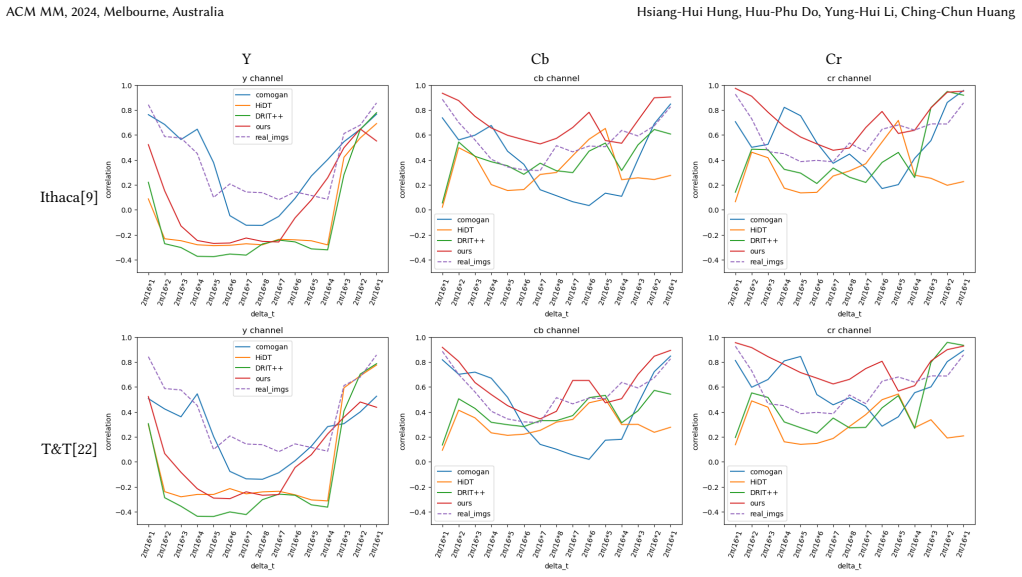
- [Fig. 17 and Tables 4-5] The 'real_imgs' baseline in Fig. 17 is mentioned in the caption but never defined in the text; specify which 24-hour videos were used and how the ground-truth time placement was obtained.
- [Sec. 3.2 and Sec. 4.1] The statement that the datasets do not contain time labels is imprecise, since both Waymo and Ithaca365 provide per-frame time-of-day or traversal metadata; use 'exact continuous timestamps' instead of 'time labels'.
- [Supp. Sec. 5.2.3] The sentence 'we utilize MVSnet as our pretrained model for feature extraction' conflicts with the description in Sec. 3.3 of a 3D-UNet applied to cost volumes; clarify which modules are initialized from MVSNet.
- [Supp. Sec. 7] The implementation section states that code will be available but gives no repository link or release mechanism; provide a public link or explicit availability statement for reproducibility.
- [Table 5] The caption contains the typo 'Itheca365'; correct it to 'Ithaca365'.
Circularity Check
TimeNeRF's temporal axis is fitted to DRIT++'s own pseudo stylized targets, so 'arbitrary time' rendering reindexes the same model's style outputs rather than being validated against real time-of-day captures; static NVS remains externally tested.
-
fitted input called prediction
[Section 3.5 (Factors Extraction Module) and Section 3.7, Eq. (8)]
"The mapping is trained in an unsupervised manner, utilizing our pseudo stylized image loss L_style_mse (eq. (8)) to guide the model in extracting time-related information from reference images and mapping it to the time range [0, 2π)."
The time code t is produced by g_t from the DRIT++ style feature of a reference image, while the target for the rendered color at t is C_pseudo(r), the style-transferred output of DRIT++ for that same reference. Training with Eq. (8) thus fits the mapping t -> c_t to DRIT++'s own pseudo stylized images, reindexed by the unsupervised interval [0, 2π). The paper provides no real time-of-day labels or real captures at queried times, so reporting novel views 'at arbitrary times' is a reparameterization of the pseudo targets rather than an independently grounded prediction.
full rationale
The static novel-view-synthesis component is externally validated: Table 2 reports PSNR/SSIM/LPIPS against real LLFF and Ithaca365 target images, and the MSE, reconstruction, and view-consistency losses are anchored to real input views. That part is not circular. The circularity is concentrated in the temporal contribution. The paper first trains DRIT++ in Stage 1, then uses DRIT++'s style extractor to define the style feature that g_t maps to t, uses DRIT++'s generator to create the pseudo ground truth C_pseudo in Eq. (8), and trains the time-dependent radiance field constructor to match that same pseudo target. There are no exact time labels, as the paper states: 'Since these datasets do not contain time labels, we train the model without relying on exact time data.' Consequently, the only constraint relating t to appearance is internal consistency with DRIT++'s output manifold; the delta-t loss and the t0 reconstruction loss impose self-consistency but do not calibrate arbitrary t to clock time. The temporal evaluations in Section 6.5.2 compare against reference style features extracted by the same DRIT++ style extractor or against CoMoGAN, not against real images captured at the queried times. The claim of rendering at 'arbitrary times' therefore reduces, for the temporal axis, to fitting and reindexing the same model's pseudo targets. Because the static 3D reconstruction is independently benchmarked, the overall circularity is partial rather than total.
Assumptions & free parameters
free parameters (3)
- lambda_1 (pseudo stylized loss weight) =
0.5
- lambda_2 (Delta_t loss weight) =
0.01
- lambda_3 (t0 reconstruction loss weight) =
0.5
assumptions (5)
- domain assumption The DRIT++ content extractor's multi-level features are appearance-agnostic; content features exclude environmental change factors such as time and weather.
- domain assumption The style feature from the pre-trained style extractor contains both time-relevant and time-irrelevant factors, and the MLPs g_t and g_a can disentangle them without time labels.
- ad hoc to paper Pseudo stylized images generated by the modified DRIT++ are valid ground truth for time-dependent colors.
- domain assumption Training on Ithaca365 source views and Waymo reference images transfers to unseen T&T and LLFF scenes.
- domain assumption Volume rendering with densities from content features suffices to represent long-range day-night appearance changes.
Cite this review
Pith. "Pith review of TimeNeRF: Building Generalizable Neural Radiance Fields across Time from Few-Shot Input Views." pith.science (2026). https://pith.science/paper/VUVQNRMW
@misc{pith2026250713929,
  author       = {Pith},
  title        = {Pith review of: TimeNeRF: Building Generalizable Neural Radiance Fields across Time from Few-Shot Input Views},
  year         = {2026},
  howpublished = {\url{https://pith.science/paper/VUVQNRMW}},
  note         = {Machine review of arXiv:2507.13929}
}
read the original abstract
We present TimeNeRF, a generalizable neural rendering approach for rendering novel views at arbitrary viewpoints and at arbitrary times, even with few input views. For real-world applications, it is expensive to collect multiple views and inefficient to re-optimize for unseen scenes. Moreover, as the digital realm, particularly the metaverse, strives for increasingly immersive experiences, the ability to model 3D environments that naturally transition between day and night becomes paramount. While current techniques based on Neural Radiance Fields (NeRF) have shown remarkable proficiency in synthesizing novel views, the exploration of NeRF's potential for temporal 3D scene modeling remains limited, with no dedicated datasets available for this purpose. To this end, our approach harnesses the strengths of multi-view stereo, neural radiance fields, and disentanglement strategies across diverse datasets. This equips our model with the capability for generalizability in a few-shot setting, allows us to construct an implicit content radiance field for scene representation, and further enables the building of neural radiance fields at any arbitrary time. Finally, we synthesize novel views of that time via volume rendering. Experiments show that TimeNeRF can render novel views in a few-shot setting without per-scene optimization. Most notably, it excels in creating realistic novel views that transition smoothly across different times, adeptly capturing intricate natural scene changes from dawn to dusk.
Figures


Figures from the paper (15 more)



Reference graph
Works this paper leans on
-
[1]
Ivan Anokhin, Pavel Solovev, Denis Korzhenkov, Alexey Kharlamov, Taras Khakhulin, Alexey Silvestrov, Sergey Nikolenko, Victor Lempitsky, and Gleb Sterkin. 2020. High-Resolution Daytime Translation Without Domain Labels. In The IEEE Conference on Computer Vision and Pattern Recognition (CVPR)
work page 2020
-
[2]
Anpei Chen, Zexiang Xu, Fuqiang Zhao, Xiaoshuai Zhang, Fanbo Xiang, Jingyi Yu, and Hao Su. 2021. Mvsnerf: Fast generalizable radiance field reconstruction from multi-view stereo. In Proceedings of the IEEE/CVF International Conference on Computer Vision. 14124–14133
work page 2021
-
[3]
Xingyu Chen, Qi Zhang, Xiaoyu Li, Yue Chen, Ying Feng, Xuan Wang, and Jue Wang. 2022. Hallucinated neural radiance fields in the wild. In CVPR. 12943– 12952
work page 2022
-
[4]
Yingshu Chen, Tuan-Anh Vu, Ka-Chun Shum, Sai-Kit Yeung, and Binh-Son Hua
-
[5]
Chia-Chi Cheng, Hung-Yu Chen, and Wei-Chen Chiu. 2020. Time Flies: Animating a Still Image With Time-Lapse Video As Reference. In IEEE/CVF Conference on Computer Vision and Pattern Recognition (CVPR)
work page 2020
-
[6]
Pei-Ze Chiang, Meng-Shiun Tsai, Hung-Yu Tseng, Wei-Sheng Lai, and Wei-Chen Chiu. 2022. Stylizing 3D Scene via Implicit Representation and HyperNetwork. In Proceedings of the IEEE/CVF Winter Conference on Applications of Computer Vision (W ACV)
work page 2022
-
[7]
Chenxi Lola Deng and Enzo Tartaglione. 2023. Compressing Explicit Voxel Grid Representations: Fast NeRFs Become Also Small. In Proceedings of the IEEE/CVF Winter Conference on Applications of Computer Vision (W ACV). 1236–1245
work page 2023
-
[8]
Kangle Deng, Andrew Liu, Jun-Yan Zhu, and Deva Ramanan. 2022. Depth- supervised NeRF: Fewer Views and Faster Training for Free. In Proceedings of the IEEE/CVF Conference on Computer Vision and Pattern Recognition (CVPR)
work page 2022
Show all 74 references
-
[9]
Diaz-Ruiz, Youya Xia, Yurong You, Jose Nino, Junan Chen, Josephine Monica, Xiangyu Chen, Katie Luo, Yan Wang, Marc Emond, Wei-Lun Chao, Bharath Hariharan, Kilian Q
Carlos A. Diaz-Ruiz, Youya Xia, Yurong You, Jose Nino, Junan Chen, Josephine Monica, Xiangyu Chen, Katie Luo, Yan Wang, Marc Emond, Wei-Lun Chao, Bharath Hariharan, Kilian Q. Weinberger, and Mark Campbell. 2022. Ithaca365: Dataset and Driving Perception Under Repeated and Chal...
2022
-
[10]
Rui Gong, Wen Li, Yuhua Chen, and Luc Van Gool. 2019. DLOW: Domain Flow for Adaptation and Generalization. In 2019 IEEE/CVF Conference on Computer Vision and Pattern Recognition (CVPR) . 2472–2481. https://doi.org/10.1109/CVPR. 2019.00258
2019
-
[11]
Xiaodong Gu, Zhiwen Fan, Siyu Zhu, Zuozhuo Dai, Feitong Tan, and Ping Tan
-
[12]
Guangcong, Zhaoxi Chen, Chen Change Loy, and Ziwei Liu. 2023. SparseNeRF: Distilling Depth Ranking for Few-shot Novel View Synthesis. Technical Report (2023)
2023
-
[13]
Haoyu Guo, Sida Peng, Haotong Lin, Qianqian Wang, Guofeng Zhang, Hujun Bao, and Xiaowei Zhou. 2022. Neural 3D Scene Reconstruction With the Manhattan- World Assumption. In CVPR. 5511–5520
2022
-
[14]
Srinivasan, Ben Mildenhall, Jonathan T
Peter Hedman, Pratul P. Srinivasan, Ben Mildenhall, Jonathan T. Barron, and Paul Debevec. 2021. Baking Neural Radiance Fields for Real-Time View Synthesis. ICCV (2021)
2021
-
[15]
Hsin-Ping Huang, Hung-Yu Tseng, Saurabh Saini, Maneesh Singh, and Ming- Hsuan Yang. 2021. Learning to Stylize Novel Views. In ICCV
2021
-
[16]
Yi-Hua Huang, Yue He, Yu-Jie Yuan, Yu-Kun Lai, and Lin Gao. 2022. StylizedNeRF: Consistent 3D Scene Stylization as Stylized NeRF via 2D-3D Mutual Learning. In Computer Vision and Pattern Recognition (CVPR)
2022
-
[17]
Ajay Jain, Matthew Tancik, and Pieter Abbeel. 2021. Putting NeRF on a Diet: Semantically Consistent Few-Shot View Synthesis. InProceedings of the IEEE/CVF International Conference on Computer Vision (ICCV) . 5885–5894
2021
-
[18]
Liming Jiang, Changxu Zhang, Mingyang Huang, Chunxiao Liu, Jianping Shi, and Chen Change Loy. 2020. TSIT: A Simple and Versatile Framework for Image- to-Image Translation. In ECCV
2020
-
[19]
Johari, Y
M. Johari, Y. Lepoittevin, and F. Fleuret. 2022. GeoNeRF: Generalizing NeRF with Geometry Priors. In Proceedings of the IEEE International Conference on Computer Vision and Pattern Recognition (CVPR)
2022
-
[20]
Mijeong Kim, Seonguk Seo, and Bohyung Han. 2022. InfoNeRF: Ray Entropy Minimization for Few-Shot Neural Volume Rendering. In CVPR
2022
-
[21]
Diederik Kingma and Jimmy Ba. 2015. Adam: A Method for Stochastic Optimiza- tion. In International Conference on Learning Representations (ICLR) . San Diega, CA, USA
2015
-
[22]
Arno Knapitsch, Jaesik Park, Qian-Yi Zhou, and Vladlen Koltun. 2017. Tanks and Temples: Benchmarking Large-Scale Scene Reconstruction. ACM Transactions on Graphics 36, 4 (2017)
2017
-
[23]
Zhengfei Kuang, Kyle Olszewski, Menglei Chai, Zeng Huang, Panos Achlioptas, and Sergey Tulyakov. 2022. NeROIC: Neural Rendering of Objects from Online Image Collections. ACM Trans. Graph. 41, 4, Article 56 (jul 2022), 12 pages. https://doi.org/10.1145/3528223.3530177
2022
-
[24]
Andreas Kurz, Thomas Neff, Zhaoyang Lv, Michael Zollhöfer, and Markus Stein- berger. 2022. AdaNeRF: Adaptive Sampling for Real-time Rendering of Neural Radiance Fields. (2022)
2022
-
[25]
Hsin-Ying Lee, Hung-Yu Tseng, Jia-Bin Huang, Maneesh Kumar Singh, and Ming-Hsuan Yang. 2018. Diverse Image-to-Image Translation via Disentangled Representations. In European Conference on Computer Vision
2018
-
[26]
Hsin-Ying Lee, Hung-Yu Tseng, Qi Mao, Jia-Bin Huang, Yu-Ding Lu, Maneesh Ku- mar Singh, and Ming-Hsuan Yang. 2020. DRIT++: Diverse Image-to-Image Trans- lation via Disentangled Representations. International Journal of Computer Vision (2020), 1–16
2020
-
[27]
Kai-En Lin, Lin Yen-Chen, Wei-Sheng Lai, Tsung-Yi Lin, Yi-Chang Shih, and Ravi Ramamoorthi. 2023. Vision Transformer for NeRF-Based View Synthesis from a Single Input Image. In W ACV
2023
-
[28]
Lindell, Julien N
David B. Lindell, Julien N. P. Martel, and Gordon Wetzstein. 2021. AutoInt: Automatic Integration for Fast Neural Volume Rendering. In Proc. CVPR
2021
-
[29]
Lingjie Liu, Jiatao Gu, Kyaw Zaw Lin, Tat-Seng Chua, and Christian Theobalt
-
[30]
Yuan Liu, Sida Peng, Lingjie Liu, Qianqian Wang, Peng Wang, Christian Theobalt, Xiaowei Zhou, and Wenping Wang. 2022. Neural Rays for Occlusion-aware Image-based Rendering. In CVPR
2022
-
[31]
Stephen Lombardi, Tomas Simon, Jason Saragih, Gabriel Schwartz, Andreas Lehrmann, and Yaser Sheikh. 2019. Neural Volumes: Learning Dynamic Ren- derable Volumes from Images. ACM Trans. Graph. 38, 4, Article 65 (July 2019), 14 pages
2019
-
[32]
NeurIPS (2020)
Neural Sparse Voxel Fields. NeurIPS (2020)
2020
-
[33]
Ricardo Martin-Brualla, Noha Radwan, Mehdi S. M. Sajjadi, Jonathan T. Barron, Alexey Dosovitskiy, and Daniel Duckworth. 2021. NeRF in the Wild: Neural Radiance Fields for Unconstrained Photo Collections. In CVPR
2021
-
[34]
Srinivasan, Rodrigo Ortiz-Cayon, Nima Khademi Kalan- tari, Ravi Ramamoorthi, Ren Ng, and Abhishek Kar
Ben Mildenhall, Pratul P. Srinivasan, Rodrigo Ortiz-Cayon, Nima Khademi Kalan- tari, Ravi Ramamoorthi, Ren Ng, and Abhishek Kar. 2019. Local Light Field Fusion: Practical View Synthesis with Prescriptive Sampling Guidelines. ACM Trans. Graph. 38, 4, Article 29 (jul 2019), 14 p...
2019 doi
-
[35]
Ilya Loshchilov and Frank Hutter. 2017. SGDR: Stochastic Gradient Descent with Warm Restarts. In International Conference on Learning Representations . https://openreview.net/forum?id=Skq89Scxx
2017
-
[36]
Thomas Müller, Alex Evans, Christoph Schied, and Alexander Keller. 2022. Instant Neural Graphics Primitives with a Multiresolution Hash Encoding. ACM Trans. Graph. 41, 4, Article 102 (July 2022), 15 pages. https://doi.org/10.1145/3528223. 3530127
2022 doi
-
[37]
real_imgs
Seonghyeon Nam, Chongyang Ma, Menglei Chai, William Brendel, Ning Xu, and Seon Joo Kim. 2019. End-To-End Time-Lapse Video Synthesis From a Single Outdoor Image. In Proceedings of the IEEE/CVF Conference on Computer Vision and Pattern Recognition (CVPR) . ACM MM, 2024, Melbourn...
2019
-
[38]
Srinivasan, Matthew Tancik, Jonathan T
Ben Mildenhall, Pratul P. Srinivasan, Matthew Tancik, Jonathan T. Barron, Ravi Ramamoorthi, and Ren Ng. 2020. NeRF: Representing Scenes as Neural Radiance Fields for View Synthesis. In ECCV
2020
-
[39]
Phong Nguyen-Ha, Animesh Karnewar, Lam Huynh, Esa Rahtu, and Janne Heikkila. 2021. RGBD-Net: Predicting color and depth images for novel views synthesis. In Proceedings of the International Conference on 3D Vision
2021
-
[40]
Barron, Ben Mildenhall, Mehdi S
Michael Niemeyer, Jonathan T. Barron, Ben Mildenhall, Mehdi S. M. Sajjadi, Andreas Geiger, and Noha Radwan. 2022. RegNeRF: Regularizing Neural Radiance TimeNeRF: Building Generalizable Neural Radiance Fields across Time from Few-Shot Input Views ACM MM, 2024, Melbourne, Austra...
2022
-
[41]
T. Neff, P. Stadlbauer, M. Parger, A. Kurz, J. H. Mueller, C. R. A. Chaitanya, A. Kaplanyan, and M. Steinberger. 2021. DONeRF: Towards Real-Time Render- ing of Compact Neural Radiance Fields using Depth Oracle Networks. Com- puter Graphics Forum 40, 4 (2021), 45–59. https://do...
2021 doi
-
[42]
Martin Piala and Ronald Clark. 2021. TermiNeRF: Ray Termination Prediction for Efficient Neural Rendering. In 2021 International Conference on 3D Vision (3DV) . 1106–1114. https://doi.org/10.1109/3DV53792.2021.00118
2021
-
[43]
Fabio Pizzati, Pietro Cerri, and Raoul de Charette. 2021. CoMoGAN: continuous model-guided image-to-image translation. In CVPR
2021
-
[44]
Barron, Sofien Bouaziz, Dan B Goldman, Ricardo Martin-Brualla, and Steven M
Keunhong Park, Utkarsh Sinha, Peter Hedman, Jonathan T. Barron, Sofien Bouaziz, Dan B Goldman, Ricardo Martin-Brualla, and Steven M. Seitz. 2021. HyperNeRF: A Higher-Dimensional Representation for Topologically Varying Neural Radiance Fields. ACM Trans. Graph. 40, 6, Article 2...
2021
-
[45]
Muhammad Usman Rafique, Yu Zhang, Benjamin Brodie, and Nathan Jacobs
-
[46]
Barron, Ben Mildenhall, Pratul P
Barbara Roessle, Jonathan T. Barron, Ben Mildenhall, Pratul P. Srinivasan, and Matthias Nießner. 2022. Dense Depth Priors for Neural Radiance Fields from Sparse Input Views. InProceedings of the IEEE/CVF Conference on Computer Vision and Pattern Recognition (CVPR)
2022
-
[47]
Albert Pumarola, Enric Corona, Gerard Pons-Moll, and Francesc Moreno-Noguer
-
[48]
D-NeRF: Neural Radiance Fields for Dynamic Scenes. In CVPR
-
[49]
Seunghyeon Seo, Donghoon Han, Yeonjin Chang, and Nojun Kwak. 2023. MixN- eRF: Modeling a Ray With Mixture Density for Novel View Synthesis From Sparse Inputs. In Proceedings of the IEEE/CVF Conference on Computer Vision and Pattern Recognition (CVPR). 20659–20668
2023
-
[50]
Cheng Sun, Min Sun, and Hwann-Tzong Chen. 2022. Direct Voxel Grid Opti- mization: Super-fast Convergence for Radiance Fields Reconstruction. In CVPR
2022
-
[51]
Pei Sun, Henrik Kretzschmar, Xerxes Dotiwalla, Aurelien Chouard, Vijaysai Patnaik, Paul Tsui, James Guo, Yin Zhou, Yuning Chai, Benjamin Caine, Vijay Vasudevan, Wei Han, Jiquan Ngiam, Hang Zhao, Aleksei Timofeev, Scott Ettinger, Maxim Krivokon, Amy Gao, Aditya Joshi, Yu Zhang,...
2020
-
[52]
Andrés Romero, Pablo Arbeláez, Luc Van Gool, and Radu Timofte. 2019. SMIT: Stochastic Multi-Label Image-to-Image Translation. ICCV Workshops (2019)
2019
-
[53]
Sara Fridovich-Keil and Giacomo Meanti, Frederik Rahbæk Warburg, Benjamin Recht, and Angjoo Kanazawa. 2023. K-Planes: Explicit Radiance Fields in Space, Time, and Appearance. In CVPR
2023
-
[54]
Barron, Ricardo Martin-Brualla, Noah Snavely, and Thomas Funkhouser
Qianqian Wang, Zhicheng Wang, Kyle Genova, Pratul Srinivasan, Howard Zhou, Jonathan T. Barron, Ricardo Martin-Brualla, Noah Snavely, and Thomas Funkhouser. 2021. IBRNet: Learning Multi-View Image-Based Rendering. In CVPR
2021
-
[55]
Xintao Wang, Ke Yu, Chao Dong, Xiaoou Tang, and Chen Change Loy. 2019. Deep Network Interpolation for Continuous Imagery Effect Transition. In 2019 IEEE/CVF Conference on Computer Vision and Pattern Recognition (CVPR) . 1692–
2019
-
[56]
Liwen Wu, Jae Yong Lee, Anand Bhattad, Yu-Xiong Wang, and David Forsyth
-
[57]
Srinivasan, Jonathan T
Matthew Tancik, Vincent Casser, Xinchen Yan, Sabeek Pradhan, Ben Mildenhall, Pratul P. Srinivasan, Jonathan T. Barron, and Henrik Kretzschmar. 2022. Block- NeRF: Scalable Large Scene Neural View Synthesis. In CVPR. 8248–8258
2022
-
[58]
Gomez, Łukasz Kaiser, and Illia Polosukhin
Ashish Vaswani, Noam Shazeer, Niki Parmar, Jakob Uszkoreit, Llion Jones, Aidan N. Gomez, Łukasz Kaiser, and Illia Polosukhin. 2017. Attention is All You Need. In Proceedings of the 31st International Conference on Neural Information Processing Systems (Long Beach, California, ...
2017
-
[59]
Hongwei Xue, Bei Liu, Huan Yang, Jianlong Fu, Houqiang Li, and Jiebo Luo
-
[60]
Hao Yang, Lanqing Hong, Aoxue Li, Tianyang Hu, Zhenguo Li, Gim Hee Lee, and Liwei Wang. 2023. ContraNeRF: Generalizable Neural Radiance Fields for Synthetic-to-Real Novel View Synthesis via Contrastive Learning. In Proceedings of the IEEE/CVF Conference on Computer Vision and ...
2023
-
[61]
Jiawei Yang, Marco Pavone, and Yue Wang. 2023. FreeNeRF: Improving Few-shot Neural Rendering with Free Frequency Regularization. (2023)
2023
-
[62]
Yao Yao, Zixin Luo, Shiwei Li, Tian Fang, and Long Quan. 2018. MVSNet: Depth Inference for Unstructured Multi-view Stereo. European Conference on Computer Vision (ECCV) (2018)
2018
-
[63]
DIVeR: Real-Time and Accurate Neural Radiance Fields With Deterministic Integration for Volume Rendering. In CVPR
-
[64]
Huang Xin, Zhang Qi, Feng Ying, Li Xiaoyu, Wang Xuan, and Wang Qing. 2023. Local Implicit Ray Function for Generalizable Radiance Field Representation. In Proceedings of the IEEE/CVF Conference on Computer Vision and Pattern Recogni- tion
2023
-
[65]
Dejia Xu, Yifan Jiang, Peihao Wang, Zhiwen Fan, Humphrey Shi, and Zhangyang Wang. 2022. SinNeRF: Training Neural Radiance Fields on Complex Scenes from a Single Image. In Computer Vision – ECCV 2022 , Shai Avidan, Gabriel Brostow, Moustapha Cissé, Giovanni Maria Farinella, and...
2022
-
[67]
In Proceedings of the 29th ACM International Conference on Multimedia (Virtual Event, China) (MM ’21)
Learning Fine-Grained Motion Embedding for Landscape Animation. In Proceedings of the 29th ACM International Conference on Multimedia (Virtual Event, China) (MM ’21). Association for Computing Machinery, New York, NY, USA, 291–299. https://doi.org/10.1145/3474085.3475421
-
[71]
Alex Yu, Vickie Ye, Matthew Tancik, and Angjoo Kanazawa. 2021. pixelNeRF: Neural Radiance Fields from One or Few Images. In CVPR
2021
-
[72]
Kai Zhang, Gernot Riegler, Noah Snavely, and Vladlen Koltun. 2020. NeRF++: Analyzing and Improving Neural Radiance Fields. arXiv:2010.07492 (2020)
2020 arXiv
-
[73]
Richard Zhang, Phillip Isola, Alexei A Efros, Eli Shechtman, and Oliver Wang
-
[1701]
https://doi.org/10.1109/CVPR.2019.00179
2019
-
[2018]
The Unreasonable Effectiveness of Deep Features as a Perceptual Metric. In CVPR
-
[2020]
In Proceedings of the IEEE/CVF Conference on Computer Vision and Pattern Recognition
Cascade cost volume for high-resolution multi-view stereo and stereo matching. In Proceedings of the IEEE/CVF Conference on Computer Vision and Pattern Recognition. 2495–2504
-
[2021]
In2021 IEEE/CVF Conference on Computer Vision and Pattern Recognition Workshops (CVPRW)
Unifying Guided and Unguided Outdoor Image Synthesis. In2021 IEEE/CVF Conference on Computer Vision and Pattern Recognition Workshops (CVPRW) . 776–785. https://doi.org/10.1109/CVPRW53098.2021.00087
2021
-
[2022]
In 2022 IEEE International Conference on Computational Photography (ICCP)
Time-of-Day Neural Style Transfer for Architectural Photographs. In 2022 IEEE International Conference on Computational Photography (ICCP) . 1–12. https://doi.org/10.1109/ICCP54855.2022.9887763
2022
Reviewed August 6, 2026 · model on record in the stance chip above.
Discussion (0). Continue with ORCID to comment.