REVIEW 2 major objections 3 minor 57 references
The "not-A", RSPT and Potts phases in an $S_3$-invariant chain
T0 review · 2 major / 3 minor · reviewed 2026-08-14 · deepseek-v4-flash
Pith's one-line read A single S3-invariant three-state quantum chain has four gapped phases meeting at one multicritical point, with every phase transition in the three-state Potts universality class.
desk verdict A solid, creative paper on an S3-invariant chain with exact ground states and a plausible phase diagram; the main weakness is the unproven Potts universality of the anti-self-dual transitions. read the letter →
The pith
A machine-rendered reading of the paper's core claim, the machinery that carries it, and where it could break.
The reading
What carries the argument
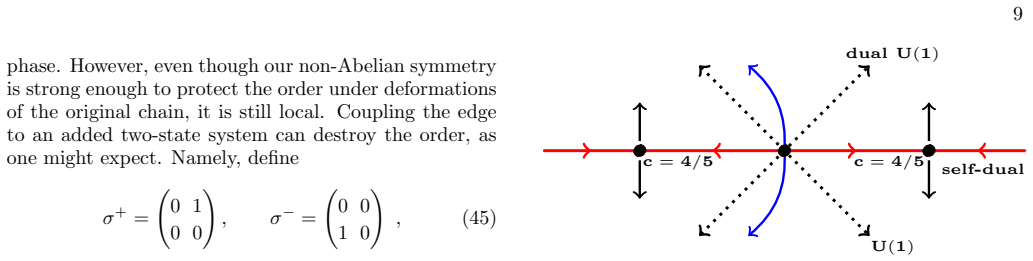
Two devices carry the argument. The first is the projector rewrite of the Hamiltonian, $H_{\gamma,\hat\gamma}=\sum_j[P_{2j-1,2j}(\gamma)+P_{2j,2j+1}(\hat\gamma)]$ with $P_{a,a+1}(\gamma)=\gamma p_a+3\gamma^{-1}p_{a+1}-p_ap_{a+1}-p_{a+1}p_a$; because the $p_a$ obey the projector algebra (13), special parameter pairs make neighbouring projectors commute and give exact zero-energy ground states. The second is the continuum action (53), $S_B+\Gamma\int d^2z\,[\,f\cos\sqrt{6}\,\phi+J\cos\sqrt{6}\,\hat{\phi}\,]$, where $S_B$ is the free compact boson at radius $r=\sqrt{3/2}$. The two cosine terms are the only relevant operators invariant under the full $S_3$ symmetry, and duality exchanges them; the self-dual direction $f=J$ flows to the three-state Potts conformal field theory, which is what ties all four phase boundaries to the same universality class.
What would settle it
Compute the effective central charge and the magnetization scaling along the numerically located not-A/disorder and Potts/RSPT transition lines: if the central charge differs from $4/5$ or the scaling dimensions differ from the three-state Potts values, the central claim fails. A second check is to couple an extra $S_3$ doublet to one edge of the open chain; the paper predicts the fourfold degeneracy splits into two doublets, whereas a true symmetry-protected topological phase would stay fourfold degenerate.
Extended reading notes
Core claim
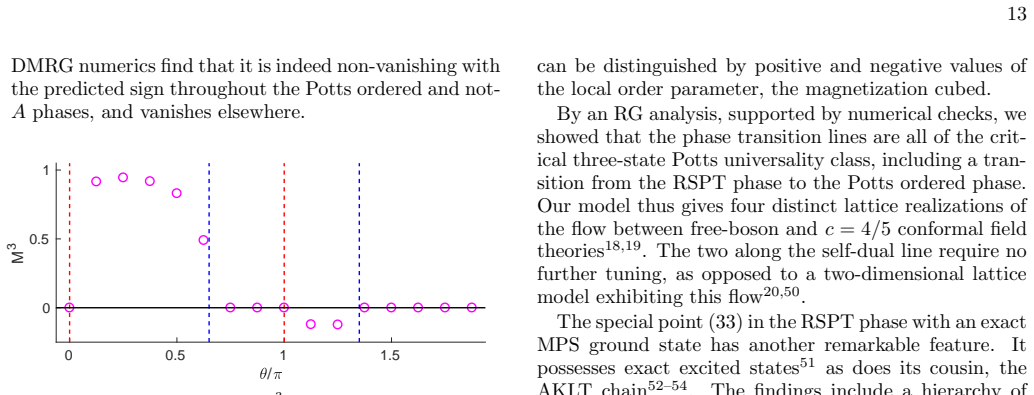
On the paper's own terms, the discovery is that the two-parameter Hamiltonian (11) has a four-phase structure around the multicritical point $H_0$. The two ordered phases are distinguished by the sign of $M^3$, where $M=\langle g|\sigma_j|g\rangle$ in an $S_3$-breaking ground state: $M^3>0$ in the Potts ordered phase and $M^3<0$ in the not-A phase. The two phases without local order both have $M^3=0$ but differ in their open-chain ground-state degeneracy: one state for Potts disorder, four states for RSPT order. In the RSPT phase each edge transforms as a two-dimensional representation of $S_3$ rather than a projective representation, which is why the phase is called representation-protected rather than a full symmetry-protected topological phase. The field-theory section derives the perturbed compact-boson action (53), identifies the boson radius as $r=\sqrt{3/2}$, and uses the known flow of that theory to the $c=4/5$ Potts conformal field theory to conclude that all four transition lines, including the two not fixed by self-duality, lie in the three-state Potts universality class. Exact product and matrix-product ground states are found at one point in each phase, and the eight states match the eight conformal boundary conditions of the critical Potts CFT.
Load-bearing premise
The load-bearing premise is that the continuum action (53), containing only the two $S_3$-invariant cosine operators, is the complete relevant field-theory description of the lattice model near $H_0$; if another relevant operator survives the continuum limit, the location and universality class of the vertical transitions could change.
Editorial extensions
If this is right
- If the phase diagram of Fig. 1 is correct, the Potts ordered and not-A phases cannot be connected without closing the gap; the sign of $M^3$ is a robust diagnostic separating them.
- All four phase boundaries have central charge $c=4/5$, including the direct transition from Potts order to the RSPT phase, so measurements of entanglement entropy along any of the lines should find the three-state Potts value.
- The exact ground states at the four special points realize the eight conformal boundary conditions of the three-state Potts CFT on a lattice, giving a concrete lattice playground for boundary-condition physics.
- The fourfold ground-state degeneracy of the RSPT phase persists under any $S_3$-preserving deformation of the chain, but coupling an extra $S_3$ doublet to one edge splits the degeneracy into two doublets, a signature that separates RSPT from true SPT order.
Reading between the lines
- The sign of $M^3$ could be used as a generic order parameter for "exclusion" order in other permutation-symmetric or clock models, where ordering means avoiding one state rather than preferring one.
- The representation-versus-projective distinction suggests a hierarchy: other non-abelian symmetry groups in one dimension should support analogous representation-protected phases whose edge degeneracy equals the dimension of the group's representation, with the same fragility to auxiliary degrees of freedom.
- Because the two anti-self-dual transition lines are not fixed by symmetry, their precise shape near the multicritical point is a quantitative field-theory prediction; high-precision numerics that resolve a bend at small couplings would point to a missing relevant operator.
- The duality between the RSPT matrix-product state and the not-A product states may extend to a broader correspondence between edge-representation data and local exclusion rules in $\mathbb{Z}_N$-symmetric chains.
Signed reviews
Editorial analysis
A structured set of objections, weighed in public.
Referee Report
Summary. The paper analyzes the two-parameter S3-invariant spin-1 chain H(J,f,λ)=λH0+HP(J,f)+(2λ−f−J)L (Eq. 11), where H0 is the U(1)-invariant self-dual point and HP is the three-state Potts Hamiltonian. The authors construct exact ground states at four isolated points: the three ferromagnetic product states, the symmetric disordered state, the three 'not-A' product states |ĀĀ...>, and an AKLT-like matrix product state. They show that the sign of M^3 distinguishes the Potts-ordered and not-A phases, while open-boundary degeneracies (1 vs 4) distinguish the disordered and RSPT phases. A free-boson field theory with compact radius r=√(3/2) is derived from duality, and the authors argue from known c=1 to c=4/5 flows that all four transition lines are in the three-state Potts universality class. DMRG provides central-charge and gap data consistent with the phase diagram.
Significance. If the central claim is fully substantiated, this is a significant contribution: it provides a single nearest-neighbor model where four distinct gapped phases meet at a multicritical point, with exact frustration-free ground states in every phase, an explicit RSPT phase protected by a non-Abelian representation, and a lattice realization of the free-boson-to-Potts flow. The projector-algebra proofs at the four special points are clean and convincing; the derivation of the boson radius r=√(3/2) from the self-duality of the Z3-twisted partition function is parameter-free and self-contained; and the MPS/RSPT analysis gives concrete, falsifiable predictions (M^3 sign and edge degeneracy) that are checked numerically. The paper is clearly written and will be of interest to the exactly-solvable-models and symmetry-protected-topology communities.
major comments (2)
- [V.C, Eq. (53), footnote 45] The conclusion that the two anti-self-dual transition lines (not-A/disorder and Potts/RSPT) are in the three-state Potts universality class is load-bearing and rests on an identification that is asserted rather than derived. The field theory (53) is a U(1)-invariant free boson, but the cited integrable c=1 to c=4/5 flow of Refs. 18–20 was established for the Z4 parafermion orbifold. As footnote 45 acknowledges, these are different theories: the free boson has an additional U(1) current algebra and an exactly marginal radius operator, so the flow is not automatic. Since no lattice symmetry protects the vertical transitions, the Potts classification of these lines depends on this RG-flow identification. I ask the authors to either supply a derivation of the free-boson-to-Potts flow (or a precise mapping from (53) to the known Z4 case), or to restrict the universality claim accordingly.
- [VI, Fig. 3] The numerical evidence for Potts universality at the anti-self-dual transitions is limited to a single effective-central-charge estimate c≈0.8 at β=0.75 (Fig. 3). A central charge alone does not identify the Potts CFT, since other CFTs can share the same central charge. Additional checks, such as scaling dimensions, entanglement-spectrum degeneracies, or correlation-function exponents, would be needed to confirm the Potts operator content. Alternatively, the text should say that these transitions are 'consistent with' Potts universality rather than that they are 'in' it. The authors' own statement in Section VI that they could not confirm the predicted vertical approach of these lines near the multicritical point further limits the strength of the claim.
minor comments (3)
- [Fig. 4] The horizontal axis label appears truncated ('/' in the reproduced figure); it should read θ/π.
- [Table I] The column header 'M3' would be clearer as 'M^3' to match the notation M^3_g used in the text, and a brief definition of M^3 via Eq. (55) would help the reader.
- [V.B] The sentence that 'all the possible scaling dimensions for a compact boson are contained in the partition function' is imprecise, since the partition function displays only the operator content on the torus; the later discussion of local operators is clear, but this sentence could be rephrased.
Circularity Check
No circular derivation: H0 and exact ground states are explicit, the boson radius is derived by duality, and the Potts-universality claim rests on external RG-flow results, not on fitting or self-citation.
full rationale
The paper's central derivation is self-contained in the sense required by the circularity rubric. The Hamiltonian (11) is explicitly defined; the multicritical H0 is written out in (10), and the earlier self-citation [12] is used only for side remarks about degeneracies, while the CFT radius r=√3/2 is either credited to Ref 43 or re-derived from the Z3-twisted partition-function duality in Section V.B. The four exact ground states follow from explicit Temperley-Lieb projector calculations (18)-(20), not from the phase diagram. The field-theory action (53) is obtained by listing the only relevant S3- and chirally-symmetric operators in the c=1 free boson; no parameter is fitted to the later transition data. The Potts-universality claim for all four lines is imported from the external integrable-flow literature (Refs 18-20), and the numerical check is an independent measurement of c≈0.8 at one anti-self-dual point. The one genuine caveat is footnote 45: the cited flow was established for the Z4 parafermion orbifold, and the authors assert that the same flow occurs for the free boson; this is an assumption about the validity of an external result, not a reduction of the prediction to its own input. Therefore no circular step can be quoted.
Assumptions & free parameters
assumptions (4)
- domain assumption Kramers-Wannier duality acts on operators as τ_j -> σ†_j σ_{j+1} and σ†_j σ_{j+1} -> τ_{j+1} (Eq. 7).
- domain assumption The continuum limit of H0 is a free compact boson with radius r = √(3/2).
- domain assumption The only relevant S3-invariant operators near H0 are cos√6φ and cos√6φ̂ with dimension (3/4,3/4).
- domain assumption The self-dual perturbation of the c=1 boson flows to the c=4/5 Potts CFT (Refs. 18-20).
Cite this review
Pith. "Pith review of The "not-A", RSPT and Potts phases in an $S_3$-invariant chain." pith.science (2026). https://pith.science/paper/VVCKNY36
@misc{pith2026190802767,
  author       = {Pith},
  title        = {Pith review of: The "not-A", RSPT and Potts phases in an $S_3$-invariant chain},
  year         = {2026},
  howpublished = {\url{https://pith.science/paper/VVCKNY36}},
  note         = {Machine review of arXiv:1908.02767}
}
abstract
We analyse in depth an $S_3$-invariant nearest-neighbor quantum chain in the region of a U(1)-invariant self-dual multicritical point. We find four distinct proximate gapped phases. One has three-state Potts order, corresponding to topological order in a parafermionic formulation. Also nearby is a phase with "representation" symmetry-protected topological (RSPT) order. Its dual exhibits an unusual "not-A" order, where the spins prefer to align in two of the three directions. Within each of the four phases, we find a frustration-free point with exact ground state(s). The exact RSPT ground state is similar to that of Affleck-Kennedy-Lieb-Tasaki, whereas its dual states in the not-A phase are product states, each an equal-amplitude sum over all states where one of the three spin states on each site is absent. A field-theory analysis shows that all transitions are in the universality class of the critical three-state Potts model. They provide a lattice realization of a flow from a free-boson field theory to the Potts conformal field theory.
Figures


Figures from the paper (3 more)


Reference graph
Works this paper leans on
-
[1]
author author A. Y. \ Kitaev ,\ 10.1070/1063-7869/44/10S/S29 journal journal Phys. Usp. \ volume 44 ,\ pages 131 ( year 2001 ) ,\ http://arxiv.org/abs/cond-mat/0010440 arXiv:cond-mat/0010440 [cond-mat.mes-hall] NoStop
arXiv 2001
-
[2]
author author F. Haldane ,\ https://doi.org/10.1016/0375-9601(83)90631-X journal journal Physics Letters A \ volume 93 ,\ pages 464 ( year 1983 a ) NoStop
-
[3]
author author F. D. M. \ Haldane ,\ 10.1103/PhysRevLett.50.1153 journal journal Phys. Rev. Lett. \ volume 50 ,\ pages 1153 ( year 1983 b ) NoStop
-
[4]
author author I. Affleck , author T. Kennedy , author E. H. \ Lieb , \ and\ author H. Tasaki ,\ 10.1103/PhysRevLett.59.799 journal journal Phys. Rev. Lett. \ volume 59 ,\ pages 799 ( year 1987 ) NoStop
-
[5]
author author I. Affleck , author T. Kennedy , author E. H. \ Lieb , \ and\ author H. Tasaki ,\ https://projecteuclid.org:443/euclid.cmp/1104161001 journal journal Comm. Math. Phys. \ volume 115 ,\ pages 477 ( year 1988 ) NoStop
arXiv 1988
-
[6]
author author Z.-C. \ Gu \ and\ author X.-G. \ Wen ,\ 10.1103/PhysRevB.80.155131 journal journal Phys. Rev. B \ volume 80 ,\ pages 155131 ( year 2009 ) NoStop
-
[7]
author author F. Pollmann , author A. M. \ Turner , author E. Berg , \ and\ author M. Oshikawa ,\ 10.1103/PhysRevB.81.064439 journal journal Phys. Rev. B \ volume 81 ,\ pages 064439 ( year 2010 ) NoStop
-
[8]
author author X. Chen , author Z.-C. \ Gu , \ and\ author X.-G. \ Wen ,\ 10.1103/PhysRevB.83.035107 journal journal Phys. Rev. B \ volume 83 ,\ pages 035107 ( year 2011 ) NoStop
Show all 57 references
-
[9]
Pollmann , author E
author author F. Pollmann , author E. Berg , author A. M. \ Turner , \ and\ author M. Oshikawa ,\ 10.1103/PhysRevB.85.075125 journal journal Phys. Rev. B \ volume 85 ,\ pages 075125 ( year 2012 ) NoStop
2012 doi
-
[10]
Verstraete , author V
author author F. Verstraete , author V. Murg , \ and\ author J. I. \ Cirac ,\ @noop journal journal Advances in Physics \ volume 57 ,\ pages 143 ( year 2008 ) NoStop
2008
-
[11]
Alicea \ and\ author P
author author J. Alicea \ and\ author P. Fendley ,\ 10.1146/annurev-conmatphys-031115-011336 journal journal Ann. Rev. Condensed Matter Phys. \ volume 7 ,\ pages 119 ( year 2016 ) ,\ http://arxiv.org/abs/1504.02476 arXiv:1504.02476 [cond-mat.str-el] NoStop
2016 arXiv
-
[12]
Vernier , author E
author author E. Vernier , author E. O'Brien , \ and\ author P. Fendley ,\ 10.1088/1742-5468/ab11c0 journal journal Journal of Statistical Mechanics: Theory and Experiment \ volume 2019 ,\ pages 043107 ( year 2019 ) ,\ http://arxiv.org/abs/1812.09091 arXiv:1812.09091 NoStop
2019 arXiv
-
[13]
Ginsparg ,\ @noop \ ( year 1988 a ) ,\ http://arxiv.org/abs/hep-th/9108028v1 arXiv:hep-th/9108028v1 NoStop
author author P. Ginsparg ,\ @noop \ ( year 1988 a ) ,\ http://arxiv.org/abs/hep-th/9108028v1 arXiv:hep-th/9108028v1 NoStop
1988 arXiv
-
[14]
author author P. D. \ Francesco , author P. Mathieu , \ and\ author D. Senechal ,\ @noop title Conformal Field Theory \ ( publisher Springer ,\ year 1997 ) NoStop
1997
-
[15]
Chaikin \ and\ author T
author author P. Chaikin \ and\ author T. Lubensky ,\ @noop title Principles of condensed matter physics \ ( publisher Cambridge University Press ,\ year 1995 ) NoStop
1995
-
[16]
Giamarchi ,\ @noop title Quantum physics in one dimension \ ( publisher Clarendon press ,\ year 2003 ) NoStop
author author T. Giamarchi ,\ @noop title Quantum physics in one dimension \ ( publisher Clarendon press ,\ year 2003 ) NoStop
2003
-
[17]
Mussardo ,\ @noop title Statistical field theory \ ( publisher Oxford Univ
author author G. Mussardo ,\ @noop title Statistical field theory \ ( publisher Oxford Univ. Press ,\ address New York, NY ,\ year 2010 ) NoStop
2010
-
[18]
Lecheminant , author A
author author P. Lecheminant , author A. O. \ Gogolin , \ and\ author A. A. \ Nersesyan ,\ https://doi.org/10.1016/S0550-3213(02)00474-1 journal journal Nuclear Physics B \ volume 639 ,\ pages 502 ( year 2002 ) NoStop
2002 doi
-
[19]
Fateev \ and\ author A
author author V. Fateev \ and\ author A. Zamolodchikov ,\ https://doi.org/10.1016/0370-2693(91)91283-2 journal journal Physics Letters B \ volume 271 ,\ pages 91 ( year 1991 ) NoStop
1991 doi
-
[20]
Delfino ,\ @noop journal journal Statistical Field Theories
author author G. Delfino ,\ @noop journal journal Statistical Field Theories. NATO SCIENCE SERIES II \ volume 73 ,\ pages 3 ( year 2002 ) ,\ http://arxiv.org/abs/hep-th/01101811 arXiv:hep-th/01101811 NoStop
2002 arXiv
-
[21]
author author J. L. \ Cardy ,\ https://doi.org/10.1016/0550-3213(89)90521-X journal journal Nuclear Physics B \ volume 324 ,\ pages 581 ( year 1989 ) NoStop
1989 doi
-
[22]
Affleck , author M
author author I. Affleck , author M. Oshikawa , \ and\ author H. Saleur ,\ 10.1088/0305-4470/31/28/003 journal journal Journal of Physics A: Mathematical and General \ volume 31 ,\ pages 5827 ( year 1998 ) NoStop
1998 doi
-
[23]
author author H. A. \ Kramers \ and\ author G. H. \ Wannier ,\ 10.1103/PhysRev.60.252 journal journal Phys. Rev. \ volume 60 ,\ pages 252 ( year 1941 ) NoStop
1941 doi
-
[24]
author author R. J. \ Baxter ,\ @noop title Exactly Solved Models in Statistical Mechanics \ ( publisher Harcourt Brace Jovanovich ,\ year 1982 ) NoStop
1982
-
[25]
author author F. C. \ Alcaraz \ and\ author M. J. \ Martins ,\ http://stacks.iop.org/0305-4470/22/i=11/a=023 journal journal J. Phys. A: Math. Gen \ volume 22 ,\ pages 1829 ( year 1989 ) NoStop
1989
-
[26]
Frahm , author N.-C
author author H. Frahm , author N.-C. \ Yu , \ and\ author M. Fowler ,\ https://doi.org/10.1016/0550-3213(90)90435-G journal journal Nuclear Physics B \ volume 336 ,\ pages 396 ( year 1990 ) NoStop
1990 doi
-
[27]
author author A. B. \ Zamolodchikov \ and\ author V. A. \ Fateev ,\ @noop journal journal Sov. J. Nucl. Phys. \ volume 32 ,\ pages 298 ( year 1980 ) ,\ note [Yad. Fiz.32,581(1980)] NoStop
1980
-
[28]
O'Brien \ and\ author P
author author E. O'Brien \ and\ author P. Fendley ,\ @noop \ ( year 2019 ) ,\ http://arxiv.org/abs/1912.09464 arXiv:1912.09464 NoStop
2019 arXiv
-
[29]
O'Brien ,\ @noop journal University of Oxford Ph.D thesis \ NoStop
author author E. O'Brien ,\ @noop journal University of Oxford Ph.D thesis \ NoStop
-
[30]
Ikhlef , author J
journal author author Y. Ikhlef , author J. L. \ Jacobsen , \ and\ author H. Saleur ,\ http://stacks.iop.org/1751-8121/42/i=29/a=292002 journal journal Journal of Physics A: Mathematical and Theoretical \ volume 42 ,\ pages 292002 ( year 2009 ) NoStop
2009
-
[31]
Fradkin \ and\ author L
author author E. Fradkin \ and\ author L. Kadanoff ,\ 10.1016/0550-3213(80)90472-1 journal journal Nuclear Physics B \ volume 170 ,\ pages 1 ( year 1980 ) NoStop
1980 doi
-
[32]
Kl\" u mper , author A
author author A. Kl\" u mper , author A. Schadschneider , \ and\ author J. Zittartz ,\ 10.1209/0295-5075/24/4/010 journal journal Europhysics Letters ( EPL ) \ volume 24 ,\ pages 293 ( year 1993 ) NoStop
1993 doi
-
[33]
u mper , \ and\ author J. Zittartz ,\ 10.1007/BF01313293 journal journal Zeitschrift f \
author author C. Lange , author A. Kl \"u mper , \ and\ author J. Zittartz ,\ 10.1007/BF01313293 journal journal Zeitschrift f \"u r Physik B Condensed Matter \ volume 96 ,\ pages 267 ( year 1994 ) NoStop
1994 doi
-
[34]
Parameswaran for suggesting the name, and the Aretha Franklin observation
note We thank S. Parameswaran for suggesting the name, and the Aretha Franklin observation. Stop
-
[35]
author author H. W. J. \ Bl\"ote , author J. L. \ Cardy , \ and\ author M. P. \ Nightingale ,\ 10.1103/PhysRevLett.56.742 journal journal Phys. Rev. Lett. \ volume 56 ,\ pages 742 ( year 1986 ) NoStop
1986 doi
-
[36]
Affleck ,\ 10.1103/PhysRevLett.56.746 journal journal Phys
author author I. Affleck ,\ 10.1103/PhysRevLett.56.746 journal journal Phys. Rev. Lett. \ volume 56 ,\ pages 746 ( year 1986 ) NoStop
1986 doi
-
[37]
Dotsenko ,\ http://dx.doi.org/10.1016/0550-3213(84)90148-2 journal journal Nuclear Physics B \ volume 235 ,\ pages 54 ( year 1984 ) NoStop
author author V. Dotsenko ,\ http://dx.doi.org/10.1016/0550-3213(84)90148-2 journal journal Nuclear Physics B \ volume 235 ,\ pages 54 ( year 1984 ) NoStop
1984 doi
-
[38]
author author J. L. \ Cardy ,\ https://doi.org/10.1016/0550-3213(86)90552-3 journal journal Nuclear Physics B \ volume 270 ,\ pages 186 ( year 1986 ) NoStop
1986 doi
-
[39]
author author R. S. K. \ Mong , author D. J. \ Clarke , author J. Alicea , author N. H. \ Lindner , \ and\ author P. Fendley ,\ http://stacks.iop.org/1751-8121/47/i=45/a=452001 journal journal Journal of Physics A: Mathematical and Theoretical \ volume 47 ,\ pages 452001 ( yea...
2014
-
[40]
author author A. B. \ Zamolodchikov ,\ 10.1142/S0217751X88000333 journal journal Int. J. Mod. Phys. \ volume A3 ,\ pages 743 ( year 1988 ) NoStop
1988 doi
-
[41]
author author J. L. \ Cardy ,\ 10.1016/0550-3213(93)90353-Q journal journal Nucl. Phys. \ volume B389 ,\ pages 577 ( year 1993 ) ,\ http://arxiv.org/abs/hep-th/9210002 arXiv:hep-th/9210002 [hep-th] NoStop
1993 arXiv
-
[42]
Nienhuis ,\ 10.1007/BF01009437 journal journal J
author author B. Nienhuis ,\ 10.1007/BF01009437 journal journal J. Statist. Phys. \ volume 34 ,\ pages 731 ( year 1984 ) NoStop
1984 doi
-
[43]
Baranowski \ and\ author V
author author D. Baranowski \ and\ author V. Rittenberg ,\ 10.1088/0305-4470/23/6/023 journal journal Journal of Physics A: Mathematical and General \ volume 23 ,\ pages 1029 ( year 1990 ) NoStop
1990 doi
-
[44]
Schutz ,\ http://stacks.iop.org/0305-4470/26/i=18/a=021 journal journal Journal of Physics A: Mathematical and General \ volume 26 ,\ pages 4555 ( year 1993 ) NoStop
author author G. Schutz ,\ http://stacks.iop.org/0305-4470/26/i=18/a=021 journal journal Journal of Physics A: Mathematical and General \ volume 26 ,\ pages 4555 ( year 1993 ) NoStop
1993
-
[45]
This parafermion field theory and free-boson field theory are not exactly the same, as the former is an orbifold of the latter and has no U(1) symmetries Ginsparg1988b
note One small subtlety: in Ref.\ @citealpnum Lecheminant2002 , the c =1 bosonic field theory involved is called, slightly inaccurately, the Z _4 parafermion theory. This parafermion field theory and free-boson field theory are not exactly the same, as the former is an orbifol...
-
[46]
@noop title iTensor , \ howpublished http://itensor.org/ NoStop
-
[47]
Calabrese \ and\ author J
author author P. Calabrese \ and\ author J. Cardy ,\ http://stacks.iop.org/1742-5468/2004/i=06/a=P06002 journal journal Journal of Statistical Mechanics: Theory and Experiment \ volume 2004 ,\ pages P06002 ( year 2004 ) NoStop
2004
-
[48]
Eisert , author M
author author J. Eisert , author M. Cramer , \ and\ author M. B. \ Plenio ,\ 10.1103/RevModPhys.82.277 journal journal Rev. Mod. Phys. \ volume 82 ,\ pages 277 ( year 2010 ) NoStop
2010 doi
-
[49]
author author M. B. \ Hastings ,\ http://stacks.iop.org/1742-5468/2007/i=08/a=P08024 journal journal Journal of Statistical Mechanics: Theory and Experiment \ volume 2007 ,\ pages P08024 ( year 2007 ) NoStop
2007
-
[50]
Otsuka \ and\ author Y
author author H. Otsuka \ and\ author Y. Okabe ,\ 10.1103/PhysRevLett.93.120601 journal journal Phys. Rev. Lett. \ volume 93 ,\ pages 120601 ( year 2004 ) NoStop
2004 doi
-
[51]
Moudgalya , author E
author author S. Moudgalya , author E. O'Brien , author B. A. \ Bernevig , author P. Fendley , \ and\ author N. Regnault ,\ @noop \ ( year 2020 ) ,\ http://arxiv.org/abs/2002.11725 arXiv:2002.11725 NoStop
2020 arXiv
-
[52]
author author D. P. \ Arovas ,\ https://doi.org/10.1016/0375-9601(89)90921-3 journal journal Physics Letters A \ volume 137 ,\ pages 431 ( year 1989 ) NoStop
1989 doi
-
[53]
Moudgalya , author S
author author S. Moudgalya , author S. Rachel , author B. A. \ Bernevig , \ and\ author N. Regnault ,\ 10.1103/PhysRevB.98.235155 journal journal Phys. Rev. B \ volume 98 ,\ pages 235155 ( year 2018 a ) NoStop
2018 doi
-
[54]
Moudgalya , author N
author author S. Moudgalya , author N. Regnault , \ and\ author B. A. \ Bernevig ,\ 10.1103/PhysRevB.98.235156 journal journal Phys. Rev. B \ volume 98 ,\ pages 235156 ( year 2018 b ) NoStop
2018 doi
-
[55]
Rahmani , author X
author author A. Rahmani , author X. Zhu , author M. Franz , \ and\ author I. Affleck ,\ @noop journal journal Physical review letters \ volume 115 ,\ pages 166401 ( year 2015 ) NoStop
2015
-
[56]
O'Brien \ and\ author P
author author E. O'Brien \ and\ author P. Fendley ,\ 10.1103/PhysRevLett.120.206403 journal journal Phys. Rev. Lett. \ volume 120 ,\ pages 206403 ( year 2018 ) NoStop
2018 doi
-
[57]
Ginsparg ,\ https://doi.org/10.1016/0550-3213(88)90249-0 journal journal Nuclear Physics B \ volume 295 ,\ pages 153 ( year 1988 b ) NoStop
author author P. Ginsparg ,\ https://doi.org/10.1016/0550-3213(88)90249-0 journal journal Nuclear Physics B \ volume 295 ,\ pages 153 ( year 1988 b ) NoStop
1988 doi
Reviewed August 14, 2026 · model on record in the stance chip above.
Discussion (0). Continue with ORCID to comment.