REVIEW 3 major objections 6 minor 59 references
AnimalClue: Recognizing Animals by their Traces
T0 review · 3 major / 6 minor · reviewed 2026-08-06 · deepseek-v4-flash
Pith's one-line read AnimalClue provides the first large-scale benchmark for recognizing animal species from footprints, feces, eggs, bones, and feathers, and its own results show current models still struggle with rare species and bones.
desk verdict A genuinely useful multi-trace dataset (five clue types, 968 species, detection/segmentation/traits) whose numbers rest on iNaturalist research-grade labels that deserve a sample audit; worth refereeing, with release and label-quality caveats. read the letter →
The pith
A machine-rendered reading of the paper's core claim, the machinery that carries it, and where it could break.
The reading
What carries the argument
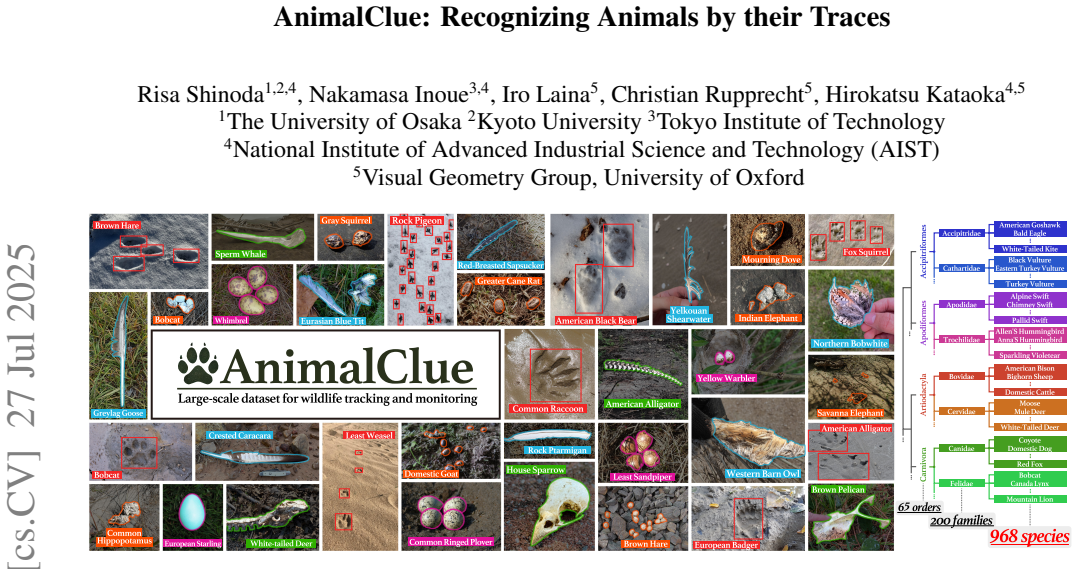
The load-bearing object is the dataset itself: images collected from a citizen-science observation platform using research-grade labels, filtered to remove text overlays, visible animals, distant subjects, and faces, then annotated with bounding boxes for footprints and pixel-level masks for feces, eggs, bones, and feathers. The same citizen-science submission is kept in a single split to prevent leakage, and species are binned into frequent, intermediate, and rare bands so benchmarks expose long-tail behaviour. This pipeline, plus four benchmark protocols (classification, detection, instance segmentation, and trait prediction), is what lets the paper claim that trace-based identification is a distinct and difficult visual task.
What would settle it
Sample, say, 400 images per trace type from the test split and have independent wildlife experts re-identify the species without seeing the original labels; if disagreement with the dataset labels varies substantially across trace types or exceeds a few percent for bones and feces, the benchmark numbers and the paper's difficulty rankings would need revisiting.
Extended reading notes
Core claim
The central claim is that animal species can be recognised from indirect clues at scale, and that a public dataset with classification, detection, segmentation, and trait annotations is what makes that research possible. The paper documents that model accuracy varies strongly by trace type — feathers and eggs are comparatively easy, bones are hard — and that performance on the long tail of rare species drops far below frequent-species accuracy at every task. A feature-space analysis shows that generic and even biology-oriented vision-language models separate trace categories imperfectly, and that fine-tuning on trace images is required. The paper therefore positions AnimalClue not as a solved benchmark but as a challenging resource: the best reported order-level detection mean average precision is 0.57 and order-level instance segmentation mean average precision is 0.48.
Load-bearing premise
The entire benchmark rests on the research-grade citizen-science labels being correct for the image–species pair; if a meaningful fraction of those labels are wrong, especially for visually ambiguous traces like bones and feces, every accuracy number and trait conclusion in the paper shifts.
Editorial extensions
If this is right
- Non-invasive monitoring can be automated for evidence types field biologists already use, so surveys can scale from manual inspection to model-assisted screening.
- Rare-species accuracy is the binding constraint; the benchmark's frequent/intermediate/rare breakdown implies that collecting more long-tail trace images is the clearest path to better models.
- Trace type matters more than species count: feathers and eggs are easier despite having many species, while bones are hardest, guiding where annotation effort should go.
- Trait prediction from traces is feasible, so models could recover ecological attributes such as diet, activity pattern, and habitat without seeing the animal, which is useful for coarse filtering in monitoring pipelines.
- Releasing boxes, masks, and traits makes AnimalClue a reusable testbed for detection and segmentation methods, not only classification.
Reading between the lines
- Because the paper keeps all images from one citizen-science submission in the same split, a natural extension is to test generalization across geography or across photographers, using metadata the paper does not report on; that would probe whether models learn species-specific traces or photographer- and background-specific shortcuts.
- The label-quality assumption could be stress-tested by training on a deliberately corrupted subset, flipping a fraction of species labels within a family, and measuring benchmark degradation; the paper does not include such a noise analysis.
- The trait annotations open a route the paper only hints at: zero-shot or text-prompted identification, where a model is asked whether a trace matches a described diet or activity pattern rather than a species name; the fine-tuned vision-language results suggest this is worth exploring.
- For conservation practice, a plausible next step is fusing evidence from multiple traces of the same species in one area, such as a footprint plus a feather, which the paper does not evaluate but its multi-trace design makes possible.
Signed reviews
Editorial analysis
A structured set of objections, weighed in public.
Referee Report
Summary. The paper introduces AnimalClue, a large-scale dataset for species identification from images of indirect animal evidence. The dataset contains 159,605 bounding boxes across five trace types (footprints, feces, eggs, bones, feathers), covers 968 species, and includes species-level labels, bounding-box/mask annotations, and 22 trait annotations. The authors establish four benchmarks—classification, detection, instance segmentation, and trait prediction—and report baseline results for representative models. The dataset is collected from iNaturalist under Creative Commons licenses, with a split that keeps images from the same iNaturalist submission in the same partition to avoid leakage. The central claims are that AnimalClue is the first large-scale multi-trace benchmark of its kind and that current models perform poorly on rare species and on visually ambiguous trace types such as bones and feces.
Significance. If the dataset's label and annotation quality are properly verified, AnimalClue would be a valuable contribution: it uniquely combines five trace types at a scale far beyond existing resources (e.g., OpenAnimalTracks has 18 footprint species; FeathersV1 covers only controlled-environment feather images), and it provides four tasks plus trait prediction, enabling research on an underexplored but ecologically important problem. The splitting protocol that avoids splitting the same iNaturalist submission across train and test is a sound methodological choice, and the release of data and code under permissive licenses is a strength. The paper also documents clear limitations in model performance, especially for rare categories, which can guide future work. However, the reliability of the benchmark depends on the accuracy of iNaturalist research-grade labels and on the quality of bounding-box/mask annotations, both of which are currently unquantified in the manuscript.
major comments (3)
- [§3.2] The species labels are inherited from iNaturalist research-grade observations without independent expert re-verification of the trace images. For ambiguous trace types such as bones and feces—where the paper's own classification results are 14.7–20.5% and 29.6–38.6% top-1 species accuracy—systematic label noise would directly distort the benchmark numbers and the relative ranking of trace types. The authors should provide an expert audit on a random sample (e.g., 1,000 images per trace type) with reported agreement rates, or otherwise demonstrate that the reported conclusions are robust to plausible label-error rates.
- [§3.3] The annotation quality for bounding boxes and masks is not quantified. Half of the footprint bounding boxes are produced by an unnamed third-party service, and egg/feather masks are initialized with SAM and then corrected; no inter-annotator agreement or quality-control metrics are reported anywhere in the paper. Since detection and instance segmentation are central benchmark contributions, the paper should report IAA on a sample or equivalent quantitative quality measures, and describe the third-party service (or at least its quality-control protocol).
- [§3.3 (Trait annotations)] The source and curation protocol for the 22 trait labels (diet, activity pattern, habitat, etc.) are not described. If these traits are aggregated from external databases (e.g., EltonTraits or PanTHERIA), those sources must be cited and any mapping rules or conflict resolutions reported; if they are expert-assigned, the procedure and any validation should be described. Without this provenance, the trait-prediction results cannot be independently reproduced or interpreted.
minor comments (6)
- [§3.3] The phrase 'taxonomy-based split' in the Frequency categorization paragraph should presumably read 'frequency-based split' (or the intended meaning should be clarified).
- [§3.3] The Segment Anything Model is used in the annotation pipeline but is not cited; a reference should be added.
- [§4.3] The sentence 'Overall, RT-DETR achieves the best results across all categories' is not supported by Table 3: for example, on egg species RT-DETR obtains mAP 0.04 versus YOLOv8's 0.13, and on feather species 0.17 versus YOLOv8's 0.25. Please qualify the claim (e.g., by taxonomy level) or correct it.
- [§4.1 / Table 2] The paper reports results for 'frequent' and 'rare' categories but does not give the number of categories or the average number of training instances per category in each group; providing these statistics would help interpret the near-zero rare-category accuracies (e.g., 1.00% for ResNet-50 on rare bone species).
- [§3.2] The description of iNaturalist research-grade status is slightly imprecise: research-grade means community agreement on the observation, not necessarily that the specific trace image has been independently confirmed by multiple experts. Please rephrase to avoid overstating the verification.
- [§4.5] Traits classification is reported only for Swin-B; a sentence noting that this model was chosen for its best classification performance and that other models were not evaluated for traits would clarify the experimental scope.
Circularity Check
No significant circularity: AnimalClue's reported numbers are direct measurements on a newly collected dataset, with no fitted parameter, self-citation chain, or definitional identification forcing the benchmark results.
full rationale
This paper is a dataset-and-benchmark contribution. It does not claim to derive predictive laws from first principles; instead it reports model accuracies (classification top-1, detection/instance-segmentation mAP, trait classification accuracy) measured on a newly introduced dataset with fixed train/validation/test splits. The ground-truth labels are inherited from iNaturalist research-grade observations, and the paper explicitly states in Section 3.2 that it uses 'research-grade images, confirmed by other citizen scientists for the image and animal species pair.' That is an input-labeling choice, not a circular derivation: the benchmark scores are computed against those labels, but no parameter is fitted to a subset and then reported as a prediction of a closely related quantity. The dataset is split by iNaturalist submission to avoid leakage, and the frequency/rarity grouping is a descriptive analysis of the training split rather than a fitted claim. The only self-citations are to earlier datasets by the same authors (OpenAnimalTracks, PetFace) in the related-work comparison; these are not load-bearing for the paper's central claim that AnimalClue is a large-scale trace dataset. No uniqueness theorem is invoked, no ansatz is smuggled in via citation, and no external empirical pattern is renamed as a new result. Concerns about label reliability for ambiguous traces such as bones and feces are correct as verification risks, but they are not circularity: a wrong label degrades the benchmark's validity without making the reported accuracy an artifact of the paper's own construction. The paper is self-contained as a measurement study, so the appropriate circularity score is 0.
Assumptions & free parameters
assumptions (1)
- domain assumption iNaturalist research-grade species labels are accurate enough to support species-level benchmarks.
Cite this review
Pith. "Pith review of AnimalClue: Recognizing Animals by their Traces." pith.science (2026). https://pith.science/paper/VVDTQTVJ
@misc{pith2026250720240,
  author       = {Pith},
  title        = {Pith review of: AnimalClue: Recognizing Animals by their Traces},
  year         = {2026},
  howpublished = {\url{https://pith.science/paper/VVDTQTVJ}},
  note         = {Machine review of arXiv:2507.20240}
}
read the original abstract
Wildlife observation plays an important role in biodiversity conservation, necessitating robust methodologies for monitoring wildlife populations and interspecies interactions. Recent advances in computer vision have significantly contributed to automating fundamental wildlife observation tasks, such as animal detection and species identification. However, accurately identifying species from indirect evidence like footprints and feces remains relatively underexplored, despite its importance in contributing to wildlife monitoring. To bridge this gap, we introduce AnimalClue, the first large-scale dataset for species identification from images of indirect evidence. Our dataset consists of 159,605 bounding boxes encompassing five categories of indirect clues: footprints, feces, eggs, bones, and feathers. It covers 968 species, 200 families, and 65 orders. Each image is annotated with species-level labels, bounding boxes or segmentation masks, and fine-grained trait information, including activity patterns and habitat preferences. Unlike existing datasets primarily focused on direct visual features (e.g., animal appearances), AnimalClue presents unique challenges for classification, detection, and instance segmentation tasks due to the need for recognizing more detailed and subtle visual features. In our experiments, we extensively evaluate representative vision models and identify key challenges in animal identification from their traces. Our dataset and code are available at https://dahlian00.github.io/AnimalCluePage/
Figures


Figures from the paper (12 more)


Reference graph
Works this paper leans on
-
[1]
Mask r-cnn for object detection and in- stance segmentation on keras and tensorflow
Waleed Abdulla. Mask r-cnn for object detection and in- stance segmentation on keras and tensorflow. https:// github.com/matterport/Mask_RCNN , 2017. 7, 8, 12
work page 2017
-
[2]
Iftekharul Abedeen, Md. Ashiqur Rahman, Fatema Zohra Prottyasha, Tasnim Ahmed, Tareque Mohmud Chowdhury, and Swakkhar Shatabda. FracAtlas: A dataset for frac- ture classification, localization and segmentation of muscu- loskeletal radiographs. Scientific Data, 10(1), 2023. 3
work page 2023
-
[3]
A footprint technique to identify white rhino ceratotherium simum at individual and species levels
Sky Alibhai et al. A footprint technique to identify white rhino ceratotherium simum at individual and species levels. Endangered Species Research, 2008. 2
work page 2008
-
[4]
Visual localisation and individual identification of holstein friesian cattle via deep learning
William Andrew, Colin Greatwood, and Tilo Burghardt. Visual localisation and individual identification of holstein friesian cattle via deep learning. In IEEE/CVF International Conference on Computer Vision (ICCV) Workshops , pages 2850–2859, 2017. 2
work page 2017
-
[5]
Feathers dataset for fine-grained visual categorization, 2020
Alina Belko, Konstantin Dobratulin, and Andrey Kuznetsov. Feathers dataset for fine-grained visual categorization, 2020. 3
work page 2020
-
[6]
Footprint recognition and feature extraction method based on artificial intelligence
Hanhua Cao, Huanping Zhang, Zhendan Liu, and Jianhuang Lai. Footprint recognition and feature extraction method based on artificial intelligence. In 2020 5th International Conference on Mechanical, Control and Computer Engi- neering (ICMCCE), pages 1302–1305, 2020. 2
work page 2020
-
[7]
Cross-domain adapta- tion for animal pose estimation
Jinkun Cao, Hongyang Tang, Hao-Shu Fang, Xiaoyong Shen, Cewu Lu, and Yu-Wing Tai. Cross-domain adapta- tion for animal pose estimation. In The IEEE International Conference on Computer Vision (ICCV), 2019. 2
work page 2019
-
[8]
Cross-domain adaptation for animal pose estimation
Jinkun Cao, Hongyang Tang, Hao-Shu Fang, Xiaoyong Shen, Yu-Wing Tai, and Cewu Lu. Cross-domain adaptation for animal pose estimation. In2019 IEEE/CVF International Conference on Computer Vision (ICCV), pages 9497–9506,
Show all 59 references
-
[9]
Coker, Michael L
Jun Chen, Ming Hu, Darren J. Coker, Michael L. Berumen, Blair Costelloe, Sara Beery, Anna Rohrbach, and Mohamed Elhoseiny. Mammalnet: A large-scale video benchmark for mammal recognition and behavior understanding. In Pro- ceedings of the IEEE/CVF Conference on Computer Vision...
2023
-
[10]
Automated egg classification dataset
Gaurav Dutta. Automated egg classification dataset. Kaggle,
-
[11]
Action recognition using a spatial-temporal net- work for wild felines
Liqi Feng, Yaqin Zhao, Yichao Sun, Wenxuan Zhao, and Ji- axi Tang. Action recognition using a spatial-temporal net- work for wild felines. Animals, 11(2), 2021. 2
2021
-
[12]
Wildclip: Scene and animal attribute retrieval from camera trap data with domain-adapted vision-language models
Valentin Gabeff, Marc Russwurm, Devis Tuia, and Alexan- der Mathis. Wildclip: Scene and animal attribute retrieval from camera trap data with domain-adapted vision-language models. bioRxiv, pages 2023–12, 2023. 2
2023
-
[13]
Augmenting gas- trointestinal health: A deep learning approach to human stool recognition and characterization in macroscopic im- ages, 2019
David Hachuel, Akshay Jha, Deborah Estrin, Alfonso Mar- tinez, Kyle Staller, and Christopher Velez. Augmenting gas- trointestinal health: A deep learning approach to human stool recognition and characterization in macroscopic im- ages, 2019. 2
2019
-
[14]
Deep residual learning for image recognition
Kaiming He, Xiangyu Zhang, Shaoqing Ren, and Jian Sun. Deep residual learning for image recognition. In CVPR. IEEE Computer Society, 2016. 5, 6, 12
2016
-
[15]
Van Horn, O
G. Van Horn, O. Mac Aodha, Y . Song, Y . Cui, C. Sun, A. Shepard, H. Adam, P. Perona, and S. Belongie. The inaturalist species classification and detection dataset. In 2018 IEEE/CVF Conference on Computer Vision and Pat- tern Recognition (CVPR), pages 8769–8778, Los Alamitos, ...
2018
-
[16]
de Groen
Sae Hwang, JungHwan Oh, Wallapak Tavanapong, Johnny Wong, and Piet C. de Groen. Stool detection in colonoscopy videos. In 2008 30th Annual International Conference of the IEEE Engineering in Medicine and Biology Society , pages 3004–3007, 2008. 2
2008
-
[17]
iNaturalist: Connecting People with Nature
iNaturalist. iNaturalist: Connecting People with Nature. Ac- cessed: 2025-02-16. 3
2025
-
[18]
Alibhai, Florian Johannes Weise, Stu- art J
Zoe C Jewell, Sky K. Alibhai, Florian Johannes Weise, Stu- art J. Munro, Marlice van Vuuren, and Rudie J. van Vu- uren. Spotting cheetahs: Identifying individuals by their footprints. JoVE, 2016. 2
2016
-
[19]
Real-time recognition research for an auto- mated egg-picking robot in free-range duck sheds
Dengfei Jie, Jun Wang, Hao Wang, Huifang Lv, Jincheng He, and Xuan Wei. Real-time recognition research for an auto- mated egg-picking robot in free-range duck sheds. Journal of Real-Time Image Processing, 22, 2025. 2
2025
-
[20]
Ultralytics yolo11, 2024
Glenn Jocher and Jing Qiu. Ultralytics yolo11, 2024. 6, 7, 8, 12
2024
-
[21]
Ultralytics yolov8, 2023
Glenn Jocher, Ayush Chaurasia, and Jing Qiu. Ultralytics yolov8, 2023. 6, 7, 8, 12
2023
-
[22]
Footprint identification using deep learning
Tanapon Keatsamarn and Chuchart Pintavirooj. Footprint identification using deep learning. In 2018 11th Biomedical Engineering International Conference (BMEiCON) , pages 1–4, 2018. 2
2018
-
[23]
Temple, and Mo- hamed Elhoseiny
Faizan Farooq Khan, Xiang Li, Andrew J. Temple, and Mo- hamed Elhoseiny. Fishnet: A large-scale dataset and bench- mark for fish recognition, detection, and functional trait pre- diction. In Proceedings of the IEEE/CVF International Con- ference on Computer Vision (ICCV) , pag...
-
[24]
Novel dataset for fine-grained image categorization
Aditya Khosla, Nityananda Jayadevaprakash, Bangpeng Yao, and Li Fei-Fei. Novel dataset for fine-grained image categorization. In First Workshop on Fine-Grained Visual Categorization, IEEE Conference on Computer Vision and Pattern Recognition, Colorado Springs, CO, 2011. 2
2011
-
[25]
An im- age is worth 16x16 words: Transformers for image recogni- tion at scale
Alexander Kolesnikov, Alexey Dosovitskiy, Dirk Weis- senborn, Georg Heigold, Jakob Uszkoreit, Lucas Beyer, Matthias Minderer, Mostafa Dehghani, Neil Houlsby, Syl- vain Gelly, Thomas Unterthiner, and Xiaohua Zhai. An im- age is worth 16x16 words: Transformers for image recogni-...
2021
-
[26]
Li, Sky Alibhai, Zoe Jewell, Desheng Li, and Hemin Zhang
Binbin V . Li, Sky Alibhai, Zoe Jewell, Desheng Li, and Hemin Zhang. Using footprints to identify and sex giant pan- das. Biological Conservation, 2018. 2
2018
-
[27]
Ni, and Heung-Yeung Shum
Feng Li, Hao Zhang, Huaizhe xu, Shilong Liu, Lei Zhang, Lionel M. Ni, and Heung-Yeung Shum. Mask dino: Towards a unified transformer-based framework for object detection and segmentation, 2022. 7, 8, 12
2022
-
[28]
Atrw: A benchmark for amur tiger re-identification in the wild
Shuyuan Li, Jianguo Li, Hanlin Tang, Rui Qian, and Weiyao Lin. Atrw: A benchmark for amur tiger re-identification in the wild. In Proceedings of the 28th ACM International Conference on Multimedia, page 2590–2598, New York, NY , USA, 2020. Association for Computing Machinery. 2
2020
-
[29]
Bone age assessment based on deep neural networks with annotation-free cas- caded critical bone region extraction
Zhangyong Li, Wang Chen, Yang Ju, Yong Chen, Zhengjun Hou, Xinwei Li, and Yuhao Jiang. Bone age assessment based on deep neural networks with annotation-free cas- caded critical bone region extraction. Frontiers in Artificial Intelligence, 6, 2023. 3
2023
-
[30]
A fine-grained image classifi- cation approach for dog feces using mc-scmnet under com- plex backgrounds
Jinyu Liang, Weiwei Cai, Zhuonong Xu, Guoxiong Zhou, Johnny Li, and Zuofu Xiang. A fine-grained image classifi- cation approach for dog feces using mc-scmnet under com- plex backgrounds. Animals, 13(10), 2023. 2, 3
2023
-
[31]
Very deep convolutional neural network based image classification using small train- ing sample size
Shuying Liu and Weihong Deng. Very deep convolutional neural network based image classification using small train- ing sample size. In 2015 3rd IAPR Asian Conference on Pattern Recognition (ACPR), pages 730–734, 2015. 5, 6, 12
2015
-
[32]
Swin transformer: Hierarchical vision transformer using shifted windows
Ze Liu, Yutong Lin, Yue Cao, Han Hu, Yixuan Wei, Zheng Zhang, Stephen Lin, and Baining Guo. Swin transformer: Hierarchical vision transformer using shifted windows. In Proceedings of the IEEE/CVF international conference on computer vision, pages 10012–10022, 2021. 5, 6, 8, 12
2021
-
[33]
Jurassic world remake: Bringing ancient fossils back to life via zero-shot long image-to-image translation
Alexander Martin, Haitian Zheng, Jie An, and Jiebo Luo. Jurassic world remake: Bringing ancient fossils back to life via zero-shot long image-to-image translation. In Proceed- ings of the 31st ACM International Conference on Multime- dia, page 9320–9328, New York, NY , USA, 20...
2023
-
[34]
Towards early poultry health prediction through non-invasive and computer vision-based dropping classification
Arnas Nakrosis, Agne Paulauskaite-Taraseviciene, Vidas Raudonis, Ignas Narusis, Valentas Gruzauskas, Romas Gruzauskas, and Ingrida Lagzdinyte-Budnike. Towards early poultry health prediction through non-invasive and computer vision-based dropping classification. Animals, 13(19...
2023
-
[35]
Animal kingdom: A large and diverse dataset for animal behavior understanding
Xun Long Ng, Kian Eng Ong, Qichen Zheng, Yun Ni, Si Yong Yeo, and Jun Liu. Animal kingdom: A large and diverse dataset for animal behavior understanding. In Pro- ceedings of the IEEE/CVF Conference on Computer Vision and Pattern Recognition (CVPR), pages 19023–19034, 2022. 2
2022
-
[36]
Parkhi, Andrea Vedaldi, Andrew Zisserman, and C
Omkar M. Parkhi, Andrea Vedaldi, Andrew Zisserman, and C. V . Jawahar. Cats and dogs. InIEEE Conference on Com- puter Vision and Pattern Recognition, 2012. 2
2012
-
[37]
Learning transferable visual models from natural language supervision
Alec Radford, Jong Wook Kim, Chris Hallacy, Aditya Ramesh, Gabriel Goh, Sandhini Agarwal, Girish Sastry, Amanda Askell, Pamela Mishkin, Jack Clark, Gretchen Krueger, and Ilya Sutskever. Learning transferable visual models from natural language supervision. In Proceedings of th...
2021
-
[38]
Mura: Large dataset for ab- normality detection in musculoskeletal radiographs
Pranav Rajpurkar, Jeremy Irvin, Aarti Bagul, Daisy Ding, Tony Duan, Hershel Mehta, Brandon Yang, Kaylie Zhu, Dil- lon Laird, Robyn L Ball, et al. Mura: Large dataset for ab- normality detection in musculoskeletal radiographs. arXiv preprint arXiv:1712.06957, 2017. 3
2017 arXiv
-
[39]
Faster r-cnn: Towards real-time object detection with region proposal networks
Shaoqing Ren, Kaiming He, Ross Girshick, and Jian Sun. Faster r-cnn: Towards real-time object detection with region proposal networks. TPAMI, 2017. 6, 7, 12
2017
-
[40]
detrex: Benchmarking de- tection transformers, 2023
Tianhe Ren, Shilong Liu, Feng Li, Hao Zhang, Ailing Zeng, Jie Yang, Xingyu Liao, Ding Jia, Hongyang Li, He Cao, Jianan Wang, Zhaoyang Zeng, Xianbiao Qi, Yuhui Yuan, Jianwei Yang, and Lei Zhang. detrex: Benchmarking de- tection transformers, 2023. 12
2023
-
[41]
Ibc127: Video dataset for fine-grained bird classification
Tomoaki Saito, Asako Kanezaki, and Tatsuya Harada. Ibc127: Video dataset for fine-grained bird classification. In 2016 IEEE International Conference on Multimedia and Expo (ICME), pages 1–6, 2016. 2
2016
-
[42]
Openanimaltracks: A dataset for animal track recognition
Risa Shinoda and Kaede Shiohara. Openanimaltracks: A dataset for animal track recognition. arXiv preprint arXiv:2406.09647, 2024. 2, 3
2024 arXiv
-
[43]
Petface: A large-scale dataset and benchmark for animal identification
Risa Shinoda and Kaede Shiohara. Petface: A large-scale dataset and benchmark for animal identification. arXiv preprint arXiv:2407.13555, 2024. 2
2024 arXiv
-
[44]
BioCLIP: A vi- sion foundation model for the tree of life
Samuel Stevens, Jiaman Wu, Matthew J Thompson, Eliza- beth G Campolongo, Chan Hee Song, David Edward Car- lyn, Li Dong, Wasila M Dahdul, Charles Stewart, Tanya Berger-Wolf, Wei-Lun Chao, and Yu Su. BioCLIP: A vi- sion foundation model for the tree of life. In Proceedings of th...
2024
-
[45]
EfficientNet: Rethinking model scaling for convolutional neural networks
Mingxing Tan and Quoc Le. EfficientNet: Rethinking model scaling for convolutional neural networks. In ICML, 2019. 5, 6, 12
2019
-
[46]
Defective egg detection based on deep features and bidirectional long-short-term-memory.Comput- ers and Electronics in Agriculture, 185:106152, 2021
Muammer Turkoglu. Defective egg detection based on deep features and bidirectional long-short-term-memory.Comput- ers and Electronics in Agriculture, 185:106152, 2021. 2
2021
-
[47]
Ultralytics, 2023
Ultralytics. Ultralytics, 2023. 12
2023
-
[48]
Building a bird recognition app and large scale dataset with citizen scientists: The fine print in fine-grained dataset collection
Grant Van Horn, Steve Branson, Ryan Farrell, Scott Haber, Jessie Barry, Panos Ipeirotis, Pietro Perona, and Serge Be- longie. Building a bird recognition app and large scale dataset with citizen scientists: The fine print in fine-grained dataset collection. In 2015 IEEE Confer...
2015
-
[49]
Jones, Oisin Mac Aodha, Sara Beery, and Grant Van Horn
Edward Vendrow, Omiros Pantazis, Alexander Shepard, Gabriel Brostow, Kate E. Jones, Oisin Mac Aodha, Sara Beery, and Grant Van Horn. Inquire: a natural world text- to-image retrieval benchmark. In Proceedings of the 38th International Conference on Neural Information Processin...
2025
-
[50]
C. Wah, S. Branson, P. Welinder, P. Perona, and S. Belongie. Caltech-ucsd birds-200-2011 (cub-200-2011). Technical Re- port CNS-TR-2011-001, California Institute of Technology,
2011
-
[51]
Acoustic feature extraction and optimization 10 of crack detection for eggshell.Journal of Food Engineering, 171:240–247, 2016
Haijun Wang, Jianhua Mao, Jianyi Zhang, Huanyu Jiang, and Jianping Wang. Acoustic feature extraction and optimization 10 of crack detection for eggshell.Journal of Food Engineering, 171:240–247, 2016. 2
2016
-
[52]
Detectron2
Yuxin Wu, Alexander Kirillov, Francisco Massa, Wan-Yen Lo, and Ross Girshick. Detectron2. https://github. com/facebookresearch/detectron2, 2019. 12
2019
-
[53]
Animal3d: A comprehen- sive dataset of 3d animal pose and shape
Jiacong Xu, Yi Zhang, Jiawei Peng, Wufei Ma, Artur Jesslen, Pengliang Ji, Qixin Hu, Jiehua Zhang, Qihao Liu, Jiahao Wang, Wei Ji, Chen Wang, Xiaoding Yuan, Prakhar Kaushik, Guofeng Zhang, Jie Liu, Yushan Xie, Yawen Cui, Alan Yuille, and Adam Kortylewski. Animal3d: A comprehen-...
2023
-
[54]
Apt-36k: A large-scale benchmark for animal pose estimation and tracking
Yuxiang Yang, Junjie Yang, Yufei Xu, Jing Zhang, Long Lan, and Dacheng Tao. Apt-36k: A large-scale benchmark for animal pose estimation and tracking. Advances in Neural Information Processing Systems, 35:17301–17313, 2022. 2
2022
-
[55]
Superanimal pretrained pose estimation models for behavioral analysis
Shaokai Ye, Anastasiia Filippova, Jessy Lauer, Steffen Schneider, Maxime Vidal, Tian Qiu, Alexander Mathis, and Mackenzie Weygandt Mathis. Superanimal pretrained pose estimation models for behavioral analysis. 2023
2023
-
[56]
Ap-10k: A benchmark for animal pose es- timation in the wild
Hang Yu, Yufei Xu, Jing Zhang, Wei Zhao, Ziyu Guan, and Dacheng Tao. Ap-10k: A benchmark for animal pose es- timation in the wild. In Thirty-fifth Conference on Neural Information Processing Systems Datasets and Benchmarks Track (Round 2), 2021. 2
2021
-
[57]
Ni, and Heung-Yeung Shum
Hao Zhang, Feng Li, Shilong Liu, Lei Zhang, Hang Su, Jun Zhu, Lionel M. Ni, and Heung-Yeung Shum. Dino: Detr with improved denoising anchor boxes for end-to-end object detection, 2022. 6, 7, 12
2022
-
[58]
Detrs beat yolos on real-time object detection, 2023
Yian Zhao, Wenyu Lv, Shangliang Xu, Jinman Wei, Guanzhong Wang, Qingqing Dang, Yi Liu, and Jie Chen. Detrs beat yolos on real-time object detection, 2023. 6, 7, 12
2023
-
[59]
Ruiz, Deborah A
Jin Zhou, Nick DeCapite, Jackson McNabb, Jose R. Ruiz, Deborah A. Fisher, Sonia Grego, and Krishnendu Chakrabarty. Stool image analysis for precision health mon- itoring by smart toilets. In Proceedings of the 6th Ma- chine Learning for Healthcare Conference, pages 709–729. PM...
2021
Reviewed August 6, 2026 · model on record in the stance chip above.
Discussion (0). Continue with ORCID to comment.