REVIEW 2 major objections 7 minor 44 references
Decision Making under Model Misspecification: DRO with Robust Bayesian Ambiguity Sets
T0 review · 2 major / 7 minor · reviewed 2026-08-15 · deepseek-v4-flash
Pith's one-line read An MMD ball around a robust nonparametric posterior predictive, instead of a KL ball around the standard posterior, keeps DRO decisions from being overly conservative under model misspecification, with a high-probability tolerance…
desk verdict Sound new construction for Bayesian DRO under misspecification; the main caveat is a tolerance guarantee that depends on the unknown misspecification gap. read the letter →
The pith
A machine-rendered reading of the paper's core claim, the machinery that carries it, and where it could break.
The reading
What carries the argument
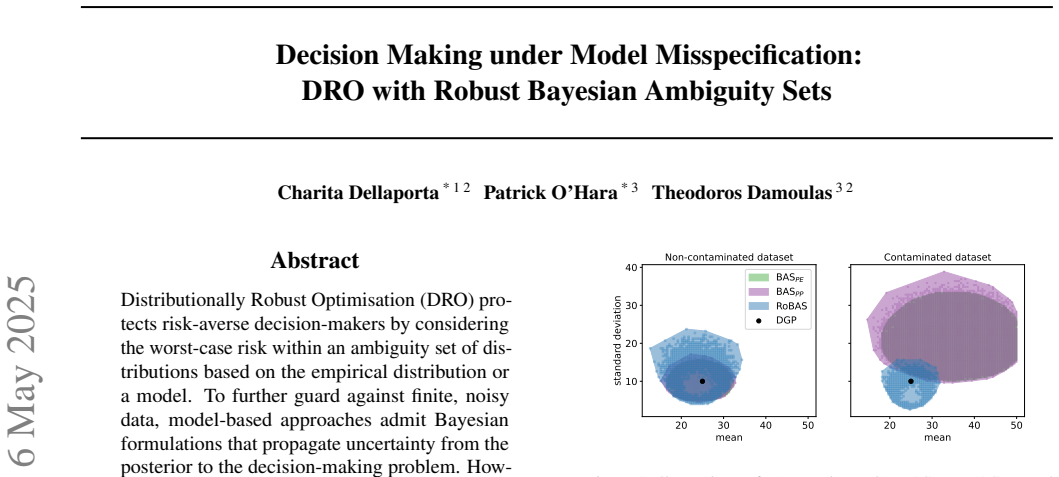
The load-bearing object is the pair formed by the NPL-MMD posterior predictive and the MMD ball. The predictive is $P^{\mathrm{NPL}}_{n} := E_{Q\sim \mathrm{DP}(\alpha', F')}[P_{\theta_k(Q)}]$, where $\theta_k(Q) := \arg\min_{\theta} D_k(Q, P_\theta)$ selects the model closest to a drawn DGP $Q$; the Dirichlet process prior states uncertainty directly about the DGP, and the push-forward posterior is sampled by the posterior bootstrap. The ambiguity set is $B_k^\epsilon(P) := \{P' : D_k(P', P) \le \epsilon\}$, where the MMD is a kernel-based metric on probability measures (zero only when the measures agree, for a characteristic kernel), so unlike KL balls it needs no absolute continuity. The argument runs through the mean embedding: with $C_\star := \{\mu \in \mathcal{H}_k : \|\mu - \mu_{P^{\mathrm{NPL}}_{n}}\|_k \le \epsilon\}$, the support function is $\delta^\star_{C_\star}(g) = E_{Q\sim\mathrm{DP}(\alpha',F')}\left[E_{\xi\sim P_{\theta_k(Q)}}[g(\xi)]\right] + \epsilon\|g\|_k$, and applying the kernel-DRO duality theorem turns the minimax problem into the minimization of $g_0 + \delta^\star_{C_\star}(g)$ over functions dominating $f_x$. The probabilistic tolerance guarantee is carried by a McDiarmid concentration bound on $E_{Q\sim\mathrm{DP}}[D_k(P_\star, Q)]$, which yields the radius constant $C_{n,M,\alpha}$ with rate $1/\sqrt{n}$.
What would settle it
Run repeated trials of a misspecified problem (say, a unimodal Gaussian model with a bimodal Gaussian DGP) and compare the two sides of Corollary 3.8: set $\epsilon = C_{n,M,\alpha} + \inf_\theta D_k(P_\theta, P_\star)$ and check whether the realized out-of-sample cost $E_{\xi\sim P_\star}[f_{x^\star}(\xi)]$ at the RoBAS decision exceeds $\sup_{P \in B_k^\epsilon(\hat{P}^{\mathrm{NPL}}_{n})} E_{\xi\sim P}[f_{x^\star}(\xi)]$ more often than the claimed rate $\delta$. A sharper test of Theorem 3.6 is to measure $D_k(P_\star, \hat{P}^{\mathrm{NPL}}_{n}) - \inf_\theta D_k(P_\theta, P_\star)$ as $n$ grows: if it does not decay at the claimed $1/\sqrt{n}$ rate, or if it levels off at a positive floor under bounded kernels and light-tailed DGPs, the concentration result that anchors the whole method is wrong.
Extended reading notes
Core claim
The central claim is that the NPL-MMD posterior predictive, $\hat{P}^{\mathrm{NPL}}_{n}$, inherits robustness from both its construction and its metric, so the MMD ball around it — the RoBAS ambiguity set — contains the DGP at a radius that scales with the minimal misspecification gap rather than with the posterior's sensitivity to outliers. Theorem 3.6 states that with probability at least $1-\delta$, $D_k(P_\star, \hat{P}^{\mathrm{NPL}}_{n}) \le \inf_{\theta\in\Theta} D_k(P_\theta, P_\star) + C_{n,M,\alpha}$, where $C_{n,M,\alpha}$ decays as $1/\sqrt{n}$ and is fully known given the kernel bound $M$. Corollary 3.8 then gives the tolerance guarantee: for $\epsilon \ge C_{n,M,\alpha} + \inf_{\theta} D_k(P_\theta, P_\star)$, the true expected cost is bounded above by the worst-case expectation over the set, $E_{\xi\sim P_\star}[f_x(\xi)] \le \sup_{P \in B_k^\epsilon(\hat{P}^{\mathrm{NPL}}_{n})} E_{\xi\sim P}[f_x(\xi)]$, with probability at least $1-\delta$. In the Huber contamination model the required gap is only $4\eta + 2C_{n,M,\alpha}$ (Corollary 3.9). Computationally, the set is a ball in the kernel mean embedding space, and its support function evaluates to $E_{Q\sim\mathrm{DP}(\alpha',F')}\left[E_{\xi\sim P_{\theta_k(Q)}}[g(\xi)]\right] + \epsilon\|g\|_k$, which converts the minimax problem into a finite-dimensional kernel optimization via the kernel-DRO duality theorem and the representer theorem.
Load-bearing premise
The radius guarantee only gives a high-probability bound if the decision maker knows or can closely approximate the misspecification gap $\inf_{\theta\in\Theta} D_k(P_\theta, P_\star)$ — precisely the unknown quantity the method is designed to be robust against — and the paper does not provide an estimator or data-dependent construction for it (Remark 3.7 only asks that it be 'reasonably approximated').
Editorial extensions
If this is right
- Setting $\epsilon = C_{n,M,\alpha} + \inf_\theta D_k(P_\theta, P_\star)$ yields a decision whose true expected cost is, with probability at least $1-\delta$, no larger than the worst-case cost over the RoBAS set — so misspecification protection does not require an arbitrarily inflated ambiguity set (Corollary 3.8).
- Because the dual problem is a kernel optimization solvable by sampling plus the representer theorem, RoBAS applies to any model family, including likelihood-free models, where DRO-BAS-PE (exponential families only) and KL-based methods needing closed-form posteriors do not apply.
- Under Huber contamination the radius requirement grows only linearly in the contamination level ($4\eta + 2C_{n,M,\alpha}$), so mildly contaminated settings do not push decisions into extreme conservatism (Corollary 3.9).
- In the Newsvendor and Portfolio experiments, RoBAS delivers better out-of-sample mean-variance trade-offs than DRO-BAS and BDRO under moderate-to-high misspecification, while KL-based Bayesian DRO remains competitive in the well-specified regime.
- The duality and tolerance results are stated for a general posterior, so the RoBAS construction can be re-instantiated with other robust posteriors (generalized Bayesian inference, MMD-Bayes) without re-deriving the machinery.
Reading between the lines
- The missing estimator for $\inf_\theta D_k(P_\theta, P_\star)$ could be supplied in a follow-up: for instance, a nested bootstrap on the posterior bootstrap samples (or a resampling-based upper confidence bound on the MMD gap) plugged into Remark 3.7's 'reasonable approximation' would make the radius fully data-driven, at the price of extra concentration terms; the paper stops short of that.
- A testable corollary of Theorem 3.6 is that RoBAS's advantage over KL-based Bayesian DRO should widen as the gap between model and DGP widens: the baselines pay a radius that tracks posterior sensitivity, while RoBAS pays only the minimal MMD gap plus $C_{n,M,\alpha}$; re-running the Newsvendor experiments while sweeping a misspecification parameter would expose this scaling directly.
- Since $C_{n,M,\alpha}$ depends on the kernel bound $M$ and the gap depends on the kernel's resolving power, kernel choice is part of the trade-off, not a free hyperparameter: a wider-bandwidth kernel shrinks the gap but inflates the constant; tuning the bandwidth against both terms is a natural extension the paper leaves open.
- The appendix's identity $B_k^\epsilon(P^{\mathrm{NPL}}_{n}) \equiv A_k^{\epsilon^2 + v(\mathrm{DP})}$ suggests the expected-squared-MMD set carries an extra posterior-variance term $v(\mathrm{DP})$, so the RoBAS ball should be systematically less conservative than the expected-MMD set for the same nominal — an empirical comparison the paper does not report.
Signed reviews
Editorial analysis
A structured set of objections, weighed in public.
Referee Report
Summary. The paper proposes DRO-RoBAS, a distributionally robust optimization method whose ambiguity set is an MMD ball centered at the NPL-MMD posterior predictive, with the goal of mitigating model misspecification in Bayesian DRO. The authors derive a dual formulation in the RKHS using the kernel DRO duality theorem of Zhu et al. (2021), prove a finite-sample tolerance guarantee bounding the MMD between the data-generating process and the approximate posterior predictive by the model's irreducible MMD misspecification gap plus a concentration term, and provide an additional guarantee under Huber contamination. The method is evaluated on Newsvendor and Portfolio problems under various misspecification regimes, with comparisons against DRO-BAS, BDRO, and empirical MMD baselines.
Significance. If the claims hold, the paper makes a useful contribution by extending Bayesian DRO to settings where the parametric model is misspecified, a setting where standard Bayesian ambiguity sets can become overly conservative. The derivation is not circular: the tolerance guarantee is stated relative to the external misspecification gap inf_theta D_k(P_theta, P_star), and the dual formulation is a correct application of an existing kernel DRO duality theorem. The concentration analysis is a standard McDiarmid argument building on existing MMD posterior bootstrap results, and the experiments cover several misspecification regimes against relevant baselines. The paper also clearly identifies the computational costs and limitations of the method. The main weakness is that the central radius-selection guarantee is conditional on an unknown quantity that the paper does not operationalize, which undermines the practical actionability of the headline non-conservatism claim.
major comments (2)
- [Theorem 3.6, Remark 3.7, Corollary 3.8] The tolerance guarantee is not directly actionable: Corollary 3.8 requires choosing epsilon at least C_{n,M,alpha} + inf_{theta in Theta} D_k(P_theta, P_star), but inf_theta D_k(P_theta, P_star) is the unknown misspecification gap that the method is designed to be robust against. Remark 3.7 states that the gap must be 'reasonably approximated', yet no estimator, confidence bound, or data-dependent construction is provided. If the gap is underestimated, the containment guarantee and hence the upper bound on the true objective can fail; if it is overestimated, the ambiguity set is unnecessarily large and the advertised reduction in conservatism is lost. The experiments in Section 4 sweep epsilon as a free parameter, which sidesteps rather than resolves this issue. The paper should either provide an estimator for the gap with its own finite-sample guarantee, or reframe the contribution so that the radius selection problem is explicitly acknowledged as an open component.
- [Appendix A.2, Lemma A.2] The verification that ri(K_{C*}) is nonempty is incomplete. The proof states that 'it suffices to prove that K_{C*} is non-empty and convex', but this implication is not generally true in infinite-dimensional spaces, where a nonempty convex set can have empty relative interior. Since the dual formulation relies on Theorem 3.1 of Zhu et al. (2021), the paper should either prove directly that the MMD ball has nonempty relative interior in the relevant topology, or cite/verify a version of the duality theorem with weaker assumptions that are satisfied here.
minor comments (7)
- [Section 3.2] The text refers to the 'NLP-MMD posterior' in the paragraph before Assumption 3.4; this should be 'NPL-MMD posterior'.
- [Appendix B] The DGP specification for the contaminated Exponential case contains a duplicated and incomplete line: 'P⋆ train := (1−η)Exp(0.05) +ηN (100, 0.5) P⋆ train := (1−η)Exp(θ⋆) +ηN (µ,σ )'. This should be cleaned up.
- [Appendix B, Table 1 caption] The caption reads 'Average (standard derivation)solve time'; 'derivation' should be 'deviation'.
- [Figure 2] The legend entry 'Posterior' is ambiguous; it should be labelled 'standard posterior' to distinguish it from the NPL-MMD posterior shown in the same plot.
- [Appendix A.3] The concentration parameter of the DP prior is denoted alpha in the main text but c in Lemmas A.3 and A.4; the notation should be unified to avoid confusion.
- [Equation (17) and Theorem 3.6] The approximate DP in (17) uses a truncation level tau, but the concentration bound and the constant C_{n,M,alpha} do not explicitly depend on tau. The paper should state whether the bound is uniform in tau or clarify how tau is absorbed into the constant.
- [Abstract and Section 4] The abstract claims the method 'outperforms other Bayesian and empirical DRO approaches', but the experiments show that empirical MMD outperforms DRO-RoBAS in the multivariate bimodal case, and DRO-BAS formulations outperform DRO-RoBAS in the well-specified contamination case. The abstract should qualify the claim to match the paper's own conclusions.
Circularity Check
No significant circularity: the RoBAS derivation is self-contained, and the tolerance guarantee is conditional on an external misspecification gap rather than on the method's own fitted output.
full rationale
The paper's central derivation is not circular. The dual formulation in Corollary 3.3 follows from the external dual theorem of Zhu et al. (2021) applied to the MMD ball C*, with the support function computed directly from the definition of C* in Proposition 3.2 and Lemma A.1; no target result is assumed in the construction. The tolerance guarantee in Theorem 3.6 bounds D_k(P*, hat P^NPL_pred_n) by inf_theta D_k(P_theta,P*) plus a finite-sample constant, using a concentration lemma adapted from Dellaporta et al. (2022). That cited result is an independent published technical bound with stated assumptions (bounded kernel, DP approximation scheme) and does not assume the paper's intended conclusion, so the self-citation is legitimate support rather than circularity. The theorem is admittedly conditional on the unknown misspecification gap: Remark 3.7 states that 'if inf_{theta in Theta} D_k(P_theta, P_star) can be reasonably approximated, this result can be used to select the radius ensuring RoBAS includes P_star with high probability.' This is an actionability limitation, not a circular reduction, because the gap is an external property of the model family and DGP, not the output of the RoBAS optimization or a parameter fitted to the same prediction the paper claims. No equation in the paper is shown to be definitionally equivalent to its own conclusion, and no fitted input is renamed as a prediction. Accordingly, no circular step is identified; the paper's contribution remains substantive even though the guaranteed radius is not directly operationalizable without additional estimation of the misspecification gap.
Assumptions & free parameters
free parameters (3)
- epsilon (DRO radius) =
not fitted; swept over a grid in experiments
- kernel bandwidth h =
median heuristic on data
- DP concentration alpha =
alpha = 0 in experiments
assumptions (6)
- standard math Theorem 3.1 of Zhu et al. (2021), duality for kernel DRO
- domain assumption Bounded kernel (Assumption 3.5): |k(xi,xi')| <= M
- domain assumption Bounded sublevel sets for theta_k(Q) (Assumption 3.4)
- standard math Lemmas 6 and 11 of Dellaporta et al. (2022) bounding E[D(P_star, Pn)] and E[D(Pn, Q)]
- domain assumption DP posterior concentration (5) and approximate DP sampling (17)
- standard math McDiarmid's inequality
Cite this review
Pith. "Pith review of Decision Making under Model Misspecification: DRO with Robust Bayesian Ambiguity Sets." pith.science (2026). https://pith.science/paper/VVHOQMSB
@misc{pith2026250503585,
  author       = {Pith},
  title        = {Pith review of: Decision Making under Model Misspecification: DRO with Robust Bayesian Ambiguity Sets},
  year         = {2026},
  howpublished = {\url{https://pith.science/paper/VVHOQMSB}},
  note         = {Machine review of arXiv:2505.03585}
}
read the original abstract
Distributionally Robust Optimisation (DRO) protects risk-averse decision-makers by considering the worst-case risk within an ambiguity set of distributions based on the empirical distribution or a model. To further guard against finite, noisy data, model-based approaches admit Bayesian formulations that propagate uncertainty from the posterior to the decision-making problem. However, when the model is misspecified, the decision maker must stretch the ambiguity set to contain the data-generating process (DGP), leading to overly conservative decisions. We address this challenge by introducing DRO with Robust, to model misspecification, Bayesian Ambiguity Sets (DRO-RoBAS). These are Maximum Mean Discrepancy ambiguity sets centred at a robust posterior predictive distribution that incorporates beliefs about the DGP. We show that the resulting optimisation problem obtains a dual formulation in the Reproducing Kernel Hilbert Space and we give probabilistic guarantees on the tolerance level of the ambiguity set. Our method outperforms other Bayesian and empirical DRO approaches in out-of-sample performance on the Newsvendor and Portfolio problems with various cases of model misspecification.
Figures


Figures from the paper (2 more)


Reference graph
Works this paper leans on
-
[1]
write newline
" write newline "" before.all 'output.state := FUNCTION n.dashify 't := "" t empty not t #1 #1 substring "-" = t #1 #2 substring "--" = not "--" * t #2 global.max substring 't := t #1 #1 substring "-" = "-" * t #2 global.max substring 't := while if t #1 #1 substring * t #2 global.max substring 't := if while FUNCTION format.date year duplicate empty "emp...
-
[2]
Alquier, P. and Gerber, M. Universal robust regression via maximum mean discrepancy. Biometrika, 111 0 (1): 0 71--92, 2024
work page 2024
-
[3]
Robust and conjugate G aussian process regression
Altamirano, M., Briol, F.-X., and Knoblauch, J. Robust and conjugate G aussian process regression. arXiv preprint arXiv:2311.00463, 2023
arXiv 2023
-
[4]
Sharp analysis of low-rank kernel matrix approximations
Bach, F. Sharp analysis of low-rank kernel matrix approximations. In Conference on learning theory, pp.\ 185--209. PMLR, 2013
2013
-
[5]
G., Holmes, C
Bissiri, P. G., Holmes, C. C., and Walker, S. G. A general framework for updating belief distributions. Journal of the Royal Statistical Society: Series B (Statistical Methodology), 78 0 (5): 0 1103--1130, 2016
2016
-
[6]
Parametric distributionally robust optimisation models for resource and inventory planning problems
Black, B. Parametric distributionally robust optimisation models for resource and inventory planning problems. Lancaster University (United Kingdom), 2022
work page 2022
-
[7]
Briol, F.-X., Barp, A., Duncan, A. B., and Girolami, M. Statistical inference for generative models with maximum mean discrepancy. arXiv preprint arXiv:1906.05944, 2019
arXiv 1906
-
[8]
Distributionally robust decision making leveraging conditional distributions
Chen, Y., Kim, J., and Anderson, J. Distributionally robust decision making leveraging conditional distributions. In 2022 IEEE 61st Conference on Decision and Control (CDC), pp.\ 5652--5659. IEEE, 2022
work page 2022
Show all 44 references
-
[9]
and Alquier, P
Ch \'e rief-Abdellatif, B.-E. and Alquier, P. MMD - B ayes: Robust B ayesian estimation via maximum mean discrepancy. In Symposium on Advances in Approximate Bayesian Inference, pp.\ 1--21. PMLR, 2020
2020
-
[10]
and Alquier, P
Ch \'e rief-Abdellatif, B.-E. and Alquier, P. Finite sample properties of parametric MMD estimation: robustness to misspecification and dependence. Bernoulli, 28 0 (1): 0 181--213, 2022
2022
-
[11]
Robust B ayesian inference for simulator-based models via the MMD posterior bootstrap
Dellaporta, C., Knoblauch, J., Damoulas, T., and Briol, F.-X. Robust B ayesian inference for simulator-based models via the MMD posterior bootstrap. In International Conference on Artificial Intelligence and Statistics, pp.\ 943--970. PMLR, 2022
2022
-
[12]
Decision making under the exponential family: Distributionally robust optimisation with bayesian ambiguity sets
Dellaporta, C., O'Hara, P., and Damoulas, T. Decision making under the exponential family: Distributionally robust optimisation with bayesian ambiguity sets. arXiv preprint arXiv:2411.16829, 2024
2024 arXiv
-
[13]
Scalable nonparametric sampling from multimodal posteriors with the posterior bootstrap
Fong, E., Lyddon, S., and Holmes, C. Scalable nonparametric sampling from multimodal posteriors with the posterior bootstrap. In International Conference on Machine Learning, pp.\ 1952--1962. PMLR, 2019
1952
-
[14]
and Kleywegt, A
Gao, R. and Kleywegt, A. Distributionally robust stochastic optimization with W asserstein distance. Mathematics of Operations Research, 48 0 (2): 0 603--655, 2023
2023
-
[15]
and Basu, A
Ghosh, A. and Basu, A. Robust B ayes estimation using the density power divergence. Annals of the Institute of Statistical Mathematics, 68: 0 413--437, 2016
2016
-
[16]
M., Rasch, M
Gretton, A., Borgwardt, K. M., Rasch, M. J., Sch \"o lkopf, B., and Smola, A. A kernel two-sample test. The Journal of Machine Learning Research, 13 0 (1): 0 723--773, 2012
2012
-
[17]
The safe B ayesian: learning the learning rate via the mixability gap
Gr \"u nwald, P. The safe B ayesian: learning the learning rate via the mixability gap. In International Conference on Algorithmic Learning Theory, pp.\ 169--183. Springer, 2012
2012
-
[18]
and Hong, L
Hu, Z. and Hong, L. J. Kullback- L eibler divergence constrained distributionally robust optimization. Available at Optimization Online, 1 0 (2): 0 9, 2013
2013
-
[19]
Huber, P. J. Robust estimation of a location parameter. In Breakthroughs in statistics: Methodology and distribution, pp.\ 492--518. Springer, 1992
1992
-
[20]
Husain, H., Nguyen, V., and Hengel, A. v. d. Distributionally robust B ayesian optimization with -divergences. arXiv preprint arXiv:2203.02128, 2022
2022 arXiv
-
[21]
Hedging against complexity: D istributionally robust optimization with parametric approximation
Iyengar, G., Lam, H., and Wang, T. Hedging against complexity: D istributionally robust optimization with parametric approximation. In International Conference on Artificial Intelligence and Statistics, pp.\ 9976--10011. PMLR, 2023
2023
-
[22]
Q., and Holmes, C
Jewson, J., Smith, J. Q., and Holmes, C. Principles of B ayesian inference using general divergence criteria. Entropy, 20 0 (6): 0 442, 2018
2018
-
[23]
Kingma, D. P. Adam: A method for stochastic optimization. arXiv preprint arXiv:1412.6980, 2014
2014 arXiv
-
[24]
An optimization-centric view on B ayes' rule: Reviewing and generalizing variational inference
Knoblauch, J., Jewson, J., and Damoulas, T. An optimization-centric view on B ayes' rule: Reviewing and generalizing variational inference. Journal of Machine Learning Research, 23 0 (132): 0 1--109, 2022
2022
-
[25]
M., Nguyen, V
Kuhn, D., Esfahani, P. M., Nguyen, V. A., and Shafieezadeh-Abadeh, S. Wasserstein distributionally robust optimization: Theory and applications in machine learning. In Operations Research & Management Science in the Age of Analytics, chapter 6, pp.\ 130--166. Informs, 2019. do...
2019
-
[26]
Li, J. Y. and Kwon, R. H. Portfolio selection under model uncertainty: a penalized moment-based optimization approach. Journal of Global Optimization, 56: 0 131--164, 2013
2013
-
[27]
Towards out-of-distribution generalization: A survey
Liu, J., Shen, Z., He, Y., Zhang, X., Xu, R., Yu, H., and Cui, P. Towards out-of-distribution generalization: A survey. arXiv preprint arXiv:2108.13624, 2021
2021 arXiv
-
[28]
Lyddon, S., Walker, S., and Holmes, C. C. Nonparametric learning from B ayesian models with randomized objective functions. Advances in neural information processing systems, 31, 2018
2018
-
[29]
Matsubara, T., Knoblauch, J., Briol, F.-X., and Oates, C. J. Robust generalised B ayesian inference for intractable likelihoods. Journal of the Royal Statistical Society Series B: Statistical Methodology, 84 0 (3): 0 997--1022, 2022
2022
-
[30]
McDiarmid, C. et al. On the method of bounded differences. Surveys in combinatorics, 141 0 (1): 0 148--188, 1989
1989
-
[31]
Modeling the second player in distributionally robust optimization
Michel, P., Hashimoto, T., and Neubig, G. Modeling the second player in distributionally robust optimization. arXiv preprint arXiv:2103.10282, 2021
2021 arXiv
-
[32]
Distributionally robust models with parametric likelihood ratios
Michel, P., Hashimoto, T., and Neubig, G. Distributionally robust models with parametric likelihood ratios. arXiv preprint arXiv:2204.06340, 2022
2022 arXiv
-
[33]
Integral probability metrics and their generating classes of functions
M \"u ller, A. Integral probability metrics and their generating classes of functions. Advances in applied probability, 29 0 (2): 0 429--443, 1997
1997
-
[34]
Porteus, E. L. Stochastic inventory theory. Handbooks in operations research and management science, 2: 0 605--652, 1990
1990
-
[35]
and Recht, B
Rahimi, A. and Recht, B. Random features for large-scale kernel machines. Advances in neural information processing systems, 20, 2007
2007
-
[36]
and Mehrotra, S
Rahimian, H. and Mehrotra, S. Distributionally robust optimization: A review. arXiv preprint arXiv:1908.05659, 2019
1908 arXiv
-
[37]
R., and Abate, A
Romao, L., Hota, A. R., and Abate, A. Distributionally robust optimal and safe control of stochastic systems via kernel conditional mean embedding. In 2023 62nd IEEE Conference on Decision and Control (CDC), pp.\ 2016--2021. IEEE, 2023
2023
-
[38]
Bayesian distributionally robust optimization
Shapiro, A., Zhou, E., and Lin, Y. Bayesian distributionally robust optimization. SIAM Journal on Optimization, 33 0 (2): 0 1279--1304, 2023
2023
-
[39]
and Jegelka, S
Staib, M. and Jegelka, S. Distributionally robust optimization and generalization in kernel methods. Advances in Neural Information Processing Systems, 32, 2019
2019
-
[40]
G., R \"u ckmann, J.-J., Stein, O., and Still, G
V \'a zquez, F. G., R \"u ckmann, J.-J., Stein, O., and Still, G. Generalized semi-infinite programming: a tutorial. Journal of computational and applied mathematics, 217 0 (2): 0 394--419, 2008
2008
-
[41]
Walker, S. G. Bayesian inference with misspecified models. Journal of statistical planning and inference, 143 0 (10): 0 1621--1633, 2013
2013
-
[42]
Learning against distributional uncertainty: On the trade-off between robustness and specificity
Wang, S., Wang, H., and Honorio, J. Learning against distributional uncertainty: On the trade-off between robustness and specificity. arXiv preprint arXiv:2301.13565, 2023
2023 arXiv
-
[43]
Coping with label shift via distributionally robust optimisation
Zhang, J., Menon, A., Veit, A., Bhojanapalli, S., Kumar, S., and Sra, S. Coping with label shift via distributionally robust optimisation. arXiv preprint arXiv:2010.12230, 2020
2010 arXiv
-
[44]
Kernel distributionally robust optimization: G eneralized duality theorem and stochastic approximation
Zhu, J.-J., Jitkrittum, W., Diehl, M., and Sch \"o lkopf, B. Kernel distributionally robust optimization: G eneralized duality theorem and stochastic approximation. In International Conference on Artificial Intelligence and Statistics, pp.\ 280--288. PMLR, 2021
2021
Reviewed August 15, 2026 · model on record in the stance chip above.
Discussion (0). Continue with ORCID to comment.