REVIEW 2 major objections 6 minor 1 cited by
Enhancing PySCF-based Quantum Chemistry Simulations with Modern Hardware, Algorithms, and Python Tools
T0 review · 2 major / 6 minor · reviewed 2026-08-07 · deepseek-v4-flash
Pith's one-line read This paper shows that careful choices of hardware, initial guesses, SCF solvers, integral approximations, and Python tools can make PySCF-based quantum chemistry simulations substantially faster and easier to develop.
desk verdict Solid PySCF guide with two small reproducible artifacts; the main new numerical result — ETG auxiliary basis optimization — is validated only against its own proxy objective and needs an SCF-level check before publication. read the letter →
The pith
A machine-rendered reading of the paper's core claim, the machinery that carries it, and where it could break.
The reading
What carries the argument
The workhorse identity is the density-fitting approximation, $(\mu\nu|\kappa\lambda)\approx\sum_P T_{P,\mu\nu}T_{P,\kappa\lambda}$ with $T_{P,\mu\nu}=\sum_Q (L^{-1})_{PQ}(\chi_Q|\mu\nu)$, which replaces four-center integrals with three-index tensors. This same approximation does double duty: it provides the cheap orbital Hessian that makes the exact second-order SCF solver (the co-iterative augmented Hessian method) nearly free to run, and its residual, $\sigma_{\mu\nu}=(\mu\nu|\mu\nu)-\sum_{P,Q}(\chi_P|\mu\nu)(M^{-1})_{PQ}(\chi_Q|\mu\nu)$, is the least-squares objective used to optimize even-tempered auxiliary Gaussian exponents with automatic differentiation. Two further devices carry the performance claims: the multigrid integration algorithm, which exploits Gaussian-basis locality on uniform grids and is used with pseudo-potentials and with SOSCF approximate Hessians, and long-range density fitting, which splits the Coulomb potential so that only the long-range part needs an auxiliary basis, shrinking it to roughly one-tenth the size of the orbital basis. JIT compilation and automatic differentiation serve as the productivity machinery, turning short Python functions into SIMD-vectorized code and exposing analytic gradients for new method parameters.
What would settle it
Converge SOSCF with exact and density-fitted Hessians on a set of, say, 20 open-shell transition-metal and dissociated systems and compare iteration counts to a fixed gradient threshold; if approximate-Hessian runs systematically need more than a couple of extra iterations, the 'essentially identical' claim fails. Also compute SCF total-energy errors with the ETG III auxiliary set for Fe/def2-TZVP; if the energy error is far larger than the 0.139 Hartree diagonal-integral error suggests, the proxy used for exponent optimization is misleading.
Extended reading notes
Core claim
The paper's central claim is that the practical performance of a PySCF calculation is largely a matter of technique choice, not a fixed property of the package. Its strongest evidence is that SOSCF converges at essentially the same speed whether the orbital Hessian is exact or approximated by density-fitted integrals, while the total energy and gradients stay exact; and that an even-tempered auxiliary basis reduced to nearly half its functions (the ETG III set) keeps the density-fitting error relatively small. Around these results the paper assembles a set of working recipes: spin-polarized and basis-projected initial guesses for difficult mean-field and active-space problems, TDDFT-based guesses for excited-state methods, multigrid integration for exchange-correlation terms, long-range density fitting for the Coulomb interaction, and GPU kernels for the heavy integral work. The stated purpose is to close the documentation gap between PySCF's conservative defaults and the faster paths that its modules and extensions make available.
Load-bearing premise
The load-bearing premise is that minimizing the least-squares error of the diagonal density-fitted integrals of Eq. (23) is a reliable proxy for how good an auxiliary basis actually is; the paper validates only that proxy, not its effect on SCF energies, gradients, or post-Hartree-Fock properties.
Editorial extensions
If this is right
- GPU4PySCF can deliver two to three orders of magnitude speedup over CPU for medium-sized DFT calculations with density fitting, and can handle molecules with more than 10,000 basis functions using on-the-fly integral evaluation.
- For hard SCF cases, running DIIS first and switching to SOSCF converges where DIIS alone struggles, and approximating the orbital Hessian with density fitting does not slow the convergence.
- Multigrid integration accelerates exchange-correlation integration for pseudo-potential and periodic calculations, and can be combined with SOSCF to build an approximate Hessian cheaply.
- The optimized even-tempered auxiliary basis sets show that cutting the auxiliary basis by nearly half keeps density-fitting error relatively small, with optimal ratios around 2.0-2.2 and larger ratios needed for the smaller sets.
- JIT compilation and automatic differentiation make it possible to add new integrals and derivative-based optimizations in a few lines of Python, shortening the path from idea to working simulation.
Reading between the lines
- A natural next test, not performed in the paper, is whether the optimized ETG exponents actually improve or preserve SCF energies, gradients, and post-Hartree-Fock properties; the paper only measures the diagonal-integral proxy.
- The 'essentially identical' SOSCF convergence claim rests on one iron-sulfur test system; a broader benchmark across open-shell, near-degenerate, and dissociated molecules would show how general the behavior is.
- The same least-squares-plus-automatic-differentiation recipe could be applied to other method parameters, for example range-separation parameters or orbital-basis exponents, not just auxiliary-basis exponents.
- The pattern of pairing JIT compilation with PySCF's low-level integral APIs suggests a general prototyping style for any new integral or property, but the paper's example is limited to absolute-value overlap integrals, so the generality is an extrapolation.
Editorial analysis
A structured set of objections, weighed in public.
Referee Report
Summary. The paper is a practical guide to accelerating PySCF-based quantum chemistry simulations. It reviews the PySCF ecosystem, describes GPU4PySCF acceleration with speedups cited from prior work, demonstrates initial-guess manipulation for mean-field, post-Hartree-Fock, and excited-state methods, explains SOSCF convergence with exact and density-fitted approximate orbital Hessians, discusses multigrid integration and density fitting including long-range DF, and shows how Numba JIT and PySCFAD can be combined with PySCF. The two numerical tables concern density-fitting auxiliary basis sets on an Fe atom: Table I compares DF diagonal-integral errors for several automatic auxiliary-basis schemes, and Table II reports optimized even-tempered auxiliary-basis parameters, with the claim that a roughly half-sized basis (ETG III) keeps the error relatively small.
Significance. If the strategies work as described, the paper will be a useful practical reference for PySCF users: it documents API ordering effects, gives concrete recipes for initial guesses, DF Hessians, multigrid integration, GPU4PySCF, Numba JIT, and PySCFAD, and the code examples are a strength. The ETG exponent optimization in Section V.B is a concrete, falsifiable demonstration of the automatic-differentiation toolchain. The GPU speedups are inherited from cited prior work rather than re-measured, which is acceptable for a guide. The main gap is that the new ETG recommendation is validated only through a diagonal fitting residual, not by actual DF-SCF or post-HF calculations, so the quantitative claim in Table II is not yet established.
major comments (2)
- [IV.C.2, Eqs. (23)-(24), Table II] The optimization objective in Eq. (23) and the error measure underlying Table II are diagonal density-fitting residuals. The objective minimizes the squared diagonal error sigma_mu_nu, but the quantities that matter in an SCF calculation, especially the exchange matrix K_mu_nu = sum_{kappa lambda} P_{kappa lambda} (mu kappa | nu lambda), depend on off-diagonal fitting errors. A basis tuned to diagonal matrix elements can therefore be poor for exchange even when Table II's residual is small. The paper itself notes in Section IV.C.2 that the built-in ETG basis may lack large-exponent functions, a deficiency that a diagonal residual is unlikely to expose. In addition, the claim that ETG III leaves the error 'relatively small' is not quantified: the reported total error increases from 7.42e-3 (built-in) to 0.139 (ETG III), a factor of roughly 19. Please add validation against actual DF-SCF energies, or density-weighted fitting errors and gradients, for Fe/def2-TZVP and at least one molecular system, and report both absolute errors and a tolerance.
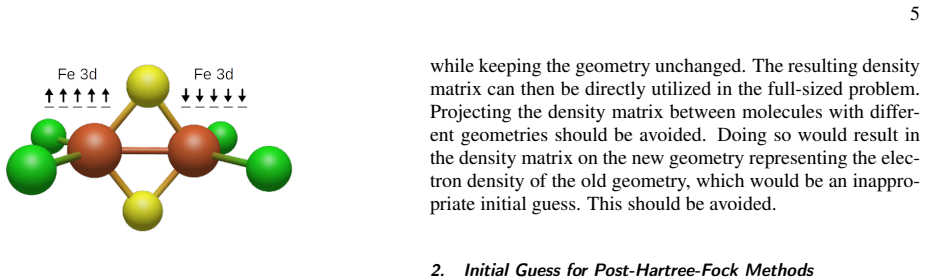
- [IV.B, Fig. 2] Figure 2 compares standard SOSCF with SOSCF using a DF-approximate Hessian for a single system (Fe2S2Cl4, PBE0/def2-TZVP, def2-universal-jfit) and one initial-guess protocol. The sentence in Section IV.B that the two schemes are 'essentially identical' is stated without qualification, yet one trajectory is weak evidence for a general recommendation. Please either restrict the claim to the tested system or add two or three additional challenging systems, such as open-shell complexes with small HOMO-LUMO gaps, and report iteration counts and total wall time.
minor comments (6)
- [V.B] In the first PySCFAD code block, the line `mol.build(trace_ctr_coeff=False, trace_exp=True)` should operate on `auxmol`, not `mol`; as written the example does not initialize the auxiliary molecule's exponent trace and cannot run. Since the code examples are a central deliverable, please verify all snippets execute.
- [Eq. (25)] The Jacobian in Eq. (25) is written as partial sigma_{mu nu kappa lambda} / partial alpha_P; the subscript should be sigma_{mu nu} only.
- [IV.A.1] The projection example computes `dma_tz` and `dmb_tz` but then calls `mf.kernel(dm0=(dma, dmb))`; it should pass `dm0=(dma_tz, dmb_tz)`.
- [III] The speedup range for medium-sized molecules is quoted from refs 15 and 18 without hardware/software context or timing tables; a sentence clarifying that these are literature results rather than re-measured here would help the reader calibrate the guide.
- [IV.C.2, Table I] The 'total error' in Table I is a sum of diagonal residuals, not an energy error; please state the formula and units explicitly in the caption.
- [V.A] There are small textual errors, such as 'perfrom' for 'perform' in Section V.A and the garbled comment 'Assigin p a r a m t e r e s' in Section II.C; please clean up OCR-induced spacing and spelling.
Circularity Check
No significant circularity: the paper is a practical guide; the ETG Table II reports the optimized least-squares objective (a validation gap, not a circular prediction), and the load-bearing performance claims rest on in-paper benchmarks or externally checkable prior publications.
full rationale
This manuscript is a guide to PySCF usage rather than a derivation of a new theoretical result. The ETG section does fit auxiliary-basis exponents by minimizing the diagonal least-squares residual of Eq. (23) and then reports that same residual as 'total error' in Table II; this is an in-sample validation gap (the proxy is not checked against SCF energies or gradients), but the paper does not rename the fit as an independent prediction, so it does not reduce to circularity under the stated rules. The SOSCF convergence claim ('essentially identical' with approximate DF Hessian) is supported by Figure 2 in the same paper and by the algorithm's original method reference; the sentence is not importing a uniqueness theorem or an unverified self-citation. GPU speedup statements cite the authors' prior peer-reviewed benchmarks (refs 15 and 18), which are externally checkable and therefore independent evidence. The remaining self-citations (e.g., refs 48, 55, 72) are about software implementation details and upcoming works, not load-bearing support for the paper's conclusions. No equation in the paper is equivalent to its own input by construction, and no 'prediction' is statistically forced by a fit.
Assumptions & free parameters
free parameters (3)
- Even-tempered auxiliary basis exponents for Fe/def2-TZVP (alpha_L,min and beta_L) =
e.g., beta_L ~2.0-2.2, alpha_min listed in Table II
- Number of Gauss-Hermite quadrature points (nroots) =
500
- Multigrid mesh size =
[105,105,105]
assumptions (3)
- standard math Gaussian product theorem and Gauss-Hermite quadrature are valid for the absolute overlap integral approximation.
- domain assumption The density fitting approximation (Eq. 1) is accurate enough for the target calculations.
- ad hoc to paper The diagonal integral error measure (Eq. 7) is a sufficient proxy for auxiliary basis quality.
Cite this review
Pith. "Pith review of Enhancing PySCF-based Quantum Chemistry Simulations with Modern Hardware, Algorithms, and Python Tools." pith.science (2026). https://pith.science/paper/VVIGWKF2
@misc{pith2026250606661,
  author       = {Pith},
  title        = {Pith review of: Enhancing PySCF-based Quantum Chemistry Simulations with Modern Hardware, Algorithms, and Python Tools},
  year         = {2026},
  howpublished = {\url{https://pith.science/paper/VVIGWKF2}},
  note         = {Machine review of arXiv:2506.06661}
}
read the original abstract
The PySCF package has emerged as a powerful and flexible open-source platform for quantum chemistry simulations. However, the efficiency of electronic structure calculations can vary significantly depending on the choice of computational techniques and hardware utilization. In this paper, we explore strategies to enhance research productivity and computational performance in PySCF-based simulations. First, we discuss GPU acceleration for selected PySCF modules. Second, we demonstrate algorithmic optimizations for particular computational tasks, such as the initial guess manipulation, the second-order self-consistent field (SOSCF) methods, multigrid integration, and density fitting approximation, to improve convergence rates and computational efficiency. Finally, we explore the use of modern Python tools, including just-in-time (JIT) compilation and automatic differentiation to accelerate code development and execution. These approaches present a practical guide for enhancing the use of PySCF's capabilities in quantum chemistry research.
Figures

Forward citations
Cited by 1 Pith paper
-
Analytical Excited-State Gradients and Derivative Couplings in TDDFT with Minimal Auxiliary Basis Set Approximation and GPU Acceleration
TDDFT-ris analytical gradients and derivative couplings are implemented and benchmarked; they give ~1.5–2.4x speedups but fail for near-degenerate excited-state couplings.
Reference graph
Works this paper leans on
-
[1]
Sun , author X
author author Q. Sun , author X. Zhang , author S. Banerjee , author P. Bao , author M. Barbry , author N. S. \ Blunt , author N. A. \ Bogdanov , author G. H. \ Booth , author J. Chen , author Z.-H. \ Cui , author J. J. \ Eriksen , author Y. Gao , author S. Guo , author J. Hermann , author M. R. \ Hermes , author K. Koh , author P. Koval , author S. Lehto...
-
[2]
author author D. G. A. \ Smith , author L. A. \ Burns , author D. A. \ Sirianni , author D. R. \ Nascimento , author A. Kumar , author A. M. \ James , author J. B. \ Schriber , author T. Zhang , author B. Zhang , author A. S. \ Abbott , author E. J. \ Berquist , author M. H. \ Lechner , author L. A. \ Cunha , author A. G. \ Heide , author J. M. \ Waldrop ...
-
[3]
author author K. Boguslawski , author A. Leszczyk , author A. Nowak , author F. Brzęk , author P. S. \ Żuchowski , author D. Kędziera , \ and\ author P. Tecmer ,\ title title Pythonic black-box electronic structure tool (pybest). an open-source python platform for electronic structure calculations at the interface between chemistry and physics , \ https:/...
work page 2021
-
[4]
author author G. Hermann , author V. Pohl , author J. C. \ Tremblay , author B. Paulus , author H.-C. \ Hege , \ and\ author A. Schild ,\ title title Orbkit: A modular python toolbox for cross-platform postprocessing of quantum chemical wavefunction data , \ https://doi.org/10.1002/jcc.24358 journal journal J. Comput. Chem. \ volume 37 ,\ pages 1511--1520...
-
[5]
author author J. Gao , author L. Fu , author S. Jiao , author Z. Zhang , author S. Chen , author Z. Zhang , author W. Wu , author L. Wan , author J. Li , author W. Hu , \ and\ author J. Yang ,\ title title Pypwdft: A lightweight python software for single-node 10k atom plane-wave density functional theory calculations , \ 10.1021/acs.jctc.4c01605 journal ...
-
[6]
author author F. A. \ Evangelista , author C. Li , author P. Verma , author K. P. \ Hannon , author J. B. \ Schriber , author T. Zhang , author C. Cai , author S. Wang , author N. He , author N. H. \ Stair , author M. Huang , author R. Huang , author J. P. \ Misiewicz , author S. Li , author K. Marin , author Z. Zhao , \ and\ author L. A. \ Burns ,\ title...
-
[7]
author author M. Chan , author T. Verstraelen , author A. Tehrani , author M. Richer , author X. D. \ Yang , author T. D. \ Kim , author E. Vöhringer-Martinez , author F. Heidar-Zadeh , \ and\ author P. W. \ Ayers ,\ title title The tale of horton: Lessons learned in a decade of scientific software development , \ https://doi.org/10.1063/5.0196638 journal...
-
[8]
author author E. Posenitskiy , author V. G. \ Chilkuri , author A. Ammar , author M. Hapka , author K. Pernal , author R. Shinde , author E. J. \ Landinez Borda , author C. Filippi , author K. Nakano , author O. Kohulák , author S. Sorella , author P. de Oliveira Castro , author W. Jalby , author P. L. \ Ríos , author A. Alavi , \ and\ author A. Scemama ,...
Show all 73 references
-
[9]
Zhang \ and\ author G
author author X. Zhang \ and\ author G. K.-L. \ Chan ,\ title title Differentiable quantum chemistry with pyscf for molecules and materials at the mean-field level and beyond , \ https://doi.org/10.1063/5.0118200 journal journal J. Chem. Phys. \ volume 157 ,\ pages 204801 ( ye...
-
[10]
author author M. F. \ Kasim , author S. Lehtola , \ and\ author S. M. \ Vinko ,\ title title Dqc: A python program package for differentiable quantum chemistry , \ https://doi.org/10.1063/5.0076202 journal journal J. Chem. Phys. \ volume 156 ,\ pages 084801 ( year 2022 ) NoStop
-
[11]
author author O. D. \ Matteo , author J. Izaac , author T. R. \ Bromley , author A. Hayes , author C. Lee , author M. Schuld , author A. Sz\' a va , author C. Roberts , \ and\ author N. Killoran ,\ title title Quantum computing with differentiable quantum transforms , \ 10.114...
-
[12]
Zhou , author B
author author G. Zhou , author B. Nebgen , author N. Lubbers , author W. Malone , author A. M. N. \ Niklasson , \ and\ author S. Tretiak ,\ title title Graphics processing unit-accelerated semiempirical born oppenheimer molecular dynamics using pytorch , \ 10.1021/acs.jctc.0c0...
-
[13]
author author A. S. \ Abbott , author B. Z. \ Abbott , author J. M. \ Turney , \ and\ author H. F. I. I. I. \ Schaefer ,\ title title Arbitrary-order derivatives of quantum chemical methods via automatic differentiation , \ 10.1021/acs.jpclett.1c00607 journal journal J. Phys. ...
-
[14]
Friede , author C
author author M. Friede , author C. Hölzer , author S. Ehlert , \ and\ author S. Grimme ,\ title title dxtb--an efficient and fully differentiable framework for extended tight-binding , \ https://doi.org/10.1063/5.0216715 journal journal J. Chem. Phys. \ volume 161 ,\ pages 06...
-
[15]
Wu , author Q
author author X. Wu , author Q. Sun , author Z. Pu , author T. Zheng , author W. Ma , author W. Yan , author Y. Xia , author Z. Wu , author M. Huo , author X. Li , author W. Ren , author S. Gong , author Y. Zhang , \ and\ author W. Gao ,\ title title Enhancing gpu-acceleration...
-
[16]
Kim , author D
author author I. Kim , author D. Jeong , author L. P. \ Weisburn , author A. Alexiu , author T. Van Voorhis , author Y. M. \ Rhee , author W.-J. \ Son , author H.-J. \ Kim , author J. Yim , author S. Kim , author Y. Cho , author I. Jang , author S. Lee , \ and\ author D. S. \ ...
-
[17]
Tornai , author I
author author G. Tornai , author I. Ladj\'anszki , author A. R\'ak , author G. Kis , \ and\ author G. Cserey ,\ title title Calculation of quantum chemical two-electron integrals by applying compiler technology on gpu , \ 10.1021/acs.jctc.9b00560 journal journal J. Chem. Theor...
-
[18]
Li , author Q
author author R. Li , author Q. Sun , author X. Zhang , \ and\ author G. K.-L. \ Chan ,\ title title Introducing gpu acceleration into the python-based simulations of chemistry framework , \ 10.1021/acs.jpca.4c05876 journal journal J. Phys. Chem. A \ volume 129 ,\ pages 1459--...
-
[19]
Vallejo , author L
author author G. Vallejo , author L. Jorge , author C. Snowdon , author R. Stocks , author F. Kazemian , author F. C. \ Yan Yu , author C. Seidl , author Z. Seeger , author M. Alkan , author D. Poole , author B. M. \ Westheimer , author M. Basha , author M. De La Pierre , auth...
-
[20]
Seritan , author C
author author S. Seritan , author C. Bannwarth , author B. S. \ Fales , author E. G. \ Hohenstein , author C. M. \ Isborn , author S. I. L. \ Kokkila-Schumacher , author X. Li , author F. Liu , author N. Luehr , author J. W. \ Snyder Jr. , author C. Song , author A. V. \ Titov...
-
[21]
Poole , author J
author author D. Poole , author J. L. \ Galvez Vallejo , \ and\ author M. S. \ Gordon ,\ title title A new kid on the block: Application of julia to hartree-fock calculations , \ 10.1021/acs.jctc.0c00337 journal journal J. Chem. Theory Comput. \ volume 16 ,\ pages 5006--5013 (...
-
[22]
author author G. J. R. \ Aroeira , author M. M. \ Davis , author J. M. \ Turney , \ and\ author H. F. I. I. I. \ Schaefer ,\ title title Fermi.jl: A modern design for quantum chemistry , \ 10.1021/acs.jctc.1c00719 journal journal J. Chem. Theory Comput. \ volume 18 ,\ pages 67...
-
[23]
Wang \ and\ author J
author author W. Wang \ and\ author J. D. \ Whitfield ,\ title title Basis set generation and optimization in the nisq era with quiqbox.jl , \ 10.1021/acs.jctc.3c00011 journal journal J. Chem. Theory Comput. \ volume 19 ,\ pages 8032--8052 ( year 2023 ) NoStop
-
[24]
Wang , author Z
author author Y. Wang , author Z. Lin , author R. Ouyang , author B. Jiang , author I. Y. \ Zhang , \ and\ author X. Xu ,\ title title Toward efficient and unified treatment of static and dynamic correlations in generalized kohn-sham density functional theory , \ 10.1021/jacsa...
-
[25]
Neese , author F
author author F. Neese , author F. Wennmohs , author U. Becker , \ and\ author C. Riplinger ,\ title title The orca quantum chemistry program package , \ https://doi.org/10.1063/5.0004608 journal journal J. Chem. Phys. \ volume 152 ,\ pages 224108 ( year 2020 ) NoStop
-
[26]
Peng , author C
author author C. Peng , author C. A. \ Lewis , author X. Wang , author M. C. \ Clement , author K. Pierce , author V. Rishi , author F. Pavošević , author S. Slattery , author J. Zhang , author N. Teke , author A. Kumar , author C. Masteran , author A. Asadchev , author J. A. ...
-
[27]
author author D. G. A. \ Smith , author L. A. \ Burns , author A. C. \ Simmonett , author R. M. \ Parrish , author M. C. \ Schieber , author R. Galvelis , author P. Kraus , author H. Kruse , author R. Di Remigio , author A. Alenaizan , author A. M. \ James , author S. Lehtola ...
-
[28]
author author T. Shiozaki ,\ title title Bagel: Brilliantly advanced general electronic-structure library , \ https://doi.org/10.1002/wcms.1331 journal journal WIREs Comput Mol Sci \ volume 8 ,\ pages e1331 ( year 2018 ) NoStop
2018 doi
-
[29]
author author D. B. \ Williams-Young , author A. Petrone , author S. Sun , author T. F. \ Stetina , author P. Lestrange , author C. E. \ Hoyer , author D. R. \ Nascimento , author L. Koulias , author A. Wildman , author J. Kasper , author J. J. \ Goings , author F. Ding , auth...
-
[30]
author author P. O. \ Dral ,\ title title Quantum chemistry in the age of machine learning , \ 10.1021/acs.jpclett.9b03664 journal journal J. Phys. Chem. Lett. \ volume 11 ,\ pages 2336--2347 ( year 2020 ) NoStop
2020 doi
-
[31]
Gong , author Y
author author S. Gong , author Y. Zhang , author Z. Mu , author Z. Pu , author H. Wang , author X. Han , author Z. Yu , author M. Chen , author T. Zheng , author Z. Wang , author L. Chen , author Z. Yang , author X. Wu , author S. Shi , author W. Gao , author W. Yan , \ and\ a...
-
[32]
Chen , author W
author author Y. Chen , author W. Yan , author Z. Wang , author J. Wu , \ and\ author X. Xu ,\ title title Constructing accurate and efficient general-purpose atomistic machine learning model with transferable accuracy for quantum chemistry , \ 10.1021/acs.jctc.4c01151 journal...
-
[33]
Khan , author A
author author D. Khan , author A. J. A. \ Price , author B. Huang , author M. L. \ Ach , \ and\ author O. A. \ von Lilienfeld ,\ title title Adapting hybrid density functionals with machine learning , \ 10.1126/sciadv.adt7769 journal journal Science Advances \ volume 11 ,\ pag...
-
[34]
Wu , author S.-M
author author J. Wu , author S.-M. \ Pun , author X. Zheng , \ and\ author G. Chen ,\ title title Construct exchange-correlation functional via machine learning , \ https://doi.org/10.1063/5.0150587 journal journal J. Chem. Phys. \ volume 159 ,\ pages 090901 ( year 2023 ) NoStop
-
[35]
Kirkpatrick , author B
author author J. Kirkpatrick , author B. McMorrow , author D. H. P. \ Turban , author A. L. \ Gaunt , author J. S. \ Spencer , author A. G. D. G. \ Matthews , author A. Obika , author L. Thiry , author M. Fortunato , author D. Pfau , author L. R. \ Castellanos , author S. Pete...
-
[36]
Li , author S
author author L. Li , author S. Hoyer , author R. Pederson , author R. Sun , author E. D. \ Cubuk , author P. Riley , \ and\ author K. Burke ,\ title title Kohn-sham equations as regularizer: Building prior knowledge into machine-learned physics , \ https://link.aps.org/doi/10...
-
[37]
author author M. F. \ Kasim \ and\ author S. M. \ Vinko ,\ title title Learning the exchange-correlation functional from nature with fully differentiable density functional theory , \ https://link.aps.org/doi/10.1103/PhysRevLett.127.126403 journal journal Phys. Rev. Lett. \ vo...
-
[38]
Sun , author T
author author Q. Sun , author T. C. \ Berkelbach , author N. S. \ Blunt , author G. H. \ Booth , author S. Guo , author Z. Li , author J. Liu , author J. D. \ McClain , author E. R. \ Sayfutyarova , author S. Sharma , author S. Wouters , \ and\ author G. K.-L. \ Chan ,\ title ...
-
[39]
Sun ,\ title title Libcint: An efficient general integral library for gaussian basis functions , \ https://doi.org/10.1002/jcc.23981 journal journal J
author author Q. Sun ,\ title title Libcint: An efficient general integral library for gaussian basis functions , \ https://doi.org/10.1002/jcc.23981 journal journal J. Comput. Chem. \ volume 36 ,\ pages 1664--1671 ( year 2015 ) NoStop
-
[40]
Li \ and\ author G
author author C. Li \ and\ author G. K.-L. \ Chan ,\ title title Accurate qm/mm molecular dynamics for periodic systems in gpu4pyscf with applications to enzyme catalysis , \ 10.1021/acs.jctc.4c01698 journal journal J. Chem. Theory Comput. \ volume 21 ,\ pages 803--816 ( year ...
-
[41]
author author D. S. \ King \ and\ author L. Gagliardi ,\ title title A ranked-orbital approach to select active spaces for high-throughput multireference computation , \ 10.1021/acs.jctc.1c00037 journal journal J. Chem. Theory Comput. \ volume 17 ,\ pages 2817--2831 ( year 202...
-
[42]
Golub , author A
author author P. Golub , author A. Antalik , author L. Veis , \ and\ author J. Brabec ,\ title title Machine learning-assisted selection of active spaces for strongly correlated transition metal systems , \ 10.1021/acs.jctc.1c00235 journal journal J. Chem. Theory Comput. \ vol...
-
[43]
Lei , author B
author author Y. Lei , author B. Suo , \ and\ author W. Liu ,\ title title icas: Imposed automatic selection and localization of complete active spaces , \ 10.1021/acs.jctc.1c00456 journal journal J. Chem. Theory Comput. \ volume 17 ,\ pages 4846--4859 ( year 2021 ) NoStop
-
[44]
Kolodzeiski \ and\ author C
author author E. Kolodzeiski \ and\ author C. J. \ Stein ,\ title title Automated, consistent, and even-handed selection of active orbital spaces for quantum embedding , \ 10.1021/acs.jctc.3c00653 journal journal J. Chem. Theory Comput. \ volume 19 ,\ pages 6643--6655 ( year 2...
-
[45]
author author E. R. \ Sayfutyarova , author Q. Sun , author G. K.-L. \ Chan , \ and\ author G. Knizia ,\ title title Automated construction of molecular active spaces from atomic valence orbitals , \ 10.1021/acs.jctc.7b00128 journal journal J. Chem. Theory Comput. \ volume 13 ...
-
[46]
Zou , author K
author author J. Zou , author K. Niu , author H. Ma , author S. Li , \ and\ author W. Fang ,\ title title Automatic selection of active orbitals from generalized valence bond orbitals , \ 10.1021/acs.jpca.0c05216 journal journal J. Phys. Chem. A \ volume 124 ,\ pages 8321--832...
-
[47]
author author J. J. \ Bao \ and\ author D. G. \ Truhlar ,\ title title Automatic active space selection for calculating electronic excitation energies based on high-spin unrestricted hartree-fock orbitals , \ 10.1021/acs.jctc.9b00535 journal journal J. Chem. Theory Comput. \ v...
-
[48]
author author Q. Sun ,\ https://arxiv.org/abs/1610.08423 title Co-iterative augmented hessian method for orbital optimization , \ ( year 2017 ),\ http://arxiv.org/abs/1610.08423 arXiv:1610.08423 [physics.chem-ph] NoStop
2017 arXiv
-
[49]
author author F. Neese ,\ title title Approximate second-order scf convergence for spin unrestricted wavefunctions , \ https://www.sciencedirect.com/science/article/pii/S000926140000662X journal journal Chemical Physics Letters \ volume 325 ,\ pages 93--98 ( year 2000 ) NoStop
2000
-
[50]
Thøgersen , author J
author author L. Thøgersen , author J. Olsen , author A. Köhn , author P. Jørgensen , author P. Sałek , \ and\ author T. Helgaker ,\ title title The trust-region self-consistent field method in kohn-sham density-functional theory , \ https://doi.org/10.1063/1.1989311 journal j...
-
[51]
author author T. H. \ Fischer \ and\ author J. Almlof ,\ title title General methods for geometry and wave function optimization , \ 10.1021/j100203a036 journal journal J. Phys. Chem. \ volume 96 ,\ pages 9768--9774 ( year 1992 ) NoStop
-
[52]
author author S. A. \ Slattery , author K. A. \ Surjuse , author C. C. \ Peterson , author D. A. \ Penchoff , \ and\ author E. F. \ Valeev ,\ title title Economical quasi-newton unitary optimization of electronic orbitals , \ http://dx.doi.org/10.1039/D3CP05557D journal journa...
-
[53]
Weigend ,\ title title Hartree-fock exchange fitting basis sets for h to rn , \ https://doi.org/10.1002/jcc.20702 journal journal J
author author F. Weigend ,\ title title Hartree-fock exchange fitting basis sets for h to rn , \ https://doi.org/10.1002/jcc.20702 journal journal J. Comput. Chem. \ volume 29 ,\ pages 167--175 ( year 2008 ) NoStop
2008 doi
-
[54]
author author T. D. \ Kühne , author M. Iannuzzi , author M. Del Ben , author V. V. \ Rybkin , author P. Seewald , author F. Stein , author T. Laino , author R. Z. \ Khaliullin , author O. Schütt , author F. Schiffmann , author D. Golze , author J. Wilhelm , author S. Chulkov ...
-
[55]
Li \ and\ author G
author author R. Li \ and\ author G. Chan ,\ @noop title Manuscript in preparation on gpu acceleration for multigrid integration algorithm , \ ( year 2025 b ),\ note manuscript in preparation NoStop
2025
-
[56]
Zhang \ and\ author G
author author X. Zhang \ and\ author G. Chan ,\ @noop title Manuscript in preparation on multigrid integration algorithm in pyscf , \ ( year 2025 ),\ note manuscript in preparation NoStop
2025
-
[58]
author author J. G. \ Hill ,\ title title Gaussian basis sets for molecular applications , \ https://doi.org/10.1002/qua.24355 journal journal Int. J. Quantum Chem. \ volume 113 ,\ pages 21--34 ( year 2013 ) NoStop
2013 doi
-
[59]
Eichkorn , author O
author author K. Eichkorn , author O. Treutler , author H. Öhm , author M. Häser , \ and\ author R. Ahlrichs ,\ title title Auxiliary basis sets to approximate coulomb potentials , \ https://www.sciencedirect.com/science/article/pii/000926149500621A journal journal Chemical Ph...
1995
-
[60]
Eichkorn , author F
author author K. Eichkorn , author F. Weigend , author O. Treutler , \ and\ author R. Ahlrichs ,\ title title Auxiliary basis sets for main row atoms and transition metals and their use to approximate coulomb potentials , \ https://doi.org/10.1007/s002140050244 journal journal...
-
[61]
Aquilante , author L
author author F. Aquilante , author L. Gagliardi , author T. B. \ Pedersen , \ and\ author R. Lindh ,\ title title Atomic cholesky decompositions: A route to unbiased auxiliary basis sets for density fitting approximation with tunable accuracy and efficiency , \ https://doi.or...
-
[62]
author author S. Lehtola ,\ title title Straightforward and accurate automatic auxiliary basis set generation for molecular calculations with atomic orbital basis sets , \ 10.1021/acs.jctc.1c00607 journal journal J. Chem. Theory Comput. \ volume 17 ,\ pages 6886--6900 ( year 2...
-
[63]
Lehtola ,\ title title Automatic generation of accurate and cost-efficient auxiliary basis sets , \ 10.1021/acs.jctc.3c00670 journal journal J
author author S. Lehtola ,\ title title Automatic generation of accurate and cost-efficient auxiliary basis sets , \ 10.1021/acs.jctc.3c00670 journal journal J. Chem. Theory Comput. \ volume 19 ,\ pages 6242--6254 ( year 2023 ) NoStop
-
[64]
author author G. L. \ Stoychev , author A. A. \ Auer , \ and\ author F. Neese ,\ title title Automatic generation of auxiliary basis sets , \ 10.1021/acs.jctc.6b01041 journal journal J. Chem. Theory Comput. \ volume 13 ,\ pages 554--562 ( year 2017 ) NoStop
-
[65]
Aquilante , author R
author author F. Aquilante , author R. Lindh , \ and\ author T. Bondo Pedersen ,\ title title Unbiased auxiliary basis sets for accurate two-electron integral approximations , \ https://doi.org/10.1063/1.2777146 journal journal J. Chem. Phys. \ volume 127 ,\ pages 114107 ( yea...
-
[66]
Yang , author A
author author R. Yang , author A. P. \ Rendell , \ and\ author M. J. \ Frisch ,\ title title Automatically generated coulomb fitting basis sets: Design and accuracy for systems containing h to kr , \ https://doi.org/10.1063/1.2752807 journal journal J. Chem. Phys. \ volume 127...
-
[67]
Díaz-Tinoco , author R
author author M. Díaz-Tinoco , author R. Flores-Moreno , author B. A. \ Zúñiga-Gutiérrez , \ and\ author A. M. \ Köster ,\ title title Automatic generation of even-tempered auxiliary basis sets with shared exponents for density fitting , \ 10.1021/acs.jctc.4c01555 journal jour...
-
[68]
author author P. Developers ,\ @noop title Psi4 manual: Basis set families , \ howpublished https://psicode.org/psi4manual/master/basissets_byfamily.html#apdx-basisfamily ( year 2025 a ),\ note accessed: 2025-05-29 NoStop
2025
-
[69]
Sun ,\ title title Efficient hartree-fock exchange algorithm with coulomb range separation and long-range density fitting , \ https://doi.org/10.1063/5.0178266 journal journal J
author author Q. Sun ,\ title title Efficient hartree-fock exchange algorithm with coulomb range separation and long-range density fitting , \ https://doi.org/10.1063/5.0178266 journal journal J. Chem. Phys. \ volume 159 ,\ pages 224101 ( year 2023 ) NoStop
-
[70]
Boldo \ and\ author J.-M
author author S. Boldo \ and\ author J.-M. \ Muller ,\ title title Exact and approximated error of the fma , \ 10.1109/TC.2010.139 journal journal IEEE Trans. Comput. \ volume 60 ,\ pages 157–164 ( year 2011 ) NoStop
2010 doi
-
[71]
\ Muller , author N
author author J.-M. \ Muller , author N. Brisebarre , author F. de Dinechin , author C.-P. \ Jeannerod , author V. Lef \`e vre , author G. Melquiond , author N. Revol , author D. Stehl \'e , \ and\ author S. Torres ,\ title The fused multiply-add instruction , \ in\ 10.1007/97...
-
[72]
author author Q. Sun ,\ title title Chapter 9 - program performance optimization , \ in\ https://www.sciencedirect.com/science/article/pii/B9780443238376000181 booktitle Theoretical and Computational Chemistry ,\ Vol. volume 23 \ ( publisher Elsevier ,\ year 2025 )\ pp.\ pages...
2025
-
[73]
Developers ,\ @noop title Jax pytrees documentation , \ howpublished https://docs.jax.dev/en/latest/pytrees.html ( year 2025 b ),\ note accessed: 2025-05-29 NoStop
author author J. Developers ,\ @noop title Jax pytrees documentation , \ howpublished https://docs.jax.dev/en/latest/pytrees.html ( year 2025 b ),\ note accessed: 2025-05-29 NoStop
2025
-
[74]
author author Q. Sun ,\ title title Chapter 16 - molecular properties , \ in\ https://www.sciencedirect.com/science/article/pii/B9780443238376000260 booktitle Theoretical and Computational Chemistry ,\ Vol. volume 23 \ ( publisher Elsevier ,\ year 2025 )\ pp.\ pages 675--712 NoStop
2025
Reviewed August 7, 2026 · model on record in the stance chip above.
Discussion (0). Continue with ORCID to comment.