REVIEW 4 major objections 5 minor 76 references
Learning Manifolds in High-D Point Embedding for Anisotropic Surface Approximation from Unstructured Point Clouds
T0 review · 4 major / 5 minor · reviewed 2026-08-03 · deepseek-v4-flash
Pith's one-line read This paper claims that anisotropic surface meshes can be produced directly from unstructured point clouds by learning an 8-dimensional Euclidean embedding of the surface and then uniformly sampling that embedded manifold.
desk verdict Plausible, well-evaluated extension of the authors' high-d embedding meshing to point clouds, but the ground-truth embedding construction is missing — worth peer review with a request to fix that. read the letter →
The pith
A machine-rendered reading of the paper's core claim, the machinery that carries it, and where it could break.
The reading
What carries the argument
The carrier is the 8D Euclidean point embedding P=[P3, F(P3,n)], formed by appending five network-predicted coordinates to each 3D point; pairwise Euclidean distance in R^8 is the proxy for the unknown Riemannian metric. The training target is produced by barycentric-invariant weight transfer from mesh triangles, and the loss in Eq. (4) is the mean absolute error between predicted and ground-truth neighbor distances. Two further mechanisms do the heavy lifting: PCA-based tangent-subspace estimation over k-nearest neighbors in R^8 replaces the 3D normal as the local orientation guide, and a tangential Delaunay complex—restricted Voronoi cells clipped inside tangent disks—turns the uniformly s
What would settle it
Run the identical pipeline with the embedding dimension set to 3 (each point keeps only its original coordinates, so the network contributes nothing) on the same test sets. If the resulting meshes have comparable Chamfer distance and anisotropic quality G, the 8D embedding is not the carrier of the anisotropy; if they degrade to isotropic-level quality and lose elongated triangles, the embedding claim passes. A complementary check: on a synthetic surface with a known analytic metric, the long axes of the output triangles should align with the metric's principal directions to within a few degre
Extended reading notes
Core claim
Central claim: a 3D anisotropic surface mesh can be produced by isometrically embedding the surface into R^8, isotropically meshing the embedded 2D manifold, and projecting the triangles back to the first three coordinates. The network learns the 8D coordinates—the original 3D position plus five predicted components—using a mean-absolute-error loss on pairwise distances, supervised by ground-truth embeddings formed by barycentric interpolation from a source mesh. At inference, PCA tangent planes in R^8 constrain a particle repulsion that gives uniformly sparse sample points; a restricted Voronoi/Delaunay clipping in those tangent disks gives the triangles. The paper reports lower Chamfer/Hau
Load-bearing premise
The load-bearing premise is that the ground-truth 8D vertex embeddings used for supervision are correct and computable for arbitrary meshes; the paper describes how sampled points inherit these embeddings via barycentric coordinates (Section 3.1, Eqs. 1–3) but never states how the vertex embeddings themselves are constructed, so the whole learning target depends on an unstated recipe.
Editorial extensions
If this is right
- Sensor point clouds can bypass the standard mesh-then-remesh pipeline, since anisotropy is produced in the same step as reconstruction.
- Curvature-tensor fields, not just meshes, are obtainable from the learned embedding, which opens a route to rendering, roughness analysis, and simulation directly from raw scans.
- The patch-based meta-embedding alignment keeps the method applicable to scene-scale inputs without per-shape optimization, with runtimes of roughly ten to fifteen seconds per model on the evaluated sets.
- Output meshes are far smaller than those of voxel/implicit baselines, so downstream processing and visualization receive a lightweight, feature-aligned representation.
- Feeding an existing reconstruction into a mesh-based anisotropic remesher propagates aliasing; learning the metric field in the embedding avoids that intermediate error source.
Reading between the lines
- One can test the geometric core independently of learning: manually construct an 8D embedding from a known analytic metric tensor, run only the sampling-and-clipping stage, and check whether the projected triangles align with that tensor's principal directions. This would show whether the high-d machinery, not the network, carries the anisotropy.
- The same recipe—isotropic sampling in high-d, anisotropic projection—could extend to other tasks, such as anisotropic volume meshing or remeshing with a user-specified directional field, by changing the intrinsic dimension m of the embedded manifold.
- Eq. (5) allows the alignment transform to rotate or shear the first three coordinates, which were meant to stay as the original point positions; a variant that constrains A to preserve the 3D subspace would produce a cleaner geometric interpretation of the final projected mesh.
Editorial analysis
A structured set of objections, weighed in public.
Referee Report
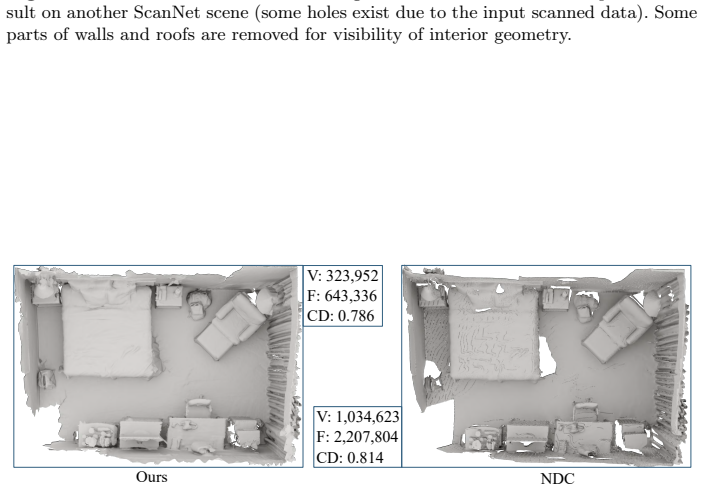
Summary. The paper proposes HD-PEA, a deep-learning pipeline that takes an unstructured point cloud with normals and produces an anisotropic surface mesh. The core idea is to learn an 8D Euclidean embedding of the input points (first three coordinates fixed to the 3D positions, the remaining five predicted by a Point Transformer), then uniformly resample this embedded manifold via a PCA-based tangent-space particle system, and finally extract a mesh by high-dimensional restricted Voronoi cells. A patch-based meta-embedding (PMEI) is used at inference to handle large point clouds. The method is evaluated on Thingi10K, Myles et al., synthetic scans, noisy data, and ScanNet, with quantitative metrics CD/F1/NC/HD and an anisotropic mesh quality metric G, against Poisson, NDC, POCO, PoNQ, NKSR, SAP, SIREN, LMR, and a two-stage NDC+NASM baseline. The authors claim state-of-the-art accuracy with many fewer vertices and much lower runtime than LMR, and describe downstream curvature-tensor estimation as an additional contribution.
Significance. If the results hold, HD-PEA would be a noteworthy step: it combines a learned metric-field representation with a high-dimensional geometric meshing pipeline that avoids per-shape optimization and explicit metric-field precomputation. The paper is well positioned relative to the literature and provides an extensive set of experiments across varied datasets, including a clear ablation of the loss function and a useful comparison against a two-stage NDC+NASM pipeline. However, the verification is incomplete: the central ground-truth embedding construction is underspecified, the PMEI alignment can break the topological prefix invariant, and the mesh-quality metric G may be self-referential. These concerns directly affect the reproducibility and fairness of the reported SOTA claims. The paper also does not report error bars, statistical significance, or hardware details for timing. Given the size of the claimed gains (e.g., CD 0.496 vs. 0.676 for NDC in Table 1), these missing details are load-bearing rather than cosmetic.
major comments (4)
- [Section 3.1, Eqs. (1)-(3)] The ground-truth high-d vertex embeddings V={v_i in R^8} are never defined. The text says d=8 'as suggested in [75]' and only describes barycentric interpolation from the mesh (Eqs. 1-3). Since Eq. (4) trains the network against pairwise distances of these V, and Section 3.2/3.3 operate entirely in the 8D space, the entire pipeline rests on an unspecified construction. If V comes from SIFHDE2 [75], that method requires a Riemannian metric on the input mesh; the paper does not say how that metric is computed for the 240 Thingi10K training meshes, nor why a network trained on such embeddings should generalize to point clouds with no metric. If V is instead a novel construction, it must be stated. Without this, the method is non-reproducible and the central SOTA claim has no foundation.
- [Section 3.1, Eq. (5)] The PMEI alignment uses an unrestricted affine transform T(x)=Ax+b with A in R^{d x d}. Because the network's final embedding is defined as P=[P, F([P,n])], i.e., the first three coordinates are supposed to be exactly the input 3D positions, an unrestricted A can rotate, shear, and translate the first three coordinates, destroying the geometric meaning of the embedding. The paper neither constrains A's first three rows nor quantifies how much metric distortion PMEI introduces. At minimum, A must be constrained to preserve the 3D prefix (e.g., first three columns = identity) and the alignment optimization should be shown to be well-posed in that subspace. This is especially important for the ScanNet experiments where PMEI is the scalability mechanism.
- [Section 4.1, mesh quality G] The quality metric G is defined using M(.), described only as 'the curvature metric tensor', to affine-transform each triangle before evaluating isotropic quality. The paper never states whether M is ground truth, estimated by HD-PEA itself, or computed by a third-party method. If M is the HD-PEA-estimated tensor field (as suggested by the curvature-tensor application in Section 4.2), then G becomes partially self-referential: HD-PEA is evaluated against baselines that do not use HD-PEA's own metric. The comparison of G across methods in Table 2 is therefore not apples-to-apples unless the same M is supplied to all methods. Please specify the exact source of M and, if it is estimated, provide a robustness analysis against ground-truth metrics.
- [Tables 1-2 and Section 4.2] The paper claims 'significantly better performance' but reports only averages over 80/75 models without error bars, standard deviations, or statistical significance tests. Given that the differences in CD (e.g., Ours 0.496 vs. NDC 0.676) are large, this may be a presentation issue, but for a strong empirical claim it should be quantified. In addition, the runtime comparisons lack hardware details, and the manuscript states 'source code and data will be publicly released after acceptance' with no code available for review. Since the central contribution is a learned embedding whose ground truth is underspecified, releasing code/data as part of the review process is necessary for the claims to be verified.
minor comments (5)
- [Section 3.1, paragraph before Eq. (5)] Typo: the distance between patch centers is written '||c_i - c_i||' instead of '||c_i - c_j||'.
- [Algorithm 1 (Appendix H)] The variable 'n' is used in the loop 'for j=1 to n' and in 'for j=1 to n' for processed flags, but the algorithm's inputs define only l and k. The loop counts should be l, and 'PointTransformer(q_j)' should be placed consistently with the patch construction.
- [Section 3.1, final paragraph] The phrase 'equivalent to Prim's algorithm' is slightly imprecise: the procedure builds an MST over patch centers but the edge weights are Euclidean distances between centers, while the alignment itself uses overlapping regions. Clarify the connection and why Euclidean center distance is the correct priority for minimizing alignment error.
- [General notation] The superscript/different fonts for embedding coordinates (p vs. p) are easy to confuse in the text; use a consistent bold or hat notation. Also, 'high-d poing embedding' and 'Univeristy' are typos.
- [Appendix E] The training is described as '5000 epochs' with batch size 16 on 2,400 augmented models. Please clarify whether each epoch is one pass over all 2,400 models, and report the total training time and GPU model.
Circularity Check
Surface-accuracy comparisons are externally grounded, but the anisotropic-mesh quality metric G is scored with a curvature tensor derived from HD-PEA's own embedding, and the training ground truth for that embedding is inherited from the authors' prior [75] without specification.
-
self citation load bearing
[Section 3.1, Data Generation for High-D Point Embedding (Eqs. 1-3)]
"there is no existing method capable of generating ground truth high-d embeddings for unstructured point sets... our data generation for point cloud embedding leverages the mapping from the original 3D Riemannian space to the target high-d Euclidean space. It can be described by an affine transformation [54,63,75]... The corresponding high-d embedded mesh is denoted as M=(V,F), where each vertex vi ∈ R^d is the high-d embedding of vi and d=8 (as suggested in [75])."
The entire supervised target for the neural embedding is the high-d vertex embedding V, but V itself is never defined in the paper: it is imported as 'suggested in [75]', and [75] is prior work by the same group (Zhong, Wang, Lévy, Hua, Guo, with four co-authors overlapping the current paper). The network is trained by Eq. (4) to regress pairwise distances of this V. Thus the central 'learning' step reduces to a learned surrogate for the output of the authors' own earlier optimizer; if [75]'s construction is not independently reproduced, the novel-embedding claim has no self-contained derivation. The external CD/F1/NC/HD comparisons give independent content, so this is load-bearing self-citation rather than full circularity.
-
other
[Section 4.1 (Metrics); Section 4.2 (Curvature Tensor Estimation)]
"To measure the anisotropic mesh quality G, for each triangle △abc in the final mesh, we use its approximated metric Q(△abc)=(Q(xa)+Q(xb)+Q(xc))/3, where Q(·)=sqrt(M(·)), to affine-transform it from the original anisotropic space into the Euclidean space. M(·) is the curvature metric tensor."
The mesh whose quality is being graded is produced by making particles uniform in the predicted high-d embedding (Section 3.2), and the 'curvature metric tensor' M in the G definition is obtained from that same predicted embedding via the least-squares fit Ax=B and SVD in Section 4.2. A mesh designed to be isotropic in an embedding that encodes M will, after transforming by M back to Euclidean space, tend to score high G by construction. The paper does not state that M is an independent ground-truth tensor from [75] or an external source. Hence the reported G advantage over baselines is at least partly self-referential rather than an independent measure of anisotropic mesh quality.
full rationale
The main surface-accuracy claims (CD, F1, NC, HD) are measured against ground-truth point clouds/meshes and are independent of the learned high-d embedding, so the paper is not wholly circular. In addition, the network is tested on unseen shapes and ScanNet-style scenes without per-shape optimization, so the central generalization claim has real empirical content. However, two steps are concerning. First, the ground-truth high-d vertex embedding that supervises the entire pipeline is not constructed in the paper: Section 3.1 only cites [75] for V and for d=8, and four of the six current authors also appear on [75]; the paper's 'data generation' contribution is therefore a regression target inherited from the authors' own earlier work, whose validity for arbitrary Thingi10K meshes is never shown. This is a reproducibility/self-citation gap, not full equivalence, because the downstream surface metrics are external. Second, the anisotropic-mesh-quality metric G uses a curvature metric tensor that the paper itself estimates from HD-PEA's predicted embedding; since the output mesh is optimized to be uniform in that very embedding, high G is partially baked in. No equation in the paper reduces a headline CD/F1 number to the training loss, and the method's core operation—predicting an embedding from raw points and reconstructing a mesh from it—is not tautological. Score 4 reflects partial, not total, circularity.
Assumptions & free parameters
free parameters (6)
- embedding dimension d =
8
- neighborhood size for distance loss =
40
- kernel width sigma constants c and alpha =
c=0.32, alpha=1.3
- local surface area estimation constants =
12 neighbors, alpha=1.3
- disk radius scaling coefficient =
alpha (user-defined)
- PMEI patch parameters =
not reported
assumptions (9)
- standard math Nash embedding theorem: every smooth Riemannian manifold can be isometrically embedded into a high-dimensional Euclidean space.
- domain assumption Input point clouds are sampled from smooth 2D manifolds with consistently oriented normals.
- domain assumption An affine transformation from 3D into high-d space inherently captures local manifold curvature and directional information.
- domain assumption Pairwise distances between neighbors in the embedded space fully encode the intrinsic Riemannian metric.
- ad hoc to paper Barycentric coordinate transfer from a source triangle mesh gives correct high-d embeddings for sampled points.
- ad hoc to paper Patch embeddings can be globally aligned by unrestricted affine transformations T(x)=Ax+b.
- domain assumption d=8 suffices for anisotropy-preserving embedding of 2D surfaces.
- domain assumption Particle repulsion with tangent projection converges to a uniform distribution on the embedded manifold.
- domain assumption Tangential Delaunay / restricted Voronoi construction extends to a 2D manifold embedded in R^8 and yields a valid mesh.
Cite this review
Pith. "Pith review of Learning Manifolds in High-D Point Embedding for Anisotropic Surface Approximation from Unstructured Point Clouds." pith.science (2026). https://pith.science/paper/VVK6FDD4
@misc{pith2026260728855,
  author       = {Pith},
  title        = {Pith review of: Learning Manifolds in High-D Point Embedding for Anisotropic Surface Approximation from Unstructured Point Clouds},
  year         = {2026},
  howpublished = {\url{https://pith.science/paper/VVK6FDD4}},
  note         = {Machine review of arXiv:2607.28855}
}
read the original abstract
Dense 3D sensors in various real-world fields produce point clouds that are geometrically redundant for real-time processing. In this paper, we propose an efficient and scalable learning-based anisotropic surface approximation framework, HD-PEA, that operates directly on unstructured point clouds, integrating anisotropic optimization into reconstruction to produce compact, geometry-aligned surface representations with higher fidelity, fewer elements, and improved numerical stability compared to isotropic and adaptive meshes. Firstly, we develop a novel learning-based high-dimensional (high-d) Euclidean point embedding method to map the input point clouds into a high-d manifold embedding space. For handling large-scale point clouds without retraining and fine-tuning, a patch-based meta-embedding scheme is designed during the inference stage. Then, we develop a new tangent subspace estimation for the high-d embedding manifold approximation and anisotropic manifold reconstruction in high-d space. The main contribution of this work is to propose a scalable deep learning framework and a variety of datasets for constructing a high-d Euclidean point embedding space aimed to 3D anisotropic surface mesh approximation and Riemannian curvature tensor estimation from point clouds. We extensively evaluate our method against state-of-the-art surface reconstruction approaches using several datasets, such as Thingi10K dataset, AIM@SHAPE and Stanford 3D Scanning Repository, ScanNet dataset, and further demonstrate its generalization and usability on diverse unseen shapes and applications from these datasets.
Figures


Figures from the paper (14 more)




Reference graph
Works this paper leans on
-
[75]
ACM Trans- actions on Graphics37(4) (2018)
Zhong, Z., Wang, W., Lévy, B., Hua, J., Guo, X.: Computing a high-dimensional Euclidean embedding from an arbitrary smooth Riemannian metric. ACM Trans- actions on Graphics37(4) (2018)
2018
-
[1]
ACM Transactions on Graphics44(4), 1–19 (2025)
Binninger, A., Wiersma, R., Herholz, P., Sorkine-Hornung, O.: TetWeave: Isosur- face extraction using on-the-fly Delaunay tetrahedral grids for gradient-based mesh optimization. ACM Transactions on Graphics44(4), 1–19 (2025)
2025
-
[2]
Computer-Aided Design36(2), 161–174 (2004)
Boissonnat,J.D.,Flötotto,J.:Acoordinatesystemassociatedwithpointsscattered on a surface. Computer-Aided Design36(2), 161–174 (2004)
2004
-
[3]
In: Proceedings of the twenty-sixth annual symposium on Computa- tional geometry
Boissonnat, J.D., Ghosh, A.: Manifold reconstruction using tangential Delaunay complexes. In: Proceedings of the twenty-sixth annual symposium on Computa- tional geometry. pp. 324–333 (2010)
2010
-
[4]
ACM Transactions on Graphics34(2), 1–11 (2015)
Boissonnat, J.D., Shi, K.L., Tournois, J., Yvinec, M.: Anisotropic Delaunay meshes of surfaces. ACM Transactions on Graphics34(2), 1–11 (2015)
2015
-
[5]
Theoretical Computer Science408(2-3), 163–173 (2008)
Boissonnat, J.D., Wormser, C., Yvinec, M.: Anisotropic diagrams: Labelle Shewchuk approach revisited. Theoretical Computer Science408(2-3), 163–173 (2008)
2008
-
[6]
Boltcheva, D., Lévy, B.: Surface reconstruction by computing restricted Voronoi cells in parallel. Comput. Aided Des.90(C), 123–134 (2017)
2017
-
[7]
Borouchaki, H., George, P.L., Hecht, F., Laug, P., Saltel, E.: Delaunay mesh gen- eration governed by metric specifications. part i. algorithms. Finite elements in analysis and design25(1-2), 61–83 (1997)
1997
Show all 76 references
-
[8]
applications
Borouchaki, H., George, P.L., Mohammadi, B.: Delaunay mesh generation gov- erned by metric specifications part ii. applications. Finite Elements in Analysis and Design25(1-2), 85–109 (1997)
1997
-
[9]
In: Proceedings of the IEEE/CVF Conference on Computer Vision and Pattern Recog- nition
Boulch, A., Marlet, R.: POCO: Point convolution for surface reconstruction. In: Proceedings of the IEEE/CVF Conference on Computer Vision and Pattern Recog- nition. pp. 6302–6314 (2022)
2022
-
[10]
ACM Transactions on Graphics35(6), 1–12 (2016)
Budninskiy, M., Liu, B., De Goes, F., Tong, Y., Alliez, P., Desbrun, M.: Opti- mal Voronoi tessellations with Hessian-based anisotropy. ACM Transactions on Graphics35(6), 1–12 (2016)
2016
-
[11]
The Vi- sual Computer22(9), 885–895 (2006)
Canas, G.D., Gortler, S.J.: Surface remeshing in arbitrary codimensions. The Vi- sual Computer22(9), 885–895 (2006)
2006
-
[12]
IEEE Transactions on Pattern Analysis and Machine Intelligence47(1), 565–582 (2024)
Chen, C., Liu, Y.S., Han, Z.: NeuralTPS: Learning signed distance functions with- out priors from single sparse point clouds. IEEE Transactions on Pattern Analysis and Machine Intelligence47(1), 565–582 (2024)
2024
-
[13]
Mathematics of Computation76(257), 179–204 (2007)
Chen, L., Sun, P., Xu, J.: Optimal anisotropic meshes for minimizing interpolation errors inl p-norm. Mathematics of Computation76(257), 179–204 (2007)
2007
-
[14]
ACM Transactions on Graphics41(4), 1–13 (2022)
Chen, Z., Tagliasacchi, A., Funkhouser, T., Zhang, H.: Neural dual contouring. ACM Transactions on Graphics41(4), 1–13 (2022)
2022
-
[15]
ACM Transactions on Graphics (TOG)40(6), 1–15 (2021)
Chen, Z., Zhang, H.: Neural marching cubes. ACM Transactions on Graphics (TOG)40(6), 1–15 (2021)
2021
-
[16]
In: Proceedings of the IEEE/CVF Conference on Computer Vision and Pattern Recognition (2017)
Dai, A., Chang, A.X., Savva, M., Halber, M., Funkhouser, T., Nießner, M.: Scan- Net: Richly-annotated 3D reconstructions of indoor scenes. In: Proceedings of the IEEE/CVF Conference on Computer Vision and Pattern Recognition (2017)
2017
-
[17]
Computer Aided Geometric Design111, 102314 (2024) HD-PEA 17
Dai, Y., Su, J.P., Fu, X.M.: Anisotropic triangular meshing using metric-adapted embeddings. Computer Aided Geometric Design111, 102314 (2024) HD-PEA 17
2024
-
[18]
Dassi,F.,Mola,A.,Si,H.:Curvature-adaptedremeshingofCADsurfaces.Procedia Engineering82, 253–265 (2014)
2014
-
[19]
Procedia Engineering124, 265–277 (2015)
Dassi, F., Si, H., Perotto, S., Streckenbach, T.: Anisotropic finite element mesh adaptation via higher dimensional embedding. Procedia Engineering124, 265–277 (2015)
2015
-
[20]
Comput- ers & Graphics35(3), 483–491 (2011)
Dey, T.K., Dyer, R., Wang, L.: Localized Cocone surface reconstruction. Comput- ers & Graphics35(3), 483–491 (2011)
2011
-
[21]
In: Proceedings of the 17th international Meshing Roundtable
Dobrzynski, C., Frey, P.: Anisotropic Delaunay mesh adaptation for unsteady simu- lations. In: Proceedings of the 17th international Meshing Roundtable. pp. 177–194 (2008)
2008
-
[22]
SIAM Journal on Scientific Computing26(3), 737–761 (2005)
Du, Q., Wang, D.: Anisotropic centroidal Voronoi tessellations and their applica- tions. SIAM Journal on Scientific Computing26(3), 737–761 (2005)
2005
-
[23]
In: ICLR Workshop on Representation Learning on Graphs and Manifolds (2019)
Fey,M.,Lenssen,J.E.:FastgraphrepresentationlearningwithPyTorchGeometric. In: ICLR Workshop on Representation Learning on Graphs and Manifolds (2019)
2019
-
[24]
ACM Transactions on Graphics24(3), 544–552 (2005)
Fleishman, S., Cohen-Or, D., Silva, C.T.: Robust moving least-squares fitting with sharp features. ACM Transactions on Graphics24(3), 544–552 (2005)
2005
-
[25]
IEEE Transactions on Pattern Analysis and Machine Intelligence24(10), 1349– 1357 (2002)
Freedman, D.: Efficient simplicial reconstructions of manifolds from their samples. IEEE Transactions on Pattern Analysis and Machine Intelligence24(10), 1349– 1357 (2002)
2002
-
[26]
International journal for numerical methods in engineering45(1), 101–118 (1999)
Frey, P.J., Borouchaki, H.: Surface mesh quality evaluation. International journal for numerical methods in engineering45(1), 101–118 (1999)
1999
-
[27]
ACM Transactions on Graphics33(6), 1–11 (2014)
Fu, X.M., Liu, Y., Snyder, J., Guo, B.: Anisotropic simplicial meshing using local convex functions. ACM Transactions on Graphics33(6), 1–11 (2014)
2014
-
[28]
In: Proceedings of the 34th Interna- tional Conference on Neural Information Processing Systems (2020)
Fuchs, F.B., Worrall, D.E., Fischer, V., Welling, M.: Se(3)-transformers: 3D roto- translation equivariant attention networks. In: Proceedings of the 34th Interna- tional Conference on Neural Information Processing Systems (2020)
2020
-
[29]
In: Proceedings of the 24th annual conference on Computer graphics and interactive techniques
Garland, M., Heckbert, P.S.: Surface simplification using quadric error metrics. In: Proceedings of the 24th annual conference on Computer graphics and interactive techniques. pp. 209–216 (1997)
1997
-
[30]
In: Bebis, G., Boyle, R., Parvin, B., Koracin, D., Wang, S., Kyungnam, K., Benes, B., Moreland, K., Borst, C., DiVerdi, S., Yi-Jen, C., Ming, J
Gschwandtner,M.,Kwitt,R.,Uhl,A.,Pree,W.:Blensor:Blendersensorsimulation toolbox. In: Bebis, G., Boyle, R., Parvin, B., Koracin, D., Wang, S., Kyungnam, K., Benes, B., Moreland, K., Borst, C., DiVerdi, S., Yi-Jen, C., Ming, J. (eds.) Advances in Visual Computing. pp. 199–208 (2011)
2011
-
[31]
Computer Graphics Forum37(2), 75–85 (2018)
Guerrero, P., Kleiman, Y., Ovsjanikov, M., Mitra, N.J.: PCPNet: Learning local shape properties from raw point clouds. Computer Graphics Forum37(2), 75–85 (2018)
2018
-
[32]
arXiv preprint arXiv:2005.11084 (2020)
Hanocka, R., Metzer, G., Giryes, R., Cohen-Or, D.: Point2mesh: A self-prior for deformable meshes. arXiv preprint arXiv:2005.11084 (2020)
2005 arXiv
-
[33]
Computational Geometry14(1–3), 49–65 (1999)
Heckbert, P.S., Garland, M.: Optimal triangulation and quadric-based surface sim- plification. Computational Geometry14(1–3), 49–65 (1999)
1999
-
[34]
ACM Transactions on Graphics 28(5), 1–7 (Dec 2009)
Huang, H., Li, D., Zhang, H., Ascher, U., Cohen-Or, D.: Consolidation of unor- ganized point clouds for surface reconstruction. ACM Transactions on Graphics 28(5), 1–7 (Dec 2009)
2009
-
[35]
In: Proceedings of the IEEE/CVF Conference on Computer Vision and Pattern Recognition
Huang, J., Gojcic, Z., Atzmon, M., Litany, O., Fidler, S., Williams, F.: Neural kernel surface reconstruction. In: Proceedings of the IEEE/CVF Conference on Computer Vision and Pattern Recognition. pp. 4369–4379 (2023)
2023
-
[36]
IEEE Transactions on Pattern Analysis and Machine Intelligence (2024) 18 H
Huang, Z., Wen, Y., Wang, Z., Ren, J., Jia, K.: Surface reconstruction from point clouds: A survey and a benchmark. IEEE Transactions on Pattern Analysis and Machine Intelligence (2024) 18 H. Li, et al
2024
-
[37]
In: Proceedings of the 29th annual conference on Computer graphics and interactive techniques
Ju, T., Losasso, F., Schaefer, S., Warren, J.: Dual contouring of hermite data. In: Proceedings of the 29th annual conference on Computer graphics and interactive techniques. pp. 339–346 (2002)
2002
-
[38]
In: Proceed- ings of the fourth Eurographics symposium on Geometry processing
Kazhdan, M., Bolitho, M., Hoppe, H.: Poisson surface reconstruction. In: Proceed- ings of the fourth Eurographics symposium on Geometry processing. vol. 7 (2006)
2006
-
[39]
In: Proceedings of the 14th ACM Symposium on solid and physical modeling
Kovacs, D., Myles, A., Zorin, D.: Anisotropic quadrangulation. In: Proceedings of the 14th ACM Symposium on solid and physical modeling. pp. 137–146 (2010)
2010
-
[40]
GitHub Repository
Lévy, B.: Geogram. GitHub Repository. URL: https://github. com/BrunoLevy/geogram (2015)
2015
-
[41]
In: Proceedings of the 21st international meshing roundtable
Lévy, B., Bonneel, N.: Variational anisotropic surface meshing with Voronoi parallel linear enumeration. In: Proceedings of the 21st international meshing roundtable. pp. 349–366 (2013)
2013
-
[42]
In: SIGGRAPH Asia 2024 Conference Papers (2024)
Li, H., Zhu, H., Zhong, S., Wang, N., Lin, C., Guo, X., Xin, S., Wang, W., Hua, J., Zhong, Z.: NASM: Neural anisotropic surface meshing. In: SIGGRAPH Asia 2024 Conference Papers (2024)
2024
-
[43]
ACM Transactions on Graphics43(6) (2024)
Lin, S., Shi, Z., Liu, Y.: Fast and globally consistent normal orientation based on the winding number normal consistency. ACM Transactions on Graphics43(6) (2024)
2024
-
[44]
ACM Transactions on Graphics26(3), 22–es (Jul 2007)
Lipman, Y., Cohen-Or, D., Levin, D., Tal-Ezer, H.: Parameterization-free projec- tion for geometry reconstruction. ACM Transactions on Graphics26(3), 22–es (Jul 2007)
2007
-
[45]
In: Seminal graphics: pioneering efforts that shaped the field, pp
Lorensen, W.E., Cline, H.E.: Marching cubes: A high resolution 3D surface con- struction algorithm. In: Seminal graphics: pioneering efforts that shaped the field, pp. 347–353 (1998)
1998
-
[46]
In: International Conference on Learning Representations (2019)
Loshchilov, I., Hutter, F.: Decoupled weight decay regularization. In: International Conference on Learning Representations (2019)
2019
-
[47]
IEEE Transactions on Visualization and Computer Graphics24(8), 2315–2326 (2018)
Lu, X., Wu, S., Chen, H., Yeung, S.K., Chen, W., Zwicker, M.: GPF: GMM- inspired feature-preserving point set filtering. IEEE Transactions on Visualization and Computer Graphics24(8), 2315–2326 (2018)
2018
-
[48]
In: Proceedings of the IEEE/CVF International Conference on Computer Vision
Maruani, N., Klokov, R., Ovsjanikov, M., Alliez, P., Desbrun, M.: VoroMesh: Learning watertight surface meshes with Voronoi diagrams. In: Proceedings of the IEEE/CVF International Conference on Computer Vision. pp. 14565–14574 (2023)
2023
-
[49]
In: Proceedings of the IEEE/CVF Conference on Computer Vision and Pattern Recognition
Maruani, N., Ovsjanikov, M., Alliez, P., Desbrun, M.: PoNQ: a neural QEM-based mesh representation. In: Proceedings of the IEEE/CVF Conference on Computer Vision and Pattern Recognition. pp. 3647–3657 (2024)
2024
-
[50]
ACM Transactions on Graphics33(4) (2014)
Myles, A., Pietroni, N., Zorin, D.: Robust field-aligned global parametrization. ACM Transactions on Graphics33(4) (2014)
2014
-
[51]
Annals of Mathematics60(3), 383–396 (1954)
Nash, J.:C 1-isometric embeddings. Annals of Mathematics60(3), 383–396 (1954)
1954
-
[52]
Annals of mathemat- ics63(1), 20–63 (1956)
Nash, J.: The imbedding problem for Riemannian manifolds. Annals of mathemat- ics63(1), 20–63 (1956)
1956
-
[53]
In: Proceedings of the Computer Vision and Pattern Recognition Conference
Noda, T., Chen, C., Zhou, J., Zhang, W., Liu, Y.S., Han, Z.: Learning bijective surface parameterization for inferring signed distance functions from sparse point clouds with grid deformation. In: Proceedings of the Computer Vision and Pattern Recognition Conference. pp. 22139...
2025
-
[54]
ACM Transactions on Graphics33(4), 134:1– 134:11 (2014)
Panozzo,D.,Puppo,E.,Tarini,M.,Sorkine-Hornung,O.:FrameFields:anisotropic and non-orthogonal cross fields. ACM Transactions on Graphics33(4), 134:1– 134:11 (2014)
2014
-
[55]
In: NIPS 2017 Workshop on Autodiff (2017) HD-PEA 19
Paszke, A., Gross, S., Chintala, S., Chanan, G., Yang, E., DeVito, Z., Lin, Z., Desmaison, A., Antiga, L., Lerer, A.: Automatic differentiation in pytorch. In: NIPS 2017 Workshop on Autodiff (2017) HD-PEA 19
2017
-
[56]
on lines and planes of closest fit to systems of points in space
Pearson, K.: Liii. on lines and planes of closest fit to systems of points in space. The London, Edinburgh, and Dublin philosophical magazine and journal of science 2(11), 559–572 (1901)
1901
-
[57]
In: Advances in Neural Information Pro- cessing Systems (NeurIPS) (2021)
Peng, S., Jiang, C.M., Liao, Y., Niemeyer, M., Pollefeys, M., Geiger, A.: Shape as points: A differentiable poisson solver. In: Advances in Neural Information Pro- cessing Systems (NeurIPS) (2021)
2021
-
[58]
Procedia engineering163, 97–109 (2016)
Rouxel-Labbé, M., Wintraecken, M., Boissonnat, J.D.: Discretized Riemannian Delaunay triangulations. Procedia engineering163, 97–109 (2016)
2016
-
[59]
Sakai, T.: Riemannian geometry, vol. 149. American Mathematical Soc. (1996)
1996
-
[60]
In: Proceedings of the European Conference on Computer Vision
Sharp, N., Ovsjanikov, M.: PointTriNet: Learned triangulation of 3D point sets. In: Proceedings of the European Conference on Computer Vision. pp. 762–778. Springer (2020)
2020
-
[61]
Ap- plied Numerical Mathematics14(1–3), 183–198 (1994)
Simpson, R.B.: Anisotropic mesh transformations and optimal error control. Ap- plied Numerical Mathematics14(1–3), 183–198 (1994)
1994
-
[62]
In: Proc
Sitzmann, V., Martel, J.N., Bergman, A.W., Lindell, D.B., Wetzstein, G.: Implicit neural representations with periodic activation functions. In: Proc. NeurIPS (2020)
2020
-
[63]
ACM Trans- actions on Graphics23(3), 399–405 (Aug 2004)
Sumner, R.W., Popović, J.: Deformation transfer for triangle meshes. ACM Trans- actions on Graphics23(3), 399–405 (Aug 2004)
2004
-
[64]
Communications of the ACM17(1), 32–42 (1974)
Sutherland, I.E., Hodgman, G.W.: Reentrant polygon clipping. Communications of the ACM17(1), 32–42 (1974)
1974
-
[65]
IEEE Transactions on Visual- ization and Computer Graphics14(2), 369–381 (2008)
Valette, S., Chassery, J.M., Prost, R.: Generic remeshing of 3D triangular meshes with metric-dependent discrete Voronoi diagrams. IEEE Transactions on Visual- ization and Computer Graphics14(2), 369–381 (2008)
2008
-
[66]
In: DAGM German Conference on Pattern Recognition
Vetsch, M., Lombardi, S., Pollefeys, M., Oswald, M.R.: Neuralmeshing: Differen- tiable meshing of implicit neural representations. In: DAGM German Conference on Pattern Recognition. pp. 317–333. Springer (2022)
2022
-
[67]
In: Proceedings of the European Conference on Computer Vision
Wang, N., Zhang, Y., Li, Z., Fu, Y., Liu, W., Jiang, Y.G.: Pixel2Mesh: Generat- ing 3D mesh models from single RGB images. In: Proceedings of the European Conference on Computer Vision. pp. 52–67 (2018)
2018
-
[68]
Wen, C., Zhang, Y., Li, Z., Fu, Y.: Pixel2mesh++: Multi-view 3D mesh generation viadeformation.In:ProceedingsoftheIEEE/CVFConferenceonComputerVision and Pattern Recognition. pp. 1042–1051 (2019)
2019
-
[69]
In: Proceedings of the 21st Annual Conference on Computer Graphics and Interactive Techniques
Witkin, A.P., Heckbert, P.S.: Using particles to sample and control implicit sur- faces. In: Proceedings of the 21st Annual Conference on Computer Graphics and Interactive Techniques. p. 269–277 (1994)
1994
-
[70]
In: Proceedings of the IEEE/CVF Conference on Computer Vision and Pattern Recognition
Wu, X., Jiang, L., Wang, P.S., Liu, Z., Liu, X., Qiao, Y., Ouyang, W., He, T., Zhao, H.: Point transformer v3: Simpler faster stronger. In: Proceedings of the IEEE/CVF Conference on Computer Vision and Pattern Recognition. pp. 4840– 4851 (2024)
2024
-
[71]
In: Proceedings of the IEEE/CVF Confer- ence on Computer Vision and Pattern Recognition
Zhang, C., Wang, W., Li, X., Liao, X., Su, W., Tao, W.: High-fidelity lightweight mesh reconstruction from point clouds. In: Proceedings of the IEEE/CVF Confer- ence on Computer Vision and Pattern Recognition. pp. 11739–11748 (2025)
2025
-
[72]
SIAM journal on scientific computing26(1), 313–338 (2004)
Zhang, Z., Zha, H.: Principal manifolds and nonlinear dimensionality reduction via tangent space alignment. SIAM journal on scientific computing26(1), 313–338 (2004)
2004
-
[73]
Computer Aided Geometric Design 71, 43–62 (2019)
Zhong, S., Zhong, Z., Hua, J.: Surface reconstruction by parallel and unified particle-based resampling from point clouds. Computer Aided Geometric Design 71, 43–62 (2019)
2019
-
[74]
ACM Transactions on Graphics32(4) (2013) 20 H
Zhong, Z., Guo, X., Wang, W., Lévy, B., Sun, F., Liu, Y., Mao, W.: Particle-based anisotropic surface meshing. ACM Transactions on Graphics32(4) (2013) 20 H. Li, et al
2013
-
[76]
Zhou, Q., Jacobson, A.: Thingi10K: A dataset of 10,000 3D-printing models. arXiv preprint arXiv:1605.04797 (2016) HD-PEA 21 Appendix: Learning Manifolds in High-D Point Embedding for Anisotropic Surface Approx A High-D Particle Formulation Givennseed points X={ xi ∈R d|i= 1, ....
2016 arXiv
Reviewed August 3, 2026 · model on record in the stance chip above.
Discussion (0). Sign in to comment.