Attend to Anything: Foundation Model for Unified Human Attention Modeling
Pith reviewed 2026-06-28 11:08 UTC · model grok-4.3
The pith
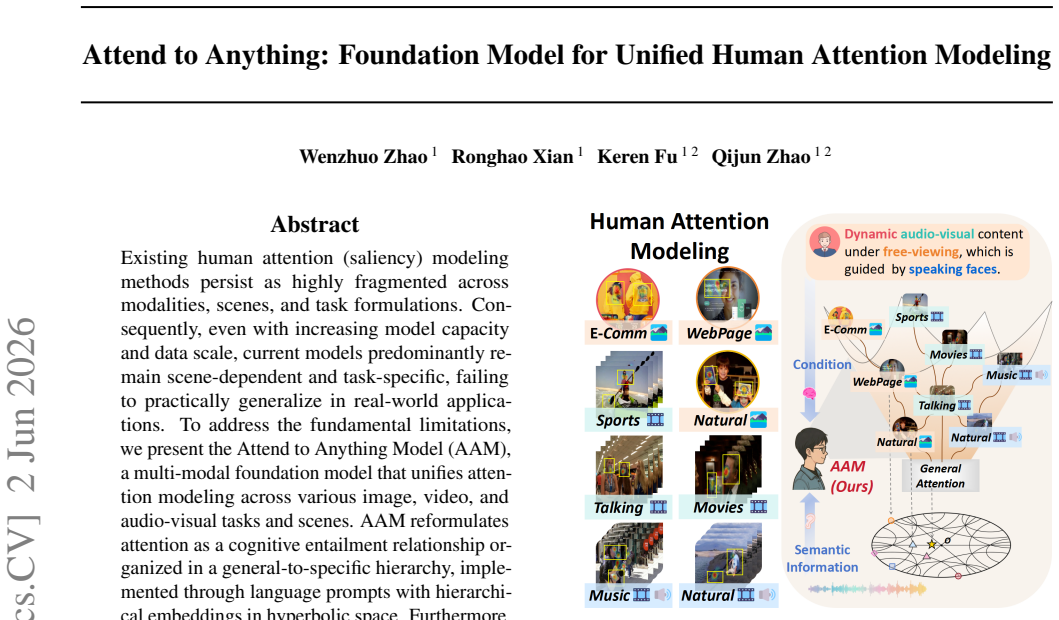
A foundation model unifies attention modeling for images, videos, and audio-visual scenes by recasting attention as hierarchical cognitive entailment.
A machine-rendered reading of the paper's core claim, the machinery that carries it, and where it could break.
Core claim
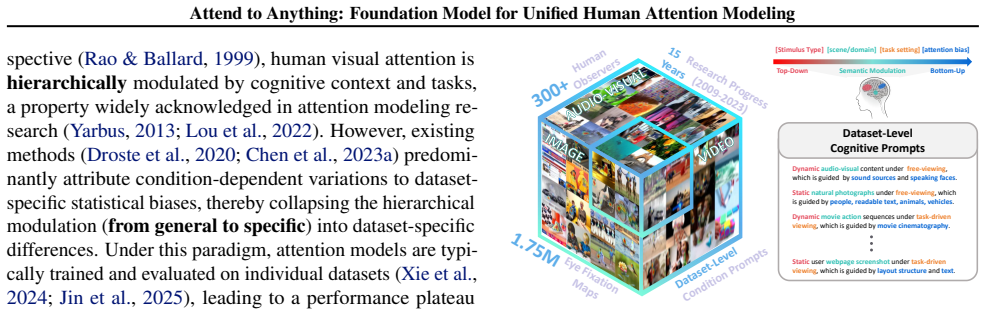
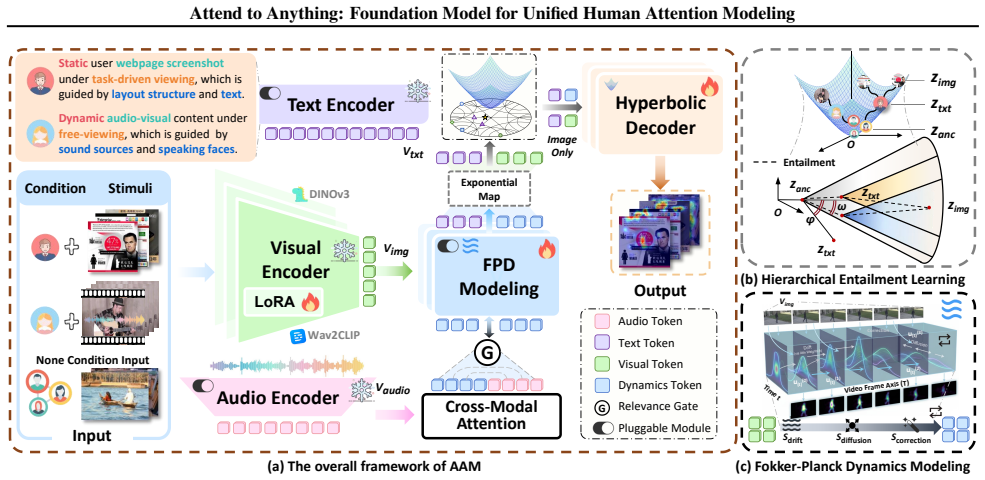
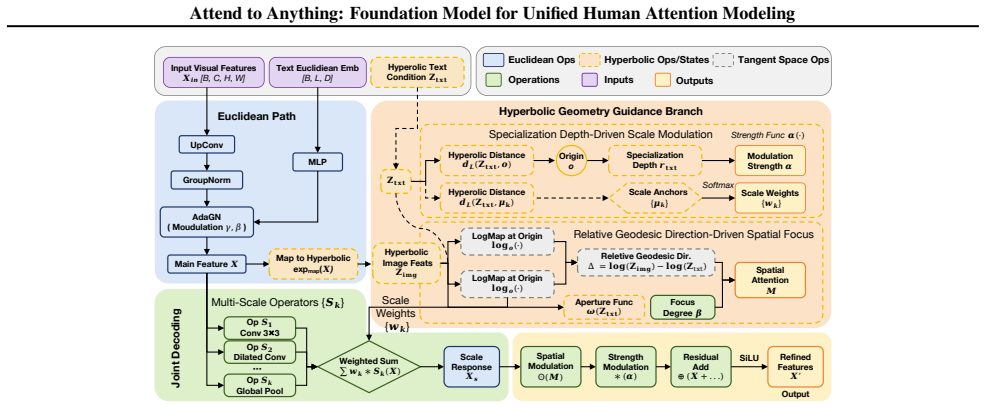
The Attend to Anything Model reformulates attention as a cognitive entailment relationship organized in a general-to-specific hierarchy, implemented through language prompts with hierarchical embeddings in hyperbolic space. Video-frame attention is formulated as a diffusive temporal evolution governed by the Fokker-Planck equation, enabling a single multi-modal foundation model to handle diverse attention tasks.
What carries the argument
Hierarchical embeddings in hyperbolic space that encode the general-to-specific entailment hierarchy of attention, combined with the Fokker-Planck equation that governs the diffusive evolution of attention across video frames.
If this is right
- A single model can replace multiple task-specific saliency predictors across image, video, and audio-visual inputs.
- Attention predictions become consistent rather than scene- or task-dependent.
- Video applications gain the reported fourfold inference speedup while retaining higher accuracy.
- Future saliency research can start from this shared formulation instead of building separate models for each setting.
Where Pith is reading between the lines
- The same hierarchical-entailment structure might apply to other perceptual or cognitive modeling problems that involve graded specificity.
- Hyperbolic geometry could be tested on additional hierarchies in vision or language that are not attention-related.
- Evaluating the model on entirely new tasks or modalities outside the sixteen benchmarks would test how far the unification extends.
Load-bearing premise
That human attention can be faithfully captured by a cognitive entailment hierarchy whose structure is expressed through language prompts in hyperbolic space and whose video dynamics follow the Fokker-Planck diffusion equation.
What would settle it
An experiment replacing hyperbolic embeddings with Euclidean ones or removing the Fokker-Planck temporal model and finding that gains disappear on the same benchmarks would indicate these components are required for the unification.
Figures
read the original abstract
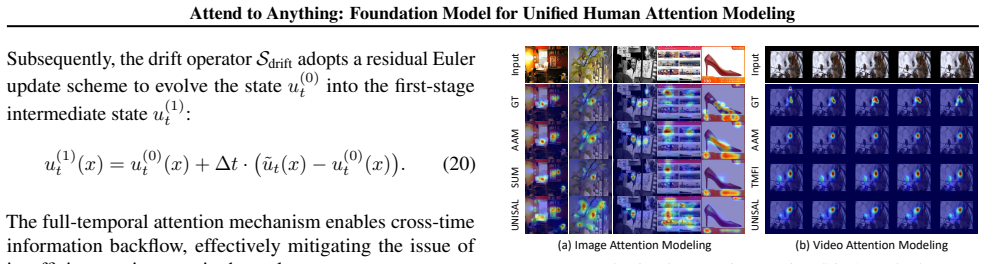
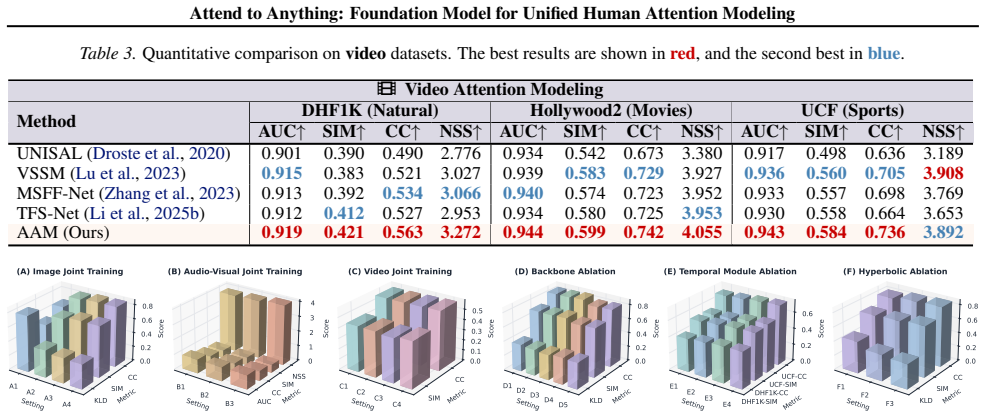
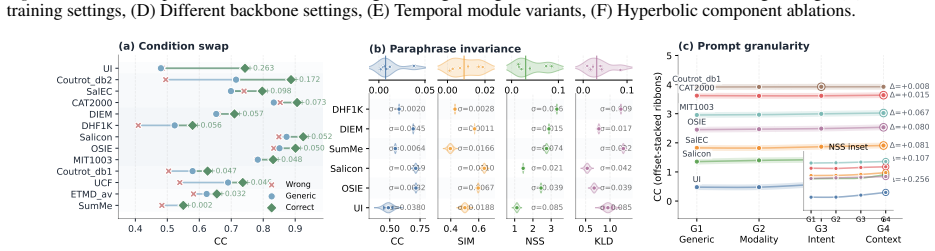
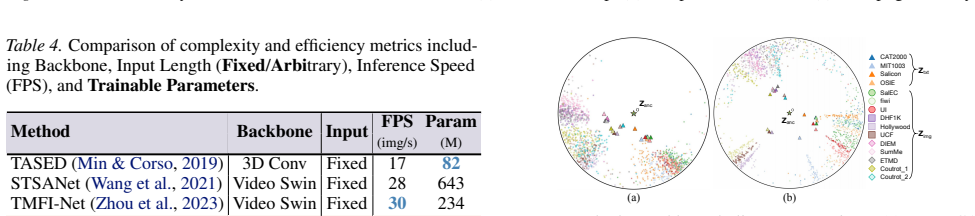
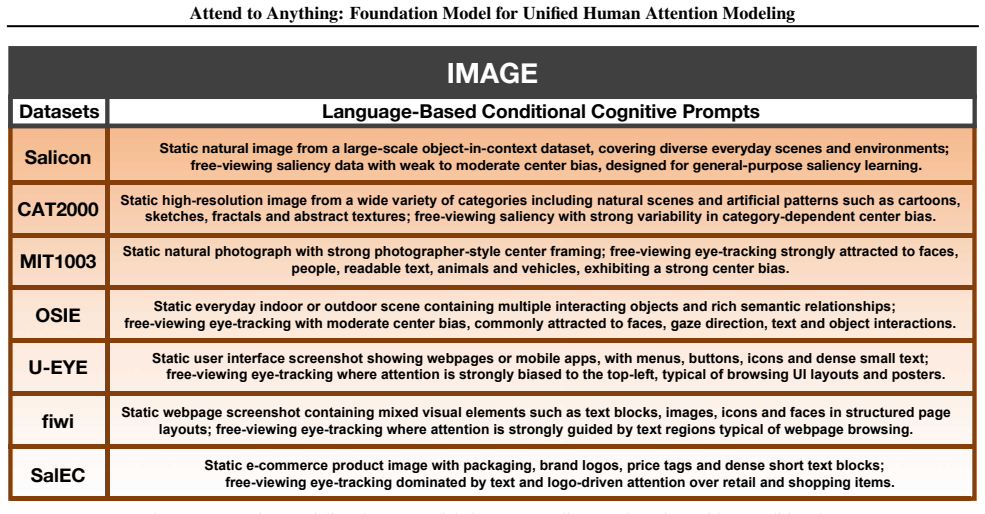
Existing human attention (saliency) modeling methods persist as highly fragmented across modalities, scenes, and task formulations. Consequently, even with increasing model capacity and data scale, current models predominantly remain scene-dependent and task-specific, failing to practically generalize in real-world applications. To address the fundamental limitations, we present the Attend to Anything Model (AAM), a multi-modal foundation model that unifies attention modeling across various image, video, and audio-visual tasks and scenes. AAM reformulates attention as a cognitive entailment relationship organized in a general-to-specific hierarchy, implemented through language prompts with hierarchical embeddings in hyperbolic space. Furthermore, to unify static image and dynamic video attention, we adopt a fluid-dynamics perspective, formulating video-frame attention as a diffusive temporal evolution governed by the Fokker--Planck equation. Extensive experiments on 16 benchmarks demonstrate that AAM consistently outperforms state-of-the-art methods by an average of 6\% across various scenarios, while achieving approximately a 4$\times$ speedup in video inference. Overall, these results demonstrate that AAM provides a principled foundation for future research on attention and saliency-related tasks. The dataset and code will be available at https://github.com/wz-zhao/Attend-to-Anything.
Editorial analysis
A structured set of objections, weighed in public.
Referee Report
Summary. The paper presents the Attend to Anything Model (AAM), a multi-modal foundation model unifying human attention (saliency) modeling across image, video, and audio-visual tasks and scenes. It reformulates attention as a cognitive entailment relationship in a general-to-specific hierarchy implemented via language prompts with hierarchical embeddings in hyperbolic space, and models video-frame attention as diffusive temporal evolution governed by the Fokker-Planck equation. Experiments on 16 benchmarks are claimed to show consistent 6% average outperformance over SOTA methods and ~4x video inference speedup, positioning AAM as a principled foundation for future attention research.
Significance. If the unification, theoretical reformulations, and empirical gains hold under scrutiny, the work could meaningfully reduce fragmentation in saliency modeling by offering a single foundation model spanning modalities and tasks. The hyperbolic entailment and Fokker-Planck framing would constitute a distinctive theoretical contribution if they are shown to be non-redundant with existing attention mechanisms.
major comments (2)
- [Abstract] Abstract: The central empirical claim of '6% average outperformance' and '4x speedup' on 16 benchmarks is stated without any reference to baselines, error bars, statistical tests, dataset splits, or data handling procedures. This absence is load-bearing because the abstract supplies no experimental details, making it impossible to determine whether the math or data support the superiority claim.
- [Abstract] Abstract: The reformulation of attention as 'cognitive entailment relationship organized in a general-to-specific hierarchy' with 'hierarchical embeddings in hyperbolic space' and the video modeling via 'Fokker-Planck equation' are presented as core technical contributions, yet no equations, derivations, or implementation details appear in the provided text. Without these, it cannot be assessed whether the performance claims reduce to fitted parameters or self-referential definitions.
Simulated Author's Rebuttal
We thank the referee for the detailed comments. We address each major point below, clarifying the role of the abstract versus the full manuscript.
read point-by-point responses
-
Referee: [Abstract] Abstract: The central empirical claim of '6% average outperformance' and '4x speedup' on 16 benchmarks is stated without any reference to baselines, error bars, statistical tests, dataset splits, or data handling procedures. This absence is load-bearing because the abstract supplies no experimental details, making it impossible to determine whether the math or data support the superiority claim.
Authors: We agree the abstract is concise and omits granular experimental metadata due to length limits. The full manuscript details all 16 benchmarks, the complete list of baselines, error bars, statistical significance tests, dataset splits, and preprocessing in Section 4 and Tables 1-4. The reported 6% average and 4x speedup are computed directly from those tabulated results. We will revise the abstract to include a brief parenthetical reference to the experimental section for improved clarity. revision: partial
-
Referee: [Abstract] Abstract: The reformulation of attention as 'cognitive entailment relationship organized in a general-to-specific hierarchy' with 'hierarchical embeddings in hyperbolic space' and the video modeling via 'Fokker-Planck equation' are presented as core technical contributions, yet no equations, derivations, or implementation details appear in the provided text. Without these, it cannot be assessed whether the performance claims reduce to fitted parameters or self-referential definitions.
Authors: The abstract summarizes the contributions at a high level. The full manuscript provides the formalization: the cognitive entailment hierarchy and hyperbolic embeddings are defined with equations and derivations in Section 3.1; the Fokker-Planck formulation for temporal video attention evolution, including the diffusion process and boundary conditions, is derived in Section 3.2; implementation via language prompts and training details appear in Section 3.3 and the appendix. The empirical gains are measured against external baselines on held-out benchmarks rather than arising from definitional choices. We can add section references to the abstract in revision if this improves readability. revision: partial
Circularity Check
No significant circularity identified
full rationale
The abstract and available description introduce AAM via reformulation of attention as entailment in hyperbolic space and Fokker-Planck diffusion for video, plus empirical results on 16 benchmarks. No equations, self-citations, or derivations are supplied that reduce a claimed prediction or uniqueness result to a fitted parameter or prior self-referential definition by construction. The modeling choices are presented as new ansatzes with external validation, keeping the chain self-contained against benchmarks.
Axiom & Free-Parameter Ledger
axioms (2)
- domain assumption Attention can be reformulated as a cognitive entailment relationship organized in a general-to-specific hierarchy implemented through language prompts with hierarchical embeddings in hyperbolic space.
- domain assumption Video-frame attention follows diffusive temporal evolution governed by the Fokker-Planck equation.
invented entities (1)
-
Attend to Anything Model (AAM)
no independent evidence
Reference graph
Works this paper leans on
-
[1]
Visual Intelligence , volume=
Effectiveness assessment of recent large vision-language models , author=. Visual Intelligence , volume=. 2024 , publisher=
2024
-
[2]
ELife , volume=
A flexible framework for simulating and fitting generalized drift-diffusion models , author=. ELife , volume=. 2020 , publisher=
2020
-
[3]
, author=
The physics of optimal decision making: a formal analysis of models of performance in two-alternative forced-choice tasks. , author=. Psychological review , volume=. 2006 , publisher=
2006
-
[4]
, author=
A theory of memory retrieval. , author=. Psychological review , volume=. 1978 , publisher=
1978
-
[5]
Journal of the Royal Society Interface , volume=
Geometry of spiking patterns in early visual cortex: a topological data analytic approach , author=. Journal of the Royal Society Interface , volume=. 2022 , publisher=
2022
-
[6]
PLoS computational biology , volume=
Hyperbolic planforms in relation to visual edges and textures perception , author=. PLoS computational biology , volume=. 2009 , publisher=
2009
-
[7]
Langley , title =
P. Langley , title =. Proceedings of the 17th International Conference on Machine Learning (ICML 2000) , address =. 2000 , pages =
2000
-
[8]
T. M. Mitchell. The Need for Biases in Learning Generalizations. 1980
1980
-
[9]
M. J. Kearns , title =
-
[10]
Machine Learning: An Artificial Intelligence Approach, Vol. I. 1983
1983
-
[11]
R. O. Duda and P. E. Hart and D. G. Stork. Pattern Classification. 2000
2000
-
[12]
Neurocomputing , pages =
RecSal-Net: Recursive Saliency Network for video saliency prediction , author=. Neurocomputing , pages =. 2025 , volume=
2025
-
[13]
Stavis: Spatio-temporal audiovisual saliency network , author=
-
[14]
arXiv preprint arXiv:2105.04213 , year=
Temporal-spatial feature pyramid for video saliency detection , author=. arXiv preprint arXiv:2105.04213 , year=
-
[15]
2021 , organization=
Vinet: Pushing the limits of visual modality for audio-visual saliency prediction , author=. 2021 , organization=
2021
-
[16]
Casp-net: Rethinking video saliency prediction from an audio-visual consistency perceptual perspective , author=
-
[17]
2024 , publisher=
From Discrete Representation to Continuous Modeling: A Novel Audio-Visual Saliency Prediction Model With Implicit Neural Representations , author=. 2024 , publisher=
2024
-
[18]
Image and Vision Computing , volume=
Audio-visual saliency prediction with multisensory perception and integration , author=. Image and Vision Computing , volume=. 2024 , publisher=
2024
-
[19]
arXiv preprint arXiv:2504.14267 , year=
Text-Audio-Visual-conditioned Diffusion Model for Video Saliency Prediction , author=. arXiv preprint arXiv:2504.14267 , year=
-
[20]
2025 , organization=
Sum: Saliency unification through mamba for visual attention modeling , author=. 2025 , organization=
2025
-
[21]
2018 , publisher=
Predicting human eye fixations via an lstm-based saliency attentive model , author=. 2018 , publisher=
2018
-
[22]
Proceedings of the 33rd Annual ACM Symposium on User Interface Software and Technology , pages=
Predicting visual importance across graphic design types , author=. Proceedings of the 33rd Annual ACM Symposium on User Interface Software and Technology , pages=
-
[23]
Proceedings of the 2023 CHI conference on human factors in computing systems , pages=
Ueyes: Understanding visual saliency across user interface types , author=. Proceedings of the 2023 CHI conference on human factors in computing systems , pages=
2023
-
[24]
Neurocomputing , volume=
TranSalNet: Towards perceptually relevant visual saliency prediction , author=. Neurocomputing , volume=. 2022 , publisher=
2022
-
[25]
DeepGaze IIE: Calibrated prediction in and out-of-domain for state-of-the-art saliency modeling , author=
-
[26]
TempSAL-uncovering temporal information for deep saliency prediction , author=
-
[27]
Does text attract attention on e-commerce images: A novel saliency prediction dataset and method , author=
-
[28]
Discover Applied Sciences , volume=
Brand visibility in packaging: A deep learning approach for logo detection, saliency-map prediction, and logo placement analysis , author=. Discover Applied Sciences , volume=. 2025 , publisher=
2025
-
[29]
Learning from unique perspectives: User-aware saliency modeling , author=
-
[30]
Image and vision computing , volume=
Eml-net: An expandable multi-layer network for saliency prediction , author=. Image and vision computing , volume=. 2020 , publisher=
2020
-
[31]
Advances in Neural Information Processing Systems , volume=
UniAR: A Unified model for predicting human Attention and Responses on visual content , author=. Advances in Neural Information Processing Systems , volume=
-
[32]
2020 , organization=
Tidying deep saliency prediction architectures , author=. 2020 , organization=
2020
-
[33]
Neural Networks , volume=
Contextual encoder--decoder network for visual saliency prediction , author=. Neural Networks , volume=. 2020 , publisher=
2020
-
[34]
arXiv preprint arXiv:1905.06803 , year=
Gazegan: A generative adversarial saliency model based on invariance analysis of human gaze during scene free viewing , author=. arXiv preprint arXiv:1905.06803 , year=
-
[35]
2020 , organization=
Unified image and video saliency modeling , author=. 2020 , organization=
2020
-
[36]
2021 , organization=
FastSal: A computationally efficient network for visual saliency prediction , author=. 2021 , organization=
2021
-
[37]
2017 , publisher=
Deep visual attention prediction , author=. 2017 , publisher=
2017
-
[38]
Salgan: Visual saliency prediction with adversarial networks , author=
-
[39]
Deepvs: A deep learning based video saliency prediction approach , author=
-
[40]
Revisiting video saliency: A large-scale benchmark and a new model , author=
-
[41]
Tased-net: Temporally-aggregating spatial encoder-decoder network for video saliency detection , author=
-
[42]
Neurocomputing , volume=
ECANet: Explicit cyclic attention-based network for video saliency prediction , author=. Neurocomputing , volume=. 2022 , publisher=
2022
-
[43]
2021 , publisher=
Hierarchical domain-adapted feature learning for video saliency prediction , author=. 2021 , publisher=
2021
-
[44]
Displays , volume=
Visual saliency assistance mechanism based on visually impaired navigation systems , author=. Displays , volume=. 2023 , publisher=
2023
-
[45]
Cognitive Computation , volume=
Human vision attention mechanism-inspired temporal-spatial feature pyramid for video saliency detection , author=. Cognitive Computation , volume=. 2023 , publisher=
2023
-
[46]
2021 , publisher=
Spatio-temporal self-attention network for video saliency prediction , author=. 2021 , publisher=
2021
-
[47]
2023 , publisher=
Multi-scale spatiotemporal feature fusion network for video saliency prediction , author=. 2023 , publisher=
2023
-
[48]
Salicon: Reducing the semantic gap in saliency prediction by adapting deep neural networks , author=
-
[49]
Image saliency prediction in transformed domain: A deep complex neural network method , author=
-
[50]
Advances in neural information processing systems , volume=
Graph-based visual saliency , author=. Advances in neural information processing systems , volume=
-
[51]
Learning video saliency from human gaze using candidate selection , author=
-
[52]
2016 , publisher=
Learning to detect video saliency with HEVC features , author=. 2016 , publisher=
2016
-
[53]
2016 , publisher=
Dynamic whitening saliency , author=. 2016 , publisher=
2016
-
[54]
How many bits does it take for a stimulus to be salient? , author=
-
[55]
2016 , publisher=
Exploiting Surroundedness for Saliency Detection: A Boolean Map Approach , author=. 2016 , publisher=
2016
-
[56]
2023 , publisher=
Transformer-based multi-scale feature integration network for video saliency prediction , author=. 2023 , publisher=
2023
-
[57]
arXiv preprint arXiv:2512.19693 , year=
The Prism Hypothesis: Harmonizing Semantic and Pixel Representations via Unified Autoencoding , author=. arXiv preprint arXiv:2512.19693 , year=
-
[58]
Nature neuroscience , volume=
Predictive coding in the visual cortex: a functional interpretation of some extra-classical receptive-field effects , author=. Nature neuroscience , volume=. 1999 , publisher=
1999
-
[59]
Avik Pal and Max van Spengler and Guido Maria D'Amely di Melendugno and Alessandro Flaborea and Fabio Galasso and Pascal Mettes , title =
-
[60]
2018 , organization=
Hyperbolic entailment cones for learning hierarchical embeddings , author=. 2018 , organization=
2018
-
[61]
ICLR , year=
Order-Embeddings of Images and Language , author=. ICLR , year=
-
[62]
Hyperbolic image embeddings , author=
-
[63]
Inferring concept hierarchies from text corpora via hyperbolic embeddings , author=
-
[64]
2023 , organization=
Hyperbolic image-text representations , author=. 2023 , organization=
2023
-
[65]
International symposium on graph drawing , pages=
Low distortion delaunay embedding of trees in hyperbolic plane , author=. International symposium on graph drawing , pages=. 2011 , organization=
2011
-
[66]
Nickel, Maximillian and Kiela, Douwe , journal=. Poincar
-
[67]
Physical Review E—Statistical, Nonlinear, and Soft Matter Physics , volume=
Hyperbolic geometry of complex networks , author=. Physical Review E—Statistical, Nonlinear, and Soft Matter Physics , volume=. 2010 , publisher=
2010
-
[68]
Dinov3 , author=. arXiv preprint arXiv:2508.10104 , year=
work page internal anchor Pith review Pith/arXiv arXiv
-
[69]
2021 , organization=
Learning transferable visual models from natural language supervision , author=. 2021 , organization=
2021
-
[70]
Wav2CLIP: Learning Robust Audio Representations From CLIP , author=
-
[71]
Wang, Wenguan and Shen, Jianbing and Guo, Fang and Cheng, Ming-Ming and Borji, Ali , title =
-
[72]
2019 , publisher=
Revisiting video saliency prediction in the deep learning era , author=. 2019 , publisher=
2019
-
[73]
Journal of vision , volume=
Predicting human gaze beyond pixels , author=. Journal of vision , volume=. 2014 , publisher=
2014
-
[74]
CAT2000: A Large Scale Fixation Dataset for Boosting Saliency Research
Cat2000: A large scale fixation dataset for boosting saliency research , author=. arXiv preprint arXiv:1505.03581 , year=
work page internal anchor Pith review Pith/arXiv arXiv
-
[75]
2009 , organization=
Learning to predict where humans look , author=. 2009 , organization=
2009
-
[76]
Vision research , volume=
Intrinsic and Extrinsic Effects on Image Memorability , author=. Vision research , volume=. 2015 , publisher=
2015
-
[77]
2014 , organization=
Webpage saliency , author=. 2014 , organization=
2014
-
[78]
2014 , publisher=
Actions in the eye: Dynamic gaze datasets and learnt saliency models for visual recognition , author=. 2014 , publisher=
2014
-
[79]
Jiang, Lai and Xu, Mai and Liu, Tie and Qiao, Minglang and Wang, Zulin , title =
-
[80]
ACM Transactions on Multimedia Computing, Communications, and Applications (TOMM) , volume=
Fixation prediction through multimodal analysis , author=. ACM Transactions on Multimedia Computing, Communications, and Applications (TOMM) , volume=. 2016 , publisher=
2016
discussion (0)
Sign in with ORCID, Apple, or X to comment. Anyone can read and Pith papers without signing in.