REVIEW 4 major objections 4 minor 84 references
Analog model for Euclidean wormholes: Bose-Einstein condensate with dirty surfaces
T0 review · 4 major / 4 minor · reviewed 2026-08-11 · deepseek-v4-flash
Pith's one-line read In a Bose-Einstein condensate between two planar surfaces, random fields produced by the non-condensed atomic cloud generate non-local terms in the effective action that have the same mathematical structure as Euclidean wormhole…
desk verdict A physically motivated analog-gravity setup undermined by a sequence of load-bearing math errors, from the quenched free energy expansion to the final Casimir pressure. read the letter →
The pith
A machine-rendered reading of the paper's core claim, the machinery that carries it, and where it could break.
The reading
What carries the argument
The load-bearing object is the distributional zeta function $\Phi(s)=\int [dh][dh^*]P(h,h^*)Z(h,h^*)^{-s}$, whose derivative at $s=0$ gives the quenched free energy $E[\ln Z]$, together with the moment expansion $E[\ln Z]=\sum_{k=1}^\infty (-1)^{k+1}c^k/(k!\,k)E[Z^k]+\ln c+\gamma-R(c)$ (Eq. (21)). The method converts disorder averaging into replicated partition functions: the integer $k$ in the series becomes a number of field copies, and after diagonalizing the $k\times k$ matrix of quadratic fluctuations one copy carries the disorder kernel $F(x,z;x',z')$ while the others remain bare. Choosing the covariance $F=\delta^2(x-x')C(z-z')$ makes that kernel non-local in $z$, and the step-function choice $C(z-z')=b_1\theta(z-z')+b_2\theta(z'-z)$ is rewritten with fractional derivatives, producing the spectrum whose spectral zeta function $\zeta_O(s)$ yields the Casimir pressure.
What would settle it
Set the disorder to zero so that the partition function is deterministic, say $Z=1$, and evaluate both sides of Eq. (21). The left side is zero, while the right side forces $R(c)=E_1(c)+2\gamma+2\ln c$, which grows like $2\ln c$ for large $c$ and violates the paper's own bound $|R(c)|\le e^{-Z(0)c}/(cZ(0))$. This single check rules out the expansion as written; a numerical test on a non-trivial single-mode Gaussian disorder model would confirm whether a corrected moment-series identity can still produce the claimed non-local effective action.
Extended reading notes
Core claim
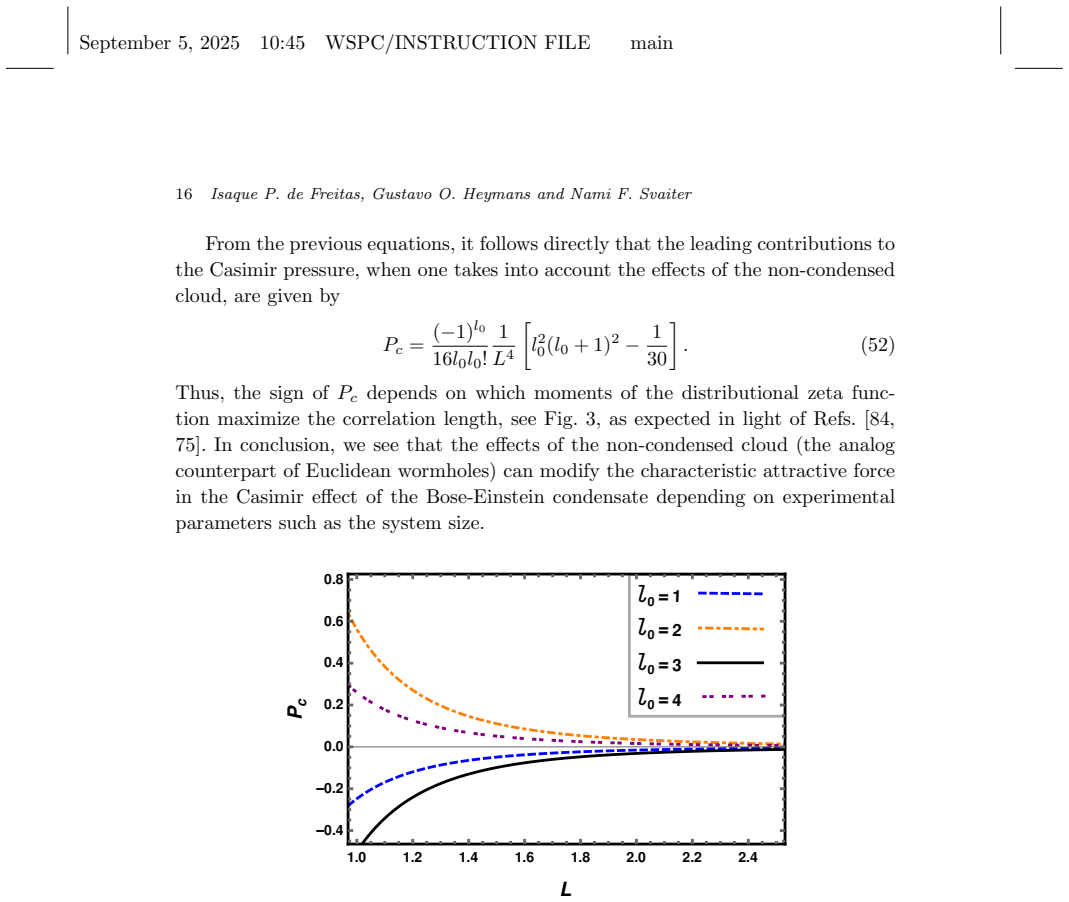
On the paper's own terms, the central discovery is that averaging the quenched free energy of a Bose-Einstein condensate with additive surface disorder produces an effective action containing the non-local term $-k\sigma^2 \int d^2x \int_0^L dz \int_0^L dz'\, \phi^*(x,z)C(z-z')\phi(x,z')$, with $C(z-z')$ encoding the disorder correlation along the confinement axis. This term has the structure of the wormhole insertion $\phi_i(x)C_{ij}(x,y)\phi_j(y)$ in the Euclidean quantum-gravity partition function, with $C$ playing the role of the wormhole kernel that does not depend on spacetime separation. Regularizing the resulting spectrum $q_x^2+q_z^2+k\sigma^2\epsilon|q_z|+m_0^2$ with the spectral zeta function, the paper obtains a leading Casimir pressure $P_c = \frac{(-1)^{l_0}}{16\, l_0\, l_0!\, L^4}\,[l_0^2(l_0+1)^2-\tfrac{1}{30}]$, whose sign is controlled by the integer $l_0$ selected by the correlation length. The paper concludes that the non-condensed cloud acts as the analog counterpart of Euclidean wormholes and can modify the usual attractive Casimir effect of the condensate.
Load-bearing premise
The argument stands on Eq. (21) in Sec. 3, an identity expressing the averaged logarithm of the partition function as a series of moments plus a remainder; the identity is asserted rather than proved, and every subsequent effective action, spectrum, and Casimir pressure inherits its validity.
Editorial extensions
If this is right
- The non-condensed atomic cloud is not just a source of noise: after disorder averaging it induces non-local, distance-independent couplings inside the condensate, with the same mathematical form as Euclidean wormhole insertions.
- The disorder-induced Casimir pressure between the confining surfaces can be attractive or repulsive depending on the integer $l_0$, which is fixed by the ratio of the correlation length to the plate separation; this contrasts with the purely attractive pressure of the ideal condensate slab.
- The pressure scales as $1/L^4$, so the effect is strongest at small separations and can in principle be distinguished from the standard $1/d^4$ Casimir force by its $l_0$-dependent prefactor and alternating sign.
- The replica structure behind the effective action means the quenched free energy is assembled from moments $E[Z^k]$, so the analog wormhole amplitude is governed by the same moment expansion used for the Casimir energy.
Reading between the lines
- A natural extension, not stated in the paper, is that any confined quantum fluid with surface disorder could exhibit wormhole-like non-local terms, so the analog may be testable in other slab geometries such as superfluid helium films or polariton condensates.
- A direct experimental check would measure the force between the two confining plates as a function of $L$; the predicted alternating sign would appear as changes in whether the plates are pulled together or pushed apart as $L$ crosses values corresponding to successive integers $l_0$.
- Because the non-local kernel connects points at the same transverse coordinate $x$ but arbitrary $z$, the analog wormhole is effectively one-dimensional along the confinement axis; density-density correlations between the surface region and the bulk at fixed $x$ would carry the signature of the kernel $C(z-z')$.
Editorial analysis
A structured set of objections, weighed in public.
Referee Report
Summary. The manuscript studies a Bose-Einstein condensate interacting with a non-condensed thermal cloud, modeling the interaction as quenched disorder. It proposes a distributional zeta-function representation of the quenched free energy and derives effective actions for multiplicative and additive disorder. With the condensate confined between two planar surfaces, the paper claims that random surface fields generate non-local bilinear terms in the effective action and that these terms constitute an analog model of Euclidean wormholes. The final section computes a disorder-dependent Casimir pressure whose sign alternates with an integer parameter l0. The central claim is that the nonlocal effects in the condensed-matter system define a Euclidean-wormhole analog and that the leading Casimir pressure due to these effects is obtained.
Significance. If the derivation were sound, the paper would offer a creative condensed-matter analog in which quenched surface disorder produces a nonlocal effective action structurally similar to the wormhole bilinear in Euclidean quantum gravity, together with a sign-controllable Casimir pressure. The conceptual link between replica-style disorder averages and Euclidean wormholes is interesting and merits attention. However, the significance is conditional: the paper does not derive the nonlocal kernel from the microscopic BEC/cloud interaction, and the mathematical steps leading to the pressure contain load-bearing errors. The manuscript does not provide reproducible code, machine-checked proofs, or an experimental calibration, so its value rests entirely on the validity of the analytic derivation, which is currently not established.
major comments (4)
- [Sec. 3, Eq. (21)] Equation (21) is asserted without proof and fails a simple consistency test. For a deterministic partition function Z=1, E[ln Z]=0 and E[Z^k]=1 for all k. The right-hand side of Eq. (21) is then S(c)+ln c+gamma-R(c), where S(c)=sum_{k>=1} (-1)^{k+1} c^k/(k! k). Since S(c)=gamma+ln c-Ei(-c), the equality forces R(c) to be approximately 2gamma+2ln c for large c, which grows logarithmically. This directly contradicts the stated bound |R(c)| <= e^{-Z(0)c}/(c Z(0)), which decays exponentially. Thus Eq. (21) cannot be a valid representation of the quenched free energy as stated. Because Eqs. (24), (25), (27), and (35) all use this expansion, the derivation of the nonlocal effective action is not grounded.
- [Sec. 6, Eq. (41)] The Fourier-space propagator in Eq. (41) does not follow from the equation of motion (37) with the step kernel (38). On the finite interval [0,L] the kernel is not translation invariant, and Fourier transformation in q_z is not legitimate under Dirichlet boundary conditions. Acting on f(z)=sin(n pi z / L), the integral term gives [b1 - b2 (-1)^n]/(n pi/L) + (b2 - b1)/(n pi/L) cos(n pi z / L), which is not proportional to f(z). The sine modes therefore do not diagonalize the operator, and the dispersion relation q_x^2 + q_z^2 + k sigma^2 epsilon |q_z| + m_0^2 in Eq. (41) is not the spectrum of the model. Since Eqs. (43)-(46) build the spectral zeta function on this dispersion relation, the subsequent Casimir energy and pressure inherit the error. In addition, the sign of the nonlocal term in Eq. (40) appears opposite to that in Eq. (37) unless an unexplained sign convention is being used.
- [Sec. 6, Eqs. (50)-(52)] Equation (51) is not the derivative of the Casimir energy defined in Eq. (50). Differentiating Ec = (-1)^{l0}/(l0 l0!) exp[l0 ln c - zeta_O(-1/2)] with respect to L produces a factor exp[l0 ln c - zeta_O(-1/2)] and no factor 1/2. Equation (51) contains a factor 1/2 and no exponential. If c is chosen to maximize the exponential, as stated in the text after Eq. (50), then c becomes L-dependent and its derivative must also be included. Consequently Eq. (52) is not the pressure obtained from the stated Casimir energy, and the sign-alternating prediction in Fig. 3 is unsupported.
- [Sec. 5, Eqs. (27)-(35); Sec. 6, Eq. (38)] The nonlocal kernel C(z-z') is chosen by hand rather than derived from the physical model. The correlation function obtained from the surface-disorder assumption is F=delta^2(x-x')[delta(z)+delta(z-L)], which gives boundary-local terms. The wormhole-like bilinear action only appears after postulating F=delta^2(x-x') C(z-z') with an unspecified C, and the specific step kernel in Eq. (38) is introduced as the simplest form. The paper therefore does not demonstrate that random surface fields generate the nonlocal wormhole structure from the BEC/cloud dynamics; it inserts that structure as a modeling assumption. The subsequent regularization choices k = floor(2 m_0/(sigma^2 epsilon)) l and l0 = floor(sqrt(m_0^2 L^2 / pi)) are imported from Ref. [66] without derivation, so the final pressure depends on special parameter choices rather than on a systematic calculation.
minor comments (4)
- [Sec. 6, Fig. 3] The figure labels curves by fixed values of l0 while L is varied, but l0 is defined as the integer part of sqrt(m_0^2 L^2 / pi), so l0 depends on L. Treating l0 as an independent curve label while plotting against L is inconsistent.
- [Sec. 2, Eqs. (9)-(14)] The passage from Eq. (10) to Eq. (11) uses several unexplained numerical factors (for example 9/10 and 1/10) and redefinitions without showing the algebra; a reader cannot reproduce the effective Hamiltonian from the stated starting point.
- [Sec. 4, Eq. (24)] The notation phi_j^{*2}(x,z) phi_i^2(x',z') is ambiguous: it is not clear whether these are complex squares, moduli squared, or replica indices, and the distinction matters for the meaning of the effective action.
- [References] Several reference entries contain typographical artifacts, such as 'Word Scientific' in Ref. [83] and the spacing in 'Funda¸ c˜ ao'; these should be corrected in a final version.
Circularity Check
The wormhole analog and the Casimir-pressure prediction are partly circular: the nonlocal kernel is inserted by hand, and the regularized spectrum and k-set used for the pressure are imported from the authors' own Ref. [66] rather than derived from the slab equation of motion.
-
renaming known result
[Sec. 5, Eq. (35) and surrounding paragraph]
"However, for an analog model of Euclidean wormholes, the contribution of F(x,z;x',z') is interesting when it is not δ-correlated along the z axis. Therefore, consider F(x,z;x',z') = δ²(x−x')C(z−z'), in which C(z−z') is expected to encode the non-locality. ... The above result shows similarity to the action for Euclidean quantum gravity (see Eq. (1)). In this comparison, C(z−z') would play the same role as C_ij(x,y), thus configuring the Bose-Einstein condensate interacting with the non-condensed atomic gas cloud as an analogous model for Euclidean wormholes."
The abstract's claim that 'random surface fields generate non-local terms' is not derived: the non-locality is put into the disorder covariance F by hand. The effective action S_σ then reproduces the wormhole bilinear by construction, because C(z−z') is chosen precisely to make the action 'similar' to Eq. (1). The later Casimir calculation inherits this hand-picked C, so the analog-model conclusion is equivalent to the ansatz rather than a first-principles result.
-
uniqueness imported from authors
[Sec. 6, Eqs. (40)-(46)]
"Proceeding in an analogous way to Ref. [66], we can obtain the Fourier representation of the two-point correlation function of the k-th equation of motion, Eq. (37), as: G^(k)_0(q_x,q_z)=1/(q_x^2+q_z^2+kσ²ε|q_z|+m0²) ... As explicitly obtained in Ref. [66], only a set of k's can be regularized; such a set is given by k=⌊2m0/(σ²ε)⌋ l, l∈N ... therefore, the main contribution to the Casimir energy will be related to ζ_O(s)=... (46)."
The propagator (41), the special allowed k-values, and the l0 choice that turn Eq. (45) into the Hurwitz-zeta expression (46) are imported from Ref. [66], a prior paper by the same authors, rather than derived from the equation of motion (37) for this slab. Because the zeta-regularized Casimir energy (47)-(49) and the final pressure (52) are built entirely on that imported spectrum and k-set, the central 'prediction' is controlled by a self-cited construction. No independent derivation or external check is supplied for the imported regularization.
full rationale
The derivation chain is not self-contained. The nonlocal wormhole-like action is obtained by selecting a nonlocal covariance F=δ²C, so the advertised 'generation' of nonlocal terms is an input ansatz; the final Casimir pressure then depends on that arbitrary C and on the k/l0 restrictions borrowed from the authors' prior Ref. [66]. This makes the central claim partially circular. I do not count the unproved Eq. (21) expansion or the apparent derivative inconsistency in Eq. (51) as circularity: Eq. (21) is a questionable mathematical identity, and Eq. (51) not following from Eq. (50) is an internal-error/correctness issue, not a reduction of output to input. If the only concerns were errors, the score would be low; the circularity score is raised by the hand-inserted kernel and the self-citation load-bearing regularization.
Assumptions & free parameters
free parameters (6)
- sigma (disorder strength) =
not specified
- epsilon = |b2 - b1| =
not specified
- c =
not specified
- l0 =
floor(sqrt(m0^2 L^2 / pi))
- k =
floor(2 m0 / (sigma^2 epsilon)) * l, l in N
- m0 =
positive constant
assumptions (5)
- ad hoc to paper The distributional zeta expansion Eq. (21) is a valid identity for E[ln Z].
- domain assumption The disorder correlation has the form delta^2(x - x') C(z - z').
- domain assumption The Hartree-Fock-Bogoliubov-Popov approximation discards m(r) and h(r).
- ad hoc to paper The step-function kernel C(z-z') is equivalent to fractional derivatives D^1_0 and D^1_L.
- ad hoc to paper Only the k set and l = l0 choices are regularizable in the spectral zeta function.
invented entities (1)
-
Non-local surface disorder kernel C(z-z') = b1 theta(z-z') + b2 theta(z'-z)
Cite this review
Pith. "Pith review of Analog model for Euclidean wormholes: Bose-Einstein condensate with dirty surfaces." pith.science (2026). https://pith.science/paper/VVOOM2VS
@misc{pith2026241211204,
  author       = {Pith},
  title        = {Pith review of: Analog model for Euclidean wormholes: Bose-Einstein condensate with dirty surfaces},
  year         = {2026},
  howpublished = {\url{https://pith.science/paper/VVOOM2VS}},
  note         = {Machine review of arXiv:2412.11204}
}
read the original abstract
We study a Bose-Einstein condensate under the effects of the non-condensate atomic cloud. We model the resulting linear interaction of the condensate with the atomic gas as a quenched disorder. Using the distributional zeta function method, we obtain a representation for the quenched free energy as a series of integral moments of the partition function. Assuming that the Bose-Einstein condensate is confined between two planar surfaces, we show that random surface fields generate non-local terms in the effective action. The non-local effects in this condensed matter system define an analog model of a Euclidean wormhole. The leading contribution of the non-local interactions to the Casimir pressure is obtained.
Figures


Reference graph
Works this paper leans on
-
[66]
G. O. Heymans, N. F. Svaiter and G. Krein,Phys. Rev. D106(2022) 125004, arXiv:2207.06927 [hep-th]
work page Pith review arXiv 2022
-
[1]
S. N. Bose,Zeitschrift f¨ ur Physik26(1924) 178. September 5, 2025 10:45 WSPC/INSTRUCTION FILE main 18Isaque P. de Freitas, Gustavo O. Heymans and Nami F. Svaiter
1924
-
[2]
Einstein,K¨ onigliche Preußische Akademie der Wissenschaften3(1925) 261
A. Einstein,K¨ onigliche Preußische Akademie der Wissenschaften3(1925) 261
1925
-
[3]
Griffin, D
A. Griffin, D. W. Snoke and S. Stringari,Bose-Einstein Condensation(Cambridge University Press, 1995)
1995
-
[4]
C. J. Pethick and H. Smith,Bose-Einstein Condensation in Dilute Gases(Cambridge University Press, Cambridge, U.K., 2002)
2002
-
[5]
L. Pitaevskii and S. Stringari,Bose-Einstein Condensation(Oxford University Press, NY, 2003)
work page 2003
- [6]
- [7]
Show all 84 references
-
[8]
Matsubara,Prog
T. Matsubara,Prog. of Theo. Phys.6(10 1951) 714, https://academic.oup.com/ptp/article-pdf/6/5/714/5216701/6-5-714.pdf
1951
-
[9]
R. P. Feynman,Phys. Rev.91(1953) 1291
1953
-
[10]
M. H. Anderson, J. R. Ensher, M. R. Matthews, C. E. Wieman and E. A. Cornell, Science269(1995) 198
1995
-
[11]
D. G. Fried, T. C. Killian, L. Willmann, D. Landhuis, S. C. Moss, D. Kleppner and T. J. Greytak,Phys. Rev. Lett.81(1998) 3811
1998
-
[12]
T. K. Hakala, A. J. Moilanen, A. I. V¨ akev¨ ainen, R. Guo, J.-P. Martikainen, K. S. Daskalakis, H. T. Rekola, A. Julku and P. T¨ orm¨ a,Nat. Phys.14(2018) 739, arXiv:1706.01528 [cond-mat.quant-gas]
2018 arXiv
-
[13]
Zaremba, T
E. Zaremba, T. Nikuni and A. Griffin,Journal of Low Temperature Physics116(1999) 277,arXiv:cond-mat.stat-mech/9903029
1999
-
[14]
Griffin, T
A. Griffin, T. Nikuni and E. Zaremba,Bose-Condensed Gases at Finite Temperature (Cambridge University Press, Cambridge, U.K., 2009)
2009
-
[15]
W. H. Zurek,Phys. Rept.276(1996) 177,arXiv:cond-mat/9607135
1996 arXiv
-
[16]
N. N. Bogolyubov,J. Phys. (USSR)11(1947) 23
1947
-
[17]
K. T. Geier, J. Maki, A. Biella, F. Dalfovo, S. Giorgini and S. Stringari (2024) arXiv:2407.17558 [cond-mat.quant-gas]
2024 arXiv
-
[18]
W. G. Unruh,Phys. Rev. Lett.46(1981) 1351
1981
-
[19]
Novello, M
M. Novello, M. Visser and G. Volovick,Artificial Black Holes(World Scientific, 2002)
2002
-
[20]
W. G. Unruh and R. Sch¨ utzhold,Quantum Analogues: From Phase Transitions to Black Holes and Cosmology(Springer, Heidelberg, 2007)
2007
-
[21]
W. G. Unruh,Phys. Rev. D51(1995) 2827
1995
- [22]
-
[23]
T. A. Jacobson and G. E. Volovik,Phys. Rev. D58(1998) 064021, arXiv:cond-mat/9801308
1998 arXiv
-
[24]
Barcelo, S
C. Barcelo, S. Liberati and M. Visser,Class. Quant. Grav.18(2001) 1137, arXiv:gr-qc/0011026
2001 arXiv
-
[25]
Balbinot, S
R. Balbinot, S. Fagnocchi and A. Fabbri,Phys. Rev. D71(2005) 064019, arXiv:gr-qc/0405098
2005 arXiv
- [26]
-
[27]
Schmitz, R
H. Schmitz, R. Matjeschk, C. Schneider, J. Glueckert, M. Enderlein, T. Huber and T. Schaetz,Phys. Rev. Lett.103(2009) 090504,arXiv:0904.4214 [quant-ph]
2009 arXiv
-
[28]
L. J. Garay, J. R. Anglin, J. I. Cirac and P. Zoller,Phys. Rev. Lett.85(2000) 4643, arXiv:gr-qc/0002015
2000 arXiv
-
[29]
P. Jain, S. Weinfurtner, M. Visser and C. W. Gardiner,Physical Review A76(2007) arXiv:0705.2077 [cond-mat.other]
2007 arXiv
-
[30]
L. H. Ford,Phys. Rev. D51(1995) 1692,arXiv:gr-qc/9410047
1995 arXiv
-
[31]
B. L. Hu and K. Shiokawa,Phys. Rev. D57(1998) 3474,arXiv:gr-qc/9708023
1998 arXiv
-
[32]
L. H. Ford and N. F. Svaiter,Phys. Rev. D54(1996) 2640,arXiv:gr-qc/9604052
1996 arXiv
-
[33]
L. H. Ford and N. F. Svaiter,Phys. Rev. D56(1997) 2226,arXiv:gr-qc/9704050. September 5, 2025 10:45 WSPC/INSTRUCTION FILE main Analog model for Euclidean wormholes:Bose-Einstein condensate with dirty surfaces19
1997 arXiv
- [34]
-
[35]
R. T. Thompson and L. H. Ford,Class. Quant. Grav.25(2008) 154006, arXiv:0802.1546 [gr-qc]
2008 arXiv
-
[36]
R. T. Thompson and L. H. Ford,Phys. Rev. D78(2008) 024014,arXiv:0803.1980 [gr-qc]
2008 arXiv
-
[37]
H. W. Yu, N. F. Svaiter and L. H. Ford,Phys. Rev. D80(2009) 124019, arXiv:0904.1087 [gr-qc]
2009 arXiv
-
[38]
Krein, G
G. Krein, G. Menezes and N. F. Svaiter,Phys. Rev. Lett.105(2010) 131301, arXiv:1006.3350 [hep-th]
2010 arXiv
-
[39]
Arias, E
E. Arias, E. Goulart, G. Krein, G. Menezes and N. F. Svaiter,Phys. Rev. D83(2011) 125022,arXiv:1103.3551 [hep-th]
2011 arXiv
-
[40]
Arias, G
E. Arias, G. Krein, G. Menezes and N. F. Svaiter,Int. J. Mod. Phys. A27(2012) 1250129,arXiv:1109.6080 [hep-th]
2012 arXiv
-
[41]
L. Ford, V. De Lorenci, G. Menezes and N. Svaiter,Ann. of Phys.329(2013) 80, arXiv:1202.3099 [gr-qc]
2013 arXiv
-
[42]
Arias, C
E. Arias, C. H. G. Bessa, J. G. Due˜ nas, G. Menezes and N. F. Svaiter,Int. J. Mod. Phys. A29(2014) 1450024,arXiv:1307.4749 [hep-th]
2014 arXiv
-
[43]
S. B. Giddings (2022)arXiv:2202.08292 [hep-th]
2022 arXiv
-
[44]
Symanzik,New York University, Courant Institute of Mathematical Sciences Re- port, IMM-NYU 327(1964)
K. Symanzik,New York University, Courant Institute of Mathematical Sciences Re- port, IMM-NYU 327(1964)
1964
-
[45]
L. R. F. Guerra and B. Simon,Ann. of Math.101(1975)
1975
-
[46]
Glimm and A
J. Glimm and A. Jaffe,Quantum Physics: A Functional Integral point of view(Springer Verlag, NY, 1981)
1981
-
[47]
Jaffe,Nuc
A. Jaffe,Nuc. Phys. B254(1985) 31
1985
-
[48]
S. W. Hawking,NATO Sci. Ser. B44(1979) 145
1979
-
[49]
C. J. Isham, R. Penrose and D. W. Sciama,Quantum Gravity 2: A Second Oxford Symposium(Oxford Science Publications, (1981))
1981
-
[50]
S. W. Hawking,Phys. Rev. D37(1988) 904
1988
-
[51]
Kiefer,Quantum Gravity(Oxford Science Publications, (2007))
C. Kiefer,Quantum Gravity(Oxford Science Publications, (2007))
2007
-
[52]
B. S. DeWitt and G. Esposito,Int. J. Geom. Meth. Mod. Phys.05(2008) 101, arXiv:0711.2445 [hep-th]
2008 arXiv
-
[53]
Anderson and B
A. Anderson and B. S. DeWitt,Found. Phys.16(1986) 91
1986
-
[54]
Coleman,Nuc
S. Coleman,Nuc. Phys. B310(1988) 643
1988
-
[55]
Preskill,Nuc
J. Preskill,Nuc. Phys. B323(1989) 141
1989
-
[56]
S. B. Giddings and A. Strominger,Phys. Lett. B230(1989) 46
1989
-
[57]
Klebanov, L
I. Klebanov, L. Susskind and T. Banks,Nucl. Phys. B137(1989) 665
1989
-
[58]
G. O. Heymans, N. F. Svaiter and G. a. Krein,Int. J. Mod. Phys. D32(2023) 2342019, arXiv:2305.07990 [hep-th]
2023 arXiv
-
[59]
Engelhardt, S
N. Engelhardt, S. Fischetti and A. Maloney,Phys. Rev. D103(2021) 046021, arXiv:2007.07444 [hep-th]
2021 arXiv
-
[60]
Okuyama,JHEP03(2021) 073,arXiv:2101.05990 [hep-th]
K. Okuyama,JHEP03(2021) 073,arXiv:2101.05990 [hep-th]
2021 arXiv
-
[61]
B. F. Svaiter and N. F. Svaiter,Int. J. Mod. Phys. A31(2016) 1650144, arXiv:1603.05919 [cond-mat.stat-mech]
2016 arXiv
-
[62]
B. F. Svaiter and N. F. Svaiter (2016)arXiv:1606.04854 [math-ph]
2016 arXiv
-
[63]
R. J. A. Diaz, C. D. Rodr ´ ıguez-Camargo and N. F. Svaiter,Polymers12(2020) 1066, arXiv:1609.07084 [cond-mat.stat-mech]
2020 arXiv
-
[64]
R. A. Diaz, G. Menezes, N. F. Svaiter and C. A. D. Zarro,Phys. Rev. D96(2017) 065012,arXiv:1705.06403 [hep-th]
2017 arXiv
-
[65]
R. A. Diaz, N. F. Svaiter, G. Krein and C. A. D. Zarro,Phys. Rev. D97(2018) 065017,arXiv:1712.07990 [cond-mat.stat-mech]. September 5, 2025 10:45 WSPC/INSTRUCTION FILE main 20Isaque P. de Freitas, Gustavo O. Heymans and Nami F. Svaiter
2018 arXiv
-
[67]
G. O. Heymans, G. Scorza, N. F. Svaiter and C. D. Rodr ´ ıguez-Camargo (2024) arXiv:2404.09923 [gr-qc]
2024 arXiv
-
[68]
Acosta-Diaz, C
R. Acosta-Diaz, C. A. D. Zarro, G. Krein, A. Saldivar and N. F. Svaiter,J. Phys. A 52(2019) 445401,arXiv:1906.03108 [cond-mat.stat-mech]
2019 arXiv
- [69]
-
[70]
N. N. Bogolyubov,Phys. Usp.2(1959) 236
1959
-
[71]
D. A. W. Hutchinson, E. Zaremba and A. Griffin,Phys. Rev. Lett.78(1997) 1842, arXiv:cond-mat.stat-mech/9611023
1997
-
[72]
V. N. Popov,Functional Integrals and Collective Modes(Cambridge University Press, New York, 1987)
1987
-
[73]
Sachdev,Quantum Phase Transitions(Cambridge University Press, New York, 1999)
S. Sachdev,Quantum Phase Transitions(Cambridge University Press, New York, 1999)
1999
-
[74]
Aharony and V
O. Aharony and V. Narovlansky,Phys. Rev. D98(2018) 045012,arXiv:1803.08534 [hep-th]
2018 arXiv
-
[75]
G. O. Heymans, N. F. Svaiter, B. F. Svaiter and G. Krein,Phys. Rev. E109(2024) 054108,arXiv:2402.01588 [cond-mat.soft]
2024 arXiv
-
[76]
H. B. G. Casimir,Indag. Math.10(1948) 261
1948
-
[77]
S. K. Lamoreaux,Phys. Rev. Lett.78(1997) 5
1997
-
[78]
Bressi, G
G. Bressi, G. Carugno, R. Onofrio and G. Ruoso,Phys. Rev. Lett.88(2002) 041804, arXiv:quant-ph/0203002
2002 arXiv
-
[79]
P. A. Martin and V. A. Zagrebnov,Europhys. Lett.73(2006) 15, arXiv:cond-mat/0507263
2006 arXiv
-
[80]
A. Edery,J. Stat. Mech.: Theory and Experiment2006(2006) 06007, arXiv:hep-th/0510238
2006 arXiv
-
[81]
Diethelm,The Analysis of Fractional Differential Equations: An Application- Oriented Exposition Using Differential Operators of Caputo Type(Springer Berlin, Heidelberg, 2010)
K. Diethelm,The Analysis of Fractional Differential Equations: An Application- Oriented Exposition Using Differential Operators of Caputo Type(Springer Berlin, Heidelberg, 2010)
2010
-
[82]
S. Blau, M. Visser and A. Wipf,Nucl. Phys. B310(1988) 163,arXiv:0906.2817 [hep-th]
1988 arXiv
-
[83]
Elizalde, S
E. Elizalde, S. D. Odintsov, A. Romeo, A. A. Bytsenko and S. Zerbini,Zeta Regular- ization Techniques with Applications(Word Scientific, 1994)
1994
-
[84]
C. D. Rodr ´ ıguez-Camargo, A. Saldivar and N. F. Svaiter,Phys. Rev. D105(2022) 105014,arXiv:2108.02330 [cond-mat.dis-nn]
2022 arXiv
Reviewed August 11, 2026 · model on record in the stance chip above.
Discussion (0). Continue with ORCID to comment.