REVIEW 2 major objections 4 minor 58 references
The new compact triple system: discovery of bright third star around contact binary using LAMOST-MRS spectra and photometry
T0 review · 2 major / 4 minor · reviewed 2026-08-16 · deepseek-v4-flash
Pith's one-line read J04+25 is a hierarchical triple system in which the third star is brighter than the inner contact binary and orbits it in about 941 days.
desk verdict A solid triple-system discovery with a clever spectral method, but the O-C timing errors are unrealistically small and the quoted outer-orbit precision is not yet credible. read the letter →
The pith
A machine-rendered reading of the paper's core claim, the machinery that carries it, and where it could break.
The reading
What carries the argument
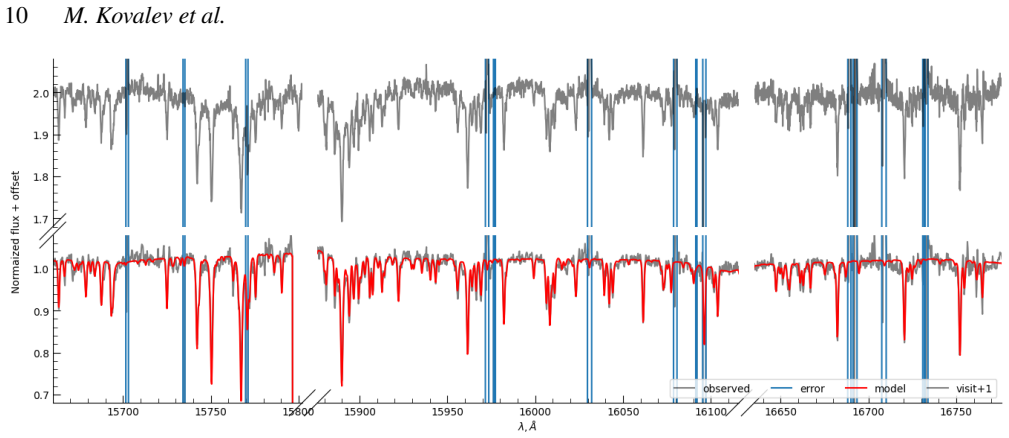
The central mechanism is the joint fit of two complementary observables: the radial velocities of the narrow-lined third star (a single-lined Keplerian orbit) and the light-travel-time effect in the eclipse-minimum times, modeled with a Keplerian O\,--\,C curve. The enabling step is the iterative two-stage spectral decomposition: the bright third-star spectrum is fit and subtracted first, then the residual contact-binary spectrum is re-fit, which yields radial velocities for all three components from blended spectra. Template matching against a Wilson\,--\,Devinney 'toy' light-curve model provides the eclipse-minimum times, and an MCMC sampler produces the joint orbit.
What would settle it
Measure the astrometric orbit of the outer system in a future Gaia data release: if the inferred inclination $i_3$ disagrees with the value $\sin i_3\approx0.92$ implied by the joint radial-velocity and LTTE fit, the mass projections are biased. A quicker check is to model the K2 and TESS light curves with spots and re-derive the times of minima; the O-C amplitude $A=0.00632\pm0.00010$ d must survive spot correction.
Extended reading notes
Core claim
The paper reports that J04+25 (T-Tau0-03027) is a hierarchical triple system: an inner contact eclipsing binary with orbital period $P_{12}=0.364277$ d is accompanied by a third star that contributes about 68\,--\,78 per cent of the total light in the surveyed bands. By extracting radial velocities for all three components from medium-resolution spectra with a two-step binary spectral fit, and by combining the third star's radial-velocity orbit with the light-travel-time signal in eclipse-minimum timings, the authors obtain a consistent outer orbit with $P_3=941.40\pm0.03$ d, $e_3=0.059\pm0.007$, a projected inner-binary mass $M_{12}\sin^3 i_3=1.05\pm0.02\,M_\odot$ and third-star projected mass $M_3\sin^3 i_3=0.90\pm0.02\,M_\odot$. They also find that the inner orbital period is decreasing at $dP/dt=-4.29\times10^{-8}$ d yr$^{-1}$, and they propose that the phase-dependent projected rotational velocity $V\sin i$ of the contact system can be used to estimate the period and minimal mass of contact binaries from spectra alone.
Load-bearing premise
The eclipse-minimum times produced by template matching are assumed to be accurate to about 0.00001 day with no systematic bias from the toy light-curve model, which cannot reproduce the spot-driven O'Connell effect in the K2 and TESS data; if spot activity or template mismatch shifts those times beyond the quoted random errors, the outer period, eccentricity, and mass projections could be biased.
Editorial extensions
If this is right
- The system becomes a rare benchmark in which the outer star outshines the inner binary, so its light must be accounted for in any future modeling of the contact pair.
- The joint solution predicts an astrometric wobble of the photocenter around the center of mass with an amplitude near 1 mas, which a future Gaia data release should be able to test.
- The empirical $V\sin i$ relation offers a spectroscopy-only route to estimate the period and minimal mass of contact binaries, usable on large samples from the same survey.
- The measured period decrease $dP/dt \simeq -4.3\times10^{-8}$ d yr$^{-1}$ gives a concrete rate for evolutionary models of angular-momentum loss in contact binaries.
Reading between the lines
- If the $V\sin i$ calibration holds for other contact binaries, single-epoch medium-resolution spectra become a crude dynamical probe, turning large spectroscopic surveys into mass estimators without photometric timing campaigns.
- A future astrometric orbit would convert the projected masses into true masses; comparing those with the contact binary's current period and temperature could test whether the outer companion drove the inner binary into contact through Kozai\,--\,Lidov cycles.
- The predicted reflected-light signal of order 3 ppm, though tiny, is a concrete observable for ultra-precise space photometry and offers a geometric check that is independent of both spectroscopy and eclipse timing.
Signed reviews
Editorial analysis
A structured set of objections, weighed in public.
Referee Report
Summary. This manuscript reports the discovery and characterization of J042901.09+254144.2 (J04+25) as a hierarchical triple consisting of a contact binary (P12 = 0.364 d) and a brighter, slowly rotating third star on a ~941 d outer orbit. Using LAMOST-MRS spectra, the authors extract radial velocities for all three components with an iterative 'Matryoshka' binary-model technique; using public photometry and a Wilson-Devinney 'toy' model, they measure eclipse times via template matching and jointly fit the third-star RVs and the O-C curve including light-travel-time (LTTE) variations. The resulting solution gives P3 = 941.40 ± 0.03 d, e3 = 0.059 ± 0.007, and projected masses M12 sin^3 i3 = 1.05 ± 0.02 and M3 sin^3 i3 = 0.90 ± 0.02 Msun. The paper also proposes an empirical method for estimating the period and minimal mass of contact binaries from the phase variation of V sin i measured in the spectra.
Significance. If the outer-orbit solution is robust, this is a valuable addition to the small sample of hierarchical triples in which the third star is brighter than the inner contact binary. The combination of an SB1 orbit of the third star with an independent LTTE O-C curve provides a rare consistency check on the wide-orbit parameters, and the two-step spectral decomposition is a sensible approach for medium-resolution, low-S/N data. The consistency between the joint solution, the GLS RV-only period (944 ± 6 d), the APOGEE single RV point, and the SED analysis strengthens the central claim. The proposed V sin i-based mass estimator is promising and could be useful for catalog-scale studies of contact binaries. The main weakness is that the reported timing precision appears far smaller than the acknowledged limitations of the light-curve model, so the formal uncertainties on the outer orbit need to be recalibrated before the quoted precision can be accepted.
major comments (2)
- [§3.3, Table B3, Figure 4] The quoted O-C timing uncertainties of ±0.00001 d (~0.9 s) are implausibly small given the authors' explicit statement in §3.2 and Figure 4 that the 'toy' W-D model cannot properly fit the K2 and TESS light curves because of the unmodeled O'Connell effect. The template-matching errors returned by curve_fit account only for photon noise and parameter covariance under the assumed template; they do not account for template distortion by time-variable spot-induced asymmetries, which can shift the apparent minimum by amounts comparable to the fitted LTTE amplitude A = 0.00632 d. Since these O-C points dominate the joint fit through their sheer number and tiny formal errors, a systematic timing bias of even 0.001 d could materially change P3, e3, and the derived mass projections. The authors should calibrate this systematic error, for example by comparing template matching with direct fits to individual minima, by injecting spot-like distortions into synthetic light curves, or by adding a jitter term in the O-C fit, and then re-derive the quoted uncertainties.
- [§3.3, Table 6] The joint fit reports P3 = 941.40 ± 0.03 d with an uncertainty that is two orders of magnitude smaller than the RV-only GLS value (P3 = 944.4 ± 5.8 d, Table 4). This dramatic improvement is driven almost entirely by the O-C data and their assumed ±0.00001 d errors. The authors should demonstrate the sensitivity of P3, e3, and the mass projections to plausible systematic O-C shifts (e.g., ±0.001 d) and to alternative relative weightings of the RV and O-C data. Without such a test, the quoted 0.03 d precision is not credible, even though the solution may be correct in a coarser sense.
minor comments (4)
- [§3.3, Figure 6] The residual plots for the O-C and RV fits show visible structure and outliers, but no reduced chi-square or rms residual values are reported; adding these statistics would help the reader judge the fit quality and the effective weight of the O-C points.
- [§4, Figure 7] The SED fitting code does not provide uncertainties, and the fitted distance of 619 pc differs from the Gaia DR3 single-star distance of 487 pc; this discrepancy is not discussed and should be addressed, as it may affect the inferred stellar parameters and the angular separation estimate in §5.
- [Table 5] The bandpass labels in Table 5 (e.g., 'L1g', 'L1V', 'L1K2', 'L1T43') are not defined in the caption; please add a sentence explaining the notation.
- [Appendix C] The authors state that four emcee walkers 'got stuck in wrong periods' and were removed, but they do not report the affected period range or how many samples were discarded; this information should be included for reproducibility.
Circularity Check
Central triple orbit is derived from independent RV3 and O-C data; only the V sin i consistency check is an in-sample calibration, so circularity is minor.
-
fitted input called prediction
[Section 5.2, Eq. 6 and following text]
"Linear fit is shown in the left panel of Figure 9: |ΔRV|= 13.52± 10.25+( 0.81± 0.04)𝑉 sin𝑖, (6) ... Using the linear relation we get (𝐾1+𝐾2)= 309± 27 km s−1, which together with doubled period provides us 𝑀12 sin3𝑖12= 1.12± 0.30𝑀⊙. This value is consistent with 𝑀12 sin3𝑖3= 1.05± 0.02𝑀⊙ from the joint fit of the third star orbit."
The linear relation (Eq. 6) is fitted to the same object's measurements of |ΔRV| and V sin i. The method then uses this in-sample calibration to estimate K1+K2 from the V sin i amplitude and derives M12 sin^3 i12, comparing it with the joint-fit value. Because the same RV1,2 data enter both the calibration (|ΔRV|) and the W-D/joint fit, the agreement is an in-sample consistency check rather than an independent prediction. This does not affect the central triple orbit, which rests on RV3 and O-C.
full rationale
The central claim—that J04+25 is a hierarchical triple with P3=941.40±0.03 d—is supported by two largely independent observables: the third-star radial velocities (from LAMOST-MRS spectra) and the O-C times of minima (from template matching on photometry). The template matching uses a W-D 'toy' model to generate light-curve templates, but the measured time shifts are not the model's orbital parameters; they are fitted shifts of the inner-binary eclipse shape. The joint fit of RV3 and O-C is therefore not reducing to its own inputs. The spectral model is borrowed from Kovalev et al. (2024b) but is described in detail in Appendix A, so the self-citation is not load-bearing. The only notable in-sample step is the V sin i method of Section 5.2, where a linear relation between |ΔRV| and V sin i is calibrated on J04+25 and then used to derive a mass estimate for the same object, yielding a consistency check rather than a prediction. This is minor and does not bear on the triple orbit. Systematic concerns about O-C timing errors from the unmodeled O'Connell effect are correctness risks, not circularity. Overall circularity is low.
Assumptions & free parameters
free parameters (5)
- LTTE semi-amplitude A =
0.00632 ± 0.00010 day
- Mass ratio q3 =
1.16 ± 0.01
- Orbital period of inner binary, P12 =
0.364277 d (fixed in W-D), 0.364275 d (updated ephemeris)
- Period change rate beta =
-4.28e-11 d/cycle^2
- W-D contact binary parameters (q12, i12, Omega, L1, L3) =
q12=0.853, i12=85.56 deg, various L1 and L3 per band
assumptions (5)
- domain assumption The eclipse timing variation of the contact binary is described by a Keplerian light-travel-time effect plus a smooth parabolic period change (Eq. 3).
- ad hoc to paper The W-D contact binary model (Mode=3) generates light-curve templates that are accurate enough for measuring times of minima, despite the O'Connell effect in K2/TESS.
- ad hoc to paper The binary spectral model, with one narrow-lined component and one broad-lined component, cleanly separates the third star from the combined light of the contact binary.
- domain assumption The empirical relation |ΔRV| = 13.5 + 0.81 V sin i (Eq. 6) from Kovalev et al. (2022) applies to this system and extends to V sin i up to 400 km/s.
- domain assumption Both components in the binary spectral fit have the same metallicity.
Cite this review
Pith. "Pith review of The new compact triple system: discovery of bright third star around contact binary using LAMOST-MRS spectra and photometry." pith.science (2026). https://pith.science/paper/VWZAIU7V
@misc{pith2026250421287,
  author       = {Pith},
  title        = {Pith review of: The new compact triple system: discovery of bright third star around contact binary using LAMOST-MRS spectra and photometry},
  year         = {2026},
  howpublished = {\url{https://pith.science/paper/VWZAIU7V}},
  note         = {Machine review of arXiv:2504.21287}
}
abstract
We present a study of the third star orbiting around known contact eclipsing binary J04+25 using spectra from the LAMOST medium-resolution survey (MRS) and publicly available photometry. This is a rare case of a hierarchical triple, where the third star is significantly brighter than the inner contact subsystem. We successfully extracted radial velocities for all three components, using the binary spectral model in two steps. Third star radial velocities have high precision and allow direct fitting of the orbit. The low precision of radial velocity measurements in the contact system is compensated by large number statistics. We employed a template matching technique for light curves to find periodic variation due to the light time travel effect (LTTE) using several photometric datasets. Joint fit of third star radial velocities and LTTE allowed us to get a consistent orbital solution with $P_3=941.40\pm0.03$ day and $e_3=0.059\pm0.007$. We made estimations of the masses $M_{\rm 12,~3}\sin^3{i_3}=1.05\pm0.02,~0.90\pm0.02~M_\odot$ in a wide system and discussed possible determination of an astrometric orbit in the future data release of Gaia. Additionally, we propose an empirical method for measuring a period and minimal mass of contact systems, based on variation of the projected rotational velocity ($V\sin{i}$) from the spectra.
Figures


Figures from the paper (6 more)



Reference graph
Works this paper leans on
-
[1]
Abdurro'uf et al., 2022, @doi [ ] 10.3847/1538-4365/ac4414 , https://ui.adsabs.harvard.edu/abs/2022ApJS..259...35A 259, 35
-
[2]
Allard F., Homeier D., Freytag B., 2011, in Johns-Krull C., Browning M. K., West A. A., eds, Astronomical Society of the Pacific Conference Series Vol. 448, 16th Cambridge Workshop on Cool Stars, Stellar Systems, and the Sun. p. 91 ( @eprint arXiv 1011.5405 ), @doi 10.48550/arXiv.1011.5405
-
[3]
Borkovits T., et al., 2025, @doi [ ] 10.1051/0004-6361/202453616 , https://ui.adsabs.harvard.edu/abs/2025A&A...695A.209B 695, A209
-
[4]
Borucki W. J., et al., 2010, @doi [Science] 10.1126/science.1185402 , https://ui.adsabs.harvard.edu/abs/2010Sci...327..977B 327, 977
-
[5]
Butters O. W., et al., 2010, @doi [ ] 10.1051/0004-6361/201015655 , https://ui.adsabs.harvard.edu/abs/2010A&A...520L..10B 520, L10
-
[6]
Chen X., Wang S., Deng L., de Grijs R., Yang M., Tian H., 2020, @doi [ ] 10.3847/1538-4365/ab9cae , https://ui.adsabs.harvard.edu/abs/2020ApJS..249...18C 249, 18
-
[7]
Cui X.-Q., et al., 2012, @doi [Research in Astronomy and Astrophysics] 10.1088/1674-4527/12/9/003 , https://ui.adsabs.harvard.edu/abs/2012RAA....12.1197C 12, 1197
-
[8]
Cutri R. M., et al., 2013, Explanatory Supplement to the AllWISE Data Release Products , Explanatory Supplement to the AllWISE Data Release Products, by R. M. Cutri et al
work page 2013
Show all 58 references
-
[9]
R., Mitnyan T., Rappaport S
Czavalinga D. R., Mitnyan T., Rappaport S. A., Borkovits T., Gagliano R., Omohundro M., Kristiansen M. H. K., P \'a l A., 2023, @doi [ ] 10.1051/0004-6361/202245300 , https://ui.adsabs.harvard.edu/abs/2023A&A...670A..75C 670, A75
2023 doi
-
[10]
P., Huber K
Czesla S., Schr \"o ter S., Schneider C. P., Huber K. F., Pfeifer F., Andreasen D. T., Zechmeister M., 2019, PyA: Python astronomy-related packages ( @eprint ascl 1906.010 )
2019
-
[11]
H., Rucinski S
D'Angelo C., van Kerkwijk M. H., Rucinski S. M., 2006, @doi [ ] 10.1086/505265 , https://ui.adsabs.harvard.edu/abs/2006AJ....132..650D 132, 650
2006 doi
-
[12]
T., Mandushev G., Torres G., 2008, @doi [ ] 10.1088/0004-6256/135/3/850 , https://ui.adsabs.harvard.edu/abs/2008AJ....135..850D 135, 850
Devor J., Charbonneau D., O'Donovan F. T., Mandushev G., Torres G., 2008, @doi [ ] 10.1088/0004-6256/135/3/850 , https://ui.adsabs.harvard.edu/abs/2008AJ....135..850D 135, 850
2008 doi
-
[13]
Foreman-Mackey D., 2016, @doi [The Journal of Open Source Software] 10.21105/joss.00024 , 1, 24
2016 doi
-
[14]
W., Lang D., Goodman J., 2013, @doi [ ] 10.1086/670067 , https://ui.adsabs.harvard.edu/abs/2013PASP..125..306F 125, 306
Foreman-Mackey D., Hogg D. W., Lang D., Goodman J., 2013, @doi [ ] 10.1086/670067 , https://ui.adsabs.harvard.edu/abs/2013PASP..125..306F 125, 306
2013 doi
-
[15]
Gaia Collaboration et al., 2023a, @doi [ ] 10.1051/0004-6361/202243940 , https://ui.adsabs.harvard.edu/abs/2023A&A...674A...1G 674, A1
-
[16]
Gaia Collaboration et al., 2023b, @doi [ ] 10.1051/0004-6361/202243782 , https://ui.adsabs.harvard.edu/abs/2023A&A...674A..34G 674, A34
-
[17]
Grupp F., 2004a, @doi [ ] 10.1051/0004-6361:20040971 , 420, 289
-
[18]
Grupp F., 2004b, @doi [ ] 10.1051/0004-6361:20040456 , 426, 309
- [19]
-
[20]
u zel O., \
G \"u zel O., \"O zdarcan O., 2020, @doi [Contributions of the Astronomical Observatory Skalnate Pleso] 10.31577/caosp.2020.50.2.535 , https://ui.adsabs.harvard.edu/abs/2020CoSka..50..535G 50, 535
2020 doi
-
[21]
M., B \'o di A., 2022, @doi [ ] 10.1093/mnras/stac2533 , https://ui.adsabs.harvard.edu/abs/2022MNRAS.tmp.2394H
Hajdu T., Mat \'e csa B., Sallai J. M., B \'o di A., 2022, @doi [ ] 10.1093/mnras/stac2533 , https://ui.adsabs.harvard.edu/abs/2022MNRAS.tmp.2394H
2022 doi
-
[22]
Halbwachs J.-L., et al., 2023, @doi [ ] 10.1051/0004-6361/202243969 , https://ui.adsabs.harvard.edu/abs/2023A&A...674A...9H 674, A9
2023 doi
-
[23]
N., et al., 2018, @doi [ ] 10.3847/1538-3881/aae47f , https://ui.adsabs.harvard.edu/abs/2018AJ....156..241H 156, 241
Heinze A. N., et al., 2018, @doi [ ] 10.3847/1538-3881/aae47f , https://ui.adsabs.harvard.edu/abs/2018AJ....156..241H 156, 241
2018 doi
-
[24]
B., et al., 2014, @doi [ ] 10.1086/676406 , https://ui.adsabs.harvard.edu/abs/2014PASP..126..398H 126, 398
Howell S. B., et al., 2014, @doi [ ] 10.1086/676406 , https://ui.adsabs.harvard.edu/abs/2014PASP..126..398H 126, 398
2014 doi
-
[25]
X., et al., 2020a, @doi [Research Notes of the American Astronomical Society] 10.3847/2515-5172/abca2e , https://ui.adsabs.harvard.edu/abs/2020RNAAS...4..204H 4, 204
Huang C. X., et al., 2020a, @doi [Research Notes of the American Astronomical Society] 10.3847/2515-5172/abca2e , https://ui.adsabs.harvard.edu/abs/2020RNAAS...4..204H 4, 204
-
[26]
X., et al., 2020b, @doi [Research Notes of the American Astronomical Society] 10.3847/2515-5172/abca2d , https://ui.adsabs.harvard.edu/abs/2020RNAAS...4..206H 4, 206
Huang C. X., et al., 2020b, @doi [Research Notes of the American Astronomical Society] 10.3847/2515-5172/abca2d , https://ui.adsabs.harvard.edu/abs/2020RNAAS...4..206H 4, 206
-
[27]
Iliji \'c S., 2017, fd3: Spectral disentangling of double-lined spectroscopic binary stars , Astrophysics Source Code Library, record ascl:1705.012 ( @eprint ascl 1705.012 )
2017
-
[28]
Jayasinghe T., et al., 2018, @doi [ ] 10.1093/mnras/sty838 , https://ui.adsabs.harvard.edu/abs/2018MNRAS.477.3145J 477, 3145
2018 doi
-
[29]
2023, mkounkel/SEDFit: 0.3 , @doi 10.5281/zenodo.8076501
Kounkel, M. 2023, mkounkel/SEDFit: 0.3 , @doi 10.5281/zenodo.8076501
2023 doi
-
[30]
Kovalev M., 2019, PhD thesis, Heidelberg University, @doi 10.11588/heidok.00027411
2019 doi
-
[31]
Kovalev M., Bergemann M., Ting Y.-S., Rix H.-W., 2019, @doi [ ] 10.1051/0004-6361/201935861 , https://ui.adsabs.harvard.edu/abs/2019A&A...628A..54K 628, A54
2019 doi
-
[32]
Kovalev M., Chen X., Han Z., 2022, @doi [ ] 10.1093/mnras/stac2513 , https://ui.adsabs.harvard.edu/abs/2022MNRAS.517..356K 517, 356
2022 doi
-
[33]
Kovalev M., Wang S., Chen X., Han Z., 2023, @doi [ ] 10.1093/mnras/stac3767 , https://ui.adsabs.harvard.edu/abs/2023MNRAS.519.5454K 519, 5454
2023 doi
-
[34]
Y., Chen X., Han Z., 2024a, @doi [Research Notes of the American Astronomical Society] 10.3847/2515-5172/ad5f2f , https://ui.adsabs.harvard.edu/abs/2024RNAAS...8..175K 8, 175
Kovalev M. Y., Chen X., Han Z., 2024a, @doi [Research Notes of the American Astronomical Society] 10.3847/2515-5172/ad5f2f , https://ui.adsabs.harvard.edu/abs/2024RNAAS...8..175K 8, 175
-
[35]
Kovalev M., Zhou Z., Chen X., Han Z., 2024b, @doi [ ] 10.1093/mnras/stad3222 , https://ui.adsabs.harvard.edu/abs/2024MNRAS.527..521K 527, 521
-
[36]
arXiv:2005.07210
Liu C., et al., 2020, arXiv e-prints, https://ui.adsabs.harvard.edu/abs/2020arXiv200507210L p. arXiv:2005.07210
2020 arXiv
-
[37]
P., Qian S
Liu N. P., Qian S. B., Liao W. P., Huang Y., Yuan Z. L., 2023, @doi [ ] 10.3847/1538-3881/acd04e , https://ui.adsabs.harvard.edu/abs/2023AJ....165..259L 165, 259
2023 doi
-
[38]
J., et al., 2019, @doi [ ] 10.1088/1538-3873/aae8ac , https://ui.adsabs.harvard.edu/abs/2019PASP..131a8003M 131, 018003
Masci F. J., et al., 2019, @doi [ ] 10.1088/1538-3873/aae8ac , https://ui.adsabs.harvard.edu/abs/2019PASP..131a8003M 131, 018003
2019 doi
-
[39]
B., 1924, @doi [ ] 10.1086/142826 , https://ui.adsabs.harvard.edu/abs/1924ApJ....60...22M 60, 22
McLaughlin D. B., 1924, @doi [ ] 10.1086/142826 , https://ui.adsabs.harvard.edu/abs/1924ApJ....60...22M 60, 22
1924 doi
- [40]
-
[41]
O'Connell D. J. K., 1951, Publications of the Riverview College Observatory, https://ui.adsabs.harvard.edu/abs/1951PRCO....2...85O 2, 85
1951
-
[42]
J., et al., 2018, @doi [ ] 10.3847/1538-3881/aa9bf4 , https://ui.adsabs.harvard.edu/abs/2018AJ....155...39O 155, 39
Oelkers R. J., et al., 2018, @doi [ ] 10.3847/1538-3881/aa9bf4 , https://ui.adsabs.harvard.edu/abs/2018AJ....155...39O 155, 39
2018 doi
-
[43]
L., et al., 2006, @doi [ ] 10.1086/508556 , https://ui.adsabs.harvard.edu/abs/2006PASP..118.1407P 118, 1407
Pollacco D. L., et al., 2006, @doi [ ] 10.1086/508556 , https://ui.adsabs.harvard.edu/abs/2006PASP..118.1407P 118, 1407
2006 doi
-
[44]
M., 2006, @doi [ ] 10.1086/503871 , https://ui.adsabs.harvard.edu/abs/2006AJ....131.2986P 131, 2986
Pribulla T., Rucinski S. M., 2006, @doi [ ] 10.1086/503871 , https://ui.adsabs.harvard.edu/abs/2006AJ....131.2986P 131, 2986
2006 doi
-
[45]
R., et al., 2015, @doi [Journal of Astronomical Telescopes, Instruments, and Systems] 10.1117/1.JATIS.1.1.014003 , https://ui.adsabs.harvard.edu/abs/2015JATIS...1a4003R 1, 014003
Ricker G. R., et al., 2015, @doi [Journal of Astronomical Telescopes, Instruments, and Systems] 10.1117/1.JATIS.1.1.014003 , https://ui.adsabs.harvard.edu/abs/2015JATIS...1a4003R 1, 014003
2015 doi
-
[46]
A., 1924, @doi [ ] 10.1086/142825 , https://ui.adsabs.harvard.edu/abs/1924ApJ....60...15R 60, 15
Rossiter R. A., 1924, @doi [ ] 10.1086/142825 , https://ui.adsabs.harvard.edu/abs/1924ApJ....60...15R 60, 15
1924 doi
-
[47]
M., Pribulla T., van Kerkwijk M
Rucinski S. M., Pribulla T., van Kerkwijk M. H., 2007, @doi [ ] 10.1086/523353 , https://ui.adsabs.harvard.edu/abs/2007AJ....134.2353R 134, 2353
2007 doi
-
[48]
Shingles L., et al., 2021, Transient Name Server AstroNote, https://ui.adsabs.harvard.edu/abs/2021TNSAN...7....1S 7, 1
2021
-
[49]
G., et al., 2019, @doi [ ] 10.3847/1538-3881/ab3467 , https://ui.adsabs.harvard.edu/abs/2019AJ....158..138S 158, 138
Stassun K. G., et al., 2019, @doi [ ] 10.3847/1538-3881/ab3467 , https://ui.adsabs.harvard.edu/abs/2019AJ....158..138S 158, 138
2019 doi
-
[50]
B., 2005, in Shopbell P., Britton M., Ebert R., eds, Astronomical Society of the Pacific Conference Series Vol
Taylor M. B., 2005, in Shopbell P., Britton M., Ebert R., eds, Astronomical Society of the Pacific Conference Series Vol. 347, Astronomical Data Analysis Software and Systems XIV. p. 29
2005
-
[51]
L., et al., 2018, @doi [ ] 10.1088/1538-3873/aabadf , https://ui.adsabs.harvard.edu/abs/2018PASP..130f4505T 130, 064505
Tonry J. L., et al., 2018, @doi [ ] 10.1088/1538-3873/aabadf , https://ui.adsabs.harvard.edu/abs/2018PASP..130f4505T 130, 064505
2018 doi
-
[52]
L., Henden A
Watson C. L., Henden A. A., Price A., 2006, Society for Astronomical Sciences Annual Symposium, https://ui.adsabs.harvard.edu/abs/2006SASS...25...47W 25, 47
2006
-
[53]
E., 1979, @doi [ ] 10.1086/157588 , https://ui.adsabs.harvard.edu/abs/1979ApJ...234.1054W 234, 1054
Wilson R. E., 1979, @doi [ ] 10.1086/157588 , https://ui.adsabs.harvard.edu/abs/1979ApJ...234.1054W 234, 1054
1979 doi
-
[54]
E., Devinney E
Wilson R. E., Devinney E. J., 1971, @doi [ ] 10.1086/150986 , https://ui.adsabs.harvard.edu/abs/1971ApJ...166..605W 166, 605
1971 doi
-
[55]
Zechmeister M., K \"u rster M., 2009, @doi [ ] 10.1051/0004-6361:200811296 , https://ui.adsabs.harvard.edu/abs/2009A&A...496..577Z 496, 577
2009 doi
-
[56]
Zhang B., et al., 2021, @doi [ ] 10.3847/1538-4365/ac0834 , https://ui.adsabs.harvard.edu/abs/2021ApJS..256...14Z 256, 14
2021 doi
-
[57]
Zhao G., Zhao Y.-H., Chu Y.-Q., Jing Y.-P., Deng L.-C., 2012, @doi [Research in Astronomy and Astrophysics] 10.1088/1674-4527/12/7/002 , https://ui.adsabs.harvard.edu/abs/2012RAA....12..723Z 12, 723
2012 doi
-
[58]
write newline
" write newline "" before.all 'output.state := FUNCTION fin.entry write newline FUNCTION new.block output.state before.all = 'skip after.block 'output.state := if FUNCTION new.sentence output.state after.block = 'skip output.state before.all = 'skip after.sentence 'output.stat...
Reviewed August 16, 2026 · model on record in the stance chip above.
Discussion (0). Continue with ORCID to comment.