Real-time nuclear-electronic orbital time-dependent density functional theory with a constrained traveling proton basis
Pith reviewed 2026-06-29 14:52 UTC · model grok-4.3
The pith
Constrained traveling proton basis in RT-NEO-TDDFT produces accurate nuclear-electronic quantum dynamics while rigorously conserving energy.
A machine-rendered reading of the paper's core claim, the machinery that carries it, and where it could break.
Core claim
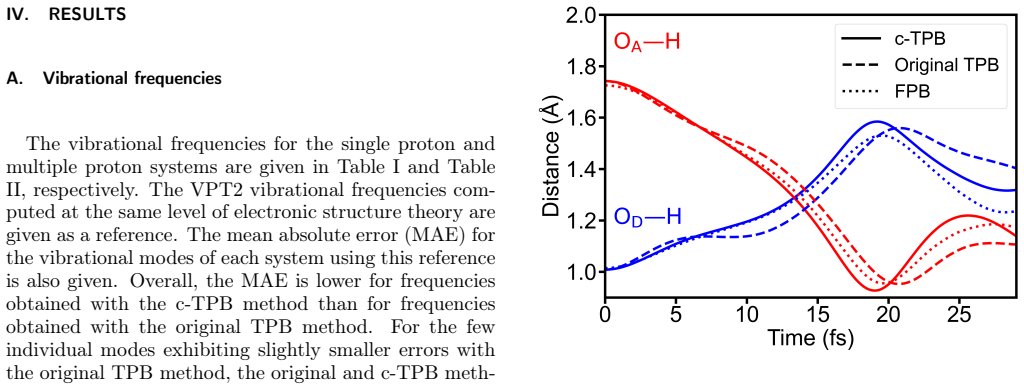
The c-TPB approach ensures each protonic basis function center coincides with the corresponding proton position expectation value during the dynamics. This produces accurate nuclear-electronic quantum dynamics and rigorously conserves energy. The accuracy and stability are shown for computing molecular vibrational frequencies as well as simulating excited-state intramolecular proton transfer and double proton transfer.
What carries the argument
The constrained traveling proton basis (c-TPB), which forces protonic basis centers to track the instantaneous proton position expectation value to remove basis-set artifacts during propagation.
If this is right
- Accurate molecular vibrational frequencies are obtained from the real-time dynamics.
- Excited-state intramolecular proton transfer is simulated in o-hydroxybenzaldehyde.
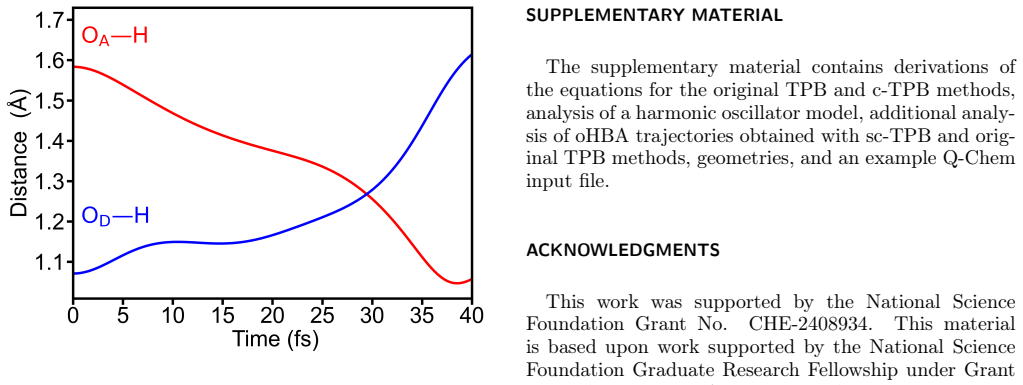
- Double proton transfer is simulated in [2,2'-bipyridyl]-3,3'-diol.
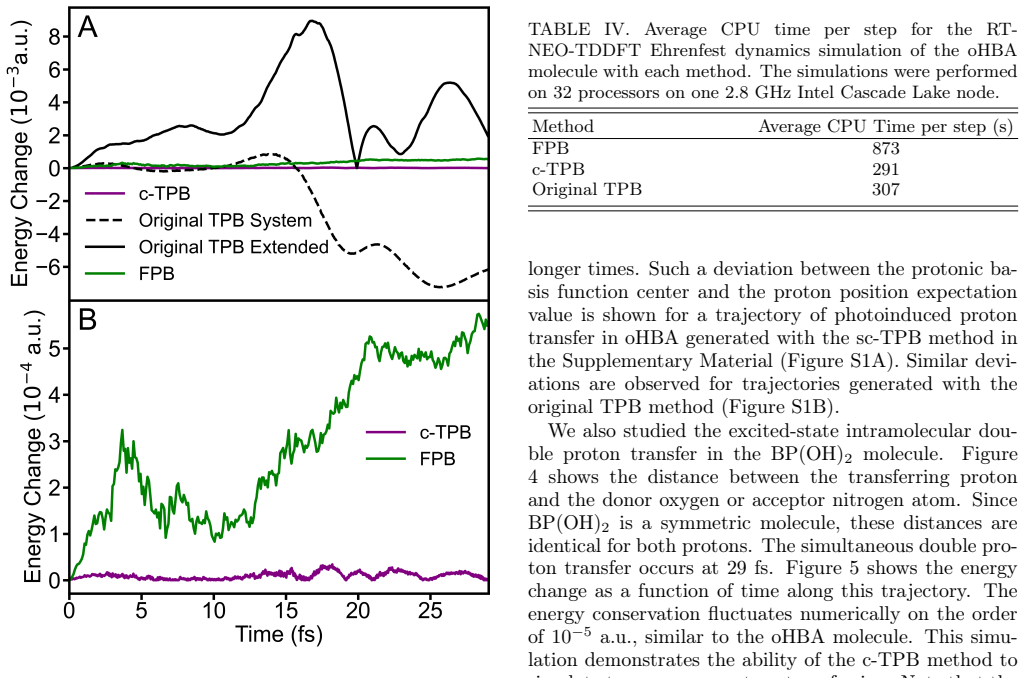
- Total energy is conserved to high precision throughout the propagation.
- The method remains computationally efficient for the tested systems.
Where Pith is reading between the lines
- The approach could be applied to enzymatic proton-transfer reactions where long-time energy conservation is required to distinguish physical from numerical effects.
- Systems containing several simultaneously quantum-treated protons could be studied to examine concerted versus sequential transfer mechanisms.
- Direct benchmarking against exact wave-function propagation on small model systems would quantify residual basis artifacts that survive the constraint.
- pacs':['81.15.-z','82.20.-w','82.20.Wt'],
Load-bearing premise
Forcing protonic basis centers to coincide exactly with the instantaneous proton position expectation value introduces no significant artifacts in the nuclear-electronic coupling or in the propagation of the time-dependent densities.
What would settle it
A direct comparison, on the same molecule, between c-TPB propagation and an unconstrained traveling proton basis that shows measurable energy drift or frequency error after several hundred femtoseconds of dynamics.
Figures
read the original abstract
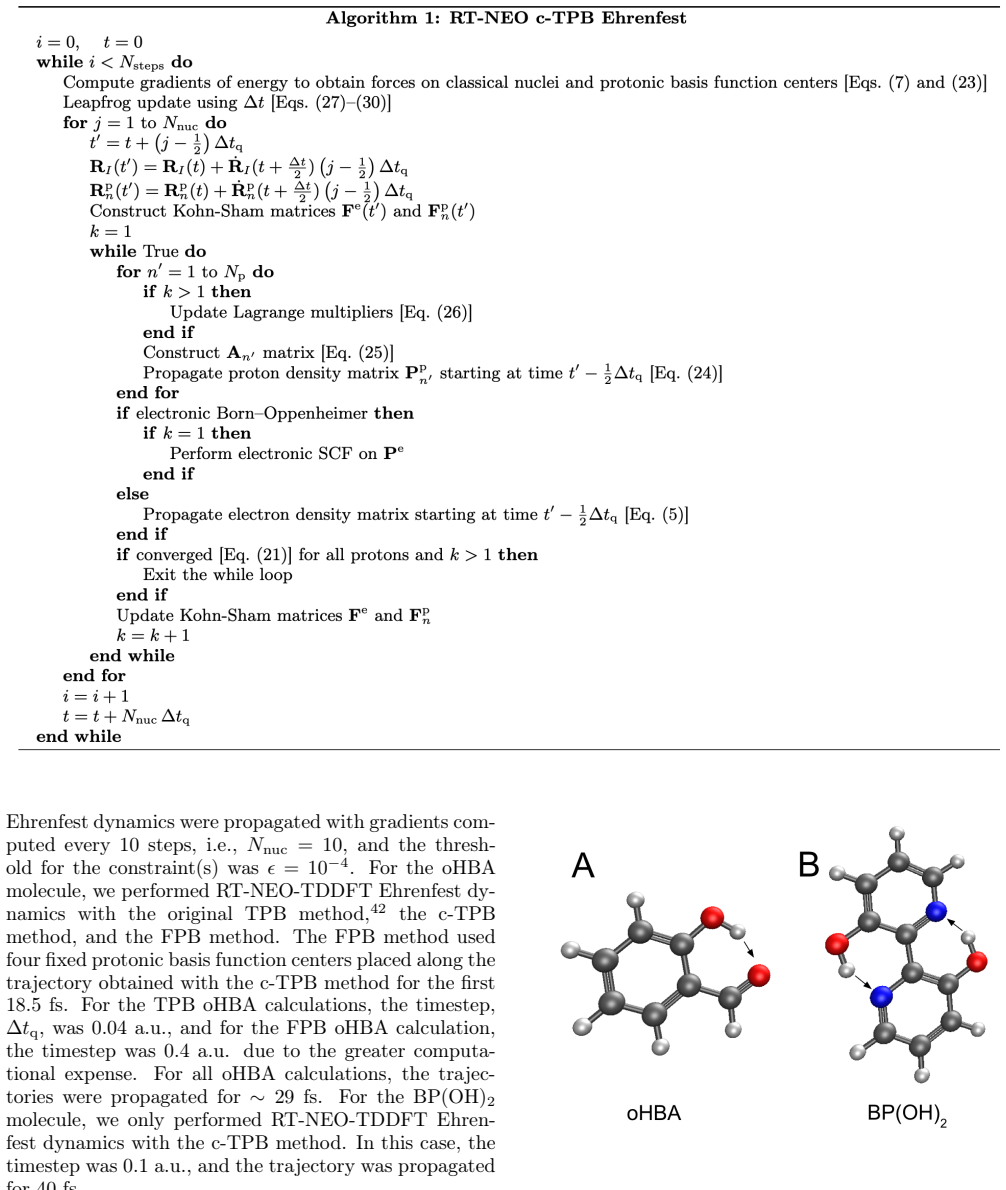
Nuclear quantum effects and non-Born--Oppenheimer effects play a vital role in many chemical and biological processes, motivating the incorporation of such effects into dynamical simulations. In real-time nuclear--electronic orbital time-dependent density functional theory (RT-NEO-TDDFT), the electronic and nuclear densities are propagated numerically in time according to the time-dependent Schr\"odinger equation. In this framework, specified protons are treated quantum mechanically on the same level as the electrons. The classical nuclei can be propagated on the instantaneous NEO vibronic surface using Ehrenfest dynamics. A traveling proton basis (TPB) can be used to describe the dynamics of moving protons in conjunction with Gaussian-type protonic and electronic basis sets for each quantum proton. Herein, we present a constrained TPB (c-TPB) approach that ensures each protonic basis function center coincides with the corresponding proton position expectation value during the dynamics. This approach produces accurate nuclear--electronic quantum dynamics and rigorously conserves energy. We demonstrate the accuracy and stability of this approach for computing molecular vibrational frequencies as well as simulating excited-state intramolecular proton transfer and double proton transfer in the o-hydroxybenzaldehyde and [2,2$'$-bipyridyl]-3,3$'$-diol molecules. These applications show that the c-TPB method provides accurate dynamics, conserves energy, and is computationally efficient.
Editorial analysis
A structured set of objections, weighed in public.
Referee Report
Summary. The manuscript introduces a constrained traveling proton basis (c-TPB) within real-time nuclear-electronic orbital time-dependent density functional theory (RT-NEO-TDDFT). Protonic Gaussian basis function centers are forced to coincide exactly with the instantaneous proton position expectation value at each propagation step. The central claims are that this structural constraint yields accurate nuclear-electronic quantum dynamics, rigorously conserves energy, and remains computationally efficient. These claims are supported by applications to molecular vibrational frequencies and to excited-state intramolecular single and double proton transfer in o-hydroxybenzaldehyde and [2,2'-bipyridyl]-3,3'-diol.
Significance. If the reported energy conservation and accuracy hold under the constraint, the c-TPB supplies a practical route to stable, non-Born-Oppenheimer dynamics for processes in which selected protons move on the same footing as electrons. The explicit tests on vibrational spectra and proton-transfer trajectories address the natural concern that rigidly tying basis centers to the expectation value might introduce artifacts in the nuclear-electronic coupling; the absence of reported instabilities or energy drift in these cases is therefore a substantive strength of the work.
minor comments (1)
- The abstract contains LaTeX artifacts (e.g., $'$-bipyridyl) that should be cleaned for the final typeset version.
Simulated Author's Rebuttal
We thank the referee for their careful reading of the manuscript and for the positive assessment. The referee's summary correctly identifies the central contribution of the constrained traveling proton basis (c-TPB) and its demonstrated performance on vibrational frequencies and excited-state proton-transfer processes. We are pleased that the energy conservation and stability properties are viewed as substantive strengths.
Circularity Check
No significant circularity identified
full rationale
The paper defines a constrained traveling proton basis (c-TPB) by construction as the choice that forces protonic basis centers to coincide with the instantaneous proton position expectation value. This is presented as a structural modification to the basis set within the existing RT-NEO-TDDFT framework, followed by numerical demonstrations on independent test cases (vibrational frequencies, excited-state proton transfers). No step reduces a claimed prediction or result to a fitted parameter from the same data, a self-citation chain, or an ansatz imported without independent justification. Energy conservation is asserted as a property of the constrained propagation, not derived circularly from the inputs. The method is self-contained against external benchmarks with no load-bearing self-referential reductions.
Axiom & Free-Parameter Ledger
axioms (1)
- standard math Time-dependent Schrödinger equation governs simultaneous propagation of electronic and nuclear densities.
invented entities (1)
-
constrained traveling proton basis (c-TPB)
no independent evidence
Reference graph
Works this paper leans on
-
[1]
Nuclear quantum effects on the structural properties of solids,
1I. Scivetti, D. Hughes, N. Gidopoulos, A. Caro, and J. Kohanoff, “Nuclear quantum effects on the structural properties of solids,” AIP Conf. Proc.963, 212–223 (2007). 2M. Ceriotti, W. Fang, P. G. Kusalik, R. H. McKenzie, A. Michaelides, M. A. Morales, and T. E. Markland, “Nuclear quantum effects in water and aqueous systems: Experiment, the- ory, and cur...
2007
-
[2]
Time-resolved vibronic spectra with nuclear–electronic orbital time-dependent configuration interaction,
64S. M. Garner, S. Upadhyay, X. Li, and S. Hammes-Schiffer, “Time-resolved vibronic spectra with nuclear–electronic orbital time-dependent configuration interaction,” J. Chem. Phys.162, 044108 (2025). 12
2025
discussion (0)
Sign in with ORCID, Apple, or X to comment. Anyone can read and Pith papers without signing in.