REVIEW 4 major objections 4 minor 33 references
Thickness Dependence of Coercive Field in Ferroelectric Doped-Hafnium Oxide
T0 review · 4 major / 4 minor · reviewed 2026-08-07 · deepseek-v4-flash
Pith's one-line read The coercive field in ferroelectric hafnium oxide scales as $E_c \propto d^{-1/2}$ rather than the classical $d^{-2/3}$, because spacer layers confine reverse domains to single polar layers.
desk verdict A genuinely new idea—anisotropic domain confinement giving Ec ∝ d^{-1/2}—but the load-bearing confinement assumption and a dimensional slip in the apparent-field definition keep the central claim unproven as written. read the letter →
The pith
A machine-rendered reading of the paper's core claim, the machinery that carries it, and where it could break.
The reading
What carries the argument
The workhorse is the energy functional $U_\Delta(E_v,r,l)$ for a half-prolate elliptical cylinder reverse domain of radius $r$, length $l$, and fixed thickness $t$: $U_\Delta = -a E_{va} r l + b l + c r^2$, with $a = P_s\pi t$, $b = 7\pi\sigma_c t/11$, $c = P_s^2 t/(4\sqrt{\varepsilon_a\varepsilon_c})$, and $E_{va} = E_v - E_h - 2\sigma_e/P_s$. Minimizing over nuclei that can grow defines the critical field at which the minimum energy crosses zero, producing the $d^{-1/2}$ law. The decisive geometric input is that spacer layers confine growth to a single polar layer, making $t$ a material constant rather than a scaling dimension.
What would settle it
Measure the log-log slope of the depolarization-corrected intrinsic coercive field versus thickness in sub-100 nm single-orientation orthorhombic HfO$_2$ films: a slope near $-1/2$ supports the confined-cylinder picture, while a slope near $-2/3$ indicates that domains are not confined to single polar layers.
Extended reading notes
Core claim
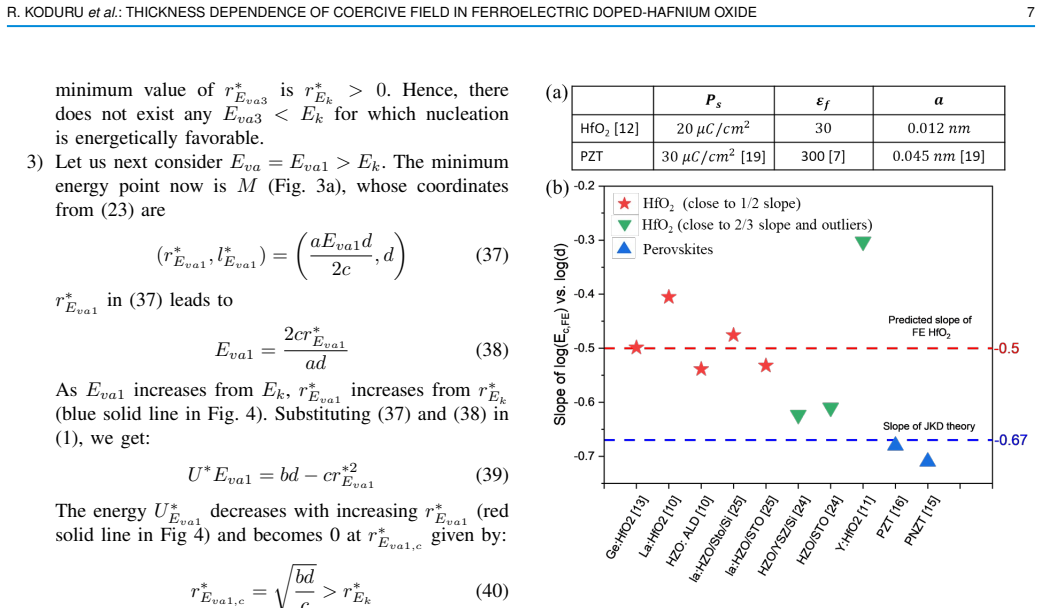
The central claim is that the anisotropic crystal structure of polar orthorhombic HfO$_2$ forces nucleated reverse domains to stay within a single polar layer: continuous polar layers along one in-plane axis and alternating polar and spacer layers along the orthogonal axis make lateral growth along the spacer direction energetically prohibitive. The domain is therefore modeled as a half-prolate elliptical cylinder with fixed thickness $t$ equal to half the lattice constant, not the half-prolate spheroid assumed in classical JKD nucleation-growth theory. Evaluating the energy of such a cylinder and requiring both nucleation and growth to be energetically favorable yields an apparent critical field $E_{va,c} = 2\sqrt{cb/a^2}/\sqrt{d}$, and hence $E_c = 2\sqrt{cb/a^2}\,d^{-1/2} + E_h + 2\sigma_e/P_s$, i.e. $E_c \propto d^{-1/2}$. This weaker thickness dependence is presented as the explanation for the sub-100 nm experimental trend in ferroelectric HfO$_2$ films.
Load-bearing premise
The reverse domain stays strictly confined to a single polar layer along the alternating polar-spacer direction, with fixed thickness equal to half the lattice constant; if domain walls could cross spacer layers under operating fields, the geometry would approach a spheroid and the classical $d^{-2/3}$ exponent would return.
Editorial extensions
If this is right
- For orthorhombic-phase HfO$_2$ films below roughly 100 nm, the coercive field grows as $d^{-1/2}$, which is slower than the $d^{-2/3}$ growth expected for perovskites.
- Thick-film saturation of $E_c$ remains explained by thickness-independent grain size, while the new $d^{-1/2}$ law applies in the thin-film regime where grains no longer limit the domain size.
- Epitaxial films dominated by the rhombohedral phase should follow the classical $d^{-2/3}$ scaling because that phase lacks the alternating polar-spacer layer structure.
- The prefactor in the scaling law depends on material constants such as polarization, domain-wall energy, and permittivity, so dopant or processing changes shift the magnitude of $E_c$ without changing the $d^{-1/2}$ exponent.
- Comparing theory with experiment requires correcting measured coercive voltages for depolarization at the metal-ferroelectric interface; raw measured slopes can be distorted by this effect.
Reading between the lines
- If the confinement picture is correct, tuning the spacer-layer energy barrier through strain, doping, or interface engineering should continuously vary the effective thickness exponent between $-1/2$ and $-2/3$, a testable prediction not made in the paper.
- The model implies strongly anisotropic in-plane domain growth, so patterned electrodes or in-plane electric-field components should reveal growth predominantly along the continuous-polar-layer direction.
- The same confined-domain logic could apply to other layered ferroelectrics with alternating polar and spacer sublattices, where similarly reduced thickness exponents might be observed.
- Because each polar layer switches quasi-independently, the model suggests that coercivity in polycrystalline films is controlled more by the distribution of local nucleation sites than by film thickness alone.
Editorial analysis
A structured set of objections, weighed in public.
Referee Report
Summary. The paper proposes that the reduced thickness dependence of the coercive field in ferroelectric HfO2, compared with the classical Janovec-Kay-Dunn (JKD) scaling Ec ∝ d^{−2/3}, originates from the anisotropic crystal structure of the orthorhombic phase. The authors argue that alternating polar and spacer layers confine reverse domains to a single polar layer, so that domains are half-prolate elliptical cylinders rather than half-prolate spheroids. By modeling the energetics of nucleation and growth of such confined domains, they derive a modified scaling law Ec ∝ d^{−1/2}. The model is then compared with experimental data from several HfO2 samples after a depolarization correction, and the reported log-log slopes are close to −1/2, in contrast to the perovskite slopes near −2/3.
Significance. If valid, the proposed mechanism would resolve a well-known puzzle in ferroelectric HfO2: why thin films exhibit a weaker thickness dependence than perovskites. The paper is clear and offers a falsifiable prediction, and it attempts a quantitative comparison with multiple experimental datasets. Its strength is that the d^{−1/2} exponent arises from a physical model rather than from a curve fit, and the comparison to experiments is a genuine test of the scaling form. However, the central derivation contains a dimensional inconsistency and an unverified extension of an electrostatic formula, and the key geometric assumption of single-layer confinement under bias is not directly validated. The significance is therefore conditional on correcting these technical issues.
major comments (4)
- [Section III, Eqs. (13), (14), and (19)] The definition Eva = Ev − Eh − 2σe/Ps is dimensionally inconsistent. In Eq. (13) the surface-energy term is 2σeπrl, and when this is combined with −EvPsπtrl and +EhPsπtrl to form −aEva rl with a = Psπt, the field-like term must be 2σe/(Ps t), not 2σe/Ps. As written, the contribution a(2σe/Ps)rl has units of J·m rather than J, so Eq. (14) does not follow from Eq. (13). This error propagates to the offset term in Eq. (42). The authors should correct Eq. (19) and re-derive the final expression, or at least clarify the intended definitions.
- [Section III, Eq. (6)] The inhomogeneous-field energy is stated as an extension of Landauer's 2D result to a 3D half-prolate elliptical cylinder, but no derivation is provided and the typeset formula is ambiguous. The reduction to Eq. (7) in the limit l ≫ r is not transparent from the printed expression, and the term appears to be missing parentheses. Because the r^2 scaling of this term is what ultimately produces the −1/2 exponent in Eq. (42), this step is load-bearing. The authors should supply a derivation of the 3D expression, or cite a source that contains it, and explicitly show the l ≫ r limit.
- [Section II] The central geometric assumption is that the reverse domain is strictly confined to a single polar layer of thickness t equal to half a lattice constant, even under applied fields near Ec. References [5], [21], and [22] establish the existence of unit-cell-wide domains in equilibrium and the structural asymmetry of the orthorhombic phase, but they do not demonstrate that a switching domain remains pinned to one polar layer when the applied field is close to the coercive field. If domain walls can cross the spacer layers, the domain geometry approaches a half-prolate spheroid and the JKD d^{−2/3} scaling is restored. The manuscript should provide a quantitative estimate of the energy barrier for domain propagation across spacer layers, or otherwise justify the confinement assumption under bias.
- [Section VI] The experimental validation compares log-log slopes of depolarization-corrected coercive fields but does not test the full predicted functional form Ec = A d^{−1/2} + B from Eq. (42). With a finite offset B, the log-log slope is not equal to −1/2, and a slope near −0.5 over a limited thickness range can be consistent with other functional forms. The authors should fit the complete expression to the data, or demonstrate explicitly that the offset B is negligible over the fitted thickness range.
minor comments (4)
- [Section III, Eq. (13)] The typesetting of the inhomogeneous-energy term in Eq. (13) is ambiguous and appears to contain a stray "r2"; the intended expression is presumably Ps^2 r^2 t/(4√(εaεc)), but this should be cleaned up.
- [Section V, after Eq. (35)] The sentence "Substituting (34) and (35) into (1)" should refer to Eq. (14), not Eq. (1), since Eq. (1) is the proposed scaling law rather than the energy expression.
- [Section II, Fig. 2] The description of the domain geometry is confusing: the relationships among r, l, t, the film thickness d, and the APSL/CPL directions should be stated explicitly in terms of coordinate axes so that the reader can verify the volume and surface-area formulas.
- [Section VI, Fig. 5a] The parameter values used for the depolarization correction are listed without sources; the authors should indicate how Ps, a, and εf were chosen for each experimental dataset.
Circularity Check
No significant circularity: the Ec ∝ d^{-1/2} exponent follows from the internal energy minimization (Eqs. 13-42); the single-layer domain confinement is an externally supported input, not the predicted quantity, and the experimental comparison is a slope check of a predicted power law, not a fit.
full rationale
The thickness-scaling claim Ec∝d^{-1/2} is obtained by minimizing the energy functional (13)-(14) with respect to nucleus dimensions and identifying the critical field at which favorable nucleation first occurs (Eqs. 31, 40-42). The exponent emerges from the algebra of the growth conditions (20)-(24) and is not imposed by any fitted parameter; a, b, and c are material and geometric constants. The geometric input that domains are half-prolate elliptical cylinders confined to a single polar layer is an assumption, but the paper supports it with first-principles and microscopic evidence [5,21,22], and that input is not the quantity being predicted. The experimental comparison in Sec. VI computes log-log slopes of depolarization-corrected data rather than fitting the model to all points, so it is a test of the predicted power law. The one self-citation ([21], a same-group arXiv study) supports the structural confinement premise but is corroborated by independent references [5] and [22], and it does not assert the thickness scaling; hence it is not load-bearing for the central claim. Eq. (42)'s constant offset is not tested against the log-log slope, but that is a validation limitation, not circularity. No step reduces to its own input by construction.
Assumptions & free parameters
free parameters (3)
- domain thickness t (set to half lattice constant) =
about 0.25 nm
- normalized screening length a (lambda/epsilon_e) =
not given in text, see Fig. 5a
- saturation polarization Ps =
material-specific, not tabulated in text
assumptions (5)
- domain assumption Landauer's 2D electrostatic energy formula can be extended to a 3D half-prolate elliptical cylinder geometry without additional derivation (Eq. 6).
- domain assumption Reverse domains are confined to a single polar layer along the APSL direction, so the domain thickness t is fixed at half the lattice constant.
- domain assumption Nucleation occurs at the metal-ferroelectric interface, and events are independent, single-grain, with polarization aligned with the field.
- standard math Ramanujan's approximation for ellipse perimeter is accurate in the high eccentricity limit (l >> r).
- domain assumption The depolarization correction of Dawber et al. applies with uniform screening parameters to all experimental HfO2 samples.
Cite this review
Pith. "Pith review of Thickness Dependence of Coercive Field in Ferroelectric Doped-Hafnium Oxide." pith.science (2026). https://pith.science/paper/VXSBGBVF
@misc{pith2026250606222,
  author       = {Pith},
  title        = {Pith review of: Thickness Dependence of Coercive Field in Ferroelectric Doped-Hafnium Oxide},
  year         = {2026},
  howpublished = {\url{https://pith.science/paper/VXSBGBVF}},
  note         = {Machine review of arXiv:2506.06222}
}
abstract
Ferroelectric hafnium oxide (${HfO_2}$) exhibits a thickness-dependent coercive field $(E_c)$ behavior that deviates from the trends observed in perovskites and the predictions of Janovec-Kay-Dunn (JKD) theory. Experiments reveal that, in thinner $HfO_2$ films ($<100\,nm$), $E_c$ increases with decreasing thickness but at a slower rate than predicted by the JKD theory. In thicker films, $E_c$ saturates and is independent of thickness. Prior studies attributed the thick film saturation to the thickness-independent grain size, which limits the domain growth. However, the reduced dependence in thinner films is poorly understood. In this work, we expound the reduced thickness dependence of $E_c$, attributing it to the anisotropic crystal structure of the polar orthorhombic (o) phase of $HfO_2$. This phase consists of continuous polar layers (CPL) along one in-plane direction and alternating polar and spacer layers (APSL) along the orthogonal direction. The spacer layers decouple adjacent polar layers along APSL, increasing the energy barrier for domain growth compared to CPL direction. As a result, the growth of nucleated domains is confined to a single polar plane in $HfO_2$, forming half-prolate elliptical cylindrical geometry rather than half-prolate spheroid geometry observed in perovskites. By modeling the nucleation and growth energetics of these confined domains, we derive a modified scaling law of $E_c \propto d^{-1/2}$ for $HfO_2$ that deviates from the classical JKD dependence of $E_c \propto d^{-2/3}$. The proposed scaling agrees well with the experimental trends in coercive field across various ferroelectric $HfO_2$ samples.
Figures


Figures from the paper (2 more)

Reference graph
Works this paper leans on
-
[5]
Scale-free ferroelectricity induced by flat phonon bands in HfO 2,
H.-J. Lee, M. Lee, K. Lee, J. Jo, H. Yang, Y . Kim, S. C. Chae, U. Waghmare, and J. H. Lee, “Scale-free ferroelectricity induced by flat phonon bands in HfO 2,” Science, vol. 369, no. 6509, pp. 1343–1347, Sep. 2020. [Online]. Available: https://www.science.org/doi/10.1126/science.aba0067
-
[21]
T. K. Paul, A. K. Saha, and S. K. Gupta, “Direction-Dependent Lateral Domain Walls in Ferroelectric Hafnium Zirconium Oxide and their Gradient Energy Coefficients: A First Principles Study,” 2022, publisher: arXiv Version Number: 3. [Online]. Available: https://arxiv.org/abs/2208.11029
work page Pith review arXiv 2022
-
[22]
Atomic-Scale Scanning of Domain Network in the Ferroelectric HfO 2 Thin Film,
K. Park, D. Kim, K. Lee, H.-J. Lee, J. Kim, S. Kang, A. Lin, A. J. Pattison, W. Theis, C. H. Kim, H. Choi, J. W. Cho, P. Ercius, J. H. Lee, S. C. Chae, and J. Park, “Atomic-Scale Scanning of Domain Network in the Ferroelectric HfO 2 Thin Film,” ACS Nano, p. acsnano.4c08721, Sep. 2024. [Online]. Available: https://pubs.acs.org/doi/10.1021/acsnano.4c08721
-
[1]
Ferroelectricity in hafnium oxide thin films,
T. S. B ¨oscke, J. M ¨uller, D. Br ¨auhaus, U. Schr ¨oder, and U. B ¨ottger, “Ferroelectricity in hafnium oxide thin films,” Applied Physics Letters, vol. 99, no. 10, p. 102903, Sep. 2011. [Online]. Available: http://aip.scitation.org/doi/10.1063/1.3634052
-
[2]
The fundamentals and applications of ferroelectric HfO2,
U. Schroeder, M. H. Park, T. Mikolajick, and C. S. Hwang, “The fundamentals and applications of ferroelectric HfO2,” Nature Reviews Materials, vol. 7, no. 8, pp. 653–669, Mar. 2022. [Online]. Available: https://www.nature.com/articles/s41578-022-00431-2
work page 2022
-
[3]
Ferroelectricity in Simple Binary ZrO 2 and HfO 2,
J. M ¨uller, T. S. B ¨oscke, U. Schr ¨oder, S. Mueller, D. Br ¨auhaus, U. B¨ottger, L. Frey, and T. Mikolajick, “Ferroelectricity in Simple Binary ZrO 2 and HfO 2,” Nano Letters, vol. 12, no. 8, pp. 4318–4323, Aug
-
[4]
R. Materlik, C. K ¨unneth, and A. Kersch, “The origin of ferroelectricity in Hf1 −xZrxO2: A computational investigation and a surface energy model,” Journal of Applied Physics , vol. 117, no. 13, p. 134109, Apr. 2015. [Online]. Avail- able: https://pubs.aip.org/jap/article/117/13/134109/568535/The-origin- of-ferroelectricity-in-Hf1-xZrxO2-A
work page 2015
-
[6]
J. Muller, T. S. Boscke, S. Muller, E. Yurchuk, P. Polakowski, J. Paul, D. Martin, T. Schenk, K. Khullar, A. Kersch, W. Weinreich, S. Riedel, K. Seidel, A. Kumar, T. M. Arruda, S. V . Kalinin, T. Schlosser, R. Boschke, R. Van Bentum, U. Schroder, and T. Mikolajick, “Ferroelectric hafnium oxide: A CMOS-compatible and highly scalable approach to future ferr...
Show all 33 references
-
[7]
Hafnium oxide based ferroelectric devices for memories and beyond,
T. Mikolajick, U. Schroeder, and S. Slesazeck, “Hafnium oxide based ferroelectric devices for memories and beyond,” in 2018 International Symposium on VLSI Technology, Systems and Application (VLSI-TSA) , Apr. 2018, pp. 1–2. [Online]. Available: https://ieeexplore.ieee.org/doc...
2018
-
[8]
The Past, the Present, and the Future of Ferroelectric Memories,
T. Mikolajick, U. Schroeder, and S. Sesazeck, “The Past, the Present, and the Future of Ferroelectric Memories,” IEEE Transactions on Electron Devices, vol. 67, no. 4, pp. 1434–1443, Apr. 2020
2020
-
[9]
A perspective on the physical scaling down of hafnia-based ferroelectrics,
J. Y . Park, D. H. Lee, G. H. Park, J. Lee, Y . Lee, and M. H. Park, “A perspective on the physical scaling down of hafnia-based ferroelectrics,” Nanotechnology, vol. 34, no. 20, p. 202001, Feb. 2023, publisher: IOP Publishing. [Online]. Available: https://dx.doi.org/10.1088/1...
2023 doi
-
[10]
Polarization switching in thin doped HfO2 ferroelectric layers,
M. Materano, P. D. Lomenzo, H. Mulaosmanovic, M. Hoffmann, A. Toriumi, T. Mikolajick, and U. Schroeder, “Polarization switching in thin doped HfO2 ferroelectric layers,” Applied Physics Letters , vol. 117, no. 26, p. 262904, Dec. 2020. [Online]. Available: https://doi.org/10.1...
2020 doi
-
[11]
Thickness-dependent crystal structure and electric properties of epitaxial ferroelectric Y2O3-HfO2 films,
T. Mimura, T. Shimizu, H. Uchida, O. Sakata, and H. Funakubo, “Thickness-dependent crystal structure and electric properties of epitaxial ferroelectric Y2O3-HfO2 films,” Applied Physics Letters , vol. 113, no. 10, p. 102901, Sep. 2018. [Online]. Available: https://doi.org/10.1...
2018 doi
-
[12]
Study on the size effect in Hf0.5Zr0.5O2 films thinner than 8 nm before and after wake-up field cycling,
M. H. Park, H. J. Kim, Y . J. Kim, Y . H. Lee, T. Moon, K. D. Kim, S. D. Hyun, and C. S. Hwang, “Study on the size effect in Hf0.5Zr0.5O2 films thinner than 8 nm before and after wake-up field cycling,” Applied Physics Letters , vol. 107, no. 19, p. 192907, Nov
-
[13]
Material perspectives of HfO2-based ferroelectric films for device applications,
A. Toriumi, L. Xu, Y . Mori, X. Tian, P. D. Lomenzo, H. Mulaosmanovic, M. Materano, T. Mikolajick, and U. Schroeder, “Material perspectives of HfO2-based ferroelectric films for device applications,” in 2019 IEEE International Electron Devices Meeting (IEDM) , Dec. 2019, pp. 1...
2019
-
[14]
Polarization switching behavior of Hf–Zr–O ferroelectric ultrathin films studied through coercive field characteristics,
S. Migita, H. Ota, H. Yamada, K. Shibuya, A. Sawa, and A. Toriumi, “Polarization switching behavior of Hf–Zr–O ferroelectric ultrathin films studied through coercive field characteristics,” Japanese Journal of Applied Physics , vol. 57, no. 4S, p. 04FB01, Mar. 2018, publisher:...
2018 doi
-
[15]
Thickness dependence of the coercive electric field of laser ablated niobium-doped lead-zirconium-titanate films,
C. Bj ¨ormander, K. Sreenivas, M. Duan, A. M. Grishin, and K. V . Rao, “Thickness dependence of the coercive electric field of laser ablated niobium-doped lead-zirconium-titanate films,” Applied Physics Letters, vol. 66, no. 19, pp. 2493–2495, May 1995. [Online]. Available: ht...
1995 doi
-
[16]
Coercive field of ultrathin Pb(Zr0.52Ti0.48)O3 epitaxial films,
N. A. Pertsev, J. Rodriguez Contreras, V . G. Kukhar, B. Hermanns, H. Kohlstedt, and R. Waser, “Coercive field of ultrathin Pb(Zr0.52Ti0.48)O3 epitaxial films,” Applied Physics Letters , vol. 83, no. 16, pp. 3356–3358, Oct. 2003. [Online]. Available: https://doi.org/10.1063/1.1621731
2003 doi
-
[17]
On the theory of the coercive field of single-domain crystals of BaTiO3,
V . Janovec, “On the theory of the coercive field of single-domain crystals of BaTiO3,” Cechoslovackij fiziceskij zurnal , vol. 8, no. 1, pp. 3–15, Jan. 1958. [Online]. Available: https://doi.org/10.1007/BF01688741
1958 doi
-
[18]
Thickness dependence of the nucleation field of triglycine sulphate,
H. F. Kay, , and J. W. Dunn, “Thickness dependence of the nucleation field of triglycine sulphate,” The Philosophical Magazine: A Journal of Theoretical Experimental and Applied Physics , vol. 7, no. 84, pp. 2027–2034, Dec. 1962, publisher: Taylor & Francis eprint: https://doi...
2027 doi
-
[19]
Scaling of the Coercive Field with Thickness in Thin-Film Ferroelectrics,
P. CHANDRA, D. , M., L. , P. B., , and J. F. SCOTT, “Scaling of the Coercive Field with Thickness in Thin-Film Ferroelectrics,” Ferroelectrics, vol. 313, no. 1, pp. 7–13, Jan. 2004, publisher: Taylor & Francis eprint: https://doi.org/10.1080/00150190490891157. [Online]. Availa...
2004 doi
-
[20]
Surface and grain boundary energy as the key enabler of ferroelectricity in nanoscale hafnia-zirconia: a comparison of model and experiment,
M. H. Park, Y . H. Lee, H. J. Kim, T. Schenk, W. Lee, K. D. Kim, F. P. G. Fengler, T. Mikolajick, U. Schroeder, and C. S. Hwang, “Surface and grain boundary energy as the key enabler of ferroelectricity in nanoscale hafnia-zirconia: a comparison of model and experiment,” Nanos...
2017
-
[23]
Epitaxial Ferroelectric HfO2 Films: Growth, Properties, and Devices,
I. Fina and F. S ´anchez, “Epitaxial Ferroelectric HfO2 Films: Growth, Properties, and Devices,” ACS Applied Electronic Materials , vol. 3, no. 4, pp. 1530–1549, Apr. 2021, publisher: American Chemical Society. [Online]. Available: https://doi.org/10.1021/acsaelm.1c00110
2021 doi
-
[24]
Growth Window of Ferroelectric Epitaxial Hf0.5Zr0.5O2 Thin Films,
J. Lyu, I. Fina, R. Solanas, J. Fontcuberta, and F. S ´anchez, “Growth Window of Ferroelectric Epitaxial Hf0.5Zr0.5O2 Thin Films,” ACS Applied Electronic Materials , vol. 1, no. 2, pp. 220–228, Feb. 2019, publisher: American Chemical Society. [Online]. Available: https://doi.o...
2019 doi
-
[25]
Epitaxial Ferroelectric La-Doped Hf0.5Zr0.5O2 Thin Films,
T. Song, R. Bachelet, G. Saint-Girons, R. Solanas, I. Fina, and F. S ´anchez, “Epitaxial Ferroelectric La-Doped Hf0.5Zr0.5O2 Thin Films,” ACS Applied Electronic Materials , vol. 2, no. 10, pp. 3221– 3232, Oct. 2020, publisher: American Chemical Society. [Online]. Available: ht...
2020 doi
-
[26]
A rhombohedral ferroelectric phase in epitaxially strained Hf0.5Zr0.5O2 thin films,
Y . Wei, P. Nukala, M. Salverda, S. Matzen, H. J. Zhao, J. Momand, A. S. Everhardt, G. Agnus, G. R. Blake, P. Lecoeur, B. J. Kooi, J. ´I˜niguez, B. Dkhil, and B. Noheda, “A rhombohedral ferroelectric phase in epitaxially strained Hf0.5Zr0.5O2 thin films,” Nature Materials, vol...
2018
-
[27]
Distinguishing the Rhombohedral Phase from Orthorhombic Phases in Epitaxial Doped HfO2 Ferroelectric Films,
A. Petraru, O. Gronenberg, U. Sch ¨urmann, L. Kienle, R. Droopad, and H. Kohlstedt, “Distinguishing the Rhombohedral Phase from Orthorhombic Phases in Epitaxial Doped HfO2 Ferroelectric Films,” ACS Applied Materials & Interfaces, vol. 16, no. 32, pp. 42 534–42 545, Aug. 2024, ...
2024 doi
-
[28]
Non-Kolmogorov-Avrami switching kinetics in ferroelectric thin films,
A. K. Tagantsev, I. Stolichnov, N. Setter, J. S. Cross, and M. Tsukada, “Non-Kolmogorov-Avrami switching kinetics in ferroelectric thin films,” Physical Review B , vol. 66, no. 21, p. 214109, Dec. 2002, publisher: American Physical Society. [Online]. Available: https://link.ap...
2002 doi
-
[29]
Phase-field simulations of polarization variations in polycrystalline Hf0.5Zr0.5O2 based MFIM: V oltage dependence and dynamics,
R. Koduru, I. Ahmed, A. K. Saha, X. Lyu, P. Ye, and S. K. Gupta, “Phase-field simulations of polarization variations in polycrystalline Hf0.5Zr0.5O2 based MFIM: V oltage dependence and dynamics,” Journal of Applied Physics , vol. 134, no. 8, p. 084104, Aug. 2023. [Online]. Ava...
2023 doi
-
[30]
Electrostatic Considerations in BaTiO3 Domain Formation during Polarization Reversal,
R. Landauer, “Electrostatic Considerations in BaTiO3 Domain Formation during Polarization Reversal,” Journal of Applied Physics , vol. 28, no. 2, pp. 227–234, Feb. 1957. [Online]. Available: https://doi.org/10.1063/1.1722712
1957 doi
-
[31]
Depolarization corrections to the coercive field in thin-film ferroelectrics,
M. Dawber, P. Chandra, P. B. Littlewood, and J. F. Scott, “Depolarization corrections to the coercive field in thin-film ferroelectrics,” Journal of Physics: Condensed Matter , vol. 15, no. 24, p. L393, Jun. 2003. [Online]. Available: https://dx.doi.org/10.1088/0953-8984/15/24/106
2003 doi
-
[2012]
Available: https://pubs.acs.org/doi/10.1021/nl302049k
[Online]. Available: https://pubs.acs.org/doi/10.1021/nl302049k
-
[2015]
Available: https://doi.org/10.1063/1.4935588
[Online]. Available: https://doi.org/10.1063/1.4935588
Reviewed August 7, 2026 · model on record in the stance chip above.
Discussion (0). Sign in to comment.