REVIEW 3 major objections 5 minor 26 references
Effectiveness of LLMs in Temporal User Profiling for Recommendation
T0 review · 3 major / 5 minor · reviewed 2026-08-04 · deepseek-v4-flash
Pith's one-line read This paper claims that separating a user's recent and long-term interaction histories into two LLM-generated text summaries, then fusing them with attention, improves recommendation accuracy and offers a natural route to interpretability.
desk verdict A cleanly written preliminary study with one unresolved temporal-leakage question; the headline numbers should not be trusted until the authors confirm that test-time profiles use only pre-test interactions. read the letter →
The pith
A machine-rendered reading of the paper's core claim, the machinery that carries it, and where it could break.
The reading
What carries the argument
The load-bearing mechanism is temporal disentanglement by prompt: the same interaction history is summarized twice, once under instructions that focus on recent interactions and once under instructions that surface persistent patterns. The two text summaries are embedded and combined via a learned scalar attention weight per user; that weight both produces the final user vector and exposes how much a recommendation leans on recency versus long-term taste.
What would settle it
Re-run the experiments with LLM profiles generated strictly from the training-period prefix of each user's history, with validation and test interactions removed before summarization; if the Recall@10 and NDCG@10 advantage over the embedding-averaging baseline collapses or falls below significance, the published gains stem from temporal leakage.
Extended reading notes
Core claim
The paper's central claim is that an LLM can turn a user's raw interaction history into two distinct natural-language profiles—one for recent interests and one for enduring tastes—and that fusing these profiles with learned attention weights improves interaction prediction compared with averaging item embeddings, while also leaving a transparent textual record of why. The gains are strongest in domains where short-term and long-term interests are distinguishable and user activity is high; in sparse domains the advantage shrinks and can be matched by a non-textual temporal fusion.
Load-bearing premise
The results assume the LLM summaries at test time use only interactions that happened before the future behavior being predicted; the paper describes profiles as generated from the full interaction history, and if later interactions leak into those summaries the reported gains would be an artifact of leakage rather than true prediction.
Editorial extensions
If this is right
- In dense, behaviorally varied domains, LLM-generated temporal profiles can beat nontemporal embedding profiles by double digits at standard cutoffs.
- In sparse domains, the extra cost of textual profiling buys little; a numerical temporal fusion can match or beat it at small K.
- Separating short-term and long-term signals matters: a single holistic LLM profile loses about 20% recall, and removing either temporal component hurts.
- The learned attention values and the text summaries themselves can support explanations of whether a suggestion comes from recent or long-standing interests.
Reading between the lines
- A natural next step, not tested here, is to make the short-term window length a tunable parameter; the magnitude of the reported gains may depend on where 'recent' is cut.
- The domain-dependent results suggest selectively applying LLM profiling to users with high interaction variance could preserve accuracy while cutting compute cost.
- If the leakage concern is resolved and gains hold, the same dual-summary structure could be adapted to content-based explainable recommendation, but the paper only demonstrates the potential, not realized user-facing explanations.
- The authors' own hypothesis implies a testable prediction: in a domain deliberately chosen for volatile item trends, the gain over nontemporal baselines should be even larger than the movie-domain numbers.
Editorial analysis
A structured set of objections, weighed in public.
Referee Report
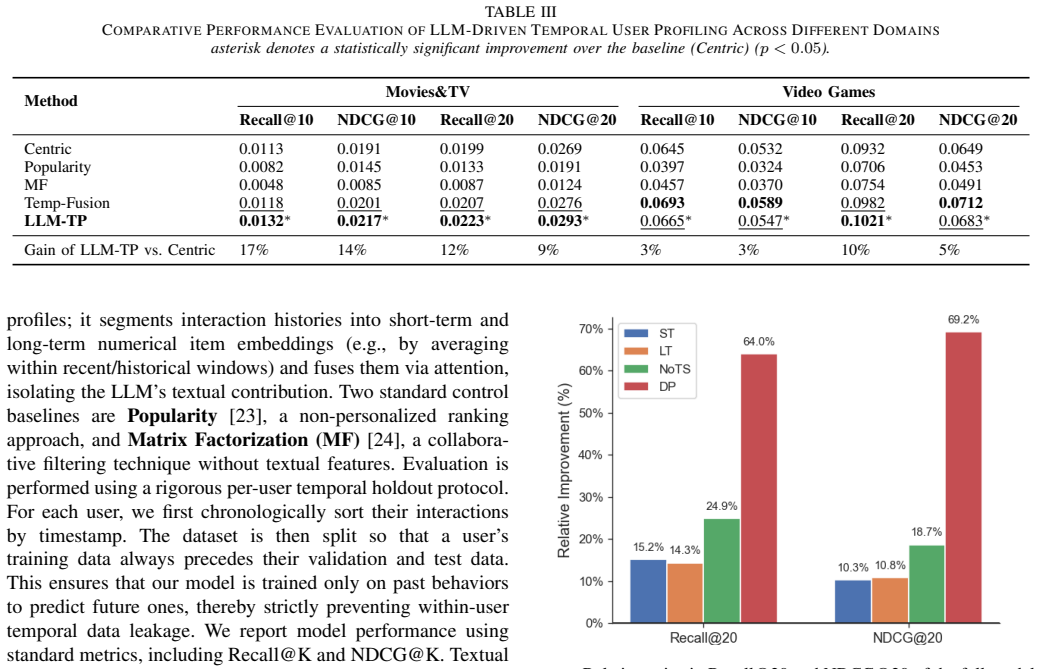
Summary. The paper proposes LLM-TP, a temporal user profiling method for content-based recommendation. For each user, an LLM generates two natural-language summaries from the interaction history: a short-term profile focused on recent interactions and a long-term profile summarizing persistent interests (Section III, Eqs. 2–3). The summaries are encoded with SBERT, adaptively fused via a learned attention mechanism (Eqs. 4–8), and scored against item embeddings with an MLP (Eq. 9). The method is evaluated on Amazon Movies&TV and Video Games under a per-user temporal holdout, with baselines including Centric, Temp-Fusion, Popularity, and MF, plus an ablation study. The headline reported results are 17% Recall@10 and 14% NDCG@10 gains over Centric on Movies&TV, smaller or mixed gains on Video Games, and ablation results favoring the full model. The paper also claims intrinsic interpretability through the natural-language profiles and attention weights.
Significance. If the evaluation is leakage-free, the paper offers a useful exploratory result: LLM-generated temporal summaries can improve content-based recommendation in dense domains, while the benefit is limited in sparse domains, with a plausible interpretability advantage. The public release of code, data, and prompts is a concrete reproducibility strength, and the ablation study (Table IV) is well designed to isolate the contribution of temporal decomposition, LLM text, and MLP scoring. However, the current ambiguity about whether LLM profiles are generated from training-period interactions only affects every number in Tables III and IV, and the statistical significance claim is not supported by any reported test procedure. These issues must be resolved before the empirical claims can be accepted.
major comments (3)
- [Section III, Eqs. (2)–(3); Section IV experimental protocol] The paper defines the LLM profiles using H_u, the user's full chronological interaction history, with no temporal cutoff. Section IV describes a per-user temporal holdout for 'model training' but never states that LLM profile generation is restricted to the training segment. In a valid temporal evaluation, test-time profiles must be computable from interactions observed before the test period. If the LLM is prompted with the full H_u, the profile can contain the very test items being predicted, making the reported gains in Table III direct label leakage rather than predictive improvements. This is a load-bearing ambiguity: the authors must either state explicitly that profiles are generated from training-period interactions only, or rerun the experiments with such a restriction. The wording in Section IV ('profiles generated using GPT-40-mini') does not resolve this.
- [Table III and Section IV.A] The table caption states that an asterisk denotes p<0.05, but no statistical test, number of runs, variance measure, or significance-testing procedure is described anywhere in the paper. With a single deterministic run and a single chronological split, the p-value is not reproducible. The claim of 'statistically significant improvement' over Centric is therefore unsupported. The authors should specify the test (e.g., paired bootstrap over users), the number of runs/splits, and report confidence intervals or variance. Without this, the 17%/14% headline is not statistically verified. Also, the asterisk is only defined relative to Centric; statements about outperforming Temp-Fusion in Movies&TV should be supported by a comparable significance test.
- [Section III, Eq. (6)–(8), and Section IV.A] The attention weights are learned on the training split, and then applied at test time to LLM profile embeddings. This is a standard supervised pipeline and not circular, but the interpretability claim that 'the learned weights convey the model's decision rationale' is only qualitative. The paper does not analyze the weights or relate them to actual recommendation outcomes. This is not a blocking issue for the predictive claims, but the interpretability discussion should be labeled as potential rather than demonstrated, unless some weight analysis is added.
minor comments (5)
- [Abstract and Introduction] The phrase 'inherently provides an intrinsic potential for interpretability' is redundant ('inherently' and 'intrinsic'). Also, 'GPT-40-mini' in Section IV should be 'GPT-4o mini'.
- [Section II, References] Reference [2] is cited as 'Waswani et al.' but the correct spelling is Vaswani. Please update.
- [Section III, Eqs. (2)–(3)] The notation H_u is used for the interaction history, but the equation labels indicate the LLM receives H_u. Since the temporal split is central, consider replacing H_u with H_u^{train} in the test-time profile generation to remove ambiguity.
- [Section IV, Dataset preprocessing] The item description length threshold ('exceeding 500 characters') is not justified. Since this threshold determines which items are kept for LLM processing, it could affect the domains differently; please state whether the same threshold is used for both domains and whether the reported results are sensitive to it.
- [Section IV.A, Video Games discussion] The statement that Temp-Fusion 'slightly surpasses it at smaller K-values' is correct per Table III (Recall@10 0.0693 vs 0.0665; NDCG@10 0.0589 vs 0.0547), but the text could more clearly state that the full model still wins at Recall@20. This nuance is helpful and should be kept.
Circularity Check
No circular derivation: the reported gains are empirical benchmark comparisons, not quantities reducible to the method's own fitted inputs.
full rationale
This paper is an empirical evaluation rather than a derivation-style argument. The trainable components—BERT encoders (Eqs. 4–5), attention parameter W_a (Eqs. 6–8), and MLP scorer (Eq. 9)—are fit by binary cross-entropy (Eq. 10) on held-out interactions, and the headline numbers in Table III are comparisons against external baselines (Centric, Popularity, MF, Temp-Fusion). No equation defines a reported improvement in terms of a fitted parameter, and no baseline result is presented as a prediction derived from the method's own inputs. The citations (BERT, attention, GPT-4, MF, etc.) are to external work; there is no load-bearing self-citation or imported uniqueness/ansatz result. The only validity concern is the temporal-holdout wording: Section III defines profiles over H_u (Eqs. 2–3) without stating that H_u is truncated to the training segment for test-time generation, while Section IV claims the split “strictly prevent[s] within-user temporal data leakage.” If test-period interactions entered H_u, that would be label leakage—an evaluation-validity flaw—but not a demonstrated circular reduction of a prediction to its own input by construction. Under the provided rubric, no circular step is established; score 0.
Assumptions & free parameters
free parameters (3)
- Item description length threshold =
>500 characters
- Short-term window definition
- Temporal holdout split ratio
assumptions (3)
- domain assumption Item descriptions are sufficient semantic signal for user preferences
- domain assumption LLM-generated summaries faithfully reflect user interactions
- standard math SBERT embeddings capture semantic similarity of interests
Cite this review
Pith. "Pith review of Effectiveness of LLMs in Temporal User Profiling for Recommendation." pith.science (2026). https://pith.science/paper/VYH5BQ2S
@misc{pith2026251100176,
  author       = {Pith},
  title        = {Pith review of: Effectiveness of LLMs in Temporal User Profiling for Recommendation},
  year         = {2026},
  howpublished = {\url{https://pith.science/paper/VYH5BQ2S}},
  note         = {Machine review of arXiv:2511.00176}
}
read the original abstract
Effectively modeling the dynamic nature of user preferences is crucial for enhancing recommendation accuracy and fostering transparency in recommender systems. Traditional user profiling often overlooks the distinction between transitory short-term interests and stable long-term preferences. This paper examines the capability of leveraging Large Language Models (LLMs) to capture these temporal dynamics, generating richer user representations through distinct short-term and long-term textual summaries of interaction histories. Our observations suggest that while LLMs tend to improve recommendation quality in domains with more active user engagement, their benefits appear less pronounced in sparser environments. This disparity likely stems from the varying distinguishability of short-term and long-term preferences across domains; the approach shows greater utility where these temporal interests are more clearly separable (e.g., Movies\&TV) compared to domains with more stable user profiles (e.g., Video Games). This highlights a critical trade-off between enhanced performance and computational costs, suggesting context-dependent LLM application. Beyond predictive capability, this LLM-driven approach inherently provides an intrinsic potential for interpretability through its natural language profiles and attention weights. This work contributes insights into the practical capability and inherent interpretability of LLM-driven temporal user profiling, outlining new research directions for developing adaptive and transparent recommender systems.
Figures


Figures from the paper (2 more)

Reference graph
Works this paper leans on
-
[1]
BERT: Pre- training of deep bidirectional transformers for language understanding,
J. Devlin, M.-W. Chang, K. Lee, and K. Toutanova, “BERT: Pre- training of deep bidirectional transformers for language understanding,” inProceedings of the 2019 Conference of the North American Chapter of the Association for Computational Linguistics: Human Language Technologies, Volume 1 (Long and Short Papers), J. Burstein, C. Doran, and T. Solorio, Eds...
2019
-
[2]
Attention is all you need,
A. Waswani, N. Shazeer, N. Parmar, J. Uszkoreit, L. Jones, A. Gomez, L. Kaiser, and I. Polosukhin, “Attention is all you need,” inNIPS, 2017
2017
-
[3]
Together is better: Hybrid recommendations combining graph embed- dings and contextualized word representations,
M. Polignano, C. Musto, M. de Gemmis, P. Lops, and G. Semeraro, “Together is better: Hybrid recommendations combining graph embed- dings and contextualized word representations,” inProceedings of the 15th ACM conference on recommender systems, 2021, pp. 187–198
2021
-
[4]
Collaborative filtering with temporal dynamics,
Y . Koren, “Collaborative filtering with temporal dynamics,” inProceed- ings of the 15th ACM SIGKDD international conference on Knowledge discovery and data mining, 2009, pp. 447–456
2009
-
[5]
Session- based recommendations with recurrent neural networks,
B. Hidasi, A. Karatzoglou, L. Baltrunas, and D. Tikk, “Session- based recommendations with recurrent neural networks,”arXiv preprint arXiv:1511.06939, 2015
arXiv 2015
-
[6]
Self-attentive sequential recommenda- tion,
W.-C. Kang and J. McAuley, “Self-attentive sequential recommenda- tion,” in2018 IEEE international conference on data mining (ICDM). IEEE, 2018, pp. 197–206
2018
-
[7]
Long short-term preference modeling for continuous-time sequential recommendation,
H. Chi, H. Xu, H. Fu, M. Liu, M. Zhang, Y . Yang, Q. Hao, and W. Wu, “Long short-term preference modeling for continuous-time sequential recommendation,”arXiv preprint arXiv:2208.00593, 2022
arXiv 2022
-
[8]
Explainable recommendation: A survey and new perspectives,
Y . Zhang, X. Chenet al., “Explainable recommendation: A survey and new perspectives,”Foundations and Trends® in Information Retrieval, vol. 14, no. 1, pp. 1–101, 2020
2020
Show all 26 references
-
[9]
A survey of large language models,
W. X. Zhao, K. Zhou, J. Li, T. Tang, X. Wang, Y . Hou, Y . Min, B. Zhang, J. Zhang, Z. Donget al., “A survey of large language models,”arXiv preprint arXiv:2303.18223, 2023
2023 arXiv
-
[10]
A survey on evaluation of large language models,
Y . Chang, X. Wang, J. Wang, Y . Wu, L. Yang, K. Zhu, H. Chen, X. Yi, C. Wang, Y . Wanget al., “A survey on evaluation of large language models,”ACM transactions on intelligent systems and technology, vol. 15, no. 3, pp. 1–45, 2024
2024
-
[11]
Recommender systems in the era of large language models (llms),
Z. Zhao, W. Fan, J. Li, Y . Liu, X. Mei, Y . Wang, Z. Wen, F. Wang, X. Zhao, J. Tanget al., “Recommender systems in the era of large language models (llms),”IEEE Transactions on Knowledge and Data Engineering, 2024
2024
-
[12]
A survey on large language models for recommendation,
L. Wu, Z. Zheng, Z. Qiu, H. Wang, H. Gu, T. Shen, C. Qin, C. Zhu, H. Zhu, Q. Liuet al., “A survey on large language models for recommendation,”World Wide Web, vol. 27, no. 5, p. 60, 2024
2024
-
[13]
Llm-generated explanations for recommender systems,
S. Lubos, T. N. T. Tran, A. Felfernig, S. Polat Erdeniz, and V .-M. Le, “Llm-generated explanations for recommender systems,” inAdjunct Proceedings of the 32nd ACM Conference on User Modeling, Adaptation and Personalization, 2024, pp. 276–285
2024
-
[14]
Xrec: Large language models for explainable recommendation,
Q. Ma, X. Ren, and C. Huang, “Xrec: Large language models for explainable recommendation,”arXiv preprint arXiv:2406.02377, 2024
2024 arXiv
-
[15]
A survey on knowledge graph-based recommender systems,
Q. Guo, F. Zhuang, C. Qin, H. Zhu, X. Xie, H. Xiong, and Q. He, “A survey on knowledge graph-based recommender systems,”IEEE Transactions on Knowledge and Data Engineering, vol. 34, no. 8, pp. 3549–3568, 2020
2020
-
[16]
Knowledge graph retrieval-augmented generation for llm-based recom- mendation,
S. Wang, W. Fan, Y . Feng, S. Lin, X. Ma, S. Wang, and D. Yin, “Knowledge graph retrieval-augmented generation for llm-based recom- mendation,”arXiv preprint arXiv:2501.02226, 2025
2025 arXiv
-
[17]
An explainable recommen- dation framework based on an improved knowledge graph attention network with massive volumes of side information,
R. Shimizu, M. Matsutani, and M. Goto, “An explainable recommen- dation framework based on an improved knowledge graph attention network with massive volumes of side information,”Knowledge-Based Systems, vol. 239, p. 107970, 2022
2022
-
[18]
Llm-powered explanations: Unraveling recommendations through subgraph reasoning,
G. Shi, X. Deng, L. Luo, L. Xia, L. Bao, B. Ye, F. Du, S. Pan, and Y . Li, “Llm-powered explanations: Unraveling recommendations through subgraph reasoning,”arXiv preprint arXiv:2406.15859, 2024
2024 arXiv
-
[19]
Improved recurrent neural networks for session-based recommendations,
Y . K. Tan, X. Xu, and Y . Liu, “Improved recurrent neural networks for session-based recommendations,” inProceedings of the 1st workshop on deep learning for recommender systems, 2016, pp. 17–22
2016
-
[20]
What to do next: Modeling user behaviors by time-lstm
Y . Zhu, H. Li, Y . Liao, B. Wang, Z. Guan, H. Liu, and D. Cai, “What to do next: Modeling user behaviors by time-lstm.” inIJCAI, vol. 17, 2017, pp. 3602–3608
2017
-
[21]
Multilayer perceptron and neural networks,
M.-C. Popescu, V . E. Balas, L. Perescu-Popescu, and N. Mastorakis, “Multilayer perceptron and neural networks,”WSEAS Transactions on Circuits and Systems, vol. 8, no. 7, pp. 579–588, 2009
2009
-
[22]
Bridging language and items for retrieval and recommendation,
Y . Hou, J. Li, Z. He, A. Yan, X. Chen, and J. McAuley, “Bridging language and items for retrieval and recommendation,”arXiv preprint arXiv:2403.03952, 2024
2024 arXiv
-
[23]
Introduction to recommender systems handbook,
F. Ricci, L. Rokach, and B. Shapira, “Introduction to recommender systems handbook,” inRecommender systems handbook. Springer, 2011, pp. 1–35
2011
-
[24]
Matrix factorization techniques for recommender systems,
Y . Koren, R. Bell, and C. V olinsky, “Matrix factorization techniques for recommender systems,”Computer, vol. 42, no. 8, pp. 30–37, 2009
2009
-
[25]
Sentence-bert: Sentence embeddings using siamese bert-networks,
N. Reimers and I. Gurevych, “Sentence-bert: Sentence embeddings using siamese bert-networks,” inProceedings of the 2019 Conference on Empirical Methods in Natural Language Processing. Association for Computational Linguistics, 11 2019. [Online]. Available: https://arxiv.org/ab...
2019 arXiv
-
[26]
Gpt-4 technical report,
J. Achiam, S. Adler, S. Agarwal, L. Ahmad, I. Akkaya, F. L. Aleman, D. Almeida, J. Altenschmidt, S. Altman, S. Anadkatet al., “Gpt-4 technical report,”arXiv preprint arXiv:2303.08774, 2023
2023 arXiv
Reviewed August 4, 2026 · model on record in the stance chip above.
Discussion (0). Sign in to comment.