REVIEW 3 major objections 4 minor 30 references
Microscopic coexistence of superconductivity and charge order in organic superconductor $\beta''$-(BEDT-TTF)$_{4}$[(H$_3$O)Ga(C$_2$O$_4$)$_3$]$\cdot$C$_6$H$_5$NO$_2$
T0 review · 3 major / 4 minor · reviewed 2026-08-14 · deepseek-v4-flash
Pith's one-line read Superconductivity and charge order coexist in the same microscopic volume of an organic superconductor, according to spin-resonance spectra that show no sign of phase separation.
desk verdict A genuinely new bilayer-resolved EPR study that likely rules out macroscopic phase segregation in β''-Ga, but the uniform-coexistence claim needs a quantified detection threshold before it fully convinces. read the letter →
The pith
A machine-rendered reading of the paper's core claim, the machinery that carries it, and where it could break.
The reading
What carries the argument
The central object is the anisotropic EPR spectrum of the two crystallographically inequivalent BEDT-TTF layers (A and B), whose g-factors differ in a way that produces two resonance lines in a general field direction and one line along symmetric axes. The authors fit the spectra with a coupled Bloch model that includes cross spin relaxation between layers, characterized by a time TX; the temperature dependence of 1/TX is the probe that reveals the gapped interplane spin-exchange channel in the CO state. This two-layer EPR splitting is the microscope that lets them see charge order and check for phase segregation as an extra spectral component.
What would settle it
A high-sensitivity EPR scan in the 45° field below 3 K with a calibrated detection threshold: if a third, central Lorentzian component appears, or if a known amount of added paramagnetic spins shows that a minority phase of the size the current fits allow would be invisible, the uniform-coexistence conclusion is falsified.
Extended reading notes
Core claim
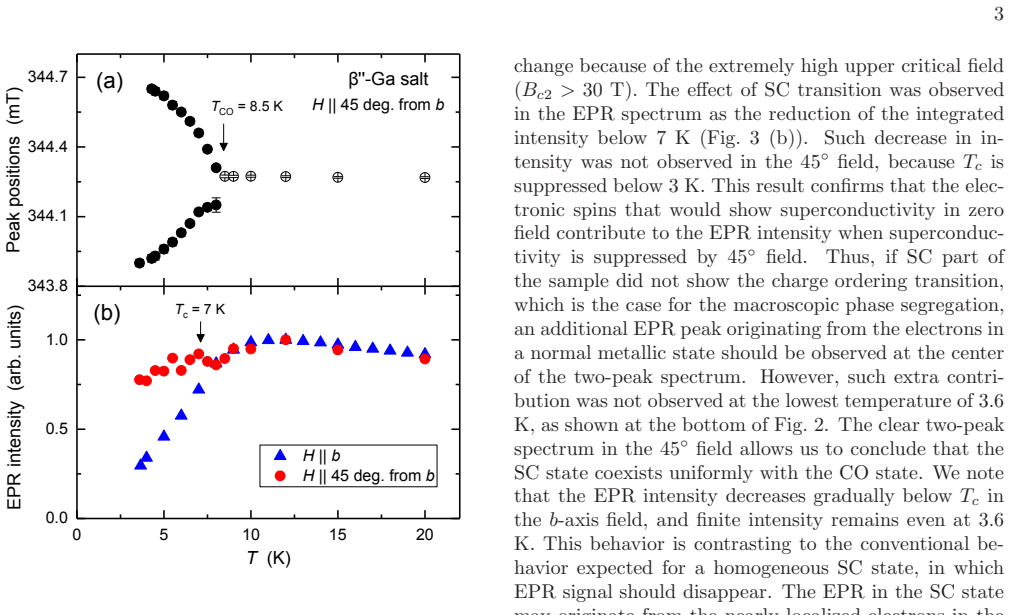
The paper's central claim is that in β''-(BEDT-TTF)4[(H3O)Ga(C2O4)3]·C6H5NO2, superconductivity and the charge-ordered state coexist uniformly at the microscopic level. Evidence comes from EPR spectra in a magnetic field oriented 45° from the b axis: the two-peak spectrum, which arises from the A and B BEDT-TTF layers with different g-factors, shows abrupt splitting below TCO = 8.5 K, marking the charge-order transition, while no central resonance line appears even at 3.6 K where a phase-separated normal-metal region would be expected to produce one. Below Tc = 7 K in the b-axis field, the EPR intensity drops but does not vanish, which the authors attribute to nearly localized electrons in the charge-ordered state rather than to paramagnetic impurities. The temperature dependence of the cross spin relaxation rate 1/TX shows an exponentially gapped interplane spin-exchange channel with Δ/kB = 16 K, while the in-plane spin relaxation T2 is unchanged across the transition, and resistivity measurements show an increase only in the interplane direction. Together these observations support a three-fold (pinball-liquid-like) charge-ordered state in which partial charge localization kills the weak interplane transfer but preserves coherent in-plane conduction, and the coexistence of this conductive CO state with superconductivity suggests charge fluctuations can promote, not destroy, the superconducting pairing.
Load-bearing premise
The coexistence conclusion rests on the assumption that a phase-separated normal region would show up as an extra, resolvable EPR line at the center of the two-peak spectrum, and that the residual EPR signal below the superconducting transition comes from charge-ordered electrons rather than from a nonsuperconducting fraction or an instrumental artifact.
Editorial extensions
If this is right
- If the coexistence is uniform, then any theory of this superconductor must explain pairing in a charge-ordered metal where parts of the Fermi surface remain conducting while interplane coherence is lost.
- The exponential 1/TX with Δ/kB = 16 K, combined with TCO = 8.5 K, gives 2Δ/kBTCO ≈ 3.8, consistent with a weak-coupling charge-density-wave gap; this makes the gapped interplane channel a quantitative test for other layered organic conductors.
- The correlation between higher Tc and a low-temperature resistivity upturn across β'' salts suggests that the conductive charge-ordered state, not just the proximity to a charge instability, is what raises Tc.
- The EPR technique demonstrated here — resolving the two BEDT-TTF layers by their g-factor anisotropy — should be able to detect phase segregation in other candidate coexistence materials.
Reading between the lines
- A quantitative detection threshold for the absent central EPR line is not given in the paper; calibrating the sensitivity with a known dilute spin population would convert the 'no extra peak' observation from a suggestive null result into a bounded statement about the maximum allowed phase-separated fraction.
- If the residual EPR intensity below Tc does come from localized charge-ordered electrons, then measuring the spin-lattice relaxation or Knight shift of those sites could reveal whether they are coupled to the superconducting condensate or only spatially adjacent to it — a distinction the present data do not address.
- The finding motivates a pressure or chemical-substitution study that tunes TCO relative to Tc: if the charge-ordered state is what promotes superconductivity, pushing TCO toward Tc should raise Tc, while suppressing CO should suppress Tc.
- Applying the same two-layer EPR splitting method to other β'' salts with and without the resistivity upturn could map whether uniform SC–CO coexistence is unique to this compound or a general feature of this family.
Signed reviews
Editorial analysis
A structured set of objections, weighed in public.
Referee Report
Summary. The manuscript reports X-band EPR and resistivity measurements on the organic superconductor beta''-(BEDT-TTF)4[(H3O)Ga(C2O4)3]·C6H5NO2. The EPR spectrum splits into two components below TCO = 8.5 K, which the authors identify with charge ordering in the two crystallographically distinct BEDT-TTF layers. In a magnetic field oriented 45 degrees from the b axis, the splitting persists down to 3.6 K while superconductivity is suppressed; in a b-axis field, the EPR intensity decreases below Tc ~ 7 K. Because no third EPR component appears at the center of the two-peak spectrum in the 45-degree field, the authors conclude that superconductivity and charge order coexist uniformly on the same microscopic volume. A coupled Bloch model with interlayer cross relaxation yields an exponential increase of 1/TX below TCO with gap Delta/kB ~ 16 K, and resistivity measurements show an increasing interlayer/in-plane resistance ratio below TCO. The authors interpret these observations as evidence for a three-fold charge-ordered 'pinball liquid' state that retains in-plane conductivity and supports superconductivity.
Significance. The claimed coexistence is of substantial interest for theories of superconductivity near charge instabilities. The paper has clear strengths: the EPR splitting and the resistivity anisotropy independently mark the same 8.5 K transition; the assignment of the splitting to charge order is anchored to prior 13C NMR results; and the coupled Bloch model treats the line shape with a transparent physical mechanism. However, the central claim of uniform microscopic coexistence rests on a negative observation (absence of a third EPR component) that is not quantified, and the interpretation of the residual EPR intensity below Tc is not unique. These issues are addressable with additional analysis, so the manuscript merits revision rather than rejection.
major comments (3)
- [Fig. 2 and the paragraph following Fig. 3(a)] The statement that 'such extra contribution was not observed at the lowest temperature of 3.6 K' is the sole evidence ruling out phase-separated non-CO regions. The paper provides no detection threshold, no fit residuals, no linewidth or intensity uncertainty for the hypothetical central component, and no test of whether a minority Lorentzian of plausible width could be hidden by the two main peaks. Without such a quantification, the negative observation cannot exclude a phase-separated SC fraction that would appear as a central EPR line when Tc is suppressed in the 45-degree field. This is load-bearing for the uniform-coexistence conclusion.
- [Fig. 3(b) and the paragraph after Eq. (2)] The residual, gradually decreasing EPR intensity below Tc in the b-axis field is attributed to nearly localized CO electrons, but no quantitative model is given for the expected intensity loss in a homogeneous SC+CO state. An alternative interpretation is that a fraction of the sample is nonsuperconducting (or has a different Tc) and contributes the residual intensity; the gradual reduction is also compatible with a distribution of Tc or with skin-depth/cavity effects. A model for the intensity reduction, or an independent estimate of the SC volume fraction, is needed to support the claim that the same microscopic volume hosts both SC and CO.
- [Equations (1)-(2) and Fig. 4(a)] The fit of the EPR spectra to the coupled Bloch model extracts 1/TX and the 16 K gap, but the main text does not report the number of fitted spectra, the parameter uncertainties, or how the fits are judged against the data. Because the interpretation of the CO state as gapping the interplane spin exchange depends on the fit quality, this is a load-bearing point for the paper's anisotropic-CO model, even though it is not needed for the coexistence claim itself.
minor comments (4)
- [Paragraph before the conclusion] Typo: 'anothor' should be 'another'.
- [Fig. 4(b) and the paragraph describing the resistivity measurements] The notation is inconsistent: the text refers to Rperp and Rpara, while the figure and text also use R_perp/R_para and R⊥/R||; the labels should be unified (e.g., R∥ for in-plane and R⊥ for interplane) throughout.
- [Fig. 2] The spectra at different temperatures appear to have different noise levels; an explicit normalization or offset description would improve readability.
- [Paragraph after Fig. 3(b)] The statement that the EPR intensity increases from 20 K up to room temperature is surprising for a metallic sample and should be explained (for instance by skin-depth effects) or referenced.
Circularity Check
No significant circularity: the coexistence claim rests on a new EPR negative observation, not on a fit to its own conclusions
full rationale
The paper's central claim—uniform microscopic coexistence of superconductivity and charge order—is derived from an EPR experiment that detects a single spectral component after suppressing Tc with a 45° field. This is a new empirical observation, not a parameter fitted to the conclusion. The charge-ordering temperature TCO=8.5 K is taken from the authors' prior 13C NMR work (ref 18), but that is an independent probe, and the EPR peak splitting is an additional anomaly that agrees with it. The three-fold CO pattern is also suggested by prior NMR and theory, but the present paper's coexistence argument does not depend on that pattern. The extracted interplane spin-gap Δ/kB=16 K is compared with the weak-coupling CDW ratio 2Δ/kBTCO=3.8 as a consistency check, not used to derive coexistence. While the coexistence conclusion relies on the absence of a hypothetical extra EPR peak, and the paper gives no explicit detection threshold, that is a sensitivity/robustness limitation, not a circularity. The self-citations (refs 16-18) are to previously published, independent measurements and are not load-bearing in the sense of defining the EPR observables through the present fits. No equation or parameter in the paper reduces by construction to its inputs. Therefore, the derivation is essentially self-contained apart from normal reliance on prior characterization, yielding a low circularity score of 2.
Assumptions & free parameters
free parameters (2)
- Charge gap Delta/k_B =
16 K
- g principal values =
(2.016, 2.010, 2.001)
assumptions (4)
- domain assumption The X-band EPR signal originates only from the pi electrons in the BEDT-TTF HOMO.
- domain assumption The principal axes of the g tensor are fixed to the BEDT-TTF molecular axes, and the two branches correspond to A and B layers.
- domain assumption The coupled Bloch model with cross spin relaxation between A and B layers describes the EPR spectra.
- domain assumption TCO = 8.5 K, previously determined by 13C NMR, corresponds to charge ordering.
Cite this review
Pith. "Pith review of Microscopic coexistence of superconductivity and charge order in organic superconductor $\beta''$-(BEDT-TTF)$_{4}$[(H$_3$O)Ga(C$_2$O$_4$)$_3$]$\cdot$C$_6$H$_5$NO$_2$." pith.science (2026). https://pith.science/paper/VYU3Q3AN
@misc{pith2026190805448,
  author       = {Pith},
  title        = {Pith review of: Microscopic coexistence of superconductivity and charge order in organic superconductor $\beta''$-(BEDT-TTF)$_4$[(H$_3$O)Ga(C$_2$O$_4$)$_3$]$\cdot$C$_6$H$_5$NO$_2$},
  year         = {2026},
  howpublished = {\url{https://pith.science/paper/VYU3Q3AN}},
  note         = {Machine review of arXiv:1908.05448}
}
abstract
The electron paramagnetic resonance study for an organic superconductor $\beta''$-(BEDT-TTF)$_{4}$[(H$_3$O)Ga(C$_2$O$_4$)$_3$]$\cdot$C$_6$H$_5$NO$_2$ reveals that superconductivity coexists uniformly with the charge ordered state in one material. In the charge ordered state, the interplane spin exchange is gapped, while the in-plane conductivity is not significantly modified. This anisotropic behavior is explained by the exotic charge ordered state, in which molecular-site selective carrier localization coexists with conducting carriers on other molecules. Relationship between superconductivity and this conductive charge ordered state is investigated.
Figures


Reference graph
Works this paper leans on
-
[1]
H. Kobayashi, R. Kato, A. Kobayashi, Y. Nishio, K. Ka- jita, and W. Sasaki, Chemistry Letters 15, 789-792 (1986)
work page 1986
- [2]
-
[3]
H. Mori, S. Tanaka, and T. Mori, Physical Review B 57, 12023 (1998)
work page 1998
-
[4]
N. D. Mathur, F. M. Groshe, S. R. Julian, I. R. Walker, D. M. Freye, R. K. Haselwimmer, and G. G. Lonzarich, Nature (London) 394 39 (1998)
work page 1998
-
[5]
J. Merino, and R. H. McKenzie, Physical Review Letters 87, 237002 (2001)
work page 2001
- [6]
-
[7]
T. Kakiuchi, Y. Wakabayashi, H. Sawa, T. Takahashi, and T. Nakamura, Journal of the Physical Society of Japan 76, 113702 (2007)
work page 2007
-
[8]
Y. Nogami, J.-P. Pouget, M. Watanaba, K. Oshima, H. Mori, S. Tanaka, and T. Mori, Synthetic Metals 103, 1911 (1999)
work page 1999
Show all 30 references
-
[9]
Miyagawa, A
K. Miyagawa, A. Kawamoto, and K. Kanoda, Physical Review B 62, R7679 (2000)
2000
-
[10]
Mori, Journal of the Physical Society of Japan 72, 1269 (2003)
T. Mori, Journal of the Physical Society of Japan 72, 1269 (2003)
2003
-
[11]
Kaneko, and M
M. Kaneko, and M. Ogata, Journal of the Physical Soci- ety of Japan 75, 014710 (2006)
2006
-
[12]
Hotta, N
C. Hotta, N. Furukawa, A. Nakagawa, and K. Kubo, Journal of the Physical Society of Japan 75, 123704 (2006)
2006
-
[13]
Merino, A
J. Merino, A. Greco, N. Drichko, and M. Dressel, Physi- cal Review Letters 96, 216402 (2006)
2006
-
[14]
Watanabe, Y
M. Watanabe, Y. Noda, Y. Nogami, and H. Mori, Jouranl of the Physical Society of Japan 73, 116 (2004)
2004
-
[15]
Akutsu, A
H. Akutsu, A. Akutsu-Sato, S. S. Turner, D. Le Peve- len, P. Day, V. Laukhin, A.-K. Klehe, J. Singleton, D. A. Tocher, M. R. Probert, and J. A. K. Howard, Jour- nal of the American Chemical Society 124, 12430 (2002)
2002
-
[16]
Ihara, H
Y. Ihara, H. Seki, and A. Kawamoto, Journal of the Phys- ical Society of Japan 82, 083701 (2013)
2013
-
[17]
Ihara, Y
Y. Ihara, Y. Futami, and A. Kawamoto, Journal of the Physical Society of Japan 85, 014601 (2016)
2016
-
[18]
Ihara, M
Y. Ihara, M. Jeong, H. Mayaffre, C. Berthier, M. Hor- vati´ c, H. Seki, and A. Kawamoto, Physical Review B 90, 121106(R) (2014)
2014
-
[19]
A. I. Coldea, A. F. Bangura, J. Singleton, A. Ardavan, A. Akutsu-Sato, H. Akutsu, S. S. Turner, and P. Day, Physical Review B 69, 085112 (2004)
2004
-
[20]
[29, 30]
See Supplemental Material [ulr], which includes Refs. [29, 30]
-
[21]
Kinoshita, M
N. Kinoshita, M. Tokumoto, H. Anzai, and G. Saito, Journal of the Physical Society of Japan 54, 4498 (1985)
1985
-
[22]
Bateni, S
A. Bateni, S. Repp, R. Thomann, S. Acar, E. Erdem, and M. Somer, Applied Physics Letters 105, 202605 (2014)
2014
-
[23]
Bateni, E
A. Bateni, E. Erdem, S. Repp, S. Acar, I. Kokal, W. H¨ aßler, S. Weber, and M. Somer, Journal of Applied Physics 117, 153905 (2015)
2015
-
[24]
Bateni, E
A. Bateni, E. Erdem, S. Repp, S. Weber, and M. Somer, Applied Physics Letters 108. 202601 (2016)
2016
-
[25]
Antal, T
´A. Antal, T. Feh´ er, E. T´ atrai-Szekeres, F. F¨ ul¨ op, B. N´ afr´ adi, L. Forr´ o, and A. J´ anossy, Physical Review B 84, 075124 (2011)
2011
-
[26]
A. F. Bangura, A. I. Coldea, J. Singleton, A. Ardavan, A. Akutsu-Sato, H. Akutsu, S. S. Turner, P. Day, T. Ya- mamoto, and K. Yakushi, Physical Review B 72, 014543 (2005)
2005
-
[27]
S. Uji, Y. Iida, S. Sugiura, T. Isono, K. Sugii, N. Kikugawa, T. Terashima, S. Yasuzuka, H. Akutsu, Y. Nakazawa, D. Graf, and P. Day, Physical Review B 97, 114505 (2018)
2018
-
[28]
Martin, A
L. Martin, A. L. Morritt, J. R. Lopez, H. Akutsu, Y. Nakazawa, S. Imajo, and Y. Ihara, Inorganic Chem- istry 56, 717 (2017)
2017
-
[29]
Y. Goto, A. Miura, C. Moriyoshi, Y. Kuroiwa, T. D. Mat- suda, Y. Aoki, and Y. Mizuguchi, Scientific Reports 8, 12852 (2018)
2018
-
[30]
Superconductors – Materials, Properties and Applications–
A. J. S. Machado, S. T. Renosto, C. A. M. dos San- tos, L. M. S. Alvas, and Z. Fisk, “Superconductors – Materials, Properties and Applications–” ch. 3. Inte- chOpen (2012)
2012
Reviewed August 14, 2026 · model on record in the stance chip above.
Discussion (0). Continue with ORCID to comment.