REVIEW 4 major objections 5 minor 108 references
PrITTI: Primitive-based Generation of Controllable and Editable 3D Semantic Urban Scenes
T0 review · 4 major / 5 minor · reviewed 2026-08-15 · deepseek-v4-flash
Pith's one-line read Coarse 3D primitives—cuboids, ellipsoids, and extruded ground polygons—can replace voxel grids as the working representation for generating controllable, editable urban scenes.
desk verdict Genuinely novel primitive-based representation for 3D urban scene generation, but the SOTA claim rests on a confounded comparison and an internal CFG contradiction the authors need to fix. read the letter →
The pith
A machine-rendered reading of the paper's core claim, the machinery that carries it, and where it could break.
The reading
What carries the argument
The load-bearing mechanism is the joint layout latent space formed by channel-wise concatenating a raster ground latent with an object primitive latent. Ground polygons are ray-cast into bird's-eye-view height maps and occupancy masks and passed through a convolutional encoder; object primitives are processed by a Transformer encoder and scattered onto the same 2D grid via a scatter-mean operation keyed by each object's 2D center. Because ground and object components occupy separate channel groups, the latent is disentangled, so the decoder can split it during reconstruction and the diffusion model can edit one modality while keeping the other fixed. Per-object orientation and size are encoded through the Cholesky decomposition of a positive-definite scatter matrix, a 6D parameterization that avoids the sign-ambiguity problems of quaternions or eigenvectors. On top of this latent, a diffusion transformer (DiT-style backbone) generates unconditionally or conditioned on scene labels, and a RePaint-inspired masked sampling loop performs inpainting and outpainting directly in latent space.
What would settle it
Run the method on urban layouts dominated by structures the primitive set cannot express—bridges, overpasses, tunnels with complex profiles, or dense pole-mounted attachments—and measure reconstruction and generation quality (e.g., mIoU, AP3D, FID). If quality collapses relative to KITTI-360 results, or if manual inspection shows systematically intersecting primitives and buildings cutting into drivable ground, the coarse-primitive abstraction is not sufficient for general urban scene generation.
Extended reading notes
Core claim
On the paper's own terms, the discovery is that a hybrid primitive representation unlocks the full capabilities of diffusion transformers for 3D urban scene generation. Objects are encoded as 9-dimensional features (normalized 3D center plus six Cholesky parameters jointly encoding orientation and size), ground classes are rasterized into height and occupancy maps, and a layout variational autoencoder maps both into a single 2D latent grid with separate ground and object channel groups. A diffusion transformer trained on this latent space generates scenes conditioned on controllable labels such as vegetation density, and a RePaint-style manipulation of the latent mask supports inpainting and outpainting without fine-tuning. Compared with voxel methods (SemCity, PDD, XCube on KITTI-360), PrITTI reports the best generation metrics (e.g., FID 71.0–73.9 versus 94.8 for the strongest voxel baseline), 0.58 s mean generation time, and 0.89 GB peak GPU memory, while keeping reconstruction competitive despite being evaluated through an unfavorable voxelization step. The paper states these results as evidence that primitive-based representations offer a more scalable and editable path to semantic urban scene modeling than resolution-bound voxel grids.
Load-bearing premise
The paper's bet is that flat extruded ground and coarse cuboid and ellipsoid boxes capture enough of a real city's structure that scenes built from them remain useful for generation, editing, and downstream simulation, despite losing fine geometry such as overpasses, facades, and small attachments.
Editorial extensions
If this is right
- Large-scale urban scene synthesis can be decoupled into semantic layout generation and appearance synthesis: the generated primitives can drive a ControlNet-based renderer to produce photorealistic street views without modifying the layout model.
- Scene editing becomes a parameter update rather than a voxel rewrite: translating, rotating, scaling, or deleting an object is a direct change to one primitive's center and Cholesky parameters, with no need to repair vacated voxel regions.
- Memory and inference cost no longer scale cubically with desired scene resolution, because the object representation is resolution-independent and only the ground raster has a fixed grid size.
- A single pre-trained model can grow scenes arbitrarily through iterative outpainting with overlapping windows, preserving road connectivity and semantic coherence across block boundaries.
- Controllability extends beyond vegetation: the label-conditioning scheme is described as general, and the paper demonstrates it on vehicle density and joint vegetation–vehicle density.
Reading between the lines
- Because the ground and object latents are disentangled, the framework could likely condition object generation on arbitrary ground semantics (lane graphs, drivable-area masks) without retraining the diffusion model, extending the demonstrated ground-to-object inpainting.
- The Cholesky-based 6D orientation/size encoding is a portable trick: any bounding-box regression task that struggles with quaternion sign ambiguity could adopt the same parameterization, independent of scene generation.
- If coarse primitives are accepted as the semantic backbone, then realism becomes a rendering-stage problem; one testable extension is swapping the ControlNet renderer for a Gaussian-splatting or NeRF-based synthesizer to see whether layout edits propagate to appearance.
- The method's current static-scene and fixed-category limits suggest a natural stress test: adding dynamic objects or unseen classes would require either an open-vocabulary extension or a separate motion model, both of which are unaddressed in this paper.
Signed reviews
Editorial analysis
A structured set of objections, weighed in public.
Referee Report
Summary. The paper proposes PrITTI, a two-stage latent diffusion model for 3D semantic urban scene generation. Stage 1 trains a layout VAE with separate ground-raster and object-primitive branches, using a Cholesky-based parameterization for cuboid/ellipsoid object attributes; Stage 2 trains a DiT over the joint latent, conditioned on a vegetation-density label, and uses RePaint-style latent manipulation for inpainting, outpainting, and editing. Experiments on KITTI-360 compare PrITTI with SemCity, PDD, and XCube, reporting lower memory, faster generation, and better FID/Precision/Recall in Table 3. The paper also demonstrates object-level editing, ground-conditioned object generation, large-scale extrapolation, and photo-realistic street-view synthesis via ControlNet, with an additional Argoverse 2 experiment in the supplement.
Significance. If the SOTA generation claim were established, PrITTI would make a useful contribution: it shows that compact vectorized primitives can support controllable 3D urban layout generation with direct editability and lower memory than voxel grids. The two-stage design is clean, the Cholesky parameterization is a sensible alternative to quaternion encodings, and the paper includes helpful supplementary material such as an overfitting/nearest-neighbor analysis, an Argoverse 2 transfer experiment, and broad downstream applications. The central empirical claim, however, is currently weakened by an uncontrolled comparison and by a direct internal contradiction about the inference protocol, so the paper is not yet ready for acceptance.
major comments (4)
- [Section 4.2, Table 3] The generation comparison is not controlled for conditioning. PrITTI is conditioned on the vegetation-density label y, with equal sampling over low/medium/high classes, while SemCity, PDD, and XCube are all unconditional. Conditioning gives the model access to target-mode information that the baselines do not receive, so the reported differences in Table 3 cannot be attributed solely to the primitive-based representation. To support the headline claim, the authors should report an unconditional PrITTI variant, or condition the baselines on the same y, or both. A clean comparison is needed before the paper's central 'state-of-the-art generation quality' claim can be accepted.
- [Section 4.2 vs. Supplement B.3.4] The main text states that PrITTI is evaluated 'without classifier-free guidance,' while Supplement B.3.4 states that 'Classifier-free guidance is applied with a guidance scale of 4.0.' These statements are mutually inconsistent. Guidance at scale 4.0 typically shifts precision/recall and FID substantially, and no baseline in Table 3 uses guidance. The authors must clarify the exact inference protocol, recompute any affected metrics, and state the guidance scale, if any, directly in the main-text evaluation setup.
- [Table 3 and Supplement Fig. 10] The generative metrics in Table 3 are single-point estimates at one evaluation configuration (1K farthest-point-sampled reference samples, k=3) with no error bars, multiple seeds, or sensitivity analysis. Supplement Fig. 10 shows that precision and recall for the proposed method vary substantially with reference-sample count and neighborhood size, with precision dropping roughly from 0.7 at 1K/k=3 to below 0.4 at 10K/k=3. The authors report this sensitivity and then select a favorable configuration; they should either report all configurations shown in Fig. 10, provide confidence intervals, or justify why the single configuration in Table 3 is the primary basis for the SOTA claim.
- [Section 4.2, Metrics] All generative quality metrics are computed on 256x256 top-down semantic renders of the 3D scenes, not on the 3D layouts themselves. Given that the paper's contribution is a 3D primitive-based representation, additional 3D-level diagnostics would materially support the '3D scene generation quality' claim: for example, distributions of object counts per category, per-category placement and geometry accuracy, and rates of geometric violations such as primitive intersections or ground-object misalignment. Without such metrics, the FID, IS, Precision, and Recall numbers characterize a 2D BEV projection rather than the proposed 3D representation directly.
minor comments (5)
- [Table 1 and Section 4.1] The phrase 'competitive reconstruction' should be quantified more carefully: at the same 256^2x32 voxelization, PrITTI reports mIoU 70.27 against 93.81 for SemCity-1M and 79.47 for XCube, so the 'competitiveness' claim is only meaningful with the caveat that PrITTI is natively primitive-based and voxelization penalizes its measurements.
- [Section 3.2 and Supplement A] The fixed per-category primitive count N_c is set to the 95th percentile and additional instances are discarded. The effect of this truncation on dense scenes (e.g., vegetation, fences, or pole-mounted attachments) is not analyzed; a short quantitative or qualitative discussion of truncation sensitivity would be useful.
- [Figure 4] The Cholesky-versus-quaternion comparison is performed on synthetic single-object samples with random yaw and scale. A full-scene ablation with multiple objects and varied orientation distributions would be more convincing evidence that the parameterization improves training stability in the actual task.
- [Section 4.3] Object-level editing, ground-conditioned generation, and photo-realistic street-view synthesis are evaluated only qualitatively. A simple quantitative measure, such as a user study or per-edit semantic consistency metric, would strengthen these claims.
- [Related Work / Experiments] SLEDGE and other layout-generation methods are discussed in Related Work but are not compared empirically. A sentence explaining why a quantitative comparison is infeasible (e.g., different data formats or task definitions) would improve clarity.
Circularity Check
No circular derivation; evaluation fairness concerns are correctness risks, not circularity.
full rationale
The paper's derivation chain is self-contained. The central claims—that a two-stage layout VAE plus latent DiT over primitive and raster latents can reconstruct and generate urban layouts—are supported by empirical comparisons against external voxel-based baselines (SemCity, PDD, XCube), not by definitions or self-citations. The primitive representation in Sec. 3.1 is an explicit modeling choice, not a derived result. The Cholesky parameterization in Sec. B.1 is a standard mathematical encoding, and its claimed benefit is tested on a synthetic vehicle-rotation experiment (Fig. 4) rather than assumed. The scene label y is computed from ground-truth vegetation statistics and used as a conditioning input; no fitted parameter is relabeled as a prediction. Self-citations such as SLEDGE [14] and UrbanGIRAFFE [96] appear only as related-work context and carry no load-bearing premise. The main concerns are evaluation fairness—PrITTI is evaluated conditionally while baselines are unconditional, the main text says sampling is done without classifier-free guidance while supplement Sec. B.3.4 states a guidance scale of 4.0, and Fig. 10 shows strong sensitivity of Precision/Recall to evaluation configuration. These are validity and correctness risks, not circularity under the definitional-equivalence tests. No step reduces to its own inputs by construction.
Assumptions & free parameters
free parameters (6)
- Per-category primitive counts N_c (95th percentile) =
VC 178, VE 159, VS 18, TW 6, H 5, CB 16, CS 77, P 19, TC 17, O 17, VB 2; total 514
- Object existence probability threshold =
0.3, with stated insensitivity in [0.25, 0.75]
- Vegetation-density label quantiles =
25th and 75th percentiles of vegetation count and volume
- Classifier-free guidance scale =
4.0 (reported in the supplement; the main text says generation was run without classifier-free guidance)
- Outpainting overlap ratio =
50%
- KL weight for the layout VAE =
1e-6
assumptions (5)
- domain assumption KITTI-360 primitive annotations, cuboids, ellipsoids, and extruded polygons, faithfully represent urban scene semantics.
- domain assumption BEV-rendered semantic maps and FID, Precision, Recall, and Inception Score adequately measure 3D scene generation quality.
- domain assumption Retraining voxel baselines on the voxelized KITTI-360 data is a fair test of those baselines.
- domain assumption The custom train/test split prevents spatial and temporal leakage between training and test poses.
- standard math Standard DDPM and DiT machinery is correct and applicable to the learned latent space.
Cite this review
Pith. "Pith review of PrITTI: Primitive-based Generation of Controllable and Editable 3D Semantic Urban Scenes." pith.science (2026). https://pith.science/paper/VYWAM6NJ
@misc{pith2026250619117,
  author       = {Pith},
  title        = {Pith review of: PrITTI: Primitive-based Generation of Controllable and Editable 3D Semantic Urban Scenes},
  year         = {2026},
  howpublished = {\url{https://pith.science/paper/VYWAM6NJ}},
  note         = {Machine review of arXiv:2506.19117}
}
read the original abstract
Existing approaches to 3D semantic urban scene generation predominantly rely on voxel-based representations, which are bound by fixed resolution, challenging to edit, and memory-intensive in their dense form. In contrast, we advocate for a primitive-based paradigm where urban scenes are represented using compact, semantically meaningful 3D elements that are easy to manipulate and compose. To this end, we introduce PrITTI, a latent diffusion model that leverages vectorized object primitives and rasterized ground surfaces for generating diverse, controllable, and editable 3D semantic urban scenes. This hybrid representation yields a structured latent space that facilitates object- and ground-level manipulation. Experiments on KITTI-360 show that primitive-based representations unlock the full capabilities of diffusion transformers, achieving state-of-the-art 3D scene generation quality with lower memory requirements, faster inference, and greater editability than voxel-based methods. Beyond generation, PrITTI supports a range of downstream applications, including scene editing, inpainting, outpainting, and photo-realistic street-view synthesis. The source code and more results can be found at https://raniatze.github.io/pritti/.
Figures


Figures from the paper (28 more)


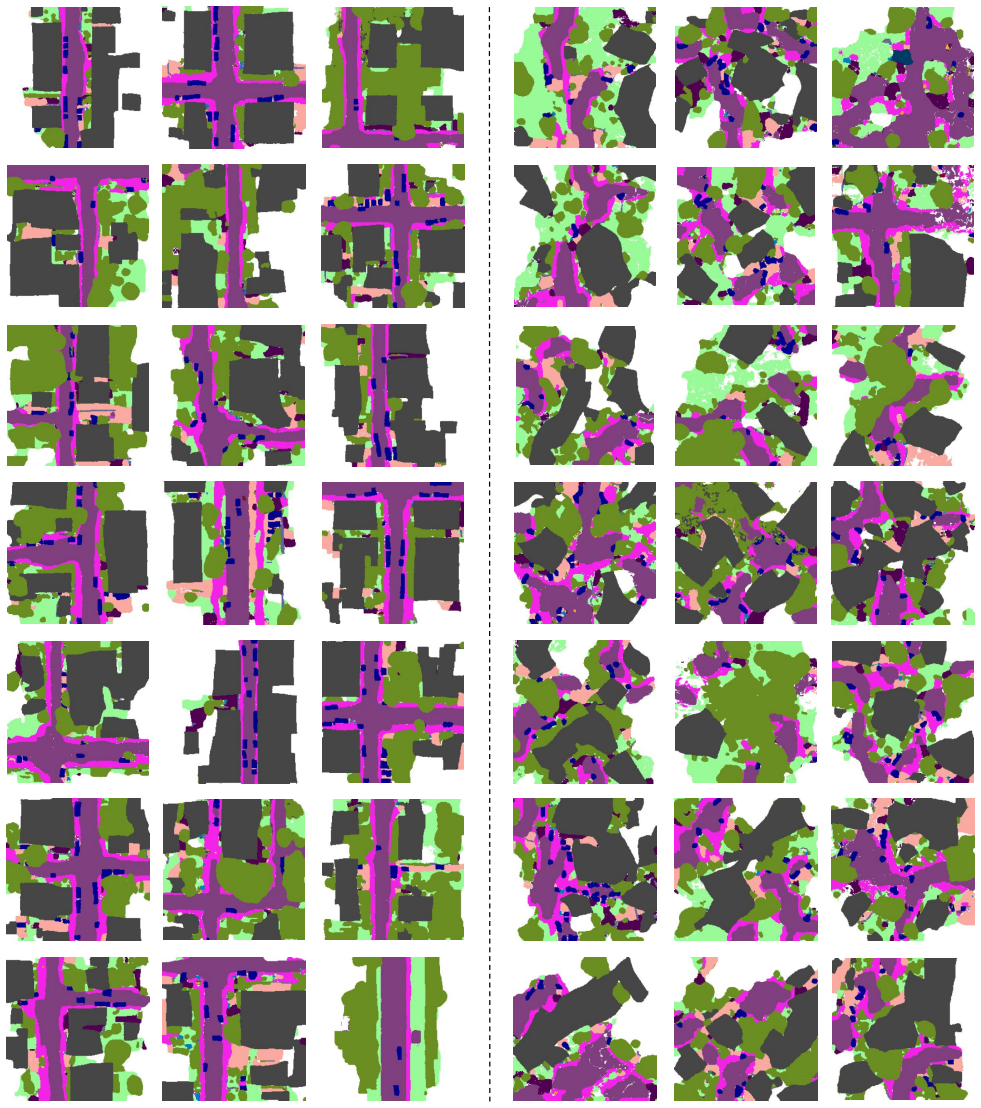


Reference graph
Works this paper leans on
-
[1]
https://www.turbosquid.com/3d- models/3d-karton-city-2-model-1196110
3d karton city model. https://www.turbosquid.com/3d- models/3d-karton-city-2-model-1196110. 20
-
[2]
Saor: Single-view articulated object reconstruction
Mehmet Aygun and Oisin Mac Aodha. Saor: Single-view articulated object reconstruction. InProc. IEEE Conf. on Computer Vision and Pattern Recognition (CVPR), 2024. 8
2024
-
[3]
Guibas, and Andrea Tagliasacchi
Sherwin Bahmani, Jeong Joon Park, Despoina Paschalidou, Xingguang Yan, Gordon Wetzstein, Leonidas J. Guibas, and Andrea Tagliasacchi. CC3D: layout-conditioned generation of compositional 3d scenes. InProc. of the IEEE Interna- tional Conf. on Computer Vision (ICCV), 2023. 2
2023
-
[4]
Se- mantickitti: A dataset for semantic scene understanding of lidar sequences
Jens Behley, Martin Garbade, Andres Milioto, Jan Quen- zel, Sven Behnke, Cyrill Stachniss, and Jurgen Gall. Se- mantickitti: A dataset for semantic scene understanding of lidar sequences. InProc. of the IEEE International Conf. on Computer Vision (ICCV), 2019. 20
2019
-
[5]
Human image understanding: Recent research and a theory.Computer vision, graphics, and image processing, 1985
Irving Biederman. Human image understanding: Recent research and a theory.Computer vision, graphics, and image processing, 1985. 2
1985
-
[6]
Visual perception by computer
Thomas Binford. Visual perception by computer. InProc. IEEE Conf. on Systems and Control, 1975, 1975. 2
1975
-
[7]
Alexey Bokhovkin, Quan Meng, Shubham Tulsiani, and Angela Dai. Scenefactor: Factored latent 3d diffusion for controllable 3d scene generation.arXiv.org, 2412.01801,
-
[8]
Omni3d: A large benchmark and model for 3d object detection in the wild
Garrick Brazil, Abhinav Kumar, Julian Straub, Nikhila Ravi, Justin Johnson, and Georgia Gkioxari. Omni3d: A large benchmark and model for 3d object detection in the wild. In Proc. IEEE Conf. on Computer Vision and Pattern Recogni- tion (CVPR), 2023. 6
2023
Show all 108 references
-
[9]
The acronym model-based vision system
Rodney A Brooks, Russell Creiner, and Thomas O Binford. The acronym model-based vision system. InProc. of the International Joint Conf. on Artificial Intelligence (IJCAI),
-
[10]
nuscenes: A multi- modal dataset for autonomous driving
Holger Caesar, Varun Bankiti, Alex H Lang, Sourabh V ora, Venice Erin Liong, Qiang Xu, Anush Krishnan, Yu Pan, Giancarlo Baldan, and Oscar Beijbom. nuscenes: A multi- modal dataset for autonomous driving. InProc. IEEE Conf. on Computer Vision and Pattern Recognition (CVPR), 20...
2020
-
[11]
Wolff, Alex H
Holger Caesar, Juraj Kabzan, Kok Seang Tan, Whye Kit Fong, Eric M. Wolff, Alex H. Lang, Luke Fletcher, Oscar Beijbom, and Sammy Omari. nuplan: A closed-loop ml- based planning benchmark for autonomous vehicles. InProc. IEEE Conf. on Computer Vision and Pattern Recognition (CVP...
2021
-
[12]
End- to-end object detection with transformers
Nicolas Carion, Francisco Massa, Gabriel Synnaeve, Nicolas Usunier, Alexander Kirillov, and Sergey Zagoruyko. End- to-end object detection with transformers. InProc. of the European Conf. on Computer Vision (ECCV), 2020. 4, 16
2020
-
[13]
Layout2scene: 3d semantic lay- out guided scene generation via geometry and appearance diffusion priors.arXiv.org, 2501.02519, 2025
Minglin Chen, Longguang Wang, Sheng Ao, Ye Zhang, Kai Xu, and Yulan Guo. Layout2scene: 3d semantic lay- out guided scene generation via geometry and appearance diffusion priors.arXiv.org, 2501.02519, 2025. 2
2025 arXiv
-
[14]
Sledge: Synthesizing driving environments with generative models and rule-based traffic
Kashyap Chitta, Daniel Dauner, and Andreas Geiger. Sledge: Synthesizing driving environments with generative models and rule-based traffic. InProc. of the European Conf. on Computer Vision (ECCV), 2024. 3
2024
-
[15]
Cholesky
A. Cholesky. Sur la résolution numérique des systèmes d’équations linéaires.Bulletin Géodésique, 1924. 2, 3, 15
1924
-
[16]
Cvxnet: Learnable convex decomposition
Boyang Deng, Kyle Genova, Soroosh Yazdani, Sofien Bouaziz, Geoffrey Hinton, and Andrea Tagliasacchi. Cvxnet: Learnable convex decomposition. InProc. IEEE Conf. on Computer Vision and Pattern Recognition (CVPR), 2020. 2
2020
-
[17]
Citygen: Infinite and controllable 3d city layout generation.arXiv.org, 2312.01508, 2023
Jie Deng, Wenhao Chai, Jianshu Guo, Qixuan Huang, Wen- hao Hu, Jenq-Neng Hwang, and Gaoang Wang. Citygen: Infinite and controllable 3d city layout generation.arXiv.org, 2312.01508, 2023. 3
2023 arXiv
-
[18]
Graph-to-3d: End-to-end generation and manipulation of 3d scenes using scene graphs
Helisa Dhamo, Fabian Manhardt, Nassir Navab, and Fed- erico Tombari. Graph-to-3d: End-to-end generation and manipulation of 3d scenes using scene graphs. InProc. of the IEEE International Conf. on Computer Vision (ICCV),
-
[19]
Diffusion mod- els beat gans on image synthesis
Prafulla Dhariwal and Alexander Nichol. Diffusion mod- els beat gans on image synthesis. InAdvances in Neural Information Processing Systems (NeurIPS), 2021. 6, 22
2021
-
[20]
Scenescape: Text-driven consistent scene generation
Rafail Fridman, Amit Abecasis, Yoni Kasten, and Tali Dekel. Scenescape: Text-driven consistent scene generation. InAd- vances in Neural Information Processing Systems (NeurIPS),
-
[21]
Learning shape templates with structured implicit functions
Kyle Genova, Forrester Cole, Daniel Vlasic, Aaron Sarna, William T Freeman, and Thomas Funkhouser. Learning shape templates with structured implicit functions. InProc. of the IEEE International Conf. on Computer Vision (ICCV),
-
[22]
Efros, and Martial Hebert
Abhinav Gupta, Alexei A. Efros, and Martial Hebert. Blocks world revisited: Image understanding using qualitative ge- ometry and mechanics. InProc. of the European Conf. on Computer Vision (ECCV), 2010. 2
2010
-
[23]
King: Generat- ing safety-critical driving scenarios for robust imitation via kinematics gradients
Niklas Hanselmann, Katrin Renz, Kashyap Chitta, Apra- tim Bhattacharyya, and Andreas Geiger. King: Generat- ing safety-critical driving scenarios for robust imitation via kinematics gradients. InProc. of the European Conf. on Computer Vision (ECCV), 2022. 8
2022
-
[24]
Belongie
Zekun Hao, Hadar Averbuch-Elor, Noah Snavely, and Serge J. Belongie. Dualsdf: Semantic shape manipulation using a two-level representation. InProc. IEEE Conf. on Computer Vision and Pattern Recognition (CVPR), 2020. 2
2020
-
[25]
Spaghetti: Editing implicit shapes through part aware generation.ACM Trans
Amir Hertz, Or Perel, Raja Giryes, Olga Sorkine-Hornung, and Daniel Cohen-Or. Spaghetti: Editing implicit shapes through part aware generation.ACM Trans. on Graphics,
-
[26]
Gans trained by a two time-scale update rule converge to a local nash equilib- rium
Martin Heusel, Hubert Ramsauer, Thomas Unterthiner, Bern- hard Nessler, and Sepp Hochreiter. Gans trained by a two time-scale update rule converge to a local nash equilib- rium. InAdvances in Neural Information Processing Systems (NeurIPS), 2017. 6
2017
-
[27]
Classifier-free diffusion guidance.arXiv.org, 2207.12598, 2022
Jonathan Ho and Tim Salimans. Classifier-free diffusion guidance.arXiv.org, 2207.12598, 2022. 20
2022 arXiv
-
[28]
Denoising diffu- sion probabilistic models
Jonathan Ho, Ajay Jain, and Pieter Abbeel. Denoising diffu- sion probabilistic models. InAdvances in Neural Informa- tion Processing Systems (NeurIPS), 2020. 5, 6, 18
2020
-
[29]
Text2room: Extracting textured 3d meshes from 2d text-to-image models
Lukas Höllein, Ang Cao, Andrew Owens, Justin Johnson, and Matthias Nießner. Text2room: Extracting textured 3d meshes from 2d text-to-image models. InProc. of the IEEE International Conf. on Computer Vision (ICCV), 2023. 2
2023
-
[30]
Scene4u: Hierarchical layered 3d scene reconstruction from single panoramic image for your immerse exploration
Zilong Huang, Jun He, Junyan Ye, Lihan Jiang, Weijia Li, Yiping Chen, and Ting Han. Scene4u: Hierarchical layered 3d scene reconstruction from single panoramic image for your immerse exploration. InProc. IEEE Conf. on Computer Vision and Pattern Recognition (CVPR), 2025. 3
2025
-
[31]
Scenediffuser: Efficient and controllable driving simulation initialization and rollout
Max Jiang, Yijing Bai, Andre Cornman, Christopher Davis, Xiukun Huang, Hong Jeon, Sakshum Kulshrestha, John Lambert, Shuangyu Li, Xuanyu Zhou, et al. Scenediffuser: Efficient and controllable driving simulation initialization and rollout. InAdvances in Neural Information Proce...
2024
-
[32]
A style-based generator architecture for generative adversarial networks
Tero Karras, Samuli Laine, and Timo Aila. A style-based generator architecture for generative adversarial networks. InProc. IEEE Conf. on Computer Vision and Pattern Recog- nition (CVPR), 2019. 6
2019
-
[33]
Alias-free generative adversarial networks
Tero Karras, Miika Aittala, Samuli Laine, Erik Härkönen, Janne Hellsten, Jaakko Lehtinen, and Timo Aila. Alias-free generative adversarial networks. InAdvances in Neural Information Processing Systems (NeurIPS), 2021. 6
2021
-
[34]
Kingma and Max Welling
Diederik P. Kingma and Max Welling. Auto-encoding varia- tional bayes.Proc. of the International Conf. on Learning Representations (ICLR), 2014. 2, 17
2014
-
[35]
Salad: Part-level latent diffusion for 3d shape genera- tion and manipulation
Juil Koo, Seungwoo Yoo, Minh Hieu Nguyen, and Minhyuk Sung. Salad: Part-level latent diffusion for 3d shape genera- tion and manipulation. InProc. of the IEEE International Conf. on Computer Vision (ICCV), 2023. 2
2023
-
[36]
The hungarian method for the assignment problem
Harold W Kuhn. The hungarian method for the assignment problem. 1955. 4, 16
1955
-
[37]
Improved precision and recall metric for assessing generative models
Tuomas Kynkäänniemi, Tero Karras, Samuli Laine, Jaakko Lehtinen, and Timo Aila. Improved precision and recall metric for assessing generative models. InAdvances in Neural Information Processing Systems (NeurIPS), 2019. 6, 22
2019
-
[38]
Semcity: Semantic scene gen- eration with triplane diffusion
Jumin Lee, Sebin Lee, Changho Jo, Woobin Im, Juhyeong Seon, and Sung-Eui Yoon. Semcity: Semantic scene gen- eration with triplane diffusion. InProc. IEEE Conf. on Computer Vision and Pattern Recognition (CVPR), 2024. 2, 3, 5, 7, 20, 21, 24, 31, 39
2024
-
[39]
Grass: Generative recursive autoencoders for shape structures.ACM Trans
Jun Li, Kai Xu, Siddhartha Chaudhuri, Ersin Yumer, Hao Zhang, and Leonidas Guibas. Grass: Generative recursive autoencoders for shape structures.ACM Trans. on Graphics,
-
[40]
Jun Li, Kai Xu, Siddhartha Chaudhuri, Ersin Yumer, Hao (Richard) Zhang, and Leonidas J. Guibas. GRASS: generative recursive autoencoders for shape structures.ACM Trans. on Graphics, 36(4), 2017. 2
2017
-
[41]
Kitti-360: A novel dataset and benchmarks for urban scene understanding in 2d and 3d.IEEE Trans
Yiyi Liao, Jun Xie, and Andreas Geiger. Kitti-360: A novel dataset and benchmarks for urban scene understanding in 2d and 3d.IEEE Trans. on Pattern Analysis and Machine Intelligence (PAMI), 2022. 2, 5, 14, 24
2022
-
[42]
Instructscene: Instruction- driven 3d indoor scene synthesis with semantic graph prior
Chenguo Lin and Yadong Mu. Instructscene: Instruction- driven 3d indoor scene synthesis with semantic graph prior. InProc. of the International Conf. on Learning Representa- tions (ICLR), 2024. 3
2024
-
[43]
Infinicity: Infinite-scale city synthesis
Chieh Hubert Lin, Hsin-Ying Lee, Willi Menapace, Menglei Chai, Aliaksandr Siarohin, Ming-Hsuan Yang, and Sergey Tulyakov. Infinicity: Infinite-scale city synthesis. InProc. of the IEEE International Conf. on Computer Vision (ICCV),
-
[44]
Pyramid diffusion for fine 3d large scene generation
Yuheng Liu, Xinke Li, Xueting Li, Lu Qi, Chongshou Li, and Ming-Hsuan Yang. Pyramid diffusion for fine 3d large scene generation. InProc. of the European Conf. on Com- puter Vision (ECCV), 2024. 2, 3, 5, 7, 19, 20, 21, 24, 33
2024
-
[45]
Urban architect: Steerable 3d urban scene generation with layout prior.arXiv.org, 2404.06780, 2024
Fan Lu, Kwan-Yee Lin, Yan Xu, Hongsheng Li, Guang Chen, and Changjun Jiang. Urban architect: Steerable 3d urban scene generation with layout prior.arXiv.org, 2404.06780, 2024. 2, 8, 22
2024 arXiv
-
[46]
Scenecontrol: Diffusion for controllable traffic scene generation
Jack Lu, Kelvin Wong, Chris Zhang, Simon Suo, and Raquel Urtasun. Scenecontrol: Diffusion for controllable traffic scene generation. InProc. IEEE International Conf. on Robotics and Automation (ICRA), 2024. 3, 24
2024
-
[47]
Repaint: In- painting using denoising diffusion probabilistic models
Andreas Lugmayr, Martin Danelljan, Andres Romero, Fisher Yu, Radu Timofte, and Luc Van Gool. Repaint: In- painting using denoising diffusion probabilistic models. In Proc. IEEE Conf. on Computer Vision and Pattern Recogni- tion (CVPR), 2022. 2, 4, 5, 18
2022
-
[48]
Tenenbaum
Andrew Luo, Zhoutong Zhang, Jiajun Wu, and Joshua B. Tenenbaum. End-to-end optimization of scene layout. In Proc. IEEE Conf. on Computer Vision and Pattern Recogni- tion (CVPR), 2020. 3
2020
-
[49]
Lt3sd: Latent trees for 3d scene diffusion
Quan Meng, Lei Li, Matthias Nießner, and Angela Dai. Lt3sd: Latent trees for 3d scene diffusion. InProc. IEEE Conf. on Computer Vision and Pattern Recognition (CVPR),
-
[50]
Hdmapgen: A hierarchical graph gen- erative model of high definition maps
Lu Mi, Hang Zhao, Charlie Nash, Xiaohan Jin, Jiyang Gao, Chen Sun, Cordelia Schmid, Nir Shavit, Yuning Chai, and Dragomir Anguelov. Hdmapgen: A hierarchical graph gen- erative model of high definition maps. InProceedings of the IEEE/CVF Conference on Computer Vision and Patter...
2021
-
[51]
Structurenet: Hierarchi- cal graph networks for 3d shape generation
Kaichun Mo, Paul Guerrero, Li Yi, Hao Su, Peter Wonka, Niloy Mitra, and Leonidas Guibas. Structurenet: Hierarchi- cal graph networks for 3d shape generation. InACM Trans. on Graphics, 2019. 2
2019
-
[52]
Structurenet: Hierarchi- cal graph networks for 3d shape generation.ACM Trans
Kaichun Mo, Paul Guerrero, Li Yi, Hao Su, Peter Wonka, Niloy Mitra, and Leonidas Guibas. Structurenet: Hierarchi- cal graph networks for 3d shape generation.ACM Trans. on Graphics, 2019. 2
2019
-
[53]
Im2struct: Recovering 3d shape structure from a single RGB image
Chengjie Niu, Jun Li, and Kai Xu. Im2struct: Recovering 3d shape structure from a single RGB image. InProc. IEEE Conf. on Computer Vision and Pattern Recognition (CVPR),
-
[54]
Text2immersion: Generative immersive scene with 3d gaussians.arXiv.org, 2312.09242, 2023
Hao Ouyang, Tiancheng Sun, Stephen Lombardi, and Kathryn Heal. Text2immersion: Generative immersive scene with 3d gaussians.arXiv.org, 2312.09242, 2023. 3
2023 arXiv
-
[55]
Superquadrics revisited: Learning 3d shape parsing beyond cuboids
Despoina Paschalidou, Ali Osman Ulusoy, and Andreas Geiger. Superquadrics revisited: Learning 3d shape parsing beyond cuboids. InProc. IEEE Conf. on Computer Vision and Pattern Recognition (CVPR), 2019. 2
2019
-
[56]
Learning unsupervised hierarchical part decomposition of 3d objects from a single rgb image
Despoina Paschalidou, Luc van Gool, and Andreas Geiger. Learning unsupervised hierarchical part decomposition of 3d objects from a single rgb image. InProc. IEEE Conf. on Computer Vision and Pattern Recognition (CVPR), 2020. 2
2020
-
[57]
Atiss: Autoregres- sive transformers for indoor scene synthesis
Despoina Paschalidou, Amlan Kar, Maria Shugrina, Karsten Kreis, Andreas Geiger, and Sanja Fidler. Atiss: Autoregres- sive transformers for indoor scene synthesis. InAdvances in Neural Information Processing Systems (NeurIPS), 2021. 3, 6
2021
-
[58]
Neural parts: Learning expressive 3d shape abstractions with invertible neural networks
Despoina Paschalidou, Angelos Katharopoulos, Andreas Geiger, and Sanja Fidler. Neural parts: Learning expressive 3d shape abstractions with invertible neural networks. In Proc. IEEE Conf. on Computer Vision and Pattern Recogni- tion (CVPR), 2021. 8
2021
-
[59]
Scalable diffusion models with transformers
William Peebles and Saining Xie. Scalable diffusion models with transformers. InProc. of the IEEE International Conf. on Computer Vision (ICCV), 2023. 5, 18, 22
2023
-
[60]
Parts: Structured descriptions of shape
Alex Pentland. Parts: Structured descriptions of shape. In Proc. of the Conf. on Artificial Intelligence (AAAI), 1986. 2
1986
-
[61]
Film: Visual reasoning with a general conditioning layer
Ethan Perez, Florian Strub, Harm De Vries, Vincent Du- moulin, and Aaron Courville. Film: Visual reasoning with a general conditioning layer. InProc. of the Conf. on Artificial Intelligence (AAAI), 2018. 5
2018
-
[62]
Compositional 3d scene generation using locally conditioned diffusion
Ryan Po and Gordon Wetzstein. Compositional 3d scene generation using locally conditioned diffusion. InProc. of the International Conf. on 3D Vision (3DV), 2024. 2
2024
-
[63]
Accelerating 3d deep learning with pytorch3d.arXiv.org, 2007.08501, 2020
Nikhila Ravi, Jeremy Reizenstein, David Novotny, Taylor Gordon, Wan-Yen Lo, Justin Johnson, and Georgia Gkioxari. Accelerating 3d deep learning with pytorch3d.arXiv.org, 2007.08501, 2020. 6
2007 arXiv
-
[64]
Xcube: Large-scale 3d generative modeling using sparse voxel hierarchies
Xuanchi Ren, Jiahui Huang, Xiaohui Zeng, Ken Museth, Sanja Fidler, and Francis Williams. Xcube: Large-scale 3d generative modeling using sparse voxel hierarchies. InProc. IEEE Conf. on Computer Vision and Pattern Recognition (CVPR), 2024. 2, 3, 5, 7, 20, 21, 24, 35
2024
-
[65]
Gen3c: 3d-informed world-consistent video generation with precise camera con- trol
Xuanchi Ren, Tianchang Shen, Jiahui Huang, Huan Ling, Yifan Lu, Merlin Nimier-David, Thomas Müller, Alexander Keller, Sanja Fidler, and Jun Gao. Gen3c: 3d-informed world-consistent video generation with precise camera con- trol. InProc. IEEE Conf. on Computer Vision and Patter...
2025
-
[66]
Fast and flexible indoor scene synthesis via deep convolutional generative models
Daniel Ritchie, Kai Wang, and Yu-An Lin. Fast and flexible indoor scene synthesis via deep convolutional generative models. InProc. IEEE Conf. on Computer Vision and Pat- tern Recognition (CVPR), 2019. 3
2019
-
[67]
PhD thesis, Massachusetts Institute of Technology, 1963
Lawrence G Roberts.Machine perception of three- dimensional solids. PhD thesis, Massachusetts Institute of Technology, 1963. 2
1963
-
[68]
High-resolution image synthesis with latent diffusion models
Robin Rombach, Andreas Blattmann, Dominik Lorenz, Patrick Esser, and Björn Ommer. High-resolution image synthesis with latent diffusion models. InProc. IEEE Conf. on Computer Vision and Pattern Recognition (CVPR), 2022. 2, 3, 4, 5, 18
2022
-
[69]
Scenario dreamer: Vec- torized latent diffusion for generating driving simulation environments.arXiv.org, 2503.22496, 2025
Luke Rowe, Roger Girgis, Anthony Gosselin, Liam Paull, Christopher Pal, and Felix Heide. Scenario dreamer: Vec- torized latent diffusion for generating driving simulation environments.arXiv.org, 2503.22496, 2025. 3
2025 arXiv
-
[70]
Improved techniques for training gans
Tim Salimans, Ian Goodfellow, Wojciech Zaremba, Vicki Cheung, Alec Radford, and Xi Chen. Improved techniques for training gans. InAdvances in Neural Information Pro- cessing Systems (NeurIPS), 2016. 6
2016
-
[71]
A recipe for generating 3d worlds from a single image
Katja Schwarz, Denis Rozumny, Samuel Rota Bulo, Lorenzo Porzi, and Peter Kontschieder. A recipe for generating 3d worlds from a single image. InProc. of the IEEE Interna- tional Conf. on Computer Vision (ICCV), 2025. 3
2025
-
[72]
Realmdreamer: Text-driven 3d scene generation with inpainting and depth diffusion
Jaidev Shriram, Alex Trevithick, Lingjie Liu, and Ravi Ra- mamoorthi. Realmdreamer: Text-driven 3d scene generation with inpainting and depth diffusion. InProc. of the Interna- tional Conf. on 3D Vision (3DV), 2025. 3
2025
-
[73]
Roomdreamer: Text-driven 3d indoor scene synthesis with coherent geome- try and texture.arXiv.org, 2305.11337, 2023
Liangchen Song, Liangliang Cao, Hongyu Xu, Kai Kang, Feng Tang, Junsong, Yuan, and Yang Zhao. Roomdreamer: Text-driven 3d indoor scene synthesis with coherent geome- try and texture.arXiv.org, 2305.11337, 2023. 2
2023 arXiv
-
[74]
Scalability in perception for autonomous driving: Waymo open dataset
Pei Sun, Henrik Kretzschmar, Xerxes Dotiwalla, Aurelien Chouard, Vijaysai Patnaik, Paul Tsui, James Guo, Yin Zhou, Yuning Chai, Benjamin Caine, Vijay Vasudevan, Wei Han, Jiquan Ngiam, Hang Zhao, Aleksei Timofeev, Scott Et- tinger, Maxim Krivokon, Amy Gao, Aditya Joshi, Yu Zhan...
2020
-
[75]
Drivescenegen: Generating diverse and realistic driving sce- narios from scratch.IEEE Robotics and Automation Letters (RA-L), 2024
Shuo Sun, Zekai Gu, Tianchen Sun, Jiawei Sun, Chen- gran Yuan, Yuhang Han, Dongen Li, and Marcelo H Ang. Drivescenegen: Generating diverse and realistic driving sce- narios from scratch.IEEE Robotics and Automation Letters (RA-L), 2024. 3
2024
-
[76]
Scenegen: Learning to generate realistic traffic scenes
Shuhan Tan, Kelvin Wong, Shenlong Wang, Sivabalan Mani- vasagam, Mengye Ren, and Raquel Urtasun. Scenegen: Learning to generate realistic traffic scenes. InProc. IEEE Conf. on Computer Vision and Pattern Recognition (CVPR),
-
[77]
Diffuscene: Denoising diffusion models for generative indoor scene synthesis
Jiapeng Tang, Yinyu Nie, Lev Markhasin, Angela Dai, Jus- tus Thies, and Matthias Nießner. Diffuscene: Denoising diffusion models for generative indoor scene synthesis. In Proc. IEEE Conf. on Computer Vision and Pattern Recogni- tion (CVPR), 2024. 3, 6
2024
-
[78]
Learning shape abstractions by assembling volumetric primitives
Shubham Tulsiani, Hao Su, Leonidas J Guibas, Alexei A Efros, and Jitendra Malik. Learning shape abstractions by assembling volumetric primitives. InProc. IEEE Conf. on Computer Vision and Pattern Recognition (CVPR), 2017. 2
2017
-
[79]
Gomez, Lukasz Kaiser, and Illia Polosukhin
Ashish Vaswani, Noam Shazeer, Niki Parmar, Jakob Uszko- reit, Llion Jones, Aidan N. Gomez, Lukasz Kaiser, and Illia Polosukhin. Attention is all you need. InAdvances in Neural Information Processing Systems (NeurIPS), pages 5998–6008, 2017. 4
2017
-
[80]
Convex decomposition of indoor scenes
Vaibhav Vavilala and David Forsyth. Convex decomposition of indoor scenes. InProc. of the IEEE International Conf. on Computer Vision (ICCV), 2023. 2
2023
-
[81]
Blocks2world: Controlling real- istic scenes with editable primitives.arXiv.org, 2307.03847, 2023
Vaibhav Vavilala, Seemandhar Jain, Rahul Vasanth, Anand Bhattad, and David Forsyth. Blocks2world: Controlling real- istic scenes with editable primitives.arXiv.org, 2307.03847, 2023
2023 arXiv
-
[82]
Improved convex decompo- sition with ensembling and boolean primitives.arXiv.org, 2405.19569, 2024
Vaibhav Vavilala, Florian Kluger, Seemandhar Jain, Bodo Rosenhahn, and David Forsyth. Improved convex decompo- sition with ensembling and boolean primitives.arXiv.org, 2405.19569, 2024. 2
2024
-
[83]
Diffusers: State-of-the-art diffusion models
Patrick von Platen, Suraj Patil, Anton Lozhkov, Pedro Cuenca, Nathan Lambert, Kashif Rasul, Mishig Davaadorj, Dhruv Nair, Sayak Paul, Steven Liu, William Berman, Yiyi Xu, and Thomas Wolf. Diffusers: State-of-the-art diffusion models. 5
-
[84]
Sceneformer: Indoor scene generation with transformers
Xinpeng Wang, Chandan Yeshwanth, and Matthias Nießner. Sceneformer: Indoor scene generation with transformers. In Proc. of the International Conf. on 3D Vision (3DV), 2021. 3
2021
-
[85]
Lego-net: Learning regular rearrangements of ob- jects in rooms
Qiuhong Anna Wei, Sijie Ding, Jeong Joon Park, Rahul Sajnani, Adrien Poulenard, Srinath Sridhar, and Leonidas Guibas. Lego-net: Learning regular rearrangements of ob- jects in rooms. InProc. IEEE Conf. on Computer Vision and Pattern Recognition (CVPR), 2023. 3
2023
-
[86]
Argoverse 2: Next generation datasets for self-driving perception and forecasting
Benjamin Wilson, William Qi, Tanmay Agarwal, John Lam- bert, Jagjeet Singh, Siddhesh Khandelwal, Bowen Pan, Rat- nesh Kumar, Andrew Hartnett, Jhony Kaesemodel Pontes, Deva Ramanan, Peter Carr, and James Hays. Argoverse 2: Next generation datasets for self-driving perception an...
2021
-
[87]
Motionsc: Data set and network for real- time semantic mapping in dynamic environments.IEEE Robotics and Automation Letters (RA-L), 2022
Joey Wilson, Jingyu Song, Yuewei Fu, Arthur Zhang, An- drew Capodieci, Paramsothy Jayakumar, Kira Barton, and Maani Ghaffari. Motionsc: Data set and network for real- time semantic mapping in dynamic environments.IEEE Robotics and Automation Letters (RA-L), 2022. 20
2022
-
[88]
Blockfusion: Expandable 3d scene generation using latent tri-plane extrapolation
Zhennan Wu, Yang Li, Han Yan, Taizhang Shang, Weixuan Sun, Senbo Wang, Ruikai Cui, Weizhe Liu, Hiroyuki Sato, Hongdong Li, and Pan Ji. Blockfusion: Expandable 3d scene generation using latent tri-plane extrapolation. In ACM Transactions on Graphics, 2024. 2
2024
-
[89]
Gaussiancity: Generative gaussian splatting for unbounded 3d city generation.arXiv.org, 2406.06526, 2024
Haozhe Xie, Zhaoxi Chen, Fangzhou Hong, and Ziwei Liu. Gaussiancity: Generative gaussian splatting for unbounded 3d city generation.arXiv.org, 2406.06526, 2024. 3
2024 arXiv
-
[90]
CityDreamer: Compositional generative model of un- bounded 3D cities
Haozhe Xie, Zhaoxi Chen, Fangzhou Hong, and Ziwei Liu. CityDreamer: Compositional generative model of un- bounded 3D cities. InProc. IEEE Conf. on Computer Vision and Pattern Recognition (CVPR), 2024
2024
-
[91]
CityDreamer4D: Compositional generative model of un- bounded 4D cities.arXiv.org, 2501.08983, 2025
Haozhe Xie, Zhaoxi Chen, Fangzhou Hong, and Ziwei Liu. CityDreamer4D: Compositional generative model of un- bounded 4D cities.arXiv.org, 2501.08983, 2025. 3
2025 arXiv
-
[92]
Worldgen: Generate any 3d scene in seconds
Ziyang Xie. Worldgen: Generate any 3d scene in seconds. https://github.com/ZiYang-xie/WorldGen, 2025. 3
2025
-
[93]
Discoscene: Spatially disentangled generative radiance fields for controllable 3d- aware scene synthesis
Yinghao Xu, Menglei Chai, Zifan Shi, Sida Peng, Ivan Sko- rokhodov, Aliaksandr Siarohin, Ceyuan Yang, Yujun Shen, Hsin-Ying Lee, Bolei Zhou, et al. Discoscene: Spatially disentangled generative radiance fields for controllable 3d- aware scene synthesis. InProc. IEEE Conf. on C...
2023
-
[94]
Layer- pano3d: Layered 3d panorama for hyper-immersive scene generation.ACM Trans
Shuai Yang, Jing Tan, Mengchen Zhang, Tong Wu, Yixuan Li, Gordon Wetzstein, Ziwei Liu, and Dahua Lin. Layer- pano3d: Layered 3d panorama for hyper-immersive scene generation.ACM Trans. on Graphics, 2025. 3
2025
-
[95]
Scenecraft: Layout-guided 3d scene generation.Advances in Neural Information Processing Systems (NeurIPS), 2024
Xiuyu Yang, Yunze Man, Junkun Chen, and Yu-Xiong Wang. Scenecraft: Layout-guided 3d scene generation.Advances in Neural Information Processing Systems (NeurIPS), 2024. 2
2024
-
[96]
Urbangiraffe: Representing urban scenes as compositional generative neural feature fields
Yuanbo Yang, Yifei Yang, Hanlei Guo, Rong Xiong, Yue Wang, and Yiyi Liao. Urbangiraffe: Representing urban scenes as compositional generative neural feature fields. In Proc. of the IEEE International Conf. on Computer Vision (ICCV), 2023. 2
2023
-
[97]
Prometheus: 3d-aware latent diffusion models for feed-forward text-to-3d scene genera- tion
Yuanbo Yang, Jiahao Shao, Xinyang Li, Yujun Shen, An- dreas Geiger, and Yiyi Liao. Prometheus: 3d-aware latent diffusion models for feed-forward text-to-3d scene genera- tion. InProc. IEEE Conf. on Computer Vision and Pattern Recognition (CVPR), 2025. 3
2025
-
[98]
Wonderjourney: Going from anywhere to everywhere
Hong-Xing Yu, Haoyi Duan, Junhwa Hur, Kyle Sargent, Michael Rubinstein, William T Freeman, Forrester Cole, Deqing Sun, Noah Snavely, Jiajun Wu, et al. Wonderjourney: Going from anywhere to everywhere. InProc. IEEE Conf. on Computer Vision and Pattern Recognition (CVPR), 2024. 3
2024
-
[99]
Trajec- torycrafter: Redirecting camera trajectory for monocular videos via diffusion models
Mark YU, Wenbo Hu, Jinbo Xing, and Ying Shan. Trajec- torycrafter: Redirecting camera trajectory for monocular videos via diffusion models. InProc. of the IEEE Interna- tional Conf. on Computer Vision (ICCV), 2025
2025
-
[100]
Viewcrafter: Taming video diffusion models for high-fidelity novel view synthesis.arXiv.org, 2409.02048, 2024
Wangbo Yu, Jinbo Xing, Li Yuan, Wenbo Hu, Xiaoyu Li, Zhipeng Huang, Xiangjun Gao, Tien-Tsin Wong, Ying Shan, and Yonghong Tian. Viewcrafter: Taming video diffusion models for high-fidelity novel view synthesis.arXiv.org, 2409.02048, 2024. 3
2024 arXiv
-
[101]
Commonscenes: Generating commonsense 3d indoor scenes with scene graphs
Guangyao Zhai, Evin Pinar Örnek, Shun-Cheng Wu, Yan Di, Federico Tombari, Nassir Navab, and Benjamin Busam. Commonscenes: Generating commonsense 3d indoor scenes with scene graphs. InAdvances in Neural Information Pro- cessing Systems (NeurIPS), 2023. 3
2023
-
[102]
Echoscene: Indoor scene generation via information echo over scene graph diffusion
Guangyao Zhai, Evin Pınar Örnek, Dave Zhenyu Chen, Ruo- tong Liao, Yan Di, Nassir Navab, Federico Tombari, and Benjamin Busam. Echoscene: Indoor scene generation via information echo over scene graph diffusion. InProc. of the European Conf. on Computer Vision (ECCV), 2024. 3
2024
-
[103]
Text2nerf: Text-driven 3d scene generation with neural radiance fields.arXiv.org, 2305.11588, 2023
Jingbo Zhang, Xiaoyu Li, Ziyu Wan, Can Wang, and Jing Liao. Text2nerf: Text-driven 3d scene generation with neural radiance fields.arXiv.org, 2305.11588, 2023. 3
2023 arXiv
-
[104]
Adding conditional control to text-to-image diffusion models
Lvmin Zhang, Anyi Rao, and Maneesh Agrawala. Adding conditional control to text-to-image diffusion models. In Proc. of the IEEE International Conf. on Computer Vision (ICCV), 2023. 8, 22, 44
2023
-
[105]
Sseditor: Controllable mask-to-scene generation with diffusion model.arXiv.org, 2411.12290, 2024
Haowen Zheng and Yanyan Liang. Sseditor: Controllable mask-to-scene generation with diffusion model.arXiv.org, 2411.12290, 2024. 2, 3, 24
2024 arXiv
-
[106]
Decoupled diffusion sparks adap- tive scene generation.arXiv.org, 2504.10485, 2025
Yunsong Zhou, Naisheng Ye, William Ljungbergh, Tianyu Li, Jiazhi Yang, Zetong Yang, Hongzi Zhu, Christoffer Pe- tersson, and Hongyang Li. Decoupled diffusion sparks adap- tive scene generation.arXiv.org, 2504.10485, 2025. 3
2025 arXiv
-
[107]
3d-prnn: Generating shape primitives with recurrent neural networks
Chuhang Zou, Ersin Yumer, Jimei Yang, Duygu Ceylan, and Derek Hoiem. 3d-prnn: Generating shape primitives with recurrent neural networks. InProc. of the IEEE International Conf. on Computer Vision (ICCV), pages 900–909, 2017. 2 PrITTI: Primitive-based Generation of Controllabl...
2017
-
[1024]
An additional linear layer predicts its probability of existence
For every query, the head outputs a 9D vector en- coding the normalized 3D center location and 6D Cholesky parameters of its corresponding primitive. An additional linear layer predicts its probability of existence. B.2.2. Training The first-stage training loss consists of thr...
Reviewed August 15, 2026 · model on record in the stance chip above.
Discussion (0). Continue with ORCID to comment.