REVIEW 4 major objections 5 minor 40 references
Power-Efficient Resource Allocation in Massive MIMO Aided Cloud RANs
T0 review · 4 major / 5 minor · reviewed 2026-08-14 · deepseek-v4-flash
Pith's one-line read This paper claims a two-step CGP/SCA resource-allocation scheme can cut total transmit power in massive-MIMO cloud RANs by over 20% versus max-SINR association, by switching off under-utilized radio remote heads.
desk verdict A credible problem formulation and a clean two-step GP recipe, but the headline >20% savings is computed on a surrogate problem and no check against the original constraints is reported. read the letter →
The pith
A machine-rendered reading of the paper's core claim, the machinery that carries it, and where it could break.
The reading
What carries the argument
The load-bearing object is the massive-MIMO rate approximation in which the per-user rate at an RRH is $\tilde{R}_{r,n} = \frac{F_r}{N_r}\log_2(\gamma_{r,n})$, valid when the number of antennas $F_r$ far exceeds the number of served users $N_r$ and SINR is high. This approximation turns non-convex logarithmic rate constraints into monomial or posynomial forms, so that DC-approximation and the arithmetic-geometric mean approximation (AGMA) can rewrite them as geometric programs, solved by the two-step CGP/SCA iteration.
What would settle it
Simulate the proposed algorithm with only slightly more antennas than users, or with users at low SINR, and compare the final power and feasibility against the original problem using exact rates; if the 20% saving over the all-RRH-on baseline shrinks or constraints are violated, the rate approximation is not carrying the claimed result.
Extended reading notes
Core claim
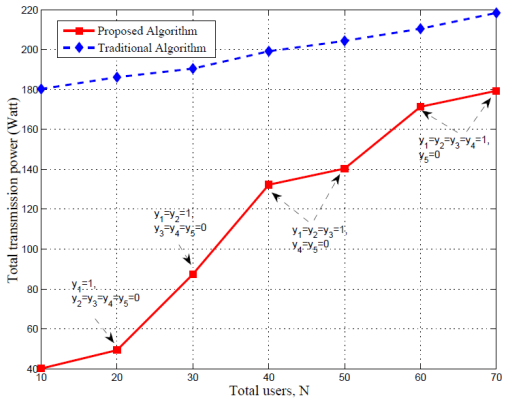
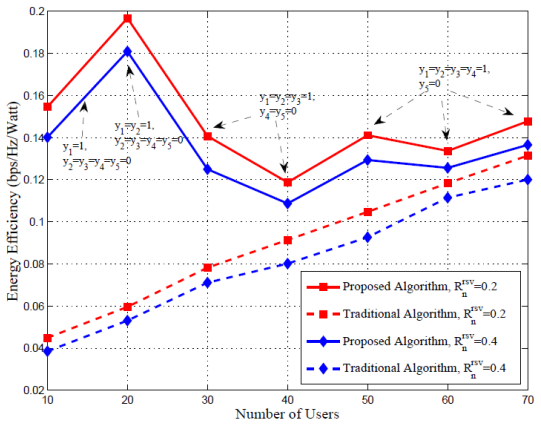
The central discovery is a tractable two-phase algorithm for the joint RRH-BBU-fronthaul-power allocation problem. At fixed transmit powers, the first step relaxes the binary association and assignment variables and uses DC-approximation and the arithmetic-geometric mean approximation to express user-rate and BBU-load constraints in geometric programming form. At fixed assignments, the second step applies the same machinery to the power variables. Simulation with five RRHs, two BBUs, 100 to 200 antennas per RRH, and random user locations shows the algorithm switching off under-utilized RRHs at low traffic and activating RRHs as traffic grows, with total transmission power more than 20% below the traditional all-RRH-on max-SINR baseline in dense regions and higher total throughput once the user count exceeds 40.
Load-bearing premise
Every claimed saving rests on the large-antenna, high-signal approximation to user rate, and on replacing the actual interference each BBU sees with a fixed threshold value that the paper never specifies.
Editorial extensions
If this is right
- At low user counts the algorithm can satisfy all minimum-rate constraints with a single active RRH, so operators can power down the remaining radio heads and save both transmit power and antenna energy.
- The more than 20% power reduction in dense regions comes with higher total throughput than the all-RRH-on max-SINR baseline once user count exceeds 40, because active RRHs are chosen to manage interference.
- Energy efficiency rises as users are added, but each newly switched-on RRH causes a temporary drop in EE, so the achievable operating points form a discrete set of antenna-activation states.
- Because each subproblem is a geometric program, the iteration can be run with standard convex solvers and inherits the convergence guarantee of block successive convex approximation.
Reading between the lines
- The rate approximation is also the natural stress test: if an operator runs the same algorithm where antennas are not far more numerous than users, or where SINR is moderate, the reported savings may not be the optimum of the original problem; evaluating the final assignment with exact rates would settle this.
- The unspecified threshold that replaces interference in the BBU-load constraint acts as a tuning knob between feasibility and power saving, and optimizing or bounding that threshold is a direct extension.
- The simulation uses distance-only path loss, so applying the method under log-normal shadowing would reveal whether RRH switch-off decisions remain stable in realistic channels.
- The same two-step CGP/SCA template should extend to uplink power control or to energy-harvesting RRHs, where the on-off decision interacts with energy arrival.
Signed reviews
Editorial analysis
A structured set of objections, weighed in public.
Referee Report
Summary. The paper formulates a joint resource allocation problem in a massive MIMO-aided cloud radio access network (C-RAN), where the variables are user-to-RRH association, RRH-to-BBU assignment, RRH on/off states, and per-user transmit powers. The objective is to minimize a weighted sum of total transmit power and RRH energy-consumption costs subject to per-RRH power limits, per-user minimum rate constraints, per-user single-association constraints, per-RRH single-BBU constraints, BBU load limits, and RRH switching consistency. The authors propose a two-step iterative algorithm based on complementary geometric programming (CGP) and successive convex approximation (SCA), in which Step 1 optimizes the association and cloud parameters with fixed powers, and Step 2 optimizes powers with fixed associations. Simulation results for a small scenario (five RRHs, two BBUs) are reported to show that the proposed scheme reduces total transmission power by switching off under-utilized RRHs and outperforms a max-SINR association baseline, with a claimed reduction of more than 20% in dense regions. The paper does not verify feasibility of the obtained solutions against the original problem constraints.
Significance. If the claimed power savings are realized on the original problem, the paper would offer a practically relevant algorithm for energy-efficient C-RAN operation, and the formulation of a joint RRH-switching and BBU-load-aware utility is a reasonable contribution. The paper has some genuine strengths: it explicitly formulates a nontrivial mixed-integer non-convex problem, it compares against a max-SINR baseline rather than fitting constants to the result, and it provides simulation evidence that RRH switching occurs as traffic varies. However, the significance is substantially reduced by several unvalidated approximations at the core of the algorithm: the high-SINR rate approximation in Eq. (5), the replacement of the interference term in the BBU-load constraint by an unspecified threshold in Proposition 3, and the unstated rounding rule for relaxed binary variables. Because the reported power savings are computed by solving surrogate problems, the central claim cannot currently be regarded as established.
major comments (4)
- [Section III, Eq. (5)] The achievable-rate approximation in Eq. (5) drops the '+1' inside the logarithm under a 'high SINR' assumption, but no validation is provided for the operating regime of the simulation. For finite effective SINR x = (F_r/N_r) * gamma_{r,n}, the approximation overestimates the true rate by log2(1 + 1/x), which is unbounded as x approaches zero. In Step 2, the objective is total transmit power, so the optimizer is incentivized to reduce transmit powers until the approximate C2.2 constraint is tight, which may produce powers that violate the original per-user rate constraint C2. The paper reports no post-optimality evaluation of the solutions of (19) against the original rate expression (1) or constraint C2. A feasibility check against the original constraints is needed before the reported power savings can be attributed to the original problem.
- [Section III, Proposition 3] The BBU-load constraint C5.2 is converted into a GP form by replacing the actual interference I_{r,n} with a 'predefined threshold' I_{r,n}^{th}, referring to [31-33]. The value of this threshold is never specified in the manuscript, and no sensitivity analysis is provided. If I_{r,n}^{th} is larger than the realized interference, then C5.2 is looser than the original constraint C5, so the reported solutions may not satisfy the BBU load limits of the original problem. The paper must either specify how I_{r,n}^{th} is chosen or verify that the final solutions satisfy the original C5 constraint.
- [Section III, Step 1] After Eq. (6), the binary variables alpha_{r,n}, beta_{r,b}, and y_r are relaxed to [0,1], but no rounding rule or recovery mechanism is given to obtain an integer-feasible solution. Since C3 and C4 are 'at most one' constraints, a fractional solution does not correspond to a valid user association or RRH-BBU assignment. The converged objective and the reported power savings are therefore computed for fractional variables, not for an implementable integer solution. A rounding procedure (e.g., with a feasibility-restoration step) and a check of the integer constraints are necessary for the claims of the paper.
- [Section III, Step 2 and convergence claim] The paper states that convergence of the proposed algorithm is guaranteed as a block SCA method, citing [22,34,35]. Standard block-SCA convergence results require that the surrogate functions are tight lower bounds of the original objective/constraints at the current iterate. Because Eq. (5) is an upper bound (not a lower bound) on the true rate, the conditions for the cited convergence theorems are not satisfied. Moreover, the alternating two-step procedure does not monotonically decrease the objective of the original problem (3), since Step 1 minimizes a surrogate with fixed powers and Step 2 minimizes a different surrogate with fixed associations. The convergence claim is therefore unsupported, and the simulations should report convergence behavior and final constraint violations.
minor comments (5)
- [Abstract and Section IV] The abstract and introduction claim a power reduction of more than 20% for dense regions, but Section IV does not explicitly state a numerical percentage from the figures; please add an explicit quantitative statement tied to a specific figure.
- [Section III, Eq. (5)] The SINR term gamma_{r,n} is defined after Eq. (5) without its iteration index; it should read gamma_{r,n}(t) to be consistent with the fixed-power context of Step 1.
- [Section III, Proposition 1] The displayed GP forms in Proposition 1 contain undefined symbols lambda, phi, psi, xi, and rho; also, a subscript 'm' appears in the product without definition. Please define all auxiliary variables and indices.
- [Section III, C7] The constant omega in constraint C7 is described only as a constant value and its numerical value is never given in Section IV; please specify omega (and any other free parameters) used in the simulations.
- [Section IV] The simulation setup states that F_r is randomly chosen in [100,200], while Fig. 2 sets F_1=...=F_5=140; please clarify which configuration applies to each figure and whether the results are averaged over random topologies.
Circularity Check
No significant circularity: the reported power saving is measured against an external max-SINR baseline using independently set system parameters, and the self-citations are methodological rather than load-bearing.
full rationale
The paper's central numerical claim, that the proposed scheme reduces total transmission power by more than 20% compared with the traditional max-SINR algorithm for the dense region (Section IV, Figs. 2-3), is not generated by fitting constants to the comparison data. The system parameters (Ca=0.25, Fr in [100,200], Lb^max in [2,24], pr^max=40 W) are fixed before simulation, and the baseline is an external max-SINR association with all RRHs active. The self-cited works [8], [22], and [32] supply user-association context, the CGP/SCA solution machinery, and an interference-threshold relaxation respectively; none of these citations is used to infer the reported power saving, and convergence is additionally supported by independent references [34], [35]. The approximations used in the derivation, such as the high-SINR rate model in (5), the dropping of the '+1' inside the logarithm, and the replacement of I_{r,n} by an unspecified threshold I_{r,n}^{th} in Proposition 3, loosen the solved problem relative to the original (3); that is a correctness and feasibility risk, not a circularity, because these are stated modeling assumptions rather than inputs that make the output equal to the input by construction. No equation is defined in terms of the predicted quantity, no fitted parameter is renamed as a prediction, and no uniqueness theorem from the authors is invoked to force the proposed choice. Therefore, no circular step is exhibited.
Assumptions & free parameters
free parameters (3)
- C_a =
0.25
- I_{r,n}^{th} =
unspecified
- omega =
unspecified
assumptions (3)
- domain assumption Massive MIMO rate expression (1) from [7,30], used with the high-SINR simplification log2(1 + ...) approximately log2(F_r/N_r * SINR) in (5).
- domain assumption Block SCA convergence guarantee from [22,34,35] applies to the alternating two-step algorithm.
- ad hoc to paper Binary associations and on/off states can be relaxed to [0,1] and still interpreted as a valid integer solution.
Cite this review
Pith. "Pith review of Power-Efficient Resource Allocation in Massive MIMO Aided Cloud RANs." pith.science (2026). https://pith.science/paper/VZDUBOVN
@misc{pith2026190807568,
  author       = {Pith},
  title        = {Pith review of: Power-Efficient Resource Allocation in Massive MIMO Aided Cloud RANs},
  year         = {2026},
  howpublished = {\url{https://pith.science/paper/VZDUBOVN}},
  note         = {Machine review of arXiv:1908.07568}
}
read the original abstract
This paper considers the power-efficient resource allocation problem in a cloud radio access network (C-RAN). The C-RAN architecture consists of a set of base-band units (BBUs) which are connected to a set of radio remote heads (RRHs) equipped with massive multiple input multiple output (MIMO), via fronthaul links with limited capacity. We formulate the power-efficient optimization problem in C-RANs as a joint resource allocation problem in order to jointly allocate the RRH and transmit power to each user, and fronthaul links and BBUs assign to active RRHs while satisfying the minimum required rate of each user. To solve this non-convex optimization problem we suggest iterative algorithm with two-step based on the complementary geometric programming (CGP) and the successive convex approximation (SCA). The simulation results indicate that our proposed scheme can significantly reduce the total transmission power by switching off the under-utilized RRHs.
Figures


Figures from the paper (2 more)

Reference graph
Works this paper leans on
-
[1]
Energy and spectral efficiency of very large multiuser MIMO systems,
H. Q. Ngo, E. Larsson, and T. Marzetta, “Energy and spectral efficiency of very large multiuser MIMO systems,” IEEE Wireless Communications Letters, vol. 61, no. 4, pp. 1436– 1449, April 2013
work page 2013
-
[2]
Secrecy and energy efficiency in massive MIMO aided heterogeneous C-RAN: A new look at interference,
L. Wang, K. Wong, M. Elkashlan, A. Nallanathan, and S. Lambotharan, “Secrecy and energy efficiency in massive MIMO aided heterogeneous C-RAN: A new look at interference,” IEEE Journal of Selected Topics in Signal Processing, vol. 10, no. 8, pp. 1375–1389, December 2016
work page 2016
-
[3]
K. Zhang, W. Tan, G. Xu, C. Yin, W. Liu, and C. Li, “Joint RRH activation and robust coordinated beamforming for massive MIMO heterogeneous cloud radio access networks,” IEEE ACCESS, vol. 6, pp. 40506–40518, July 2018
work page 2018
-
[4]
M. Feng and T. J. Sh. Mao and, “Joint frame design, resource allocation and user association for massive MIMO heterogeneous networks with wwireless backhaul,” IEEE Transactions on Wireless Communications, vol. 17, no. 3, pp. 1937–1950, March 2018
work page 1937
-
[5]
Harvest the potential of massive MIMO with multi-layer techniques,
M. Feng and S. Mao, “Harvest the potential of massive MIMO with multi-layer techniques,” IEEE Network, vol. 30, no. 5, pp. 40–45, September 2016
work page 2016
-
[6]
User grouping for massive MIMO in FDD systems: new design methods and analysis,
Y. Xu, G. Yue, and S. Mao, “User grouping for massive MIMO in FDD systems: new design methods and analysis,” IEEE Access Journal, vol. 2, no. 1, pp. 947–959, September 2014
work page 2014
-
[7]
formulates joint sub-carrier, power, AP and activated antennas allocation with the aim of minimizing the total power consumption and maximizing SE simultaneously in massive MIMO enabled heterogeneous networks (HetNets). The authors of [19] by employing a stochastic geometry method, analyze that using flexible cell association can improve the EE of HetNets...
-
[8]
Y.Hao, Q. Ni, H. Li, and S. Hou, “On the energy and spectral efficiency trade-off in massive MIMO enabled HetNets with capacity constrained backhaul links,” IEEE Communications Letter, vol. 65, no. 11, pp. 4720–4733, July 2017
work page 2017
Show all 40 references
-
[9]
User association in cloud RANs with massive MIMO,
S. Parsaeefard, V. Jumbay, A. D. Shoaeiy, M. Derakhshaniz, and T. Le-Ngocy, “User association in cloud RANs with massive MIMO,” IEEE Transactions on Cloud Computing, pp. 1–1, 2018
2018
-
[10]
Five disruptive technology directions for 5G,
F. Boccardi, R. Heath, A. Lozano, and T. L. Marzetta, “Five disruptive technology directions for 5G,” IEEE Communications Magazine, vol. 52, no. 2, pp. 74–80, February 2014
2014
-
[11]
The role of small cells, coordinated multipoint, and massive mimo in 5g,
V. Jungnickel, K. Manolakis, W. Zirwas, B. Panzner, V. Braun, M. Lossow, M. Sternad, R. Apelfrojd, and T. Svensson, “The role of small cells, coordinated multipoint, and massive mimo in 5g,” IEEE communication magazine, May 2014
2014
-
[12]
Dynamic resource provisioning for energy efficient cloud radio access networks,
N. Yu, Z. Song, H. Du, H. Huang, and X. Jia, “Dynamic resource provisioning for energy efficient cloud radio access networks,” IEEE Transactions on Cloud Computing, 2018
2018
-
[13]
Downlink and up-link energy minimization through user association and beamforming in cloud RAN,
S. Luo, R. Zhang, and T. J. Lim, “Downlink and up-link energy minimization through user association and beamforming in cloud RAN,” IEEE Transactions on Wireless Communications, vol. 14, no. 1, pp. 494–508, January 2015
2015
-
[14]
Group sparse beamforming for green cloud-RAN,
Y. Shi, J. Zhang, and K. B. Letaief, “Group sparse beamforming for green cloud-RAN,” IEEE Transactions on Wireless Communications, vol. 13, no. 5, pp. 2809–2823, May 2014
2014
-
[15]
Traffic-aware cloud RAN: A key for green 5G networks,
N. Saxena, A. Roy, and H. Kim, “Traffic-aware cloud RAN: A key for green 5G networks,” IEEE Journal on Selected Areas in Communications, vol. 34, no. 4, pp. 1010–1021, April 2016
2016
-
[16]
Energy efficient resource assignment and power allocation in heterogeneous cloud radio access networks,
M. Peng, K. Zhang, J. Jiang, J. Wang, and W. Wang, “Energy efficient resource assignment and power allocation in heterogeneous cloud radio access networks,” IEEE Transactions on Vehicular Technolgy, vol. 64, no. 11, pp. 5275–5287, November 2015
2015
-
[17]
Optimal power and range adaptation for green broadcasting,
S. Luo, R. Zhang, and T. J. Lim, “Optimal power and range adaptation for green broadcasting,” IEEE Transactions on Wireless Communications, vol. 12, no. 9, pp. 4592–4603, September 2013
2013
-
[18]
Cell zooming for cost-efficient green celular networks,
Z. Niu, Y. Wu, J. Gong, and Z. Yang, “Cell zooming for cost-efficient green celular networks,” IEEE Communications Magazine, vol. 48, no. 11, pp. 74–79, September 2010
2010
-
[19]
Base station operation and user association mechanisms for energy-delay tradeoffs in green cellular networks,
K. Son, H. Kim, Y. Yi, and B. Krishnamachari, “Base station operation and user association mechanisms for energy-delay tradeoffs in green cellular networks,” IEEE Journal on Selected Areas in Communications, vol. 29, no. 8, pp. 1525– 1536, September 2011
2011
-
[20]
Spectrum and energy efficiency in massive mimo enabled hetnets: A stochastic geometry approach,
A. He, L. Wang, M. Elkashlan, Y. Chen, and K.-K. Wong, “Spectrum and energy efficiency in massive mimo enabled hetnets: A stochastic geometry approach,” IEEE Communications Letters, vol. 19, no. 12, pp. 2294–2297, December 2015
2015
-
[21]
Energy-efficient transmit power control for multi-tier MIMO HetNets,
Y. Kwon, T. Hwang, and X. Wang, “Energy-efficient transmit power control for multi-tier MIMO HetNets,” IEEE Journal on Selected Areas in Communications, vol. 33, no. 10, pp. 2070–2086, October 2015
2015
-
[22]
Dynamic spectrum management: Complexity and duality,
Z.-Q. Luo and S. Zhang, “Dynamic spectrum management: Complexity and duality,” IEEE Journal of Selected Topics in Signal Processing, vol. 2, no. 1, pp. 57–73, February 2008
2008
-
[23]
Joint user association and resource-allocation in virtualized wireless networks,
S. Parsaeefard, R. Dawadi, M. Derakhshani, and T. Le-Ngoc, “Joint user association and resource-allocation in virtualized wireless networks,” IEEE Access, vol. 4, pp. 2738–2750, 2016
2016
-
[24]
Geometric programming for communication systems,
M. Chiang, “Geometric programming for communication systems,” Foundations and Trends in Communications and Information Theory, vol. 2, no. 1-2, pp. 1–154, 2005
2005
-
[25]
Power control by geometric programming,
M. Chiang, C. W. Tan, D. Palomar, D. ONeill, and D. Julian, “Power control by geometric programming,” IEEE Transactions Wireless Communication, vol. 6, no. 7, pp. 2640–2651, July 2007
2007
-
[26]
Global optimization of signomial geometric programming problems,
G. Xu, “Global optimization of signomial geometric programming problems,” European Journal of Operational Research, vol. 233, no. 4, pp. 500–510, July 2014
2014
-
[27]
AP-STA association control for throughput maximization in virtualized WiFi networks,
M. Derakhshani, X. Wang, D. Tweed, T. Le-Ngoc, and A. Leon-Garcia, “AP-STA association control for throughput maximization in virtualized WiFi networks,” IEEE Access, vol. 6, pp. 45034–45050, August 2018
2018
-
[28]
A tutorial on geometric programming,
S.Boyd, S.-J. Kim, L. Vandenberghe, and A. Hassibi, “A tutorial on geometric programming,” Optim. Eng., vol. 8, no. 1, pp. 67–127, 2007
2007
-
[29]
Effcient optimization of constrained nonlinear resource allocation,
M. Chiang and A. Sutivong, “Effcient optimization of constrained nonlinear resource allocation,” in Proc. IEEE Global Commun. Conf. (GLOBECOM), vol. 7, pp. 3782– 3786, December 2003
2003
-
[30]
Cvx: Matlab software for disciplined convex programming, version 2.0,
I. CVX-Research, “Cvx: Matlab software for disciplined convex programming, version 2.0,” http://cvxr.com/cvx, August
-
[31]
User association and load balancing for cellular massive MIMO,
D. Bethanabhotla, O. Y. Bursalioglu, H. C. Papadopoulos, and G. Caire, “User association and load balancing for cellular massive MIMO,” Information Theory and Applications Workshop (ITA), pp. 1–10, 2014
2014
-
[32]
Tier-aware resource allocation in OFDMA macrocell-small cell networks,
A. Abdelnasser, E. Hossain, and D. I. Kim, “Tier-aware resource allocation in OFDMA macrocell-small cell networks,” IEEE Transactions on Communications, vol. 63, no. 3, pp. 695–710, March 2015
2015
-
[33]
Multi-objective resource allocation in density aware designed of C-RAN in 5G,
M. Baghani, S. Parsaeefard, and T. Le-Ngoc, “Multi-objective resource allocation in density aware designed of C-RAN in 5G,” IEEE Access, vol. 6, pp. 45177–45190, August 2018
2018
-
[34]
Distributed resource allocation in D2D-enabled multi-tier cellular networks: An auction approach,
M. Hasan and E. Hossain, “Distributed resource allocation in D2D-enabled multi-tier cellular networks: An auction approach,” 2015 IEEE International Conference on Communication (ICC), pp. 2949–2954, September 2015
2015
-
[35]
Joint subchannel assignment and power allocation for OFDMA femtocell networks,
D.T.Ngo, S. Khakurel, and T. Le-Ngoc, “Joint subchannel assignment and power allocation for OFDMA femtocell networks,” IEEE Transactions on Wireless Communication, vol. 13, no. 1, pp. 342–355, January 2014
2014
-
[36]
Successive convex approximation: Analysis and applications,
M.Razaviyayn, “Successive convex approximation: Analysis and applications,” Ph.D. dissertation, Dept. Elect. Eng., Univ. Minnesota. Minneapolis, MN, USA, p. [Online]. Available: (http://hdl.handle.net/11299/163884), May 2014
2014
-
[37]
Distributed pricing-based user association for downlink heterogeneous cellular networks,
K. Shen and W. Yu, “Distributed pricing-based user association for downlink heterogeneous cellular networks,” IEEE Journal on Selected Areas in Communication, vol. 32, no. 6, pp. 1100–1113, June 2014
2014
-
[38]
Analysis of cell range extension and a bias configuration strategy in dense small cell networks,
D. Xin, W. Yingkang, G. X., L. X., and Z. Lin, “Analysis of cell range extension and a bias configuration strategy in dense small cell networks,” 2014 IEEE international conference on network infrastructure and digital content, pp. 425–429, 2014
2014
-
[39]
Wireless comunications. cambridge,
A. Goldsmith, “Wireless comunications. cambridge,” U.K.: Cambridge Univ. Press, 2004
2004
-
[40]
Energy efficiency of downlink transmission strategies for cloud radio access networks,
B. Dai and W. Yu, “Energy efficiency of downlink transmission strategies for cloud radio access networks,” IEEE Journal on Selected Area in Communication, vol. 34, no. 4, pp. 1037 – 1050, June 2016
2016
Reviewed August 14, 2026 · model on record in the stance chip above.
Discussion (0). Continue with ORCID to comment.