REVIEW 3 major objections 4 minor 1 cited by
PS-GS: Gaussian Splatting for Multi-View Photometric Stereo
T0 review · 3 major / 4 minor · reviewed 2026-08-06 · deepseek-v4-flash
Pith's one-line read PS-GS is the first Gaussian-splatting method for multi-view photometric stereo, jointly estimating geometry, materials, and lighting from multi-light images in about 0.7 hours while achieving state-of-the-art normal accuracy and enabling…
desk verdict First 2DGS+MVPS integration with strong benchmark numbers; the UPS-normal regularizer is load-bearing and its GBR ambiguity is unaddressed, so the accuracy claims are conditional. read the letter →
The pith
A machine-rendered reading of the paper's core claim, the machinery that carries it, and where it could break.
The reading
What carries the argument
The load-bearing machinery is the 2D Gaussian primitive, whose surface normal is defined directly as the cross product of its two tangent vectors, giving per-primitive geometry that participates in alpha-blended feature maps; the full rendering equation with a simplified Disney BRDF (diffuse albedo, metallic, roughness) evaluated via deferred shading; an MLP that predicts incident radiance as a function of position, tangents, normal, and in/out directions with Fourier-encoded position; and two regularizers. The first regularizer is the UPS-estimated normal map, aligned to world coordinates by a fixed transform and compared with the rendered normal map at the pixel level. The second is visibility computed by a 2D Gaussian ray-tracing technique modified to sample a single directional light, used to constrain the MLP's predicted lighting. Together these components let multi-view and multi-light observations constrain material, shape, and lighting simultaneously.
What would settle it
A reader could run PS-GS on a synthetic object with ground-truth normals and deliberately feed the UPS guidance normal maps through a fixed, non-identity 3x3 linear transform (the generalized bas-relief ambiguity) before the alignment step. If the final reconstructed normals and mesh shift predictably with that transform, the assumption is load-bearing; if the reconstruction remains accurate, the optimization is absorbing the ambiguity elsewhere.
Extended reading notes
Core claim
PS-GS's central claim is that 2D Gaussian splatting can carry the full inverse-rendering workload for multi-view photometric stereo without sacrificing the efficiency of splatting or the physical fidelity of a full rendering equation. After a standard 2DGS pretraining stage that fixes a reliable initial geometry, the method jointly optimizes per-Gaussian BRDF parameters (albedo, roughness, metallic), the Gaussian normals, and an MLP that predicts incident lighting, using deferred shading in image space for speed. Two regularizers anchor the otherwise ill-posed optimization: the rendered normal maps are pushed toward normals estimated by an uncalibrated photometric stereo method, and the MLP-predicted lighting is pushed toward visibility computed by a modified 2D Gaussian ray-tracer adapted to a single directional light. On the DiLiGenT-MV and PS-NeRF synthetic datasets, the method reports the best normal MAE on five of seven objects, the best PSNR on four, and the best SSIM on all seven, while completing training in 0.7 hours and 6.5 GB of GPU memory. The result, if accepted, means a single optimized model supports novel-view synthesis, relighting, and direct material and shape editing.
Load-bearing premise
The strongest load-bearing assumption is that the uncalibrated photometric stereo normals are recovered in true metric camera coordinates, so that the fixed camera-to-world transform in the normal regularization aligns them with the Gaussian model's world-space normals; if those normals carry an unknown linear ambiguity, that bias is injected directly into the optimized geometry.
Editorial extensions
If this is right
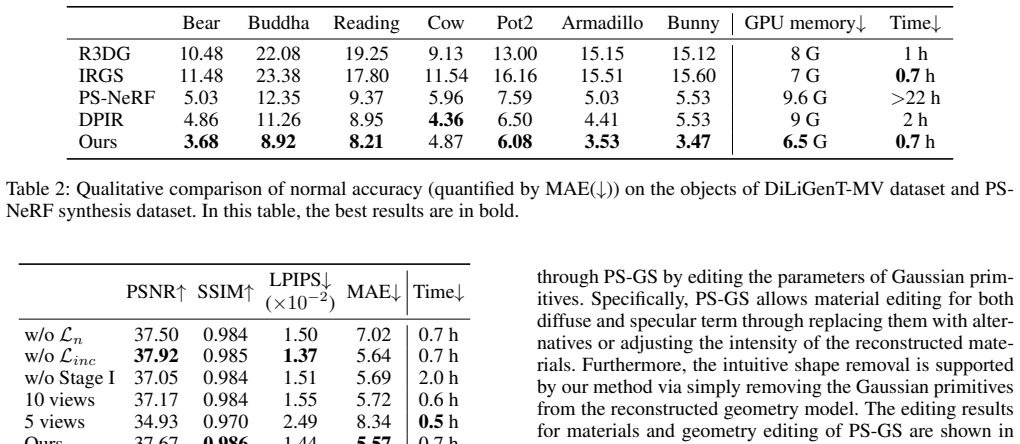
- Training time of about 0.7 hours and GPU memory of 6.5 GB make MVPS-based inverse rendering practical on a single modest GPU, a sharp drop from PS-NeRF's more than 22 hours.
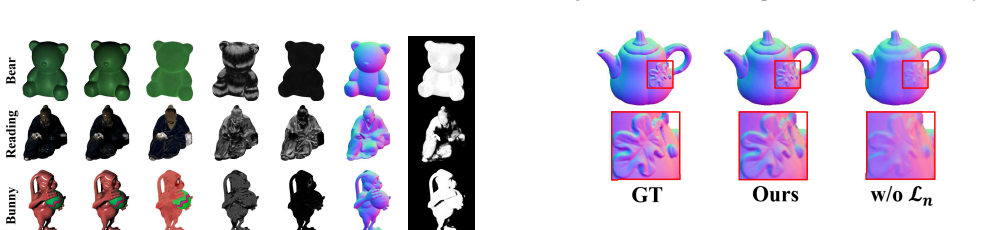
- The same optimized model supports novel-view synthesis, relighting, and material and shape editing by directly editing Gaussian primitive attributes.
- Quality degrades gracefully with sparse views: the method still produces usable reconstructions with five training views.
- Ablations show both regularizers matter: dropping the UPS normal regularization smooths away detail, and dropping the lighting regularization bakes lighting into albedo.
- Relying on multi-light inputs rather than fixed environment illumination yields sharper shadows and more detailed normals than prior splatting-based inverse renderers.
Reading between the lines
- If the UPS normals are affected by the generalized bas-relief ambiguity, the fixed alignment transform could systematically skew the recovered geometry; a testable extension is to estimate that linear transform jointly instead of hard-coding it.
- The two-stage design suggests a general recipe: pretrain a geometric splat model, then run deferred inverse rendering with external normal and visibility regularizers, which could transfer to other light configurations beyond single directional lights.
- Because ray-tracing is performed only against the Stage-I geometry, large geometry changes in Stage II could make the visibility regularizer stale; re-running ray-tracing periodically would test whether that matters.
- Scene-level effects such as inter-reflections between separate objects are out of scope; extending the method to multi-object scenes would require coupling the lighting MLP with light transport beyond the current single-directional-light visibility model.
Editorial analysis
A structured set of objections, weighed in public.
Referee Report
Summary. The paper presents PS-GS, a two-stage inverse rendering method based on 2D Gaussian Splatting for multi-view photometric stereo. Stage I pretrains a standard 2DGS model on light-averaged images; Stage II jointly optimizes geometry, BRDF materials, and incident lighting using the rendering equation, an MLP-based lighting model, a normal regularization from uncalibrated photometric stereo (UPS) estimates, and a visibility-based lighting regularizer from 2D Gaussian ray-tracing adapted to single directional lights. The authors report improved normal accuracy, NVS/relighting quality, and lower training time and GPU memory relative to PS-NeRF, DPIR, R3DG, and IRGS on DiLiGenT-MV and PS-NeRF synthesis datasets.
Significance. If the results are reproducible, this is a useful and timely contribution: it appears to be the first Gaussian-splatting-based MVPS inverse rendering method, and the efficiency gains (0.7 hours, 6.5 GB GPU memory) over PS-NeRF are substantial. The explicit 2DGS representation also enables material and geometry editing. However, the headline claims are conditional on the UPS-estimated normals being metrically correct in camera coordinates, an assumption the paper neither justifies nor tests; the main quantitative claims therefore need additional evidence before they can be considered established.
major comments (3)
- [Stage I: 2D Gaussian Pretraining, Eq. (10); Stage II loss, Eq. (15)] The normal regularization Ln,r transforms the UPS normals Ne only by the rigid camera-to-world transform Tc2w and then penalizes the rendered normals against that target. This is valid only if Ne is expressed in the same metric camera coordinates as the posed images. Uncalibrated photometric stereo recovers normals only up to a generalized bas-relief (GBR) ambiguity, i.e., an unknown 3x3 linear transform per view; the cited Chen et al. 2019 deep UPS method may select one member of the GBR family, but the paper neither shows that this member is the metric one nor cites a GBR-resolution step. This assumption is load-bearing: Table 3 attributes a large part of the final normal accuracy to Ln,r (MAE 7.02 without it versus 5.57 with it), and Table 2 reports state-of-the-art MAE values against ground-truth normals. If the UPS normals are GBR-warped, the reported MAE partly measures the quality of the UPS prior rather than the contribution of PS-GS. The authors should either add a GBR-resolution/canonicalization step, or provide a concrete test on the actual benchmark objects (e.g., report the MAE of the raw UPS normals against ground truth after only a rigid alignment on the DiLiGenT-MV test views) to demonstrate that the assumption holds.
- [Experimental] The paper repeatedly defers implementation details to a supplementary document and ships no code, but the empirical claims depend on several unspecified choices: the loss weights lambda_n,c, lambda_n,r, lambda_o, lambda_inc, the MLP architecture and Fourier encoding for the incident lighting network, how the light direction omega_in is obtained for each multi-light image, the optimizer and learning-rate schedule, and the number of training iterations. Without these details, the quantitative results in Tables 1-3 cannot be reproduced or independently checked, and the sensitivity of the central regularizers to their weights cannot be assessed. The authors should include these details in the main paper or make the supplementary material and code available.
- [Tables 1 and 2] All quantitative results are reported from single runs with no error bars or variance across seeds. Some comparisons are close (e.g., Bear PSNR 40.22 for DPIR versus 39.95 for PS-GS in Table 1, and Cow LPIPS 0.642 for DPIR versus 0.931 for PS-GS), so the state-of-the-art claims are not robustly supported without some measure of variability. The authors should report at least mean and standard deviation over multiple runs, or state if only one run was performed and temper the superiority claims accordingly.
minor comments (4)
- [Eq. (10)] The loss term Ln,r is written as a sum of vectors without an explicit norm; it should specify L1 or L2 loss, otherwise the loss value is not well defined.
- [Captions and text] There are several typos and caption errors: 'devided' and 'rednering' in the Preliminary section, 'uesd' in the rendering equation text, and Table 2 is captioned 'Qualitative comparison' even though it reports quantitative MAE values. These should be corrected.
- [Table 2] The rightmost columns 'GPU memory' and 'Time' are not normal-accuracy metrics and should be moved to a separate efficiency table or clearly labeled in the caption to avoid mixing metric types.
- [Eq. (14) and contribution claim] The paper describes the rendering model as the 'full rendering equation without simplification,' but Eq. (14) accounts only for direct illumination from a single directional light; there is no interreflection or global illumination term. The authors should soften this claim or clarify that 'full' refers only to the local BRDF evaluation.
Circularity Check
No significant circularity: PS-GS uses UPS normals as external supervision; its normal-accuracy claims are evaluated on held-out views and are not construction-equivalent to the regularizer.
full rationale
The paper's central pipeline is an optimization that fits 2D Gaussians, BRDF parameters, and an incident-light MLP to multi-view multi-light images. The only external prior is the UPS normal map, which is computed from the same training images but is not a quantity the paper claims to predict; Ln,r is a regularizer, not a fitted parameter later reported as a prediction. The headline normal MAE is computed on held-out novel views not used in training, so it tests generalization of the learned geometry rather than reproducing the UPS input. The incident-light regularization uses visibility from 2DGS ray-tracing and is an independent physical constraint. The GBR ambiguity of uncalibrated PS is an assumption about the external normal estimator, not a self-referential derivation step; it affects the validity of the supervision, not the circularity of the method. No load-bearing step reduces by construction to a fitted parameter or to a self-citation chain.
Assumptions & free parameters
free parameters (3)
- loss weights λn,c, λn,r, λo, λinc =
not reported
- incident lighting MLP weights θ =
learned from data
- Gaussian primitive BRDF parameters (albedo, metallic, roughness) =
per-primitive, learned
assumptions (5)
- domain assumption The object is illuminated exclusively by directional lights, with one light per image, and the BRDF is an isotropic Disney model with only albedo, metallic, and roughness.
- domain assumption The camera poses and object masks are known and correct.
- ad hoc to paper UPS-estimated normals are metric-correct up to the rigid transform Tc2w; the generalized bas-relief ambiguity is absent.
- domain assumption The geometry changes only slightly in Stage II, so visibility computed by ray tracing on the Stage I pretrained model remains valid.
- domain assumption The 2D Gaussian disk representation can faithfully represent the object surface, including sharp edges and discontinuities.
invented entities (1)
-
Implicit incident lighting MLP fθ
Cite this review
Pith. "Pith review of PS-GS: Gaussian Splatting for Multi-View Photometric Stereo." pith.science (2026). https://pith.science/paper/VZHUO5R5
@misc{pith2026250718231,
  author       = {Pith},
  title        = {Pith review of: PS-GS: Gaussian Splatting for Multi-View Photometric Stereo},
  year         = {2026},
  howpublished = {\url{https://pith.science/paper/VZHUO5R5}},
  note         = {Machine review of arXiv:2507.18231}
}
read the original abstract
Integrating inverse rendering with multi-view photometric stereo (MVPS) yields more accurate 3D reconstructions than the inverse rendering approaches that rely on fixed environment illumination. However, efficient inverse rendering with MVPS remains challenging. To fill this gap, we introduce the Gaussian Splatting for Multi-view Photometric Stereo (PS-GS), which efficiently and jointly estimates the geometry, materials, and lighting of the object that is illuminated by diverse directional lights (multi-light). Our method first reconstructs a standard 2D Gaussian splatting model as the initial geometry. Based on the initialization model, it then proceeds with the deferred inverse rendering by the full rendering equation containing a lighting-computing multi-layer perceptron. During the whole optimization, we regularize the rendered normal maps by the uncalibrated photometric stereo estimated normals. We also propose the 2D Gaussian ray-tracing for single directional light to refine the incident lighting. The regularizations and the use of multi-view and multi-light images mitigate the ill-posed problem of inverse rendering. After optimization, the reconstructed object can be used for novel-view synthesis, relighting, and material and shape editing. Experiments on both synthetic and real datasets demonstrate that our method outperforms prior works in terms of reconstruction accuracy and computational efficiency.
Figures


Figures from the paper (3 more)


Forward citations
Cited by 1 Pith paper
-
A Hybrid Neural-Microfacet BRDF Model for Real-Time Rendering
A hybrid BRDF model, combining a GGX analytical term with a tiny learned residual and gating network, fits measured materials more accurately than fully neural models at equal memory cost.
Reference graph
Works this paper leans on
-
[1]
, " * write output.state after.block = add.period write newline
ENTRY address archivePrefix author booktitle chapter edition editor eid eprint howpublished institution isbn journal key month note number organization pages publisher school series title type volume year label extra.label sort.label short.list INTEGERS output.state before.all mid.sentence after.sentence after.block FUNCTION init.state.consts #0 'before.a...
-
[2]
write newline
" write newline "" before.all 'output.state := FUNCTION n.dashify 't := "" t empty not t #1 #1 substring "-" = t #1 #2 substring "--" = not "--" * t #2 global.max substring 't := t #1 #1 substring "-" = "-" * t #2 global.max substring 't := while if t #1 #1 substring * t #2 global.max substring 't := if while FUNCTION word.in bbl.in capitalize " " * FUNCT...
-
[3]
T.; Mildenhall, B.; Tancik, M.; Hedman, P.; Martin-Brualla, R.; and Srinivasan, P
Barron, J. T.; Mildenhall, B.; Tancik, M.; Hedman, P.; Martin-Brualla, R.; and Srinivasan, P. P. 2021. Mip-NeRF: A Multiscale Representation for Anti-Aliasing Neural Radiance Fields. In Proceedings of the IEEE/CVF International Conference on Computer Vision, 5835--5844. IEEE Computer Society
work page 2021
-
[4]
B.; Durou, J.-D.; and Calvet, L
Brument, B.; Bruneau, R.; Quéau, Y.; Mélou, J.; Lauze, F. B.; Durou, J.-D.; and Calvet, L. 2024. RNb-NeuS: Reflectance and Normal-Based Multi-View 3D Reconstruction. In Proceedings of the IEEE/CVF Conference on Computer Vision and Pattern Recognition, 5230--5239. IEEE Computer Society
work page 2024
-
[5]
Burley, B.; and Studios, W. D. A. 2012. Physically-based shading at Disney. In ACM SIGGRAPH
work page 2012
-
[6]
Chen, G.; Han, K.; Shi, B.; Matsushita, Y.; and Wong, K.-Y. K. 2019. Self-Calibrating Deep Photometric Stereo Networks. In Proceedings of the IEEE/CVF Conference on Computer Vision and Pattern Recognition. IEEE Computer Society
work page 2019
-
[7]
Chung, H.-G.; Choi, S.; and Baek, S.-H. 2024. Differentiable Point-based Inverse Rendering. In Proceedings of the IEEE/CVF Conference on Computer Vision and Pattern Recognition, 4399--4409. IEEE Computer Society
work page 2024
-
[8]
Gao, J.; Gu, C.; Lin, Y.; Li, Z.; Zhu, H.; Cao, X.; Zhang, L.; and Yao, Y. 2024. Relightable 3D Gaussians: Realistic Point Cloud Relighting with BRDF Decomposition and Ray Tracing. In European conference on computer vision, 73--89. Springer
work page 2024
Show all 40 references
-
[9]
Gu, C.; Wei, X.; Zeng, Z.; Yao, Y.; and Zhang, L. 2025. IRGS: Inter-Reflective Gaussian Splatting with 2D Gaussian Ray Tracing. In Proceedings of the Computer Vision and Pattern Recognition Conference (CVPR), 10943--10952. IEEE Computer Society
2025
-
[10]
Hargreaves, S.; and Harris, M. 2004. Deferred shading. In Game Developers Conference
2004
-
[11]
Hu, H.; Fan, Z.; Wu, T.; Xi, Y.; Lee, S.; Pavlakos, G.; and Wang, Z. 2025. Expressive Gaussian human avatars from monocular RGB video. In Proceedings of the 38th International Conference on Neural Information Processing Systems, NIPS '24. Red Hook, NY, USA: Curran Associates I...
2025
-
[12]
Hu, T.; Liu, S.; Chen, Y.; Shen, T.; and Jia, J. 2022. EfficientNeRF Efficient Neural Radiance Fields. In Proceedings of the IEEE/CVF Conference on Computer Vision and Pattern Recognition, 12902--12911. IEEE Computer Society
2022
-
[13]
Hu, W.; Wang, Y.; Ma, L.; Yang, B.; Gao, L.; Liu, X.; and Ma, Y. 2023. Tri-MipRF: Tri-Mip Representation for Efficient Anti-Aliasing Neural Radiance Fields. In Proceedings of the IEEE/CVF International Conference on Computer Vision, 19717--19726. IEEE Computer Society
2023
-
[14]
Huang, B.; Yu, Z.; Chen, A.; Geiger, A.; and Gao, S. 2024. 2D Gaussian Splatting for Geometrically Accurate Radiance Fields. In ACM SIGGRAPH 2024 Conference Papers, 1--11
2024
-
[15]
Ikehata, S. 2023. Scalable, Detailed and Mask-Free Universal Photometric Stereo. In Proceedings of the IEEE/CVF Conference on Computer Vision and Pattern Recognition, 13198--13207. IEEE Computer Society
2023
-
[16]
Jiang, Y.; Tu, J.; Liu, Y.; Gao, X.; Long, X.; Wang, W.; and Ma, Y. 2024. GaussianShader: 3D Gaussian Splatting with Shading Functions for Reflective Surfaces. In 2024 IEEE/CVF Conference on Computer Vision and Pattern Recognition, 5322--5332. IEEE Computer Society
2024
-
[17]
Kaya, B.; Kumar, S.; Sarno, F.; Ferrari, V.; and Van Gool, L. 2022. Neural Radiance Fields Approach to Deep Multi-View Photometric Stereo. In Proceedings of the IEEE/CVF Winter Conference on Applications of Computer Vision, 1965--1977. IEEE Computer Society
2022
-
[18]
Kerbl, B.; Kopanas, G.; Leimkuehler, T.; and Drettakis, G. 2023. 3D Gaussian Splatting for Real-Time Radiance Field Rendering. ACM Trans. Graph., 42(4)
2023
-
[19]
Li, M.; Zhou, Z.; Wu, Z.; Shi, B.; Diao, C.; and Tan, P. 2020. Multi-View Photometric Stereo: A Robust Solution and Benchmark Dataset for Spatially Varying Isotropic Materials. IEEE Transactions on Image Processing, 29: 4159--4173
2020
-
[20]
Li, Z.; Chen, Z.; Li, Z.; and Xu, Y. 2024 a . Spacetime Gaussian Feature Splatting for Real-Time Dynamic View Synthesis. In Proceedings of the IEEE/CVF Conference on Computer Vision and Pattern Recognition, 8508--8520. IEEE Computer Society
2024
-
[21]
Li, Z.; Zheng, Z.; Wang, L.; and Liu, Y. 2024 b . Animatable Gaussians: Learning Pose-Dependent Gaussian Maps for High-Fidelity Human Avatar Modeling. In Processings of the IEEE/CVF Conference on Computer Vision and Pattern Recognition, 19711--19722. IEEE Computer Society
2024
-
[22]
Liang, Z.; Zhang, Q.; Feng, Y.; Shan, Y.; and Jia, K. 2024. GS-IR: 3D Gaussian Splatting for Inverse Rendering. In 2024 IEEE/CVF Conference on Computer Vision and Pattern Recognition, 21644--21653. IEEE Computer Society
2024
-
[23]
Logothetis, F.; Mecca, R.; and Cipolla, R. 2019. A Differential Volumetric Approach to Multi-View Photometric Stereo. In Proceedings of the IEEE/CVF International Conference on Computer Vision, 1052--1061. IEEE Computer Society
2019
-
[24]
Matsuki, H.; Murai, R.; Kelly, P. H. J.; and Davison, A. J. 2024. Gaussian Splatting SLAM. In Proceedings of the IEEE/CVF Conference on Computer Vision and Pattern Recognition, 18039--18048. IEEE Computer Society
2024
-
[25]
P.; Tancik, M.; Barron, J
Mildenhall, B.; Srinivasan, P. P.; Tancik, M.; Barron, J. T.; Ramamoorthi, R.; and Ng, R. 2020. NeRF: Representing Scenes as Neural Radiance Fields for View Synthesis. In European Conference on Computer Vision, 405--421. Springer
2020
-
[26]
M\" u ller, T.; Evans, A.; Schied, C.; and Keller, A. 2022. Instant neural graphics primitives with a multiresolution hash encoding. ACM Trans. Graph., 41(4)
2022
-
[27]
N.; Matsushita, Y.; Tai, Y.-W.; and Kweon, I
Park, J.; Sinha, S. N.; Matsushita, Y.; Tai, Y.-W.; and Kweon, I. S. 2017. Robust Multiview Photometric Stereo Using Planar Mesh Parameterization. IEEE Transactions on Pattern Analysis and Machine Intelligence, 39(8): 1591--1604
2017
-
[28]
Shi, R.; Wei, X.; Wang, C.; and Su, H. 2024. ZeroRF: Fast Sparse View 360° Reconstruction with Zero Pretraining. In Proceedings of the IEEE/CVF Conference on Computer Vision and Pattern Recognition, 21114--21124. IEEE Computer Society
2024
-
[29]
C.; and Liu, Z
Wang, G.; Chen, Z.; Loy, C. C.; and Liu, Z. 2023. SparseNeRF: Distilling Depth Ranking for Few-shot Novel View Synthesis. In Proceedings of the IEEE/CVF International Conference on Computer Vision, 9065--9076. IEEE Computer Society
2023
-
[30]
Wang, H.; Hu, W.; Zhu, L.; and Lau, R. W. 2024. Inverse Rendering of Glossy Objects via the Neural Plenoptic Function and Radiance Fields. In Proceedings of the IEEE/CVF Conference on Computer Vision and Pattern Recognition, 19999--20008. IEEE Computer Society
2024
-
[31]
C.; Sheikh, H
Wang, Z.; Bovik, A. C.; Sheikh, H. R.; and Simoncelli, E. P. 2004. Image quality assessment: from error visibility to structural similarity. IEEE transactions on image processing, 13(4): 600--612
2004
-
[32]
Wu, S.; Basu, S.; Broedermann, T.; Van Gool, L.; and Sakaridis, C. 2025. PBR-NeRF : Inverse Rendering with Physics-Based Neural Fields. In Proceedings of the IEEE/CVF Conference on Computer Vision and Pattern Recognition. IEEE Computer Society
2025
-
[33]
Yan, C.; Qu, D.; Xu, D.; Zhao, B.; Wang, Z.; Wang, D.; and Li, X. 2024. GS-SLAM: Dense Visual SLAM with 3D Gaussian Splatting. In Proceedings of the IEEE/CVF Conference on Computer Vision and Pattern Recognition, 19595--19604. IEEE Computer Society
2024
-
[34]
Yang, W.; Chen, G.; Chen, C.; Chen, Z.; and Wong, K.-Y. K. 2022. PS-NeRF: Neural Inverse Rendering for Multi-view Photometric Stereo. In European conference on computer vision, 266--284. Springer
2022
-
[35]
Yang, Z.; Gao, X.; Zhou, W.; Jiao, S.; Zhang, Y.; and Jin, X. 2024. Deformable 3D Gaussians for High-Fidelity Monocular Dynamic Scene Reconstruction. In Proceedings of the IEEE/CVF Conference on Computer Vision and Pattern Recognition, 20331--20341. IEEE Computer Society
2024
-
[36]
Yao, Y.; Zeng, Z.; Gu, C.; Zhu, X.; and Zhang, L. 2025. Reflective Gaussian Splatting. In Processings of International Conference on Representation Learning, volume 2025, 68695--68711
2025
-
[37]
Yao, Y.; Zhang, J.; Liu, J.; Qu, Y.; Fang, T.; McKinnon, D.; Tsin, Y.; and Quan, L. 2022. Neilf: Neural incident light field for physically-based material estimation. In European conference on computer vision, 700--716. Springer
2022
-
[38]
Zhang, J.; Yao, Y.; Li, S.; Liu, J.; Fang, T.; McKinnon, D.; Tsin, Y.; and Quan, L. 2023. NeILF++: Inter-Reflectable Light Fields for Geometry and Material Estimation. In Proceedings of the IEEE/CVF International Conference on Computer Vision, 3601--3610. IEEE Computer Society
2023
-
[39]
A.; Shechtman, E.; and Wang, O
Zhang, R.; Isola, P.; Efros, A. A.; Shechtman, E.; and Wang, O. 2018. The Unreasonable Effectiveness of Deep Features as a Perceptual Metric. In Proceedings of the IEEE Conference on Computer Vision and Pattern Recognition. IEEE Computer Society
2018
-
[40]
P.; Deng, B.; Debevec, P.; Freeman, W
Zhang, X.; Srinivasan, P. P.; Deng, B.; Debevec, P.; Freeman, W. T.; and Barron, J. T. 2021. NeRFactor: neural factorization of shape and reflectance under an unknown illumination. ACM Trans. Graph., 40(6)
2021
Reviewed August 6, 2026 · model on record in the stance chip above.
Discussion (0). Continue with ORCID to comment.