REVIEW 3 major objections 6 minor 4 references
Nanoscale magnetic and charge anisotropies at manganite interfaces
T0 review · 3 major / 6 minor · reviewed 2026-08-14 · deepseek-v4-flash
Pith's one-line read This paper shows that in manganite bilayers, the out-of-plane orbital occupation and antiferromagnetic spin axis grow with capping-layer thickness and saturate at a doping-dependent critical thickness, at which point the spin axis points…
desk verdict Careful systematic XLD/XMLD study of manganite bilayers, but the central doping-dependent critical thickness is sitting directly on the TEY probe-depth confound the authors acknowledge and do not control for. read the letter →
The pith
A machine-rendered reading of the paper's core claim, the machinery that carries it, and where it could break.
The reading
What carries the argument
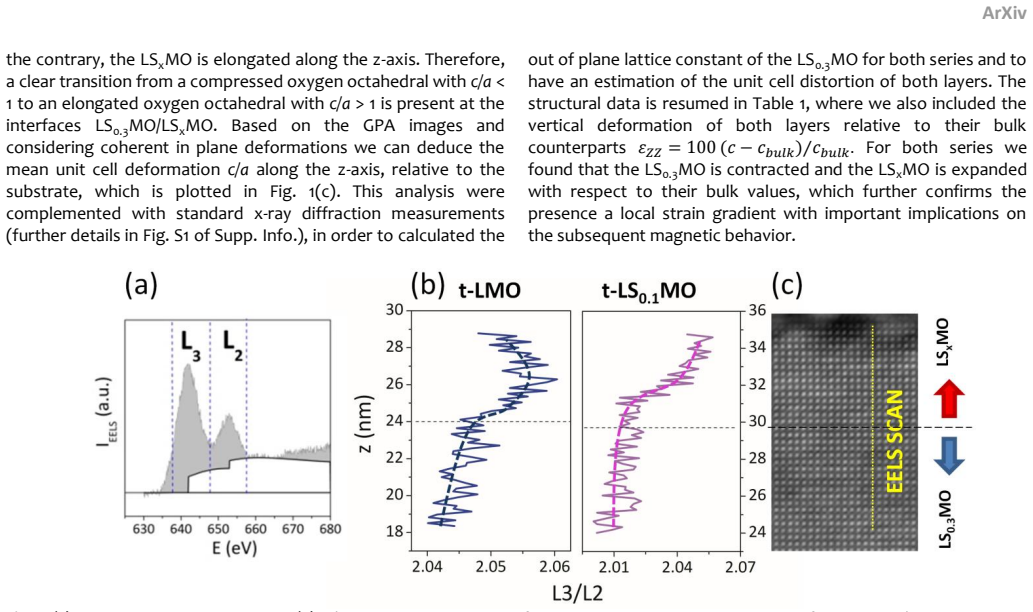
The central tool is x-ray linear dichroism (XLD) at the Mn L2,3 and O K edges, decomposed into an orbital part (XNLD), assumed temperature-independent, and a magnetic part (XMLD), obtained by subtracting the room-temperature XLD spectrum from the low-temperature spectrum while a 1 T field cancels the ferromagnetic contribution. The integrated XNLD intensity measures the out-of-plane orbital occupation asymmetry, and the integrated XMLD intensity in the 649.7-652.7 eV range measures the out-of-plane component of the antiferromagnetic spin axis as a function of capping thickness. Supporting measurements are STEM-GPA strain mapping, which shows the transition from tensile to compressive unit cells across the interface, and EELS L3/L2 ratios, which track the increasing Mn3+ fraction toward the surface. The correlation of these three probes locates the critical thickness where orbital and antiferromagnetic anisotropies saturate together.
What would settle it
Take XLD spectra at a third temperature or with the field direction varied: if the subtracted spectrum changes with temperature in a nonmagnetic reference film, or if the apparent antiferromagnetic axis rotates when the 1 T field direction changes, the thickness dependence of the spin axis would be an artifact of incomplete subtraction. A direct check would be to measure the antiferromagnetic axis by neutron diffraction or by rotating the x-ray polarization on the same bilayer series and see whether the out-of-plane preference at t = tc survives.
Extended reading notes
Core claim
The central claim is that in La0.7Sr0.3MnO3/La1-xSrxMnO3 bilayers with x = 0 and x = 0.1, the preferential occupation of out-of-plane 3z2-r2 orbitals and the out-of-plane component of the antiferromagnetic spin axis both increase with capping-layer thickness up to a critical thickness tc, approximately 3 nm for LaMnO3 and approximately 4 nm for La0.9Sr0.1MnO3, and then saturate; at tc the antiferromagnetic spin axis points preferentially out of plane, while for thicknesses farther from tc it tilts partially into the plane. The paper also claims that the Mn3+ content rises toward the surface, that the orbital and magnetic evolution is driven jointly by the local strain gradient (compressive in the low-doped cap) and by the extra electrons supplied by the cap, and that the minimum of the in-plane coercive field at tc follows from the in-plane antiferromagnetic component pinning the La0.7Sr0.3MnO3 domains less effectively when the axis is out of plane. These measurements establish concrete length scales for the electronic and magnetic reconstruction at manganite interfaces and connect them to macroscopic magnetization reversal.
Load-bearing premise
The entire antiferromagnetic-axis analysis assumes that the orbital dichroism (XNLD) is exactly temperature-independent and that a 1 T field fully removes the ferromagnetic contribution, so that the low-temperature minus room-temperature difference spectrum represents the antiferromagnetic anisotropy alone.
Editorial extensions
If this is right
- Above the critical thickness, the surface of the bilayer behaves like the low-doped material itself, so thicker caps do not further change the orbital or antiferromagnetic configuration.
- The coincidence of the coercivity minimum with tc means the macroscopic reversal process of the La0.7Sr0.3MnO3 layer encodes the interfacial spin orientation, giving a simple magnetometry readout of the reconstruction.
- Tuning the capping-layer doping shifts tc (3 nm for x = 0, 4 nm for x = 0.1), so the spatial extent of the electronic reconstruction is controllable through composition.
- The out-of-plane antiferromagnetic axis at tc implies enhanced ferromagnetic exchange along [001] and antiferromagnetic coupling in-plane, which should be visible in layer-resolved magnetic depth profiles.
- Since the XNLD and XMLD saturate together, a single mechanism - strain plus electron doping - accounts for both the charge and the spin anisotropies.
Reading between the lines
- Editorial inference: because the total-electron-yield probing depth is about 4 nm, similar to tc, part of the observed saturation may reflect the x-ray probe no longer reaching the buried interface; depth-resolved x-ray resonant reflectivity on the same series could separate the true interface reconstruction from this geometric averaging.
- Editorial inference: the monotonic dependence of tc on electron supply suggests a testable design rule for oxide spintronics - coercivity can be tuned by choosing the cap composition at a fixed total thickness, without changing the ferromagnetic electrode.
- Editorial inference: the model implies that the in-plane antiferromagnetic tilt away from tc should create a measurable in-plane uniaxial anisotropy; torque magnetometry or ferromagnetic resonance on these bilayers would be a macroscopic test of the proposed pinning mechanism.
Signed reviews
Editorial analysis
A structured set of objections, weighed in public.
Referee Report
Summary. The paper reports x-ray absorption and magnetic measurements on La0.7Sr0.3MnO3/La1-xSrxMnO3 (x=0, 0.1) bilayers with variable capping-layer thickness, combined with STEM-HAADF, GPA, EELS, and SQUID magnetometry. The authors find that the out-of-plane orbital asymmetry (IXNLD) and the antiferromagnetic XMLD amplitude grow with capping thickness and saturate at a doping-dependent critical thickness tc (~3 nm for LaMnO3, ~4 nm for La0.9Sr0.1MnO3), that the AFM spin axis is preferentially out of plane at tc and tilts partially in-plane away from tc, and that the coercive field has a minimum at tc. They interpret these observations as a charge and magnetic reconstruction driven by the Sr-doping gradient and local strain.
Significance. The paper combines a well-designed thickness series with a reasonable set of structural, electronic, and magnetic probes, and it provides quantitative length scales for orbital and magnetic reconstruction at manganite interfaces if the central claim holds. The explicit statement of the TEY probe-depth assumption is honest, and the structural/chemical analysis (GPA, EELS) appears coherent and consistent with prior literature. However, the central quantitative claim—the doping-dependent critical thickness and the associated AFM spin-axis behavior—currently rests on unvalidated TEY weighting and XMLD subtraction assumptions. Should these be addressed with appropriate controls, the result would be a valuable benchmark in oxide interface physics.
major comments (3)
- [Sec. 2.2.1, Fig. 5]
- [Sec. 2.2 (XMLD isolation), Fig. 7]
- [Sec. 2.2.1 (coercive field), Fig. 8(a)]
minor comments (6)
- [Section numbering]
- [Supplementary figure references]
- [Reference [5]]
- [Fig. 4 caption / surrounding text]
- [Abstract and text]
- [General]
Circularity Check
No significant circularity: the reported anisotropies and critical thickness are read directly from measured spectra, and the TEY probe-depth limitation is explicitly acknowledged rather than hidden.
full rationale
This paper is an experimental study, not a derivation. The two central quantities, IXNLD (integral of the room-temperature linear dichroism) and IAF (integral of the low-temperature minus room-temperature dichroism), are defined directly from measured spectra; no parameter is fitted and then renamed as a prediction. The critical thickness tc is the thickness at which the measured IXNLD(t) plateaus, and the claim that the AFM axis is out-of-plane at that thickness follows from the sign of the XMLD using the standard XLD selection rules. The paper explicitly considers the TEY probe-depth caveat in Section 2.2.1: 'we need to consider that the probing region of the x-ray beam in TEY mode (~ 4 nm) is similar to the capping layer thickness [36]. Therefore, we can assume that above this critical thickness the XAS signal is no longer sensitive to the interface...' This is a stated experimental limitation and a possible confound for interpreting tc as an electronic reconstruction length, but it is not circular: the authors do not claim to derive tc from the escape depth, and they present the valence profile of Ref. [16] as independent consistency. The temperature-independence assumption for XNLD is an unverified input used to isolate XMLD, not a quantity claimed to be derived. The self-citation to the authors' previous APL paper is not load-bearing; the current EELS line scans and the thickness series are the primary evidence. No equation in the paper reduces to its own input, and no prediction is forced by construction. Therefore the circularity score is 0.
Assumptions & free parameters
assumptions (3)
- domain assumption The XNLD is assumed to be temperature independent, so the room-temperature XLD can be subtracted from low-temperature XLD to isolate the XMLD.
- domain assumption A 1 T magnetic field fully cancels the ferromagnetic contribution from the dichroic signal, leaving only the antiferromagnetic XMLD.
- domain assumption The TEY probing depth of about 4 nm is comparable to the capping layer thickness, so above tc the XAS signal probes mostly the cap rather than the interface.
Cite this review
Pith. "Pith review of Nanoscale magnetic and charge anisotropies at manganite interfaces." pith.science (2026). https://pith.science/paper/VZSBSDHE
@misc{pith2026190801196,
  author       = {Pith},
  title        = {Pith review of: Nanoscale magnetic and charge anisotropies at manganite interfaces},
  year         = {2026},
  howpublished = {\url{https://pith.science/paper/VZSBSDHE}},
  note         = {Machine review of arXiv:1908.01196}
}
read the original abstract
Strong correlated manganites are still under intense research owing to their complex phase diagrams in terms of the Sr-doping and their sensitivity to intrinsic and extrinsic structural deformations. Here, we performed x-ray absorption spectroscopy measurements of manganites bilayers to explore the effects that a local Sr-doping gradient produce on the charge and antiferromagnetic anisotropies. In order to gradually tune the Sr-doping level along the axis perpendicular to the samples we have grown a series of bilayers with different thicknesses of low-doped manganites (from 0 nm to 6 nm) deposited over a La0.7Sr0.3MnO3 metallic layer. This strategy permitted us to resolve with high accuracy the thickness region where the charge and spin anisotropies vary and the critical thickness tc over which the out of plane orbital asymmetry does not have any further modifications. We found that the antiferromagnetic spin axis points preferentially out of the sample plane regardless the capping layer thickness. However, it tilts partially into the sample plane far from this critical thickness, owing to the jointed contributions of the external structural strain and electron doping. Furthermore, we found that the doping level of the capping layer sensibly affects the critical thickness, giving clear evidence of the influence exerted by the electron doping on the orbital and magnetic configurations. These anisotropy changes induce subtle modifications on the domain reorientation of the La0.7Sr0.3MnO3, as evidenced from the magnetic hysteresis cycles.
Figures

Reference graph
Works this paper leans on
-
[1]
Introduction Artificial heterostructures of complex oxides are still highly attractive as an alternative path to overcome the miniaturization issues arisen in current semiconductor technologies. Among these oxides, perovskite manganites offer an excellent illustration of the rich and complex electronic and magnetic phases that can arise at oxides interfac...
-
[2]
Results and discussion 2.1 Structural and chemical analysis The symmetry of the crystalline structure in manganites is severely affected by the Sr -doping level and subtle structural distortions of the oxygen octahedral strongly alter the resulting electronic and magnetic properties. In this work we use as the inner layer the half -metallic manganite LS 0...
-
[3]
Conclusions In summary, we found a direct correlation between local antiferromagnetic spin axis and the preferential orbital occupation throughout the interfaces LS 0.3MO/LSxMO. The antiferromagnetic anisotropy reaches a maximum value with the spin axis oriented OOP for intermediate barrier thicknesses, giving rise to a strong ferromagnetic interaction al...
-
[4]
Laboratorio de Microscopias Avanzadas
Experimental section Two series of La 0.7Sr0.3MnO3/La1-xSrxMnO3 (x = 0, 0.1) bilayers (refer as LS0.3MO/LSxMO) were grown on (001) SrTiO 3 single- crystalline substrates by pulsed laser deposition. The thickness of the LS 0.3MO electrode was kept fix at around 22 nm in both samples'series while the capping layer thickness was varied between 1.2 nm ≤ t ≤ 4...
work page 2014
Reviewed August 14, 2026 · model on record in the stance chip above.
Discussion (0). Continue with ORCID to comment.