REVIEW 5 major objections 5 minor 18 references
Hierarchical Task Offloading for UAV-Assisted Vehicular Edge Computing via Deep Reinforcement Learning
T0 review · 5 major / 5 minor · reviewed 2026-08-06 · deepseek-v4-flash
Pith's one-line read A dual-layer UAV architecture—high-altitude relay plus low-altitude computing drones—steered by hierarchical soft actor-critic and priority-based scheduling, achieves higher task completion and system utility than fixed-trajectory…
desk verdict A coherent hierarchical SAC offloading design whose performance claims are not yet backed by the experiments as reported. read the letter →
The pith
A machine-rendered reading of the paper's core claim, the machinery that carries it, and where it could break.
The reading
What carries the argument
The load-bearing mechanism is a two-level action decomposition. The upper level is a soft actor-critic agent that observes a global state—vehicle positions, tasks, speeds, node locations and remaining compute, and LUA V motion—and outputs continuous actions: the per-vehicle offloading-ratio vector and LUA V headings and speeds. The lower level is a priority-based scheduler that orders tasks by priority and deadline, scores candidate nodes by distance and remaining resources, and requires a node to hold more than 30 percent free capacity before it can be selected. This decomposition turns a mixed-integer nonlinear program into a Markov decision process with a small continuous action space, which is what makes SAC training stable enough to compare favorably with the baselines.
What would settle it
Run the identical algorithm with delayed or partial state feedback and packet-level interference; if task completion at 40 MHz relay bandwidth falls below the 0.820 reported for the fixed-trajectory baseline, the claimed benefit of dynamic trajectories and ratio control is contradicted.
Extended reading notes
Core claim
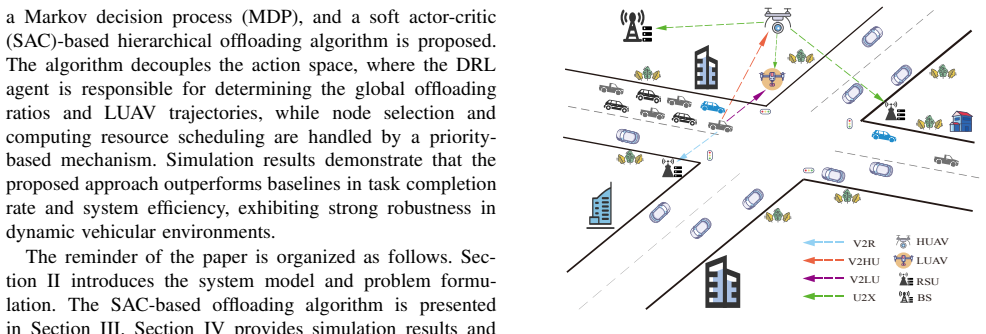
The central claim, stated on the paper's own terms, is that decoupling global from local decisions is what makes UAV-assisted vehicular offloading both tractable and effective. The proposed dual-layer architecture has a high-altitude UAV (HUA V) act as relay and coordinator and low-altitude UAVs (LUA Vs) act as nearby compute nodes; the algorithm then splits the decision: a soft actor-critic agent outputs continuous offloading ratios and LUA V trajectories, and a priority-based scheduler picks target nodes and allocates their remaining CPUs. Against baselines that drop priority scheduling, freeze trajectories, or use a discrete-action deep Q-network, the reported experiments show the proposed method sustaining higher task completion rates as vehicle density scales from 5 to 50 and as relay bandwidth narrows, at a reported 0.950 completion rate at 100 MHz and 0.875 at 40 MHz.
Load-bearing premise
The plan assumes the high-altitude UAV receives complete, accurate, immediate knowledge of every vehicle's position, task, speed, and every node's remaining resources, and that radio links are only distance-based line-of-sight/non-line-of-sight rates with no interference or control overhead.
Editorial extensions
If this is right
- If the central claim holds, operators can absorb rising vehicle density by adding low-altitude UAVs and letting the high-altitude relay re-dispatch them, since completion rate stays high from 5 to 50 vehicles in the reported runs.
- Urgent tasks benefit most from the priority ordering, because deadlines and priority values determine scheduling order before resource allocation.
- Deploying more LUA Vs raises completion rate but eventually stops raising system utility, since propulsion energy grows; the reported utility curves identify a deployment sweet spot rather than a monotone benefit.
- The continuous SAC action space converges faster than the discrete DQN baseline in the reported episodes, suggesting that quantizing offloading ratios into discrete actions was a bottleneck for the baseline.
- Under scarce relay bandwidth the dynamic trajectory and ratio control matter most: at 40 MHz the proposed method reports 0.875 completion while the fixed-trajectory baseline reports 0.820.
Reading between the lines
- Beyond the paper, the obvious stress test is to replace the perfect global state assumption with noisy, delayed, or partial feedback; if completion gains shrink towards the baselines, the real-world value rests on the HUA V's sensing and reporting quality, not on the algorithm alone.
- A second extension is to sweep the fixed 30-percent free-resource threshold in the scheduling rule; the reported gains could depend on that threshold matching the simulated load.
- The model omits interference, control overhead, and sub-slot mobility, so a packet-level or ray-tracing simulator with concurrent transmissions would show how much of the reported 0.950 completion rate survives realistic radio conditions.
- The same two-level decomposition—continuous global policy plus a rule-based local scheduler—could transfer to other heterogeneous edge settings with large mixed action spaces, such as ground base stations plus drone relays.
Editorial analysis
A structured set of objections, weighed in public.
Referee Report
Summary. The manuscript proposes a dual-layer UAV-assisted vehicular edge computing architecture in which a high-altitude UAV (HUAV) relays traffic to RSUs or the BS while low-altitude UAVs (LUAVs) provide edge computation, with partial task offloading from vehicles. It formulates a mixed-integer nonlinear program P0 (Eq. 23a) that maximizes a weighted sum of task completion rate, negative delay, and negative energy consumption, then reformulates the problem as an MDP. A hierarchical SAC-based algorithm is introduced: the SAC agent outputs offloading ratios and LUAV trajectories, while a priority-based scheduler selects nodes and allocates computing resources. Simulation results in Sections IV and V claim that the proposed method outperforms NoPriority, FixedUAV, and DQN-based baselines in task completion rate, system utility, and convergence speed, with robustness to vehicle density and bandwidth variations.
Significance. If validated, the hierarchical decomposition of global continuous actions (offloading ratios and trajectories) plus a local priority scheduler would be a useful tool for managing the large action space in UAV-assisted VEC. The system model is coherent and includes propulsion energy for LUAVs and hovering energy for the HUAV, which is a positive feature. However, the performance claims are not currently established. The empirical evidence consists of single-seed, ablation-style baselines, the reward function duplicates the optimization objective, and the simulation environment assumes perfect global state and interference-free communication. No code, hyperparameters, or convergence plots are provided. The paper would make a modest contribution after a major revision that adds multi-seed experiments, stronger baselines or appropriately tempered claims, and full reproducibility details.
major comments (5)
- [Section IV, Figs. 3-5] The central comparative claim rests on learning curves and bar-style comparisons without error bars, seed counts, or tabulated final values. The abstract and conclusion claim improved 'convergence speed,' but no figure or table compares the learning curve of the proposed SAC method against DQN-based or other baselines. Please provide multi-seed means with confidence intervals, tabulated steady-state metrics, and an explicit convergence-speed comparison (e.g., episodes to reach a target utility or reward).
- [Section IV, baseline definitions] NoPriority, FixedUAV, and DQN-based are ablations of the proposed system or a discretized version of its own SAC logic; they are not established VEC offloading benchmarks. Therefore, the results can only show the contribution of each component, not that the method 'outperforms existing approaches' as stated in Section V. Please add comparisons with at least one or two published UAV-assisted or vehicular edge offloading algorithms (e.g., [9]-[13], [18]), or explicitly restrict the claim to outperforming the considered ablations.
- [Section III-A, Eq. (26) and Section II-E, Eq. (23a)] The immediate reward r(t) is identical to the optimization objective P0 in Eq. (23a), with the task completion rate weighted by ω1 = 0.6. Because Rsucc is part of the training signal, the reported task completion-rate advantage partly reflects the chosen reward weights rather than an independent evaluation metric. This circularity is common in RL, but it should be stated explicitly, and the paper should report raw delay and energy components separately as well as the completion rate. In addition, robustness of the conclusions to ω1, ω2, and ω3 should be demonstrated.
- [Section II-C and Section III-A, Eq. (24)] The simulation environment assumes perfect global state information (Eq. 24), quasi-static node positions within each time slot, and distance-based LoS/NLoS rates without interference, control overhead, or feedback delay. Consequently, the claim of 'strong robustness and adaptability in dynamic vehicular environments' in the abstract and Section IV is not actually demonstrated. Please include sensitivity analysis to imperfect state information, channel fading/shadowing dynamics, or mobility within a slot, or soften the robustness claim to the specific simulation conditions.
- [Section IV and Section III-B, Eqs. (23a), (26), (28)] Key algorithmic parameters are missing: the normalization constants β_T and β_E in Eqs. (23a) and (26), the scoring weights α_s and β_s in Eq. (28), the 30% resource-availability threshold, and the SAC hyperparameters (learning rates, network sizes, batch sizes, entropy coefficient schedule). Without these values, the simulation results cannot be reproduced or meaningfully compared with other algorithms. Please provide a complete parameter table.
minor comments (5)
- [Section II-D, Eq. (16)] There is a typo in the last term of Eq. (16): 'f_i(t)x' should read 'f_i^x(t)' to match the notation used elsewhere.
- [Section IV, first paragraph] The sentence 'The simulations are implemented on the PyCharm platform' is imprecise, since PyCharm is an integrated development environment, not a simulation platform. Please rephrase as, for example, 'simulations are implemented in Python 3.8 and PyTorch.'
- [Fig. 3 caption and text] The caption says 'System utility versus episode' while the text describes both task completion rate and system utility. The figure should be split into two clearly labeled subplots (one for completion rate, one for utility) with axis labels and units.
- [Section IV, simulation setup] The simulation setup is described in prose without a consolidated parameter table. A table listing all default values (β0, α1, α2, Pn, bandwidths, transmit powers, node counts, energy model constants) would greatly improve readability and reproducibility.
- [Eq. (23a)] The notation 'P0 : max_{λ,F,Q} = ...' is incomplete; it should be 'P0 : max_{λ,F,Q} ...' or a utility function should be defined on the right-hand side, such as 'maximize U(λ,F,Q) = ...'.
Circularity Check
The reported task completion rate and system utility are, by construction, the same weighted sum the SAC agent is trained to maximize; no other load-bearing circularity was found.
-
self definitional
[Section III-A, Eq. (26); Section II-E, Eq. (23a); Section IV simulation settings]
"P0 : max = ω1Rsucc − ω2βT ∑_{i∈I} T_total_i(t) − ω3βEEsys(t) (23a) ... r(t) = ω1Rsucc(t) − ω2βT T_total(t) − ω3βEEsys(t), (26) ... the system utility is defined in accordance with the reward function, with the weights set as ω1 = 0.6, ω2 = 0.2, and ω3 = 0.2."
The reward in Eq. (26) is exactly the objective P0 in Eq. (23a): T_total(t) is defined as Σ_i T_total_i(t), so the reward and the optimization objective are the same weighted sum. The paper then defines its reported 'system utility' as this very reward with the same weights, and plots task completion rate, the ω1 = 0.6 component of the same quantity, as a headline metric. Hence the claimed gains in completion rate and system utility are the quantity the SAC agent is trained to maximize, not an independent performance measure. The comparison is not vacuous because all baselines are measured on the same reward, but the evaluation is self-referential by construction.
full rationale
The main derivation chain — communication and computation models, delay/energy equations, P0, the MDP reformulation, and the SAC update — is self-contained and does not import a load-bearing result from the authors' prior work. The self-citations (e.g., [3], [6]-[8], [12], [18]) supply contextual architecture and motivation, not an invoked uniqueness theorem or a forbidden ansatz, so they do not raise the circularity score. The one genuine circular element is the evaluation metric: Eq. (26) is the same objective as Eq. (23a), and Section IV explicitly adopts the reward as the system utility. Consequently, the reported completion-rate and utility curves are the training objective itself, which makes the 'demonstration' of superiority partially tautological. This is mitigated by the fact that all baselines are optimized under the same reward, so the relative ordering still has algorithmic content. Separately, the claimed convergence-speed advantage is asserted in the abstract and conclusion but never shown in a convergence plot; that is an evidence gap, not a circularity. Overall score 3 reflects one mild self-referential step in an otherwise non-circular derivation.
Assumptions & free parameters
free parameters (5)
- Objective and reward weights omega_1, omega_2, omega_3 =
0.6, 0.2, 0.2
- Normalization parameters beta_T, beta_E =
not reported
- Node score weights alpha_s, beta_s =
not reported
- Resource availability threshold for candidate nodes =
30 percent
- Task priority function K_i(t) =
unspecified
assumptions (6)
- domain assumption Within each time slot, node positions are static.
- domain assumption Vehicle-to-RSU links are NLoS with log-normal shadowing; vehicle-to-UAV and HUA V links are LoS.
- domain assumption Every vehicle generates exactly one computation task per time slot.
- domain assumption Task execution delays across offloading modes are concurrent, so total delay is the max over modes and energy is additive.
- domain assumption The HUA V agent observes the full network state each slot.
- ad hoc to paper A node is a candidate for offloading only if more than 30 percent of its computing resources remain available.
Cite this review
Pith. "Pith review of Hierarchical Task Offloading for UAV-Assisted Vehicular Edge Computing via Deep Reinforcement Learning." pith.science (2026). https://pith.science/paper/VZULN5IR
@misc{pith2026250705722,
  author       = {Pith},
  title        = {Pith review of: Hierarchical Task Offloading for UAV-Assisted Vehicular Edge Computing via Deep Reinforcement Learning},
  year         = {2026},
  howpublished = {\url{https://pith.science/paper/VZULN5IR}},
  note         = {Machine review of arXiv:2507.05722}
}
read the original abstract
With the emergence of compute-intensive and delay-sensitive applications in vehicular networks, unmanned aerial vehicles (UAVs) have emerged as a promising complement for vehicular edge computing due to the high mobility and flexible deployment. However, the existing UAV-assisted offloading strategies are insufficient in coordinating heterogeneous computing resources and adapting to dynamic network conditions. Hence, this paper proposes a dual-layer UAV-assisted edge computing architecture based on partial offloading, composed of the relay capability of high-altitude UAVs and the computing support of low-altitude UAVs. The proposed architecture enables efficient integration and coordination of heterogeneous resources. A joint optimization problem is formulated to minimize the system delay and energy consumption while ensuring the task completion rate. To solve the high-dimensional decision problem, we reformulate the problem as a Markov decision process and propose a hierarchical offloading scheme based on the soft actor-critic algorithm. The method decouples global and local decisions, where the global decisions integrate offloading ratios and trajectory planning into continuous actions, while the local scheduling is handled via designing a priority-based mechanism. Simulations are conducted and demonstrate that the proposed approach outperforms several baselines in task completion rate, system efficiency, and convergence speed, showing strong robustness and applicability in dynamic vehicular environments.
Figures


Figures from the paper (2 more)


Reference graph
Works this paper leans on
-
[9]
Flexedge: Digital twin- enabled task offloading for UA V-aided vehicular edge comput ing,
B. Li, W. Xie, Y . Y e, L. Liu, and Z. Fei, “Flexedge: Digital twin- enabled task offloading for UA V-aided vehicular edge comput ing,” IEEE Trans. V eh. Technol. , vol. 72, no. 8, pp. 11 086–11 091, Aug. 2023
work page 2023
-
[13]
UA V-assisted task offloading in vehicular edge computing networks,
X. Dai, Z. Xiao, H. Jiang, and J. C. S. Lui, “UA V-assisted task offloading in vehicular edge computing networks,” IEEE Trans. Mobile Comput., vol. 23, no. 4, pp. 2520–2534, Apr. 2024
work page 2024
-
[18]
Hierarchical aerial computing for Internet of things via cooperation of HAPs and UA Vs,
Z. Jia, Q. Wu, C. Dong, C. Y uen, and Z. Han, “Hierarchical aerial computing for Internet of things via cooperation of HAPs and UA Vs,” IEEE Internet Things J. , vol. 10, no. 7, pp. 5676–5688, Apr. 2023
work page 2023
-
[1]
Regional-centralized content dissemination for eV2X services in 5G mmwave-enabled IoV,
J. Hu, C. Chen, T. Qiu, and Q. Pei, “Regional-centralized content dissemination for eV2X services in 5G mmwave-enabled IoV,” IEEE Internet of Things Journal , vol. 7, no. 8, pp. 7234–7249, Aug. 2020
work page 2020
-
[2]
V e hicular communication networks in the automated driving era,
S. Zhang, J. Chen, F. Lyu, N. Cheng, W. Shi, and X. Shen, “V e hicular communication networks in the automated driving era,” IEEE Com- mun. Mag. , vol. 56, no. 9, pp. 26–32, Sep. 2018
work page 2018
-
[3]
Generative AI-e nhanced cooperative MEC of UA Vs and ground stations for unmanned sur face vehicles,
J. Y ou, Z. Jia, C. Dong, Q. Wu, and Z. Han, “Generative AI-e nhanced cooperative MEC of UA Vs and ground stations for unmanned sur face vehicles,” in Proc. 59th Annu. Conf. Inf. Sci. Syst. (CISS) , Mar. 2025
work page 2025
-
[4]
R. Liu, A. Liu, Z. Qu, and N. N. Xiong, “An UA V-enabled inte lligent connected transportation system with 6G communications fo r Internet of vehicles,” IEEE Trans. Intell. Transp. Syst., vol. 24, no. 2, pp. 2045– 2059, Feb. 2023
work page 2023
-
[5]
J. Hu, C. Chen, L. Cai, M. R. Khosravi, Q. Pei, and S. Wan, “U A V- assisted vehicular edge computing for the 6G Internet of veh icles: Architecture, intelligence, and challenges,” IEEE Commun. Stand. Mag., vol. 5, no. 2, pp. 12–18, Jun. 2021
work page 2021
Show all 18 references
-
[6]
Co- operative cognitive dynamic system in UA V swarms: Reconfigu rable mechanism and framework,
Z. Jia, J. Y ou, C. Dong, Q. Wu, F. Zhou, D. Niyato, and Z. Han , “Co- operative cognitive dynamic system in UA V swarms: Reconfigu rable mechanism and framework,” IEEE V eh. Technol. Mag., vol. 19, no. 3, pp. 90–101, Sep. 2024
2024
-
[7]
Adaptive qoe-aware sfc orc hestration in uav networks: A deep reinforcement learning approach,
Y . Wu, Z. Jia, Q. Wu, and Z. Lu, “Adaptive qoe-aware sfc orc hestration in uav networks: A deep reinforcement learning approach,” IEEE Trans. Netw. Sci. Eng., vol. 11, no. 6, pp. 6052–6065, Nov.-Dec. 2024
2024
-
[8]
Distributionally robust optimization for aerial multi-a ccess edge computing via cooperation of UA Vs and HAPs,
Z. Jia, C. Cui, C. Dong, Q. Wu, Z. Ling, D. Niyato, and Z. Han , “Distributionally robust optimization for aerial multi-a ccess edge computing via cooperation of UA Vs and HAPs,” IEEE Trans. Mob. Comput., vol. –, no. –, pp. 1–15, 2025
2025
-
[10]
Joint task offloading and resource allocation in UA V-enabled mobile edge computing,
Z. Y u, Y . Gong, S. Gong, and Y . Guo, “Joint task offloading and resource allocation in UA V-enabled mobile edge computing, ” IEEE Internet Things J. , vol. 7, no. 4, pp. 3147–3159, Apr. 2020
2020
-
[11]
Energy-efficient resource management in UA V-assisted mobile edge computing,
Y . K. Tun, Y . M. Park, N. H. Tran, W. Saad, S. R. Pandey, and C. S. Hong, “Energy-efficient resource management in UA V-assisted mobile edge computing,” IEEE Commun. Lett. , vol. 25, no. 1, pp. 249–253, Jan. 2021
2021
-
[12]
Service function chain dynamic scheduling in space-air-ground int egrated networks,
Z. Jia, Y . Cao, L. He, Q. Wu, Q. Zhu, D. Niyato, and Z. Han, “ Service function chain dynamic scheduling in space-air-ground int egrated networks,” IEEE Trans. V eh. Technol., vol. –, no. –, pp. 1–15, 2025
2025
-
[14]
Deep reinforcement learning based resource management for multi-access edge computing in vehicular ne tworks,
H. Peng and X. Shen, “Deep reinforcement learning based resource management for multi-access edge computing in vehicular ne tworks,” IEEE Transactions on Network Science and Engineering , vol. 7, no. 4, pp. 2416–2428, Oct.-Dec. 2020
2020
-
[15]
UA V-relaying-assisted multi- access edge computing with multi-antenna base station: Offl oading and scheduling optimization,
X. Diao, W. Y ang, L. Y ang, and Y . Cai, “UA V-relaying-assisted multi- access edge computing with multi-antenna base station: Offl oading and scheduling optimization,” IEEE Trans. V eh. Technol. , vol. 70, no. 9, pp. 9495–9509, Sep. 2021
2021
-
[16]
A survey on channel soundin g technologies and measurements for UA V-assisted communica tions,
K. Mao, Q. Zhu, C.-X. Wang, X. Y e, J. Gomez-Ponce, X. Cai, Y . Miao, Z. Cui, Q. Wu, and W. Fan, “A survey on channel soundin g technologies and measurements for UA V-assisted communica tions,” IEEE Trans. Instrum. Meas. , vol. 73, pp. 1–24, Jan. 2024
2024
-
[17]
Sparse bayesian learning-based hierarchical cons truction for 3d radio environment maps incorporating channel shadowing ,
J. Wang, Q. Zhu, Z. Lin, J. Chen, G. Ding, Q. Wu, G. Gu, and Q. Gao, “Sparse bayesian learning-based hierarchical cons truction for 3d radio environment maps incorporating channel shadowing ,” IEEE Trans. Wireless Commun. , vol. 23, no. 10, pp. 14 560–14 574, 2024
2024
Reviewed August 6, 2026 · model on record in the stance chip above.
Discussion (0). Continue with ORCID to comment.