TailorMind: Towards Preference-Aligned Multimodal Content Generation
Pith reviewed 2026-06-26 08:12 UTC · model grok-4.3
The pith
TailorMind generates user-tailored multimodal content by linking hypergraph-based preference modeling to controllable generators.
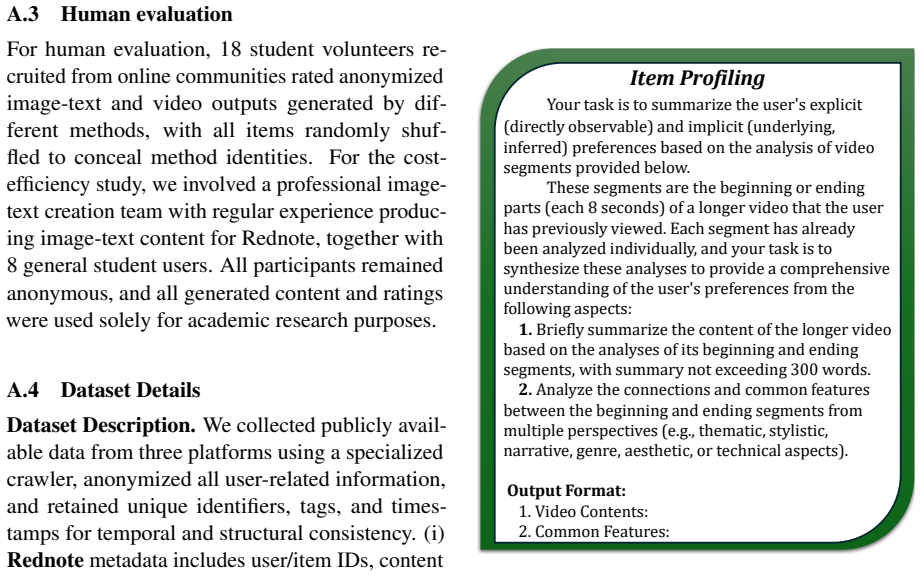
A machine-rendered reading of the paper's core claim, the machinery that carries it, and where it could break.
Core claim
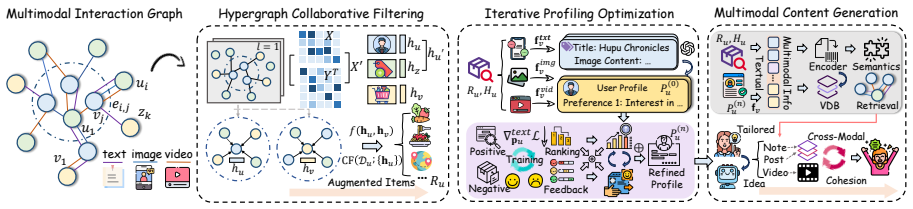
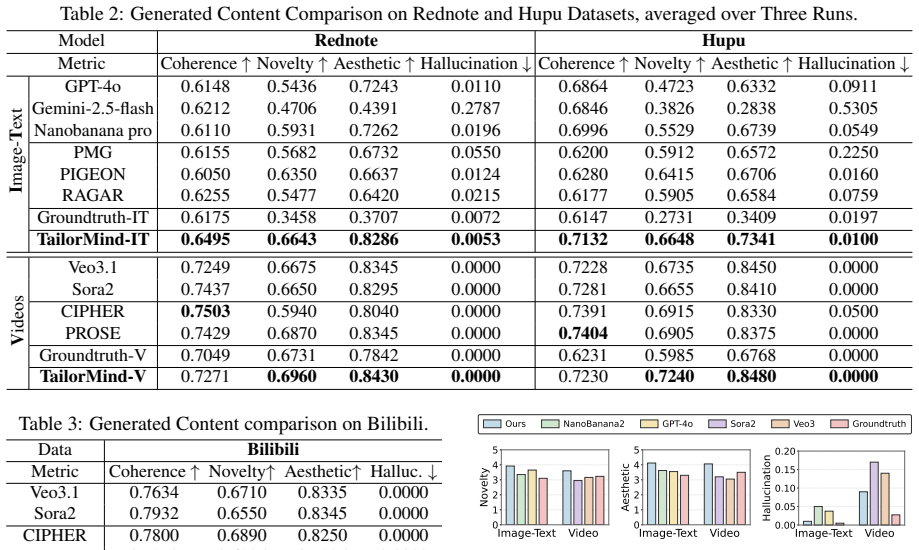
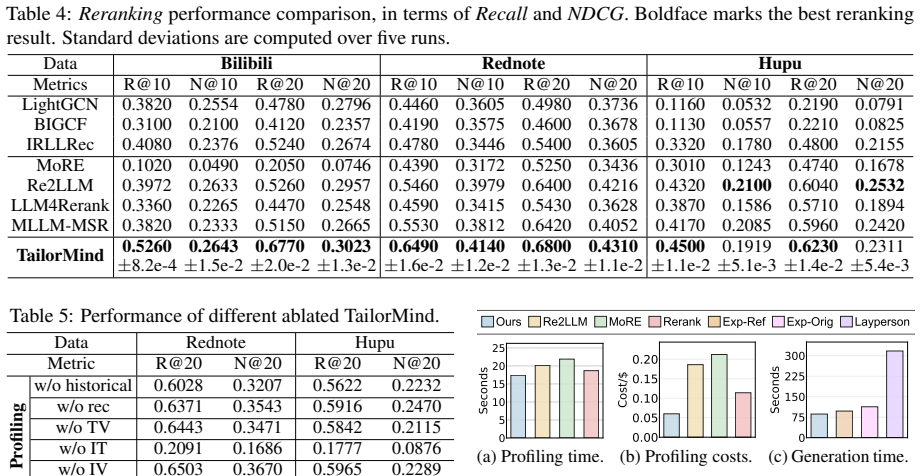
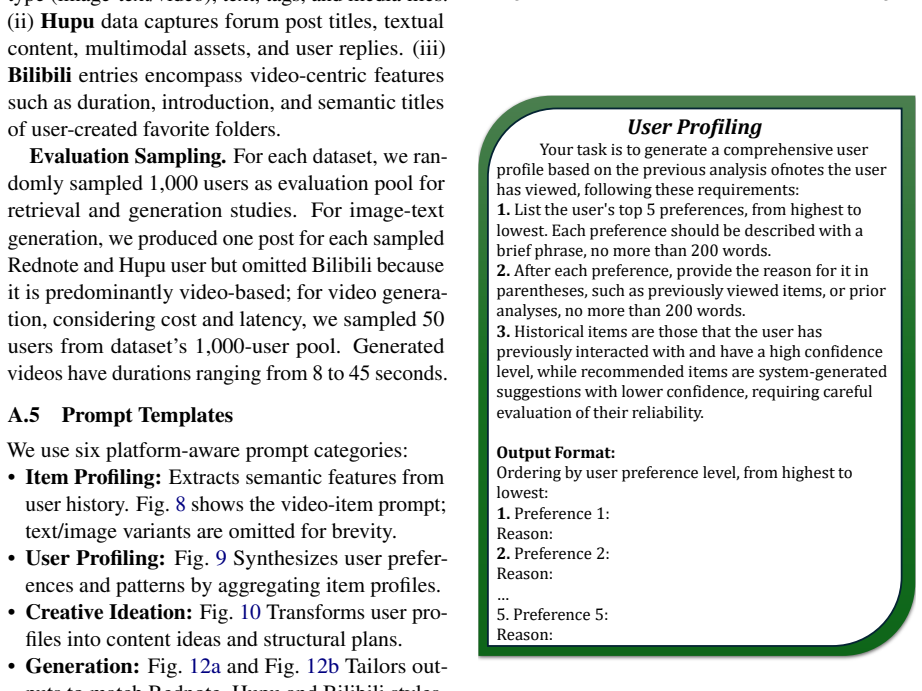
TailorMind links collaborative preference modeling with controllable multimodal generation by enriching sparse user histories via hypergraph collaborative filtering, optimizing textual profiles with ranking-error feedback and textual gradient descent, applying retrieval-augmented style control, and employing cross-modal cohesion reflection to limit semantic drift. On the TailorBench benchmark constructed from three platforms, the system produces content that achieves competitive or stronger coherence while improving novelty and aesthetic quality over representative generation baselines and ground-truth user-generated content, and it records up to 29 percent recall gains when used for reranki
What carries the argument
TailorMind, the framework that connects hypergraph collaborative filtering for history enrichment and textual gradient descent for profile optimization to guide controllable multimodal generation.
If this is right
- Generated outputs match or surpass coherence of existing generation baselines and real user content.
- Novelty and aesthetic quality scores rise above those of representative generation methods and ground-truth UGC.
- The system shows clear gains over simply retrieving available content or similar user-generated items.
- Reranking performance improves by as much as 29 percent recall on the tested tasks.
Where Pith is reading between the lines
- Platforms could shift from waiting for community uploads to synthesizing content directly from individual behavior traces.
- The same preference-to-generation pipeline might apply to other modalities or recommendation settings with sparse data.
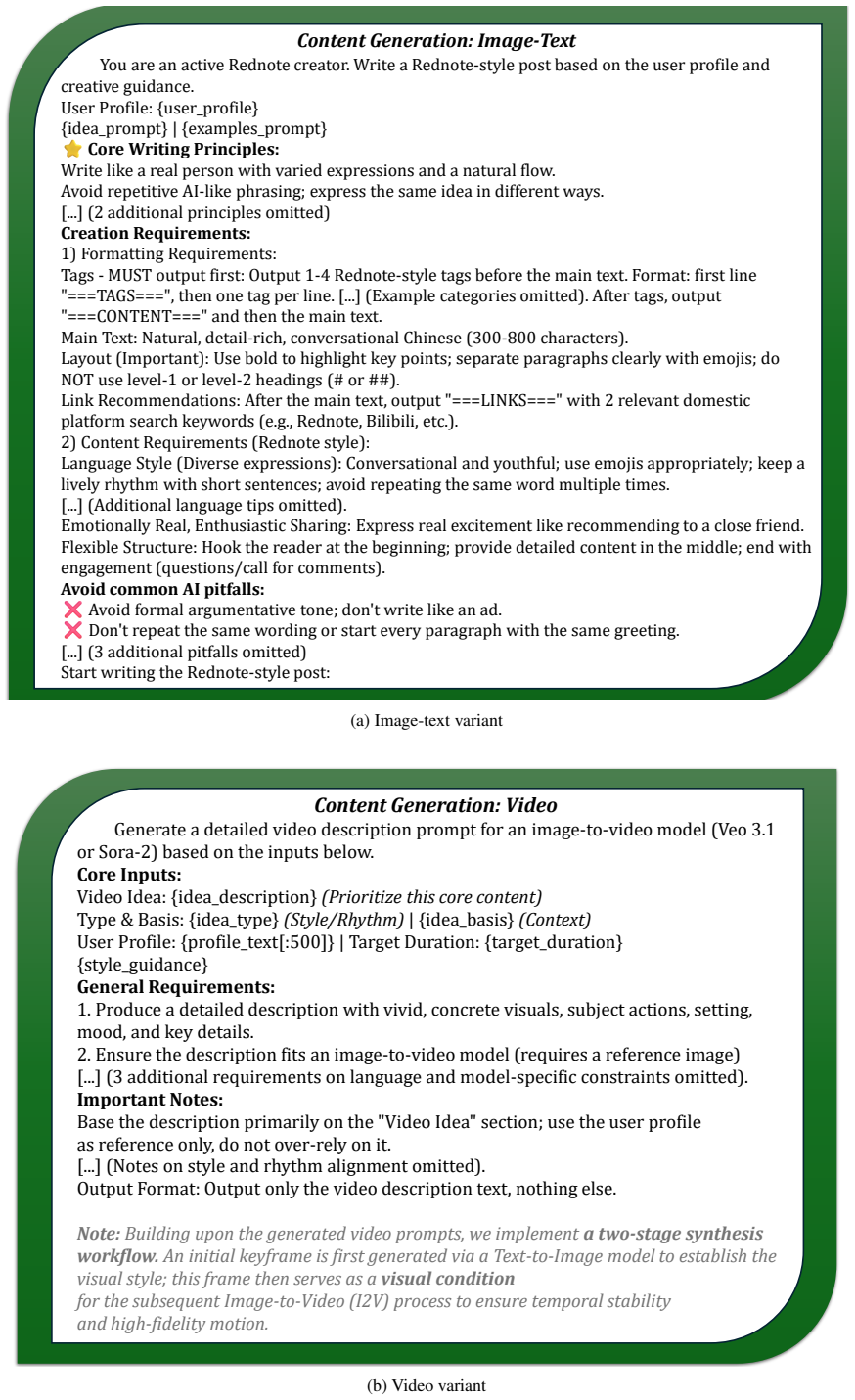
- Content creation and recommendation systems could merge into a single on-demand pipeline rather than remaining separate stages.
Load-bearing premise
Enriching sparse histories with hypergraph collaborative filtering and refining profiles via ranking-error feedback will yield preference signals that steer generation reliably without semantic drift or hallucinations.
What would settle it
A user study in which participants rate TailorMind outputs lower in preference alignment than retrieved real user-generated content on the same prompts would falsify the claimed advantage.
Figures

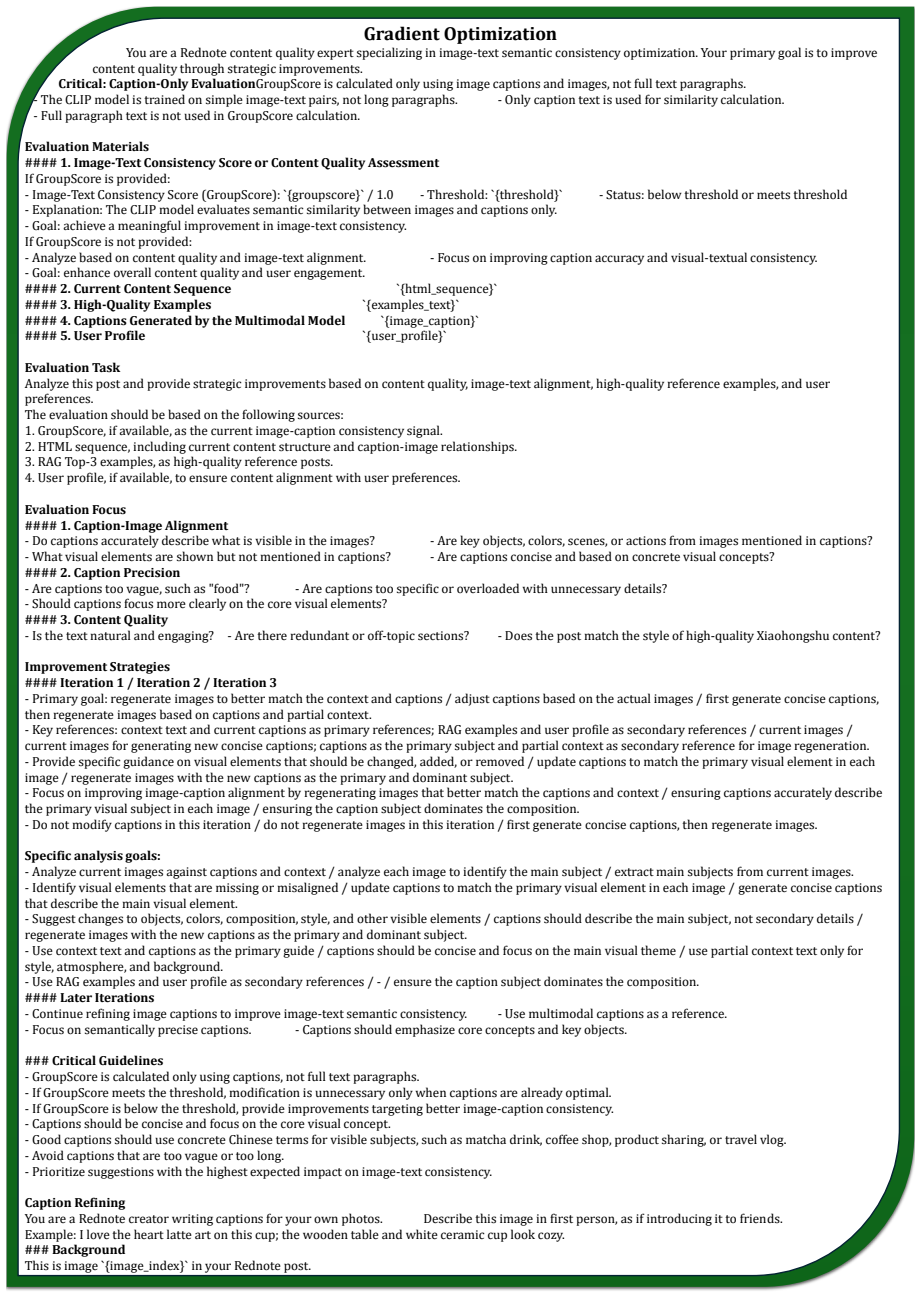
read the original abstract
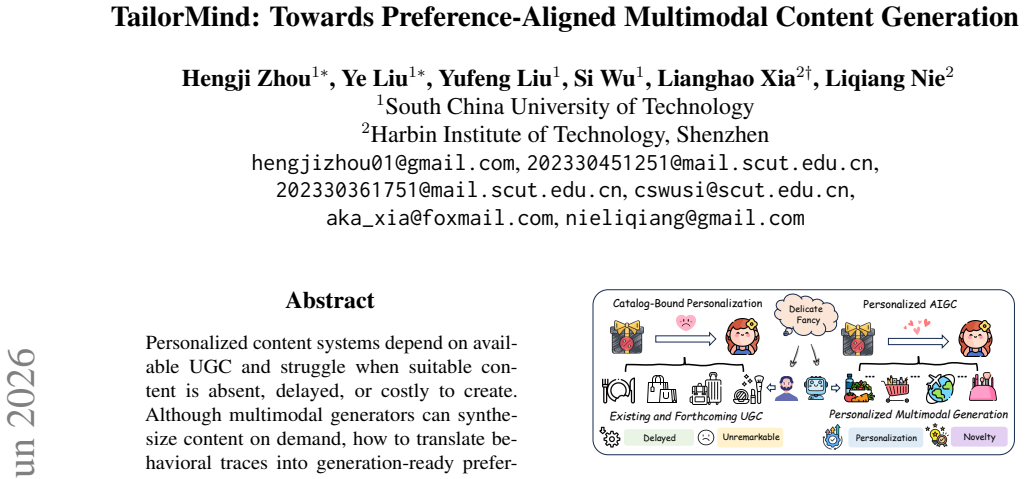
Personalized content systems depend on available UGC and struggle when suitable content is absent, delayed, or costly to create. Although multimodal generators can synthesize content on demand, how to translate behavioral traces into generation-ready preferences remains underexplored. We study personalized multimodal content generation: creating user-tailored multimodal content without existing item pools or waiting for matching UGC. We propose TailorMind, linking collaborative preference modeling with controllable multimodal generation. TailorMind enriches sparse user histories via hypergraph collaborative filtering and optimizes textual profiles with ranking-error feedback and textual gradient descent. Retrieval-augmented style control grounds outputs in authentic UGC patterns, while cross-modal cohesion reflection reduces semantic drift. We construct TailorBench, a benchmark from three mainstream platforms evaluated along five dimensions: coherence, novelty, aesthetic, hallucination, profiling. Experiments show that TailorMind achieves competitive or stronger coherence, improves novelty and aesthetic quality over representative generation baselines and ground-truth UGC, demonstrating advantages over retrieving available content or comparable UGC, while achieving up to 29% Recall gains in reranking. Our code is released at: https://github.com/iLearn-Lab/TailorMind.
Editorial analysis
A structured set of objections, weighed in public.
Referee Report
Summary. The paper proposes TailorMind for personalized multimodal content generation without relying on existing UGC pools. It enriches sparse user histories via hypergraph collaborative filtering, optimizes textual profiles using ranking-error feedback and textual gradient descent, applies retrieval-augmented style control, and uses cross-modal cohesion reflection to reduce semantic drift. The work introduces the TailorBench benchmark from three platforms and evaluates along coherence, novelty, aesthetic, hallucination, and profiling dimensions, claiming competitive or superior coherence, gains in novelty and aesthetic quality over generation baselines and ground-truth UGC, advantages over retrieval, and up to 29% recall gains in reranking.
Significance. If the experimental claims hold with proper controls and verification, the work would address an underexplored gap in translating behavioral traces into controllable generation signals, offering a potential alternative to retrieval-based personalization in multimodal systems.
major comments (3)
- [Abstract] Abstract: The claim of 'up to 29% Recall gains in reranking' is load-bearing for the central experimental result but supplies no definition of the reranking task, the recall metric, the set of baselines, dataset splits, or statistical tests/error bars, preventing assessment of whether the data support the stated advantage.
- [Abstract] Abstract: The statement that TailorMind 'achieves competitive or stronger coherence, improves novelty and aesthetic quality over representative generation baselines and ground-truth UGC' lacks any description of the baselines, how UGC comparisons are constructed, or the five evaluation dimensions' operationalization, which is required to substantiate the 'advantages over retrieving available content' claim.
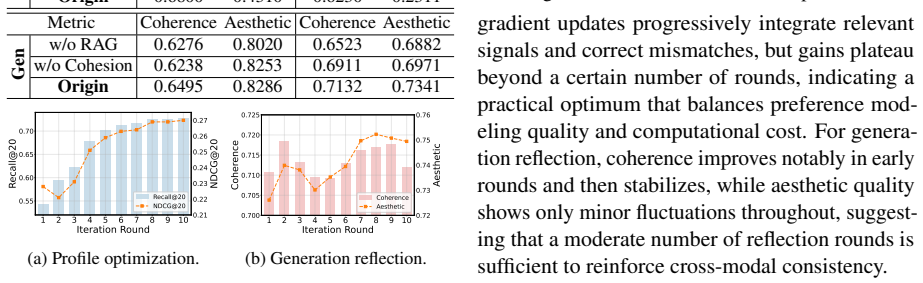
- [Abstract] Abstract: The mechanism 'cross-modal cohesion reflection reduces semantic drift' is presented as addressing the core assumption that preference signals from hypergraph CF and textual optimization will reliably steer generation, yet no ablation, metric, or result on hallucination/profiling is supplied to show this component's contribution.
Simulated Author's Rebuttal
We thank the referee for the constructive comments on the abstract. We agree that the abstract's claims would benefit from additional context to allow standalone assessment. We will revise the abstract to incorporate brief definitions, parenthetical references to relevant sections, and indications of supporting evidence from the main text while preserving its conciseness.
read point-by-point responses
-
Referee: [Abstract] Abstract: The claim of 'up to 29% Recall gains in reranking' is load-bearing for the central experimental result but supplies no definition of the reranking task, the recall metric, the set of baselines, dataset splits, or statistical tests/error bars, preventing assessment of whether the data support the stated advantage.
Authors: The reranking task (using optimized profiles to rerank candidate items), Recall@K metric, baselines (standard CF and generation methods), 80/10/10 splits, and statistical tests with error bars are defined and reported in Section 4.3 and Table 3. We will revise the abstract to add a brief qualifier: 'up to 29% Recall@10 gains in reranking (Sec. 4.3)'. revision: yes
-
Referee: [Abstract] Abstract: The statement that TailorMind 'achieves competitive or stronger coherence, improves novelty and aesthetic quality over representative generation baselines and ground-truth UGC' lacks any description of the baselines, how UGC comparisons are constructed, or the five evaluation dimensions' operationalization, which is required to substantiate the 'advantages over retrieving available content' claim.
Authors: Baselines are listed in Section 4.1, UGC comparisons are constructed via similarity matching to user histories (Section 3.5), and the five dimensions (coherence, novelty, aesthetic, hallucination, profiling) are operationalized with specific metrics in Section 3.4. We will revise the abstract to include: 'over representative generation baselines (Sec. 4.1) and ground-truth UGC (Sec. 3.5), along coherence, novelty, aesthetic, hallucination, and profiling (Sec. 3.4)'. revision: yes
-
Referee: [Abstract] Abstract: The mechanism 'cross-modal cohesion reflection reduces semantic drift' is presented as addressing the core assumption that preference signals from hypergraph CF and textual optimization will reliably steer generation, yet no ablation, metric, or result on hallucination/profiling is supplied to show this component's contribution.
Authors: Ablation results quantifying the reflection component's impact on hallucination and profiling metrics appear in Section 4.4. We will revise the abstract to note: 'with cross-modal cohesion reflection reducing semantic drift (ablations in Sec. 4.4)'. revision: yes
Circularity Check
No circularity: forward pipeline with independent experimental validation
full rationale
The paper describes a pipeline (hypergraph CF for history enrichment, ranking-error feedback + textual gradient descent for profiles, retrieval-augmented style control, cross-modal cohesion reflection) leading to generation and benchmark results. No equations, self-citations, or definitions are supplied in the provided text that reduce any claimed prediction or result to its own inputs by construction. Experiments on TailorBench are presented as external validation along coherence/novelty/aesthetic/hallucination/profiling axes, with no fitted-input-called-prediction or self-definitional steps. This is the common case of a self-contained empirical pipeline.
Axiom & Free-Parameter Ledger
axioms (2)
- domain assumption Hypergraph collaborative filtering can effectively enrich sparse user histories for preference modeling
- domain assumption Textual gradient descent on ranking-error feedback produces improved profiles for generation control
Reference graph
Works this paper leans on
-
[1]
Iisan: Efficiently adapting multimodal repre- sentation for sequential recommendation with decou- pled peft. InSIGIR, pages 687–697. Junchen Fu, Xuri Ge, Xin Xin, Alexandros Karatzoglou, Ioannis Arapakis, Kaiwen Zheng, Yongxin Ni, and Joemon M Jose Joemon. 2025. Efficient and effec- tive adaptation of multimodal foundation models in sequential recommendat...
Pith/arXiv arXiv 2025
-
[2]
Representation learning with large language models for recommendation. InWWW, pages 3464– 3475. Nickolay Safonov, Alexey Bryntsev, Andrey Moskalenko, Dmitry Kulikov, Dmitriy Vatolin, Radu Timofte, Haibo Lei, Qifan Gao, Qing Luo, Yaqing Li, and 1 others. 2025. Ntire 2025 challenge on ugc video enhancement: Methods and results. In Proceedings of the Compute...
Pith/arXiv arXiv 2025
-
[3]
Content-rich aigc video quality assessment via intricate text alignment and motion-aware consis- tency.arXiv preprint arXiv:2502.04076. Weiwei Sun, Lingyong Yan, Xinyu Ma, Shuaiqiang Wang, Pengjie Ren, Zhumin Chen, Dawei Yin, and Zhaochun Ren. 2023. Is chatgpt good at search? investigating large language models as re-ranking agents.arXiv preprint arXiv:23...
arXiv 2023
-
[4]
Briefly summarize the content of the longer video based on the analyses of its beginning and ending segments, with summary not exceeding 300 words
-
[5]
Output Format:
Analyze the connections and common features between the beginning and ending segments from multiple perspectives (e.g., thematic, stylistic, narrative, genre, aesthetic, or technical aspects). Output Format:
-
[6]
User Profiling Your task is to generate a comprehensive user profile based on the previous analysis ofnotes the user has viewed, following these requirements:
Common Features: Figure 8: Video-item variant of the Item Profiling. User Profiling Your task is to generate a comprehensive user profile based on the previous analysis ofnotes the user has viewed, following these requirements:
-
[7]
Each preference should be described with a brief phrase, no more than 200 words
List the user's top 5 preferences, from highest to lowest. Each preference should be described with a brief phrase, no more than 200 words
-
[8]
After each preference, provide the reason for it in parentheses, such as previously viewed items, or prior analyses, no more than 200 words
-
[9]
Output Format: Ordering by user preference level, from highest to lowest:
Historical items are those that the user has previously interacted with and have a high confidence level, while recommended items are system-generated suggestions with lower confidence, requiring careful evaluation of their reliability. Output Format: Ordering by user preference level, from highest to lowest:
-
[10]
Preference 1: Reason:
-
[11]
Preference 2: Reason: …
-
[12]
how to accomplish something
Preference 5: Reason: Figure 9: User Profiling prompt for aggregating item- level profiles into user personas. 13 Creative Ideation: Product Types Main Type: Video Content(7 Categories) Type 1: Cross Talk Description: Adapt audio content of talk shows into Chinese crosstalk Type 2: Meme Video Description: Create engaging and viral-worthy meme content by i...
-
[13]
Your product types should be selected from the following product types: {product_types}
-
[14]
Each product idea should be concise and clear, yet possess a distinct theme
-
[15]
Each idea should have relevant supporting evidence from the user profile
-
[16]
idea": "Product Idea 1
The number of product ideas should not exceed 3. Output Format: Please return the response to me in the following format: [ {{ "idea": "Product Idea 1", "main_type": "Main Category Type", "type": "Product Type", "basis": "Supporting evidence from user profile" }}, {{ "idea": "Product Idea 2", "main_type": "Main Category Type", "type": "Product Type", "bas...
-
[17]
===TAGS===
Formatting Requirements: Tags - MUST output first: Output 1-4 Rednote-style tags before the main text. Format: first line "===TAGS===", then one tag per line. [...] (Example categories omitted). After tags, output "===CONTENT===" and then the main text. Main Text: Natural, detail-rich, conversational Chinese (300-800 characters). Layout (Important): Use b...
-
[18]
[...] (Additional language tips omitted)
Content Requirements (Rednote style): Language Style (Diverse expressions): Conversational and youthful; use emojis appropriately; keep a lively rhythm with short sentences; avoid repeating the same word multiple times. [...] (Additional language tips omitted). Emotionally Real, Enthusiastic Sharing: Express real excitement like recommending to a close fr...
-
[19]
Produce a detailed description with vivid, concrete visuals, subject actions, setting, mood, and key details
-
[20]
Video Idea
Ensure the description fits an image-to-video model (requires a reference image) [...] (3 additional requirements on language and model-specific constraints omitted). Important Notes: Base the description primarily on the "Video Idea" section; use the user profile as reference only, do not over-rely on it. [...] (Notes on style and rhythm alignment omitte...
-
[21]
GroupScore, if available, as the current image-caption consistency signal
-
[22]
HTML sequence, including current content structure and caption-image relationships
-
[23]
RAG Top-3 examples, as high-quality reference posts
-
[24]
Evaluation Focus #### 1
User profile, if available, to ensure content alignment with user preferences. Evaluation Focus #### 1. Caption-Image Alignment - Do captions accurately describe what is visible in the images? - Are key objects, colors, scenes, or actions from images mentioned in captions? - What visual elements are shown but not mentioned in captions? - Are captions conc...
discussion (0)
Sign in with ORCID, Apple, or X to comment. Anyone can read and Pith papers without signing in.