REVIEW 3 major objections 5 minor 20 references
Experimental Study of a Planar-integrated Dual-Polarization Balanced SIS Mixer
T0 review · 3 major / 5 minor · reviewed 2026-08-14 · deepseek-v4-flash
Pith's one-line read A single-chip planar circuit can realize a dual-polarization balanced SIS mixer with performance comparable to modular receivers.
desk verdict A solid, honest device paper that completes the experimental case for a monolithic planar dual-polarization balanced SIS mixer, with one calibration assumption that deserves a closer look before the headline NRR number is taken as settled. read the letter →
The pith
A machine-rendered reading of the paper's core claim, the machinery that carries it, and where it could break.
The reading
What carries the argument
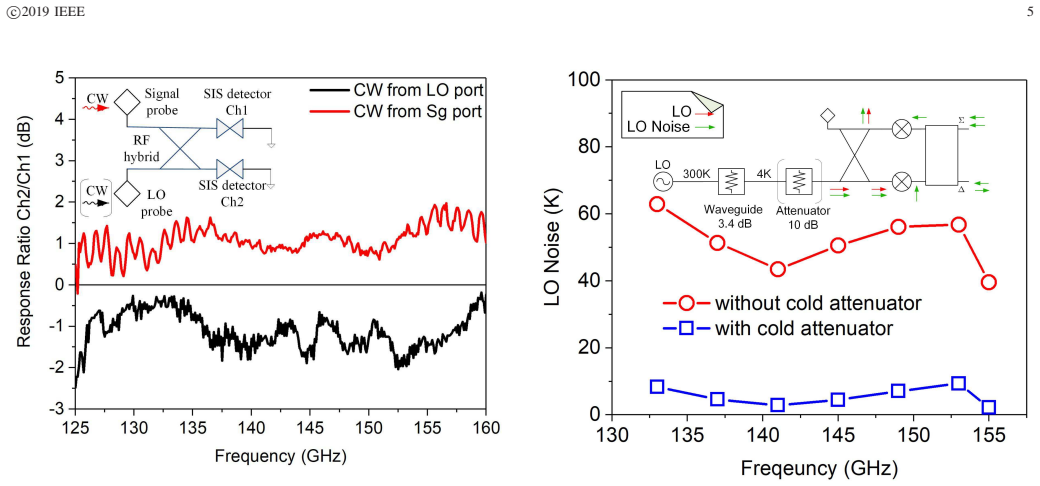
The enabling object is a monolithic superconducting chip with locally formed 6 µm silicon membranes that carry planar waveguide probes, together with a planar orthomode transducer that separates the two linear polarizations and two balanced mixers arranged mirror-symmetrically. Each balanced mixer combines a 3 dB branch-line quadrature coupler with two identical three-junction SIS series arrays, followed by a 180° IF hybrid whose ∆ output adds the down-converted signals while the Σ output collects the LO noise. The co-polar-bias configuration, with one mixer biased above the gap to calibrate IF chain gain, gives a direct single-sideband noise-rejection-ratio measurement that avoids the bias-dependent IF impedance problem of the conventional anti-polar method.
What would settle it
Measure the NRR twice: once with the paper's method and once with both mixers held at operating bias while a calibrated CW source is injected through a variable coupler; if the two values differ by more than a few decibels, the reported 15 dB is an artifact of bias-dependent IF impedance. Alternatively, measure the SIS IF reflection coefficient versus bias voltage and show it is constant across the gap.
Extended reading notes
Core claim
The central claim is that planar integration of SIS receiver front ends is ready for focal-plane arrays. The authors show that a single chip can contain both polarization channels of a balanced mixer, using locally thinned silicon membranes to support planar probes that couple signal and LO, and that this integrated circuit performs on par with conventional modular mixers: receiver noise near 35 K at IF = 4.5 GHz, an LO-noise rejection ratio of about 15 dB over the RF band, and cross-polarization below −20 dB after replacing the Y-junction LO divider with a branch-line coupler. The good balance is attributed to photolithographic symmetry of the on-chip couplers, and the flat response to high-current-density junctions and low-dispersion planar transmission lines.
Load-bearing premise
The noise-rejection measurement assumes that the two IF chains' gain difference, calibrated while one SIS mixer is biased above its gap voltage, stays the same at the normal operating bias—that is, that the SIS mixers' IF impedance does not noticeably change with bias and unbalance the 180° hybrid.
Editorial extensions
If this is right
- The measured performance implies that heterodyne arrays can be scaled from this single-pixel chip to multi-pixel monolithic circuits without the interconnection overhead of modular receivers.
- An LO-noise rejection of about 15 dB means one LO source can pump many balanced pixels while keeping LO noise well below receiver noise.
- The flat 125–163 GHz response, attributed to high-current-density junctions and planar transmission lines, suggests the same layout can be retuned to cover wider or higher-frequency bands.
- Planar orthomode transducers with cross-polarization below −20 dB are practical for mm-wave polarimetry, including future sub-mm arrays.
Reading between the lines
- If the IF hybrid's rejection were measured with both mixers biased at the operating point rather than with one biased above the gap, the reported 15 dB NRR might shift; a direct comparison of the two calibrations would settle the size of any bias-dependent error.
- The crosstalk fix with a branch-line coupler shows that LO distribution isolation, not just on-chip matching, sets array performance; the same trade-off will recur in larger arrays and could be tested before building them.
- The compactness and the absence of isolators in the design point toward balloon-borne or space-borne heterodyne spectrometers, where cryostat volume and mass are limiting; that extension is not explored in the paper.
- A natural next step is to add on-chip thin-film loads and turn the balanced mixer into a sideband-separating receiver; the authors note the required fabrication has not yet been established.
Signed reviews
Editorial analysis
A structured set of objections, weighed in public.
Referee Report
Summary. The manuscript reports the design and experimental characterization of a monolithic planar-integrated dual-polarization balanced SIS mixer for the 125–163 GHz band. The chip integrates planar orthomode transducers and LO couplers on locally formed silicon membranes. Measurements yield receiver noise temperature of about 35–40 K, an LO noise rejection ratio (NRR) of about 15 dB across the band, and cross-polarization below -20 dB after replacing a Y-junction LO divider with a branch-line coupler. The authors conclude that planar integration of SIS mixer focal plane arrays is readily achievable.
Significance. If the results hold, this is a valuable step toward compact SIS heterodyne focal plane arrays, a recognized bottleneck for wide-field millimeter-wave astronomy. The paper provides a clear experimental demonstration, standard Y-factor noise measurements, a convincing diagnosis and mitigation of a crosstalk mechanism, and an appendix that correctly reproduces and credits a known waveguide noise formula. The main risk is the calibration of the headline NRR value, which depends on an unvalidated assumption about bias-dependent IF impedance and hybrid balance; the quantitative headline claims also lack stated uncertainties.
major comments (3)
- [III-B] The NRR gain-correction procedure assumes that biasing one SIS mixer above the gap voltage leaves the balance of the 180-degree IF hybrid unchanged relative to the normal bias condition. The paper itself criticizes the conventional anti-polar bias method for bias-dependent IF impedance and cites [16] on this point, so the same concern applies directly to the above-gap bias used here. If the off-biased mixer presents a different IF impedance to the hybrid, the measured gain ratio will not represent the gain difference during the actual NRR measurement, and the reported ~15 dB rejection could be systematically biased. Please provide a quantitative validation—for example, a comparison with the conventional method at several frequencies with stated agreement, or a measurement of the hybrid balance as a function of mixer bias voltage.
- [III-B and III-C] The quantitative claims of NRR and cross-polarization are not accompanied by uncertainties or repeatability statements. Figure 5 shows a frequency sweep with no error bars, and the cross-polarization result is quoted as a hard threshold (< -20 dB) without uncertainty. Since these are two of the three anchor numbers in the abstract, the authors should report measurement uncertainty, number of devices measured, or at least a clear statement of estimated systematic and random error.
- [III-C] The manuscript does not state explicitly whether the NRR and noise-temperature measurements were performed on the device with the original Y-junction LO divider or on the upgraded branch-line-coupler version. The cross-polarization result is reported after the upgrade, but Figures 2–5 may correspond to the earlier configuration. This ambiguity affects reproducibility and the interpretation of the combined performance summary; please clarify which hardware configuration was used for each measurement.
minor comments (5)
- [Abstract and Section III-A] The abstract says 'overall receiver noise about 40 K' while the text reports about 35 K at IF = 4.5 GHz over the RF band; please reconcile these numbers or state the range and measurement conditions in the abstract.
- [Abstract and Section III-B] The abstract states 'NRR about 15 dB' while the text says 'better than 15 dB can be obtained ... with a few exceptions being less than 15 dB but better than 10 dB.' Clarify whether the band-average or a typical value is meant, and avoid implying a hard 15 dB floor.
- [Section II] The sentence 'Each output port of the IF hybrid coupler is followed by a cryogenic isolator-low noise amplifier (LNA) assembly with a passband of 4-8 GHz' should be checked for grammatical clarity; consider splitting into two sentences.
- [Figure 2] The caption states that the RMS error is smaller than the symbol size, but no error bars are plotted; please add error bars or describe how the RMS was estimated and why it is not visible.
- [References] The reference list has minor formatting inconsistencies (for example, the use of Cyrillic characters in reference [3] and missing spaces); a careful copy-edit would improve presentation.
Circularity Check
No circularity: the paper is an experimental demonstration; all performance figures are directly measured, and the only derivation in the appendix is explicitly cross-checked against an independent prior result.
full rationale
This manuscript reports measurements of a fabricated planar-integrated SIS mixer: receiver noise temperature, conversion gain, noise rejection ratio, and cross-polarization. No quantity that is claimed as a result is obtained by fitting a parameter to that same quantity, and no prediction is derived from an assumption that already contains the conclusion. The NRR measurement uses a CW injected tone and a gain-correction step that assumes the IF hybrid balance is unchanged when one mixer is biased above the gap; this is a measurement calibration assumption, not a circular definition or a fitted input renamed as a prediction. The paper explicitly identifies the limitation of the conventional anti-polar bias method and uses a co-polar CW method instead, and the conventional-method points in Fig. 5 are provided for comparison rather than being used as the basis of the reported value. The only analytical derivation is the Appendix's thermal-noise formula for a lossy waveguide with a linear temperature profile; the authors derive it from the radiative transfer equation and then state that the same result was previously obtained in [20] by a different method. That prior citation is used as corroboration, not as the load-bearing source of the derivation. The self-citations to the authors' earlier work [6], [7], [8], [9] concern the design, fabrication, and simulated components of the same integrated-circuit concept; they are normal continuity of research and are not used to justify the measured performance claims. There is no uniqueness theorem, no ansatz smuggled in via citation, and no renaming of a known empirical pattern as a new organization. The central claims stand or fall on the direct measurements described in Sections III-A, III-B, and III-C. Therefore no significant circularity is present.
Assumptions & free parameters
assumptions (3)
- domain assumption The radiative transfer equation and a linear physical temperature distribution along the lossy input waveguide (T_g = (T_b - T_a)x/L + T_a) describe the thermal noise contribution.
- domain assumption The two SIS junction arrays in each balanced mixer are identical, so the ratio of their direct-detection responses gives the RF coupler amplitude imbalance.
- ad hoc to paper The gain-difference calibration for the NRR measurement, obtained with one mixer biased above the gap voltage, is valid at the normal bias condition because the IF impedance and hybrid balance are unaffected by the bias state.
Cite this review
Pith. "Pith review of Experimental Study of a Planar-integrated Dual-Polarization Balanced SIS Mixer." pith.science (2026). https://pith.science/paper/W2YHYRJI
@misc{pith2026190806564,
  author       = {Pith},
  title        = {Pith review of: Experimental Study of a Planar-integrated Dual-Polarization Balanced SIS Mixer},
  year         = {2026},
  howpublished = {\url{https://pith.science/paper/W2YHYRJI}},
  note         = {Machine review of arXiv:1908.06564}
}
read the original abstract
A dual-polarization balanced superconductor-insulator-superconductor mixer operating at 2 mm wavelength is realized in form of a monolithic planar integrated circuit. Planar orthomode transducers and LO couplers are enabled by using silicon membranes that are locally formed on the silicon-on-insulator substrate. The performance of the balanced mixer is experimentally investigated. Over the entire RF band (125-163 GHz), the balanced mixer shows an LO noise rejection ratio about 15 dB, an overall receiver noise about 40 K, and a cross-polarization <-20 dB. The demonstrated compactness and the performance of the integrated circuit indicate that this approach is feasible in developing heterodyne focal plane arrays.
Figures


Figures from the paper (3 more)


Reference graph
Works this paper leans on
-
[6]
Wenlei Shan, Shohei Ezaki, Jie Liu, Shinichiro Asayama, and Takashi Noguchi, A New Concept for Quasi-Planar Integration of Superconductor-Insulator-Superconductor Array Receiver Front Ends, IEEE Trans. on Terahertz Sci. and Tech., vol. 8, no. 4, pp.472-474, 2018. DOI: 10.1109/TTHZ.2018.2842750
arXiv 2018
-
[7]
W. Shan, S. Ezaki, J. Liu, S. Asayama, T. Noguchi, S. Iguchi, "Planar superconductor-insulator-superconductor mixer array receivers for wide field of view astronomical observation," Proc. SPIE, 10708, Millimeter, Submillimeter, and Far-Infrared Detectors and Instrumentation for Astronomy IX, 1070814, 2018. DOI: 10.1117/12.2311933
- [20]
-
[16]
R. Kerr, A. W. Lichtenberger, C. M. Lyons, E. F. Lauria, L. M. Ziurys and M. R. Lambeth, A superconducting 180 degree IF hybrid for balanced SIS mixers, Proceedings of the 17th International Symposium on Space Terahertz Technology, 2007
work page 2007
-
[1]
The Event Horizon Telescope Collaboration, First M87 Event Horizon Telescope Results. I. The Shadow of the Supermassive Black Hole, The Astrophysical Journal Letters, 875, L1 (17pp), 2019. DOI: 10.3847/2041-8213/ab0ec7
-
[2]
Yang Su, Ji Yang, Shaobo Zhang, Yan Gong, Hongchi Wang, Xin Zhou, Min Wang, Zhiwei Chen, Yan Sun, Xuepeng Chen, The Milky Way Imaging Scroll Painting (MWISP): Project Details and Initial Results from the Galactic Longitudes of 25^o.8-49^o.7 , The Astrophysical Journal, vol. 240, L1(21pp), 2019. DOI: 10.3847/1538-4365/aaf1c8
-
[3]
Wenlei Shan, Ji Yang, Shengcai Shi, Qijun Yao, Yingxi Zuo, Zhenhui Lin, Shanhuai Chen, Xuguo Zhang, Wenying Duan, Aiqing Cao, Sheng Li, Zhenqiang Li, Jie Liu, Jiaqiang Zhong, Development of Superconducting Spectroscopic Array Receiver: A Multibeam 2SB SIS Receiver for Millimeter-Wave Radio Astronomy, IEEE Trans. on Terahertz Sci. and Tech., vol.2 , no. 6,...
arXiv 2012
-
[4]
Christopher E. Groppi and Jonathan H. Kawamura, Coherent Detector Arrays for Terahertz Astrophysics Applications, IEEE Trans. on Terahertz Sci. and Tech., vol. 1, no. 1, pp. 85-96, 2011. DOI: 10.1109/TTHZ.2011.2159555
arXiv 2011
Show all 20 references
-
[5]
The ALMA Development Roadmap, available: https://www.almaobservatory.org/en/publications/the-alma-development-roadmap/
-
[8]
Fabrication and Characterization of Silicon (100) Membranes for a Multi-beam Superconducting Heterodyne Receiver,
S. Ezaki, W. Shan, T. Kojima, A. Gonzalez, S. Asayama, and T. Noguchi, "Fabrication and Characterization of Silicon (100) Membranes for a Multi-beam Superconducting Heterodyne Receiver," Journal of Low Temperature Physics, vol. 193, pp. 720-725, 2018. DOI: 10.1007/s10909-018-2004-2
2018 doi
-
[9]
Fabrication of Superconductor Integrated Circuits of D-band Dual-polarization Balanced SIS Mixers,
S. Ezaki, W. Shan, S. Asayama, and T. Noguchi, "Fabrication of Superconductor Integrated Circuits of D-band Dual-polarization Balanced SIS Mixers," IEEE Trans. on Appl. Supercond., vol. 29 (5), 1101405, 2019. DOI: 10.1109/TASC.2019.2902985
2019
-
[10]
Development of ALMA Band 4 (125-163 GHz) receiver,
ShinIchiro Asayama, Toshikazu Takahashi, Kouichi Kubo, Tetsuya Ito, Motoko Inata, Takakiyo Suzuki, Toru Wada, Tomio Soga, Chiyoshi Kamada, Miki Karatsu, Yumi Fujii, Yoshiyuki Obuchi, Susumu Kawashima, Hiroyuki Iwashita, and Yoshinori Uzawa,"Development of ALMA Band 4 (125-163 ...
2014 doi
-
[11]
Wenlei Shan, Zhenqiang Li, Jiaqiang Zhong, Shengcai Shi, An 85-115 GHz SIS Mixer Demonstrating Nearly Constant Dynamic Resistance, IEEE Trans. on Appl. Supercond., vol 19, no. 3, pp. 432-435, 2009. DOI: 10.1109/TASC.2009.2017885
2009
-
[12]
SISMA: A Numerical Simulation Software for SIS Mixer Design,
Wenlei Shan, Wentao Wu, Shengcai Shi, "SISMA: A Numerical Simulation Software for SIS Mixer Design," 2018 43rd International Conference on Infrared, Millimeter, and Terahertz Waves (IRMMW-THz), Nagoya, pp. 1-2, 2018. DOI: 10.1109/IRMMW-THz.2018.8510451
2018
-
[13]
Modular 2SB SIS Receiver for 600-720 GHz: Performance and Characterization Methods,
A. Khudchenko, R. Hesper, A. M. Baryshev, J. Barkhof and F. P. Mena, "Modular 2SB SIS Receiver for 600-720 GHz: Performance and Characterization Methods," IEEE Trans. on Terahertz Sci. and Tech., vol. 7, no. 1, pp. 2-9, Jan. 2017. DOI: 10.1109/TTHZ.2016.2633528
2017
-
[14]
DOI: 10.1063/1.4764324
Marc Peter Westig, Matthias Justen, Karl Jacobs, Jurgen Stutzki, Michael Schultz, Florian Schomacker, and Netty Honingh, A 490 GHz planar circuit balanced Nb - Al_2O_3 - Nb quasiparticle mixer for radio astronomy: application to quantitative local oscillator noise determinatio...
2012 doi
-
[15]
Yasunori Fujii, Takafumi Kojima, Alvaro Gonzalez, Shinichiro Asayama, Matthias Kroug, Keiko Kaneko, Hideo Ogawa and Yoshinori Uzawa, Low-noise integrated balanced SIS mixer for 787-950 GHz, Supercond. Sci. Technol., 30, 024001 (13 pp), 2017. DOI: 10.1088/0953-2048/30/2/024001
2017 doi
-
[17]
A. R. Kerr, S.-K. Pan, A. W. Lichtenberger, N. Horner, J. E. Effland, and K. Crady, A single-chip balanced sis mixer for 200-300 GHz, Proceedings of the 11th International Symposium on Space Terahertz Technology, pp.251-259, 2000
2000
-
[18]
Kooi, Richard A
Jacob W. Kooi, Richard A. Chamberlin, Raquel Monje, Brian Force, David Miller, and Tom G. Phillips, Balanced Receiver Technology Development for the Caltech Submillimeter Observatory, IEEE Trans. on Terahertz Sci. and Tech., vol. 2, no. 1, pp.71-82, 2012. DOI: 10.1109/TTHZ.201...
2012
-
[19]
Compact broadband planar orthomode transducer,
P. K. Grimes, O. G. King, G. Yassin and M. E. Jones, "Compact broadband planar orthomode transducer," Electronics Letters, vol. 43, no. 21, pp. 1146-1147, 11 Oct. 2007. DOI: 10.1049/el:20071649
2007 doi
Reviewed August 14, 2026 · model on record in the stance chip above.
Discussion (0). Continue with ORCID to comment.