Overcoming the Limits of Finite Difference Method; Physics-Informed Neural Network for Noisy High-Dimensional Heat Diffusion
Pith reviewed 2026-06-27 20:21 UTC · model grok-4.3
The pith
Physics-informed neural networks sustain 91 percent accuracy in three-dimensional heat diffusion under 20 percent boundary noise while finite difference methods fall to 36 percent.
A machine-rendered reading of the paper's core claim, the machinery that carries it, and where it could break.
Core claim
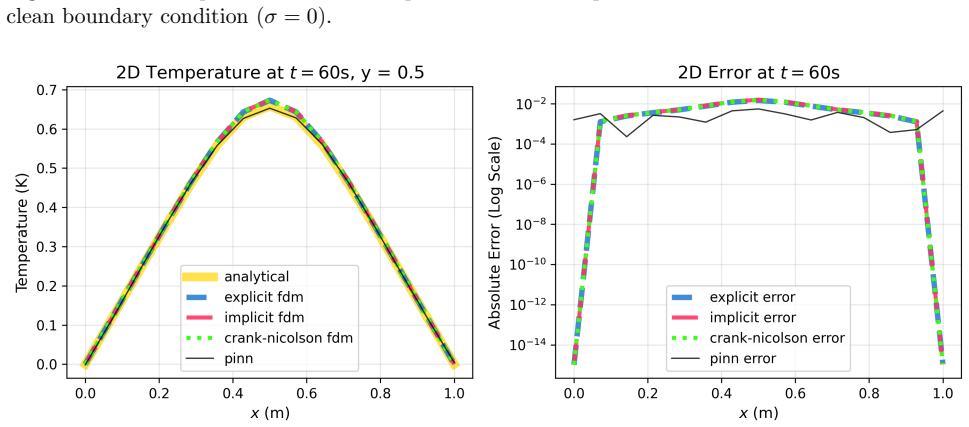
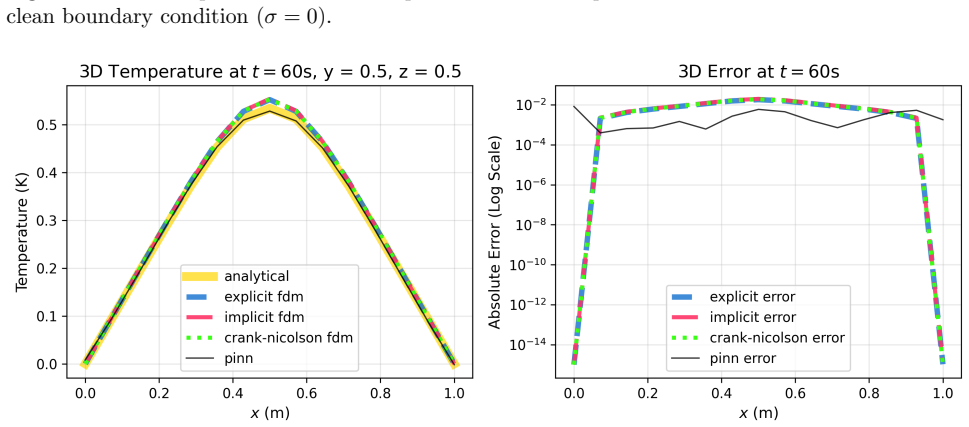
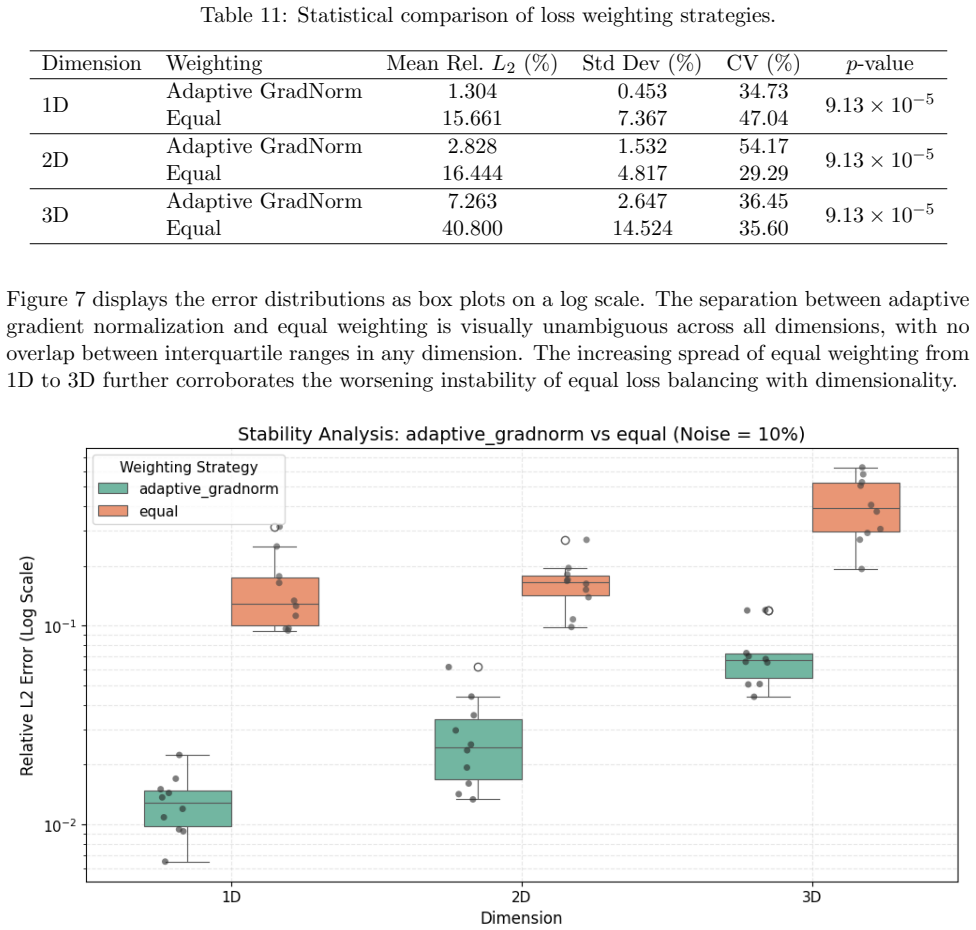
Under 20% boundary noise in 3D, PINN sustains approximately 91% accuracy while Finite Difference Method (FDM) collapses to 36%, a clear decisive advantage. This is further confirmed in a physical copper thermal system, where PINN reduces boundary reconstruction error by 3.3 times under realistic noise conditions. PINN also requires fewer spacetime nodes than FDM in 3D while delivering the higher accuracy.
What carries the argument
The Physics-Informed Neural Network that incorporates the heat equation residual and noisy boundary data directly into its training loss to solve the diffusion problem across dimensions.
If this is right
- PINN requires fewer spacetime nodes than FDM in 3D while achieving superior accuracy.
- Solver selection must weigh noise exposure together with dimensionality rather than accuracy alone.
- When noise and dimensionality are both high the classical discretization approach becomes insufficient.
- PINN supplies an operational alternative that remains usable in the high-noise high-dimension regime.
Where Pith is reading between the lines
- The same noise-resilience pattern may appear in other linear parabolic equations once boundary data are noisy.
- Training-cost comparisons at fixed accuracy would clarify whether the node reduction translates into lower overall compute.
- If inference speed is adequate, the approach could support online monitoring of thermal systems where sensors provide noisy boundary readings.
Load-bearing premise
Noise added to boundary conditions in the simulations matches the statistical character of noise that occurs in real physical measurements and the trained network generalizes to new instances of the same problem class.
What would settle it
Run a controlled 3D copper-plate experiment that records both the true temperature field and the exact noise statistics on the boundaries, then compare PINN and FDM reconstructions against those ground-truth measurements.
Figures
read the original abstract
High-dimensional transient heat diffusion under noisy boundary conditions exposes a fundamental limitation of classical numerical methods: accuracy degrades catastrophically where physical noise is unavoidable. This paper presents a Physics-Informed Neural Network (PINN) framework as a systematic solution to this problem across one, two, and three spatial dimensions, establishing clear operational regimes that redefine solver selection in noisy thermal systems. Under 20% boundary noise in 3D, PINN sustains approximately 91% accuracy while Finite Difference Method (FDM) collapses to 36%, a clear decisive advantage. This is further confirmed in a physical copper thermal system, where PINN reduces boundary reconstruction error by 3.3 times under realistic noise conditions. This noise resilience is accompanied by a dimensionality-driven efficiency crossover: PINN requires fewer spacetime nodes than FDM in 3D while achieving superior accuracy, exposing the true cost of classical discretization at scale. These findings reframe solver selection: the decisive axis is not accuracy alone, but noise exposure and dimensionality jointly. When noise and dimensionality are both high, the classical solver paradigm is insufficient; this work provides the foundation to justify PINN as the operational standard in such regimes.
Editorial analysis
A structured set of objections, weighed in public.
Referee Report
Summary. The manuscript introduces a PINN framework for transient heat diffusion in 1D–3D under noisy boundary conditions. It reports that under 20% boundary noise in 3D, PINN achieves ~91% accuracy while FDM drops to 36%, with a 3.3× reduction in boundary reconstruction error demonstrated on a physical copper thermal system. The work also identifies a dimensionality-driven efficiency crossover favoring PINN in 3D and argues that solver choice should jointly consider noise exposure and dimensionality.
Significance. If the quantitative claims and noise-model transfer hold, the results would be significant for practical thermal modeling in noisy high-dimensional regimes, providing empirical support for preferring PINNs over classical discretizations when both noise and dimension are elevated. The physical experiment supplies a concrete test case, though its value hinges on unverified noise-statistic equivalence.
major comments (2)
- [Physical experiment / results on copper system] The central claim of a decisive 91%-vs-36% advantage (and its transfer to the copper experiment) rests on the unverified assumption that the 20% i.i.d. boundary noise used in simulations produces error statistics comparable to those in the physical experiment. No quantitative match (autocorrelation, power spectrum, or higher moments) between the two noise sources is supplied, leaving the reported robustness dependent on an untested modeling choice.
- [Efficiency comparison / 3D results] The efficiency-crossover statement (PINN requiring fewer spacetime nodes than FDM in 3D) is load-bearing for the reframing of solver selection, yet the manuscript provides no explicit node-count or runtime tables that isolate the effect of noise level from dimensionality.
minor comments (2)
- [Methods] Notation for accuracy metric (e.g., whether it is relative L2 error, pointwise, or integrated) should be defined explicitly in the methods section.
- [Abstract / results] The abstract states specific percentages (91%, 36%, 3.3×) without accompanying uncertainty estimates or number of trials; these should be reported with error bars or standard deviations in the results.
Simulated Author's Rebuttal
We thank the referee for the constructive comments, which help clarify the validation of our noise modeling and the presentation of efficiency results. We address each major comment below.
read point-by-point responses
-
Referee: [Physical experiment / results on copper system] The central claim of a decisive 91%-vs-36% advantage (and its transfer to the copper experiment) rests on the unverified assumption that the 20% i.i.d. boundary noise used in simulations produces error statistics comparable to those in the physical experiment. No quantitative match (autocorrelation, power spectrum, or higher moments) between the two noise sources is supplied, leaving the reported robustness dependent on an untested modeling choice.
Authors: We agree that a direct quantitative comparison of noise statistics between the simulated i.i.d. noise and the physical measurements would strengthen the transfer of the robustness claim. In the revised manuscript we will add a new subsection that reports the autocorrelation function and power spectral density of both noise sources, along with a comparison of higher-order moments, to verify the modeling assumption. revision: yes
-
Referee: [Efficiency comparison / 3D results] The efficiency-crossover statement (PINN requiring fewer spacetime nodes than FDM in 3D) is load-bearing for the reframing of solver selection, yet the manuscript provides no explicit node-count or runtime tables that isolate the effect of noise level from dimensionality.
Authors: We acknowledge the value of explicit tabular data to isolate dimensionality from noise level. The revised manuscript will include a new table that reports spacetime node counts, wall-clock runtimes, and accuracy for both methods across 1D–3D at 0 % and 20 % noise, allowing readers to observe the crossover directly. revision: yes
Circularity Check
No circularity: claims rest on direct empirical comparisons between PINN and FDM
full rationale
The paper reports numerical experiments in 1D-3D heat diffusion with added boundary noise and a physical copper validation experiment. Accuracy figures (e.g., 91% vs 36%) are measured outcomes of running the two solvers on the same noisy data; no derivation, ansatz, or fitted parameter is presented whose output is definitionally identical to its input. The comparison is therefore falsifiable against external benchmarks and does not reduce to self-citation or renaming.
Axiom & Free-Parameter Ledger
Reference graph
Works this paper leans on
-
[1]
Shengze Cai, Zhicheng Wang, Sifan Wang, Paris Perdikaris, and George Karniadakis,Physics-Informed Neural Networks (PINNs) for Heat Transfer Problems, Journal of Heat Transfer143(2021), DOI 10.1115/1.4050542
-
[2]
1, 015013, DOI 10.1088/2632-2153/acb416
Chandrajit Bajaj, Luke McLennan, Timothy Andeen, and Avik Roy,Recipes for when physics fails: recovering robust learning of physics informed neural networks, Machine Learning: Science and Technology4(2023), no. 1, 015013, DOI 10.1088/2632-2153/acb416
-
[3]
Liu Yang, Xuhui Meng, and George Em Karniadakis,B-PINNs: Bayesian physics-informed neural networks for forward and inverse PDE problems with noisy data, Journal of Computational Physics425(2021), 109913, DOI 10.1016/j.jcp.2020.109913
-
[4]
Hansaem Oh and Gwanghyun Jo,Physics-informed neural network for the heat equation under imperfect contact conditions and its error analysis, AIMS Mathematics10(2025), 7920–7940, DOI 10.3934/math.2025364
-
[5]
Pietro de Oliveira Esteves,Robust Physics Discovery from Highly Corrupted Data: A PINN Framework Applied to the Nonlinear Schr¨ odinger Equation, ArXivabs/2601.04176(2026)
arXiv 2026
-
[6]
Tamara Grossmann, Urszula Komorowska, Jonas Latz, and Carola-Bibane Sch¨ onlieb,Can physics-informed neural networks beat the finite element method?, IMA Journal of Applied Mathematics89(2024), DOI 10.1093/ima- mat/hxae011
-
[7]
Batyr Sharimbayev, Shirali Kadyrov, and Aleksei Kavokin,Development and optimization of physics-informed neural networks for solving partial differential equations, posted on 2025, DOI 10.48550/arXiv.2502.02599
-
[8]
Lu Lu, Xuhui Meng, Zhiping Mao, and George Karniadakis,DeepXDE: A Deep Learning Library for Solving Dif- ferential Equations, SIAM Review63(2021), 208–228, DOI 10.1137/19M1274067
-
[9]
Maziar Raissi, Paris Perdikaris, and George Karniadakis,Physics-Informed Neural Networks: A Deep Learning Framework for Solving Forward and Inverse Problems Involving Nonlinear Partial Differential Equations, Journal of Computational Physics378(2018), DOI 10.1016/j.jcp.2018.10.045
-
[10]
Pearlmutter, Alexey Andreyevich Radul, and Jeffrey Mark Siskind,Automatic Differentiation in Machine Learning: a Survey, Journal of Machine Learning Research18(2018), no
Atilim Gunes Baydin, Barak A. Pearlmutter, Alexey Andreyevich Radul, and Jeffrey Mark Siskind,Automatic Differentiation in Machine Learning: a Survey, Journal of Machine Learning Research18(2018), no. 153, 1–43
2018
-
[11]
Vitor Bueno, Cristiane Faria, Karla Figueiredo, and Fabio dos Santos,Convergence analysis of physics-informed neural networks and comparison with finite difference methods of the two-dimensional heat equation, Proceeding Series of the Brazilian Society of Computational and Applied Mathematics11(2025), no. 1, 1–7
2025
-
[12]
Jian Cheng Wong, Pao-Hsiung Chiu, Chinchun Ooi, and My Ha Da,Robustness of Physics-Informed Neural Networks to Noise in Sensor Data, ArXivabs/2211.12042(2022)
arXiv 2022
-
[13]
Wasif Khan and Ahmad Shahbaz,Comparative analysis of Finite Difference Method (FDM) and Physics-Informed Neural Networks (PINNs), i-manager’s Journal on Mathematics13(2024), 27, DOI 10.26634/jmat.13.1.20383
-
[14]
10, 982, DOI 10.3390/axioms12100982
Svetislav Savovi´ c, Miloˇ s Ivanovi´ c, and Rui Min,A Comparative Study of the Explicit Finite Difference Method and Physics-Informed Neural Networks for Solving the Burgers’ Equation, Axioms12(2023), no. 10, 982, DOI 10.3390/axioms12100982
-
[15]
Aleksandra Jekic, Afroditi Natsaridou, Signe Riemer-Sørensen, Helge Langseth, and Odd Erik Gundersen,Exam- ining the robustness of Physics-Informed Neural Networks to noise for Inverse Problems, posted on 2025, DOI 10.48550/arXiv.2509.20191
-
[16]
Wei Zhou and Y. Xu,Data-Guided Physics-Informed Neural Networks for Solving Inverse Problems in Partial Differential Equations, posted on 2024, DOI 10.48550/arXiv.2407.10836
-
[17]
Rafael Bischof and Michael A. Kraus,Multi-Objective Loss Balancing for Physics-Informed Deep Learning, Computer Methods in Applied Mechanics and Engineering439(2025), 117914, DOI 10.1016/j.cma.2025.117914
-
[18]
George Karniadakis, Yannis Kevrekidis, Lu Lu, Paris Perdikaris, Sifan Wang, and Liu Yang,Physics-informed machine learning, Nature Reviews Physics, posted on 2021, 1–19, DOI 10.1038/s42254-021-00314-5
-
[19]
Guofei Pang, Lu Lu, and George Karniadakis,fPINNs: Fractional Physics-Informed Neural Networks, SIAM Journal on Scientific Computing41(2019), A2603–A2626, DOI 10.1137/18M1229845
-
[20]
Colbrook,Noisy PDE Training Requires Bigger PINNs, ArXivabs/2507.06967(2025)
Sebastien Andre-Sloan, Anirbit Mukherjee, and Matthew J. Colbrook,Noisy PDE Training Requires Bigger PINNs, ArXivabs/2507.06967(2025)
arXiv 2025
-
[21]
Hankyeol Kim and Pilsung Kang,naPINN: Noise-Adaptive Physics-Informed Neural Networks for Recovering Physics from Corrupted Measurement, posted on 2026, DOI 10.48550/arXiv.2602.02547
work page internal anchor Pith review Pith/arXiv arXiv doi:10.48550/arxiv.2602.02547 2026
-
[22]
Hao Xu, Haibin Chang, and Dongxiao Zhang,DL-PDE: Deep-learning based data-driven discovery of partial differ- ential equations from discrete and noisy data, posted on 2019, DOI 10.48550/arXiv.1908.04463
-
[23]
Carslaw and J.C
H.S. Carslaw and J.C. Jaeger,Conduction of Heat in Solids, Clarendon Press, 1986
1986
-
[24]
Bureau International des Poids et Mesures,Le Syst` eme international d’unit´ es/The International System of Units, 9th ed., 2024
2024
-
[25]
LeVeque,Finite Difference Methods for Ordinary and Partial Differential Equations: Steady-State and Time- Dependent Problems, Society for Industrial and Applied Mathematics, 2007
R.J. LeVeque,Finite Difference Methods for Ordinary and Partial Differential Equations: Steady-State and Time- Dependent Problems, Society for Industrial and Applied Mathematics, 2007. 20
2007
-
[26]
Lawrence Craig Evans,Partial Differential Equations, Graduate studies in mathematics, American Mathematical Society, 2010
2010
-
[27]
Strikwerda,Finite Difference Schemes and Partial Differential Equations, Second Edition, Society for Industrial and Applied Mathematics, 2004
John C. Strikwerda,Finite Difference Schemes and Partial Differential Equations, Second Edition, Society for Industrial and Applied Mathematics, 2004
2004
-
[28]
Ameya Jagtap, Kenji Kawaguchi, and George Karniadakis,Adaptive activation functions accelerate convergence in deep and physics-informed neural networks, Journal of Computational Physics404(2019), 109136, DOI 10.1016/j.jcp.2019.109136
-
[29]
M. Mckay, Richard Beckman, and William Conover,A Comparison of Three Methods for Selecting Vales of Input Variables in the Analysis of Output From a Computer Code, Technometrics21(1979), 239–245, DOI 10.1080/00401706.1979.10489755
-
[30]
Florian Mannel,A Globalization of L-BFGS and the Barzilai-Borwein Method for Nonconvex Unconstrained Opti- mization, arXiv (2024), available at2401.03805
arXiv 2024
-
[31]
A. Ali Heydari, Craig A. Thompson, and Asif Mehmood,SoftAdapt: Techniques for Adaptive Loss Weighting of Neural Networks with Multi-Part Loss Functions, arXiv (2019), available at1912.12355
arXiv 2019
-
[32]
Adam Paszke, Sam Gross, Francisco Massa, Adam Lerer, James Bradbury, Gregory Chanan, Trevor Killeen, Zeming Lin, Natalia Gimelshein, Luca Antiga, Alban Desmaison, Andreas K¨ opf, Edward Yang, Zachary DeVito, Martin Raison, Alykhan Tejani, Sasank Chilamkurthy, Benoit Steiner, Lu Fang, Junjie Bai, and Soumith Chintala,PyTorch: An Imperative Style, High-Perf...
Pith/arXiv arXiv 1912
-
[33]
Kingma and Jimmy Ba,Adam: A Method for Stochastic Optimization, arXiv (2017), available at1412
Diederik P. Kingma and Jimmy Ba,Adam: A Method for Stochastic Optimization, arXiv (2017), available at1412. 6980
2017
-
[34]
Nadim Nachar,The Mann-Whitney U: A Test for Assessing Whether Two Independent Samples Come from the Same Distribution, Tutorials in Quantitative Methods for Psychology4(2008), DOI 10.20982/tqmp.04.1.p013. 21
discussion (0)
Sign in with ORCID, Apple, or X to comment. Anyone can read and Pith papers without signing in.