REVIEW 1 major objections 2 references
Generation of Bloch Points with Controlled Spin Texture Using Geometrical Boundary Conditions
T0 review · 1 major / 0 minor · reviewed 2026-06-29 · grok-4.3
Pith's one-line read Chirality interfaces in kinked double-helix nanowires produce Bloch points with fully controlled spin texture.
desk verdict Kinked opposite-handed double-helix nanowires fix Bloch point spin texture via geometry and a saturating field. read the letter →
The pith
A machine-rendered reading of the paper's core claim, the machinery that carries it, and where it could break.
The reading
What carries the argument
The chirality interface between opposite-handedness double-helix nanowires that imposes competing topological constraints to uniquely define the Bloch point spin texture.
What would settle it
If the magnetization configuration around the Bloch point at the chirality interface is not uniquely determined but varies or is random in experiments or simulations, the central claim would be falsified.
Extended reading notes
Core claim
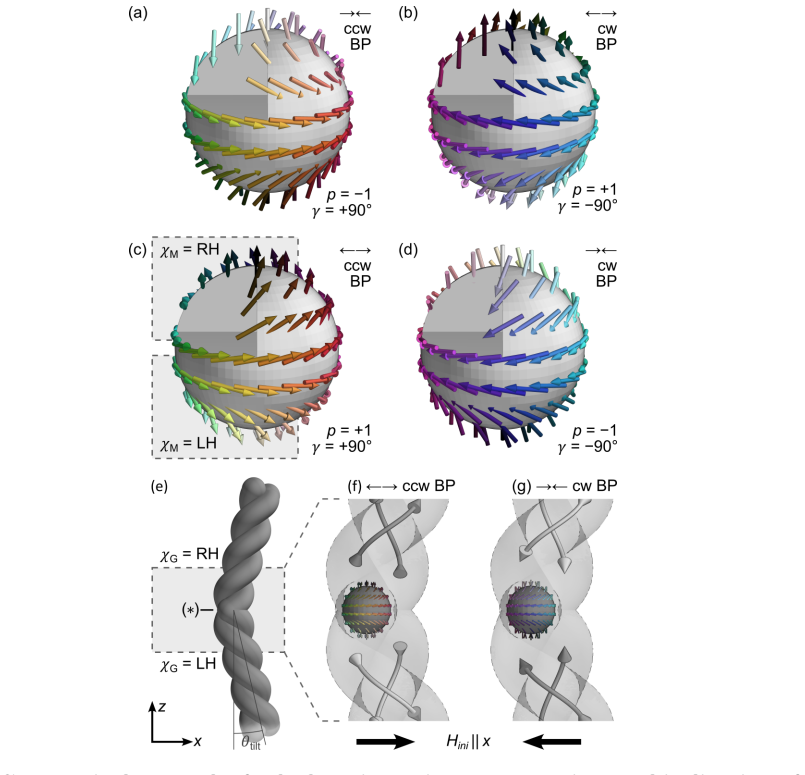
By introducing a chirality interface between two three-dimensional double-helix nanowires of opposite handedness, forming a kinked, non-collinear structure, we impose competing topological constraints that uniquely define the magnetization configuration surrounding the Bloch point. A saturating magnetic field nucleates head-to-head or tail-to-tail domain configurations at the chirality interface, producing a Bloch-point domain wall with deterministic polarity, circulation and helicity. This geometrical approach enables full three-dimensional control of Bloch point domain walls allowing deterministic engineering of their spin texture and its selective coupling to current-induced Oersted field
Load-bearing premise
The chirality interface between opposite-handedness double-helix nanowires imposes competing topological constraints that uniquely define the magnetization configuration surrounding the Bloch point.
Editorial analysis
A structured set of objections, weighed in public.
Referee Report
Summary. The manuscript claims that introducing a chirality interface between two three-dimensional double-helix nanowires of opposite handedness creates competing topological constraints that uniquely define the magnetization configuration around a Bloch point. A saturating magnetic field then nucleates head-to-head or tail-to-tail domains at this interface, producing a Bloch-point domain wall whose polarity, circulation, and helicity are deterministic; the approach is presented as enabling full three-dimensional control over Bloch-point spin texture and its coupling to Oersted fields.
Significance. If the central claim holds, the work supplies a geometry-based route to deterministic Bloch-point engineering that avoids reliance on finely tuned external stimuli. This could be relevant for studies of three-dimensional topological spin textures and their dynamics in confined nanomagnets.
major comments (1)
- [Abstract] Abstract: the assertion of experimental (or simulation-based) demonstration that the chirality interface 'uniquely define[s] the magnetization configuration surrounding the Bloch point' is unsupported because the manuscript supplies no data, figures, micromagnetic parameters, energy landscapes, or topological analysis. Without these elements the load-bearing claim of uniqueness cannot be evaluated.
Simulated Author's Rebuttal
We thank the referee for their review and the opportunity to clarify the manuscript. We address the single major comment below, providing details on the supporting elements present in the full text.
read point-by-point responses
-
Referee: [Abstract] Abstract: the assertion of experimental (or simulation-based) demonstration that the chirality interface 'uniquely define[s] the magnetization configuration surrounding the Bloch point' is unsupported because the manuscript supplies no data, figures, micromagnetic parameters, energy landscapes, or topological analysis. Without these elements the load-bearing claim of uniqueness cannot be evaluated.
Authors: The full manuscript includes a Methods section with explicit micromagnetic parameters (Ms = 860 kA/m, Aex = 13 pJ/m, alpha = 0.5 for permalloy, discretized on a 5 nm mesh), Figures 2-4 showing vector-field plots and isosurface renderings of the magnetization before/after field application with the Bloch point location marked, an energy landscape comparison (supplementary figure S1) demonstrating that the chirality interface raises the energy of all but one configuration, and a topological analysis section computing the winding number and Hopf charge to confirm the unique 3D texture. The uniqueness is shown by contrasting the kinked double-helix case (single stable state) against control simulations without the interface (multiple degenerate states). We can revise the abstract to explicitly state 'via micromagnetic simulations' for clarity. revision: partial
Circularity Check
No significant circularity detected
full rationale
The paper's central claim rests on geometrical boundary conditions at a chirality interface between opposite-handedness double-helix nanowires imposing competing topological constraints that uniquely define the Bloch-point magnetization configuration. The provided abstract and description contain no equations, fitted parameters, self-citations for uniqueness theorems, or ansatzes that reduce any prediction or result to the inputs by construction. The derivation is presented as following from standard topological constraints in micromagnetics applied to the engineered geometry, with no load-bearing self-referential steps identified.
Assumptions & free parameters
assumptions (1)
- domain assumption Topological constraints in confined magnetic geometries enforce Bloch-point formation
Cite this review
Pith. "Pith review of Generation of Bloch Points with Controlled Spin Texture Using Geometrical Boundary Conditions." pith.science (2026). https://pith.science/paper/W3U35Y2R
@misc{pith2026260529672,
  author       = {Pith},
  title        = {Pith review of: Generation of Bloch Points with Controlled Spin Texture Using Geometrical Boundary Conditions},
  year         = {2026},
  howpublished = {\url{https://pith.science/paper/W3U35Y2R}},
  note         = {Machine review of arXiv:2605.29672}
}
read the original abstract
Bloch points are three-dimensional topological singularities in magnetization that play a key role in topological transformations of spin textures, such as skyrmion creation or annihilation. While topology often enforces the existence of Bloch points in confined geometries like cylindrical nanowires, deterministic control over their position and magnetic configuration remains challenging. Here we demonstrate the generation of Bloch points with controlled spin texture by engineering geometrical boundary conditions in three-dimensional nanomagnets. By introducing a chirality interface between two three-dimensional double-helix nanowires of opposite handedness, forming a kinked, non-collinear structure, we impose competing topological constraints that uniquely define the magnetization configuration surrounding the Bloch point. A saturating magnetic field nucleates head-to-head or tail-to-tail domain configurations at the chirality interface, producing a Bloch-point domain wall with deterministic polarity, circulation and helicity. This geometrical approach enables full three-dimensional control of Bloch point domain walls allowing deterministic engineering of their spin texture and its selective coupling to current-induced Oersted fields.
Figures


Figures from the paper (2 more)


Reference graph
Works this paper leans on
-
[1]
Bloch Points and Topological Dipoles Observed by X-ray Vector Magnetic Tomography in a Ferromagnetic Microstructure.Communications Physics 2023,6, 49
Pereiro, E.; Vélez, M.; Ferrer, S. Bloch Points and Topological Dipoles Observed by X-ray Vector Magnetic Tomography in a Ferromagnetic Microstructure.Communications Physics 2023,6, 49. (5) Fullerton, J.; Leo, N.; Jurczyk, J.; Donnelly, C.; Sanz-Hernández, D.; Skoric, L.; Mille, N
2023
-
[2]
Hyperbolic Bloch Points in Ferrimagnetic Ex- change Spring.Results in Physics2024,61, 107771
Pereiro, E.; Quirós, C.; Vélez, M.; Ferrer, S. Hyperbolic Bloch Points in Ferrimagnetic Ex- change Spring.Results in Physics2024,61, 107771. (7) Tonomura, A.; Matsuda, T.; Endo, J.; Arii, T.; Mihama, K. Holographic Interference Elec- tron Microscopy for Determining Specimen Magnetic Structure and Thickness Distribution. Physical Review B1986,34, 3397–3402...
1998
Reviewed June 29, 2026 · model on record in the stance chip above.
Discussion (0). Sign in to comment.