PianoKontext: Expressive Performance Rendering from Deadpan Context
Pith reviewed 2026-06-27 08:07 UTC · model grok-4.3
The pith
PianoKontext renders variable-length expressive piano performances by aligning deadpan and real audio embeddings with DTW.
A machine-rendered reading of the paper's core claim, the machinery that carries it, and where it could break.
Core claim
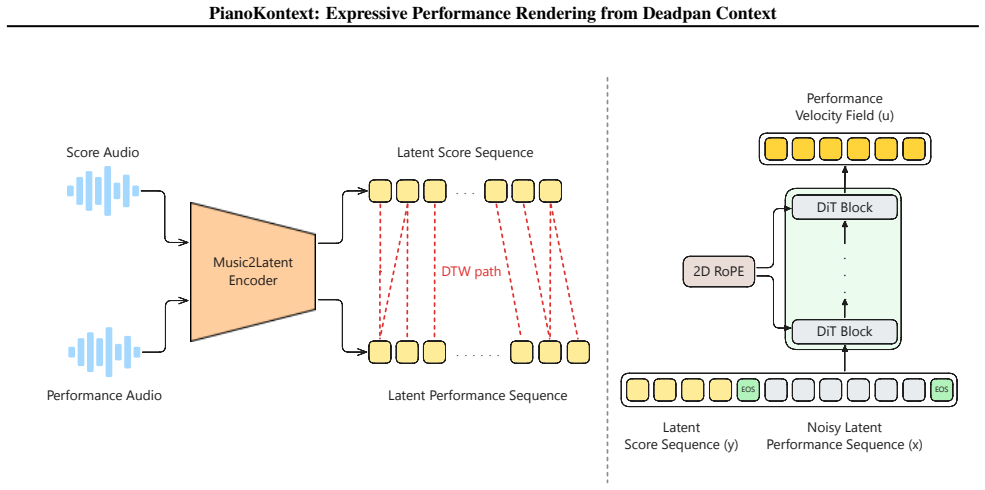
PianoKontext generates expressive performances in the latent space of Music2Latent by synthesizing deadpan audio from MIDI, aligning it to real performances via DTW, and concatenating the aligned embeddings in DiT blocks for flow matching training.
What carries the argument
Concatenation of DTW-aligned deadpan and expressive embeddings inside the DiT blocks of the flow matching model.
Load-bearing premise
Dynamic Time Warping alignment performed in the latent space of the pretrained Music2Latent model produces sufficiently accurate paired data between deadpan synthesized audio and real expressive performances for training.
What would settle it
Measuring whether the model's output timing deviations on held-out scores match human performance statistics, or whether DTW alignments frequently swap note positions, would directly test the central claim.
Figures
read the original abstract
Expressive performance rendering (EPR) aims to generate realistic performances constrained on sequences of notes. However, flow matching audio editing models manipulate only synchronized music samples of the same duration, limiting their understanding of expressive timing. We introduce PianoKontext, a flow matching rendering model for classical piano music that generates variable-length performances in the latent space of a pretrained Music2Latent model. We synthesize MIDI scores into deadpan audio and employ Dynamic Time Warping (DTW) in the latent space to construct paired data for training. The aligned embeddings are concatenated in DiT blocks, allowing for a simple and effective learning of the dependencies between the score and performances. Audio samples are available at our demo page: https://realfolkcode.github.io/pianokontext_demo/.
Editorial analysis
A structured set of objections, weighed in public.
Referee Report
Summary. The manuscript introduces PianoKontext, a flow matching model for expressive performance rendering of classical piano music. It generates variable-length performances in the latent space of a pretrained Music2Latent model by synthesizing deadpan audio from MIDI scores, aligning it with real expressive performances via Dynamic Time Warping (DTW) in the latent space, and training a DiT model where aligned embeddings are concatenated to learn dependencies between score and performance.
Significance. If the proposed method holds, it addresses a key limitation in flow matching audio editing models by enabling handling of expressive timing deviations through latent alignment and concatenation in DiT blocks. This could advance EPR for piano by providing a simple conditioning mechanism. The availability of audio samples on a demo page is a positive for reproducibility and evaluation.
major comments (2)
- [Method (DTW alignment and data construction)] The central claim that DTW alignment in the Music2Latent latent space produces usable paired data for training relies on the assumption that the latent representation preserves fine-grained temporal structure sufficiently for accurate event-level correspondences. No alignment error statistics, note-level correspondence rates, or ablation studies on alignment quality are mentioned, which is load-bearing for the effectiveness of the subsequent concatenation in DiT blocks.
- [Experiments and evaluation] The abstract and description provide no quantitative results, ablation studies, listening tests, or error analysis to support that the concatenated embeddings enable 'simple and effective learning' of dependencies. This absence makes it impossible to evaluate whether the approach outperforms baselines or handles timing deviations as claimed.
minor comments (1)
- [Abstract] The abstract mentions 'Audio samples are available at our demo page' but does not provide a direct link or details on what aspects of the model are demonstrated.
Simulated Author's Rebuttal
We thank the referee for the constructive review and for recognizing the potential of the approach for handling expressive timing in flow matching models, as well as the value of the demo page. We address each major comment below.
read point-by-point responses
-
Referee: [Method (DTW alignment and data construction)] The central claim that DTW alignment in the Music2Latent latent space produces usable paired data for training relies on the assumption that the latent representation preserves fine-grained temporal structure sufficiently for accurate event-level correspondences. No alignment error statistics, note-level correspondence rates, or ablation studies on alignment quality are mentioned, which is load-bearing for the effectiveness of the subsequent concatenation in DiT blocks.
Authors: We agree that explicit validation of the DTW alignment quality would strengthen the manuscript, as the paired data construction is central to the method. The Music2Latent latent space is chosen because it is pretrained on musical audio and thus expected to preserve temporal and structural information better than raw waveforms for DTW. In the revised manuscript we will add an analysis of alignment quality, including average DTW path costs, note-level correspondence rates computed against MIDI annotations on a held-out subset, and a small ablation comparing latent-space DTW to waveform-based alignment. revision: yes
-
Referee: [Experiments and evaluation] The abstract and description provide no quantitative results, ablation studies, listening tests, or error analysis to support that the concatenated embeddings enable 'simple and effective learning' of dependencies. This absence makes it impossible to evaluate whether the approach outperforms baselines or handles timing deviations as claimed.
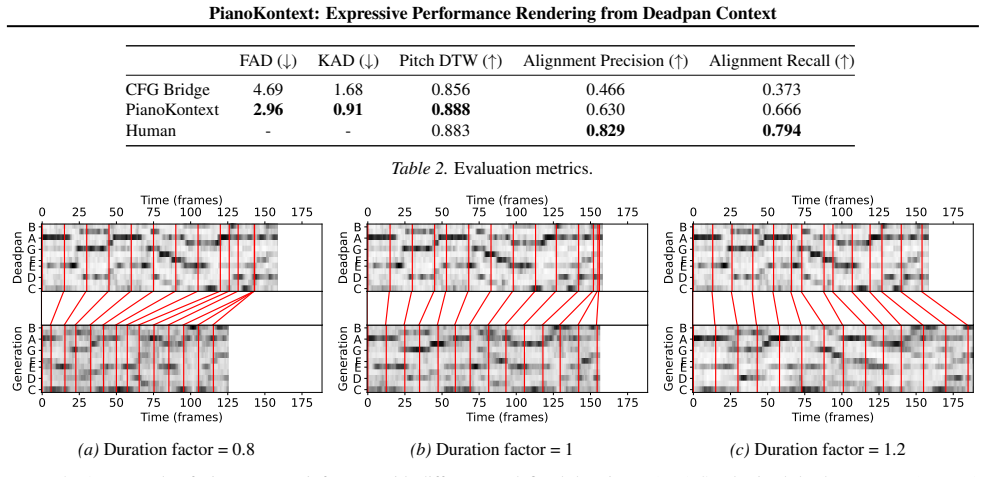
Authors: The current manuscript is primarily a method introduction and demonstrates feasibility via the released audio samples. We acknowledge that the absence of quantitative metrics and ablations limits the ability to assess performance claims. In the revised version we will add objective metrics (e.g., Fréchet Audio Distance against real performances), ablation studies on the concatenation mechanism inside DiT blocks, and a small-scale listening test comparing PianoKontext outputs to a baseline without latent alignment. revision: yes
Circularity Check
No circularity: method uses external pretrained model and DTW without self-referential reduction
full rationale
The paper describes synthesizing deadpan audio from MIDI, applying DTW in the frozen Music2Latent latent space to create paired data, and concatenating aligned embeddings inside DiT blocks for training. No equations, fitted parameters, or predictions are presented that reduce the claimed learning of score-performance dependencies to a quantity defined by the inputs themselves. The approach depends on an external pretrained model and standard alignment technique; the central claim does not collapse by construction to a self-citation chain or renamed fit. This is the most common honest non-finding for a methods paper without internal derivation loops.
Axiom & Free-Parameter Ledger
Reference graph
Works this paper leans on
-
[2]
Copet, J., Kreuk, F., Gat, I., Remez, T., Kant, D., Synnaeve, G., Adi, Y ., and D´efossez, A
URLhttps://arxiv.org/abs/2502.15602. Copet, J., Kreuk, F., Gat, I., Remez, T., Kant, D., Synnaeve, G., Adi, Y ., and D´efossez, A. Simple and controllable music generation.Advances in neural information pro- cessing systems, 36:47704–47720,
-
[3]
D., Carr, C., Zukowski, Z., Taylor, J., and Pons, J
Evans, Z., Parker, J. D., Carr, C., Zukowski, Z., Taylor, J., and Pons, J. Stable audio open. InICASSP 2025-2025 IEEE International Conference on Acoustics, Speech and Signal Processing (ICASSP), pp. 1–5. IEEE,
2025
-
[4]
net/ismir2021/latebreaking/000005.pdf
URL https://archives.ismir. net/ismir2021/latebreaking/000005.pdf. Gui, A., Gamper, H., Braun, S., and Emmanouilidou, D. Adapting frechet audio distance for generative music evaluation. InICASSP 2024-2024 IEEE International Conference on Acoustics, Speech and Signal Processing (ICASSP), pp. 1331–1335. IEEE,
2024
-
[5]
and Salimans, T
Ho, J. and Salimans, T. Classifier-free diffusion guidance. InNeurIPS 2021 Workshop on Deep Generative Models and Downstream Applications,
2021
-
[6]
Labs, B. F., Batifol, S., Blattmann, A., Boesel, F., Con- sul, S., Diagne, C., Dockhorn, T., English, J., English, Z., Esser, P., et al. Flux. 1 kontext: Flow matching for in-context image generation and editing in latent space. arXiv preprint arXiv:2506.15742,
-
[7]
H., Nistal, J., Lattner, S., Pasini, M., and Fazekas, G
Lee, C. H., Nistal, J., Lattner, S., Pasini, M., and Fazekas, G. Diffusion timbre transfer via mutual information guided inpainting.arXiv preprint arXiv:2601.01294,
-
[8]
Mert: Acoustic music understanding model with large-scale self-supervised training
Li, Y ., Yuan, R., Zhang, G., Ma, Y ., Chen, X., Yin, H., Xiao, C., Lin, C., Ragni, A., Benetos, E., et al. Mert: Acoustic music understanding model with large-scale self-supervised training. InInternational Conference on Learning Representations, volume 2024, pp. 12181– 12204,
2024
-
[9]
T., Lopez-Paz, D., Ben-Hamu, H., and Gat, I
Lipman, Y ., Havasi, M., Holderrieth, P., Shaul, N., Le, M., Karrer, B., Chen, R. T., Lopez-Paz, D., Ben-Hamu, H., and Gat, I. Flow matching guide and code.arXiv preprint arXiv:2412.06264,
-
[10]
and Hutter, F
Loshchilov, I. and Hutter, F. Decoupled weight decay regu- larization. In7th International Conference on Learning Representations, ICLR 2019, New Orleans, LA, USA, May 6-9,
2019
-
[11]
Loth, J., Sarmento, P., Sandler, M., and Barthet, M
URL https: //openreview.net/forum?id=Bkg6RiCqY7. Loth, J., Sarmento, P., Sandler, M., and Barthet, M. Gui- tarflow: Realistic electric guitar synthesis from tabla- tures via flow matching and style transfer.arXiv preprint arXiv:2510.21872,
-
[12]
W., Moliner, E., Lai, C.-H., Uhlich, S., Koo, J., Mart´ınez-Ram´ırez, M
Mancusi, M., Halychanskyi, Y ., Cheuk, K. W., Moliner, E., Lai, C.-H., Uhlich, S., Koo, J., Mart´ınez-Ram´ırez, M. A., Liao, W.-H., Fabbro, G., et al. Latent diffusion bridges for unsupervised musical audio timbre transfer. InICASSP 2025-2025 IEEE International Conference on Acoustics, Speech and Signal Processing (ICASSP), pp. 1–5. IEEE,
2025
-
[13]
Polyffusion: A diffusion model for polyphonic score generation with internal and external controls
Min, L., Jiang, J., Xia, G., and Zhao, J. Polyffusion: A diffusion model for polyphonic score generation with internal and external controls. InIsmir 2023 Hybrid Conference,
2023
-
[14]
doi: 10.5334/tismir.149. Sakoe, H. and Chiba, S. A similarity evaluation of speech patterns by dynamic programming. InNat. Meeting of In- stitute of Electronic Communications Engineers of Japan, volume 136,
-
[15]
Renderbox: Ex- pressive performance rendering with text control.arXiv preprint arXiv:2502.07711,
Zhang, H., Maezawa, A., and Dixon, S. Renderbox: Ex- pressive performance rendering with text control.arXiv preprint arXiv:2502.07711,
discussion (0)
Sign in with ORCID, Apple, or X to comment. Anyone can read and Pith papers without signing in.