REVIEW 4 major objections 6 minor 46 references
Quantum-Limited Estimation of Phase Gradient
T0 review · 4 major / 6 minor · reviewed 2026-08-14 · deepseek-v4-flash
Pith's one-line read The paper establishes quantum Cramér-Rao bounds for estimating the phase gradient of a finite-width optical beam, showing that the single-photon uncertainty product matches the Heisenberg principle and that a maximally entangled…
desk verdict Correct QFI bounds, but the structured-measurement and joint-estimation Fisher information formulas are algebraically wrong, invalidating the paper's main quantitative claims. read the letter →
The pith
A machine-rendered reading of the paper's core claim, the machinery that carries it, and where it could break.
The reading
What carries the argument
The engine is the pure-state quantum Fisher information $F_Q(\theta)=4\left(\langle\psi'|\psi'\rangle-|\langle\psi|\psi'\rangle|^2\right)$, applied to the phase-imprinted state $|\psi\rangle=\int dx\, e^{-i\theta x}\psi_0(x)|x\rangle$. For an even probe the cross term vanishes and $F_Q$ becomes 4 times the second moment of $|\psi_0|^2$. The entangled two-photon state carries the phase $e^{-i\theta(x_1+x_2)}$, so maximal entanglement along $x_1=x_2$ doubles the accumulated phase and quadruples the Fisher information. On the measurement side, the image-inversion interferometer performs a binary even/odd projection whose outcome probabilities for a Gaussian beam are $P_\pm=\tfrac{1}{2}\left(1\pm e^{-2\theta^2\sigma_x^2}\right)$, and whose Fisher information $4\sigma_x^2/\zeta^2(\sigma_x\theta)$ saturates the quantum bound as $\sigma_x\theta\to 0$.
What would settle it
Measure the variance of an unbiased phase-gradient estimator for a single-photon Gaussian beam of known width $\sigma_x$ and check whether $\sigma_x\sigma_\theta$ can be pushed below $1/2$; a repeated experiment with a two-photon entangled state at $\sigma_x\theta$ well below 0.32 should confirm the factor-of-2 improvement, and the advantage should disappear when $\sigma_x\theta$ exceeds 0.32.
Extended reading notes
Core claim
The central discovery is the set of quantum Fisher information values for gradient estimation. For a pure single-photon state with an even wavefunction, $F_Q^{(1p)}(\theta)=4\sigma_x^2$, giving $\sigma_x\sigma_\theta=1/2$; because $\theta$ is the transverse wavevector component, this is the Heisenberg relation. For a maximally entangled two-photon state $\psi_0(x_1,x_2)=f_0(x_1)\delta(x_1-x_2)$ with even $f_0$, $F_Q^{(2p)}(\theta)=16\sigma_x^2$, giving $\sigma_x\sigma_\theta=1/4$. A separable two-photon state instead yields $F_Q=8\sigma_x^2$, matching two independent single-photon measurements. The paper further shows that the image-inversion interferometer, using binary projective measurement of even/odd parity, reaches these bounds in the small-gradient limit $\sigma_x\theta\ll 1$, and that in joint estimation of phase and gradient the quantum Fisher information matrix is diagonal, so both parameters can be estimated at their individual quantum limits simultaneously.
Load-bearing premise
The load-bearing premise is an idealized probe: a pure, lossless, noise-free, one-dimensional beam whose intensity profile is symmetric about the beam center, so the quoted $\sigma_x\sigma_\theta$ products and the two-photon advantage hold only in that idealized setting.
Editorial extensions
If this is right
- For small phase gradients ($\sigma_x\theta\ll 1$), a scanning image-inversion interferometer reaches the ultimate quantum limit, so tilt sensing can be made quantum-optimal without specialized non-Gaussian measurements.
- The entangled two-photon advantage is real but fragile in gradient magnitude: for $\sigma_x\theta>0.3199$ the two-photon uncertainty product exceeds the single-photon one, so the advantage is lost for large tilts or wide beams.
- Phase and phase gradient can be estimated simultaneously at their individual quantum limits using cascaded Mach-Zehnder and image-inversion interferometers; no trade-off between the two parameters is forced by quantum mechanics.
- The image-inversion scheme needs a narrower beam than a fringe-spacing Mach-Zehnder measurement ($\sigma_x\theta<2$ vs $\sigma_x\theta>2\pi$), which improves spatial resolution in scanning wavefront sensors.
- The available signal $P_+-P_-=e^{-2\theta^2\sigma_x^2}$ shrinks as beam width grows, so sensitivity drops quickly with increasing $\sigma_x\theta$ for both single- and two-photon probes.
Reading between the lines
- Generalizing the maximally entangled construction to $N$ photons with $\psi_0=\delta(x_1-\cdots-x_N)$ would give an effective phase $N\theta$ and Fisher information $4N^2\sigma_x^2$, suggesting $\sigma_x\sigma_\theta=1/(2N)$; the paper does not state this $N$-photon extrapolation, but it follows directly from the same computation.
- In the presence of loss or noise, the two-photon entangled advantage should degrade faster than the single-photon bound, following the fragility already visible in the large-gradient regime; this is a natural experimental test but is not analyzed in the paper.
- The compatibility result suggests a practical wavefront sensor that outputs both piston and tilt at quantum-limited precision, something classical sensors typically sacrifice by allocating resources between the two parameters.
Signed reviews
Editorial analysis
A structured set of objections, weighed in public.
Referee Report
Summary. The paper derives quantum Cramér-Rao bounds for estimating an optical phase gradient with finite-width beams. For a single-photon probe with an even wavefunction the QFI is F_Q = 4σ_x², giving σ_x σ_θ = 1/2; for a maximally entangled two-photon state of the form ∫dx f_0(x)|x,x⟩ the QFI is F_Q = 16σ_x², giving σ_x σ_θ = 1/4. The authors then analyze structured measurements based on image-inversion interferometers, claiming that these saturate the QFI in the slowly-varying-phase limit, that the two-photon factor-of-2 advantage is lost for large beam width or gradient, and that phase and phase-gradient estimation are compatible in both single- and two-photon settings. The paper also proposes cascaded Mach-Zehnder plus image-inversion configurations for concurrent estimation of phase and gradient.
Significance. Section II is a clean, correct derivation of the fundamental QFI limits for the single-photon and maximally-entangled two-photon cases, and Eq. (17) for the Mach-Zehnder Fisher information is also correctly derived. These results provide a useful, though mostly standard, link between QFI and the Heisenberg uncertainty relation. The paper's distinctive contributions, however, are the structured image-inversion-interferometer Fisher informations, the finite-width sensitivity curves, the claimed loss of the two-photon advantage, and the demonstration that a structured concurrent-estimation scheme saturates the QCR bounds. As detailed in the major comments, these contributions are not supported by the manuscript's own equations. The qualitative picture may survive after correction, but the quantitative claims in the abstract and figures do not follow from the presented derivations.
major comments (4)
- [III A, Eq. (13) vs. Eq. (11)] Direct differentiation of Eq. (11) contradicts Eq. (13). With u = θ²σ_x², P_± = 1/2(1 ± e^{-2u}), so dP_±/dθ = ∓2θσ_x² e^{-2u} and Eq. (12) yields F = 16uσ_x²/(e^{4u}-1). Equation (13) evaluates to 4σ_x²/ζ²(σ_xθ) = 16uσ_x² e^{2u}/(e^{4u}-1), which is larger by a factor e^{2u}. The finite-θ curves in Fig. 2, the uncertainty product in Eq. (14) and Fig. 3, and the statement that the image-inversion interferometer saturates the QFI for slowly varying phase therefore rest on an incorrect expression; agreement with the QFI holds only at u = 0.
- [III B, Eq. (20)] For a Gaussian f_0, Eqs. (19) give P_c = 1/2(1 + e^{-8u}) and P_a = 1/2(1 - e^{-8u}) with u = θ²σ_x², so direct differentiation gives F^(2p)(θ) = 256uσ_x²/(e^{16u}-1), not the printed 16σ_x²/ζ²(4σ_xθ) = 512uσ_x²/sinh(32u). In addition, the displayed equality 16σ_x²/ζ²(4σ_xθ) = 4F^(1p)(2θ) is not consistent with the paper's own Eq. (13): using Eq. (13), 4F^(1p)(2θ) = 128uσ_x²/sinh(8u), which differs from the left-hand side. The two-photon curve in Fig. 2, Eq. (21), and the crossover value σ_xθ = 0.3199 are consequently unsupported.
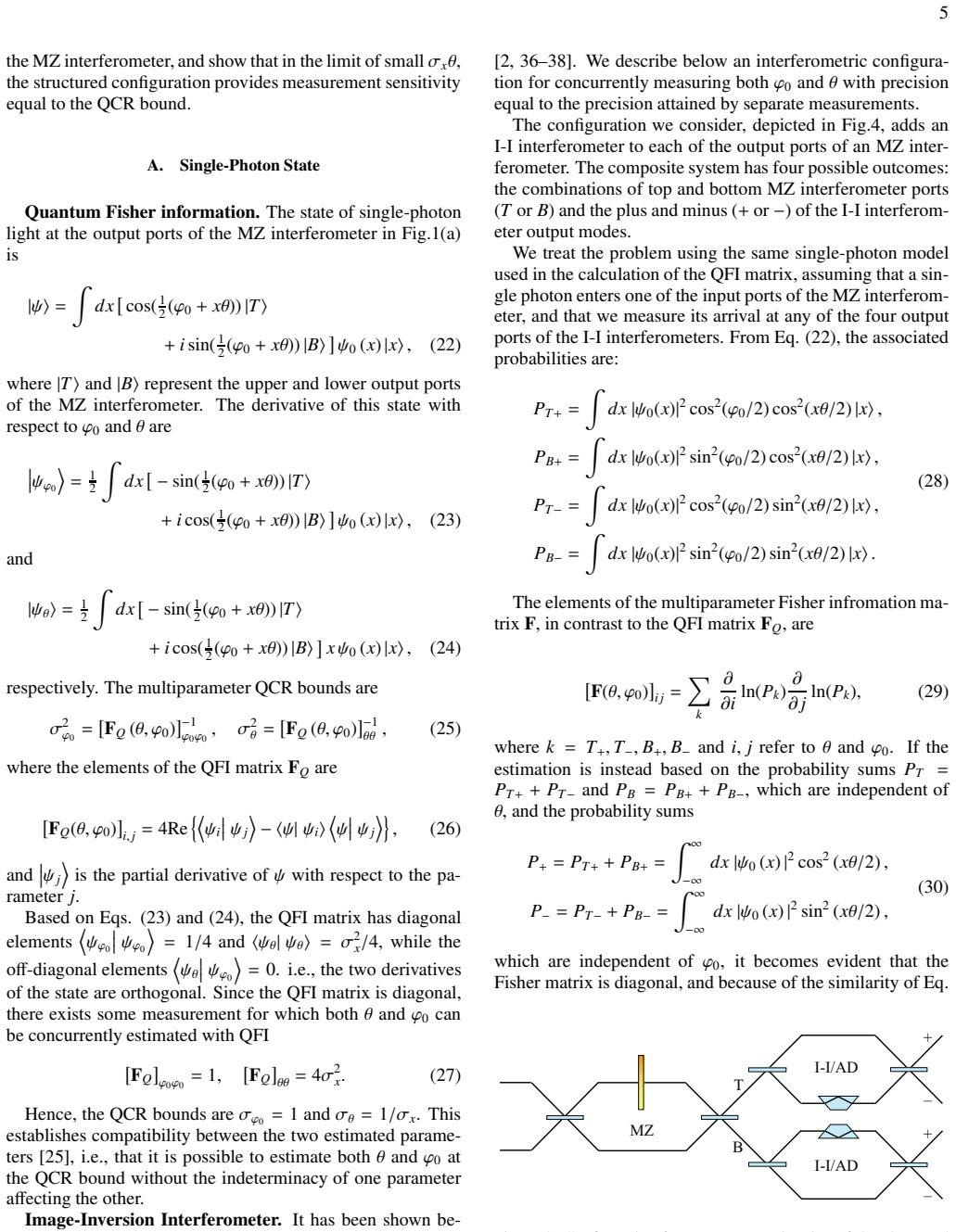
- [IV A, Eqs. (26)–(31)] The derivative norms stated in the text, ⟨ψ_φ0|ψ_φ0⟩ = 1/4 and ⟨ψ_θ|ψ_θ⟩ = σ_x²/4, with zero off-diagonal derivative overlaps, give [F_Q]_φ0φ0 = 1 and [F_Q]_θθ = σ_x² through Eq. (26), not the values 1 and 4σ_x² printed in Eq. (27). The claimed concurrent QCR bound σ_θ = 1/(2σ_x) therefore does not follow. Consistently, direct differentiation of the Gaussian probabilities obtained from Eq. (30) gives F_θ = uσ_x²/(e^u-1), which tends to σ_x² as u→0, not the 4σ_x²/ζ²(σ_xθ/2) → 4σ_x² reported in Eq. (31). The structured configuration of Fig. 4 does not attain the stated concurrent QCR precision.
- [IV B, Eqs. (35)–(38)] From Eqs. (35)–(36), ⟨ψ_θ|ψ_θ⟩ = ∫x²|f_0(x)|²dx = σ_x² and ⟨ψ_φ0|ψ_φ0⟩ = 1, so Eq. (26) gives [F_Q]_θθ = 4σ_x² and [F_Q]_φ0φ0 = 4, not the values 16σ_x² and 4 claimed in Eq. (37). The factor 4 in [F_Q]_θθ would require θ to enter as 2θx, as in Eq. (18), but the state in Eqs. (33)–(34) has θx. The structured result in Eq. (38), F^(2p)(θ) = 16σ_x²/ζ²(σ_xθ), is likewise inconsistent with Eq. (44): for a Gaussian f_0, Eq. (44) has the same form as Eq. (11), so its Fisher information is 16uσ_x²/(e^{4u}-1), not 16σ_x²/ζ²(σ_xθ). The two-photon concurrent-estimation advantage is therefore unsupported.
minor comments (6)
- [Throughout] The symbol ζ is used both as a function and through ζ² without a consistent definition; please define ζ once and use it consistently in Eqs. (13), (14), (20), (21), (31), and (38).
- [Eq. (28)] The probabilities P_T+, P_B+, P_T-, P_B- in Eq. (28) are written with a final |x⟩, but they are scalars; the ket should be removed.
- [Abstract] The phrase "Precision bounds ... are higher" is ambiguous; higher Fisher information corresponds to lower precision bounds, so the intended comparison should be restated.
- [II B] The argument that the maximally entangled state maximizes the QFI because the product σ_x+ σ_x- is fixed is heuristic; a concise proof or a reference with the proof would strengthen this part.
- [III B, Eq. (20)] Under the paper's own Eq. (13), replacing θ by 2θ should give a ζ argument of 2σ_xθ, not 4σ_xθ; this notational inconsistency should be corrected in any revision.
- [Throughout] The submitted text contains numerous OCR/formatting artifacts such as "iintegtext", "/iintegdisplay", and missing spaces around θ; the equations and display math should be retypeset.
Circularity Check
No significant circularity: the precision limits and structured-measurement Fisher informations are derived from explicit state ansätze and the standard QFI definition, not from fitted parameters or from a load-bearing self-citation chain.
full rationale
The paper's central results are self-contained derivations from the standard quantum Fisher information definition (Eq. 1) and explicit state ansätze. The single-photon bound σ_x σ_θ = 1/2 follows algebraically from Eqs. (3)-(5) for an even wavefunction; the two-photon bound σ_x σ_θ = 1/4 follows from Eq. (7) with the delta-correlated maximally entangled state, and the factor of 2 is explicitly derived because x1+x2 = 2x under maximal entanglement. No parameter is fitted to a subset of data and then renamed a prediction, and no 'uniqueness theorem' is imported from the authors' prior work. The only self-citation ([22]) is offered as an implementation option ('another ancillary degree of freedom such as polarization [22, 30-32]') and is not used to justify any information-theoretic claim. The skeptical headline's complaint that Eq. (13) does not follow from Eq. (11) is a potential algebraic-error or correctness objection, not a circularity: it does not show that any claimed result is equivalent to its own inputs by construction. Under the required standard of quoting a specific reduction or a fitted parameter renamed as a prediction, no circular step is present.
Assumptions & free parameters
assumptions (5)
- standard math Quantum Fisher information for pure states is F_Q = 4(<psi'|psi'> - |<psi|psi'>|^2) and the QCR bound Var(theta) >= 1/F_Q.
- domain assumption The optical probe is a pure state with a one-dimensional transverse wavefunction psi_0(x), and the phase object multiplies the field by e^{-i theta x}.
- domain assumption The probe amplitude psi_0(x) or f_0(x) is an even function; for closed-form interferometer results it is Gaussian.
- domain assumption The maximally entangled two-photon state is represented by psi_0(x1,x2) = f_0(x1) delta(x1 - x2).
- domain assumption Binary projective measurements on even and odd spatial modes are implemented perfectly by the image-inversion interferometer.
Cite this review
Pith. "Pith review of Quantum-Limited Estimation of Phase Gradient." pith.science (2026). https://pith.science/paper/W45JJDJN
@misc{pith2026190803145,
  author       = {Pith},
  title        = {Pith review of: Quantum-Limited Estimation of Phase Gradient},
  year         = {2026},
  howpublished = {\url{https://pith.science/paper/W45JJDJN}},
  note         = {Machine review of arXiv:1908.03145}
}
read the original abstract
We show that the quantum Cram\'er-Rao bound on the precision of measurements of the optical phase gradient, or the wavefront tilt, with a beam of finite width is consistent with the Heisenberg uncertainty principle for a single-photon state, and is a factor of 2 better for the two-photon state that is maximally entangled. This fundamental bound governs a trade-off between quantum sensitivity and spatial resolution. Precision bounds based on a structured configuration using binary projective measurements implemented by an image-inversion interferometer, are higher, and the two-photon factor of 2 advantage is lost for large beam width or large phase gradient. In all cases, estimation of the phase gradient is compatible with estimation of the phase, allowing for optimal joint estimation of both parameters simultaneously.
Figures


Figures from the paper (2 more)

Reference graph
Works this paper leans on
-
[1]
L. Mandel and E. Wolf, Optical Coherence and Quantum Optics , V ol. 64 (Cambridge University, New Y ork, 1995) p. 1192
work page 1995
-
[2]
(5) Because the phase gradientθequals the transverse component q of the wavevector, this is simply an expression of the bound dictated by the Heisenberg uncertainty principle σxσq = 1 2 . 2 B. Two-photon state A two-photon pure quantum state is described by the inte- gral |ψ0⟩= /iintegtext dx 1 dx 2 ψ0(x1, x2) |x1, x2⟩, whereψ0(x1, x2) is an arbitrary two...
-
[3]
S. L. Braunstein, How large a sample is needed for the maximum likelihood estimator to be approximately Gaussian ?, Journal of Physics A: Mathematical and General 25, 3813 (1992)
work page 1992
-
[4]
(9) The bound for the entangled two-photon Heisenberg uncer- tainty product is therefore smaller by a factor of 2 than that of the single-photon case, assuming equal widths of the func - tions |ψ0 (x)|2 in the single-photon case and | f0 (x)|2 in the two- photon case. Note that if the two-photon state ψ(x1, x2) is separable, then (7) yields F(2p) Q (θ) = ...
-
[5]
C. M. Caves, Quantum-mechanical noise in an interferome ter, Physical Review D 23, 1693 (1981)
work page 1981
-
[6]
M. J. Holland and K. Burnett, Interferometric detec- tion of optical phase shifts at the Heisenberg limit, Physical Review Letters 71, 1355 (1993)
work page 1993
-
[7]
D. S. Simon, Quantum sensors: Improved optical measure- ment via specialized quantum states, Journal of Sensors 2016, 10.1155/2016/6051286 (2016)
-
[8]
V . Giovannetti, S. Lloyd, and L. Maccone, Quantum- enhanced measurements: beating the standard quantum limit ., Science 306, 1330 (2004)
work page 2004
Show all 46 references
-
[9]
C. W. Helstrom, Quantum Detection and Estimation Theory (Academic Press, London, 1976)
1976
-
[10]
Holevo, Probabilistic and Statistical Aspects of Quantum Mechanics (North-Holland, Amsterdam, 1982)
A. Holevo, Probabilistic and Statistical Aspects of Quantum Mechanics (North-Holland, Amsterdam, 1982)
1982
-
[11]
S. L. Braunstein and C. M. Caves, Statistical distance and the geometry of quantum states, Physical Review Letters 72, 3439 (1994)
1994
-
[12]
Giovannetti, S
V . Giovannetti, S. Lloyd, and L. Maccone, Advances in qu an- tum metrology, Nature Photonics 5, 222 (2011)
2011
-
[13]
Giovannetti, S
V . Giovannetti, S. Lloyd, and L. Maccone, Quantum metrology, Physical Review Letters 96, 010401 (2006)
2006
-
[14]
Matsumoto, A new approach to the Cramer Rao-type bound of the pure-state model, Journal of Physics A: Mathematical and General 35, 3111 (2002)
K. Matsumoto, A new approach to the Cramer Rao-type bound of the pure-state model, Journal of Physics A: Mathematical and General 35, 3111 (2002)
2002
-
[15]
Demkowicz-Dobrza´ nski, J
R. Demkowicz-Dobrza´ nski, J. Kołody´ nski, and M. Gut˘ a, The elusive Heisenberg limit in quantum-enhanced metrolog y, Nature Communications 3, 1063 (2012)
2012
-
[16]
Sun, Y .-S
L.-L. Sun, Y .-S. Song, C.-F. Qiao, S. Y u, and Z.-B. Chen, Uncertainty relation based on unbiased parameter estimati ons, Physical Review A 95, 022112 (2017)
2017
-
[17]
S. L. Braunstein, C. M. Caves, and G. J. Milburn, General ized uncertainty relations: Theory, examples, and Lorentz inva ri- ance, Annals of Physics 173, 39 (1995). 8
1995
-
[18]
H. Shin, K. W. C. Chan, H. J. Chang, and R. W. Boyd, Quan- tum spatial superresolution by optical centroid measureme nts, Physical Review Letters 107, 1 (2011)
2011
-
[19]
G. R. Jin, W. Yang, and C. P . Sun, Quantum-enhanced microscopy with binary-outcome photon counting, Physical Review A 95, 1 (2017)
2017
-
[20]
J. P . Dowling, Quantum optical metrologythe lowdown onhigh- N00N states, Contemporary Physics 49, 125 (2008)
2008
-
[21]
H. Lee, P . Kok, C. P . Williams, and J. P . Dowling, From linear optical quantum com- puting to Heisenberg-limited interferometry, Journal of Optics B: Quantum and Semiclassical Optics 6, S796 (2004)
2004
-
[22]
Strekalov and J
D. Strekalov and J. P . Dowling, Two-photon interferometry for high-resolution imaging, Journal of Modern Optics 49, 519 (2002)
2002
-
[23]
Dorner, R
U. Dorner, R. Demkowicz-Dobrzanski, B. J. Smith, J. S. Lundeen, W. Wasilewski, K. Banaszek, and I. A. Walmsley, Optimal quantum phase estimation, Physical Review Letters 102, 1 (2009)
2009
-
[24]
Larson, N
W. Larson, N. V . Tabiryan, and B. E. A. Saleh, A common-path polarization-based image-inversion interfe rome- ter, Optics Express 27, 5685 (2019)
2019
-
[25]
Z. S. Tang, K. Durak, and A. Ling, Fault-tolerant and fini te- error localization for point emitters within the di ffraction limit, Optics Express 24, 22004 (2016)
2016
-
[26]
Cohen, D
L. Cohen, D. Istrati, L. Dovrat, and H. S. Eisenberg, Sup er- resolved phase measurements at the shot noise limit by parit y measurement., Optics express 22, 11945 (2014)
2014
-
[27]
S. Ragy, M. Jarzyna, and R. Demkowicz-dobrza, Compatibility in multiparameter quantum metrology, Phys. Rev. A 052108, 1 (2016)
2016
-
[28]
Demkowicz-Dobrza´ nski, M
R. Demkowicz-Dobrza´ nski, M. Jarzyna, and J. Kołody´ nski, Quantum limits in optical interferometry, Progress in Optics 60, 345 (2015)
2015
-
[29]
Fujiwara and H
A. Fujiwara and H. Nagaoka, Quantum Fisher metric and pu re state estimation, Math.Sci.Osaka-U.Ac.Jp , 1 (1995)
1995
-
[30]
Schneeloch and J
J. Schneeloch and J. C. Howell, Introduction to the tran sverse spatial correlations in spontaneous parametric down-conversion through the biphoton birth zone, Journal of Optics (United Kingdom) 18, 10.1088/2040-8978/18/5/053501 (2016)
2016 doi
-
[31]
Weigel, H
D. Weigel, H. Babovsky, A. Kiessling, and R. Kowarschik , Widefield microscopy with infinite depth of field and enhanced lateral resolution based on an image inverting interferome ter, Optics Communications 342, 102 (2015)
2015
-
[32]
Weigel, A
D. Weigel, A. Kiessling, and R. Kowarschik, Aberration correc- tion in coherence imaging microscopy using an image inverti ng interferometer, Opt. Express 23, 20505 (2015)
2015
-
[33]
Aiello, F
A. Aiello, F. T¨ oppel, C. Marquardt, E. Giacobino, and G. Leuchs, Quantum-like nonseparable struc- tures in optical beams, New Journal of Physics 17, 10.1088/1367-2630/17/4/043024 (2015)
2015 doi
-
[34]
Nair and M
R. Nair and M. Tsang, Interferometric superlocal- ization of two incoherent optical point sources, Optics Express 24, 3684 (2016)
2016
-
[35]
Roccia, V
E. Roccia, V . Cimini, M. Sbroscia, I. Gianani, L. Ruggie ro, L. Mancino, M. G. Genoni, M. A. Ricci, and M. Barbieri, Mul- tiparameter approach to quantum phase estimation with limi ted visibility, Optica 5, 1171 (2018)
2018
-
[36]
Pezz` e, M
L. Pezz` e, M. A. Ciampini, N. Spagnolo, P . C. Humphreys, A. Datta, I. A. Walmsley, M. Barbieri, F. Sciarrino, and A. Smerzi, Optimal measurements for simultaneous quantum estimation of multiple phases, Phys. Rev. Lett. 119, 1 (2017)
2017
-
[37]
Szczykulska, T
M. Szczykulska, T. Baumgratz, and A. Datta, Multi-para meter quantum metrology, Advances in Physics: X , 1 (2016)
2016
-
[38]
Ben-Aryeh, Phase estimation by photon counting meas ure- ments in the output of a linear Mach Zehnder interferometer, Journal of the Optical Society of America B 29, 2754 (2012)
Y . Ben-Aryeh, Phase estimation by photon counting meas ure- ments in the output of a linear Mach Zehnder interferometer, Journal of the Optical Society of America B 29, 2754 (2012)
2012
-
[39]
Okamoto, M
R. Okamoto, M. Iefuji, S. Oyama, K. Yamagata, H. Imai, A. Fujiwara, and S. Takeuchi, Experimen- tal demonstration of adaptive quantum state estimation, Physical Review Letters 109, 1 (2012)
2012
-
[40]
Okamoto, H
R. Okamoto, H. F. Hofmann, T. Nagata, J. L. O’Brien, K. Sasaki, and S. Takeuchi, Beating the standard quantum limit: Phase super-sensitivity of N-photon interferometers, New Jour- nal of Physics 10 (2008)
2008
-
[41]
H. F. Hofmann, All path-symmetric pure states achieve their maximal phase sensitiv- ity in conventional two-path interferometry, Physical Review A - Atomic, Molecular, and Optical Physics 79, 1 (2009)
2009
-
[42]
K. P . Seshadreesan, S. Kim, J. P . Dowling, and H. Lee, Phase es- timation at the quantum Cram´ er-Rao bound via parity detection, Physical Review A - Atomic, Molecular, and Optical Physics 87, 043833 (2013)
2013
-
[43]
C. K. Hong, Z. Ou, and L. Mandel, Measurement of Subpi- cosecond Time Intervals between Two Photons by Interference, Physical Review Letters 59, 2044 (1987)
1987
-
[44]
W. K. Tham, H. Ferretti, and A. M. Steinberg, Beat- ing Rayleigh’s Curse by imaging using phase information, Physical Review Letters 118, 1 (2017)
2017
-
[45]
Tsang, R
M. Tsang, R. Nair, and X.-M. Lu, Semiclassical theory of superresolution for two incoherent optical point source s, Phys. Rev. X 031033, 1 (2016)
2016
-
[46]
Pa´ ur, B
M. Pa´ ur, B. Stoklasa, Z. Hradil, L. L. S´ anchez-Soto, and J. Rehacek, Achieving the ultimate optical resolution, Optica 3, 1144 (2016)
2016
Reviewed August 14, 2026 · model on record in the stance chip above.
Discussion (0). Continue with ORCID to comment.