REVIEW 3 major objections 4 minor 14 references
Learning Laplacian Positional Encodings for Heterophilous Graphs
T0 review · 3 major / 4 minor · reviewed 2026-08-16 · deepseek-v4-flash
Pith's one-line read Learnable Laplacian encodings that weight the full spectrum recover a general class of spectral graph distances and improve node classification on heterophilous graphs by up to 35% on synthetic and 14% on real-world benchmarks.
desk verdict The expressivity proof covers d=n while the deployed LLPE uses d=128, but the heterophily result and the broad empirical evaluation are solid enough to deserve a proper review. read the letter →
The pith
A machine-rendered reading of the paper's core claim, the machinery that carries it, and where it could break.
The reading
What carries the argument
The load-bearing object is the learned spectral weighting function $h(\lambda; \theta) = \sum_{m=0}^{M} \theta_m T_m(\tilde{\lambda})$, a truncated Chebyshev series evaluated at normalized Laplacian eigenvalues. Applied as $W_{\mathrm{LLPE}}$ with entries $h(\lambda_i; \theta_j)$, it converts the full eigenvector matrix $U$ into a positional encoding whose per-node Euclidean distances approximate a target spectral distance. The mechanism carries the argument because the Chebyshev weights are smooth universal approximators on the spectrum, so the same encoding can act as a low-pass filter on homophilous graphs and a high-pass filter on heterophilous ones; the smoothness of the weights also keeps the hypothesis class low-dimensional, which the paper shows yields favorable Rademacher complexity.
What would settle it
Train LLPE with $d=128$ on a heterophilous graph where the class structure is known to live in a specific high-frequency eigenspace, then compare its node classification accuracy to that of a PE built directly from the exact label-correlated eigenvectors. A systematically large gap would falsify the practical expressivity claim, since the theory does not guarantee that the fixed-dimensional Chebyshev encoding can recover that subspace.
Extended reading notes
Core claim
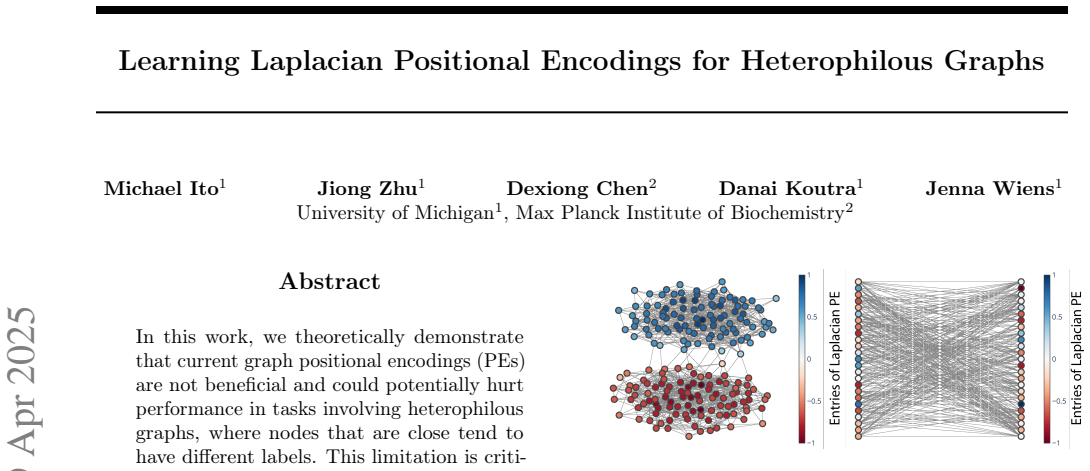
The central claim is that the eigenvectors of the graph Laplacian that carry the label-relevant structure shift with the homophily of the graph: in homophilous stochastic block models the first nontrivial eigenvectors encode communities, while in heterophilous block models it is the last eigenvectors that do so, and the first ones provably fail. Consequently, any positional encoding fixed to the low end of the spectrum cannot serve both regimes. LLPE removes this restriction by forming $P_{\mathrm{LLPE}} = U W_{\mathrm{LLPE}}$, where the columns of $W_{\mathrm{LLPE}}$ are truncated Chebyshev series evaluated at the eigenvalues, so the network learns which spectral directions matter for the task. The paper proves (Theorem 4.3) that, with output dimension equal to $n$, LLPE can recover any distance of the form $f_r(i,j)^2 = \sum_k r(\lambda_k)(u_k[i] - u_k[j])^2$ for a nonnegative weight function $r$, thereby subsuming several known graph distances and capturing both low- and high-frequency structure. It also proves Rademacher-complexity bounds showing that the Chebyshev-coefficient norm, not the series order, controls generalization.
Load-bearing premise
The proof that LLPE can approximate any spectral distance assumes the output dimension equals the number of nodes, while the deployed version fixes a much smaller output dimension, and the paper gives no theorem that the reduced encoding still achieves the same approximation.
Editorial extensions
If this is right
- LLPE can be added to any GNN or graph transformer without changing the model, improving accuracy on heterophilous benchmarks and on locally heterophilous regions of homophilous graphs.
- Because LLPE provably approximates commute time, diffusion distance, and biharmonic distance, a single learned encoding can replace several purpose-built positional encodings.
- The generalization bound implies that increasing the Chebyshev order $M$ improves expressivity without degrading generalization, as long as the learned coefficient norm stays small.
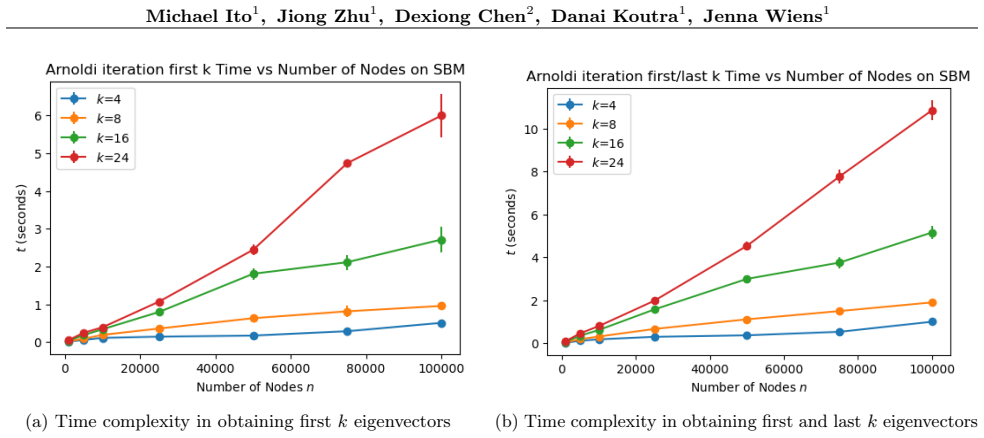
- For large graphs, the approximate LLPE using only the first and last $k$ eigenvectors obtained by Arnoldi iteration preserves most of the benefit while keeping computation feasible.
- Existing learnable PEs that process the full eigenvector matrix with MLPs or transformers scale poorly in the node count; LLPE's parameter count depends on $M$, not $n$, so it scales more gracefully.
Reading between the lines
- The expressivity theorem is proven with output dimension $d = n$ using narrow Gaussian bumps approximated by Chebyshev series; the practical LLPE fixes $d = 128$, so whether the fixed-dimensional encoding retains the full approximation power on real graphs is an empirical premise rather than a proven guarantee.
- LLPE's learned weight curve $h(\lambda)$ could be inspected post-hoc to identify which spectral bands actually mediate the label structure of a dataset, offering a diagnostic for heterophily that is not currently part of the paper.
- The method's ability to capture both same-label and opposite-label proximity suggests it could transfer to link prediction or graph-level tasks in heterophilous settings, though the paper only evaluates node classification.
- One could test LLPE against a directly supervised selection of eigenvectors (e.g., chosen by label correlation) on heterophilous benchmarks; a large gap would indicate that the Chebyshev parametrization, rather than spectral content, is the bottleneck.
Signed reviews
Editorial analysis
A structured set of objections, weighed in public.
Referee Report
Summary. The paper studies Laplacian positional encodings (LPEs) for node classification on heterophilous graphs. It first shows (Section 3) that on heterophilous SBMs the last eigenvectors of the graph Laplacian, not the first k, recover the communities, so standard LPEs fail. It then proposes LLPE, which forms P = U W_LLPE where W_LLPE is an n×d matrix whose entries are learnable Chebyshev polynomials evaluated at the eigenvalues, thus weighting all eigenvectors. The main theoretical claims are: (i) an expressivity theorem (Theorem 4.3) stating that LLPE can approximate any spectral distance f_r of the form f_r(i,j)^2 = Σ_k r(λ_k)(u_k[i]-u_k[j])^2; (ii) a Rademacher-complexity bound (Theorem 4.4) for the Chebyshev function class; and (iii) an approximate large-graph variant using the first and last k eigenpairs. Empirically, LLPE is evaluated on 12 benchmarks with MLP, GraphSAGE, and a full graph transformer, reporting up to 35% and 14% accuracy improvements over baselines on synthetic and real graphs, respectively.
Significance. The paper addresses a real and under-studied problem: positional encodings for heterophilous graphs. The SBM analysis connecting heterophily to the high end of the Laplacian spectrum is clear and useful, and the proposed LLPE is simple, scalable, and empirically strong: it obtains the best average rank on almost every benchmark and shows consistent gains over LPE-FK, including on large graphs. The theoretical framework linking full-spectrum PEs to spectral distances (Definition 4.2) is a valuable step. However, the central expressivity theorem is not established as stated (r vs r^2 mismatch) and, more importantly, the theorem that is proved (d=n) does not cover the deployed configuration (d=128), so the theoretical justification for the headline empirical results is currently missing. The generalization analysis is also limited to a univariate polynomial class rather than the end-to-end classifier. These are correctable in revision but are load-bearing.
major comments (3)
- [4.2 / Appendix B.2, Theorem 4.3 and Eqs. (43)-(46)] The proof of Theorem 4.3 is not internally consistent. The construction sets h(λ;θ_j) to approximate f_j(λ)=r(λ_j)exp(-C_max(λ-λ_j)^2), so the j-th column of W_LLPE is approximately r(λ_j) times a bump that is 1 at λ_j and 0 elsewhere. Consequently P=UW_LLPE ≈ U diag(r(λ_1),...,r(λ_n)), and the squared distance between rows i and j is approximately Σ_k r(λ_k)^2(u_k[i]-u_k[j])^2, which is not f_r(i,j)^2 = Σ_k r(λ_k)(u_k[i]-u_k[j])^2 as claimed. The displayed chain (44)-(46) replaces the approximation by r(λ_k) plus an ε term, thereby dropping the square; that step does not follow from the stated construction. The theorem is repairable by choosing the bump amplitude to be sqrt(r(λ_j)) rather than r(λ_j), but as written the proof does not establish the statement. The proof also does not control the overlap of the Gaussian bumps when eigenvalues are close, since C_max and M are not chosen relative to the minimal spectral gap of G; this is another gap in the same argument.
- [4.2 / Appendix D.2] The expressivity guarantee does not cover the configuration used in all experiments. Theorem B.6 (main text Theorem 4.3) sets d=n, with one Chebyshev column per eigenvalue. In the experiments, Appendix D.2 fixes d=128. For n>128, P=UW_LLPE has W_LLPE∈R^{n×128}, so the Gram matrix W_LLPE W_LLPE^T has rank at most 128, whereas representing f_r^2 for arbitrary r from Definition 4.2 requires a diagonal Gram matrix diag(r(λ)) of rank up to n. Thus no statement in the paper guarantees that the fixed-dimensional LLPE evaluated in Section 5 can approximate the class of distances in Theorem 4.3. This is load-bearing because the abstract and Section 5 attribute the empirical gains (up to 35% and 14%) to LLPE's expressivity, but the proved expressivity is for a different, larger model.
- [4.3 / Theorem 4.4] The Rademacher-complexity result is for the univariate function class H_LLPE = {λ→Σ_m θ_m \tilde T_m(λ)}, not for the hypothesis class of the node classifier that consumes the LLPE encodings. The theorem therefore does not establish the paper's claim that 'LLPE exhibits the best statistical generalization among other designs' (Section 4, opening paragraph) or that LLPE as a positional encoding generalizes better than LPE-FK, SAN-PE, or RWSE. To support that claim, one would need a bound on the empirical Rademacher complexity of the composed GNN/classifier with LLPE input, or at least an end-to-end bound that incorporates the l1/l2 regularization on the columns of W_LLPE that is actually used in training (Appendix D.2). As stated, Theorem 4.4 is a bound on a component function class and should be presented as such.
minor comments (4)
- [3.2 / Appendix A.2] The statement of Theorem 3.2 says the 'first nontrivial k eigenvectors' do not recover the communities, but the proof shows that any k−1 eigenvectors from the eigenvalue-1 eigenspace cannot do so; the statement should be adjusted to 'first k−1 nontrivial eigenvectors' or 'first k nontrivial eigenvectors' with a matching proof.
- [Appendix C.1, Figure 5 caption] The caption says 'while LPE-FK does not' but the experiment is a comparison with LPE-FLK (first and last k eigenvectors), as stated in the text; the caption should use the same name as the text.
- [Appendix B.1, Theorem B.4] The approximation order in Theorem B.4 is denoted n while the number of nodes is also n in the rest of the paper, and the number of derivatives is d while d is the output dimension of LLPE; this notation clash should be removed (e.g., use M for the series order and s for the number of derivatives).
- [Appendix D.2] No sensitivity analysis over the output dimension d is reported, although d is the only architectural parameter for which the theoretical expressivity theorem is silent; reporting accuracy for a few values of d (e.g., 32, 128, 256) would help the reader assess the practical dependence on this parameter.
Circularity Check
No significant circularity: LLPE's theoretical and empirical claims are evaluated against held-out data and external approximation-theoretic results, not against its own fitted parameters.
full rationale
The paper's central theoretical claim (Theorem 4.3) is a representability statement: LLPE is defined as P=UW with per-eigenvalue Chebyshev weights, and the theorem shows that with d=n and a sufficiently high Chebyshev order M, this class can approximate spectral distances f_r(i,j)^2 = sum_k r(λ_k)(u_k[i]-u_k[j])^2. The target class is admittedly close to the model's own definition, but the proof relies on independent, external approximation theory (Chebyshev series convergence, Mason and Handscomb 2002; Rivlin 2020) rather than on fitting f_r from data. No parameter is estimated to reproduce a specific distance, and no empirical result is claimed to be a prediction of Theorem 4.3; the experimental gains are measured on held-out splits across external benchmarks with standard training. The cited prior work on SBMs, Laplacian concentration, and Davis-Kahan bounds (Abbe 2018; Oliveira 2009; Yu et al. 2015) is external and not authored by the present paper's authors. Self-citations such as Ito et al. 2025 and Loveland et al. 2023 appear only as contextual or motivational references and are not load-bearing for the main derivation. The identified d=n versus d=128 gap and the apparent r(λ) versus r(λ)^2 mismatch in the proof of Theorem 4.3 are correctness or expressivity concerns, not circularity: they do not make the derivation equivalent to its inputs by construction.
Assumptions & free parameters
free parameters (4)
- M (Chebyshev series order) =
[64, 128] searched on real benchmarks
- k (number of first/last eigenvectors for large graphs) =
best at k=64 in sensitivity; searched over k in [8,512] for baselines and [64,1024] for LLPE
- C_max (Gaussian bump sharpness in expressivity proof) =
not specified; set 'large enough'
- l1/l2 regularization coefficients =
[0.001, 0.0001, 0.0]
assumptions (5)
- standard math Graph Laplacian concentrates around its expectation when minimum degree is at least C ln n (Oliveira 2009).
- standard math Davis-Kahan sinTheta theorem bounds eigenspace perturbations (Yu et al. 2015).
- standard math Chebyshev series partial sums converge exponentially fast for functions with smooth derivatives (Mason and Handscomb 2002).
- domain assumption Stochastic block models with p>>q or q>>p are the relevant model for homophilous and heterophilous community structure.
- ad hoc to paper The fixed output dimension d=128 in practice preserves the expressivity established for d=n.
Cite this review
Pith. "Pith review of Learning Laplacian Positional Encodings for Heterophilous Graphs." pith.science (2026). https://pith.science/paper/W4KW2IA6
@misc{pith2026250420430,
  author       = {Pith},
  title        = {Pith review of: Learning Laplacian Positional Encodings for Heterophilous Graphs},
  year         = {2026},
  howpublished = {\url{https://pith.science/paper/W4KW2IA6}},
  note         = {Machine review of arXiv:2504.20430}
}
read the original abstract
In this work, we theoretically demonstrate that current graph positional encodings (PEs) are not beneficial and could potentially hurt performance in tasks involving heterophilous graphs, where nodes that are close tend to have different labels. This limitation is critical as many real-world networks exhibit heterophily, and even highly homophilous graphs can contain local regions of strong heterophily. To address this limitation, we propose Learnable Laplacian Positional Encodings (LLPE), a new PE that leverages the full spectrum of the graph Laplacian, enabling them to capture graph structure on both homophilous and heterophilous graphs. Theoretically, we prove LLPE's ability to approximate a general class of graph distances and demonstrate its generalization properties. Empirically, our evaluation on 12 benchmarks demonstrates that LLPE improves accuracy across a variety of GNNs, including graph transformers, by up to 35% and 14% on synthetic and real-world graphs, respectively. Going forward, our work represents a significant step towards developing PEs that effectively capture complex structures in heterophilous graphs.
Figures


Figures from the paper (6 more)




Reference graph
Works this paper leans on
-
[1]
Yes (b) An analysis of the properties and complexity (time, space, sample size) of any algorithm
For all models and algorithms presented, check if you include: (a) A clear description of the mathematical set- ting, assumptions, algorithm, and/or model. Yes (b) An analysis of the properties and complexity (time, space, sample size) of any algorithm. Yes (c) (Optional) Anonymized source code, with specification of all dependencies, including external l...
-
[2]
For any theoretical claim, check if you include: (a) Statements of the full set of assumptions of all theoretical results.Yes (b) Complete proofs of all theoretical results.Yes (c) Clear explanations of any assumptions.Yes
-
[3]
For all figures and tables that present empirical results, check if you include: (a) The code, data, and instructions needed to re- produce the main experimental results (either in the supplemental material or as a URL). No (b) All the training details (e.g., data splits, hy- perparameters, how they were chosen).Yes (c) A clear definition of the specific ...
-
[4]
If you are using existing assets (e.g., code, data, models) or curating/releasing new assets, check if you include: (a) Citations of the creator If your work uses existing assets.Yes (b) The license information of the assets, if appli- cable.Not Applicable (c) Newassetseitherinthesupplementalmaterial or as a URL, if applicable.Not Applicable (d) Informati...
-
[5]
2 2.2 Homophily, GNNs and Graph PEs
If you used crowdsourcing or conducted research with human subjects, check if you include: (a) The full text of instructions given to partici- pants and screenshots.Not Applicable (b) Descriptions of potential participant risks, withlinkstoInstitutionalReviewBoard(IRB) approvals if applicable.Not Applicable (c) The estimated hourly wage paid to partici- p...
work page 1990
-
[6]
SAN-PE: SAN-PE as defined in Kreuzer et al. (2021)
work page 2021
-
[7]
where they propose to apply MLPs to the random walk matrix. Bo et al. (2023) propose Specformer, a new spectral GNN, that applies sine and cosine PEs to the eigenvalues, feeds them to a transformer and MLP, and finally uses the processed eigenvalues as spectral filters in a spectral GNN. Li et al. (2024) propose a PE that applies message-passing and sine ...
work page 2023
-
[8]
LPE-FK: The firstk nontrivial eigenvectors of the graph Laplacian as defined in Dwivedi and Bresson (2021) with a learnable linear projection matrix
work page 2021
Show all 14 references
-
[9]
LPE-FLK: The first and lastk eigenvectors of the graph Laplacian with a learnable linear projection matrix
-
[10]
LPE-Full: All eigenvectors of the graph Laplacian with a learnable linear projection matrix
-
[11]
(2023) with a learnable linear projection matrix
Elastic-PE: The matrix of electrostatic potentials as defined in Liu et al. (2023) with a learnable linear projection matrix
2023
-
[12]
SignNet: SignNet with DeepSets as defined in Lim et al. (2022)
2022
-
[14]
For LPE-FK, LPE-FLK, Elastic-PE, SignNet, and SAN-PE, we search across the number of eigenvector and eigenvalue pairsk∈ [8, 16, 32, 64, 128, 256, 512]
RWSE: The diagonals of them-step random walk matrix as defined in (Dwivedi et al., 2022). For LPE-FK, LPE-FLK, Elastic-PE, SignNet, and SAN-PE, we search across the number of eigenvector and eigenvalue pairsk∈ [8, 16, 32, 64, 128, 256, 512]. For all PEs, we find that typically...
2021
-
[2022]
addresses LPE’s sign ambiguity, and PEG (Wang et al., 2022) designs rotation and reflection equivariant LPEs. PEs other than LPE rely on random walks and node distances such as RWSE, the diagonals of them-step random walk matrix (Dwivedi et al., 2022), pair-wise shortest path ...
2022
Reviewed August 16, 2026 · model on record in the stance chip above.
Discussion (0). Continue with ORCID to comment.