REVIEW 3 major objections 4 minor 53 references
Restage4D: Reanimating Deformable 3D Reconstruction from a Single Video
T0 review · 3 major / 4 minor · reviewed 2026-08-05 · deepseek-v4-flash
Pith's one-line read Restage4D claims that rewinding a real video and splicing it to a generated one allows one shared motion representation to propagate real geometry into novel synthetic motion, preserving deformable structure and correcting generative artifa
desk verdict The video-rewinding idea is genuinely clever, but the core lemma is unproven and the evaluation is too thin to support the strong claims. read the letter →
The pith
A machine-rendered reading of the paper's core claim, the machinery that carries it, and where it could break.
The reading
What carries the argument
Low-rank decomposed 4D Gaussian representation: each dynamic foreground point has canonical position $\mu_i$, shared time-independent coefficients $\beta_i \in \mathbb{R}^K$, and $K$ smooth time-varying SE(3) bases $M_k(t)$; deformation is $T_i(t)=\gamma(\sum_k \beta_{ik}M_k(t))$ applied to $\mu_i$. Shared coefficients let the rewound real clip and the driving clip express one articulation, so real-video supervision flows into the edited segment. Supporting it are the video-rewinding concatenation, the occlusion-aware rigidity loss acting on an invisibility score, and disocclusion backtracing.
What would settle it
On a PointOdyssey clip with ground-truth 3D tracks, reconstruct the base clip forward and backward under the same low-rank representation and compare per-point canonical positions; then run the joint rewind+driving training and measure $\mathrm{Var}_{t\in[0,t_1]}(d(t))$ against a model trained on the edited clip alone. If the forward/backward reconstructions differ beyond tracking noise, or if the joint-training variance is not below the edited-only variance, the temporal-reversal premise and Lemma 1's propagation mechanism fail.
Extended reading notes
Core claim
Restage4D's central claim: a monocular video can be reanimated with new synthetic motion while retaining its geometry by treating the reconstruction as a puppet with shared motion coefficients. The method plays the base video backward, splices it to a synthetic driving video, and optimizes both through one low-rank set of SE(3) motion bases; Lemma 1 states that with temporal smoothness this joint training gives $\mathrm{Var}_{t\in[0,t_1]}(d(t)) < \sigma_0$ for pairwise distances, so real-clip supervision stabilizes the edited segment. Occlusion-aware rigidity and disocclusion backtracing protect invisible and newly revealed regions. DAVIS and PointOdyssey experiments show improved consistenc
Load-bearing premise
The rewind scheme rests on the unproved premise that deformable 3D reconstruction from a video played backward gives the same geometry as forward playback, so that the reversed real clip and the synthetic clip can be trained as one shared articulation; if that invariance fails, joint training may fit two incompatible deformation fields instead of propagating supervision.
Editorial extensions
If this is right
- Real-world video becomes an articulation prior that can supervise many generated motions from the same scene, not just one reconstruction.
- Artifacts in diffusion-generated driving videos—limb swaps, fused background, geometry changes after occlusion—can be corrected during reconstruction instead of requiring a separate filtering step.
- Occluded and disoccluded regions stay geometrically consistent under novel motion, extending usable 4D restaging to long or complex motions.
- The variance-reduction lemma gives a quantitative target: joint training with a supervised real clip should make pairwise 3D distances in the edited clip more stable, which is checkable independently of rendering quality.
- A restaged 4D asset is produced by truncating the jointly reconstructed scene to the edited clip, preserving original appearance with new dynamics.
Reading between the lines
- The paper does not test its temporal-reversal invariance premise; a direct forward-versus-rewound reconstruction comparison would confirm it, and a failure would mean joint training could fit two incompatible deformation fields.
- The appendix proof (labeled Lemma 2 while the main text calls it Lemma 1) is qualitative: it argues smoothness suppresses fluctuation rather than deriving a bound; the ablation table is what substantiates the variance claim.
- If the rewind scheme holds, one real video could supervise a batch of generated variants, and the reconstruction loss could double as a physical-consistency filter that flags generated clips outside the real articulation space.
- The paper's conclusion notes that severe generated artifacts and highly deformable or textureless objects can exceed the method's assumptions, so the correction and propagation claims are bounded, not universal.
Editorial analysis
A structured set of objections, weighed in public.
Referee Report
Summary. The paper introduces 4D restaging: given a monocular base video and a text prompt, an image-to-video diffusion model generates a driving video, and the scene is reconstructed as a deformable 4D Gaussian representation with low-rank motion bases. The proposed Restage4D pipeline uses (i) a video-rewinding joint-training scheme that temporally concatenates the reversed base video with the driving video and optimizes a shared motion representation, (ii) an occlusion-aware rigidity loss, and (iii) a disocclusion backtracing mechanism. The authors claim this preserves geometry from the real video while reanimating the scene with novel synthetic motion, and can correct artifacts produced by video diffusion models. Evaluation is reported on DAVIS and PointOdyssey, including a 3D tracking benchmark with ground truth.
Significance. The problem is timely and relevant: using real video as a geometric supervisor for synthetic-motion 4D content creation is a sensible direction, and the PointOdyssey evaluation provides an external ground-truth benchmark. The paper also promises code release. If the central mechanism works, the task itself is a useful contribution. However, the formal justification for the core joint-training scheme is not established, and the quantitative evidence is currently too thin to support the strength of the claims. The significance is therefore conditional on additional rigorous proof or empirical validation.
major comments (3)
- [Section 3.2 / Appendix A] Lemma 1 is load-bearing but not proven. The appendix's 'Proof of Lemma 2' essentially asserts that temporal smoothness reduces variance; no rigorous derivation of Var_{t in [0,t1]}(d(t)) < sigma0 is given. The proof also conflates 'without supervision' with 'without regularization'. Since the central geometry-propagation claim rests on this lemma, it must either be proved rigorously with explicit assumptions and quantitative bounds, or be presented as an empirical design choice supported by measurements. As written, the lemma is not a proof.
- [Section 3.2, paragraph 2] The video-rewinding scheme relies on the unverified assumption that deformable 3D reconstruction is invariant to temporal direction. This is not a trivial property: the initialization uses TAPIR 2D tracks, camera pose estimation, and visibility/occlusion patterns, all of which are time-asymmetric, and the optimization can converge to different canonical configurations when the sequence is reversed. If the reversal changes the reconstruction, then the 'supervised' segment in Lemma 1 is not the original geometry, and the claimed propagation collapses. Please add a direct experiment reconstructing the base video forward and backward and comparing canonical Gaussians, rendered geometry, and motion coefficients; report quantitative discrepancies.
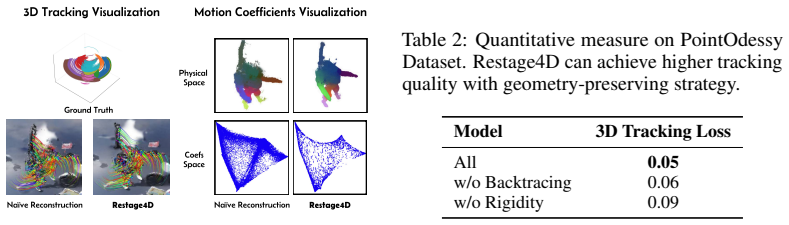
- [Table 1 and Section 4.2] The quantitative evaluation is not yet convincing. Table 1 reports only training-view PSNR and uses three metrics introduced in this paper (OCV CLIP, volume consistency with hand-set gamma=1.5, edge consistency); no validation of these metrics or significance tests are provided. Several deltas are within the reported standard deviations (e.g., Baseline 26.71±1.97 vs +Joint 26.58±2.21 for PSNR). Table 2 reports 3D tracking loss without the number of sequences, error bars, or variance, making it impossible to assess whether the differences are meaningful. Please report per-sequence paired confidence intervals/significance tests, specify the number of sequences, and justify or ablate the gamma choice.
minor comments (4)
- [Appendix A] The appendix heading says 'Proof of Lemma 2' while the main text states Lemma 1; the numbering should be consistent. Also, the proof is informal and should be clearly labeled as intuition if it cannot be made rigorous.
- [Section 4.1] The 'Baseline' method is not defined. It should be stated explicitly (presumably Shape-of-Motion without the proposed losses) and compared with at least one existing monocular deformable reconstruction method.
- [Equations (5) and (9)] Thresholds tau0/tau1 in Equation (5) are not specified in the hyperparameters; please provide values and sensitivity. In Equation (9), the direction of the metric is counterintuitive (higher is better despite a negative log); please clarify and justify gamma=1.5.
- [General] Typos and formatting: 'LRegidity_ref ine' in Equation (6), 'PointOdessy' in Table 2 caption, and 'Bootstap' in the references. Please also state how many sequences were used in Table 2 and whether they overlap with the 20 DAVIS sequences.
Circularity Check
No significant circularity
full rationale
Restage4D's central claim is that a video-rewinding joint-training scheme, an occlusion-aware rigidity loss, and disocclusion backtracing propagate geometry from a real base video into a synthetic driving video. This is a proposed training objective, not a quantity fitted to the metric it is later used to support. The formal statement (Lemma 1, with the appendix proof mislabeled as 'Proof of Lemma 2') is informal and under-specified: it asserts that adding smoothness/supervision reduces temporal variance, and then concludes the desired inequality. That is a proof gap or a non-rigorous step, but it is not circular in the structural sense—the inequality is not obtained by substituting a definition, renaming a fitted parameter, or importing a uniqueness theorem from the authors' own prior work. The temporal-reversal invariance premise ('We observe that the deformable 3D reconstruction frameworks are invariant to temporal direction, reconstructing from a video playing in a reversed temporal order would result in the same reconstruction') is an explicit unverified assumption; an unsupported premise is a correctness risk, not a circular derivation. The paper also has independent external grounding: the 3D tracking evaluation uses PointOdyssey ground-truth trajectories (Table 2), and the method builds on Shape-of-Motion and standard 2D tracking/depth priors by citation, without relying on self-citations as load-bearing evidence. The custom DAVIS metrics (CLIP-OCV, volume consistency, edge consistency) are consistent with the method's objectives, but they are computed from reconstructed outputs rather than being fitted parameters renamed as predictions; the hand-set gamma=1.5 is arbitrary but not circular. Overall, no load-bearing step reduces by construction to its own inputs.
Assumptions & free parameters
free parameters (5)
- Rigidity loss weight =
10^-3
- Number of motion bases K =
100
- Smooth-step visibility thresholds tau0, tau1 =
not reported
- Volume consistency exponent gamma =
1.5
- k-NN graph size for rigidity loss =
not reported
assumptions (6)
- domain assumption Temporal reversal invariance of the underlying deformable 3D reconstruction
- ad hoc to paper Joint training with temporal smoothness reduces pairwise distance variance in the unsupervised segment
- domain assumption The rendered depth buffer is accurate enough to define occluded regions during optimization
- domain assumption Upstream 2D priors (Tapir, MegaSAM, VideoDepthAnything, SAM, Track Anything) are correct enough for initialization and backtracing
- domain assumption CLIP similarity is a valid proxy for geometric consistency of occluded regions
- standard math Standard 3D Gaussian Splatting rendering model and SE(3) motion composition in Eq. 1 are taken as given
invented entities (1)
-
Backtraced canonical Gaussians for disoccluded points
independent evidence
Cite this review
Pith. "Pith review of Restage4D: Reanimating Deformable 3D Reconstruction from a Single Video." pith.science (2026). https://pith.science/paper/W4L2PP3F
@misc{pith2026250806715,
  author       = {Pith},
  title        = {Pith review of: Restage4D: Reanimating Deformable 3D Reconstruction from a Single Video},
  year         = {2026},
  howpublished = {\url{https://pith.science/paper/W4L2PP3F}},
  note         = {Machine review of arXiv:2508.06715}
}
read the original abstract
Creating deformable 3D content has gained increasing attention with the rise of text-to-image and image-to-video generative models. While these models provide rich semantic priors for appearance, they struggle to capture the physical realism and motion dynamics needed for authentic 4D scene synthesis. In contrast, real-world videos can provide physically grounded geometry and articulation cues that are difficult to hallucinate. One question is raised: \textit{Can we generate physically consistent 4D content by leveraging the motion priors of the real-world video}? In this work, we explore the task of reanimating deformable 3D scenes from a single video, using the original sequence as a supervisory signal to correct artifacts from synthetic motion. We introduce \textbf{Restage4D}, a geometry-preserving pipeline for video-conditioned 4D restaging. Our approach uses a video-rewinding training strategy to temporally bridge a real base video and a synthetic driving video via a shared motion representation. We further incorporate an occlusion-aware rigidity loss and a disocclusion backtracing mechanism to improve structural and geometry consistency under challenging motion. We validate Restage4D on DAVIS and PointOdyssey, demonstrating improved geometry consistency, motion quality, and 3D tracking performance. Our method not only preserves deformable structure under novel motion, but also automatically corrects errors introduced by generative models, revealing the potential of video prior in 4D restaging task. Source code and trained models will be released.
Figures


Figures from the paper (6 more)



Reference graph
Works this paper leans on
-
[1]
High-resolution image synthesis with latent diffusion models,
R. Rombach, A. Blattmann, D. Lorenz, P. Esser, and B. Ommer, “High-resolution image synthesis with latent diffusion models,” in Proceedings of the IEEE/CVF conference on computer vision and pattern recognition, 2022, pp. 10 684–10 695. 1, 3
work page 2022
-
[2]
I. J. Goodfellow, J. Pouget-Abadie, M. Mirza, B. Xu, D. Warde-Farley, S. Ozair, A. Courville, and Y . Bengio, “Generative adversarial nets,”Advances in neural information processing systems, vol. 27, 2014. 1
work page 2014
-
[3]
Make-a-video: Text-to-video generation without text-video data,
U. Singer, A. Polyak, T. Hayes, X. Yin, J. An, S. Zhang, Q. Hu, H. Yang, O. Ashual, O. Gafni et al., “Make-a-video: Text-to-video generation without text-video data,” arXiv preprint arXiv:2209.14792, 2022. 1
arXiv 2022
-
[4]
Instant-3d: Instant neural radiance field training towards on-device ar/vr 3d reconstruction,
S. Li, C. Li, W. Zhu, B. Yu, Y . Zhao, C. Wan, H. You, H. Shi, and Y . Lin, “Instant-3d: Instant neural radiance field training towards on-device ar/vr 3d reconstruction,” in Proceedings of the 50th Annual International Symposium on Computer Architecture, 2023, pp. 1–13. 1
work page 2023
-
[5]
Dreamfusion: Text-to-3d using 2d diffusion,
B. Poole, A. Jain, J. T. Barron, and B. Mildenhall, “Dreamfusion: Text-to-3d using 2d diffusion,”arXiv preprint arXiv:2209.14988, 2022. 1
arXiv 2022
-
[6]
Text-to-4d dynamic scene generation,
U. Singer, S. Sheynin, A. Polyak, O. Ashual, I. Makarov, F. Kokkinos, N. Goyal, A. Vedaldi, D. Parikh, J. Johnson et al., “Text-to-4d dynamic scene generation,”arXiv preprint arXiv:2301.11280, 2023. 1
arXiv 2023
-
[7]
Animate124: Animating one image to 4d dynamic scene,
Y . Zhao, Z. Yan, E. Xie, L. Hong, Z. Li, and G. H. Lee, “Animate124: Animating one image to 4d dynamic scene,” arXiv preprint arXiv:2311.14603, 2023. 1
arXiv 2023
-
[8]
4d-fy: Text-to-4d generation using hybrid score distillation sampling,
S. Bahmani, I. Skorokhodov, V . Rong, G. Wetzstein, L. Guibas, P. Wonka, S. Tulyakov, J. J. Park, A. Tagliasacchi, and D. B. Lindell, “4d-fy: Text-to-4d generation using hybrid score distillation sampling,” in Proceedings of the IEEE/CVF Conference on Computer Vision and Pattern Recognition , 2024, pp. 7996–8006. 1, 3
work page 2024
Show all 53 references
-
[9]
Shape of motion: 4d reconstruction from a single video,
Q. Wang, V . Ye, H. Gao, J. Austin, Z. Li, and A. Kanazawa, “Shape of motion: 4d reconstruction from a single video,” arXiv preprint arXiv:2407.13764, 2024. 2, 3, 4, 5
2024
-
[10]
Mosca: Dynamic gaussian fusion from casual videos via 4d motion scaffolds,
J. Lei, Y . Weng, A. Harley, L. Guibas, and K. Daniilidis, “Mosca: Dynamic gaussian fusion from casual videos via 4d motion scaffolds,” arXiv preprint arXiv:2405.17421, 2024. 2, 3
2024 arXiv
-
[11]
Articulated mesh animation from multi-view silhouettes,
D. Vlasic, I. Baran, W. Matusik, and J. Popovi´c, “Articulated mesh animation from multi-view silhouettes,” in Acm Siggraph 2008 papers, 2008, pp. 1–9. 2
2008
-
[12]
A benchmark dataset and evaluation methodology for video object segmentation,
F. Perazzi, J. Pont-Tuset, B. McWilliams, L. Van Gool, M. Gross, and A. Sorkine-Hornung, “A benchmark dataset and evaluation methodology for video object segmentation,” inProceedings of the IEEE conference on computer vision and pattern recognition, 2016, pp. 724–732. 2, 6
2016
-
[13]
Pointodyssey: A large-scale synthetic dataset for long-term point tracking,
Y . Zheng, A. W. Harley, B. Shen, G. Wetzstein, and L. J. Guibas, “Pointodyssey: A large-scale synthetic dataset for long-term point tracking,” in Proceedings of the IEEE/CVF International Conference on Computer Vision, 2023, pp. 19 855–19 865. 2, 6
2023
-
[14]
Nerf: Representing scenes as neural radiance fields for view synthesis,
B. Mildenhall, P. P. Srinivasan, M. Tancik, J. T. Barron, R. Ramamoorthi, and R. Ng, “Nerf: Representing scenes as neural radiance fields for view synthesis,” Communications of the ACM , vol. 65, no. 1, pp. 99–106, 2021. 3
2021
-
[15]
Tensorf: Tensorial radiance fields,
A. Chen, Z. Xu, A. Geiger, J. Yu, and H. Su, “Tensorf: Tensorial radiance fields,” inEuropean conference on computer vision. Springer, 2022, pp. 333–350
2022
-
[16]
Instant neural graphics primitives with a multiresolution hash encoding,
T. Müller, A. Evans, C. Schied, and A. Keller, “Instant neural graphics primitives with a multiresolution hash encoding,” ACM transactions on graphics (TOG), vol. 41, no. 4, pp. 1–15, 2022
2022
-
[17]
Nerf in the wild: Neural radiance fields for unconstrained photo collections,
R. Martin-Brualla, N. Radwan, M. S. Sajjadi, J. T. Barron, A. Dosovitskiy, and D. Duckworth, “Nerf in the wild: Neural radiance fields for unconstrained photo collections,” in Proceedings of the IEEE/CVF conference on computer vision and pattern recognition, 2021, pp. 7210–7219
2021
-
[18]
Plenoxels: Radiance fields without neural networks,
S. Fridovich-Keil, A. Yu, M. Tancik, Q. Chen, B. Recht, and A. Kanazawa, “Plenoxels: Radiance fields without neural networks,” in Proceedings of the IEEE/CVF conference on computer vision and pattern recognition, 2022, pp. 5501–5510
2022
-
[19]
Mip-nerf: A multiscale representation for anti-aliasing neural radiance fields,
J. T. Barron, B. Mildenhall, M. Tancik, P. Hedman, R. Martin-Brualla, and P. P. Srinivasan, “Mip-nerf: A multiscale representation for anti-aliasing neural radiance fields,” in Proceedings of the IEEE/CVF international conference on computer vision, 2021, pp. 5855–5864. 10
2021
-
[20]
K-planes: Explicit radiance fields in space, time, and appearance,
S. Fridovich-Keil, G. Meanti, F. R. Warburg, B. Recht, and A. Kanazawa, “K-planes: Explicit radiance fields in space, time, and appearance,” in Proceedings of the IEEE/CVF Conference on Computer Vision and Pattern Recognition, 2023, pp. 12 479–12 488. 3
2023
-
[21]
3d gaussian splatting for real-time radiance field rendering
B. Kerbl, G. Kopanas, T. Leimkühler, and G. Drettakis, “3d gaussian splatting for real-time radiance field rendering.” ACM Trans. Graph., vol. 42, no. 4, pp. 139–1, 2023. 3
2023
-
[22]
D-nerf: Neural radiance fields for dynamic scenes,
A. Pumarola, E. Corona, G. Pons-Moll, and F. Moreno-Noguer, “D-nerf: Neural radiance fields for dynamic scenes,” in Proceedings of the IEEE/CVF conference on computer vision and pattern recognition, 2021, pp. 10 318–10 327. 3
2021
-
[23]
Nerfies: Deformable neural radiance fields,
K. Park, U. Sinha, J. T. Barron, S. Bouaziz, D. B. Goldman, S. M. Seitz, and R. Martin-Brualla, “Nerfies: Deformable neural radiance fields,” in Proceedings of the IEEE/CVF international conference on computer vision, 2021, pp. 5865–5874. 3
2021
-
[24]
Hypernerf: A higher-dimensional representation for topologically varying neural radiance fields,
K. Park, U. Sinha, P. Hedman, J. T. Barron, S. Bouaziz, D. B. Goldman, R. Martin-Brualla, and S. M. Seitz, “Hypernerf: A higher-dimensional representation for topologically varying neural radiance fields,” arXiv preprint arXiv:2106.13228, 2021. 3
2021 arXiv
-
[25]
Deformable 3d gaussians for high-fidelity monocular dynamic scene reconstruction,
Z. Yang, X. Gao, W. Zhou, S. Jiao, Y . Zhang, and X. Jin, “Deformable 3d gaussians for high-fidelity monocular dynamic scene reconstruction,” in Proceedings of the IEEE/CVF conference on computer vision and pattern recognition, 2024, pp. 20 331–20 341. 3
2024
-
[26]
3d geometry-aware deformable gaussian splatting for dynamic view synthesis,
Z. Lu, X. Guo, L. Hui, T. Chen, M. Yang, X. Tang, F. Zhu, and Y . Dai, “3d geometry-aware deformable gaussian splatting for dynamic view synthesis,” in Proceedings of the IEEE/CVF Conference on Computer Vision and Pattern Recognition, 2024, pp. 8900–8910
2024
-
[27]
4d gaussian splatting for real-time dynamic scene rendering,
G. Wu, T. Yi, J. Fang, L. Xie, X. Zhang, W. Wei, W. Liu, Q. Tian, and X. Wang, “4d gaussian splatting for real-time dynamic scene rendering,” in Proceedings of the IEEE/CVF conference on computer vision and pattern recognition, 2024, pp. 20 310–20 320
2024
-
[28]
Deformable 3d gaussian splatting for animatable human avatars,
H. Jung, N. Brasch, J. Song, E. Perez-Pellitero, Y . Zhou, Z. Li, N. Navab, and B. Busam, “Deformable 3d gaussian splatting for animatable human avatars,” arXiv preprint arXiv:2312.15059, 2023. 3
2023 arXiv
-
[29]
Depth anything: Unleashing the power of large-scale unlabeled data,
L. Yang, B. Kang, Z. Huang, X. Xu, J. Feng, and H. Zhao, “Depth anything: Unleashing the power of large-scale unlabeled data,” in Proceedings of the IEEE/CVF Conference on Computer Vision and Pattern Recognition, 2024, pp. 10 371–10 381. 3
2024
-
[30]
Tapir: Tracking any point with per-frame initialization and temporal refinement,
C. Doersch, Y . Yang, M. Vecerik, D. Gokay, A. Gupta, Y . Aytar, J. Carreira, and A. Zisserman, “Tapir: Tracking any point with per-frame initialization and temporal refinement,” inProceedings of the IEEE/CVF International Conference on Computer Vision, 2023, pp. 10 061–10 072. 3, 6
2023
-
[31]
Droid-slam: Deep visual slam for monocular, stereo, and rgb-d cameras,
Z. Teed and J. Deng, “Droid-slam: Deep visual slam for monocular, stereo, and rgb-d cameras,” Advances in neural information processing systems, vol. 34, pp. 16 558–16 569, 2021. 3
2021
-
[32]
Articulated body motion capture by annealed particle filtering,
J. Deutscher, A. Blake, and I. Reid, “Articulated body motion capture by annealed particle filtering,” in Proceedings IEEE Conference on Computer Vision and Pattern Recognition. CVPR 2000 (Cat. No. PR00662), vol. 2. IEEE, 2000, pp. 126–133. 3
2000
-
[33]
Tour into the picture: using a spidery mesh interface to make animation from a single image,
Y . Horry, K.-I. Anjyo, and K. Arai, “Tour into the picture: using a spidery mesh interface to make animation from a single image,” in Proceedings of the 24th annual conference on Computer graphics and interactive techniques, 1997, pp. 225–232. 3
1997
-
[34]
Farhat, M
C. Farhat, M. Lesoinne, and P. Le Tallec, “Load and motion transfer algorithms for fluid/structure inter- action problems with non-matching discrete interfaces: Momentum and energy conservation, optimal discretization and application to aeroelasticity,” Computer methods in app...
1998
-
[35]
Retargetting motion to new characters,
M. Gleicher, “Retargetting motion to new characters,” inProceedings of the 25th annual conference on Computer graphics and interactive techniques, 1998, pp. 33–42. 3
1998
-
[36]
Interactive control of avatars animated with human motion data,
J. Lee, J. Chai, P. S. Reitsma, J. K. Hodgins, and N. S. Pollard, “Interactive control of avatars animated with human motion data,” in Proceedings of the 29th annual conference on Computer graphics and interactive techniques, 2002, pp. 491–500. 3
2002
-
[37]
Deformation transfer for triangle meshes,
R. W. Sumner and J. Popovi´c, “Deformation transfer for triangle meshes,” ACM Transactions on graphics (TOG), vol. 23, no. 3, pp. 399–405, 2004. 3 11
2004
-
[38]
Skeleton-aware networks for deep motion retargeting,
K. Aberman, P. Li, D. Lischinski, O. Sorkine-Hornung, D. Cohen-Or, and B. Chen, “Skeleton-aware networks for deep motion retargeting,”ACM Transactions on Graphics (TOG), vol. 39, no. 4, pp. 62–1,
-
[39]
A modular neural motion retargeting system decoupling skeleton and shape perception,
J. Zhang, Z. Tu, J. Weng, J. Yuan, and B. Du, “A modular neural motion retargeting system decoupling skeleton and shape perception,” IEEE Transactions on Pattern Analysis and Machine Intelligence, 2024. 3
2024
-
[40]
Sc-gs: Sparse-controlled gaussian splatting for editable dynamic scenes,
Y .-H. Huang, Y .-T. Sun, Z. Yang, X. Lyu, Y .-P. Cao, and X. Qi, “Sc-gs: Sparse-controlled gaussian splatting for editable dynamic scenes,” in Proceedings of the IEEE/CVF conference on computer vision and pattern recognition, 2024, pp. 4220–4230. 3
2024
-
[41]
D-miso: Editing dynamic 3d scenes using multi-gaussians soup,
J. Waczynska, P. Borycki, J. Kaleta, S. Tadeja, and P. Spurek, “D-miso: Editing dynamic 3d scenes using multi-gaussians soup,” Advances in Neural Information Processing Systems, vol. 37, pp. 107 865–107 889,
-
[42]
B. F. Labs, “Flux,” https://github.com/black-forest-labs/flux, 2024. 3
2024
-
[43]
Video generation models as world simulators,
T. Brooks, B. Peebles, C. Holmes, W. DePue, and Y . Guo, “Video generation models as world simulators,” https://openai.com/index/video-generation-models-as-world-simulators/, 2024, openAI Technical Report. 3, 5
2024
-
[44]
Zero-1-to-3: Zero-shot one image to 3d object,
R. Liu, R. Wu, B. Van Hoorick, P. Tokmakov, S. Zakharov, and C. V ondrick, “Zero-1-to-3: Zero-shot one image to 3d object,” in Proceedings of the IEEE/CVF international conference on computer vision, 2023, pp. 9298–9309. 3
2023
-
[45]
Diffusion4d: Fast spatial-temporal consistent 4d generation via video diffusion models,
H. Liang, Y . Yin, D. Xu, H. Liang, Z. Wang, K. N. Plataniotis, Y . Zhao, and Y . Wei, “Diffusion4d: Fast spatial-temporal consistent 4d generation via video diffusion models,” arXiv preprint arXiv:2405.16645,
-
[46]
Dreamgaussian: Generative gaussian splatting for efficient 3d content creation,
J. Tang, J. Ren, H. Zhou, Z. Liu, and G. Zeng, “Dreamgaussian: Generative gaussian splatting for efficient 3d content creation,” arXiv preprint arXiv:2309.16653, 2023. 3
2023 arXiv
-
[47]
Instruct-nerf2nerf: Editing 3d scenes with instructions,
A. Haque, M. Tancik, A. A. Efros, A. Holynski, and A. Kanazawa, “Instruct-nerf2nerf: Editing 3d scenes with instructions,” in Proceedings of the IEEE/CVF International Conference on Computer Vision, 2023, pp. 19 740–19 750. 3
2023
-
[48]
Dreambooth3d: Subject-driven text-to-3d generation,
A. Raj, S. Kaza, B. Poole, M. Niemeyer, N. Ruiz, B. Mildenhall, S. Zada, K. Aberman, M. Rubinstein, J. Barron et al., “Dreambooth3d: Subject-driven text-to-3d generation,” in Proceedings of the IEEE/CVF international conference on computer vision, 2023, pp. 2349–2359. 3
2023
-
[49]
As-rigid-as-possible shape manipulation,
T. Igarashi, T. Moscovich, and J. F. Hughes, “As-rigid-as-possible shape manipulation,”ACM transactions on Graphics (TOG), vol. 24, no. 3, pp. 1134–1141, 2005. 5
2005
-
[50]
Bootstap: Bootstrapped training for tracking-any-point,
C. Doersch, P. Luc, Y . Yang, D. Gokay, S. Koppula, A. Gupta, J. Heyward, I. Rocco, R. Goroshin, J. Carreira et al., “Bootstap: Bootstrapped training for tracking-any-point,” in Proceedings of the Asian Conference on Computer Vision, 2024, pp. 3257–3274. 6
2024
-
[51]
Learning transferable visual models from natural language supervision,
A. Radford, J. W. Kim, C. Hallacy, A. Ramesh, G. Goh, S. Agarwal, G. Sastry, A. Askell, P. Mishkin, J. Clark et al., “Learning transferable visual models from natural language supervision,” in International conference on machine learning. PmLR, 2021, pp. 8748–8763. 7
2021
-
[52]
Towards a multiscale point cloud structural similarity metric,
D. Lazzarotto and T. Ebrahimi, “Towards a multiscale point cloud structural similarity metric,” in2023 IEEE 25th International Workshop on Multimedia Signal Processing (MMSP), 2023, pp. 1–6. 7
2023
-
[53]
Inferring point cloud quality via graph similarity,
Q. Yang, Z. Ma, Y . Xu, Z. Li, and J. Sun, “Inferring point cloud quality via graph similarity,” IEEE Transactions on Pattern Analysis and Machine Intelligence, vol. 44, no. 6, pp. 3015–3029, 2022. 7 A Proof of Lemma 2 We introduce Lemma 2 to demonstrate the necessity of using...
2022
Reviewed August 5, 2026 · model on record in the stance chip above.
Discussion (0). Sign in to comment.