ConcoLixir: Reactive LLM Discovery Oracles for Python Concolic Testing
Pith reviewed 2026-06-26 04:27 UTC · model grok-4.3
The pith
A reactive LLM discovery oracle raises line coverage in Python concolic testing by 8.6 to 17 percentage points.
A machine-rendered reading of the paper's core claim, the machinery that carries it, and where it could break.
Core claim
The paper claims that inserting a bounded LLM as a reactive discovery oracle into concolic execution lets it generate useful concrete inputs precisely where the symbolic solver stalls on library calls, regular expressions, checksums, and parsers, producing measured coverage gains without the LLM ever replacing the solver or serving as a correctness oracle.
What carries the argument
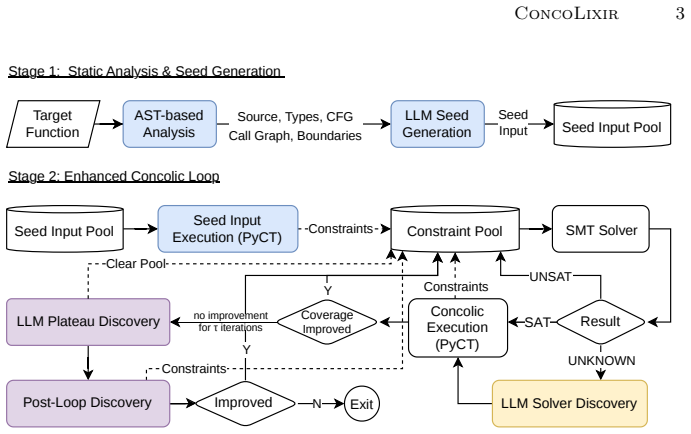
The reactive LLM discovery oracle that proposes seeds, post-failure inputs, and stalled-coverage targets, each validated by full concolic execution using only observed coverage and path constraints.
If this is right
- Gains concentrate near semantic barriers and library boundaries.
- Improvements appear on synthetic, real-world, and library code.
- Total API cost for the full evaluation stays at $1.63.
- Bounded LLM discovery complements symbolic reasoning instead of replacing it.
Where Pith is reading between the lines
- The same oracle pattern could be attached to concolic engines for other languages that face similar semantic barriers.
- Manual seed selection might become less critical if the oracle reliably supplies diverse starting points.
- Prompts tuned to specific hard operations such as checksums could produce further targeted gains.
Load-bearing premise
Coverage gains are produced by the LLM-generated candidates themselves rather than by differences in experimental setup or seeding between the baseline and augmented runs.
What would settle it
Run the baseline concolic tester on exactly the same set of LLM-generated inputs and check whether its final line coverage matches the augmented version.
Figures
read the original abstract
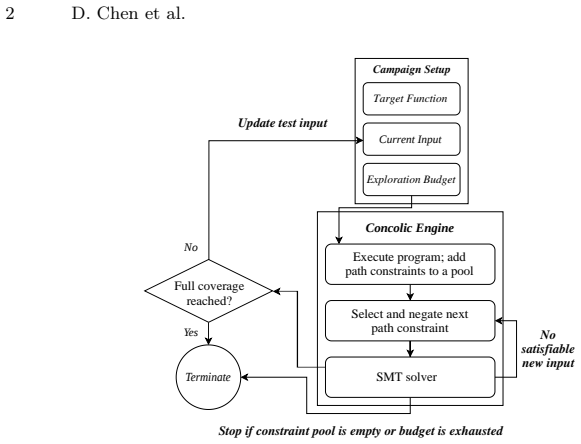
Concolic testing combines concrete execution with symbolic constraint solving, but Python programs expose recurring limits. Library calls can cause symbolic variables to downgrade to concrete values. Regular expressions, checksums, parsers, and other semantic operations can be hard to solve, and exploration can plateau on already covered paths. We present ConcoLixir, a reactive LLM extension for Python concolic execution. The LLM acts as a discovery oracle, not a replacement for the solver or a correctness oracle. It generates initial seeds, proposes concrete inputs after solver failures, and targets uncovered code when coverage stalls. Each candidate is executed concolically, and only observed coverage and collected path constraints guide later exploration. Across synthetic, real-world, and library targets, ConcoLixir improves mean line coverage over the baseline concolic tester without an LLM oracle by 8.6, 15.1, and 17.0 percentage points. The gains are strongest near semantic barriers and library boundaries, and the full evaluation costs \$1.63 in API charges. These results show that bounded LLM discovery can complement symbolic reasoning without replacing it.
Editorial analysis
A structured set of objections, weighed in public.
Referee Report
Summary. The manuscript presents ConcoLixir, a reactive LLM extension for Python concolic testing where the LLM serves as a discovery oracle to generate initial seeds, propose concrete inputs after solver failures, and target uncovered code upon coverage stalls. Each LLM candidate is executed concolically, with only observed coverage and path constraints guiding further exploration. The paper reports that this approach improves mean line coverage over a baseline concolic tester without an LLM oracle by 8.6, 15.1, and 17.0 percentage points across synthetic, real-world, and library targets, with the evaluation costing $1.63 in API charges.
Significance. If the empirical results hold under controlled conditions, the work would demonstrate a practical, low-cost way to integrate LLMs as bounded discovery oracles that complement rather than replace symbolic execution in Python testing, with particular value near semantic barriers and library boundaries.
major comments (2)
- [Abstract] Abstract: the reported coverage improvements of 8.6, 15.1, and 17.0 percentage points are presented without any information on experimental setup, number of runs, statistical significance, error bars, baseline implementation, or controls for total concrete inputs, solver invocations, or wall-clock budget; this information is load-bearing for attributing the deltas to the reactive LLM oracle mechanism.
- [Abstract] Abstract: the description states that LLM candidates are executed concolically and that only observed coverage/path constraints guide later steps, but supplies no explicit statement that the baseline receives an identical number of proposals or equivalent exploration quota; without this control the measured gains cannot be attributed to the oracle rather than unmatched exploration effort.
minor comments (1)
- [Abstract] Abstract: the phrase 'the full evaluation costs $1.63 in API charges' is unclear about whether this figure covers only LLM API calls or includes other experimental costs.
Simulated Author's Rebuttal
We thank the referee for highlighting the need for greater transparency in the abstract regarding experimental controls and setup. We will revise the abstract to incorporate the requested details while preserving its conciseness, and we address each comment below.
read point-by-point responses
-
Referee: [Abstract] Abstract: the reported coverage improvements of 8.6, 15.1, and 17.0 percentage points are presented without any information on experimental setup, number of runs, statistical significance, error bars, baseline implementation, or controls for total concrete inputs, solver invocations, or wall-clock budget; this information is load-bearing for attributing the deltas to the reactive LLM oracle mechanism.
Authors: We agree the abstract should be more self-contained on methodology. The full manuscript (Section 4) details that results are means over 10 independent runs per target, with paired t-tests for significance (p<0.05 reported), error bars in Figure 3, and explicit matching of total concrete executions and solver calls between ConcoLixir and baseline. We will revise the abstract to include a one-sentence summary of these controls and the baseline (PyExZ3 extended with the same input budget). revision: yes
-
Referee: [Abstract] Abstract: the description states that LLM candidates are executed concolically and that only observed coverage/path constraints guide later steps, but supplies no explicit statement that the baseline receives an identical number of proposals or equivalent exploration quota; without this control the measured gains cannot be attributed to the oracle rather than unmatched exploration effort.
Authors: We will add an explicit clause to the abstract stating that the baseline receives an identical exploration quota (same total number of concrete proposals and solver invocations) as ConcoLixir. This matching is already enforced in the evaluation harness described in Section 4.2; the revision will make the control visible at the abstract level. revision: yes
Circularity Check
No circularity; empirical results with no derivation chain
full rationale
The paper reports experimental coverage gains from running ConcoLixir versus a baseline concolic tester on synthetic, real-world, and library targets. No equations, first-principles derivations, fitted parameters renamed as predictions, or self-citation load-bearing steps appear in the abstract or described mechanism. The central claims rest on observed execution outcomes rather than any reduction of outputs to inputs by construction. The skeptic concern addresses experimental controls (budget matching) but does not constitute circularity under the enumerated patterns.
Axiom & Free-Parameter Ledger
axioms (1)
- domain assumption Concolic testing can be extended with external oracles for input generation without compromising the validity of path constraints
invented entities (1)
-
Reactive LLM discovery oracle
no independent evidence
Reference graph
Works this paper leans on
-
[1]
IEEE Security & Privacy 16(2), 52–60 (2018).https://doi.org/10.1109/MSP.2018.1870873
Avgerinos, T., Brumley, D., Davis, J., Goulden, R., Nighswander, T., Rebert, A., Williamson, N.: The Mayhem cyber reasoning system. IEEE Security & Privacy 16(2), 52–60 (2018).https://doi.org/10.1109/MSP.2018.1870873
-
[2]
In: Dependable Software Systems Engineering, NATO Science for Peace and Security Series D, vol
Ball, T., Daniel, J.: Deconstructing dynamic symbolic execution. In: Dependable Software Systems Engineering, NATO Science for Peace and Security Series D, vol. 40, pp. 26–41. IOS Press (2015).https://doi.org/10.3233/978-1-61499-495-4-26
-
[3]
In: OSDI
Cadar, C., Dunbar, D., Engler, D.: KLEE: Unassisted and automatic generation of high-coverage tests for complex systems programs. In: OSDI. USENIX Association (2008)
2008
-
[4]
Cadar, C., Ganesh, V., Pawlowski, P.M., Dill, D.L., Engler, D.R.: EXE: Au- tomatically generating inputs of death. In: CCS. pp. 322–335 (2006).https: //doi.org/10.1145/1180405.1180445
-
[5]
Communications of the ACM56(2), 82–90 (2013).https://doi.org/10.1145/ 2408776.2408795
Cadar, C., Sen, K.: Symbolic execution for software testing: three decades later. Communications of the ACM56(2), 82–90 (2013).https://doi.org/10.1145/ 2408776.2408795
arXiv 2013
-
[6]
Chen, Y.F., Tsai, W.L., Wu, W.C., Yen, D.D., Yu, F.: PyCT: A Python concolic tester. In: APLAS. pp. 38–46 (2021).https://doi.org/10.1007/978-3-030-89051-3_3
-
[7]
In: TACAS
De Moura, L., Bjørner, N.: Z3: An efficient SMT solver. In: TACAS. pp. 337–340. Springer (2008)
2008
-
[8]
Deng, Y., Xia, C.S., Peng, H., Yang, C., Zhang, L.: Large language models are zero-shot fuzzers: Fuzzing deep-learning libraries via large language models. arXiv preprint arXiv:2212.14834 (2023).https://doi.org/10.48550/arXiv.2212.14834, accepted at ISSTA 2023
-
[9]
Erni, N., Al-Ameen, M., Birchler, C., Derakhshanfar, P., Lukasczyk, S., Panichella, S.: SBFT tool competition 2024 – Python test case generation track. In: SBFT. pp. 37–40 (2024).https://doi.org/10.1145/3643659.3643930
-
[10]
In: WOOT
Fioraldi, A., Maier, D., Eißfeldt, H., Heuse, M.: AFL++: Combining incremental steps of fuzzing research. In: WOOT. USENIX Association (2020)
2020
-
[11]
Fraser, G., Arcuri, A.: EvoSuite: Automatic test suite generation for object- oriented software. In: ESEC/FSE. pp. 416–419 (2011).https://doi.org/10.1145/ 2025113.2025179
arXiv 2011
-
[12]
In: PLDI
Godefroid, P., Klarlund, N., Sen, K.: DART: Directed automated random testing. In: PLDI. pp. 213–223 (2005)
2005
-
[13]
In: NDSS
Godefroid, P., Levin, M.Y., Molnar, D.A.: Automated whitebox fuzz testing. In: NDSS. The Internet Society (2008)
2008
-
[14]
Hong, C.D., Jiang, H., Lin, A.W., Markgraf, O., Parsert, J., Tan, T.: Extracting robust register automata from neural networks over data sequences (2025).https: //doi.org/10.48550/arXiv.2511.19100
-
[15]
Hong, C.D., Yang, C.C., Wang, Y., Yu, F.: Influence-guided concolic testing of transformer robustness (2025).https://doi.org/10.48550/arXiv.2509.23806, accepted at the International Conference on Software Quality, Reliability, and Security ConcoLixir21
work page internal anchor Pith review Pith/arXiv arXiv doi:10.48550/arxiv.2509.23806 2025
-
[16]
Huang, M.I., Hong, C.D., Yu, F.: Concolic testing on individual fairness of neural network models (2025).https://doi.org/10.48550/arXiv.2509.06864
work page internal anchor Pith review Pith/arXiv arXiv doi:10.48550/arxiv.2509.06864 2025
-
[17]
In: Proceedings of the 45th IEEE/ACM International Conference on Software Engineering (2023)
Lemieux, C., Inala, J.P., Lahiri, S., Sen, S.: CodaMOSA: Escaping coverage plateaus in test generation with pre-trained large language models. In: Proceedings of the 45th IEEE/ACM International Conference on Software Engineering (2023)
2023
-
[18]
Li, Y., Meng, R., Duck, G.J.: Large language model powered symbolic execu- tion.Proc.ACMProgram.Lang.9(OOPSLA2),3148–3176(2025).https://doi.org/ 10.1145/3763163
-
[19]
Lin, L.J., Hong, C.D.: Robustness verification of recurrent neural networks with abstraction refinement (2026).https://doi.org/10.48550/arXiv.2606.12490
work page internal anchor Pith review Pith/arXiv arXiv doi:10.48550/arxiv.2606.12490 2026
-
[20]
Lukasczyk, S., Fraser, G.: Pynguin: Automated unit test generation for Python. In: ICSE Companion. pp. 168–172 (2022).https://doi.org/10.1145/3510454.3516829
-
[21]
In: IEEE S&P
Luo, Z., Zhao, H., Wolff, D., Cadar, C., Roychoudhury, A.: Agentic concolic exe- cution. In: IEEE S&P. pp. 1–19. IEEE Computer Society (2026)
2026
-
[22]
Journal of Open Source Software4(43), 1891 (2019).https://doi.org/10.21105/joss.01891
MacIver, D.R., Hatfield-Dodds, Z., Contributors, M.O.: Hypothesis: A new ap- proach to property-based testing. Journal of Open Source Software4(43), 1891 (2019).https://doi.org/10.21105/joss.01891
-
[23]
Pizzorno, J.A., Berger, E.D.: CoverUp: Effective high coverage test generation for Python (2025).https://doi.org/10.1145/3729398, to appear at FSE 2025
-
[24]
Poeplau, S., Francillon, A.: Symbolic execution with SymCC: Don’t interpret, com- pile! In: USENIX Security. pp. 181–198. USENIX Association (2020)
2020
-
[25]
Schanely, P.: CrossHair: An analysis tool for Python.https://github.com/pschanely/ CrossHair(2017)
2017
-
[26]
Improving change prediction with fine-grained source code mining,
Sen, K.: Concolic testing. In: Proceedings of the 22nd IEEE/ACM Interna- tional Conference on Automated Software Engineering. pp. 571–572 (2007).https: //doi.org/10.1145/1321631.1321746
-
[27]
Cute: a concolic unit testing engine for c
Sen, K., Marinov, D., Agha, G.: CUTE: A concolic unit testing engine for C. In: ESEC/FSE. pp. 263–272 (2005).https://doi.org/10.1145/1081706.1081750
-
[28]
In: NDSS (2016)
Stephens, N., Grosen, J., Salls, C., Dutcher, A., Wang, R., Corbetta, J., Shoshi- taishvili, Y., Krügel, C., Vigna, G.: Driller: Augmenting fuzzing through selective symbolic execution. In: NDSS (2016)
2016
-
[29]
Tu, H., Lee, S., Li, Y., Chen, P., Jiang, L., Böhme, M.: COTTONTAIL: Large lan- guage model-driven concolic execution for highly structured test input generation. arXiv preprint arXiv:2504.17542 (2025).https://doi.org/10.48550/arXiv.2504.17542, to appear at the 2026 IEEE Symposium on Security and Privacy
-
[30]
Available: https://doi.org/10.3102/10769986025002101
Vargha, A., Delaney, H.D.: A critique and improvement of the CL common lan- guage effect size statistics of McGraw and Wong. Journal of Educational and Be- havioral Statistics25(2), 101–132 (2000).https://doi.org/10.3102/10769986025002101
-
[31]
arXiv preprint arXiv:2409.09271 (2024).https://doi.org/10.48550/arXiv.2409.09271
Wang, W., Liu, K., Chen, A.R., Li, G., Jin, Z., Huang, G., Ma, L.: Python symbolic execution with LLM-powered code generation. arXiv preprint arXiv:2409.09271 (2024).https://doi.org/10.48550/arXiv.2409.09271
-
[32]
Individual Comparisons by Ranking Methods , volume=
Wilcoxon, F.: Individual comparisons by ranking methods. Biometrics Bulletin 1(6), 80–83 (1945).https://doi.org/10.2307/3001968
-
[33]
In: USENIX Security
Yun, I., Lee, S., Xu, M., Jang, Y., Kim, T.: QSYM: A practical concolic execution engine tailored for hybrid fuzzing. In: USENIX Security. pp. 745–761. USENIX Association (2018)
2018
discussion (0)
Sign in with ORCID, Apple, or X to comment. Anyone can read and Pith papers without signing in.