REVIEW 3 major objections 6 minor 63 references
A tertiary review on quantum cryptography
T0 review · 3 major / 6 minor · reviewed 2026-08-07 · deepseek-v4-flash
Pith's one-line read A tertiary review of 51 surveys finds quantum key distribution in every one and six recurring practical bottlenecks.
desk verdict A competent and useful tertiary review of quantum cryptography, but its headline QKD-prevalence claim is partly an artifact of its own search string. read the letter →
The pith
A machine-rendered reading of the paper's core claim, the machinery that carries it, and where it could break.
The reading
What carries the argument
The load-bearing mechanism is the tertiary-review protocol: a Scopus search string requiring "quantum cryptography" or "quantum key distribution" together with "survey," "systematic review," or "systematic mapping," filtered through abstract and full-text screening down to 51 studies, then scored by correlation, systematicity, year, and citations. The frequency-based keyword extraction, which keeps any technique mentioned in at least three selected papers, is what produces the 15-keyword technique list and the 12-protocol QKD list, and the direct reading of the selected texts is what produces the list of open challenges.
What would settle it
Re-run the same protocol on Scopus together with other bibliographic databases, using two independent screeners, and check whether QKD still appears in 100 percent of the included studies and whether the same six challenges recur. A cheaper check: examine the 17 full texts that were inaccessible through institutional login; if they disproportionately cover non-QKD techniques, the "QKD in every study" result is a selection artifact rather than a field-wide fact.
Extended reading notes
Core claim
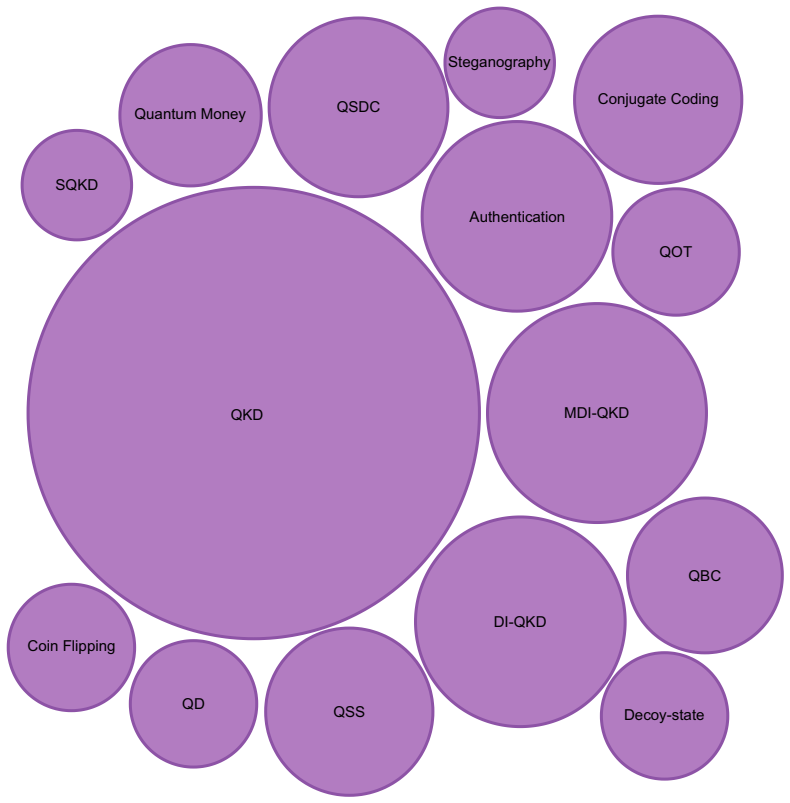
On the paper's own terms, the discovery is a corpus-level pattern: after screening 258 Scopus records down to 51 secondary studies, QKD is present in 100 percent of the selected papers, making it the most popular technique by a large margin. The review maps 15 relevant technique keywords and 12 QKD protocols, with BB84 the oldest and most frequently discussed. It further reports that the selected studies converge on the same open challenges—high implementation cost, hardware decoherence, error-correction limits, short communication distances, low key rates, and side-channel or denial-of-service vulnerabilities—and that most secondary work in the area is narrative surveys rather than fully systematic studies, with only 8 of the 51 classified as systematic or systematized.
Load-bearing premise
The reviewed corpus of 51 Scopus-indexed secondary studies, screened and classified by a single researcher, is representative enough of the quantum-cryptography review literature that the reported prevalences and gap lists describe the field rather than the sample.
Editorial extensions
If this is right
- Research attention and funding will likely keep concentrating on QKD, especially BB84 and discrete-variable variants, rather than on alternative primitives.
- Practical QKD deployment efforts should target distance, key rate, cost, error correction, and detector side-channel hardening, since these appear as the shared bottlenecks.
- Hybrid classical-quantum networks and combined PQC-plus-QKD designs are a natural next step, since QKD alone does not supply authentication or certificates.
- Because only 8 of the 51 secondary studies are fully systematic, the evidence base for claims about tendencies is largely narrative and would be strengthened by more systematic secondary studies.
- Quantum Internet, satellite-based QKD, and networked rather than point-to-point QKD emerge from the review as the rising research frontier.
Reading between the lines
- The search string itself requires "quantum cryptography" or "quantum key distribution," so the finding that every selected study mentions QKD partly reflects the inclusion filter; it is not independent evidence of QKD's real-world dominance.
- The challenge list is probably QKD-centric: QSDC, quantum money, and semi-quantum cryptography have distinct bottlenecks that a corpus dominated by QKD surveys would underrepresent.
- A direct test of the review's generalizability would be to run the same protocol on other databases and compare the keyword-frequency and open-challenge lists; divergence would point to selection bias rather than field-wide convergence.
Editorial analysis
A structured set of objections, weighed in public.
Referee Report
Summary. This paper reports a tertiary systematic review of quantum cryptography, selecting 51 secondary studies from Scopus via a defined search string and screening process. It presents bibliometric statistics, a quality/affinity scoring scheme, a list of quantum cryptography techniques and QKD protocols, and a synthesis of open challenges and future directions. The central empirical claims are that QKD is the overwhelmingly dominant technique, appearing in every selected study, and that the field's main obstacles are implementation cost, error correction, decoherence, key rates, communication distance, and quantum hacking.
Significance. If the prevalence result were valid, the paper would provide a useful high-level map of the quantum cryptography review literature and its open problems. The authors are transparent about their protocol, and the screening flow (258 to 101 to 51) is internally consistent and easy to follow. The qualitative synthesis of challenges (cost, distance, key rates, hacking, hardware limitations) is broadly supported by the cited secondary sources and is a credible contribution. However, the headline quantitative claim about QKD prevalence is substantially weakened by the construction of the search string, as detailed below; the enduring value of the paper lies more in its organized summary of challenges than in its prevalence statistics.
major comments (3)
- [Section 2, Table 1; Section 5.1; Section 7] The claim that QKD 'appeared in every selected paper' and therefore 'prevailed untouched' (Section 7, echoed in Section 5.1) is guaranteed by the inclusion criteria rather than being an empirical finding. The search string in Table 1 requires that each candidate paper contain in title, abstract, or keywords at least one of 'quantum cryptography', 'quantum key cryptography', or 'quantum key distribution'. Any paper included on the strength of the third term necessarily mentions QKD, and the corpus is also enriched for QKD-related content because 'quantum key distribution' is a more specific term than the other two. Consequently, the prevalence comparison between QKD and other techniques such as QSDC, QSS, or quantum money is not a neutral observation; it is an artifact of the sampling condition. The authors should either rephrase the conclusion as a property of the inclusion criteria, or provide a supplementary search that does not require QKD in the query before making claims about relative prevalence.
- [Section 2.3; Figure 3; Section 5.2; Figure 4] The paper reports that 15 technique keywords and 12 QKD protocol keywords were found to be relevant, but the only supporting evidence is Figures 3 and 4, which show keyword names without a corresponding frequency table or raw counts. The data extraction section states that techniques appearing in fewer than three materials were eliminated, yet the reader cannot verify the threshold application, the exact counts, or the assignment of keywords from individual references. This lack of a reproducible data table makes the central keyword-frequency analysis untestable. The authors should include a supplementary table listing each selected study, the technique keywords extracted from it, and the resulting frequency counts, or provide the extraction data in a repository.
- [Section 2.1; Section 4 (Threats to Validity)] The review's representativeness for any field-level prevalence statement is limited by the use of Scopus as the sole database, a single researcher performing both screening steps, and a subjective correlation classification. These limitations are acknowledged in Section 4, but the paper's quantitative conclusions—particularly the dominance of QKD—are stated in Section 7 without carrying those caveats forward. Since the prevalence claim is already conditioned by the search string, the cumulative effect of database and screening choices means the paper should not assert, without qualification, that the selected set reflects the broader field's emphasis. The authors should add a clear statement in the conclusion that all frequency results are relative to the specific Scopus-based, single-screener corpus, and should soften the 'prevailed untouched' phrasing accordingly.
minor comments (6)
- [Section 2.2] The quality score adds a subjective correlation score (C) and a normalized citation count (N); because C is decided by a single researcher and N conflates popularity with quality, the resulting 'affinity score' is presented with three decimal places of precision. Consider rounding to whole percent or otherwise displaying the score with fewer significant digits, and explicitly state that the score is an ordinal heuristic, not a precise measurement.
- [Section 2.1; Figure 2] The caption of Figure 2 reads 'Selection process', which is the same caption as Figure 1, but the figure appears to show a histogram of publication years. The caption should be corrected to describe the histogram content.
- [Section 5.1] There are several typographical and grammatical errors throughout, including 'tipically' (Introduction), 'Sates' in reference [55], 'Benet' in Section 5.2 (should be Bennett), 'Yamanoto' in reference [58], and 'Twin-Filed' in Section 6.2. These should be corrected before publication.
- [Section 6.4] The text states that quantum currency was 'already introduced in Section 4', but the concept is actually introduced in Section 5.1 under quantum money. This cross-reference should be updated.
- [Section 6.2] The sentence 'discrete modulation protocols are a strong alternative do gaussian modulation' contains a typo ('do' should be 'to'); also, the phrase 'the cost of implementation is very high' in Section 7 is redundant with the immediately preceding 'high cost' bullet in Section 6.5.
- [References] A few references are incomplete or inconsistent, e.g., reference [57] is marked 'unpublished' and reference [60] is also marked 'unpublished'; if these works are not published, consider citing the published versions or removing them from the protocol list. Reference [52] uses a 2014 reprint of a 1984 paper; this should be noted to avoid confusion about the original publication date.
Circularity Check
No circularity: the QKD prevalence claim is a sample observation, not a consequence of the search string by construction.
full rationale
No circular steps can be exhibited. This is a tertiary literature review whose claims are bibliometric summaries of 51 external secondary studies, not derivations from assumed inputs. The abstract's 'prevalence of QKD ... among the selected papers' and Section 7's 'QKD prevailing untouched and mentioned in every selected study' are empirical statements about the sample, and the search string in Table 1 ('quantum cryptography' OR 'quantum key cryptography' OR 'quantum key distribution') does not force them: a paper matching only 'quantum cryptography' and a survey term could enter the sample without mentioning QKD. Including QKD as one permitted keyword may enrich the sample and is a selection-bias/generalizability concern—explicitly acknowledged in Section 4—but it is not a circular reduction. There are no fitted parameters renamed as predictions, no load-bearing self-citations, no imported uniqueness theorems, and no renaming of known results. The review is self-contained with respect to circularity, so the score is 0.
Assumptions & free parameters
assumptions (4)
- domain assumption The Scopus database alone contains a representative sample of secondary studies on quantum cryptography.
- domain assumption The search string, requiring 'quantum cryptography' or 'quantum key distribution' together with survey/review terms, captures most relevant secondary studies.
- ad hoc to paper The authors' subjective classification of papers as strongly, moderately, or loosely correlated is reliable.
- ad hoc to paper Citation count is an appropriate proxy for quality in the quality score.
Cite this review
Pith. "Pith review of A tertiary review on quantum cryptography." pith.science (2026). https://pith.science/paper/W4YJAOE6
@misc{pith2026250602028,
  author       = {Pith},
  title        = {Pith review of: A tertiary review on quantum cryptography},
  year         = {2026},
  howpublished = {\url{https://pith.science/paper/W4YJAOE6}},
  note         = {Machine review of arXiv:2506.02028}
}
read the original abstract
Quantum computers impose an immense threat to system security. As a countermeasure, new cryptographic classes have been created to prevent these attacks. Technologies such as post-quantum cryptography and quantum cryptography. Quantum cryptography uses the principle of quantum physics to produce theoretically unbreakable security. This tertiary review selected 51 secondary studies from the Scopus database and presented bibliometric analysis, a list of the main techniques used in the field, and existing open challenges and future directions in quantum cryptography research. The results showed a prevalence of QKD over other techniques among the selected papers and stated that the field still faces many problems related to implementation cost, error correction, decoherence, key rates, communication distance, and quantum hacking.
Figures


Figures from the paper (1 more)

Reference graph
Works this paper leans on
-
[1]
Quantum Cryptography for Future Networks Security: A Sys- tematic Review,
Durr-E-Shahwar, M. Imran, A.B. Altamimi, W. Khan, S. Hussain, M. Alsaffar, “Quantum Cryptography for Future Networks Security: A Sys- tematic Review,” IEEE Access, vol. 12, pp. 180048–180078, 2024
work page 2024
-
[2]
S. Singh, V. Bharathi, “Quantum cryptography research over the past two decades - Review, research implications, and future directions,” AIP Conference Proceedings, vol. 2869, 2023
work page 2023
-
[3]
Secure communication in IOT-based UAV net- works: A systematic survey,
J. Sharma, P.S. Mehra, “Secure communication in IOT-based UAV net- works: A systematic survey,” Internet of Things (Netherlands), vol. 23, 2023
work page 2023
-
[4]
D. Chawla, P.S. Mehra, “A roadmap from classical cryptography to post-quantum resistant cryptography for 5G-enabled IoT: Challenges, opportunities and solutions,” Internet of Things (Netherlands), vol. 24, 2023
work page 2023
-
[5]
A SYSTEMATIC SURVEY ON CRYPTO ALGORITHMS USING QUANTUM COMPUTING,
G. Surla, R. Lakshmi, I. Thamarai, “A SYSTEMATIC SURVEY ON CRYPTO ALGORITHMS USING QUANTUM COMPUTING,” Jour- nal of Theoretical and Applied Information Technology, vol. 101, pp. 5194–5208, 2023
work page 2023
-
[6]
Structured Literature Review on Quantum Communications,
A.A. Aware, M.B. Pande, “Structured Literature Review on Quantum Communications,” 2023 7th International Conference On Computing, Communication, Control And Automation, ICCUBEA 2023, 2023
work page 2023
-
[7]
State-of-the-Art Survey of Quantum Cryptog- raphy,
A. Kumar, S. Garhwal, “State-of-the-Art Survey of Quantum Cryptog- raphy,” Archives of Computational Methods in Engineering, vol. 28, pp. 3831–3868, 2021
work page 2021
-
[8]
Quantum Cryptography Research: A Scientometric Assessment of Global Publications during 1992-2019,
B.M. Gupta, S.M. Dhawan, G.M. Mamdapur, “Quantum Cryptography Research: A Scientometric Assessment of Global Publications during 1992-2019,” Science and Technology Libraries, vol. 40, pp. 282–300, 2021
work page 1992
Show all 63 references
-
[9]
A brief review on Quantum Key Distribution Protocols,
M. Kumar, B. Mondal, “A brief review on Quantum Key Distribution Protocols,” Multimedia Tools and Applications, 2025
2025
-
[10]
Secure quantum key distribution,
H.-K. Lo, M. Curty, K. Tamaki, “Secure quantum key distribution,” Nature Photonics, vol. 8, pp. 595–604, 2014 24
2014
-
[11]
Quantum Cryptography in 5G Networks: A Comprehensive Overview,
M. Mehic, L. Michalek, E. Dervisevic, P. Burdiak, M. Plakalovic, J. Rozhon, N.Mahovac, F.Richter, E.Kaljic, F.Lauterbach, P.Njemcevic, A. Maric, M. Hamza, P. Fazio, M. Voznak, “Quantum Cryptography in 5G Networks: A Comprehensive Overview,” IEEE Communications Surveys and Tuto...
2024
-
[12]
The Evolution of Quantum Secure Direct Communication: On the Road to the Qinternet,
D. Pan, G.-L. Long, L. Yin, Y.-B. Sheng, D. Ruan, S.X. Ng, J. Lu, L. Hanzo, “The Evolution of Quantum Secure Direct Communication: On the Road to the Qinternet,” IEEE Communications Surveys and Tutorials, vol. 26, pp. 1898–1949, 2024
1949
-
[13]
Advances and Vulnerabilities in Modern Cryptographic Techniques: A Comprehensive Survey on Cybersecurity in the Domain of Machine/Deep Learning and Quantum Techniques,
A. Mehmood, A. Shafique, M. Alawida, A.N. Khan, “Advances and Vulnerabilities in Modern Cryptographic Techniques: A Comprehensive Survey on Cybersecurity in the Domain of Machine/Deep Learning and Quantum Techniques,” IEEE Access, vol. 12, pp. 27530–27555, 2024
2024
-
[14]
Advances in artificial intelligence and machine learning for quantum communication applications,
M. Mafu, “Advances in artificial intelligence and machine learning for quantum communication applications,” IET Quantum Communication, 2024
2024
-
[15]
A survey on non-terrestrial quantum networking: Challenges and trends,
F. Chiti, R. Picchi, L. Pierucci, “A survey on non-terrestrial quantum networking: Challenges and trends,” Computer Networks, vol. 252, 2024
2024
-
[16]
Quantum vs post-quantum security for future networks: Sur- vey,
S. Glisic, “Quantum vs post-quantum security for future networks: Sur- vey,” Cyber Security and Applications, vol. 2, 2024
2024
-
[17]
A Comprehensive Study on Quantum Key Distribution Protocols,
S. Mummadi, S. Fathima, “A Comprehensive Study on Quantum Key Distribution Protocols,” 2024 15th International Conference on Com- puting Communication and Networking Technologies, ICCCNT 2024, 2024
2024
-
[18]
From Coherent Communications to Quantum Security: Modern Techniques in CV- QKD,
V.L. Da Silva, M.A. Dias, N.A.F. Neto, A.B. Tacla, “From Coherent Communications to Quantum Security: Modern Techniques in CV- QKD,” 2024 SBFoton International Optics and Photonics Conference, SBFoton IOPC 2024, 2024
2024
-
[19]
A Survey of Important Issues in Quan- tum Computing and Communications,
Z. Yang, M. Zolanvari, R. Jain, “A Survey of Important Issues in Quan- tum Computing and Communications,” IEEE Communications Surveys and Tutorials, vol. 25, pp. 1059–1094, 2023 25
2023
-
[20]
A Survey of Machine Learning Assisted Continuous-Variable Quantum Key Distribution,
N.K. Long, R. Malaney, K.J. Grant, “A Survey of Machine Learning Assisted Continuous-Variable Quantum Key Distribution,” Information (Switzerland), vol. 14, 2023
2023
-
[21]
Quantum Cryptography for Enhanced Network Security: A Compre- hensive Survey of Research, Developments, and Future Directions,
M.S. Akter, J. Rodriguez-Cardenas, H. Shahriar, A. Cuzzocrea, F. Wu, “Quantum Cryptography for Enhanced Network Security: A Compre- hensive Survey of Research, Developments, and Future Directions,” Pro- ceedings - 2023 IEEE International Conference on Big Data, BigData 2023, p...
2023
-
[22]
Quantum Money : Opportunities, Challenges and Open Issues,
S. Mishra, A. Ojha, A. Aggarwal, P. Singh Mehra, “Quantum Money : Opportunities, Challenges and Open Issues,” Proceedings of the 8th International Conference on Communication and Electronics Systems, ICCES 2023, pp. 173–178, 2023
2023
-
[23]
Quantum Key Distri- bution: A Networking Perspective,
M. Mehic, M. Niemiec, S. Rass, J. Ma, M. Peev, A. Aguado, V. Martin, S. Schauer, A. Poppe, C. Pacher, M. Voznak, “Quantum Key Distri- bution: A Networking Perspective,” ACM Computing Surveys, vol. 53, 2021
2021
-
[24]
The recent trends in cyber security: A re- view,
J. Kaur, K.R. Ramkumar, “The recent trends in cyber security: A re- view,” Journal of King Saud University - Computer and Information Sciences, vol. 34, pp. 5766–5781, 2022
2022
-
[25]
Satellite-based communica- tions security: A survey of threats, solutions, and research challenges,
P. Tedeschi, S. Sciancalepore, R. DiPietro, “Satellite-based communica- tions security: A survey of threats, solutions, and research challenges,” Computer Networks, vol. 216, 2022
2022
-
[26]
Towards the industrialisation of quantum key distribution in communication net- works: A short survey,
R. Liu, G.G. Rozenman, N.K. Kundu, D. Chandra, D. De, “Towards the industrialisation of quantum key distribution in communication net- works: A short survey,” IET Quantum Communication, vol. 3, pp. 151– 163, 2022
2022
-
[27]
Quantum Cryptography-as-a-Service for Se- cure UAV Communication: Applications, Challenges, and Case Study,
V.K. Ralegankar, J. Bagul, B. Thakkar, R. Gupta, S. Tanwar, G. Sharma, I.E. Davidson, “Quantum Cryptography-as-a-Service for Se- cure UAV Communication: Applications, Challenges, and Case Study,” IEEE Access, vol. 10, pp. 1475–1492, 2022
2022
-
[28]
A Survey on Quantum Computing for Internet of Things Security,
D. Chawla, P.S. Mehra, “A Survey on Quantum Computing for Internet of Things Security,” Procedia Computer Science, vol. 218, pp. 2191– 2200, 2022 26
2022
-
[29]
Practical challenges in quantum key distribution,
E. Diamanti, H.-K. Lo, B. Qi, Z. Yuan, “Practical challenges in quantum key distribution,” npj Quantum Information, vol. 2, 2016
2016
-
[30]
Quantum Oblivious Transfer: A Short Review,
M.B. Santos, P. Mateus, A.N. Pinto, “Quantum Oblivious Transfer: A Short Review,” Entropy, vol. 24, 2022
2022
-
[31]
Quantum Key Distribution Secured Optical Networks: A Survey,
P. Sharma, A. Agrawal, V. Bhatia, S. Prakash, A.K. Mishra, “Quantum Key Distribution Secured Optical Networks: A Survey,” IEEE Open Journal of the Communications Society, vol. 2, pp. 2049–2083, 2021
2021
-
[32]
Recent Advances on Quantum Key Distribution Overcoming the Linear Secret Key Capacity Bound,
Y. Mao, P. Zeng, T.-Y. Chen, “Recent Advances on Quantum Key Distribution Overcoming the Linear Secret Key Capacity Bound,” Ad- vanced Quantum Technologies, vol. 4, 2021
2021
-
[33]
Survey of the Development of Quantum Cryp- tography and Its Applications,
D. Alvarez, Y. Kim, “Survey of the Development of Quantum Cryp- tography and Its Applications,” 2021 IEEE 11th Annual Computing and Communication Workshop and Conference, CCWC 2021, pp. 1074– 1080, 2021
2021
-
[34]
Semi-quantum cryptography,
H. Iqbal, W.O. Krawec, “Semi-quantum cryptography,” Quantum In- formation Processing, vol. 19, 2020
2020
-
[35]
Satellite- based continuous-variable quantum communications: State-of-the-art and a predictive outlook,
N. Hosseinidehaj, Z. Babar, R. Malaney, S.X. Ng, L. Hanzo, “Satellite- based continuous-variable quantum communications: State-of-the-art and a predictive outlook,” IEEE Communications Surveys and Tuto- rials, vol. 21, pp. 881–919, 2019
2019
-
[36]
A survey on quantum key distribution,
L. Gyongyosi, L. Bacsardi, “A survey on quantum key distribution,” Infocommunications Journal, vol. 11, pp. 14–21, 2019
2019
-
[37]
Survey on quantum information security,
H. Zhang, Z. Ji, H. Wang, W. Wu, “Survey on quantum information security,” China Communications, vol. 16, pp. 1–36, 2019
2019
-
[38]
Quantum Computing: Survey and Anal- ysis,
M.M. Savchuk, A.V. Fesenko, “Quantum Computing: Survey and Anal- ysis,” Cybernetics and Systems Analysis, vol. 55, pp. 10–21, 2019
2019
-
[39]
Quantum cryptography: A survey,
L. Upadhyay, “Quantum cryptography: A survey,” Advances in Intelli- gent Systems and Computing, vol. 939, pp. 20–35, 2019
2019
-
[40]
Quantum Key Distribution (QKD) Pro- tocols: A Survey,
A.I. Nurhadi, N.R. Syambas, “Quantum Key Distribution (QKD) Pro- tocols: A Survey,” Proceeding of 2018 4th International Conference on Wireless and Telematics, ICWT 2018, 2018 27
2018
-
[41]
QUANTUM-BASEDPRIVACY-PRESERVINGTECHNIQUES FOR SECURE AND TRUSTWORTHY INTERNET OF MEDICAL THINGS: AN EXTENSIVE ANALYSIS,
D. Dhinakaran, L. Srinivasan, S.M. Udhaya Sankar, D. Sel- varaj, “QUANTUM-BASEDPRIVACY-PRESERVINGTECHNIQUES FOR SECURE AND TRUSTWORTHY INTERNET OF MEDICAL THINGS: AN EXTENSIVE ANALYSIS,” Quantum Information and Computation, vol. 24, pp. 227–266, 2024
2024
-
[42]
Implementation vul- nerabilities in general quantum cryptography,
A. Huang, S. Barz, E. Andersson, V. Makarov, “Implementation vul- nerabilities in general quantum cryptography,” New Journal of Physics, vol. 20, 2018
2018
-
[43]
A survey on quantum cryptography,
L. Jian, L. Na, Z. Yu, W. Shuang, D. Wei, C. Wei, M. Wenping, “A survey on quantum cryptography,” Chinese Journal of Electronics, vol. 27, pp. 223–228, 2018
2018
-
[44]
Classical and Quantum Cryptography for Image Encryption Decryption,
H.R. Pawar, D.G. Harkut, “Classical and Quantum Cryptography for Image Encryption Decryption,” Proceedings of the 2018 3rd IEEE In- ternational Conference on Research in Intelligent and Computing in En- gineering, RICE 2018, 2018
2018
-
[45]
Quantum cryptography beyond quantum key distribution,
A. Broadbent, C. Schaffner, “Quantum cryptography beyond quantum key distribution,” Designs, Codes, and Cryptography, vol. 78, pp. 351– 382, 2016
2016
-
[46]
A comprehensive survey: Quantum cryptography,
M. Moizuddin, J. Winston, M. Qayyum, “A comprehensive survey: Quantum cryptography,” 2017 2nd International Conference on Anti- Cyber Crimes, ICACC 2017, pp. 98–102, 2017
2017
-
[47]
Quantum Cryptogra- phy and Quantum Key Distribution Protocols: A Survey,
V. Padamvathi, B.V. Vardhan, A.V.N. Krishna, “Quantum Cryptogra- phy and Quantum Key Distribution Protocols: A Survey,” Proceedings - 6th International Advanced Computing Conference, IACC 2016, pp. 556–562, 2016
2016
-
[48]
Quan- tum cryptography trends: A milestone in information security,
W.Noor-ul-Ain, M.Atta-ur-Rahman, M.Nadeem, A.G.Abbasi, “Quan- tum cryptography trends: A milestone in information security,” Ad- vances in Intelligent Systems and Computing, vol. 420, pp. 25–39, 2016
2016
-
[49]
Using quantum key distribution for cryptographic purposes: A survey,
R. Alléaume, C. Branciard, J. Bouda, T. Debuisschert, M. Dianati, N. Gisin, M. Godfrey, P. Grangier, T. Länger, N. Lütkenhaus, C. Monyk, P. Painchault, M. Peev, A. Poppe, T. Pornin, J. Rarity, R. Renner, G. Ribordy, M. Riguidel, L. Salvail, A. Shields, H. Weinfurter, A. Zeilin...
2014
-
[50]
Authenti- cation mechanism for cloud network and its fitness with quantum key distribution protocol: A survey,
R. Khalid, Z.A. Zukarnain, Z.M. Hanapi, M.A. Mohamed, “Authenti- cation mechanism for cloud network and its fitness with quantum key distribution protocol: A survey,” Journal of Theoretical and Applied Information Technology, vol. 81, pp. 51–64, 2015
2015
-
[51]
Quantum cryptography: Approaching communication secu- rity from a quantum perspective,
A. Porzio, “Quantum cryptography: Approaching communication secu- rity from a quantum perspective,” 2014 Fotonica AEIT Italian Confer- ence on Photonics Technologies, Fotonica AEIT 2014, 2014
2014
-
[52]
Quantum cryptography: Public key dis- tribution and coin tossing,
C. H. Bennett, G. Brassard, “Quantum cryptography: Public key dis- tribution and coin tossing,” Theoretical computer science, vol. 560, pp. 7–11, 2014, ISSN: 0304-3975
2014
-
[53]
QuantumcryptographybasedonBell’stheorem,
A.K.Ekert, “QuantumcryptographybasedonBell’stheorem,” Physical review letters vol. 67, pp. 661-663, August 1991
1991
-
[54]
Quantum cryptography pro- tocols robust against photon number splitting attacks for weak laser pulse implementations,
V. Scarani, A. Acin, G.Ribordy, N. Gisin, “Quantum cryptography pro- tocols robust against photon number splitting attacks for weak laser pulse implementations,” Physical Review Letters, vol. 92. February 2004
2004
-
[55]
Quantum Cryptography using any two Nonorthogonal Sates,
C. H. Bennett, “Quantum Cryptography using any two Nonorthogonal Sates,” Physical review letters vol. 68, pp.3121-3124, June 1992
1992
-
[56]
Incoherent and coherent eavesdropping in the six-state protocol of quantum cryptography,
H. B. Pasquinucci, N. Gisin, “Incoherent and coherent eavesdropping in the six-state protocol of quantum cryptography,” Physical Review Letter A59, pp. 4238-4248, 1999
1999
-
[57]
Towards practical and fast quantum cryptography,
N. Gisin et al., “Towards practical and fast quantum cryptography,” unpublished, 2004
2004
-
[58]
Differential-phase-shift quantum key distribution using coherent light,
K. Inoue, E. Waks, Y. Yamanoto, “Differential-phase-shift quantum key distribution using coherent light,” Phys.Rev. A 68, 2003
2003
-
[59]
Quantum cryptography without Bell’s theorem,
C. H. Bennett, G. Brassard, and N.D. Mermin, “Quantum cryptography without Bell’s theorem,” Physical review letters, vol. 68. pp. 557–559, 1992. 29
1992
-
[60]
Quantum Key Distribution from a random seed,
E. H. Serna, “Quantum Key Distribution from a random seed,” unpub- lished, 2013
2013
-
[61]
Overcoming the rate-distance limit of quantum key distribution without quantum repeaters,
M. Lucamarini, Z. L. Yuan, J. F. Dynes, A. J. Shields, “Overcoming the rate-distance limit of quantum key distribution without quantum repeaters,” Nature, vol. 557, no. 7705, pp. 400–403, 2018
2018
-
[62]
High error-rate quantum key distribu- tion for long-distance communication,
M. Khan, M. Murphy, A. Beige, “High error-rate quantum key distribu- tion for long-distance communication,” New Journal of Physics, 2009
2009
-
[63]
Conjugate Coding,
S. Wiesner, “Conjugate Coding,” SIGACT News, 1983. 30
1983
Reviewed August 7, 2026 · model on record in the stance chip above.
Discussion (0). Sign in to comment.