REVIEW 5 major objections 4 minor 54 references
The importance of the dynamical corotation torque for the migration of low-mass planets -- 1D analytical prescriptions verified by 2D hydrodynamical simulations
T0 review · 5 major / 4 minor · reviewed 2026-08-06 · deepseek-v4-flash
Pith's one-line read This paper shows that the dynamical corotation torque on a migrating low-mass planet can be represented in 1D planet-formation models by a single memory timescale, and finds that the torque can halve the classical type I migration speed…
desk verdict Useful 1D prescription for the dynamical corotation torque, honestly benchmarked, but its key memory coefficient is calibrated on the same 2D runs used for validation. read the letter →
The pith
A machine-rendered reading of the paper's core claim, the machinery that carries it, and where it could break.
The reading
What carries the argument
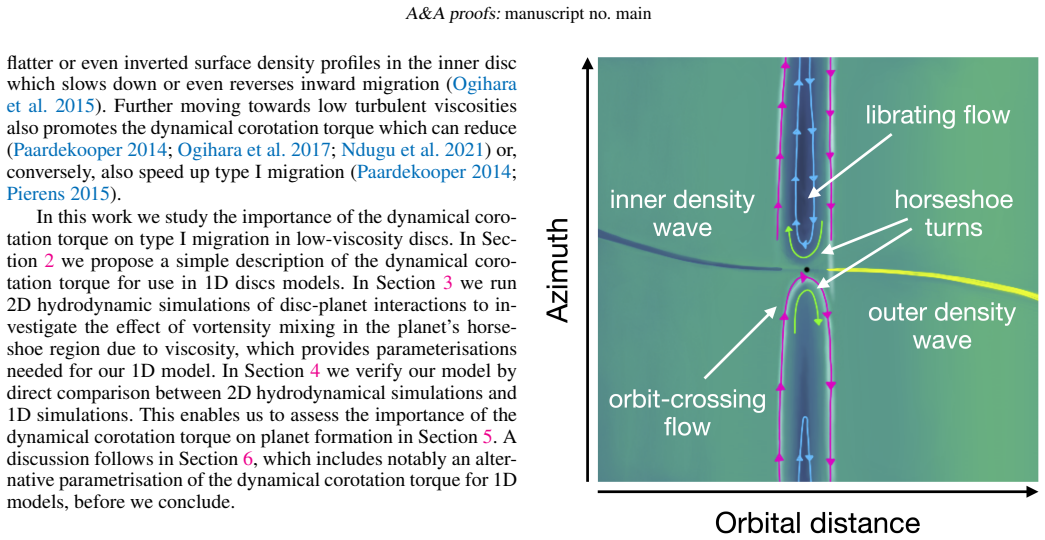
The central object is the dynamical corotation torque, written in Eq. (1) as an integral across the planet's horseshoe region — the crescent-shaped band of coorbital gas that U-turns around the planet — of the difference $I_{\nu,\mathrm{lib}} - I_{\nu,\mathrm{cross}}$ between the inverse vortensities of the librating and orbit-crossing flows, with $I_\nu = \Sigma/[(\nabla\times\mathbf{v})\cdot\mathbf{e}_z]$. The load-bearing move is the memory-time ansatz: the librating flow's inverse vortensity equals the unperturbed value at the planet's location $\tau_{\mathrm{memory}}$ earlier, so in a power-law disc $I_{\nu,\mathrm{lib}}/I_\nu(r_P) = [\min(1 - \tau_{\mathrm{memory}}/\tau_{\mathrm{mig}}, r_0/r_P)]^{3/2-\beta}$, with $\tau_{\mathrm{mig}} = r_P/\dot r_P$ the migration timescale. The single parameter $\tau_{\mathrm{memory}} = 0.4\,\tau_{\mathrm{vis}}\max(1 - \tau_{\mathrm{lib}}/2\tau_{\mathrm{vis}}, 0)$ is calibrated from 2D simulations that show $\tau_{\mathrm{memory}} \simeq 0.3$–$0.4\,\tau_{\mathrm{vis}}$; this converts a migration-history problem into a local formula that 1D models can evaluate at each timestep.
What would settle it
Rerun the 2D simulations at the paper's lowest viscosity ($\alpha_{\mathrm{vis}} = 10^{-5}$) with twice the radial and azimuthal resolution: the paper quotes a numerical-diffusion floor between $\alpha_{\mathrm{vis}} = 10^{-7}$ and $10^{-6}$ for its grid, so if the memory time inferred from Eq. (8) leaves the $0.3$–$0.4\,\tau_{\mathrm{vis}}$ band as the grid is refined, the calibration is set by the numerics rather than by physical vortensity mixing.
Extended reading notes
Core claim
The central claim is that the vortensity of the gas librating in a migrating low-mass planet's horseshoe region is, to good approximation, the unperturbed disc vortensity at the planet's position one memory time in the past, $I_{\nu,\mathrm{lib}} = I_\nu(r_P - \dot r_P \tau_{\mathrm{memory}})$, with $\tau_{\mathrm{memory}} \simeq 0.4\,\tau_{\mathrm{vis}}$ once the viscous time across the horseshoe region exceeds roughly half the libration time and zero otherwise. Here $I_\nu = \Sigma/[(\nabla\times\mathbf{v})\cdot\mathbf{e}_z]$ is the inverse vortensity and $\tau_{\mathrm{vis}} = x_s^2/\nu$ the viscous diffusion time across the horseshoe half-width $x_s$. With the orbit-crossing flow's vortensity fixed by the local density gradient, this turns the dynamical corotation torque — which normally depends on the planet's migration history — into a local formula that the authors implement in 1D disc-planet simulations and benchmark against 2D hydrodynamical simulations of locally isothermal discs. They find very good agreement for density slopes $\beta = 1/2,\,1,\,3/2,\,2$, for $\alpha_{\mathrm{vis}}$ between $10^{-3}$ and $10^{-5}$, and for Toomre parameters $Q_0$ from 8 to 32, in both the slow-down and runaway regimes. The paper concludes that global models of planet formation should include the dynamical corotation torque at $\alpha_{\mathrm{vis}} \lesssim 10^{-4}$, where it can reduce the classical type I torque by about half for a 10 Earth-mass planet at 10 au.
Load-bearing premise
The whole result rests on one premise: that the gas trapped near the planet keeps the imprint of a single earlier disc location for a fixed length of time, about 40 percent of the time viscosity takes to smooth that region, and erases the memory afterwards; if the real mixing is more complicated — through temperature gradients, three-dimensional flows, or numerical diffusion inside the simulations themselves — the 1D model's agreement with the 2D runs would be a calibration artifact rather than a physical prediction.
Editorial extensions
If this is right
- 1D global models of planet formation and evolution can evaluate the dynamical corotation torque with a closed-form prescription, with no need to track the disc's full vortensity field or the planet's migration history.
- In discs with $\alpha_{\mathrm{vis}} \lesssim 10^{-4}$ the dynamical corotation torque reduces the classical type I migration torque by up to about 50% for a 10 Earth-mass planet at 10 au, so low-mass planets survive longer in the outer disc before migrating inward.
- The same prescription also reproduces runaway inward migration for steep density slopes ($\beta > 3/2$), where the dynamical corotation torque accelerates the planet instead of slowing it down.
- The memory effect switches on only when the viscous time across the horseshoe region exceeds roughly half the libration time (near $\alpha_{\mathrm{vis}} \simeq 10^{-4}$ for the fiducial case), so above that viscosity the classical torque formulae remain adequate without any extra term.
- The published maps of the reduction factor $f_{\mathrm{red}}$ give an immediate multiplicative correction to the type I torque as a function of planet mass and orbital distance, ready for direct use in population syntheses.
Reading between the lines
- Editorial inference: if the $0.4\,\tau_{\mathrm{vis}}$ calibration survives higher-resolution tests, the same memory-time trick could be extended to discs with radiative cooling or baroclinic vortensity production, which the paper explicitly leaves out; calibrating an effective memory time there would generalise the prescription.
- Editorial inference: the 2D data show a mild dependence of $\tau_{\mathrm{memory}}/\tau_{\mathrm{vis}}$ on the migration rate, so a two-parameter fit letting the fraction depend on $\tau_{\mathrm{vis}}/|\tau_{\mathrm{mig}}|$ could remove the residual offset the paper reports at $\alpha_{\mathrm{vis}} = 10^{-5}$ in the runaway regime.
- Editorial inference: because the slow-down branch acts at several Earth masses and distances beyond roughly 10 au, population syntheses of super-Earths in wind-driven low-viscosity discs should predict a pile-up at 5–20 au; this is a checkable demographic signature for planet surveys.
- Editorial inference: the numerical-diffusion floor the paper quotes means the $\alpha_{\mathrm{vis}} = 10^{-5}$ validation runs sit close to the grid's resolving power, so applying the prescription to even lower viscosities should wait for a higher-resolution benchmark.
Editorial analysis
A structured set of objections, weighed in public.
Referee Report
Summary. The paper develops a 1D analytical prescription for the dynamical corotation torque acting on low-mass planets in low-viscosity discs. The central element is a 'memory timescale' for the vortensity of the librating horseshoe flow: the librating flow is assumed to retain the inverse vortensity from a single upstream location, with a memory timescale that is a fraction of the viscous timescale across the horseshoe region. The coefficient 0.4 in this memory timescale is estimated from 2D FARGO3D simulations, and the resulting 1D model is then compared with the same 2D runs across variations in surface-density slope beta, alpha viscosity, Toomre parameter Q0, and aspect ratio h0. The paper also presents an alternative 1D model based on a time-weighted average of initial and local vortensity, tests the model on non-isothermal temperature profiles, and produces maps of the reduction factor of the classical type I torque as a function of planet mass and orbital distance. The authors conclude that the dynamical corotation torque should be included in global planet formation models for alpha_vis below about 1e-4.
Significance. If the proposed prescription is robust, it would be a useful and immediately applicable ingredient for 1D population synthesis models, which currently often omit the dynamical corotation torque. The paper's strengths are the systematic parameter study, the explicit comparison of several 1D prescriptions against 2D hydrodynamics, the inclusion of numerical-diffusion tests in Section 6.1, and the out-of-sample checks provided by the h0=0.07 runs in Appendix A and the non-isothermal runs in Section 6.1. The reduction-factor maps in Figure 5 are a genuine practical contribution. However, the central validation is weakened by the fact that the memory coefficient is calibrated on the very simulations used for the 'verification', and by the absence of quantitative error metrics. The alternative model in Section 6.2 is stated to work comparably well, which means the specific memory-timescale form is not uniquely constrained by the migration curves.
major comments (5)
- [Sections 3.3 and 4.2, Eq. (13)] The memory timescale coefficient 0.4 in Eq. (13) is estimated in Section 3.3 from the 2D simulations shown in Fig. 4, and the same family of runs (including Q0=8, beta=1/2 and 1, alpha_vis=1e-5) is then used in Section 4.2 to validate the 1D model in Fig. 2. The claimed 'very good agreement' is therefore partly in-sample. The non-isothermal runs in Section 6.1 and the h0=0.07 runs in Appendix A are useful out-of-sample checks, but they share the same code, setup, and planet mass, and they do not test whether the value 0.4 is universal across mass or viscosity. I request an explicitly out-of-sample validation, for example with a different planet mass at fixed q/h^3 or with a viscosity value not used in the calibration, and a quantitative error metric computed for runs not used in the calibration. The abstract and conclusions should also state that 0.4 is a calibrated coefficient rather than a parameter-free prediction.
- [Section 4.2, Figs. 2 and B.1] The central claim that the 1D and 2D simulations are in 'very good agreement' is based only on visual comparison of time series. No normalized RMS difference, maximum deviation, or other quantitative metric is reported for the migration rate, orbital distance, or vortensity ratio. Because the paper explicitly claims a quantitative level of agreement, a quantitative measure should be added, along with a statement of what level of disagreement would be considered acceptable for the intended use in population synthesis.
- [Section 6.2 and Fig. 7] The alternative model of Eqs. (21)-(22), which is not based on a memory timescale, is stated to 'also work very well, overall', and in Appendix A it reproduces the h0=0.07 runs nearly perfectly. This means the migration curves do not distinguish the memory-timescale prescription from the alternative mixing model. Since the paper presents Eqs. (6) and (13) as a verified description of the physical mechanism, the authors should either provide a test that discriminates between the two models (for example, the early transient of the vortensity ratio before quasi-steady state, or a parameter regime where their predictions diverge) or explicitly temper the claim that the memory-timescale form is uniquely validated.
- [Section 4.1, Eq. (13)] The text near Eq. (13) states that 'a memory effect sets in at tau_vis ~ 2 tau_lib', but Eq. (13) gives a zero memory timescale at tau_vis = tau_lib/2 and a positive value for tau_vis > tau_lib/2. With the values quoted in Section 3.3 (tau_vis ~ 130 orbits, tau_lib ~ 100 orbits at alpha_vis=1e-4), tau_vis/tau_lib is about 1.3, so a memory effect is already present at alpha_vis=1e-4. This internal inconsistency affects the interpretation of when the dynamical corotation torque becomes important and should be corrected.
- [Section 5 and Fig. 5] The reduction-factor maps in Figure 5 vary the planet mass over a wide range, but all 2D validation simulations use a single planet-to-star mass ratio of q=1e-5 (with one additional value q=2.7e-5 in Appendix A at h0=0.07). The mass dependence of the prescription is therefore not directly tested against hydrodynamical simulations. The paper should either add 2D runs at a different q for fixed h0, or present the mass dependence in Fig. 5 as an extrapolation that has not been simulation-tested.
minor comments (4)
- [Section 2.2] The notation in Eq. (3) uses 'min[rP - rdot_P tau_memory, r0]' and then states in the text that for outward migration the minimum should be replaced by a maximum, but this is not shown in a displayed equation; adding a one-line formula for outward migration would avoid ambiguity.
- [Section 3.2.2] The measurement of I_nu,lib in the runaway regime uses a narrow azimuthal window phi-phi_p in [0.4,0.6] at r=r_p, which is a very small portion of the libration island; a brief justification of why this window is representative of the librating flow would strengthen the methodology.
- [Section 4.1] The sentence 'The default timestep is one orbit at the planet's initial location' is ambiguous: it could mean 2*pi/Omega(r0), or that a timestep is taken once per orbit. Please clarify the actual time-step control.
- [Appendix A] In Appendix A the text says 'the latter inequality is marginally fulfilled in the simulations presented here', but the inequality referred to is not explicitly identified; please restate it for clarity.
Circularity Check
Memory coefficient 0.4 in Eq. (13) is fitted to the same 2D runs used for validation, so the 'very good agreement' is partly in-sample for the low-viscosity slow-down regime.
-
fitted input called prediction
[Section 3.3 (Eq. 8, Fig. 4) -> Section 4.1 (Eq. 13) -> Section 4.2 (Fig. 2)]
"To estimate the memory timescale in our 2D simulations, we simply make use of Eq. (6)... Reversing Eq. (6) then gives τmemory = τmig × (1 − (Iν,lib/Iν(rP))^(1/(3/2−β)))... The panel also shows that the memory timescale has a mild dependence on the migration rate (via Q0), but overall τmemory ∼ [0.3−0.4]×τvis is a good match to our simulations results."
Eq. (8) inverts the model's own Eq. (6) against Iν,lib/Iν,cross measured in the 2D runs (Q0 = 8, 12, 16, 24, 32; β = 1/2 and 1; αvis = 10^-4 and 10^-5), and Section 3.3 concludes a memory timescale of about 0.4τvis. Eq. (13) imports that fitted constant: τmemory = 0.4τvis × max(1 − τlib/(2τvis), 0). Section 4.2 then claims 'very good agreement' of the 1D model against Fig. 2, which contains the very same Q0 = 8, β = 1/2 and 1, αvis = 10^-4 and 10^-5 runs used for the calibration. Since the 1D model's Iν,lib/Iν,cross (Eq. 6) is tuned to match the measured ratio through the 0.4 coefficient, the slow-down migration curves in the low-viscosity regime are partly reproduced, not predicted; the comparison is in-sample. Out-of-sample checks (β = 2 runaway, αvis = 10^-3, h0 = 0.07 in App.
full rationale
The paper is transparent about its method, stating in the Abstract that '2D hydrodynamical simulations of disc-planet interactions are used to assess the memory timescale and validate our model' and in Section 6.2 that 'the results of 2D simulations were used to estimate the memory timescale.' That dual use is the crux of the finding. The single fitted constant 0.4 in Eq. (13) controls the librating-flow vortensity, and the calibration set (Q0 = 8-32, β = 1/2 and 1, αvis = 10^-4 and 10^-5) overlaps the headline validation set (Fig. 2: Q0 = 8, β = 1/2 and 1 at those viscosities), so the central 'very good agreement' for the slow-down regime is partly in-sample. This is a genuine, though partial, case of fitted input called prediction. The circularity is not total: (i) the β = 2 runaway runs were not used to set the 0.4 coefficient, and the model reproduces them at a 'satisfactory' level; (ii) the h0 = 0.07 runs (App. A) and T ∝ r^-1 runs (Sec. 6.1) are out-of-sample in aspect ratio and temperature profile; (iii) the parameter-free alternative model (Eq. 21) independently brackets the same 2D results; and (iv) Section 6.3 benchmarks against the external Paardekooper (2014) steady-state model, showing the new form improves on the prior analytical model. The alternative model's comparable success is an under-determination concern rather than circularity, since it shows the agreement does not uniquely validate the memory-timescale mechanism. Self-citations (Baruteau & Masset 2013; Baruteau et al. 2016; Wafflard-Fernandez & Baruteau 2020) are methodological rather than load-bearing, so they do not raise the score. An honest overall assessment is 5/10: the derivation is not forced by construction, but the headline verification rests substantially on a coefficient calibrated on the very simulations used for comparison, and a fully out-of-sample test of the 0.4τvis coefficient is still needed.
Assumptions & free parameters
free parameters (2)
- Memory timescale coefficient C_mem =
0.4 (relative to τvis)
- Memory-onset cutoff factor =
1/2 (in τlib/(2τvis))
assumptions (5)
- domain assumption Keplerian, power-law background disc with Σ ∝ r^-β and no radial background velocity
- domain assumption Locally isothermal equation of state with baroclinic vortensity source neglected
- ad hoc to paper The librating flow's vortensity is set by its value at one upstream radius
- domain assumption Vortensity mixing is captured by α-viscosity diffusion across the horseshoe region
- domain assumption Fixed azimuthal windows isolate the librating and orbit-crossing flows
Cite this review
Pith. "Pith review of The importance of the dynamical corotation torque for the migration of low-mass planets -- 1D analytical prescriptions verified by 2D hydrodynamical simulations." pith.science (2026). https://pith.science/paper/W53XKJIQ
@misc{pith2026250702050,
  author       = {Pith},
  title        = {Pith review of: The importance of the dynamical corotation torque for the migration of low-mass planets -- 1D analytical prescriptions verified by 2D hydrodynamical simulations},
  year         = {2026},
  howpublished = {\url{https://pith.science/paper/W53XKJIQ}},
  note         = {Machine review of arXiv:2507.02050}
}
abstract
Recent developments suggested that planet formation occurs in regions of the discs with low turbulent viscosity. There, the dynamical corotation torque is thought to play an important role by slowing down type I migration. We aim to provide a simple analytical prescription for the dynamical corotation torque for use in 1D global models of planet formation and evolution, and assess the importance of the dynamical corotation torque for the migration of low-mass planets in low-viscosity discs. We propose simple prescriptions for calculating in 1D the time evolution of the vortensities of the librating and orbit-crossing flows around a low-mass planet, which both enter the analytical expression for the dynamical corotation torque. One of our prescriptions involves a memory timescale for the librating flow, and 2D hydrodynamical simulations of disc-planet interactions are used to assess the memory timescale and validate our model. The orbital evolution of a low-mass planet is calculated by 1D simulations where the dynamical corotation torque features our prescriptions for the vortensities of the librating and orbit-crossing flows, and by 2D hydrodynamical simulations of disc-planet interactions, assuming locally isothermal discs. We find very good agreement between the 1D and 2D simulations for a wide parameter space, whether the dynamical corotation torque slows down or accelerates inward migration. We provide maps showing how much the dynamical corotation torque reduces the classical type I migration torque as a function of planet mass and orbital distance. The reduction is about 50\% for a 10 Earth-mass planet at 10 au in a young disc with surface density profile in $r^{-1/2}$ and alpha viscosity of $10^{-4}$. In discs with low turbulent viscosity, the dynamical corotation torque should be taken into account in global models as it can strongly slow down type I migration.
Figures


Figures from the paper (5 more)


Reference graph
Works this paper leans on
-
[1]
2005, , 434, 343
Alibert , Y., Mordasini , C., Benz , W., & Winisdoerffer , C. 2005, , 434, 343
2005
- [2]
- [3]
-
[4]
Baruteau , C., Bai , X., Mordasini , C., & Molli \`e re , P. 2016, , 205, 77
work page 2016
- [5]
-
[6]
Baruteau , C. & Masset , F. 2013, in Lecture Notes in Physics, Berlin Springer Verlag, ed. J. Souchay , S. Mathis , & T. Tokieda , Vol. 861, 201
work page 2013
-
[7]
& Masset , F
Ben \' tez-Llambay , P. & Masset , F. S. 2016, , 223, 11
2016
- [8]
Show all 54 references
-
[9]
2015, , 582, A112
Bitsch , B., Lambrechts , M., & Johansen , A. 2015, , 582, A112
2015
- [10]
-
[11]
& Masset , F
Casoli , J. & Masset , F. S. 2009, , 703, 845
2009
-
[12]
O., Masset , F
Chrenko , O., Chametla , R. O., Masset , F. S., Baruteau , C., & Bro z , M. 2024, , 690, A41
2024
-
[13]
2022, in SF2A-2022: Proceedings of the Annual meeting of the French Society of Astronomy and Astrophysics, ed
Crida , A., Griveaud , P., Lega , E., et al. 2022, in SF2A-2022: Proceedings of the Annual meeting of the French Society of Astronomy and Astrophysics, ed. J. Richard , A. Siebert , E. Lagadec , N. Lagarde , O. Venot , J. Malzac , J. B. Marquette , M. N'Diaye , & B. Briot , 315--317
2022
-
[14]
G., Artymowicz , P., et al
de Val-Borro , M., Edgar , R. G., Artymowicz , P., et al. 2006, , 370, 529
2006
-
[15]
2023, in Astronomical Society of the Pacific Conference Series, Vol
Dr a \.z kowska , J., Bitsch , B., Lambrechts , M., et al. 2023, in Astronomical Society of the Pacific Conference Series, Vol. 534, Protostars and Planets VII, ed. S. Inutsuka , Y. Aikawa , T. Muto , K. Tomida , & M. Tamura , 717
2023
-
[16]
2023, , 673, A78
Emsenhuber , A., Burn , R., Weder , J., et al. 2023, , 673, A78
2023
-
[17]
2021, , 656, A69
Emsenhuber , A., Mordasini , C., Burn , R., et al. 2021, , 656, A69
2021
-
[18]
M., Benitez-Llambay , P., Miller Bertolami , M
Guilera , O. M., Benitez-Llambay , P., Miller Bertolami , M. M., & Pessah , M. E. 2023, , 953, 97
2023
-
[19]
1998, , 495, 385
Hartmann , L., Calvet , N., Gullbring , E., & D'Alessio , P. 1998, , 495, 385
1998
-
[20]
N., Dullemond , C
Kimmig , C. N., Dullemond , C. P., & Kley , W. 2020, , 633, A4
2020
-
[21]
& Ikoma , M
Kimura , T. & Ikoma , M. 2022, Nature Astronomy, 6, 1296
2022
-
[22]
Lau , T. C. H., Birnstiel , T., Dr a \.z kowska , J., & Stammler , S. M. 2024, , 688, A22
2024
-
[23]
2023, in Astronomical Society of the Pacific Conference Series, Vol
Lesur , G., Flock , M., Ercolano , B., et al. 2023, in Astronomical Society of the Pacific Conference Series, Vol. 534, Protostars and Planets VII, ed. S. Inutsuka , Y. Aikawa , T. Muto , K. Tomida , & M. Tamura , 465
2023
-
[24]
Lin , D. N. C. & Papaloizou , J. C. B. 1993, in Protostars and Planets III, ed. E. H. Levy & J. I. Lunine , 749
1993
-
[25]
2019, , 632, A7
Liu , B., Lambrechts , M., Johansen , A., & Liu , F. 2019, , 632, A7
2019
-
[26]
2000, , 141, 165
Masset , F. 2000, , 141, 165
2000
-
[27]
Masset , F. S. 2002, , 387, 605
2002
-
[28]
Masset , F. S. 2017, , 472, 4204
2017
-
[29]
Masset , F. S. & Papaloizou , J. C. B. 2003, , 588, 494
2003
-
[30]
P., Nelson , R
McNally , C. P., Nelson , R. P., & Paardekooper , S.-J. 2018, , 477, 4596
2018
-
[31]
P., Nelson , R
McNally , C. P., Nelson , R. P., Paardekooper , S.-J., & Ben \' tez-Llambay , P. 2019, , 484, 728
2019
-
[32]
P., Nelson , R
McNally , C. P., Nelson , R. P., Paardekooper , S.-J., Ben \' tez-Llambay , P., & Gressel , O. 2020, , 493, 4382
2020
-
[33]
P., Nelson , R
McNally , C. P., Nelson , R. P., Paardekooper , S.-J., Gressel , O., & Lyra , W. 2017, , 472, 1565
2017
-
[34]
2012, , 547, A111
Mordasini , C., Alibert , Y., Klahr , H., & Henning , T. 2012, , 547, A111
2012
-
[35]
M \"u ller , T. W. A., Kley , W., & Meru , F. 2012, , 541, A123
2012
-
[36]
& Inutsuka , S.-i
Muto , T. & Inutsuka , S.-i. 2009, , 701, 18
2009
-
[37]
2021, , 501, 2017
Ndugu , N., Bitsch , B., Morbidelli , A., Crida , A., & Jurua , E. 2021, , 501, 2017
2021
-
[38]
K., & Morbidelli , A
Ogihara , M., Kokubo , E., Suzuki , T. K., & Morbidelli , A. 2018, , 615, A63
2018
-
[39]
K., Morbidelli , A., & Crida , A
Ogihara , M., Kokubo , E., Suzuki , T. K., Morbidelli , A., & Crida , A. 2017, , 608, A74
2017
-
[40]
2015, , 584, L1
Ogihara , M., Morbidelli , A., & Guillot , T. 2015, , 584, L1
2015
-
[41]
Paardekooper , S. J. 2014, , 444, 2031
2014
-
[42]
J., Baruteau , C., Crida , A., & Kley , W
Paardekooper , S. J., Baruteau , C., Crida , A., & Kley , W. 2010, , 401, 1950
2010
-
[43]
J., Baruteau , C., & Kley , W
Paardekooper , S. J., Baruteau , C., & Kley , W. 2011, , 410, 293
2011
-
[44]
2015, , 454, 2003
Pierens , A. 2015, , 454, 2003
2015
-
[45]
2023, in Astronomical Society of the Pacific Conference Series, Vol
Pinte , C., Teague , R., Flaherty , K., et al. 2023, in Astronomical Society of the Pacific Conference Series, Vol. 534, Protostars and Planets VII, ed. S. Inutsuka , Y. Aikawa , T. Muto , K. Tomida , & M. Tamura , 645
2023
-
[46]
Rafikov , R. R. 2002, , 572, 566
2002
-
[47]
Shakura , N. I. & Sunyaev , R. A. 1973, in IAU Symposium, Vol. 55, X- and Gamma-Ray Astronomy, ed. H. Bradt & R. Giacconi , 155
1973
-
[48]
& Baruteau , C
Wafflard-Fernandez , G. & Baruteau , C. 2020, , 493, 5892
2020
-
[49]
& Lesur , G
Wafflard-Fernandez , G. & Lesur , G. 2023, , 677, A70
2023
-
[50]
2022, , 938, 102
Yun , H.-G., Kim , W.-T., Bae , J., & Han , C. 2022, , 938, 102
2022
-
[51]
M., & Rafikov , R
Zhu , Z., Stone , J. M., & Rafikov , R. R. 2012, , 758, L42
2012
-
[52]
P., & Paardekooper , S.-J
Ziampras , A., Nelson , R. P., & Paardekooper , S.-J. 2024 a , , 532, 351
2024
-
[53]
P., & Paardekooper , S.-J
Ziampras , A., Nelson , R. P., & Paardekooper , S.-J. 2024 b , , 528, 6130
2024
-
[54]
P., & Paardekooper , S.-J
Ziampras , A., Nelson , R. P., & Paardekooper , S.-J. 2025, arXiv e-prints, arXiv:2502.18564
2025 arXiv
Reviewed August 6, 2026 · model on record in the stance chip above.
Discussion (0). Sign in to comment.