REVIEW 1 major objections 1 minor 1 cited by
StringSpinner 2.0: Enabling quark spin effects in PYTHIA for $e^+e^-$ annihilation
T0 review · 1 major / 1 minor · reviewed 2026-06-26 · grok-4.3
Pith's one-line read StringSpinner 2.0 adds joint spin density matrices to PYTHIA so that quark spin correlations propagate through string fragmentation in e+e- annihilation.
desk verdict This is a clean code extension that adds e+e- support and joint density matrix handling to the existing StringSpinner string+3P0 implementation in PYTHIA. read the letter →
The pith
A machine-rendered reading of the paper's core claim, the machinery that carries it, and where it could break.
The reading
What carries the argument
The joint spin density matrix of the q qbar pair, whose elements are updated at each string break according to the string+3P0 model's production amplitudes for mesons.
What would settle it
If the polar-angle dependence of the Collins asymmetry for back-to-back pions generated by the package deviates significantly from the measured data while all other inputs remain fixed, the propagation rules or the chosen density-matrix parametrization would be shown to be insufficient.
Extended reading notes
Core claim
The updated package implements the string+3P0 model rules for propagating a user-defined joint spin density matrix of the q qbar pair along the fragmentation chain, allowing simulation of spin effects including Collins and Artru-Collins asymmetries for pseudoscalar and vector mesons produced in e+e- annihilation at leading order.
Load-bearing premise
Spin correlations between the initial quark and antiquark can be completely captured by a single joint density matrix and then transferred step-by-step using only the local production rules of the string+3P0 model.
Editorial extensions
If this is right
- The package now generates events that exhibit the Collins asymmetry and the Artru-Collins asymmetry at leading order.
- Any spin-dependent observable predicted by the string+3P0 model can be studied by supplying a custom joint density matrix for the q qbar pair.
- The implementation covers both pseudoscalar and vector meson production during string fragmentation.
Reading between the lines
- The same machinery could be used to explore how initial spin correlations affect the transverse momentum distributions of hadrons in e+e- events.
- If the density matrix is taken from a different production mechanism, the package would allow direct comparison of competing models of quark spin transfer.
Signed reviews
Editorial analysis
A structured set of objections, weighed in public.
Referee Report
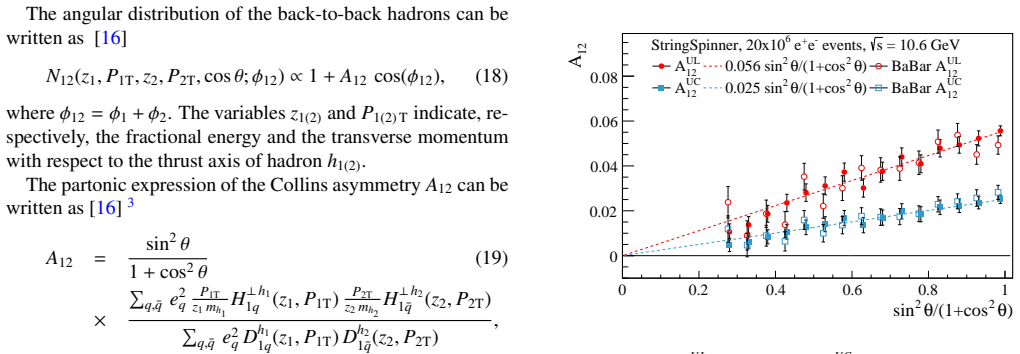
Summary. The manuscript presents StringSpinner 2.0, an extension of the StringSpinner package that implements quark spin effects in PYTHIA for the process e⁺e⁻ → q q̄ → hadrons at leading order. Spin correlations are encoded in a user-defined joint spin density matrix for the initial q q̄ pair and propagated through the string fragmentation chain according to the rules of the string+³P₀ model, with explicit implementations for both pseudoscalar and vector meson production. The package is shown to enable simulation of spin asymmetries such as the Collins and Artru-Collins asymmetries; its usage is illustrated by a comparison of the polar-angle dependence of the Collins asymmetry for back-to-back pions against existing data.
Significance. If the implementation is correct, the work supplies a publicly released Monte Carlo tool that allows systematic exploration of spin-dependent hadronization effects in e⁺e⁻ annihilation with arbitrary initial q q̄ spin correlations. This is useful for phenomenology because it connects the string+³P₀ framework directly to observable asymmetries and supplies an external data anchor for at least the Collins case.
major comments (1)
- [Abstract] Abstract (final paragraph): the polar-angle dependence of the Collins asymmetry is compared with data, yet the manuscript supplies neither the numerical values chosen for the elements of the joint spin density matrix nor any quantitative measure (χ², pull distribution, or uncertainty band) of the agreement. Because this comparison is presented as the principal demonstration that the spin-propagation rules function correctly, the absence of these details is load-bearing for the central claim.
minor comments (1)
- The abstract refers to 'the new version of the package' while the title uses 'StringSpinner 2.0'; a single consistent versioning statement would improve clarity.
Simulated Author's Rebuttal
We thank the referee for the careful review and positive recommendation. We address the single major comment below.
read point-by-point responses
-
Referee: [Abstract] Abstract (final paragraph): the polar-angle dependence of the Collins asymmetry is compared with data, yet the manuscript supplies neither the numerical values chosen for the elements of the joint spin density matrix nor any quantitative measure (χ², pull distribution, or uncertainty band) of the agreement. Because this comparison is presented as the principal demonstration that the spin-propagation rules function correctly, the absence of these details is load-bearing for the central claim.
Authors: We agree that the specific numerical values of the joint spin density matrix elements used for the Collins asymmetry comparison, together with a quantitative measure of agreement, should be stated explicitly. In the revised manuscript we will add these values (taken from the string+³P₀ model parameters already employed in the code) to the results section and report a χ² per degree of freedom for the polar-angle dependence shown in the figure. This change will be reflected in an updated abstract as well. revision: yes
Circularity Check
No significant circularity: implementation of established model with external data anchor
full rationale
The manuscript extends an existing StringSpinner package by implementing propagation rules for a user-defined joint spin density matrix of the q qbar pair through the string+3P0 fragmentation chain, for both pseudoscalar and vector mesons. The central claim is the correctness of this software implementation for producing observables such as Collins and Artru-Collins asymmetries. A direct comparison of the resulting polar-angle dependence against existing data supplies an external benchmark. No derivation reduces by construction to fitted inputs, no self-definitional equations appear, and no load-bearing uniqueness theorem or ansatz is imported via self-citation. The work is self-contained as a released code package whose predictions are not forced by its own inputs.
Assumptions & free parameters
assumptions (1)
- domain assumption Rules of the string+3P0 model govern propagation of spin correlations along the fragmentation chain for pseudoscalar and vector mesons
Cite this review
Pith. "Pith review of StringSpinner 2.0: Enabling quark spin effects in PYTHIA for $e^+e^-$ annihilation." pith.science (2026). https://pith.science/paper/W5AD3EUY
@misc{pith2026260627162,
  author       = {Pith},
  title        = {Pith review of: StringSpinner 2.0: Enabling quark spin effects in PYTHIA for $e^+e^-$ annihilation},
  year         = {2026},
  howpublished = {\url{https://pith.science/paper/W5AD3EUY}},
  note         = {Machine review of arXiv:2606.27162}
}
abstract
The StringSpinner package, which implements quark spin effects in the PYTHIA event generator using the string+${}^3P_0$ model of hadronization, is extended to handle the process $e^+e^-\rightarrow q\bar{q} \rightarrow hadrons$ at leading order. The correlations between the spin states of the $q\bar{q}$ pair produced in the reaction are described by a joint spin density matrix. The spin correlations are propagated along the string fragmentation chain by using the rules of the string+${}^3P_0$ model and are implemented for the production of pseudoscalar and vector mesons. The new version of the package can be used to simulate spin effects in $e^+e^-$ annihilation like the Collins and the Artru-Collins asymmetries. It can also be applied to the study of other spin effects in hadronization predicted by the string+${}^3P_0$ model with a user-defined joint spin density matrix of the $q\bar{q}$ pair. To showcase the usage of the package the polar angle dependence of the Collins asymmetries for back-to-back pions is studied and compared with the available data.
Figures
Forward citations
Cited by 1 Pith paper
-
Transverse Charge Distribution as a Probe of Nucleon Transversity
A charge-flow measurement built only from track angles and charge signs contains a leading-twist chiral-odd dipole that matches the charge-weighted Collins moment, giving enhanced transversity-sensitive asymmetries.
Reference graph
Works this paper leans on
-
[1]
A. Kerbizi, L. Lönnblad, StringSpinner - adding spin to the PYTHIA string fragmentation, Comput. Phys. Com- mun. 272 (2022) 108234.arXiv:2105.09730,doi: 10.1016/j.cpc.2021.108234
-
[2]
A. Kerbizi, L. Lönnblad, Extending StringSpinner to han- dle vector-meson spin, Comput. Phys. Commun. 292 (2023) 108886.arXiv:2305.05058,doi:10.1016/j. cpc.2023.108886
work page doi:10.1016/j 2023
-
[3]
A. Kerbizi, X. Artru, A. Martin, Production of vector mesons in the String+ 3P0 model of polarized quark frag- mentation, Phys. Rev. D 104 (11) (2021) 114038.arXiv: 2109.06124,doi:10.1103/PhysRevD.104.114038
-
[4]
J. C. Collins, Fragmentation of transversely polarized quarks probed in transverse momentum distributions, Nucl. Phys. B 396 (1993) 161–182.arXiv:hep-ph/ 9208213,doi:10.1016/0550-3213(93)90262-N
-
[5]
J. C. Collins, S. F. Heppelmann, G. A. Ladinsky, Mea- suring transversity densities in singly polarized hadron hadron and lepton - hadron collisions, Nucl. Phys. B 420 (1994) 565–582.arXiv:hep-ph/9305309,doi: 10.1016/0550-3213(94)90078-7
work page Pith review arXiv doi:10.1016/0550-3213(94)90078-7 1994
-
[6]
R. L. Jaffe, X.-m. Jin, J. Tang, Interference fragmentation functions and the nucleon’s transversity, Phys. Rev. Lett. 80 (1998) 1166–1169.arXiv:hep-ph/9709322,doi: 10.1103/PhysRevLett.80.1166
work page Pith review arXiv doi:10.1103/physrevlett.80.1166 1998
-
[7]
A. Bianconi, S. Boffi, R. Jakob, M. Radici, Two hadron in- terference fragmentation functions. Part 1. General frame- work, Phys. Rev. D 62 (2000) 034008.arXiv:hep-ph/ 9907475,doi:10.1103/PhysRevD.62.034008
-
[8]
Recursive model for the fragmentation of polarized quarks
A. Kerbizi, X. Artru, Z. Belghobsi, F. Bradamante, A. Martin, Recursive model for the frag- mentation of polarized quarks, Phys. Rev. D 97 (7) (2018) 074010.arXiv:1802.00962, doi:10.1103/PhysRevD.97.074010
work page Pith review arXiv doi:10.1103/physrevd.97.074010 2018
Show all 29 references
-
[9]
Adolph, et al., Collins and Sivers asymmetries in muonproduction of pions and kaons offtransversely polarised protons, Phys
C. Adolph, et al., Collins and Sivers asymmetries in muonproduction of pions and kaons offtransversely polarised protons, Phys. Lett. B 744 (2015) 250–259. arXiv:1408.4405,doi:10.1016/j.physletb.2015. 03.056
-
[10]
The COMPASS collaboration, Collins and Sivers transverse-spin asymmetries in inclusive muoproduction ofρ 0 mesons, CERN-EP-2022-234 .arXiv:2211. 00093
2022
-
[11]
Airapetian, et al., Effects of transversity in deep- inelastic scattering by polarized protons, Phys
A. Airapetian, et al., Effects of transversity in deep- inelastic scattering by polarized protons, Phys. Lett. B 693 (2010) 11–16.arXiv:1006.4221,doi:10.1016/ j.physletb.2010.08.012
2010 arXiv
-
[12]
Adolph, et al., A high-statistics measurement of transverse spin effects in dihadron production from muon–proton semi-inclusive deep-inelastic scattering, Phys
C. Adolph, et al., A high-statistics measurement of transverse spin effects in dihadron production from muon–proton semi-inclusive deep-inelastic scattering, Phys. Lett. B 736 (2014) 124–131.arXiv:1401.7873, doi:10.1016/j.physletb.2014.06.080
-
[13]
T. B. Hayward, et al., Observation of Beam Spin Asym- metries in the Processep→e ′ π+π−Xwith CLAS12, Phys. Rev. Lett. 126 (2021) 152501.arXiv:2101. 04842,doi:10.1103/PhysRevLett.126.152501
2021 doi
-
[14]
Kerbizi, X
A. Kerbizi, X. Artru, Model for baryon production in spin-dependent string fragmentation, Phys. Rev. D 113 (3) (2026) 034007.arXiv:2507.06810,doi:10.1103/ 7dd2-61z8
2026
- [15]
- [16]
- [17]
-
[18]
Seidl, et al., Measurement of Azimuthal Asymmetries in Inclusive Production of Hadron Pairs ine +e− Annihila- tion at √s=10.58-GeV, Phys
R. Seidl, et al., Measurement of Azimuthal Asymmetries in Inclusive Production of Hadron Pairs ine +e− Annihila- tion at √s=10.58-GeV, Phys. Rev. D 78 (2008) 032011, [Erratum: Phys.Rev.D 86, 039905 (2012)].arXiv:0805. 2975,doi:10.1103/PhysRevD.78.032011. 8
2008 doi
-
[19]
Li, et al., Azimuthal asymmetries of back-to-back π± −(π 0, η, π±) pairs ine +e− annihilation, Phys
H. Li, et al., Azimuthal asymmetries of back-to-back π± −(π 0, η, π±) pairs ine +e− annihilation, Phys. Rev. D 100 (9) (2019) 092008.arXiv:1909.01857,doi: 10.1103/PhysRevD.100.092008
2019 doi
- [20]
- [21]
-
[22]
Ablikim, et al., Measurement of azimuthal asymme- tries in inclusive charged dipion production ine +e− an- nihilations at √s=3.65 GeV, Phys
M. Ablikim, et al., Measurement of azimuthal asymme- tries in inclusive charged dipion production ine +e− an- nihilations at √s=3.65 GeV, Phys. Rev. Lett. 116 (4) (2016) 042001.arXiv:1507.06824,doi:10.1103/ PhysRevLett.116.042001
2016 arXiv
-
[23]
V ossen, et al., Observation of transverse polariza- tion asymmetries of charged pion pairs ine +e− anni- hilation near √s=10.58 GeV, Phys
A. V ossen, et al., Observation of transverse polariza- tion asymmetries of charged pion pairs ine +e− anni- hilation near √s=10.58 GeV, Phys. Rev. Lett. 107 (2011) 072004.arXiv:1104.2425,doi:10.1103/ PhysRevLett.107.072004
2011 arXiv
-
[24]
Kerbizi, X
A. Kerbizi, X. Artru, String fragmentation of a quark pair with entangled spin states: Application toe +e− annihi- lation, Phys. Rev. D 109 (5) (2024) 054029.arXiv: 2312.14694,doi:10.1103/PhysRevD.109.054029
2024 doi
-
[25]
Kerbizi, L
A. Kerbizi, L. Lönnblad, A. Martin, Quark spin effects ine +e− annihilation: A Monte Carlo event generator study, Phys. Rev. D 110 (7) (2024) 074029.arXiv: 2407.07706,doi:10.1103/PhysRevD.110.074029
2024 doi
-
[26]
J. C. Collins, Spin Correlations in Monte Carlo Event Generators, Nucl. Phys. B 304 (1988) 794–804.doi: 10.1016/0550-3213(88)90654-2
1988 doi
-
[27]
I. G. Knowles, Spin Correlations in Parton - Parton Scat- tering, Nucl. Phys. B 310 (1988) 571–588.doi:10. 1016/0550-3213(88)90092-2
1988
- [28]
-
[29]
Buckley, C
A. Buckley, C. Gutchov, A. Kerbizi, L. Lönnblad, in preparation. 9
Reviewed June 26, 2026 · model on record in the stance chip above.
Discussion (0). Continue with ORCID to comment.