Bloch-to-N\'eel domain wall transition evinced through morphology of magnetic bubble expansion in Ta/CoFeB/MgO layers
Pith reviewed 2026-05-25 00:53 UTC · model grok-4.3
The pith
Helium ion irradiation transforms Bloch domain walls into Néel walls in Ta/CoFeB/MgO films, shown by the shape of expanding magnetic bubbles.
A machine-rendered reading of the paper's core claim, the machinery that carries it, and where it could break.
Core claim
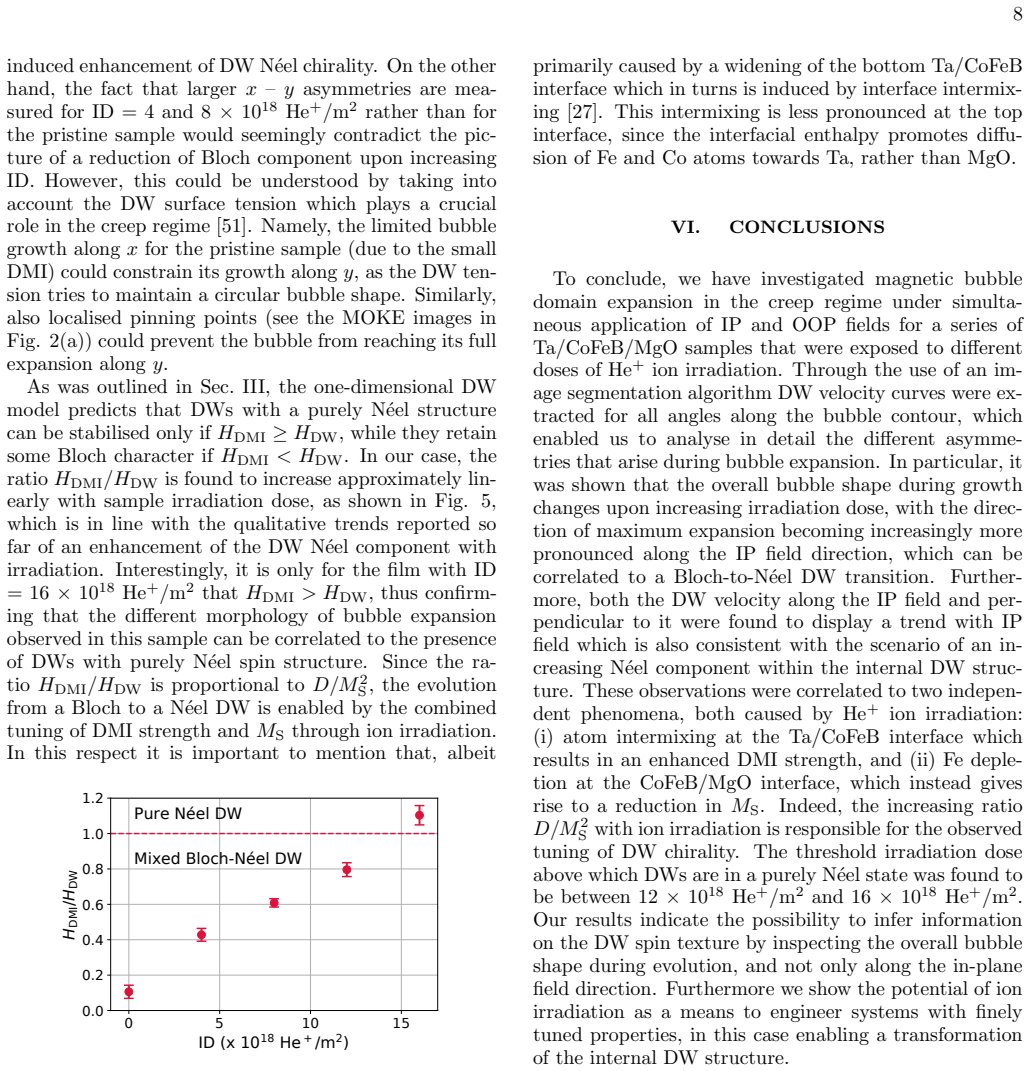
He+ ion irradiation induces a transition of the internal domain wall structure towards a fully Néel spin texture. This transition can be correlated to a simultaneous increase in DMI strength and reduction in saturation magnetisation, which are a direct consequence of the effects of ion irradiation on the bottom and top CoFeB interfaces, respectively. The threshold irradiation dose above which DWs acquire a pure Néel character is experimentally found to be between 12 × 10^18 He+/m² and 16 × 10^18 He+/m², matching estimations from the one dimensional DW model based on material parameters. The results indicate that evaluating the global bubble shape during its expansion can be an effective tool
What carries the argument
The global shape of a magnetic bubble expanding under combined in-plane and out-of-plane fields, serving as a proxy for whether its domain wall has Bloch or Néel internal spin texture.
Load-bearing premise
The overall shape taken by an expanding magnetic bubble under combined fields directly reflects the internal Bloch or Néel character of its domain wall without major interference from pinning or stray fields.
What would settle it
High-resolution imaging of domain-wall magnetization direction on samples irradiated at doses straddling the 12–16 × 10^18 He+/m² threshold would directly confirm or refute the claimed transition to pure Néel texture.
Figures
read the original abstract
Ta/CoFeB/MgO trilayers with perpendicular magnetic anisotropy are often characterised by vanishing or modest values of interfacial Dzyaloshinskii-Moriya interaction (DMI), which results in purely Bloch or mixed Bloch-N\'eel domain walls (DWs). Here we investigate the creep evolution of the overall magnetic bubble morphology in these systems under the combined presence of in-plane and out-of-plane magnetic fields and we show that He$^+$ ion irradiation induces a transition of the internal DW structure towards a fully N\'eel spin texture. This transition can be correlated to a simultaneous increase in DMI strength and reduction in saturation magnetisation -- which are a direct consequence of the effects of ion irradiation on the bottom and top CoFeB interfaces, respectively. The threshold irradiation dose above which DWs acquire a pure N\'eel character is experimentally found to be between 12 $\times$ 10$^{18}$ He$^+$/m$^2$ and 16 $\times$ 10$^{18}$ He$^+$/m$^2$, matching estimations from the one dimensional DW model based on material parameters. Our results indicate that evaluating the global bubble shape during its expansion can be an effective tool to sense the internal bubble DW structure. Furthermore, we show that ion irradiation can be used to achieve post-growth engineering of a desired DW spin texture.
Editorial analysis
A structured set of objections, weighed in public.
Referee Report
Summary. The paper claims that He+ ion irradiation in Ta/CoFeB/MgO trilayers induces a Bloch-to-Néel domain wall transition, observed via changes in the asymmetry of expanding magnetic bubbles under combined in-plane (Hx) and out-of-plane (Hz) fields. This is correlated with irradiation-driven increase in DMI and decrease in Ms, with the threshold dose (between 12 and 16 × 10^18 He+/m²) matching predictions from a one-dimensional domain wall model based on the measured material parameters. The work positions bubble morphology as a proxy for internal DW spin texture and ion irradiation as a post-growth engineering tool.
Significance. If the bubble expansion morphology reliably reports the internal DW structure without dominant confounding, the result offers a practical route to tune DW chirality after growth and a diagnostic for DW type via creep dynamics. This would be relevant for DMI-based spintronic devices, as it links interface modification by irradiation to both DMI enhancement and Ms reduction while providing an experimental handle on the Bloch-Néel transition.
major comments (2)
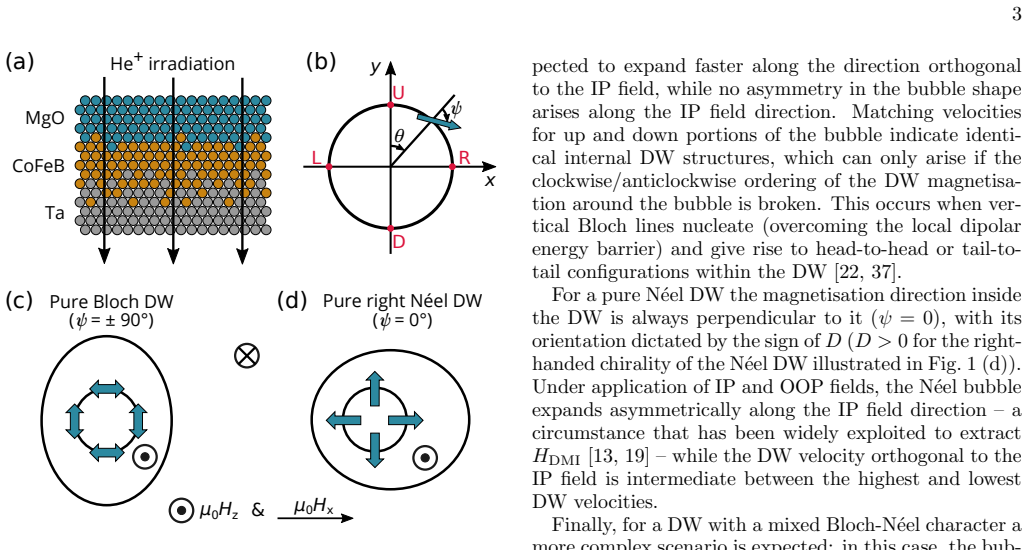
- [threshold dose comparison and 1D DW model] The central interpretation equates observed changes in bubble asymmetry with a transition to pure Néel walls driven by DMI. However, the 1D model comparison (threshold dose section) uses only measured DMI and Ms values and does not test whether equivalent shape evolution can be reproduced when wall type is held fixed while pinning strength or effective anisotropy are varied to match the irradiated samples. This leaves the proxy assumption load-bearing and untested against the simultaneous irradiation effects on defect density and demagnetizing fields.
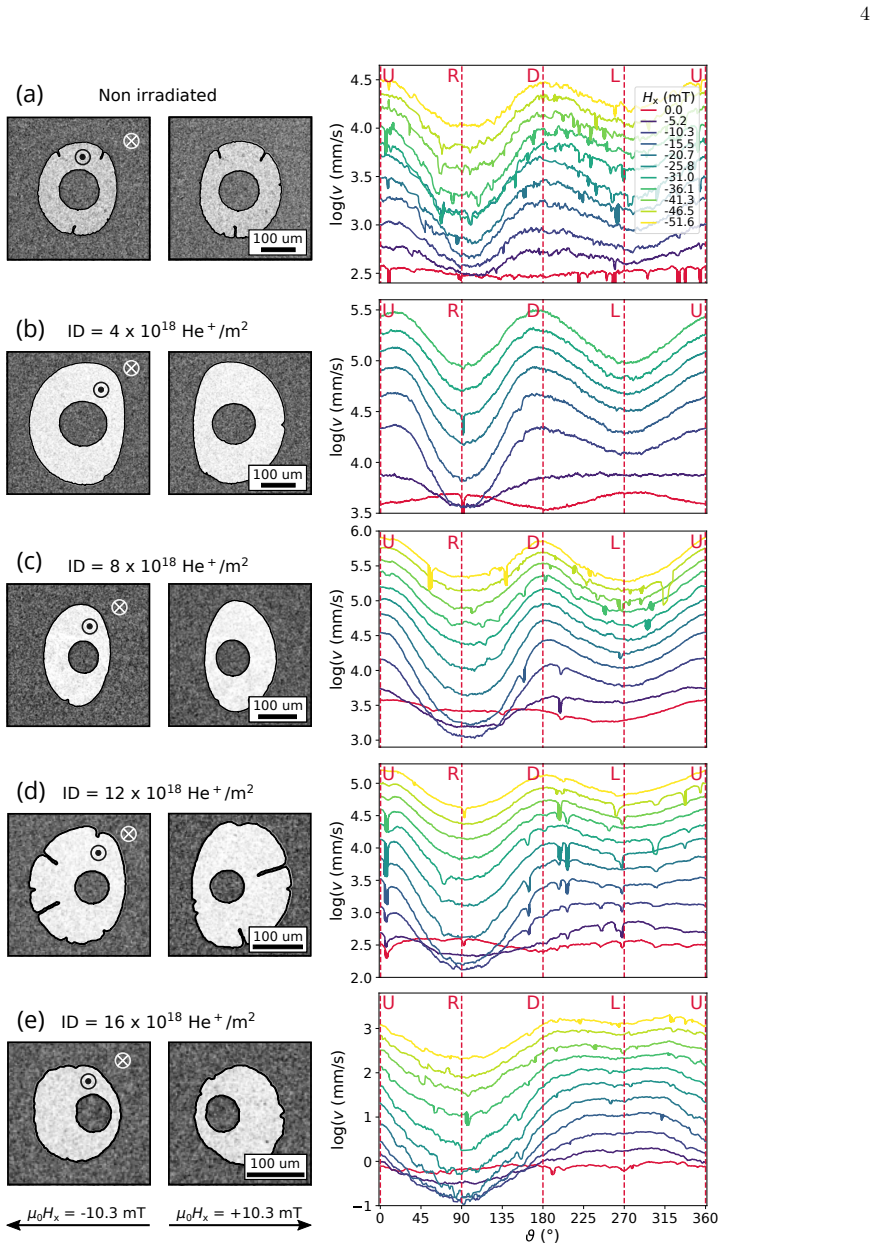
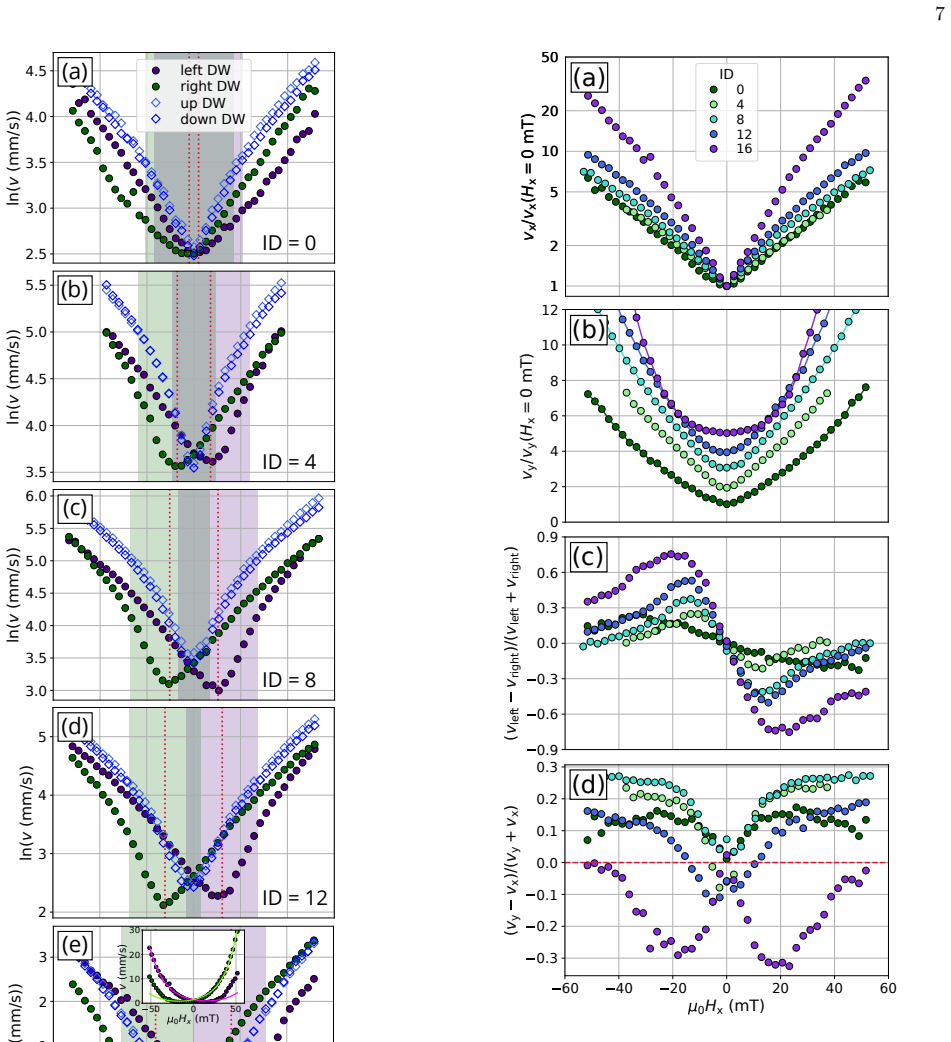
- [experimental results on bubble morphology] The experimental claim that bubble shape under combined Hx and Hz fields serves as a reliable proxy for DW internal structure requires explicit quantification details (error bars on asymmetry metrics, criteria for fitting bubble contours, and checks for pinning-induced directionality) to confirm that post-hoc analysis choices do not drive the reported correlation with the model.
minor comments (1)
- [abstract] The abstract states the threshold range but does not specify the full set of doses investigated or the number of samples per dose; adding this would clarify the sampling of the transition.
Simulated Author's Rebuttal
We thank the referee for their thorough and constructive review of our manuscript. We provide point-by-point responses to the major comments below, indicating where revisions have been made to address the concerns.
read point-by-point responses
-
Referee: [threshold dose comparison and 1D DW model] The central interpretation equates observed changes in bubble asymmetry with a transition to pure Néel walls driven by DMI. However, the 1D model comparison (threshold dose section) uses only measured DMI and Ms values and does not test whether equivalent shape evolution can be reproduced when wall type is held fixed while pinning strength or effective anisotropy are varied to match the irradiated samples. This leaves the proxy assumption load-bearing and untested against the simultaneous irradiation effects on defect density and demagnetizing fields.
Authors: The 1D domain wall model determines the critical DMI for the Bloch-Néel transition from the condition where the DMI energy overcomes the magnetostatic energy cost of the Néel configuration, using the measured Ms and effective perpendicular anisotropy Keff. The observed bubble asymmetry under Hx + Hz is a direct signature of the chiral Néel wall, as the in-plane field couples to the wall magnetization to favor expansion in one direction only for Néel walls. While pinning and demagnetization change with irradiation, these affect the creep rate uniformly but do not introduce a directional bias that would mimic the asymmetry transition. The fact that the morphology change occurs precisely at the dose where the model predicts the transition, based on independently measured DMI and Ms, supports our interpretation. We have added a discussion section addressing potential confounding effects from defect density and demagnetizing fields in the revised manuscript. revision: partial
-
Referee: [experimental results on bubble morphology] The experimental claim that bubble shape under combined Hx and Hz fields serves as a reliable proxy for DW internal structure requires explicit quantification details (error bars on asymmetry metrics, criteria for fitting bubble contours, and checks for pinning-induced directionality) to confirm that post-hoc analysis choices do not drive the reported correlation with the model.
Authors: We appreciate this suggestion for improving the experimental details. In the revised version, we now include error bars on all asymmetry data points, derived from the standard deviation across at least five independent bubbles per irradiation dose and field condition. The bubble contours are fitted using an elliptical model to the isointensity lines from polar MOKE images, with the asymmetry metric defined as (r_forward - r_backward)/r_average along the Hx axis. To rule out pinning-induced artifacts, we have added data showing that the asymmetry reverses with Hx sign and is consistent across different sample regions with varying pinning landscapes. These additions ensure the robustness of the proxy. revision: yes
Circularity Check
No circularity: experimental measurements compared to standard 1D model
full rationale
The paper reports experimental observations of bubble expansion morphology under irradiation, with material parameters (DMI, Ms) measured independently. The threshold dose is stated to match estimates from the standard one-dimensional domain wall model using those measured parameters; no derivation, ansatz, or prediction is constructed from the same data set by definition. No self-citation chains or fitted-input renamings appear in the load-bearing steps. This is the normal case for an experimental materials paper whose central claim rests on direct measurement rather than internal algebraic reduction.
Axiom & Free-Parameter Ledger
Reference graph
Works this paper leans on
-
[1]
based on the measured materials parameters. Our results indicate the importance of evaluating the overall bubble domain morphology to extract information on the internal DW texture. Furthermore, we demonstrate that interface engineering can be used to tailor the DW struc- ture via post-growth ion irradiation, opening new routes for designing spintronics d...
- [2]
- [3]
-
[4]
U. K. R¨ oßler, A. N. Bogdanov, and C. Pfleiderer, Nature 442, 797 (2006)
work page 2006
-
[5]
S. M¨ uhlbauer, B. Binz, F. Jonietz, C. Pfleiderer, A. Rosch, A. Neubauer, R. Georgii, and P. B¨ oni, Science 323, 915 (2009)
work page 2009
-
[6]
X. Z. Yu, Y. Onose, N. Kanazawa, J. H. Park, J. H. Han, Y. Matsui, N. Nagaosa, and Y. Tokura, Nature 465, 901 (2010)
work page 2010
- [7]
- [8]
-
[9]
K.-S. Ryu, L. Thomas, S.-H. Yang, and S. Parkin, Nature Nanotechnology 8, 527 EP (2013), article
work page 2013
-
[10]
C. Moreau-Luchaire, C. Moutafis, N. Reyren, J. Sampaio, C. A. F. Vaz, N. Van Horne, K. Bouzehouane, K. Garcia, C. Deranlot, P. Warnicke, P. Wohlh¨ uter, J.-M. George, M. Weigand, J. Raabe, V. Cros, and A. Fert, Nature Nanotechnology 11, 444 (2016)
work page 2016
-
[11]
M. Bode, M. Heide, K. von Bergmann, P. Ferriani, S. Heinze, G. Bihlmayer, A. Kubetzka, O. Pietzsch, S. Bl¨ ugel, and R. Wiesendanger, Nature447, 190 (2007)
work page 2007
-
[12]
A. Thiaville, S. Rohart, ´E. Ju´ e, V. Cros, and A. Fert, Europhysics Letters 100, 57002 (2012)
work page 2012
-
[13]
S.-H. Yang, K.-S. Ryu, and S. Parkin, Nature Nanotech- nology 10, 221 (2015)
work page 2015
- [14]
-
[15]
J. Torrejon, J. Kim, J. Sinha, S. Mitani, M. Hayashi, M. Yamanouchi, and H. Ohno, Nature Communications 5, 4655 (2014)
work page 2014
-
[16]
J. H. Franken, M. Herps, H. J. M. Swagten, and B. Koop- mans, Scientific Reports 4, 5248 (2014)
work page 2014
-
[17]
M. J. Benitez, A. Hrabec, A. P. Mihai, T. A. Moore, G. Burnell, D. McGrouther, C. H. Marrows, and S. McVi- tie, Nature Communications 6, 8957 (2015), article
work page 2015
-
[18]
H. T. Nembach, J. M. Shaw, M. Weiler, E. Ju´ e, and T. J. Silva, Nature Physics 11, 825 (2015)
work page 2015
-
[19]
S. Woo, K. Litzius, B. Kr¨ uger, M.-Y. Im, L. Caretta, K. Richter, M. Mann, A. Krone, R. M. Reeve, M. Weigand, P. Agrawal, I. Lemesh, M.-A. Mawass, P. Fischer, M. Kl¨ aui, and G. S. D. Beach, Nature Ma- terials 15, 501 (2016)
work page 2016
- [20]
-
[21]
R. Lavrijsen, D. M. F. Hartmann, A. van den Brink, Y. Yin, B. Barcones, R. A. Duine, M. A. Verheijen, H. J. M. Swagten, and B. Koopmans, Phys. Rev. B 91, 104414 (2015)
work page 2015
-
[22]
A. W. J. Wells, P. M. Shepley, C. H. Marrows, and T. A. Moore, Phys. Rev. B 95, 054428 (2017)
work page 2017
-
[23]
G. Chen, T. Ma, A. T. N’Diaye, H. Kwon, C. Won, Y. Wu, and A. K. Schmid, Nature Communications 4, 2671 (2013)
work page 2013
- [24]
-
[25]
A. Cao, X. Zhang, B. Koopmans, S. Peng, Y. Zhang, Z. Wang, S. Yan, H. Yang, and W. Zhao, Nanoscale 10, 12062 (2018)
work page 2018
-
[26]
R. A. Khan, P. M. Shepley, A. Hrabec, A. W. J. Wells, B. Ocker, C. H. Marrows, and T. A. Moore, Applied Physics Letters 109, 132404 (2016)
work page 2016
-
[27]
A. L. Balk, K.-W. Kim, D. T. Pierce, M. D. Stiles, J. Un- guris, and S. M. Stavis, Phys. Rev. Lett. 119, 077205 (2017)
work page 2017
-
[28]
L. Herrera Diez, M. Voto, A. Casiraghi, M. Belmegue- nai, Y. Roussign´ e, G. Durin, A. Lamperti, R. Mantovan, V. Sluka, V. Jeudy, Y. T. Liu, A. Stashkevich, S. M. Ch´ erif, J. Langer, B. Ocker, L. Lopez-Diaz, and D. Rav- elosona, Phys. Rev. B 99, 054431 (2019)
work page 2019
-
[29]
L. Herrera Diez, F. Garc´ ıa-S´ anchez, J.-P. Adam, T. De- volder, S. Eimer, M. S. El Hadri, A. Lamperti, R. Manto- van, B. Ocker, and D. Ravelosona, Applied Physics Let- ters 107, 032401 (2015)
work page 2015
-
[30]
M. Yamanouchi, A. Jander, P. Dhagat, S. Ikeda, F. Mat- sukura, and H. Ohno, IEEE Magnetics Letters2, 3000304 (2011)
work page 2011
-
[31]
G. Asti, M. Ghidini, M. Mulazzi, R. Pellicelli, M. Solzi, K. Chesnel, and A. Marty, Phys. Rev. B 76, 094414 (2007)
work page 2007
-
[32]
A. Hubert and R. Sch¨ afer, Magnetic domains (Springer- Verlag, 1998) p. 390
work page 1998
-
[33]
Even at the largest Hx applied, the velocity reached by the DW is comparable to that achieved in the presence of an Hz only, of magnitude up to about 30 % of the de- pinning field, thus ensuring creep dynamics for the entire range of applied Hx
-
[34]
Grady, IEEE Transactions on Pattern Analysis and Machine Intelligence 28, 1768 (2006)
L. Grady, IEEE Transactions on Pattern Analysis and Machine Intelligence 28, 1768 (2006)
work page 2006
-
[35]
S. V. Tarasenko, A. Stankiewicz, V. V. Tarasenko, and J. Ferr´ e, Journal of Magnetism and Magnetic Materials 189, 19 (1998)
work page 1998
-
[36]
Y. P. Kabanov, Y. L. Iunin, V. I. Nikitenko, A. J. Shapiro, R. D. Shull, L. Y. Zhu, and C. L. Chien, IEEE Transactions on Magnetics 46, 2220 (2010)
work page 2010
- [37]
- [38]
-
[39]
R. Soucaille, M. Belmeguenai, J. Torrejon, J.-V. Kim, T. Devolder, Y. Roussign´ e, S.-M. Ch´ erif, A. A. Stashke- vich, M. Hayashi, and J.-P. Adam, Phys. Rev. B 94, 104431 (2016)
work page 2016
-
[40]
P. M. Shepley, H. Tunnicliffe, K. Shahbazi, G. Burnell, and T. A. Moore, Phys. Rev. B 97, 134417 (2018)
work page 2018
-
[41]
G. V. Karnad, F. Freimuth, E. Martinez, R. Lo Conte, G. Gubbiotti, T. Schulz, S. Senz, B. Ocker, Y. Mokrousov, and M. Kl¨ aui, Phys. Rev. Lett. 121, 147203 (2018)
work page 2018
-
[42]
K. Shahbazi, A. c. v. Hrabec, S. Moretti, M. B. Ward, T. A. Moore, V. Jeudy, E. Martinez, and C. H. Marrows, Phys. Rev. B 98, 214413 (2018)
work page 2018
-
[43]
S. Lemerle, J. Ferr´ e, C. Chappert, V. Mathet, T. Gi- amarchi, and P. Le Doussal, Phys. Rev. Lett. 80, 849 (1998). 10
work page 1998
- [44]
-
[45]
R. Lo Conte, E. Martinez, A. Hrabec, A. Lamperti, T. Schulz, L. Nasi, L. Lazzarini, R. Mantovan, F. Mac- cherozzi, S. S. Dhesi, B. Ocker, C. H. Marrows, T. A. Moore, and M. Kl¨ aui, Phys. Rev. B91, 014433 (2015)
work page 2015
-
[46]
Similar conclusions can be drawn also for radial velocity curves measured under positive IP fields, which are not shown here
- [47]
-
[48]
J. P. Pellegren, D. Lau, and V. Sokalski, Phys. Rev. Lett. 119, 027203 (2017)
work page 2017
-
[49]
K. Shahbazi, J.-V. Kim, H. T. Nembach, J. M. Shaw, A. Bischof, M. D. Rossell, V. Jeudy, T. A. Moore, and C. H. Marrows, Phys. Rev. B 99, 094409 (2019)
work page 2019
-
[50]
S. DuttaGupta, S. Fukami, B. Kuerbanjiang, H. Sato, F. Matsukura, V. K. Lazarov, and H. Ohno, AIP Ad- vances 7, 055918 (2017)
work page 2017
-
[51]
X. Ma, G. Yu, C. Tang, X. Li, C. He, J. Shi, K. L. Wang, and X. Li, Phys. Rev. Lett. 120, 157204 (2018)
work page 2018
- [52]
- [53]
discussion (0)
Sign in with ORCID, Apple, or X to comment. Anyone can read and Pith papers without signing in.